


 Скачать презентацию Storage Devices and RAID Professor David A
4d614feba2f5eae182a43d7a32634cf6.ppt
- Количество слайдов: 51
 Storage Devices and RAID Professor David A. Patterson Computer Science 252 Fall 2000 DAP Fall. ‘ 00 ©UCB 1
 Outline • • • Disk Basics Disk History Disk options in 2000 Disk fallacies and performance Tapes RAID DAP Fall. ‘ 00 ©UCB 2
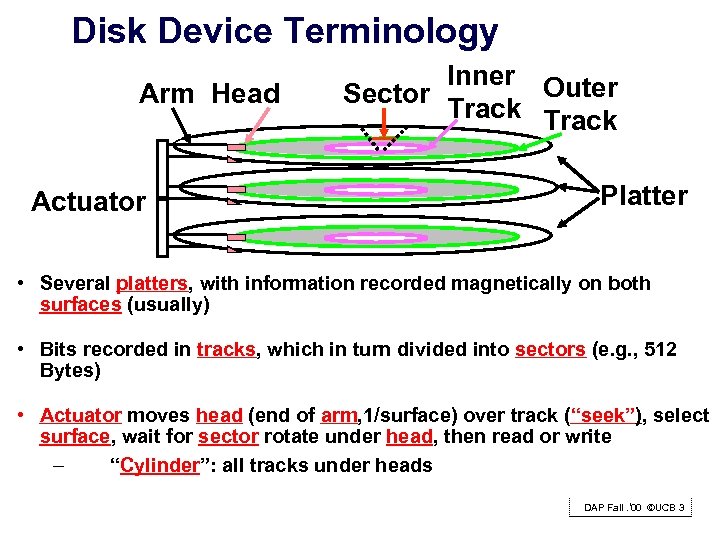 Disk Device Terminology Arm Head Actuator Inner Outer Sector Track Platter • Several platters, with information recorded magnetically on both surfaces (usually) • Bits recorded in tracks, which in turn divided into sectors (e. g. , 512 Bytes) • Actuator moves head (end of arm, 1/surface) over track (“seek”), select surface, wait for sector rotate under head, then read or write – “Cylinder”: all tracks under heads DAP Fall. ‘ 00 ©UCB 3
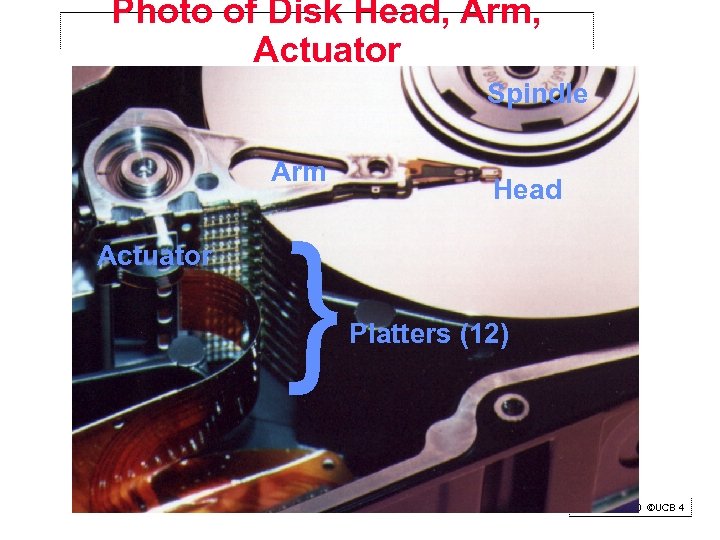 Photo of Disk Head, Arm, Actuator Spindle Arm { Actuator Head Platters (12) DAP Fall. ‘ 00 ©UCB 4
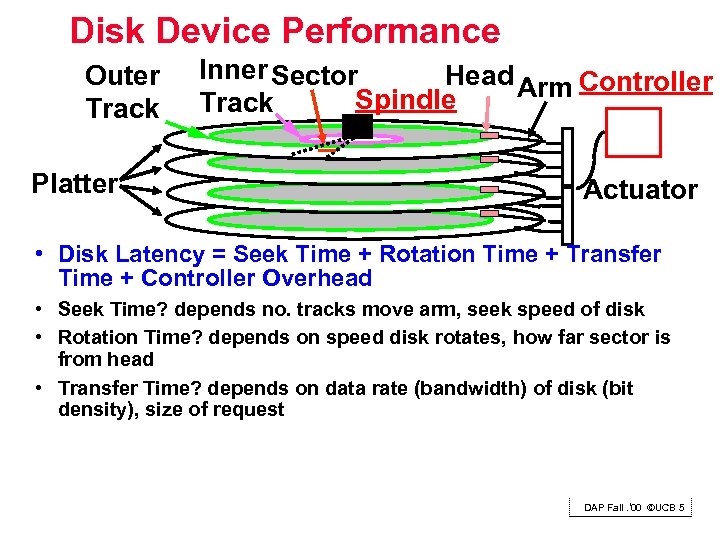 Disk Device Performance Outer Track Platter Inner Sector Head Arm Controller Spindle Track Actuator • Disk Latency = Seek Time + Rotation Time + Transfer Time + Controller Overhead • Seek Time? depends no. tracks move arm, seek speed of disk • Rotation Time? depends on speed disk rotates, how far sector is from head • Transfer Time? depends on data rate (bandwidth) of disk (bit density), size of request DAP Fall. ‘ 00 ©UCB 5
 Disk Device Performance • Average distance sector from head? • 1/2 time of a rotation – 7200 Revolutions Per Minute 120 Rev/sec – 1 revolution = 1/120 sec 8. 33 milliseconds – 1/2 rotation (revolution) 4. 16 ms • Average no. tracks move arm? – Sum all possible seek distances from all possible tracks / # possible » Assumes average seek distance is random – Disk industry standard benchmark DAP Fall. ‘ 00 ©UCB 6
 Data Rate: Inner vs. Outer Tracks • To keep things simple, orginally kept same number of sectors per track – Since outer track longer, lower bits per inch • Competition decided to keep BPI the same for all tracks (“constant bit density”) More capacity per disk More of sectors per track towards edge Since disk spins at constant speed, outer tracks have faster data rate • Bandwidth outer track 1. 7 X inner track! DAP Fall. ‘ 00 ©UCB 7
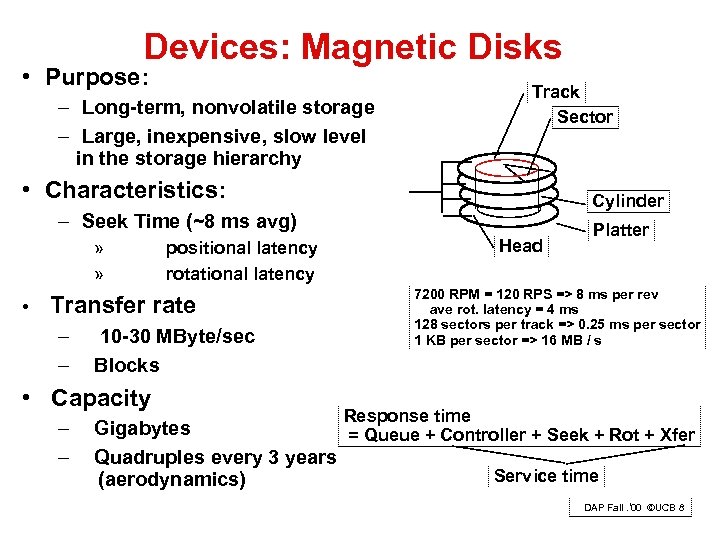 Devices: Magnetic Disks • Purpose: Track Sector – Long-term, nonvolatile storage – Large, inexpensive, slow level in the storage hierarchy • Characteristics: Cylinder – Seek Time (~8 ms avg) » » • Transfer rate – – 10 -30 MByte/sec Blocks • Capacity – – Head positional latency rotational latency Platter 7200 RPM = 120 RPS => 8 ms per rev ave rot. latency = 4 ms 128 sectors per track => 0. 25 ms per sector 1 KB per sector => 16 MB / s Response time Gigabytes = Queue + Controller + Seek + Rot + Xfer Quadruples every 3 years Service time (aerodynamics) DAP Fall. ‘ 00 ©UCB 8
 Historical Perspective • 1956 IBM Ramac — early 1970 s Winchester – Developed for mainframe computers, proprietary interfaces – Steady shrink in form factor: 27 in. to 14 in. • 1970 s developments – 5. 25 inch floppy disk formfactor (microcode into mainframe) – early emergence of industry standard disk interfaces » ST 506, SASI, SMD, ESDI • Early 1980 s – PCs and first generation workstations • Mid 1980 s – Client/server computing – Centralized storage on file server » accelerates disk downsizing: 8 inch to 5. 25 inch – Mass market disk drives become a reality » industry standards: SCSI, IPI, IDE DAP Fall. ‘ 00 ©UCB 9 » 5. 25 inch drives for standalone PCs, End of proprietary interfaces
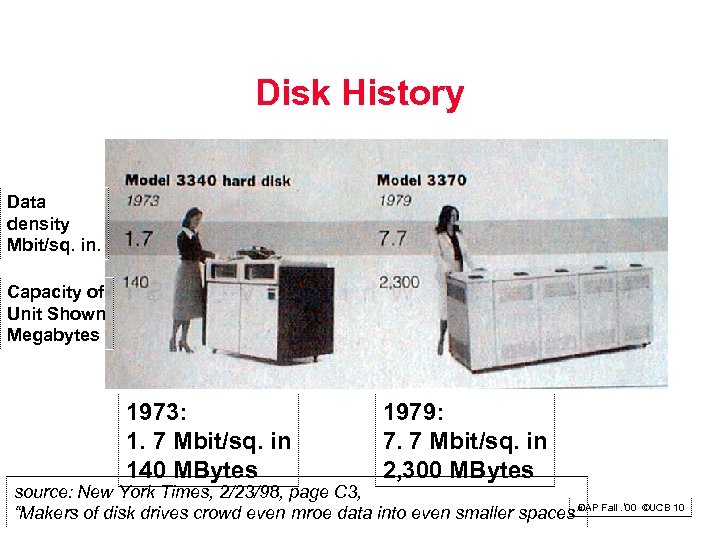 Disk History Data density Mbit/sq. in. Capacity of Unit Shown Megabytes 1973: 1. 7 Mbit/sq. in 140 MBytes 1979: 7. 7 Mbit/sq. in 2, 300 MBytes source: New York Times, 2/23/98, page C 3, “Makers of disk drives crowd even mroe data into even smaller spaces”DAP Fall. ‘ 00 ©UCB 10
 Historical Perspective • Late 1980 s/Early 1990 s: – Laptops, notebooks, (palmtops) – 3. 5 inch, 2. 5 inch, (1. 8 inch formfactors) – Formfactor plus capacity drives market, not so much performance » Recently Bandwidth improving at 40%/ year – Challenged by DRAM, flash RAM in PCMCIA cards » still expensive, Intel promises but doesn’t deliver » unattractive MBytes per cubic inch – Optical disk fails on performace but finds niche (CD ROM) DAP Fall. ‘ 00 ©UCB 11
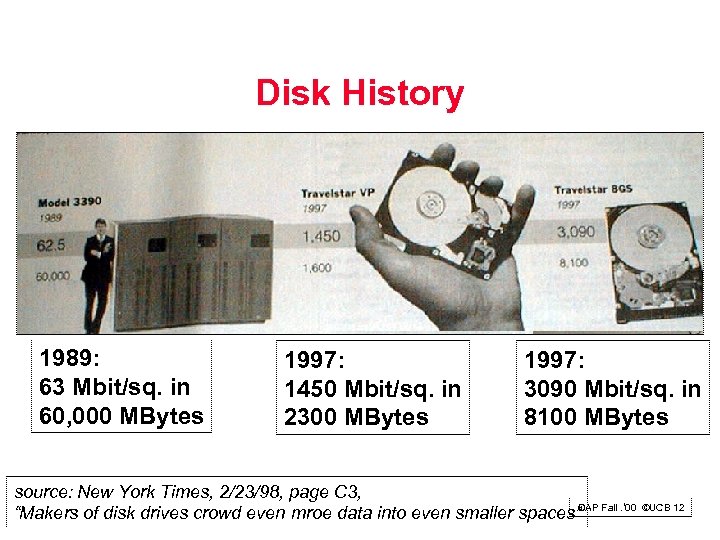 Disk History 1989: 63 Mbit/sq. in 60, 000 MBytes 1997: 1450 Mbit/sq. in 2300 MBytes 1997: 3090 Mbit/sq. in 8100 MBytes source: New York Times, 2/23/98, page C 3, “Makers of disk drives crowd even mroe data into even smaller spaces”DAP Fall. ‘ 00 ©UCB 12
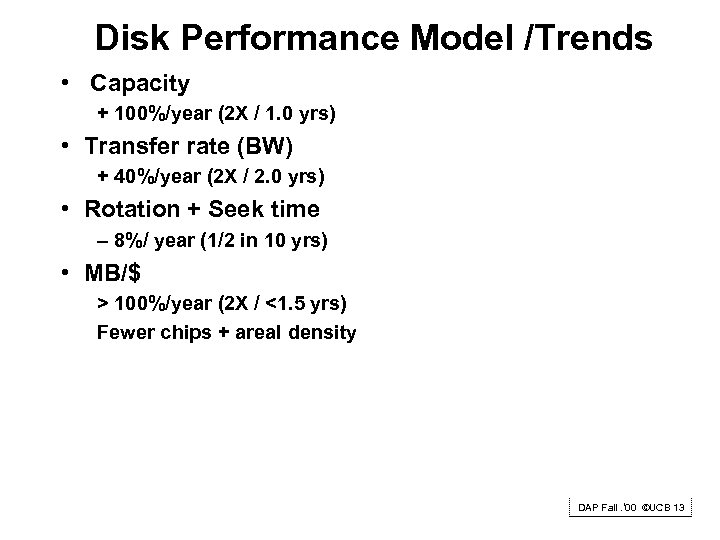 Disk Performance Model /Trends • Capacity + 100%/year (2 X / 1. 0 yrs) • Transfer rate (BW) + 40%/year (2 X / 2. 0 yrs) • Rotation + Seek time – 8%/ year (1/2 in 10 yrs) • MB/$ > 100%/year (2 X / <1. 5 yrs) Fewer chips + areal density DAP Fall. ‘ 00 ©UCB 13
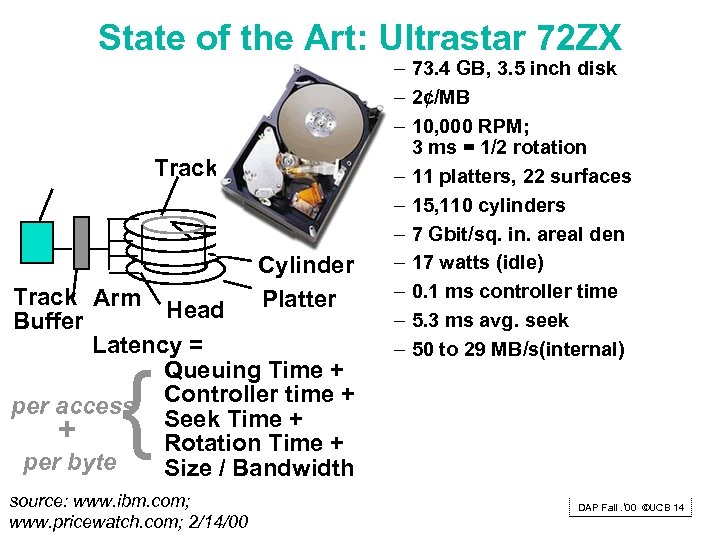 State of the Art: Ultrastar 72 ZX Track Sector Cylinder Track Arm Platter Head Buffer Latency = Queuing Time + Controller time + per access Seek Time + + Rotation Time + per byte Size / Bandwidth { source: www. ibm. com; www. pricewatch. com; 2/14/00 – 73. 4 GB, 3. 5 inch disk – 2¢/MB – 10, 000 RPM; 3 ms = 1/2 rotation – 11 platters, 22 surfaces – 15, 110 cylinders – 7 Gbit/sq. in. areal den – 17 watts (idle) – 0. 1 ms controller time – 5. 3 ms avg. seek – 50 to 29 MB/s(internal) DAP Fall. ‘ 00 ©UCB 14
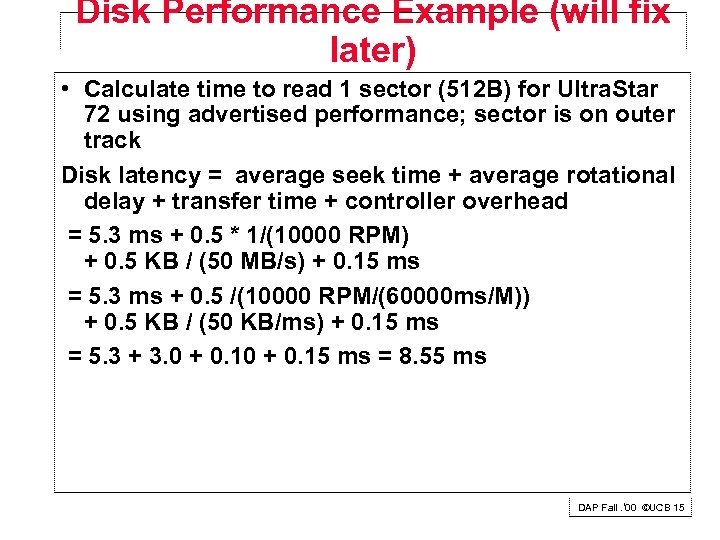 Disk Performance Example (will fix later) • Calculate time to read 1 sector (512 B) for Ultra. Star 72 using advertised performance; sector is on outer track Disk latency = average seek time + average rotational delay + transfer time + controller overhead = 5. 3 ms + 0. 5 * 1/(10000 RPM) + 0. 5 KB / (50 MB/s) + 0. 15 ms = 5. 3 ms + 0. 5 /(10000 RPM/(60000 ms/M)) + 0. 5 KB / (50 KB/ms) + 0. 15 ms = 5. 3 + 3. 0 + 0. 15 ms = 8. 55 ms DAP Fall. ‘ 00 ©UCB 15
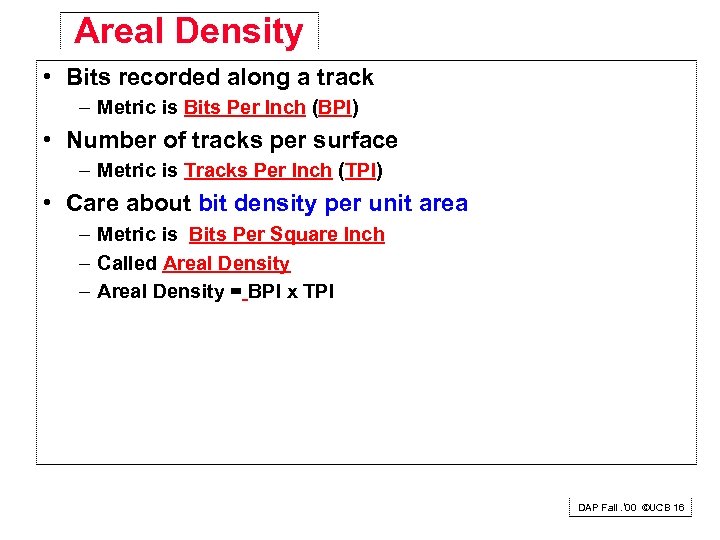 Areal Density • Bits recorded along a track – Metric is Bits Per Inch (BPI) • Number of tracks per surface – Metric is Tracks Per Inch (TPI) • Care about bit density per unit area – Metric is Bits Per Square Inch – Called Areal Density – Areal Density = BPI x TPI DAP Fall. ‘ 00 ©UCB 16
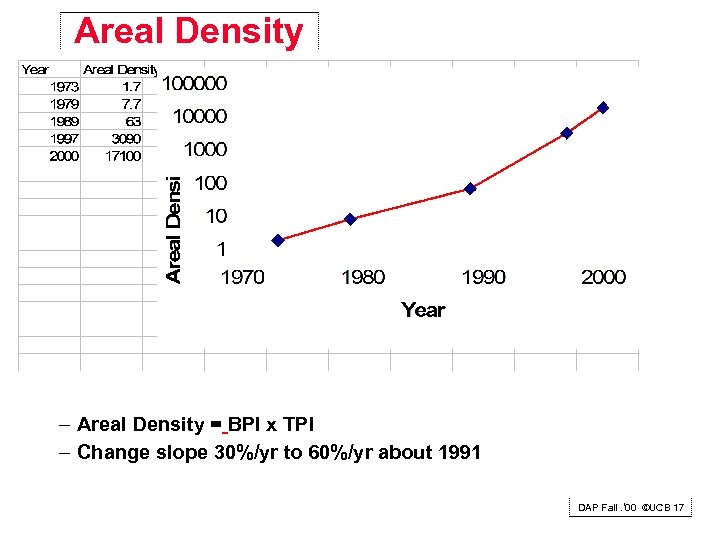 Areal Density – Areal Density = BPI x TPI – Change slope 30%/yr to 60%/yr about 1991 DAP Fall. ‘ 00 ©UCB 17
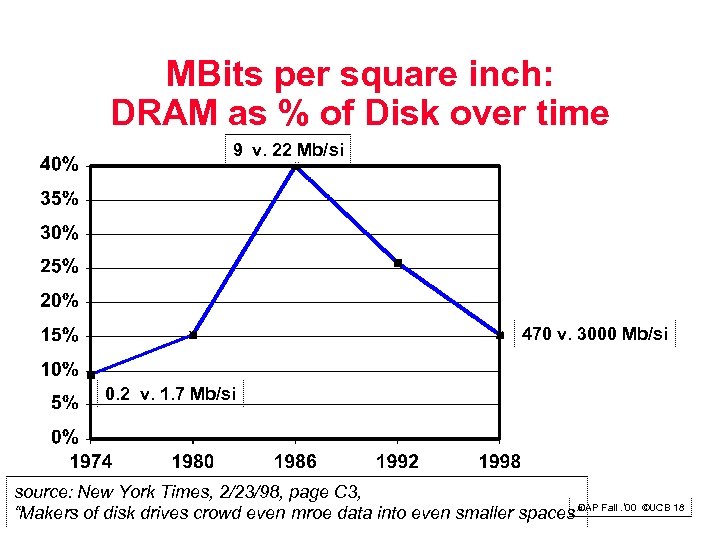 MBits per square inch: DRAM as % of Disk over time 9 v. 22 Mb/si 470 v. 3000 Mb/si 0. 2 v. 1. 7 Mb/si source: New York Times, 2/23/98, page C 3, “Makers of disk drives crowd even mroe data into even smaller spaces”DAP Fall. ‘ 00 ©UCB 18
 Historical Perspective • Form factor and capacity drives market, more than performance • 1970 s: Mainframes 14 inch diameter disks • 1980 s: Minicomputers, Servers 8”, 5. 25” diameter disks • Late 1980 s/Early 1990 s: – Pizzabox PCs 3. 5 inch diameter disks – Laptops, notebooks 2. 5 inch disks – Palmtops didn’t use disks, so 1. 8 inch diameter disks didn’t make it DAP Fall. ‘ 00 ©UCB 19
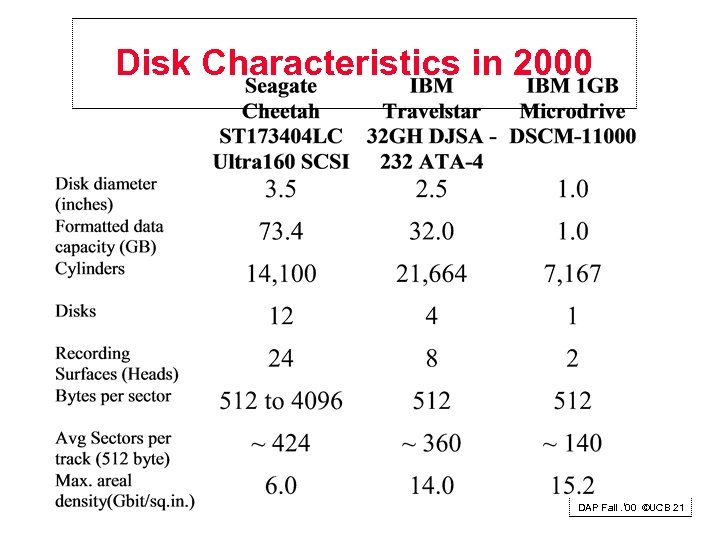
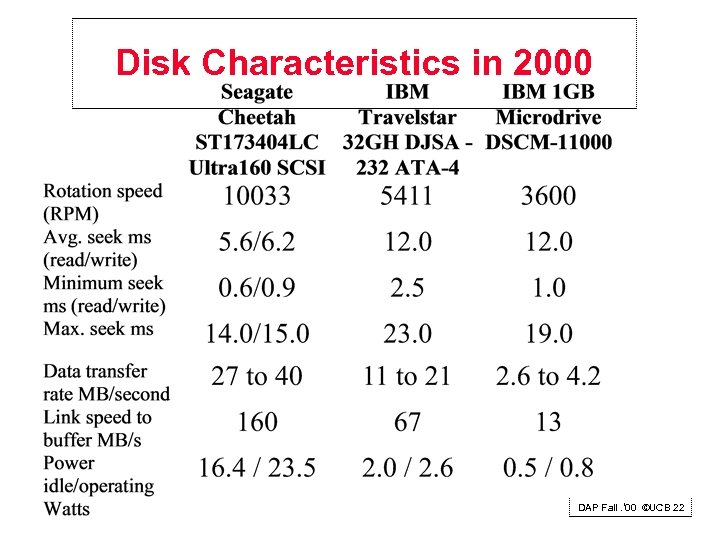
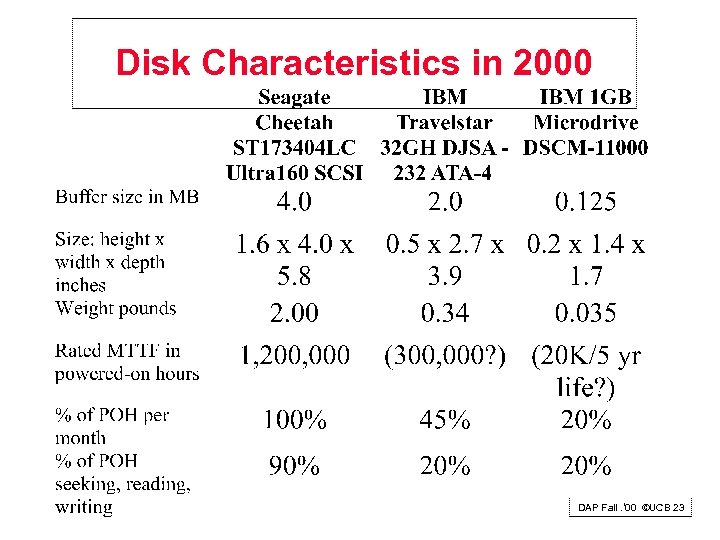
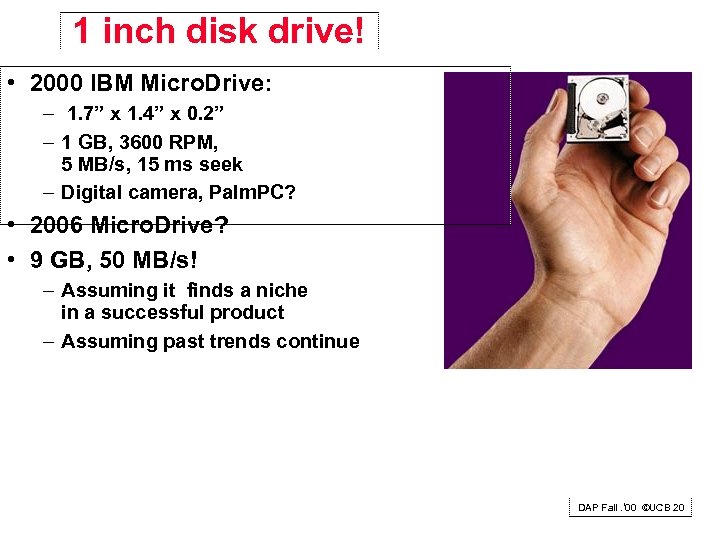 1 inch disk drive! • 2000 IBM Micro. Drive: – 1. 7” x 1. 4” x 0. 2” – 1 GB, 3600 RPM, 5 MB/s, 15 ms seek – Digital camera, Palm. PC? • 2006 Micro. Drive? • 9 GB, 50 MB/s! – Assuming it finds a niche in a successful product – Assuming past trends continue DAP Fall. ‘ 00 ©UCB 20
 Disk Characteristics in 2000 DAP Fall. ‘ 00 ©UCB 21
 Disk Characteristics in 2000 DAP Fall. ‘ 00 ©UCB 22
 Disk Characteristics in 2000 DAP Fall. ‘ 00 ©UCB 23
 Disk Characteristics in 2000 DAP Fall. ‘ 00 ©UCB 24
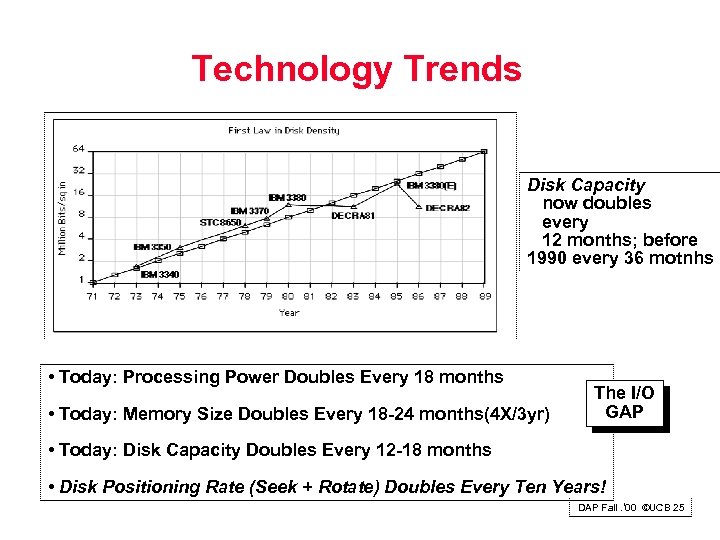 Technology Trends Disk Capacity now doubles every 12 months; before 1990 every 36 motnhs • Today: Processing Power Doubles Every 18 months • Today: Memory Size Doubles Every 18 -24 months(4 X/3 yr) The I/O GAP • Today: Disk Capacity Doubles Every 12 -18 months • Disk Positioning Rate (Seek + Rotate) Doubles Every Ten Years! DAP Fall. ‘ 00 ©UCB 25
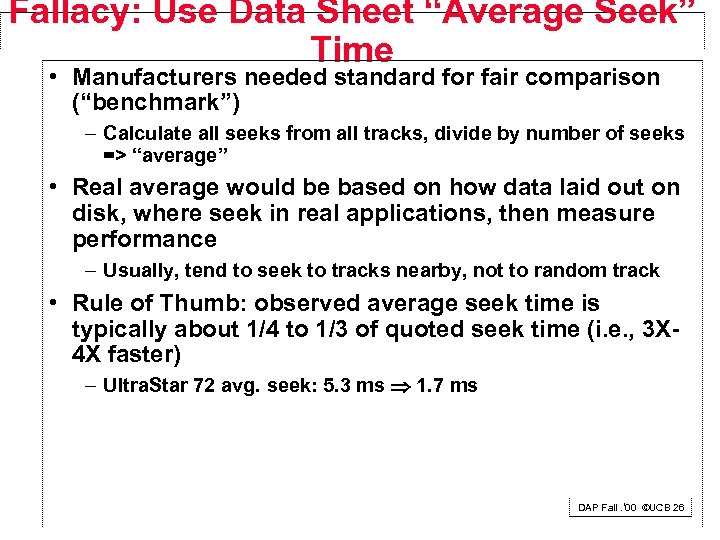 Fallacy: Use Data Sheet “Average Seek” Time • Manufacturers needed standard for fair comparison (“benchmark”) – Calculate all seeks from all tracks, divide by number of seeks => “average” • Real average would be based on how data laid out on disk, where seek in real applications, then measure performance – Usually, tend to seek to tracks nearby, not to random track • Rule of Thumb: observed average seek time is typically about 1/4 to 1/3 of quoted seek time (i. e. , 3 X 4 X faster) – Ultra. Star 72 avg. seek: 5. 3 ms 1. 7 ms DAP Fall. ‘ 00 ©UCB 26
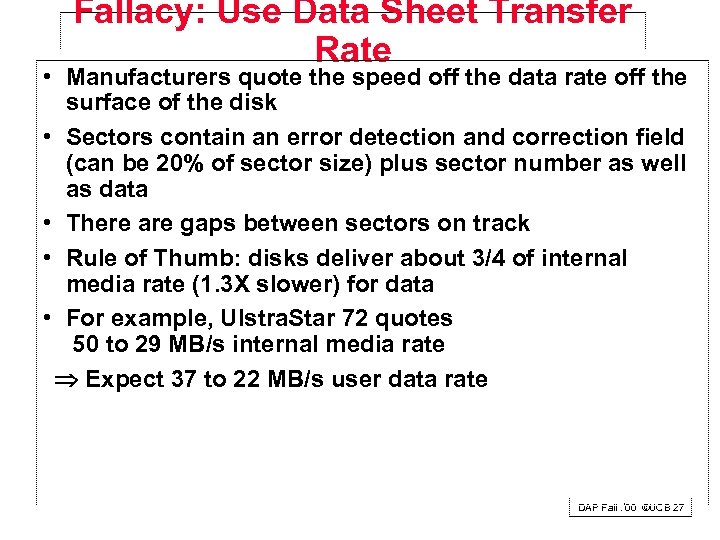 Fallacy: Use Data Sheet Transfer Rate • Manufacturers quote the speed off the data rate off the surface of the disk • Sectors contain an error detection and correction field (can be 20% of sector size) plus sector number as well as data • There are gaps between sectors on track • Rule of Thumb: disks deliver about 3/4 of internal media rate (1. 3 X slower) for data • For example, Ulstra. Star 72 quotes 50 to 29 MB/s internal media rate Expect 37 to 22 MB/s user data rate DAP Fall. ‘ 00 ©UCB 27
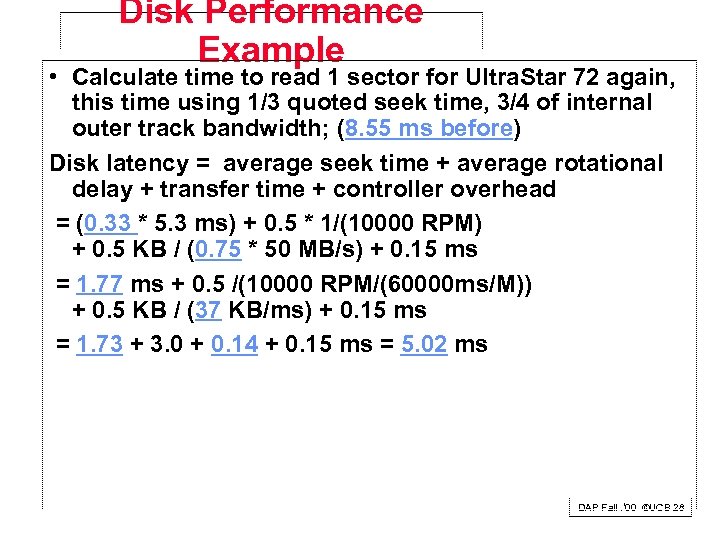 Disk Performance Example • Calculate time to read 1 sector for Ultra. Star 72 again, this time using 1/3 quoted seek time, 3/4 of internal outer track bandwidth; (8. 55 ms before) Disk latency = average seek time + average rotational delay + transfer time + controller overhead = (0. 33 * 5. 3 ms) + 0. 5 * 1/(10000 RPM) + 0. 5 KB / (0. 75 * 50 MB/s) + 0. 15 ms = 1. 77 ms + 0. 5 /(10000 RPM/(60000 ms/M)) + 0. 5 KB / (37 KB/ms) + 0. 15 ms = 1. 73 + 3. 0 + 0. 14 + 0. 15 ms = 5. 02 ms DAP Fall. ‘ 00 ©UCB 28
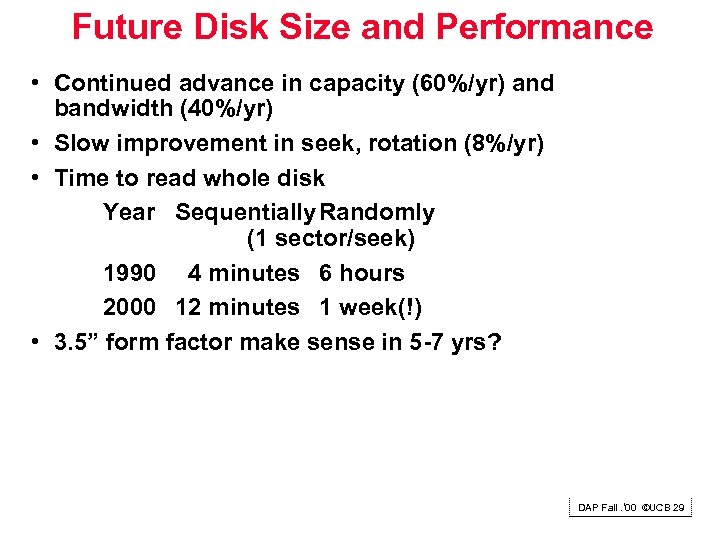 Future Disk Size and Performance • Continued advance in capacity (60%/yr) and bandwidth (40%/yr) • Slow improvement in seek, rotation (8%/yr) • Time to read whole disk Year Sequentially Randomly (1 sector/seek) 1990 4 minutes 6 hours 2000 12 minutes 1 week(!) • 3. 5” form factor make sense in 5 -7 yrs? DAP Fall. ‘ 00 ©UCB 29
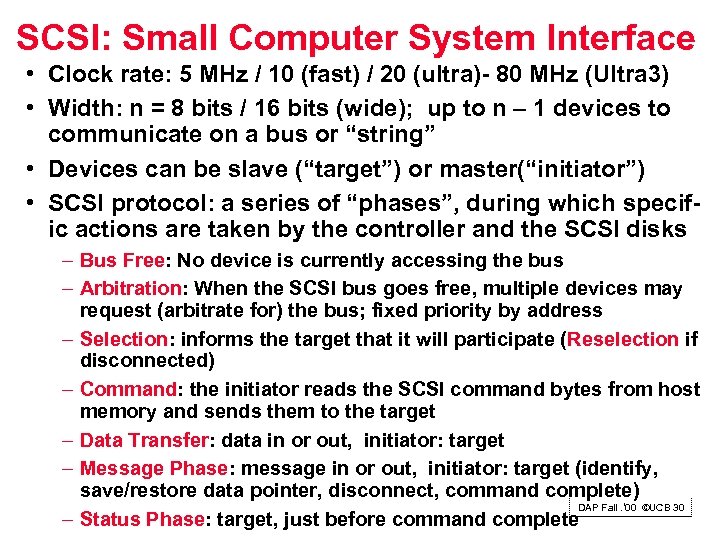 SCSI: Small Computer System Interface • Clock rate: 5 MHz / 10 (fast) / 20 (ultra)- 80 MHz (Ultra 3) • Width: n = 8 bits / 16 bits (wide); up to n – 1 devices to communicate on a bus or “string” • Devices can be slave (“target”) or master(“initiator”) • SCSI protocol: a series of “phases”, during which specific actions are taken by the controller and the SCSI disks – Bus Free: No device is currently accessing the bus – Arbitration: When the SCSI bus goes free, multiple devices may request (arbitrate for) the bus; fixed priority by address – Selection: informs the target that it will participate (Reselection if disconnected) – Command: the initiator reads the SCSI command bytes from host memory and sends them to the target – Data Transfer: data in or out, initiator: target – Message Phase: message in or out, initiator: target (identify, save/restore data pointer, disconnect, command complete) DAP Fall. ‘ 00 ©UCB 30 – Status Phase: target, just before command complete
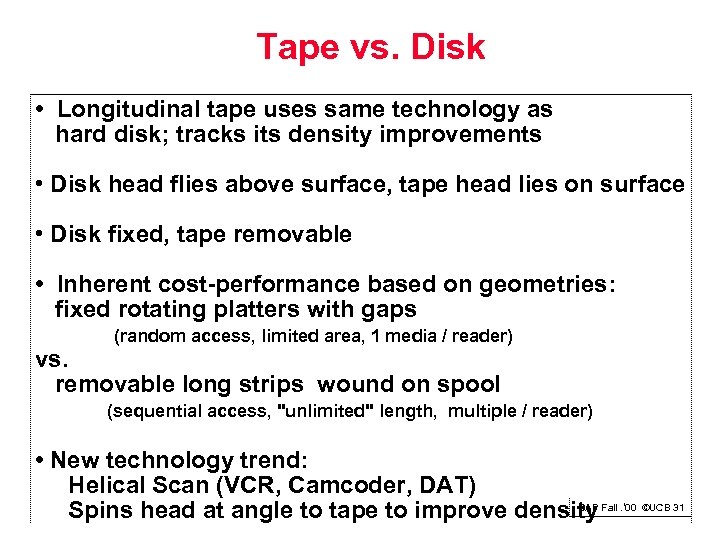 Tape vs. Disk • Longitudinal tape uses same technology as hard disk; tracks its density improvements • Disk head flies above surface, tape head lies on surface • Disk fixed, tape removable • Inherent cost-performance based on geometries: fixed rotating platters with gaps (random access, limited area, 1 media / reader) vs. removable long strips wound on spool (sequential access, "unlimited" length, multiple / reader) • New technology trend: Helical Scan (VCR, Camcoder, DAT) DAP Spins head at angle to tape to improve density Fall. ‘ 00 ©UCB 31
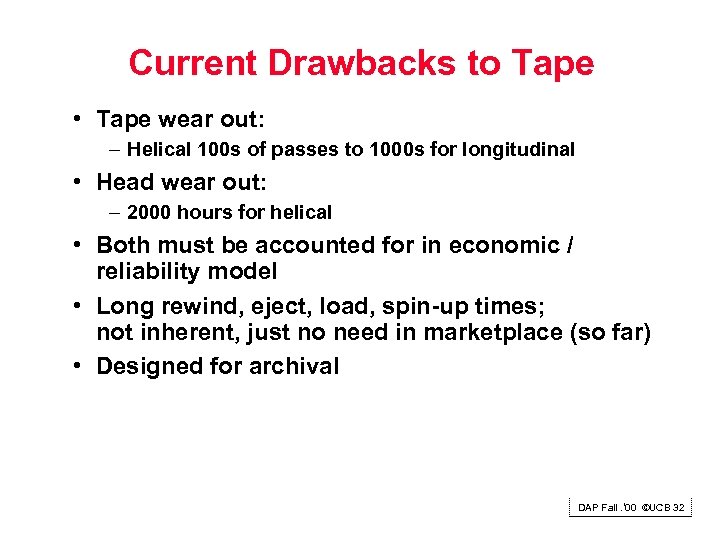 Current Drawbacks to Tape • Tape wear out: – Helical 100 s of passes to 1000 s for longitudinal • Head wear out: – 2000 hours for helical • Both must be accounted for in economic / reliability model • Long rewind, eject, load, spin-up times; not inherent, just no need in marketplace (so far) • Designed for archival DAP Fall. ‘ 00 ©UCB 32
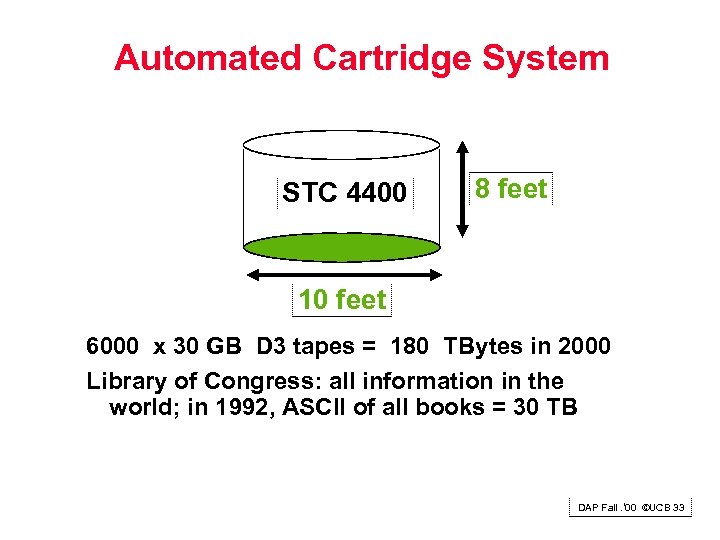 Automated Cartridge System STC 4400 8 feet 10 feet 6000 x 30 GB D 3 tapes = 180 TBytes in 2000 Library of Congress: all information in the world; in 1992, ASCII of all books = 30 TB DAP Fall. ‘ 00 ©UCB 33
 Library vs. Storage • Getting books today as quaint as the way I learned to program – punch cards, batch processing – wander thru shelves, anticipatory purchasing • • • Cost $1 per book to check out $30 for a catalogue entry 30% of all books never checked out Write only journals? Digital library can transform campuses Will have lecture on getting electronic information DAP Fall. ‘ 00 ©UCB 34
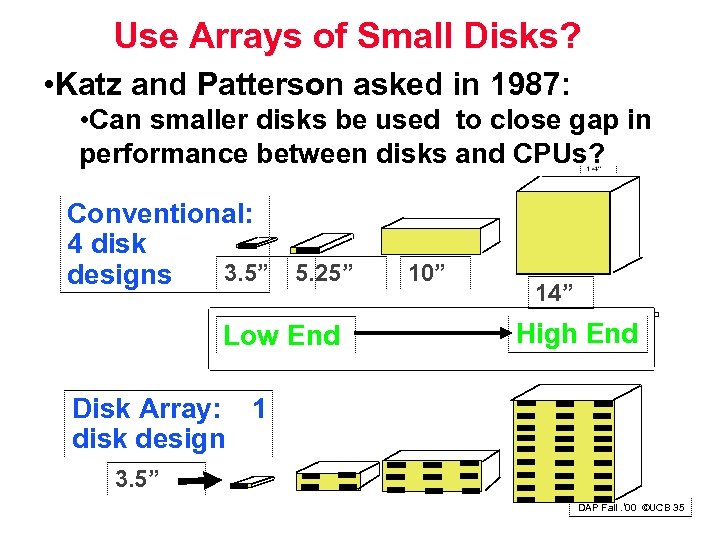 Use Arrays of Small Disks? • Katz and Patterson asked in 1987: • Can smaller disks be used to close gap in performance between disks and CPUs? Conventional: 4 disk 3. 5” 5. 25” 10” designs Low End 14” High End Disk Array: 1 disk design 3. 5” DAP Fall. ‘ 00 ©UCB 35
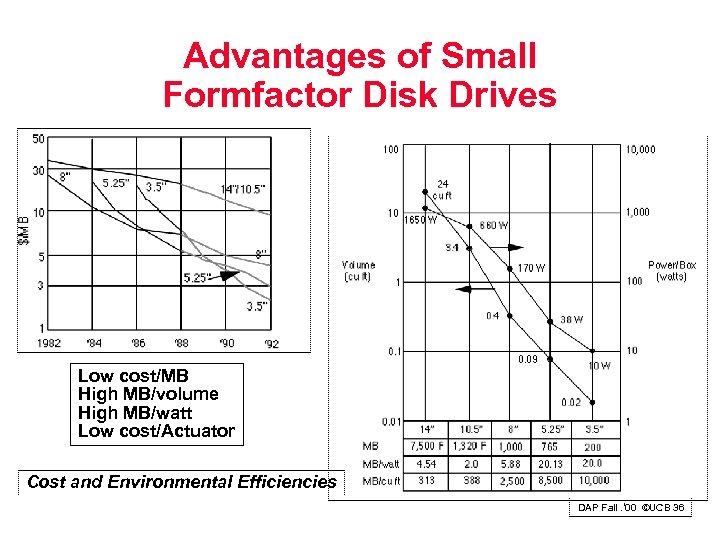 Advantages of Small Formfactor Disk Drives Low cost/MB High MB/volume High MB/watt Low cost/Actuator Cost and Environmental Efficiencies DAP Fall. ‘ 00 ©UCB 36
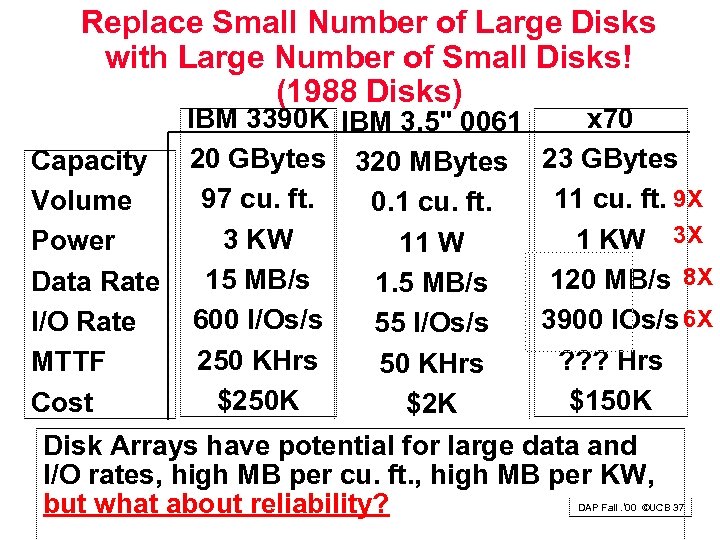 Replace Small Number of Large Disks with Large Number of Small Disks! (1988 Disks) IBM 3390 K IBM 3. 5" 0061 x 70 Capacity 20 GBytes 320 MBytes 23 GBytes 97 cu. ft. 11 cu. ft. 9 X Volume 0. 1 cu. ft. 3 KW 1 KW 3 X Power 11 W 120 MB/s 8 X Data Rate 15 MB/s 1. 5 MB/s 3900 IOs/s 6 X I/O Rate 600 I/Os/s 55 I/Os/s 250 KHrs ? ? ? Hrs MTTF 50 KHrs $250 K $150 K Cost $2 K Disk Arrays have potential for large data and I/O rates, high MB per cu. ft. , high MB per KW, but what about reliability? DAP Fall. ‘ 00 ©UCB 37
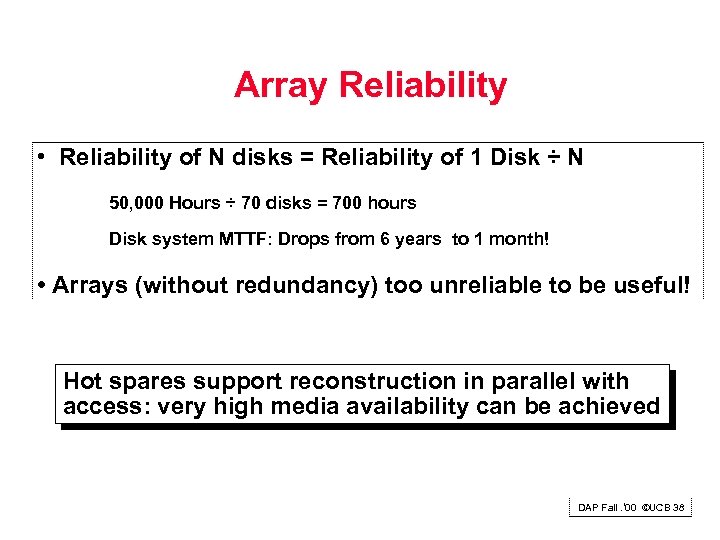 Array Reliability • Reliability of N disks = Reliability of 1 Disk ÷ N 50, 000 Hours ÷ 70 disks = 700 hours Disk system MTTF: Drops from 6 years to 1 month! • Arrays (without redundancy) too unreliable to be useful! Hot spares support reconstruction in parallel with access: very high media availability can be achieved DAP Fall. ‘ 00 ©UCB 38
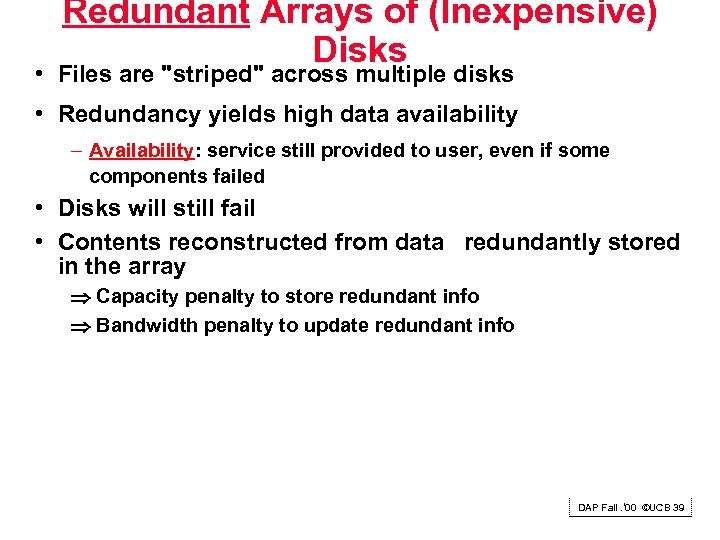 Redundant Arrays of (Inexpensive) Disks • Files are "striped" across multiple disks • Redundancy yields high data availability – Availability: service still provided to user, even if some components failed • Disks will still fail • Contents reconstructed from data redundantly stored in the array Capacity penalty to store redundant info Bandwidth penalty to update redundant info DAP Fall. ‘ 00 ©UCB 39
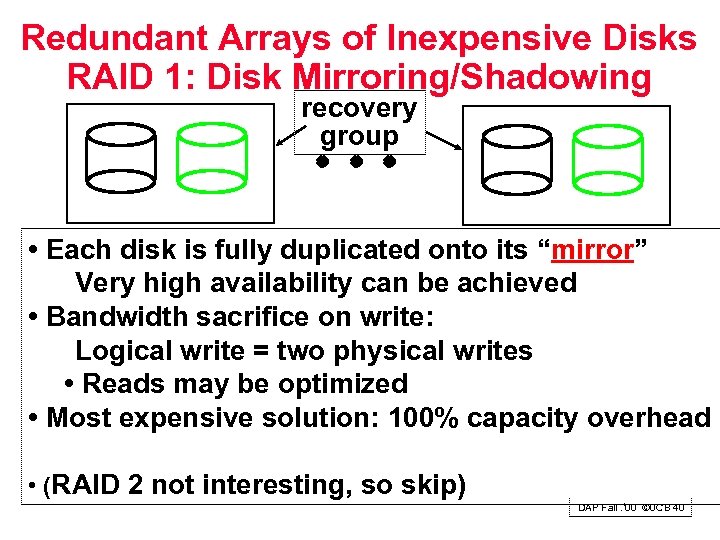 Redundant Arrays of Inexpensive Disks RAID 1: Disk Mirroring/Shadowing recovery group • Each disk is fully duplicated onto its “mirror” Very high availability can be achieved • Bandwidth sacrifice on write: Logical write = two physical writes • Reads may be optimized • Most expensive solution: 100% capacity overhead • (RAID 2 not interesting, so skip) DAP Fall. ‘ 00 ©UCB 40
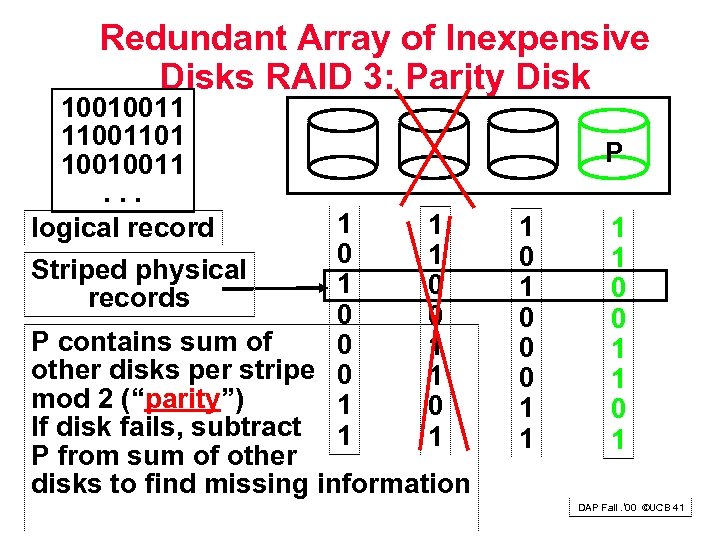 Redundant Array of Inexpensive Disks RAID 3: Parity Disk 10010011 11001101 10010011. . . logical record 1 1 0 1 Striped physical 1 0 records 0 0 P contains sum of 0 1 other disks per stripe 0 1 mod 2 (“parity”) 1 0 If disk fails, subtract 1 1 P from sum of other disks to find missing information P 1 0 0 0 1 1 0 1 DAP Fall. ‘ 00 ©UCB 41
 RAID 3 • Sum computed across recovery group to protect against hard disk failures, stored in P disk • Logically, a single high capacity, high transfer rate disk: good for large transfers • Wider arrays reduce capacity costs, but decreases availability • 33% capacity cost for parity in this configuration DAP Fall. ‘ 00 ©UCB 42
 Inspiration for RAID 4 • RAID 3 relies on parity disk to discover errors on Read • But every sector has an error detection field • Rely on error detection field to catch errors on read, not on the parity disk • Allows independent reads to different disks simultaneously DAP Fall. ‘ 00 ©UCB 43
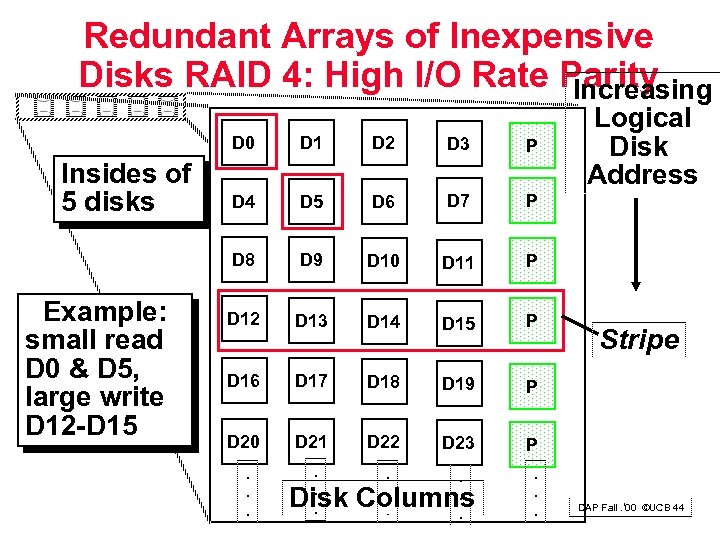 Redundant Arrays of Inexpensive Disks RAID 4: High I/O Rate Parity Increasing D 0 Example: small read D 0 & D 5, large write D 12 -D 15 D 2 D 3 P D 4 D 5 D 6 D 7 P D 8 Insides of 5 disks D 1 D 9 D 10 D 11 P D 12 D 13 D 14 D 15 P D 16 D 17 D 18 D 19 P D 20 D 21 D 22 D 23 P . . . Disk Columns. . . Logical Disk Address . . . Stripe DAP Fall. ‘ 00 ©UCB 44
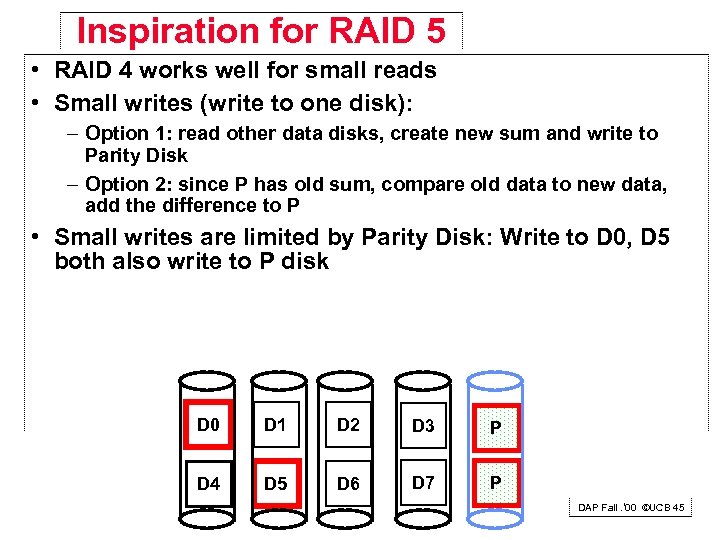 Inspiration for RAID 5 • RAID 4 works well for small reads • Small writes (write to one disk): – Option 1: read other data disks, create new sum and write to Parity Disk – Option 2: since P has old sum, compare old data to new data, add the difference to P • Small writes are limited by Parity Disk: Write to D 0, D 5 both also write to P disk D 0 D 1 D 2 D 3 P D 4 D 5 D 6 D 7 P DAP Fall. ‘ 00 ©UCB 45
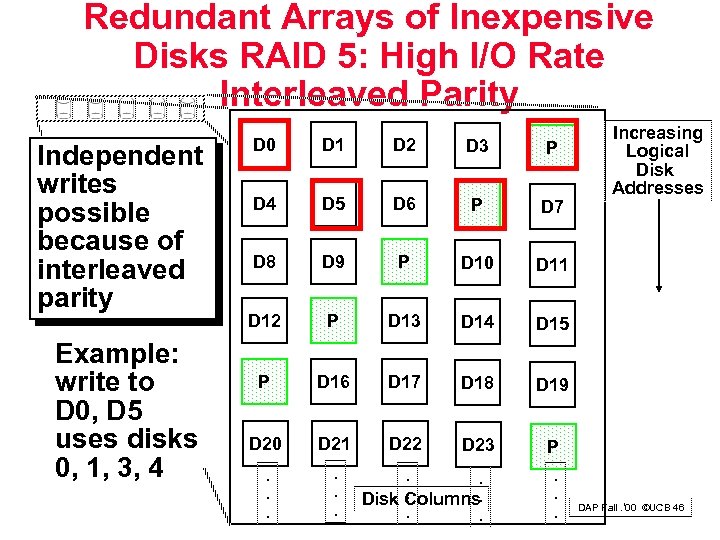 Redundant Arrays of Inexpensive Disks RAID 5: High I/O Rate Interleaved Parity Independent writes possible because of interleaved parity Example: write to D 0, D 5 uses disks 0, 1, 3, 4 D 0 D 1 D 2 D 3 P D 4 D 5 D 6 P D 7 D 8 D 9 P D 10 D 11 D 12 P D 13 D 14 D 15 P D 16 D 17 D 18 D 19 D 20 D 21 D 22 D 23 P . . . Increasing Logical Disk Addresses . . . Disk Columns. . . DAP Fall. ‘ 00 ©UCB 46
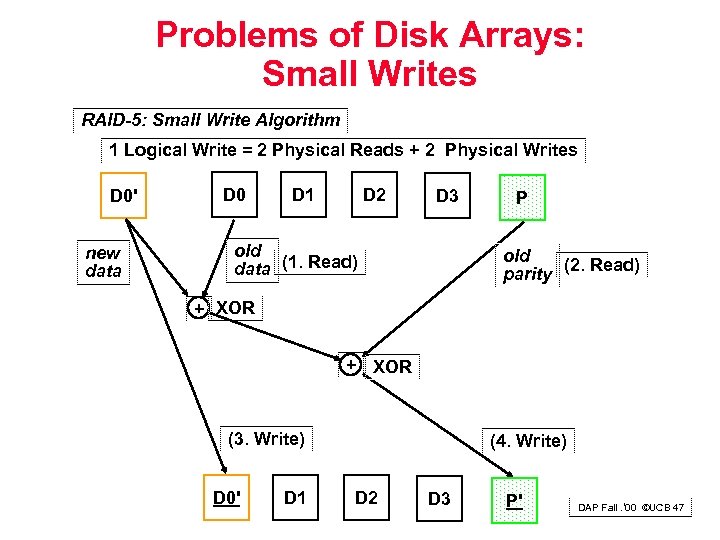 Problems of Disk Arrays: Small Writes RAID-5: Small Write Algorithm 1 Logical Write = 2 Physical Reads + 2 Physical Writes D 0' new data D 0 D 1 D 2 D 3 old data (1. Read) P old (2. Read) parity + XOR (3. Write) D 0' D 1 (4. Write) D 2 D 3 P' DAP Fall. ‘ 00 ©UCB 47
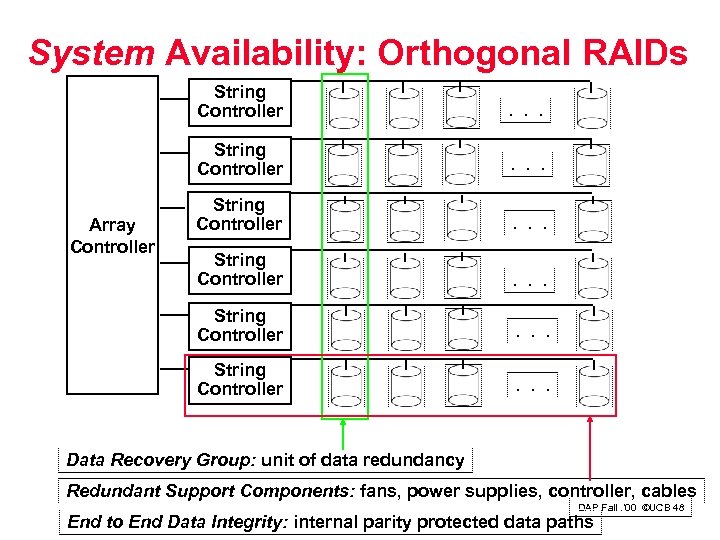 System Availability: Orthogonal RAIDs String Controller . . . String Controller Array Controller . . . Data Recovery Group: unit of data redundancy Redundant Support Components: fans, power supplies, controller, cables DAP Fall. ‘ 00 ©UCB 48 End to End Data Integrity: internal parity protected data paths
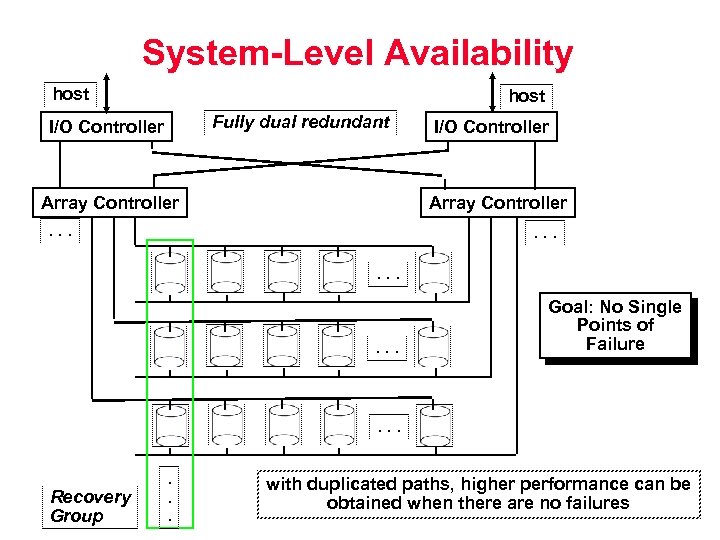 System-Level Availability host Fully dual redundant I/O Controller Array Controller . . . Goal: No Single Points of Failure . . . Recovery Group . . . with duplicated paths, higher performance can be obtained when there are no failures ©UCB 49 DAP Fall. ‘ 00
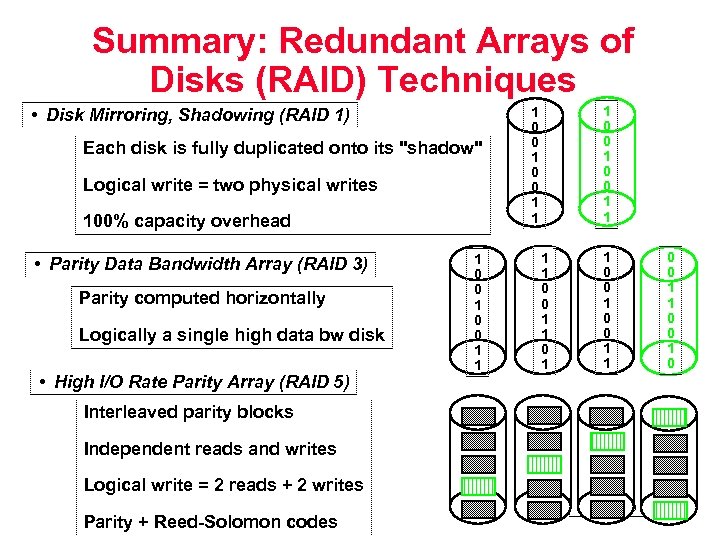 Summary: Redundant Arrays of Disks (RAID) Techniques • Disk Mirroring, Shadowing (RAID 1) Each disk is fully duplicated onto its "shadow" Logical write = two physical writes 100% capacity overhead • Parity Data Bandwidth Array (RAID 3) Parity computed horizontally Logically a single high data bw disk • High I/O Rate Parity Array (RAID 5) 1 0 0 1 1 1 0 0 1 1 0 0 1 0 Interleaved parity blocks Independent reads and writes Logical write = 2 reads + 2 writes Parity + Reed-Solomon codes DAP Fall. ‘ 00 ©UCB 50
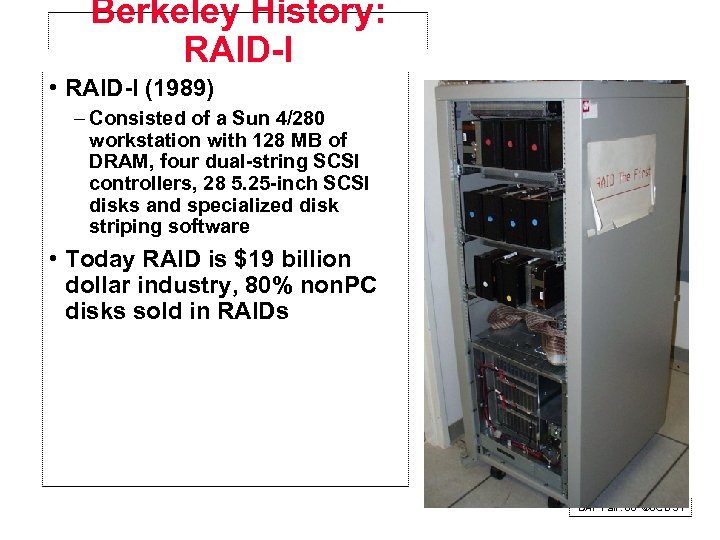 Berkeley History: RAID-I • RAID-I (1989) – Consisted of a Sun 4/280 workstation with 128 MB of DRAM, four dual-string SCSI controllers, 28 5. 25 -inch SCSI disks and specialized disk striping software • Today RAID is $19 billion dollar industry, 80% non. PC disks sold in RAIDs DAP Fall. ‘ 00 ©UCB 51