


 Скачать презентацию Storage at the ATLAS Great Lakes Tier-2 Storage
c3aa449c6ce53e170d9e7331b0ae1c34.ppt
- Количество слайдов: 17
 Storage at the ATLAS Great Lakes Tier-2 Storage Administrator Talks Shawn Mc. Kee / University of Michigan Shawn Mc. Kee OSG Storage Forum 1
 AGLT 2 Storage: Outline T Overview of AGLT 2 T Description, hardware and configuration T Storage Implementation T Original options: AFS, NFS, Lustre, d. Cache T Choose d. Cache (broad support in USATLAS/OSG) T Issues T Monitoring needed T Manpower to maintain (including creating custom cron scripts) T Reliability and performance T Future? T NFSv 4(. x), Lustre (1. 8. 1+), Hadoop Shawn Mc. Kee OSG Storage Forum 2
 The ATLAS Great Lakes Tier-2 T Within the US there are five Tier-2 computing centers, most split over two physical locations. They support “production” and user analysis tasks. T The ATLAS Great Lakes Tier-2 (AGLT 2) is hosted at the University of Michigan and Michigan State University. T AGLT 2 design goals: q Incorporate 10 GE networks for high-performance data transfers q Utilize 2. 6 custom kernels (Ultra. Light) and SL[C]4 OS (soon to SL[C]5) q Deploy inexpensive high-capacity storage systems with large partitions using the XFS filesystem --- Still must address SRM q Take advantage of Mi. LR to the extent possible Shawn Mc. Kee OSG Storage Forum 3
 AGLT 2 Storage Node Information T AGLT 2 has 13 d. Cache storage nodes distributed between MSU and UM with either 40 or 52 useable TB each. T Total d. Cache production storage is 500 TB T We use space-tokens to manage space allocations for ATLAS and currently have 7 space-token areas. T We use XFS for the filesystem on our 50 pools. Each pool varies from 10 -20 TB in size. T d. Cache version is 1. 9. 2. 5 and we are running Chimera T We also use AFS (1. 4. 10) and NFSv 3 for storage Shawn Mc. Kee OSG Storage Forum 4
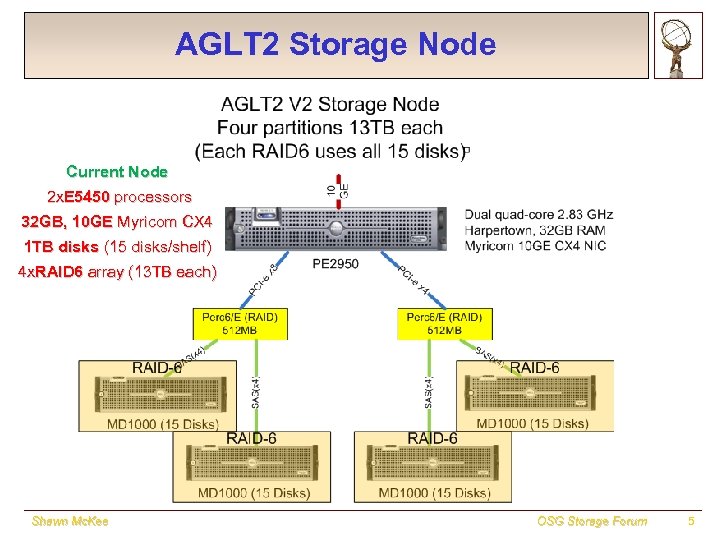 AGLT 2 Storage Node UMFS 05 Current Node 2 x. E 5450 processors 32 GB, 10 GE Myricom CX 4 1 TB disks (15 disks/shelf) 4 x. RAID 6 array (13 TB each) Shawn Mc. Kee OSG Storage Forum 5
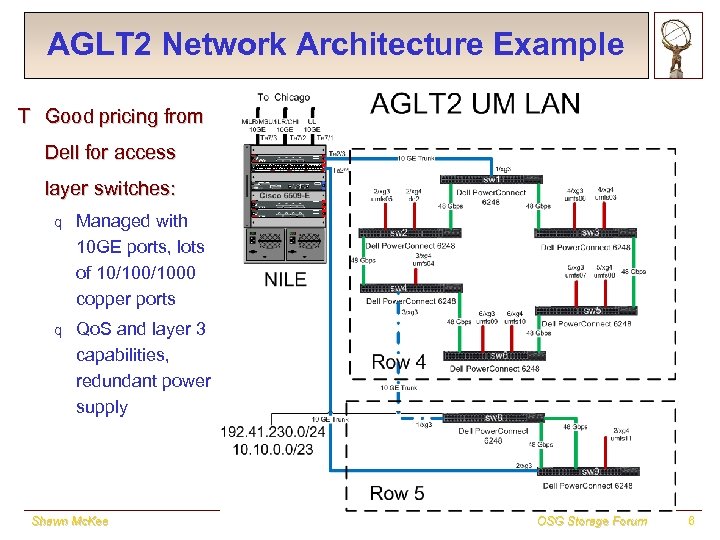 AGLT 2 Network Architecture Example T Good pricing from Dell for access layer switches: q Managed with 10 GE ports, lots of 10/1000 copper ports q Qo. S and layer 3 capabilities, redundant power supply Shawn Mc. Kee OSG Storage Forum 6
 d. Cache at AGLT 2 T Choose d. Cache because BNL and OSG both supported it. T Really using a system outside of its original design purpose q We wanted a way to tie multiple storage locations into a single user accessible name-space providing unified storage. q d. Cache was intended as a front-end for a HSM system T Lots of manpower and attention has been required q Significant effort required to “watch for” and debug problems early q For a while we felt like the little Dutch boy…every time we fixed a problem, another popped up! q 1. 9. 2. 5/Chimera has improved the situation Shawn Mc. Kee OSG Storage Forum 7
 AGLT 2 Lustre Storage T We have been exploring options for alternative storage systems. Best. Man provides an SRM for a posix-filesystem T Lustre was originally tested by us in 2007: Too early! q Recently setup a 200 TB (4 server) Lustre configuration with dual MDT+MGS headnodes configured with heartbeat using V 1. 6. 6 z z Performance very good (faster for clients than /tmp) Some “issues” with huge load on one storage server q Need 2. 6. 24 (or 2. 6. 30) support for “patchless” client. Should be available in v 1. 8. 1. q Planning to re-test once we have the needed kernel support Shawn Mc. Kee OSG Storage Forum 8
 Monitoring Storage T Monitoring our Tier-2 is a critical part of our work and storage monitoring is one of the most important aspects T We use a number of tools to track status: q Cacti q Ganglia q Custom web pages q Brian’s d. Cache billing web interface q Email alerting (low space, failed auto-tests, specific errors noted) T See http: //head 02. aglt 2. org/cgi-bin/dashboard or https: //hep. pa. msu. edu/twiki/bin/view/AGLT 2/Monitors Shawn Mc. Kee OSG Storage Forum 9
 Scripts to Manage Storage T As we have found problems we sometimes needed to automate the solution q Rephot – Automated replica creation developed by Wenjing Wu scans for “hot” files and automatically adds/removes replicas q Pool-balancer – Rebalances pools within a group T Numerous scripts (cron) for maintenance q Directory ownership q Consistency checking, including Adler 32 checksum verification q Repairing inconsistencies q Tracking usage (real space and space-token) q Auto-loading PNFSID into Chimera DB for faster access Shawn Mc. Kee OSG Storage Forum 10
 AGLT 2 Storage Issues T Information is scattered across server nodes and log files T Java based components have verbose output which makes it hard to find the real problem T With d. Cache we find the large number of components have a large phase-space for problems T Errors are not always indicative of the real problem… T Is syslog-ng a part of the solution? T Can error messages be significantly improved? Shawn Mc. Kee OSG Storage Forum 11
 Benchmarking and Optimization T We have spent some time trying to optimize our storage performance. T See https: //hep. pa. msu. edu/twiki/bin/view/AGLT 2/IOTest. On. Raid Systems T Explored system/kernel/network and I/O tunings for our hardware. Have achieved good performance for single read/write (>700 MB/sec) per partition. Multiple readers/writers at a few hundred MB/sec. Shawn Mc. Kee OSG Storage Forum 12
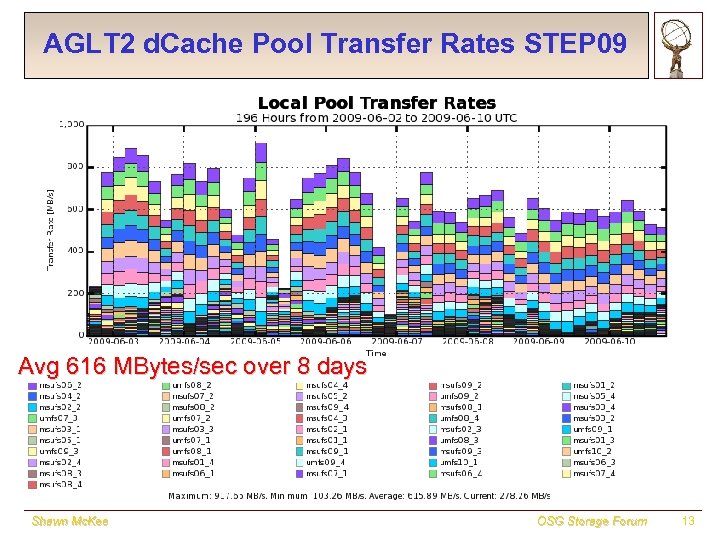 AGLT 2 d. Cache Pool Transfer Rates STEP 09 Avg 616 MBytes/sec over 8 days Shawn Mc. Kee OSG Storage Forum 13
 Future AGLT 2 Storage T We are interested in exploring Best. Man+X where ‘X’ is q NFSv 4[. x] q Lustre 1. 8. x q Hadoop T We are interested in the following characteristics for each option: q Expertise required to install/configure q Manpower required to maintain q Robustness over time q Performance (single and multiple read/writer) T Our plan is to test these during the rest of 2009 Shawn Mc. Kee OSG Storage Forum 14
 ? Questions? Shawn Mc. Kee OSG Storage Forum 15
 Backup Slides Shawn Mc. Kee OSG Storage Forum 16
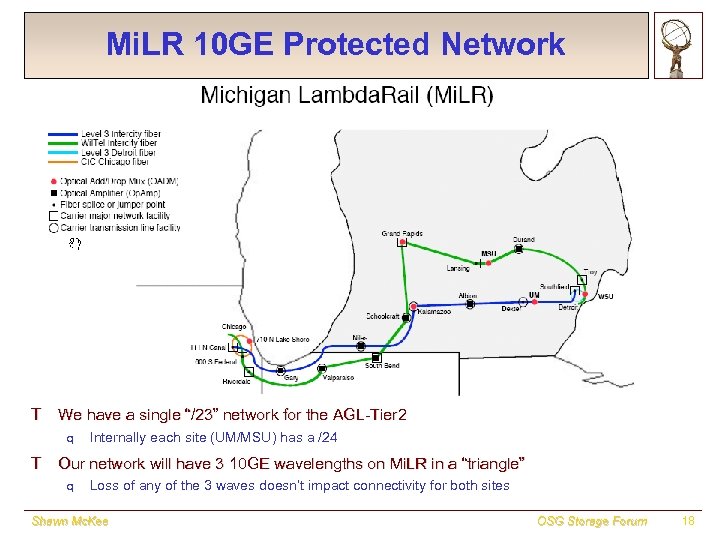 Mi. LR 10 GE Protected Network T We have a single “/23” network for the AGL-Tier 2 q Internally each site (UM/MSU) has a /24 T Our network will have 3 10 GE wavelengths on Mi. LR in a “triangle” q Loss of any of the 3 waves doesn’t impact connectivity for both sites Shawn Mc. Kee OSG Storage Forum 18