Скачать презентацию Stomach and Duodenum L 4 Hawler Medical University
L4.ppt
- Количество слайдов: 26
 Stomach and Duodenum L 4 Hawler Medical University College of Medicine Department: Surgery Rawand M. Haweizy Senior Lecturer M. B. Ch. B, MSc, MRCS e. mail: rawand_haweizy@yahoo. com
 Objectives l l To know incidence of cancer in PU. To learn clinical features of DU and its pathological process. Management of PU. To have knowledge about medical and surgical treatment of PU.
 Contents l l l Ø Ø Malignancy in Gastric Ulcer Duodenal Ulcer Pathology of duodenal ulcer Clinical features of PU Investigations of PU Treatment of PU Medical treatment(Eradication therapy) Surgical treatment
 Introduction l l l l Ulcer in stomach may be cancer from start. Duodenal ulcer never malignant. Gastric ulcer larger than duodenal ulcer. Difficult to differentiate clinically between GU&DU. The most useful investigations to diagnose PU is endoscopy. Nowadays PU is medical problem rather than surgical Proton pump inhibitor and eradication therapy of H. Pylori can treat all cases of PU.
 Malignancy in gastric ulcers l Chronic duodenal ulcers not associated with malignancy but gastric ulcers are? l Clinically patient identified as having an ulcer in the stomach Endoscopically or on contrast radiology, benign but biopsies reveal malignancy. l l In this situation the patient does not have chronic peptic ulceration in the stomach but has presented with an ulcerated cancer.
 Malignancy in gastric ulcers cont, d l Gastric ulcer should be regarded as being malignant. l Multiple biopsies should always be taken. l Modern anti-secretory agents heal the ulceration with gastric cancer.
 Duodenal Ulcer l l l Incidence of duodenal ulceration and frequency of elective surgery falling. Relate to the widespread use of gastric antisecretory agents. Eradication therapy for patients with dyspepsia. Peak incidence now much older age group than previously. Although more common in men, the difference is less marked. These changes mirror changes in epidemiology of H. pylori infection.
 Duodenal Ulcer cont, d l In Eastern Europe the disease remains common. l Observed more frequently in some developing nations. l The relationship with H. pylori appears convincing.
 Pathology of Doudenal Ulcer l l l l Most duodenal ulcers occur in the first part of the duodenum. chronic ulcer penetrates the mucosa and into the muscle coat, leading to fibrosis causes deformities such as pyloric stenosis. When ulcer heals, scar can be observed in mucosa. May be more than one ulcer (The‘kissing ulcers’). Anteriorly placed ulcers tend to perforate. Posterior duodenal ulcers tend to bleed.
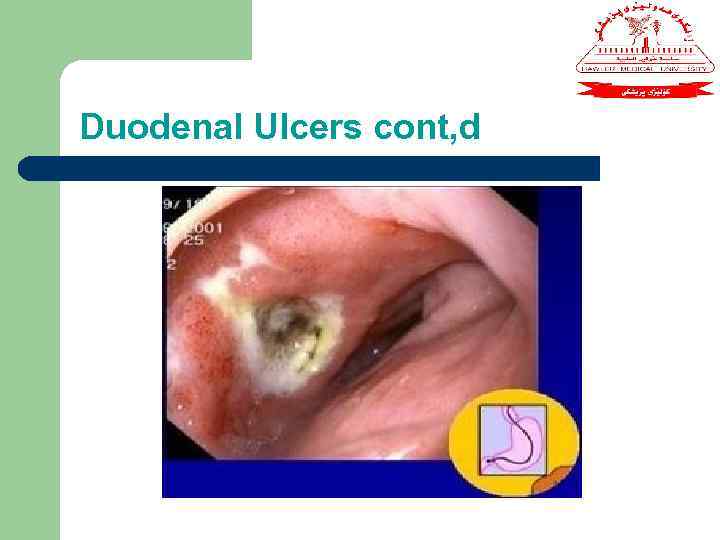 Duodenal Ulcers cont, d
 Histopathology of DU l Microscopically, destruction of muscular coat. l Base of ulcer covered with granulation tissue. l Arteries in region showing typical changes (endarteritis obliterans). l Sometimes terminations of nerves can be seen among fibrosis.
 Clinical features of PU l • • • Pain: Pain is epigastric. Described as gnawing, radiate to back. Eating may relieve the discomfort. Pain normally intermittent rather than intractable. Periodicity: One of classic features of untreated peptic ulceration. Symptoms disappear for weeks or months to return again. Periodicity related to spontaneous healing of ulcer.
 Clinical features of PU cont, d l Vomiting: Ø Although occurs, not feature unless stenosis occurred. l Alteration in weight: Ø Weight loss. Sometimes, weight gain may occur. Patients with gastric ulceration underweight. Ø Ø
 Clinical features of PU cont, d l Bleeding: • • All peptic ulcers may bleed. Bleeding may be chronic and presentation with anaemia. Acute presentation with haematemesis and melaena. l Clinical examination: • Examination of patient may reveal epigastric tenderness. •
 Investigations of suspected PU l Gastroduodenoscopy(OGD) Ø Investigation of choice in management of suspected peptic ulceration. In hands of well-trained operator, highly accurate. In stomach, any abnormal lesion multiple biopsied. Biopsies of antrum taken (histological evidence of gastritis). Ø Ø Ø
 Investigations of suspected PU cont, d l l CLO test performed to determine the presence of H. pylori. A ‘U’ maneuver performed to exclude ulcers around gastro-oesophageal junction.
 Treatment of peptic ulceration l l l Majority of uncomplicated peptic ulcers treated medically. Surgical treatment of uncomplicated peptic ulceration decreased since the 1960 s. Surgery now seldom performed in the west.
 Treatment of peptic ulceration cont, d l l l Surgical treatment aimed reducing gastric acid secretion. in gastric ulceration, removing the diseased mucosa. medical treatment aimed to reduce gastric acid secretion. initially H 2 -receptor antagonists then, PPI. Eradication therapy
 Medical treatment cont, d l l l Modifications to the patient’s lifestyle. H 2 -receptor antagonists and proton pump inhibitors. Proton pump inhibitors render a patient achlorhydric. All benign ulcers will heal using drugs. Proton pump inhibitors safe and devoid of serious side-effects. Following cessation of therapy, relapse is almost universal.
 Eradication therapy l l l Eradication therapy now routinely given to PU. Complete eradication of organism cure the disease. Reinfection as an adult is uncommon. Eradication therapy mainstay treatment for PU. Extremely economical by comparison. Also safer than surgical treatment.
 Treatment cont, d l l l H. pylori therapy: First Line: – Amoxicillin and Clarithromycin –or– Clarithromycin and Flagyl (+) – PPI (or H 2 blocker). Treat for 7 – 14 days. Recheck for H. pylori after treatment. Continue acid suppression until ulcer is healed.
 Surgical treatment of uncomplicated peptic ulceration l Peak in the 1960 s. l l Incidence of surgery for uncomplicated peptic ulceration fallen. Surgery now little more than historical interest.
 Operations for duodenal ulceration l l l Billroth II gastrectomy Gastrojejunostomy Truncal vagotomy and drainage Highly selective vagotomy Truncal vagotomy and antrectomy
 Operations for gastric ulcer l Billroth I gastrectomy
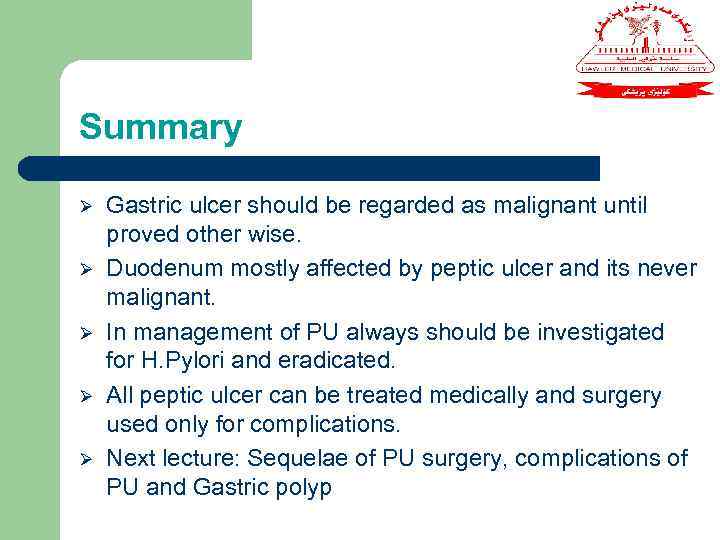 Summary Ø Ø Ø Gastric ulcer should be regarded as malignant until proved other wise. Duodenum mostly affected by peptic ulcer and its never malignant. In management of PU always should be investigated for H. Pylori and eradicated. All peptic ulcer can be treated medically and surgery used only for complications. Next lecture: Sequelae of PU surgery, complications of PU and Gastric polyp