 Скачать презентацию Stock exchange market Duisembiyeva Akzharkyn Ways of
Stock exchange market.pptx
- Количество слайдов: 21



Stock exchange market Duisembiyeva Akzharkyn
Ways of company financing: Debt vs. Equity The process of raising capital through the sale of shares in an enterprise Debt The other way of raising capital is to get debt (assets that require a fixed payment to the holder, usually with interest: bonds (government or corporate) and mortgages. ).
Definition of stocks Stock is a share in the ownership of a company. Stock represents a claim on the company's assets and earnings. A stock is represented by a stock certificate. As you acquire more stock, your ownership stake in the company becomes greater. • Holding a company's stock means that you are one of the many owners (shareholders) of a company and, as such, you have a claim (albeit usually very small) to everything the company owns. • As an owner, you are entitled to your share of the company's earnings as well as any voting rights attached to the stock. • •
Stocks Basics: What Causes Stock Prices To Change? 1. At the most fundamental level, supply and demand in the market determines stock price. 2. Price times the number of shares outstanding (market capitalization) is the value of a company. 3. What does affect investors' valuation of a company: earnings, sentiments, attitudes and expectations. 4. No theory that explains the way stock prices move the way they do.
Risk • Risk of not taking back dividends • However, an investment in stocks has historically had an average return of around 10 -12%.
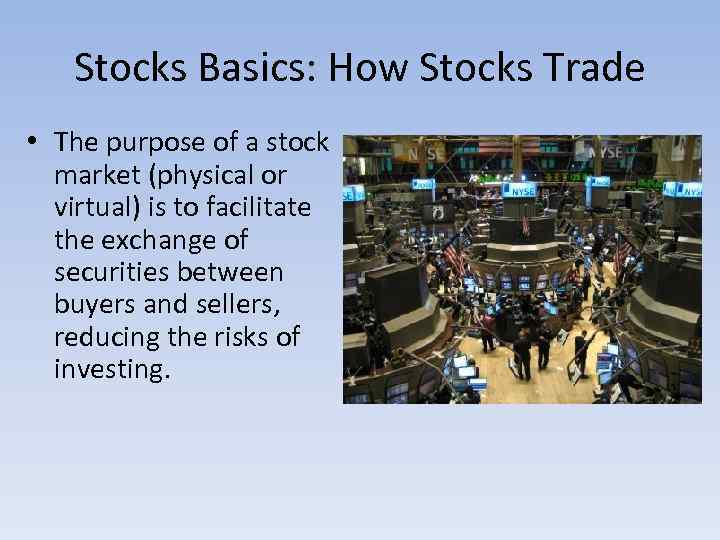
Stocks Basics: How Stocks Trade • The purpose of a stock market (physical or virtual) is to facilitate the exchange of securities between buyers and sellers, reducing the risks of investing.
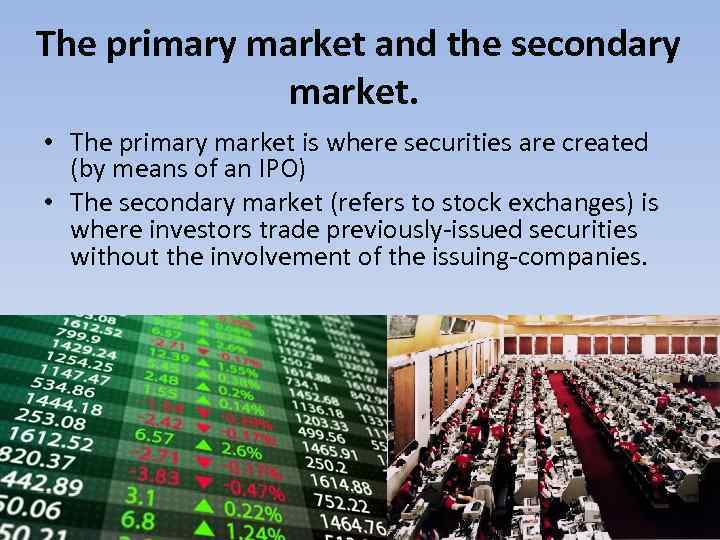
The primary market and the secondary market. • The primary market is where securities are created (by means of an IPO) • The secondary market (refers to stock exchanges) is where investors trade previously-issued securities without the involvement of the issuing-companies.
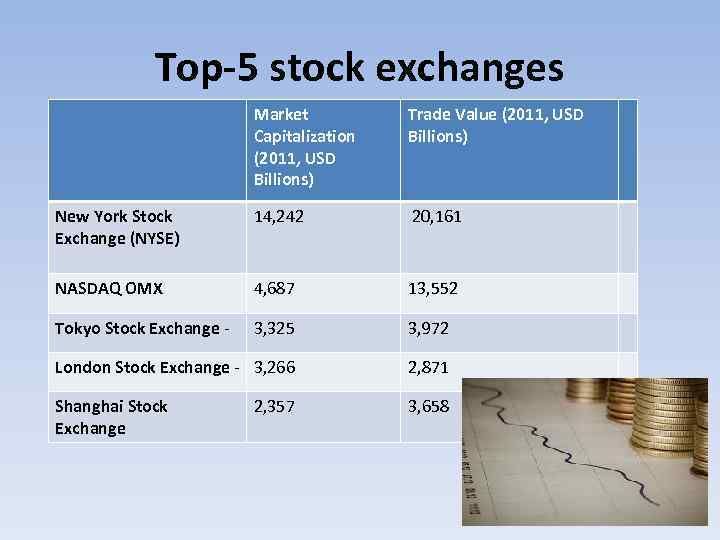
Top-5 stock exchanges Market Capitalization (2011, USD Billions) Trade Value (2011, USD Billions) New York Stock Exchange (NYSE) 14, 242 20, 161 NASDAQ OMX 4, 687 13, 552 Tokyo Stock Exchange - 3, 325 3, 972 London Stock Exchange - 3, 266 2, 871 Shanghai Stock Exchange 3, 658 2, 357
Stock market indices • The Major Stock Indices is a measurement of the value of a section of the stock market. It is computed from the prices of selected stocks (typically a weighted average). • It is a tool used by investors and financial managers to describe the market, and to compare the return on specific investments. • The main indices are: The Dow The S&P 500 The Wilshire 5000 The Russell 2000
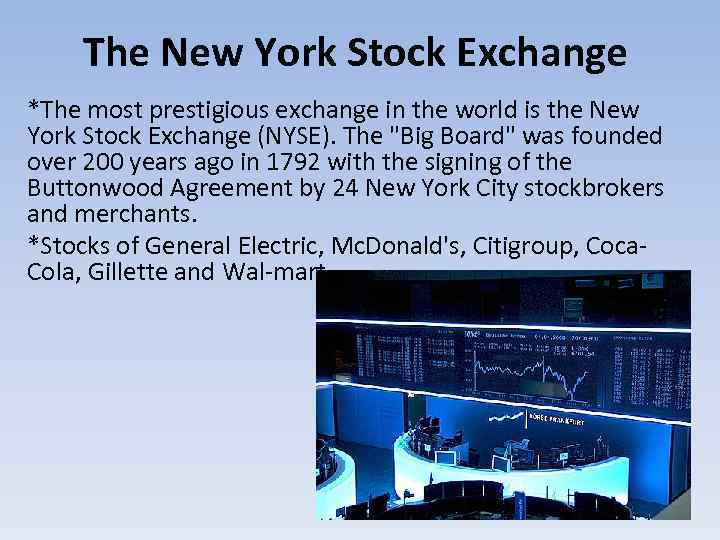
The New York Stock Exchange *The most prestigious exchange in the world is the New York Stock Exchange (NYSE). The "Big Board" was founded over 200 years ago in 1792 with the signing of the Buttonwood Agreement by 24 New York City stockbrokers and merchants. *Stocks of General Electric, Mc. Donald's, Citigroup, Coca. Cola, Gillette and Wal-mart
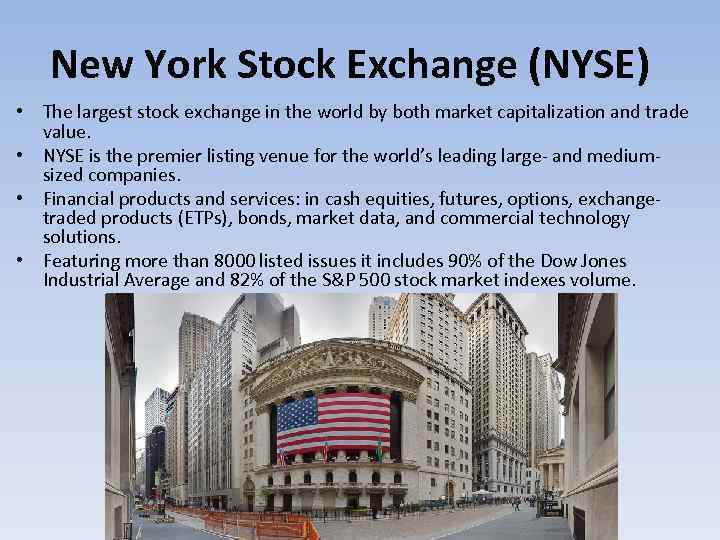
New York Stock Exchange (NYSE) • The largest stock exchange in the world by both market capitalization and trade value. • NYSE is the premier listing venue for the world’s leading large- and mediumsized companies. • Financial products and services: in cash equities, futures, options, exchangetraded products (ETPs), bonds, market data, and commercial technology solutions. • Featuring more than 8000 listed issues it includes 90% of the Dow Jones Industrial Average and 82% of the S&P 500 stock market indexes volume.
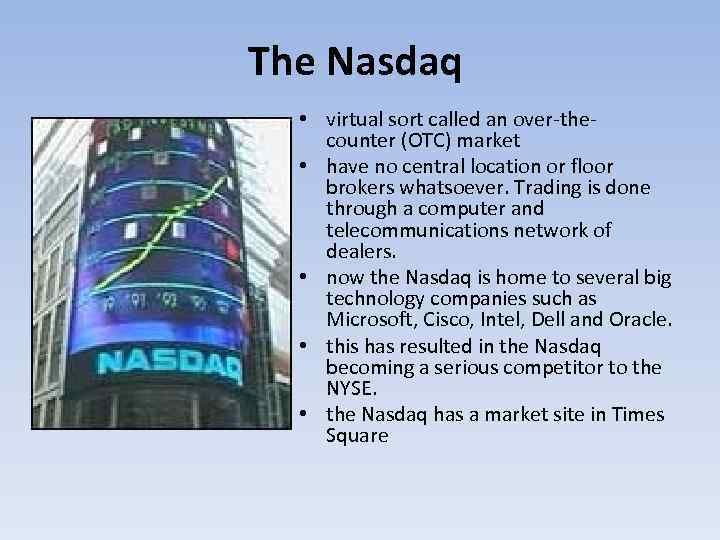
The Nasdaq • virtual sort called an over-thecounter (OTC) market • have no central location or floor brokers whatsoever. Trading is done through a computer and telecommunications network of dealers. • now the Nasdaq is home to several big technology companies such as Microsoft, Cisco, Intel, Dell and Oracle. • this has resulted in the Nasdaq becoming a serious competitor to the NYSE. • the Nasdaq has a market site in Times Square
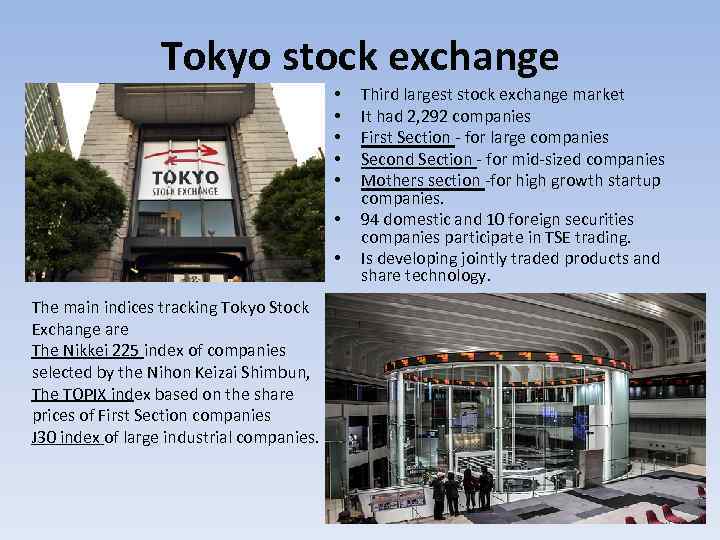
Tokyo stock exchange • • The main indices tracking Tokyo Stock Exchange are The Nikkei 225 index of companies selected by the Nihon Keizai Shimbun, The TOPIX index based on the share prices of First Section companies J 30 index of large industrial companies. Third largest stock exchange market It had 2, 292 companies First Section - for large companies Second Section - for mid-sized companies Mothers section -for high growth startup companies. 94 domestic and 10 foreign securities companies participate in TSE trading. Is developing jointly traded products and share technology.
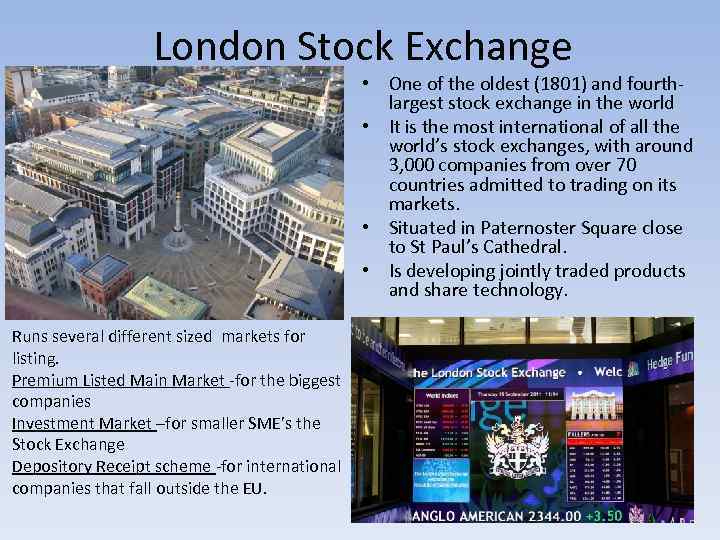
London Stock Exchange • One of the oldest (1801) and fourthlargest stock exchange in the world • It is the most international of all the world’s stock exchanges, with around 3, 000 companies from over 70 countries admitted to trading on its markets. • Situated in Paternoster Square close to St Paul’s Cathedral. • Is developing jointly traded products and share technology. Runs several different sized markets for listing. Premium Listed Main Market -for the biggest companies Investment Market –for smaller SME’s the Stock Exchange Depository Receipt scheme -for international companies that fall outside the EU.
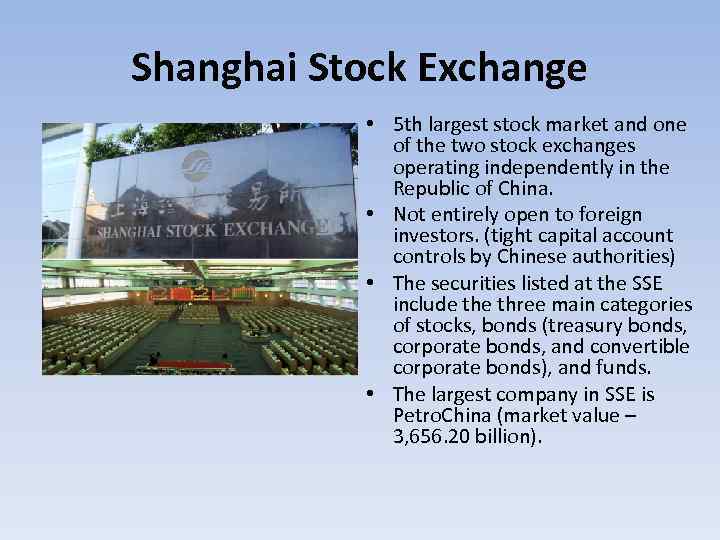
Shanghai Stock Exchange • 5 th largest stock market and one of the two stock exchanges operating independently in the Republic of China. • Not entirely open to foreign investors. (tight capital account controls by Chinese authorities) • The securities listed at the SSE include three main categories of stocks, bonds (treasury bonds, corporate bonds, and convertible corporate bonds), and funds. • The largest company in SSE is Petro. China (market value – 3, 656. 20 billion).
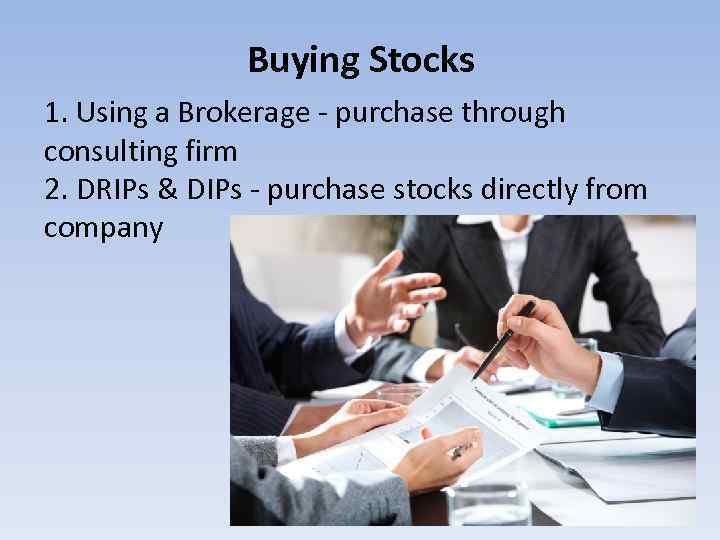
Buying Stocks 1. Using a Brokerage - purchase through consulting firm 2. DRIPs & DIPs - purchase stocks directly from company
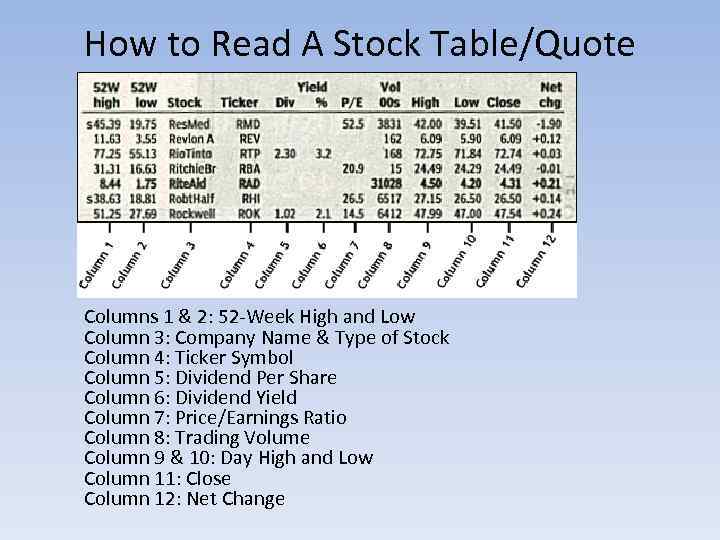
How to Read A Stock Table/Quote Columns 1 & 2: 52 -Week High and Low Column 3: Company Name & Type of Stock Column 4: Ticker Symbol Column 5: Dividend Per Share Column 6: Dividend Yield Column 7: Price/Earnings Ratio Column 8: Trading Volume Column 9 & 10: Day High and Low Column 11: Close Column 12: Net Change
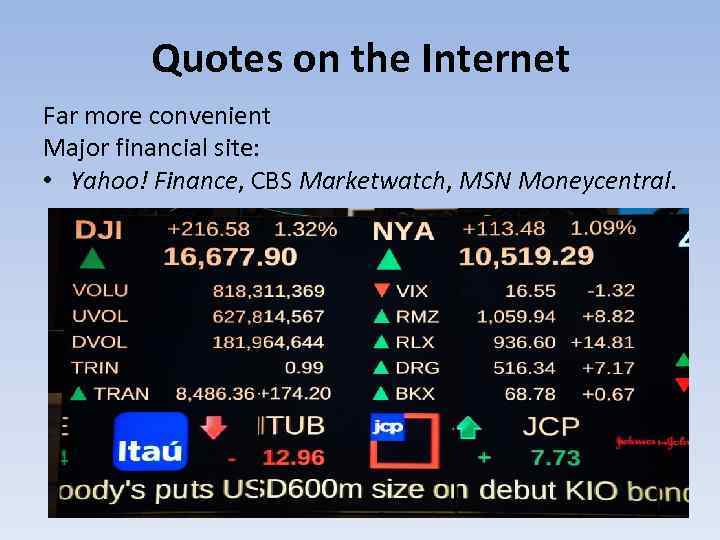
Quotes on the Internet Far more convenient Major financial site: • Yahoo! Finance, CBS Marketwatch, MSN Moneycentral.
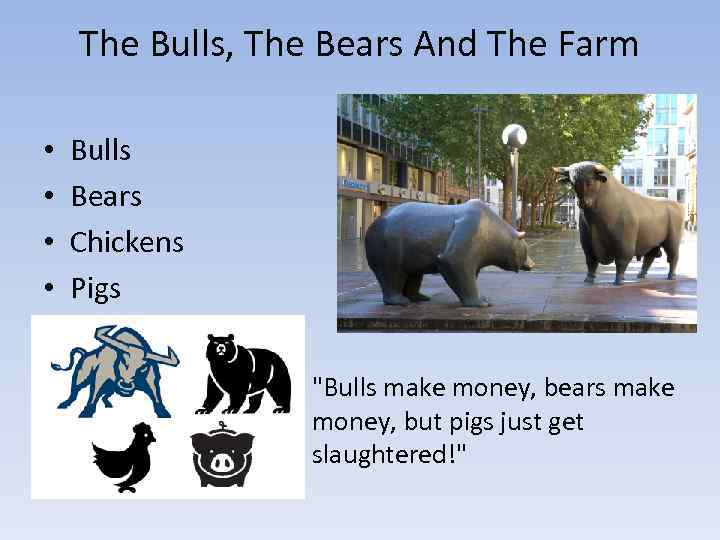
The Bulls, The Bears And The Farm • • Bulls Bears Chickens Pigs "Bulls make money, bears make money, but pigs just get slaughtered!"

Used sources • Stocks Basics: What Are Stocks? | Investopedia http: //www. investopedia. com/u niversity/stocks 1. asp#ixzz 3 q 328 Pmc. Y • http: //www. world-stock-exchanges. net/
Скачать презентацию Stock exchange market Duisembiyeva Akzharkyn Ways of
Stock exchange market.pptx