



STL
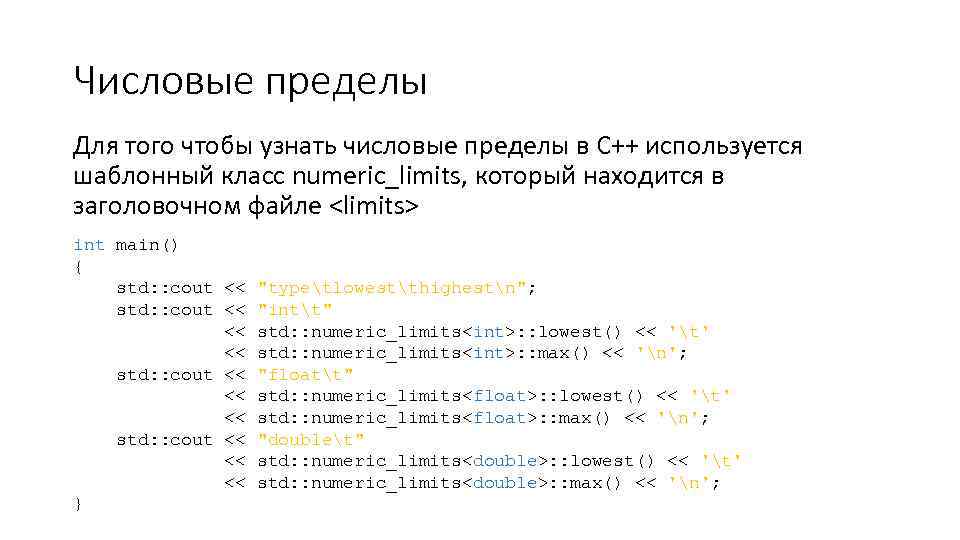
Числовые пределы Для того чтобы узнать числовые пределы в С++ используется шаблонный класс numeric_limits, который находится в заголовочном файле <limits> int main() { std: : cout << "typetlowestthighestn"; std: : cout << "intt" << std: : numeric_limits<int>: : lowest() << 't' << std: : numeric_limits<int>: : max() << 'n'; std: : cout << "floatt" << std: : numeric_limits<float>: : lowest() << 't' << std: : numeric_limits<float>: : max() << 'n'; std: : cout << "doublet" << std: : numeric_limits<double>: : lowest() << 't' << std: : numeric_limits<double>: : max() << 'n'; }
public-поля и методы numeric_limits http: //en. cppreference. com/w/cpp/types/numeric_limits
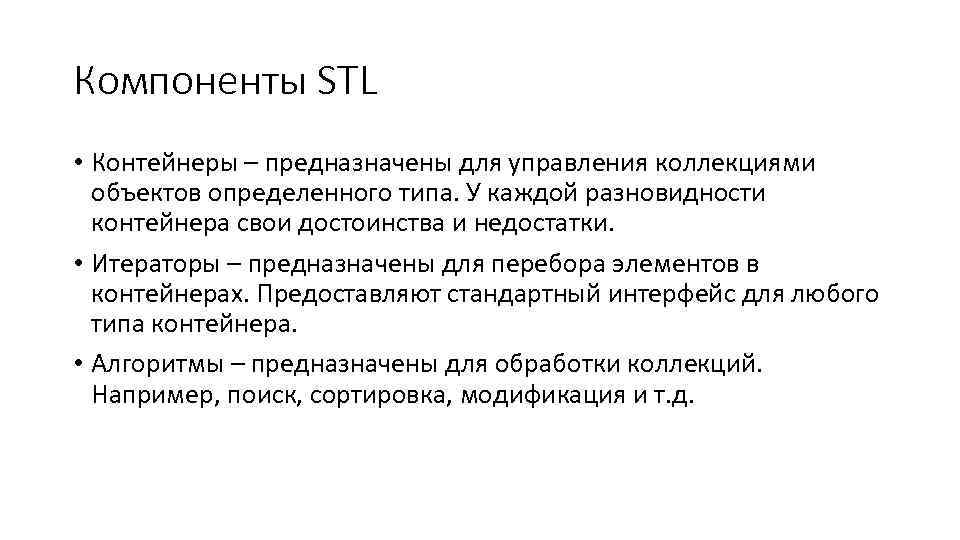
Компоненты STL • Контейнеры – предназначены для управления коллекциями объектов определенного типа. У каждой разновидности контейнера свои достоинства и недостатки. • Итераторы – предназначены для перебора элементов в контейнерах. Предоставляют стандартный интерфейс для любого типа контейнера. • Алгоритмы – предназначены для обработки коллекций. Например, поиск, сортировка, модификация и т. д.
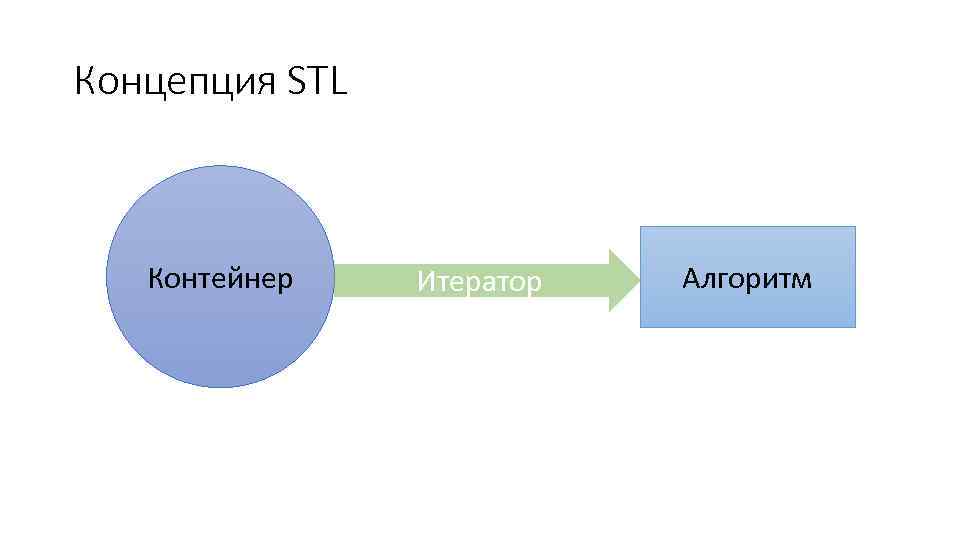
Концепция STL Контейнер Итератор Алгоритм
Требования к хранимым объектам 1. copy – constructable 2. assignable 3. «Стандартная семантика»

Категории контейнеров • Последовательные • Ассоциативные • Неупорядоченные ассоциативные • Адаптеры контейнеров
Общие методы контейнеров 1. Конструктор по умолчанию, конструктор копирования, оператор присваивания, деструктор 2. begin(), end() 3. Операторы сравнения: ==, !=, >, >=, <, <= 4. size() 5. empty() 6. swap(obj 2)
Общие типы контейнеров 1. 2. 3. 4. 5. 6. 7. С: : value_type C: : reference C: : const_reference C: : pointer C: : iterator C: : const_iterator C: : size_type
Последовательные контейнеры • Статический массив (array) • Вектор (vector) • Дека (deque) • Односвязный список (forward_list) • Двусвязный список (list)

Общие члены последовательных контейнеров 1. Конструктор от 2 итераторов 2. Конструктор от count и def. Val 3. Двухитераторный erase 4. push_back, pop_back, back 5. front 6. assign от двух итераторов 7. assign от count и val 8. insert от итератора и val 9. insert от итератора, n и val 10. insert от трех итераторов
vector С – подобный динамический массив произвольного доступа с автоматическим изменением размера при добавлении элементов 1. operator[], at 2. resize 3. capacity, reserve http: //en. cppreference. com/w/cpp/container/vector
array Array – контейнер, являющийся оберткой над обычным массивом фиксированного размера. http: //en. cppreference. com/w/cpp/container/array deque http: //en. cppreference. com/w/cpp/container/deque
forward_list / list http: //en. cppreference. com/w/cpp/container/forward_list http: //en. cppreference. com/w/cpp/container/list

Ассоциативные контейнеры • set http: //en. cppreference. com/w/cpp/container/set • map http: //en. cppreference. com/w/cpp/container/map • multiset http: //en. cppreference. com/w/cpp/container/multiset • multimap http: //en. cppreference. com/w/cpp/container/multimap
Неупорядоченные ассоциативные контейнеры • unordered_set http: //en. cppreference. com/w/cpp/container/unordered_set • unordered_map http: //en. cppreference. com/w/cpp/container/unordered_map • unordered_multiset http: //en. cppreference. com/w/cpp/container/unordered_multiset • unordered_multimap http: //en. cppreference. com/w/cpp/container/unordered_multimap
Контейнеры - адаптеры • stack http: //en. cppreference. com/w/cpp/container/stack • queue http: //en. cppreference. com/w/cpp/container/queue • priority_queue http: //en. cppreference. com/w/cpp/container/priority_queue

Итераторы http: //en. cppreference. com/w/cpp/iterator #include <vector> #include <forward_list> #include <iostream> int main() { std: : vector <int> elements { 1, 2, 3, 4, 5 }; //std: : forward_list <int> elements { 1, 2, 3, 4, 5 }; /*std: : vector<int>: : const_iterator*/ auto iter = elements. cbegin(); for(; iter != elements. cend(); ++iter) std: : cout << *iter << ' '; return 0; }
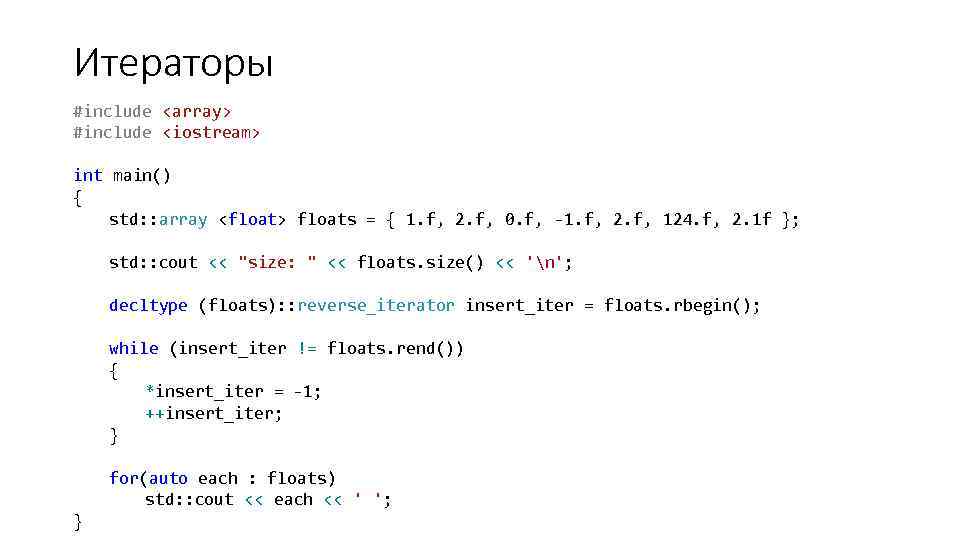
Итераторы #include <array> #include <iostream> int main() { std: : array <float> floats = { 1. f, 2. f, 0. f, -1. f, 2. f, 124. f, 2. 1 f }; std: : cout << "size: " << floats. size() << 'n'; decltype (floats): : reverse_iterator insert_iter = floats. rbegin(); while (insert_iter != floats. rend()) { *insert_iter = -1; ++insert_iter; } for(auto each : floats) std: : cout << each << ' '; }

Алгоритмы http: //en. cppreference. com/w/cpp/algorithm #include #include <vector> <list> <iostream> <algorithm> <iterator> int main() { srand(1024); std: : vector <int> v(10); std: : generate(v. begin(), v. end(), [] { return rand() % 100; }); std: : list <int> l; std: : cout << "size: " << l. size() << std: : endl; std: : copy(v. begin(), v. end(), std: : back_inserter(l)); std: : copy(l. crbegin(), l. crend(), std: : ostream_iterator<int>(std: : cout, " ")); std: : cout << 'n'; }
string http: //en. cppreference. com/w/cpp/string/basic_string
