Скачать презентацию STEREOTYPES Stereotypes of old people and relation to
Stereotypes.pptx
- Количество слайдов: 14
 STEREOTYPES Stereotypes of old people and relation to them.
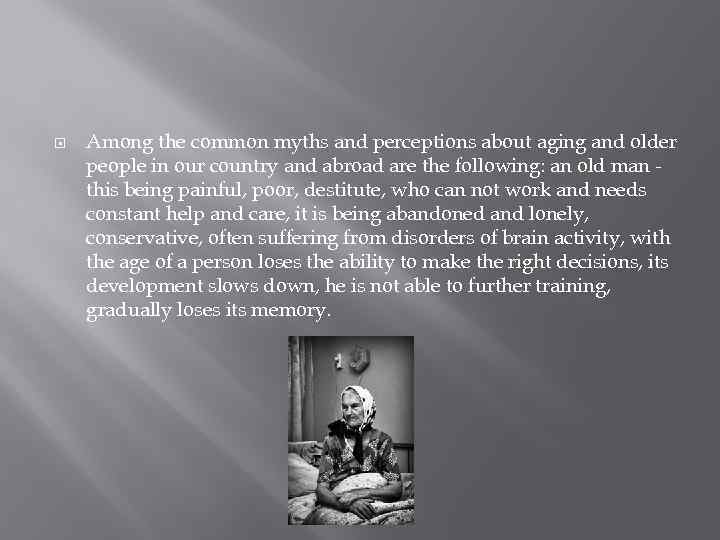 Among the common myths and perceptions about aging and older people in our country and abroad are the following: an old man this being painful, poor, destitute, who can not work and needs constant help and care, it is being abandoned and lonely, conservative, often suffering from disorders of brain activity, with the age of a person loses the ability to make the right decisions, its development slows down, he is not able to further training, gradually loses its memory.
 As S. Collette-Pratl (1976), a positive attitude towards life is correlated with satisfaction, which is represented by three factors: the extension of social ties, financial independence and good health. In old age, these factors become negative: there are or may be social isolation, helplessness and poor financial health. They can influence the negative attitudes towards the elderly.
 Another explanation for the devaluation of old age - the inability for an elderly person to be productive, focused on achieving. For industrialized Western societies are characterized by high grade qualities such as faith in their own strength, endurance. The dependence is considered a sign of weakness. The important values of modern Western civilization may also include social ethics activities and productivity (as opposed to passivity and consumerism), which gives preference to youth, energy, enthusiasm and innovation as the antipodes of passive, inert, oldage. All these values are transmitted in the course of socialization of new generations who assimilate age stereotypes with the internalization of new roles and functions.
 Social stereotype (in this case, the stereotype of the elderly) includes an assessment of a particular object (the elderly) and her emotional (relationship to them), that is cognitive and affective elements in the sum with behavioral give special The attitude (installation on the elderly). Attitudes toward the elderly are not universal and depend on the specific stereotype formed in the individual.
 Therefore, the study of stereotypes and expectations of the elderly, held in Moscow in 1996, we discovered the following. In almost all age groups are present, such representations of the elderly as their social isolation (loneliness), low material level, poor health. However, a higher separation of the concepts of attitude and stereotype suggests that the elderly are not always in fact negative. Knowledge of the characteristics that accompany later life does not mean a bad attitude towards older people in general. Moreover, in the young group were not significant idea that "the need to respect the elders", "mature cause pity and compassion, " "necessary social protection for the elderly. " Proved to be insignificant or do not meet such views as: the elderly are all the same, to be depressed, can not function in society, are imbeciles.
 In the content of the stereotype of Russian elderly, along with the negative characteristics (conservatism, critical attitude to young people, tediousness, grouchiness) are present and positive (taking care of family, kindness, having lots of experience, wisdom, and spiritual significance for older youth, seniors have lived a decent life. ) In the group of seniors has all the characteristics highlighted, but the proportion of negative indicators significantly reduced and the positive increases accordingly. This indicates a high degree of coincidence auto and hetero-stereotypes of the elderly in our society. Thus, the presence of a "negative image" of the elderly in the views of different groups in our society, including the elderly group were observed.
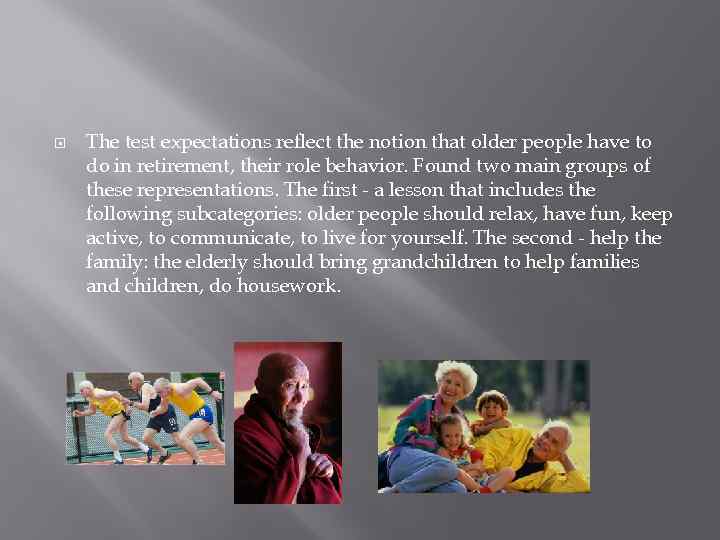 The test expectations reflect the notion that older people have to do in retirement, their role behavior. Found two main groups of these representations. The first - a lesson that includes the following subcategories: older people should relax, have fun, keep active, to communicate, to live for yourself. The second - help the family: the elderly should bring grandchildren to help families and children, do housework.




 Стереотипы пожилых и отношение к ним Среди распространенных мифов и представлений о старости и людях пожилого возраста в нашей стране и за рубежом можно выделить следующие: старый человек – это существо болезненное, слабое, без средств к существованию, которое не может работать и нуждается в постоянной помощи и опеке; это существо заброшенное и одинокое, консервативное, нередко страдающее нарушениями мозговой деятельности; с возрастом человек утрачивает умение принимать правильные решения, его развитие затормаживается, он не способен к дальнейшему обучению, постепенно утрачивает память и сексуальные функции. Как отмечает С. Collette-Pratl (1976), позитивное отношение к жизни коррелирует с удовлетворенностью, которая представляется тремя факторами: продолжением социальных связей, финансовой независимостью и хорошим здоровьем. В старости именно эти факторы становятся негативными: появляются или возможны социальная изоляция, финансовая беспомощность и плохое здоровье. Они могут влиять на негативное отношение к пожилым. Другое объяснение девальвации старого возраста – невозможность для пожилого человека быть продуктивным, ориентированным на достижение. Для индустриальных западных обществ характерна высокая оценка таких качеств, как вера в собственные силы, автономность. При этом зависимость считается признаком слабости. К важным ценностям современной западной цивилизации можно отнести также социальную этику активности и продуктивности (в противоположность пассивности и потребительству), которая отдает предпочтение молодости, энергии, энтузиазму и новаторству как антиподам пассивной, косной, старомодной старости. Все эти ценности передаются в ходе социализации новым поколениям, которые усваивают возрастные стереотипы вместе с интернализацией новых ролевых функций. <. . . > Таким образом, понятие «стереотип» в геронтологической литературе традиционно применяется для выражения негативного отношения к пожилым. М. Кермис (1984) суммировала стереотипы пожилых в современной западной культуре: Все пожилые одинаковы. Старые люди бедные. Все пожилые нездоровы. Все пожилые подвержены депрессии. Пожилые – обуза для других. Пожилые не могут функционировать в обществе. Все старые люди одиноки. Все старые люди становятся слабоумными. В то же время достаточно много исследований не подтвердили очевидность негативного стереотипизирования пожилых людей (Braithwaite, 1986). Они оцениваются более негативно чем молодые только в том случае, если они физически недееспособны или умственно отсталы. <. . . > В нашей стране много лет подспудно формировалось негативное отношение к старости. Появился общественный стереотип пассивного пожилого человека, нуждающегося в постоянном уходе, являющегося лишь дополнительной ненужной нагрузкой для здоровых людей,