


 Скачать презентацию Stephanie Golski Ph D golski rider edu l
bfeef9ae70f1940c103ccf0737d95ef3.ppt
- Количество слайдов: 43
 Stephanie Golski, Ph. D. golski@rider. edu
 l Plasticity l Brains change l Use it or lose it l Top-down Processing l Fit it in frameworks l What are your/their expectations? l Optimal Arousal l Depends l on task Selective Brain Development l Works in progress Stephanie Golski, Ph. D. golski@rider. edu
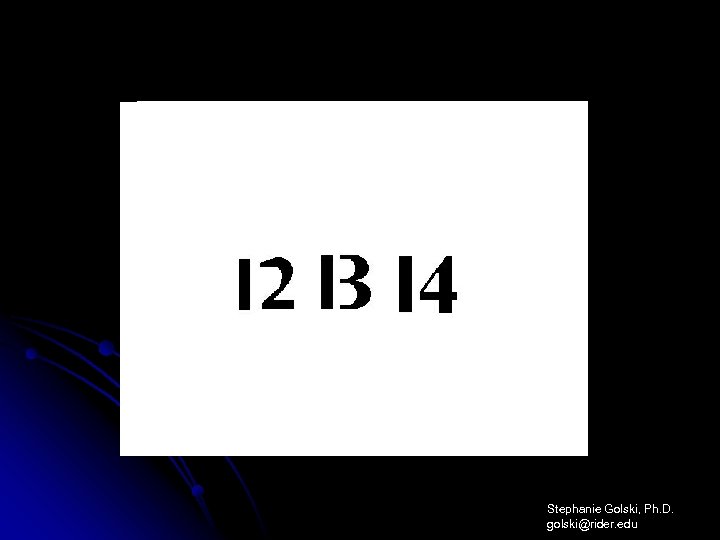
 Try It… Seated to the LEFT? l Check out picture l Close eyes l Seated to the RIGHT? l Close eyes l When asked, check out picture l Stephanie Golski, Ph. D. golski@rider. edu
 Stephanie Golski, Ph. D. golski@rider. edu
 Stephanie Golski, Ph. D. golski@rider. edu
 Psychology and Neurons Tying human behavior to neurons is difficult. There may be 100 billion neurons in your nervous system. Each neuron has many connections (within brain average = 10 K) Stephanie Golski, Ph. D. golski@rider. edu
 Changing Brains l What changes can occur in synapses? l# (increases or decreases) l Strength and pattern of signal l Character (excitation or inhibition) l Changed by: l Use l Importance of signal Stephanie Golski, Ph. D. golski@rider. edu
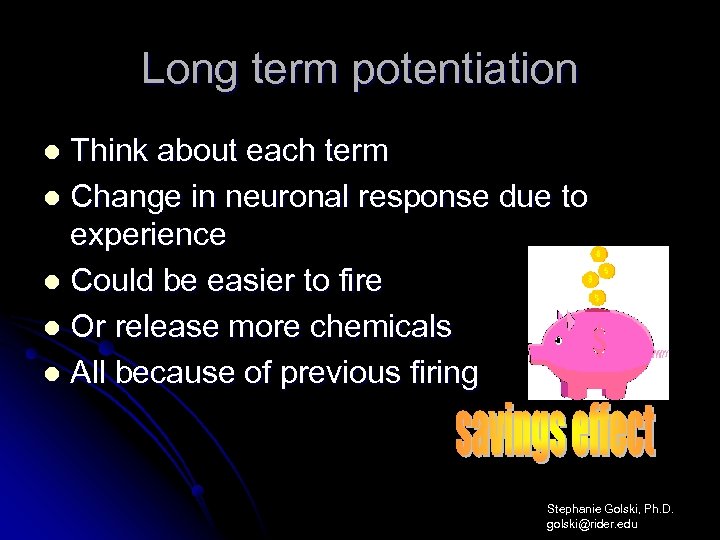 Long term potentiation Think about each term l Change in neuronal response due to experience l Could be easier to fire l Or release more chemicals l All because of previous firing l Stephanie Golski, Ph. D. golski@rider. edu
 Plasticity l Neuronal changes produced by experience l Spines on dendrites can appear within minutes of stimulation l Existing structure will play a role, be modified l We’ll have to pay attention to existing knowledge Stephanie Golski, Ph. D. golski@rider. edu
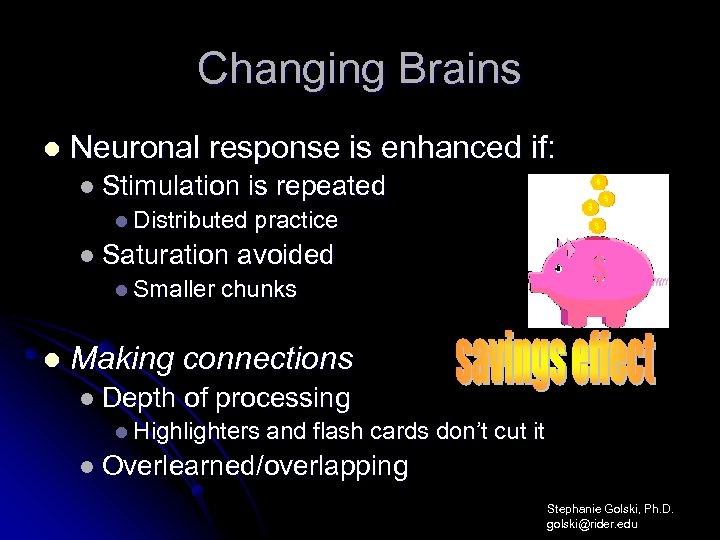 Changing Brains l Neuronal response is enhanced if: l Stimulation is repeated l Distributed l Saturation l Smaller l practice avoided chunks Making connections l Depth of processing l Highlighters and flash cards don’t cut it l Overlearned/overlapping Stephanie Golski, Ph. D. golski@rider. edu
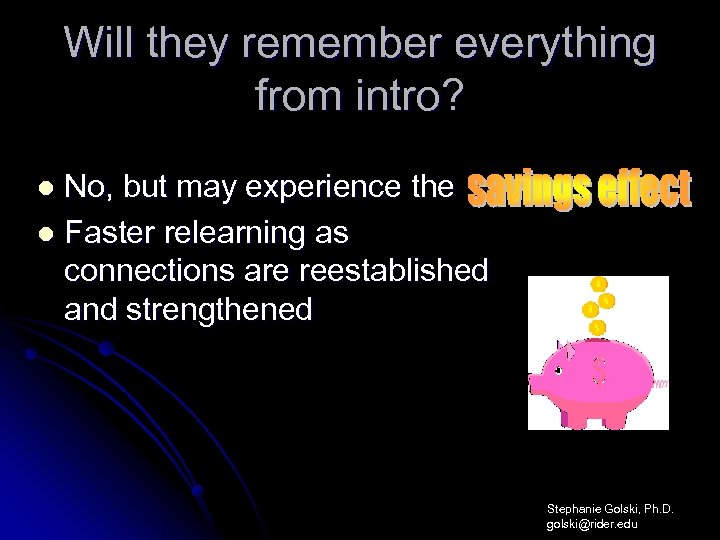 Will they remember everything from intro? No, but may experience the l Faster relearning as connections are reestablished and strengthened l Stephanie Golski, Ph. D. golski@rider. edu
 BRIDGE and the Brain l Focus of BRIDGE l Scholarship of teaching l Discipline-based epistemology l Classroom experimentation l Themes across three years l Content coverage vs. mastery l Transition from novice to expert l Backward design Stephanie Golski, Ph. D. golski@rider. edu
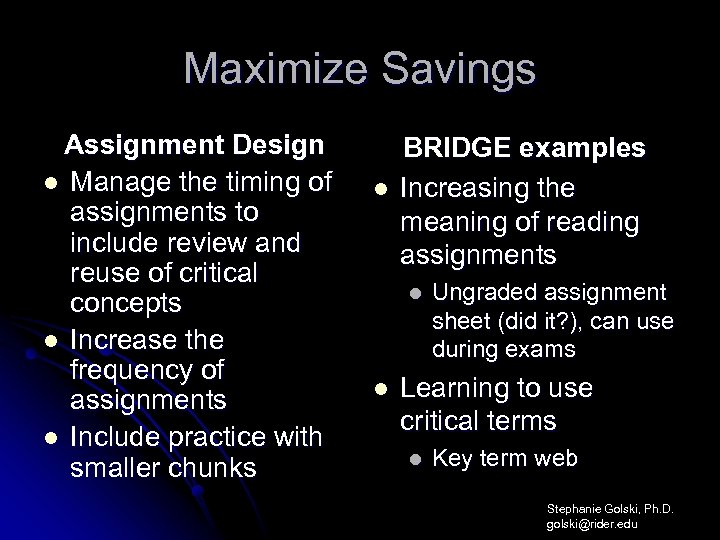 Maximize Savings Assignment Design l Manage the timing of assignments to include review and reuse of critical concepts l Increase the frequency of assignments l Include practice with smaller chunks l BRIDGE examples Increasing the meaning of reading assignments l l Ungraded assignment sheet (did it? ), can use during exams Learning to use critical terms l Key term web Stephanie Golski, Ph. D. golski@rider. edu
 Stephanie Golski, Ph. D. golski@rider. edu
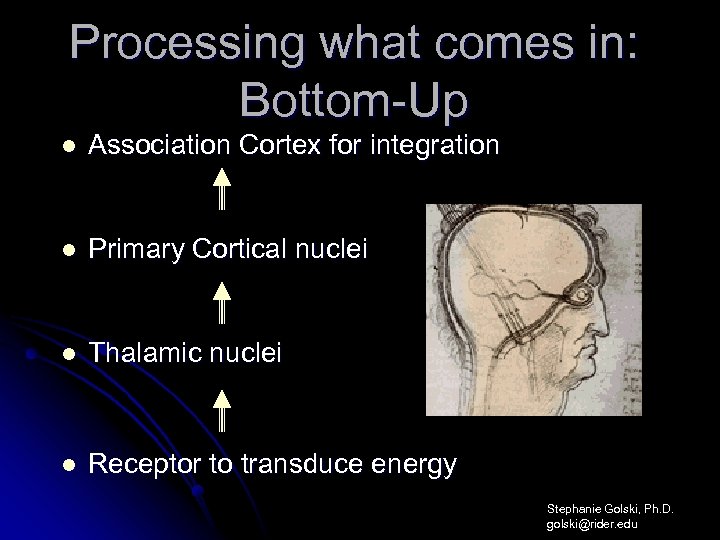 Processing what comes in: Bottom-Up l Association Cortex for integration l Primary Cortical nuclei l Thalamic nuclei l Receptor to transduce energy Stephanie Golski, Ph. D. golski@rider. edu
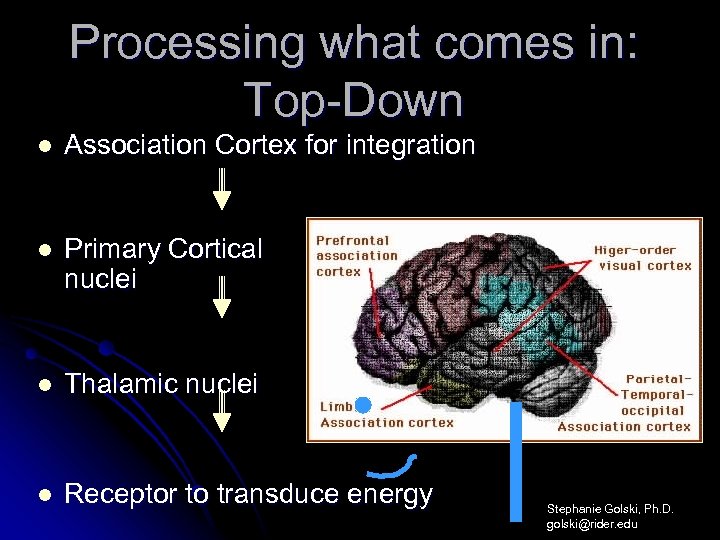 Processing what comes in: Top-Down l Association Cortex for integration l Primary Cortical nuclei l Thalamic nuclei l Receptor to transduce energy Stephanie Golski, Ph. D. golski@rider. edu
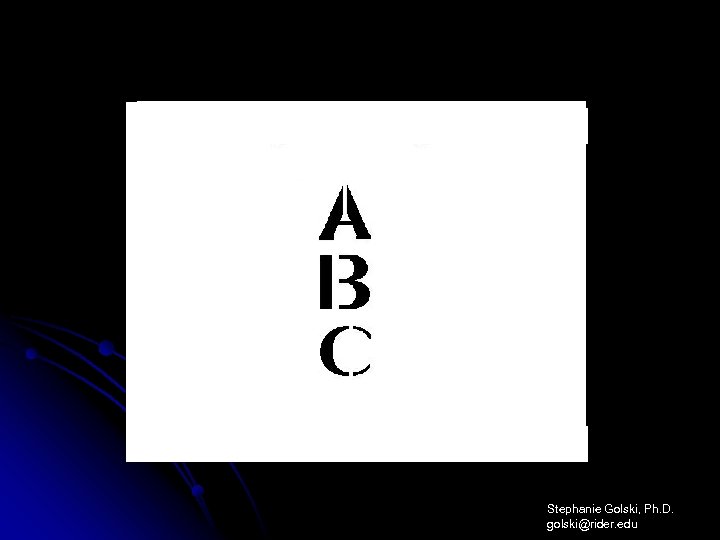
 Try It… Seated to the LEFT? l Check out picture l Close eyes l When asked, open eyes and blink quickly l Seated to the RIGHT? l Close eyes l When asked, check out picture l Then blink repeatedly for final slide l Stephanie Golski, Ph. D. golski@rider. edu
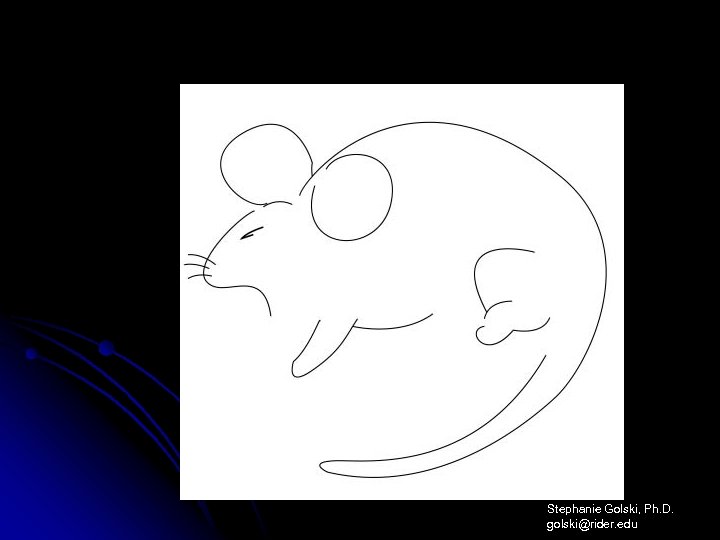 Stephanie Golski, Ph. D. golski@rider. edu
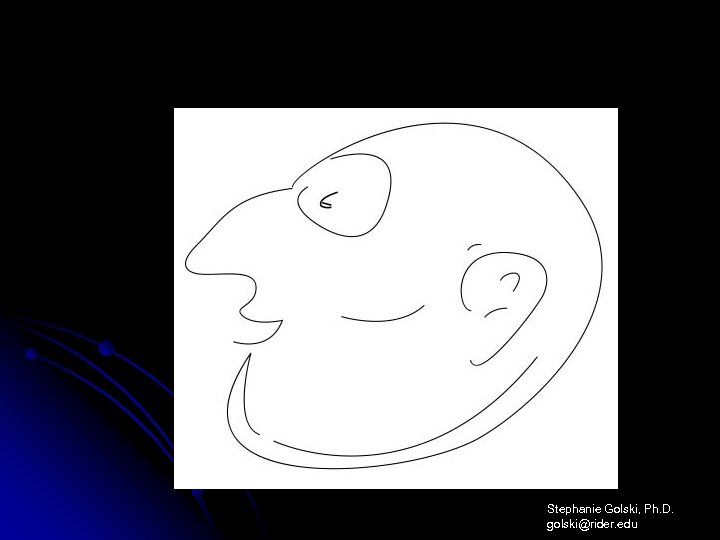 Stephanie Golski, Ph. D. golski@rider. edu
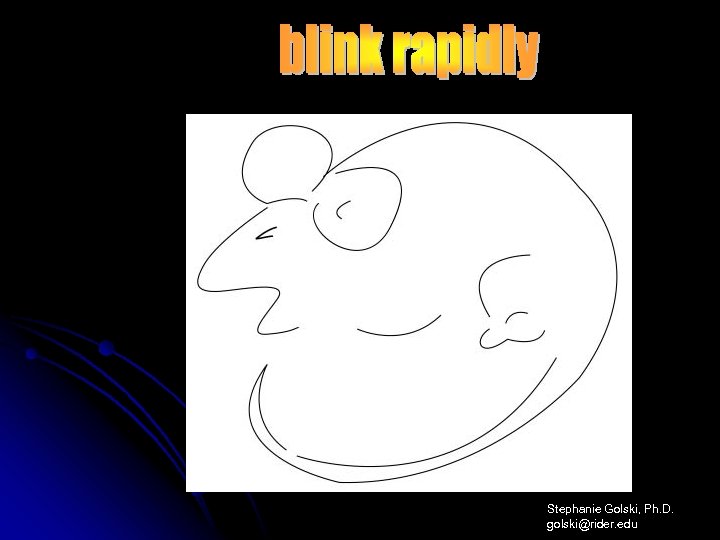 Stephanie Golski, Ph. D. golski@rider. edu
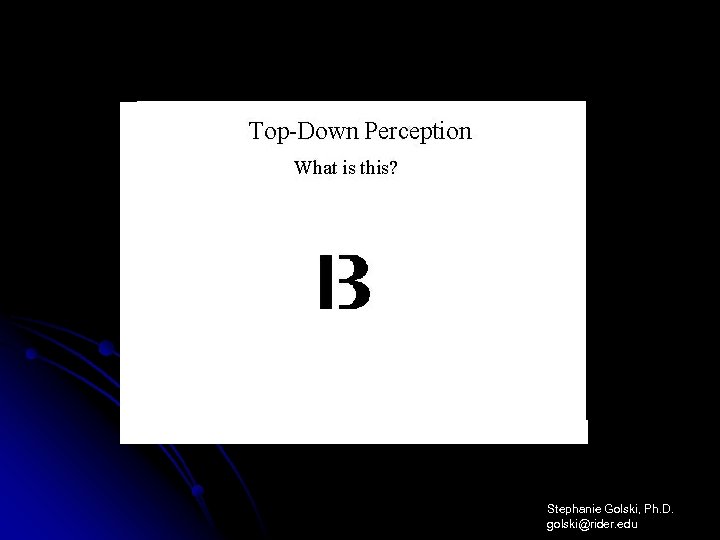
 Go beyond “cool”… Make the connection explicit l HOW you saw the second item was influenced by your “preparation” l Once you see it one way it is difficult, but not impossible, to see other ways l Reading ahead of time, slides/outlines available can prime students to get the lecture l Stephanie Golski, Ph. D. golski@rider. edu
 Top-Down Processing l l l Looking at a brain end of semester vs. first week l Expertise Recognizing your friend from really far away b/c you knew she would be here l Expectations Hearing the words to the song so clearly once you read the lyrics l 20 -20 Hindsight Stephanie Golski, Ph. D. golski@rider. edu
 Reality Raw sensory (biological) info l + past experiences l + context l + motivation l + expectations. . . l Stephanie Golski, Ph. D. golski@rider. edu
 l “The Last Supper is supposed to be thirteen men. Who is this woman? ” Although Sophie had seen this classic image many times, she had not once noticed this glaring discrepancy. “Everyone misses it, ” Teabring said. “Our preconceived notions of this scene are so powerful that our mind blocks out the incongruity and overrides our eyes. ” Dan Brown, Da Vinci Code Stephanie Golski, Ph. D. golski@rider. edu
 Top-down and Teaching l Be aware of biases, prior info l Can we think like Novices? l The obvious is NOT obvious l We see details, students need to be SHOWN l Framework, l Point knowledge reminders out patterns, themes l Encourage/reward class reading before Stephanie Golski, Ph. D. golski@rider. edu
 Existing neural networks/knowledge= Top-down processing l Use for: l Examples…concrete, interesting l Vocabulary breakdown l Group work, explanations from students l Teaching approach l Memory of own student habits Stephanie Golski, Ph. D. golski@rider. edu
 Existing neural networks/knowledge • Help students find their own networks l What does this make you think of? l What makes this memorable to you? l Use from one semester to another and/or one class session to another (supplemental instructor/tutor) l Language and/or technology barriers l “comparing apples to oranges” l “I can do it on my computer at home” Stephanie Golski, Ph. D. golski@rider. edu
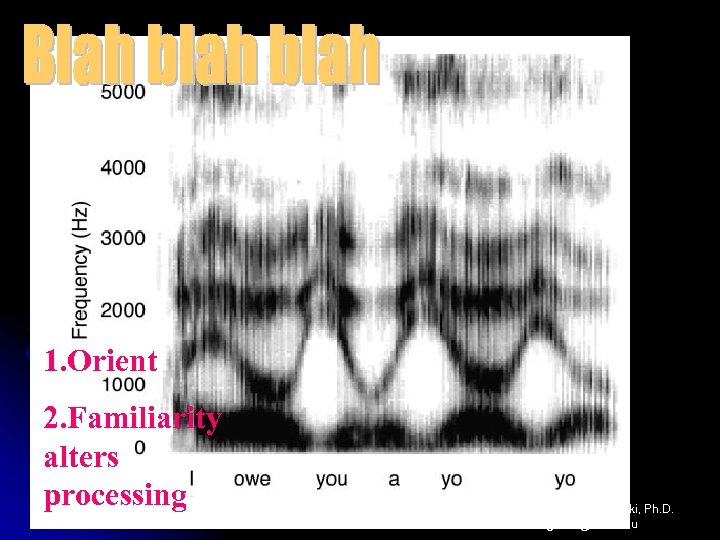 1. Orient 2. Familiarity alters processing Stephanie Golski, Ph. D. golski@rider. edu
 What if their “top” is wrong? l Focus on factually and conceptually correct information l Asterisks in notes l Error in previous thinking- show it fits in l Freud l Negative correlation, negative reinforcement l Polygraph Stephanie Golski, Ph. D. golski@rider. edu
 Attention: More Filters The Brain sees what it wants to see, not just what you put in front of it l Same stimuli can be on retina- only cause brain response when attended to l Optimal level of arousal l l Engagement/rewards l Depth of processing again Stephanie Golski, Ph. D. golski@rider. edu
 Managing Attention Assignment Design l Know what is important and make that apparent l Match course contingencies to real value of activities l Influence student perceptions of value l l l BRIDGE examples Should students have class notes on Blackboard (web)? Value of practice and homework What happens when you assign work that isn’t completed? Stephanie Golski, Ph. D. golski@rider. edu
 Teacher sees important details, students need to be shown l E. g. purpose of assignments (“busy work!”) syllabus design can include(w/recurring patterns) purpose, points, procedure l Stephanie Golski, Ph. D. golski@rider. edu
 10 Minute Reading Reinforcers (RR) Purpose: Reinforce review of correct quiz answers and previous class notes as well as active reading of current chapter. Procedure: Twice during each unit several questions (usually multiple choice) will be projected during the first 10 minutes of class. Please bring a pencil to class everyday (there is a sharpener just outside the classroom on counter in TLC office space). Notes can be used; the text book cannot. Latecomers will miss that day’s reinforcer. Answers will be discussed immediately afterwards. Because this is not intended to take more than 10 minutes of class time, if you have an Individual Education Plan (IEP) through Rider Learning Center that recommends longer time on assessments please advocate for yourself by discussing this with me early in the semester. You should plan regular times throughout the week to read the text and review your notes. Plan on reading about 30 pages per class session on average. Points: 9(5) = 45 points possible (can skip one w/out penalty or drop lowest) [12. 7% of grade]
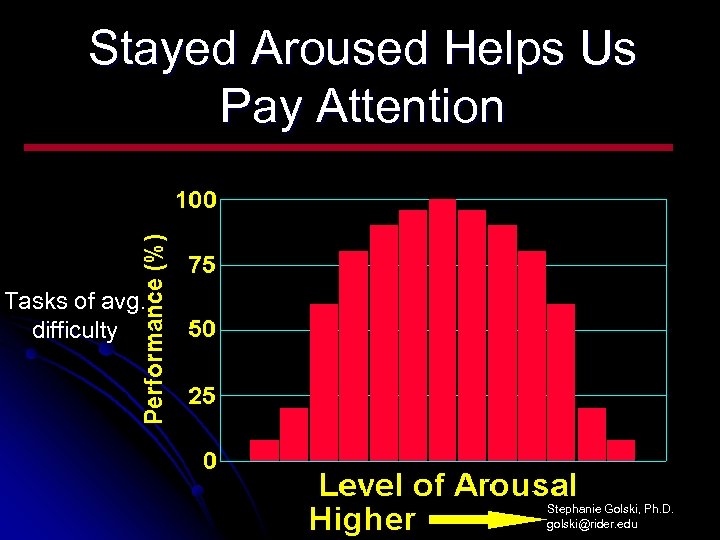 Stayed Aroused Helps Us Pay Attention Tasks of avg. difficulty Stephanie Golski, Ph. D. golski@rider. edu
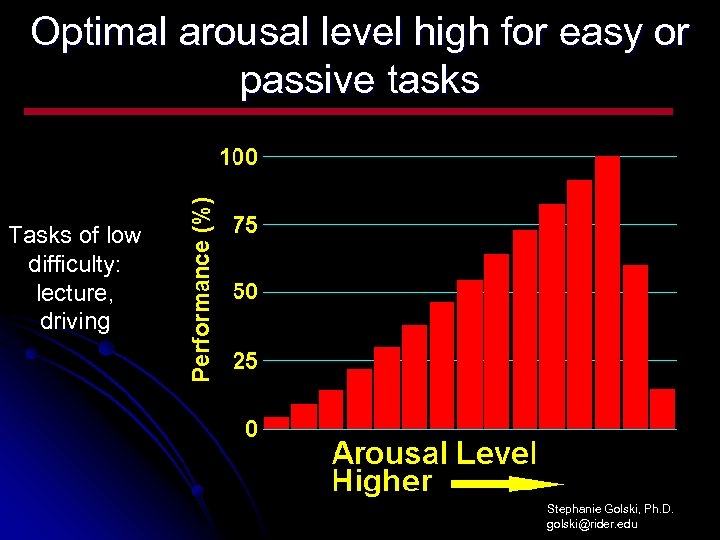 Optimal arousal level high for easy or passive tasks Tasks of low difficulty: lecture, driving Stephanie Golski, Ph. D. golski@rider. edu
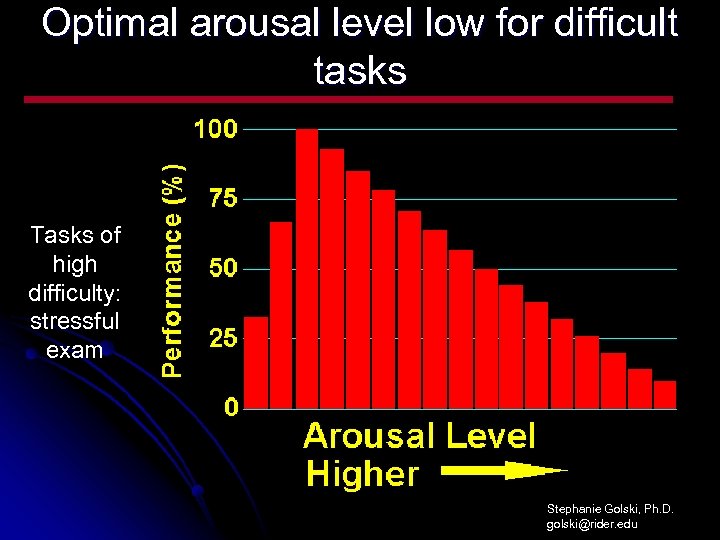 Optimal arousal level low for difficult tasks Tasks of high difficulty: stressful exam Stephanie Golski, Ph. D. golski@rider. edu
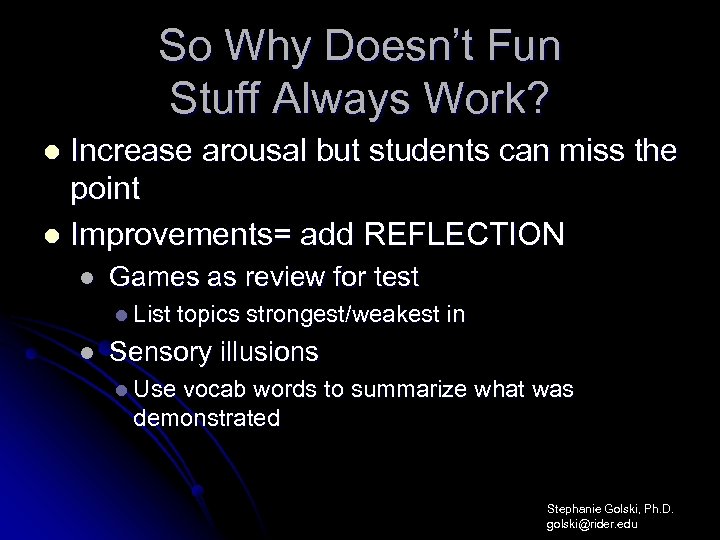 So Why Doesn’t Fun Stuff Always Work? Increase arousal but students can miss the point l Improvements= add REFLECTION l l Games as review for test l List l topics strongest/weakest in Sensory illusions l Use vocab words to summarize what was demonstrated Stephanie Golski, Ph. D. golski@rider. edu
 Stephanie Golski, Ph. D. golski@rider. edu
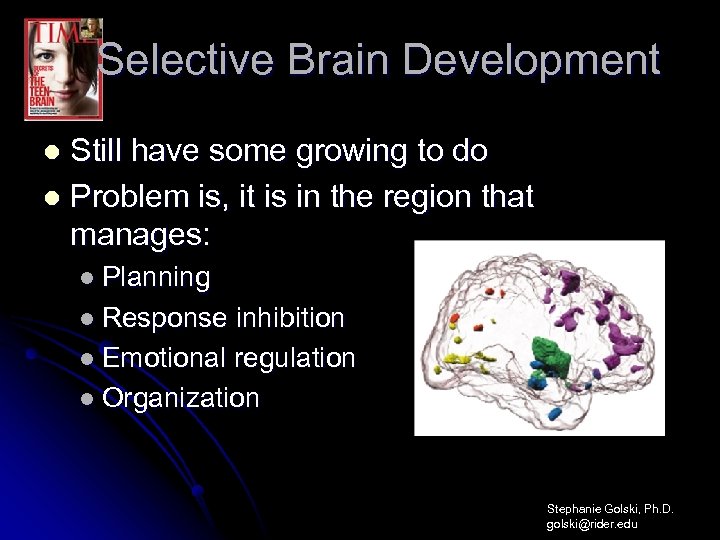 Selective Brain Development Still have some growing to do l Problem is, it is in the region that manages: l l Planning l Response inhibition l Emotional regulation l Organization Stephanie Golski, Ph. D. golski@rider. edu
 PFC and Teaching l Encourage planning l Interim l deadlines Model applications/abstractions l Piaget l Use action to complete learning cycle l Group work to test ideas, promote outward use of terms and concepts l Encourage metacognition l Knowing what you know, reflection Stephanie Golski, Ph. D. golski@rider. edu
 Long term planning Assignment Design l Anticipate needs for long term planning l Use assignments that build on each other l BRIDGE examples Adding preprofessional activities to assignments l l interview Linked assignments that create planning l Intermediate deadlines Stephanie Golski, Ph. D. golski@rider. edu
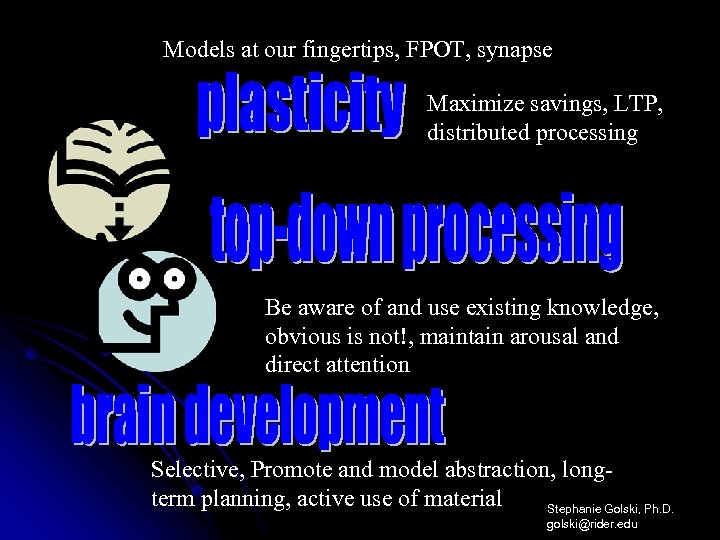 Models at our fingertips, FPOT, synapse Maximize savings, LTP, distributed processing Be aware of and use existing knowledge, obvious is not!, maintain arousal and direct attention Selective, Promote and model abstraction, longterm planning, active use of material Stephanie Golski, Ph. D. golski@rider. edu
 The Art of Changing the Brain: Enriching the practice of teaching by exploring the biology of learning James E. Zull 2002 http: //Styluspup. com