


 Скачать презентацию Stephan s Quintet SQ A Multi-galaxy Collision C K
eba57d2260c1197f86b6a6144e3c3e41.ppt
- Количество слайдов: 20
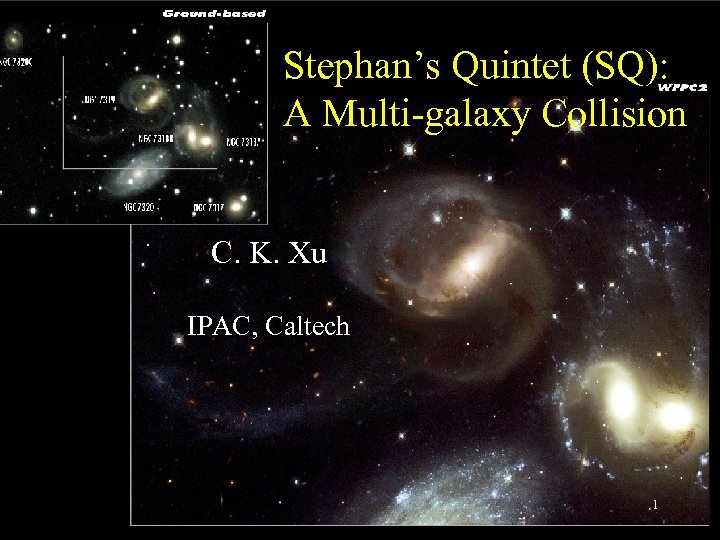 Stephan’s Quintet (SQ): A Multi-galaxy Collision C. K. Xu IPAC, Caltech 1
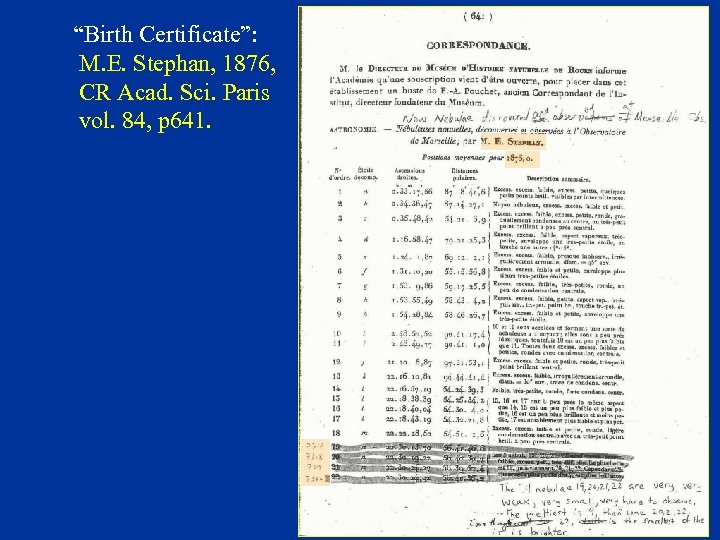 “Birth Certificate”: M. E. Stephan, 1876, CR Acad. Sci. Paris vol. 84, p 641. 2
 Why is SQ interesting? (1) It looks fantastic in every waveband. (2) It reveals surprises every time being looked at by a new instrument. (3) Behind all the spectacular images and strange spectrographs, lies a very complex web of galaxy-galaxy and galaxy-IGM interactions. (4) It shows all kinds of interaction induced phenomena, including a large scale shock (~40 kpc), an IGM starburst, long tidal tails with tidal dwarf candidates, and a type II AGN. (5) How useful is the knowledge gained in studying this local (94 Mpc) system to our understanding of those multi-galaxy systems afar, such as multi-nuclei ULIRGs and multi-mergers in deep surveys? Who cares! 3
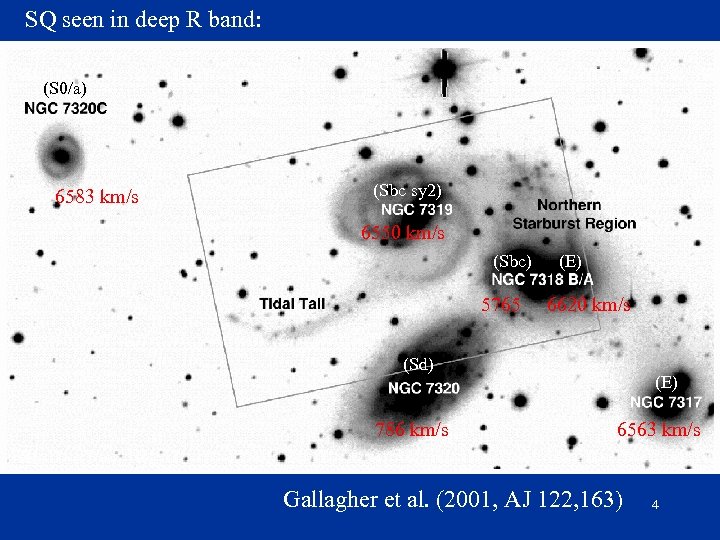 SQ seen in deep R band: (S 0/a) 6583 km/s (Sbc sy 2) 6550 km/s (Sbc) 5765 (E) 6620 km/s (Sd) 786 km/s (E) 6563 km/s Gallagher et al. (2001, AJ 122, 163) 4
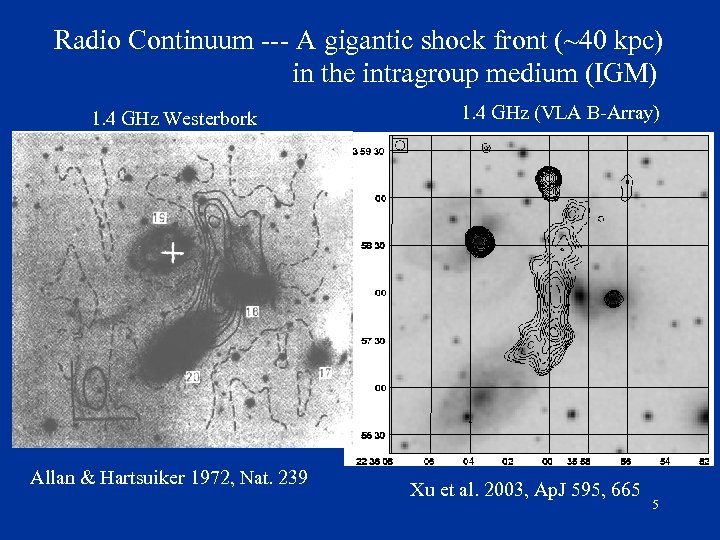 Radio Continuum --- A gigantic shock front (~40 kpc) in the intragroup medium (IGM) 1. 4 GHz Westerbork Allan & Hartsuiker 1972, Nat. 239 1. 4 GHz (VLA B-Array) Xu et al. 2003, Ap. J 595, 665 5
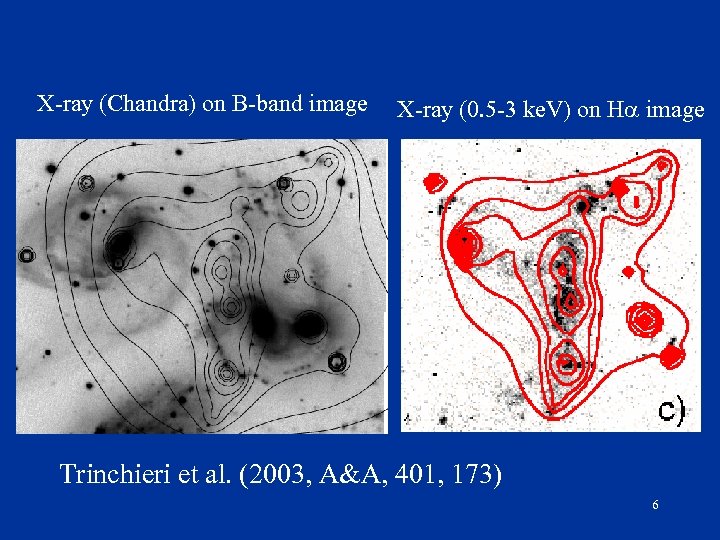 X-ray (Chandra) on B-band image X-ray (0. 5 -3 ke. V) on H image Trinchieri et al. (2003, A&A, 401, 173) 6
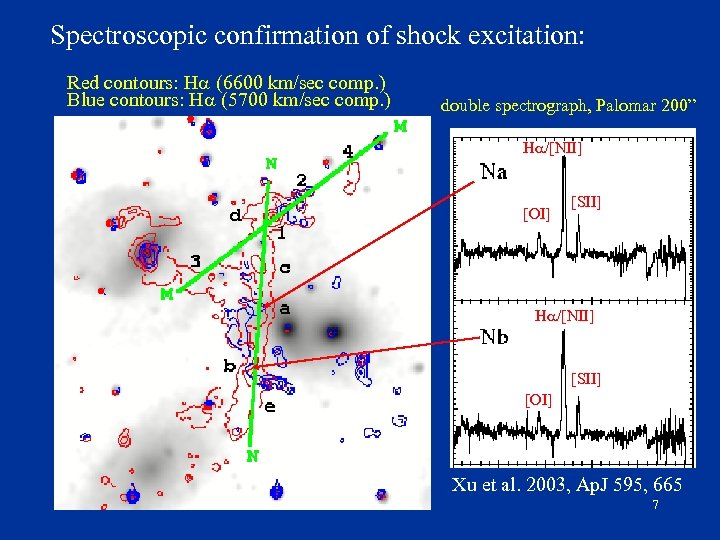 Spectroscopic confirmation of shock excitation: Red contours: H (6600 km/sec comp. ) Blue contours: H (5700 km/sec comp. ) double spectrograph, Palomar 200” H /[NII] [OI] [SII] H /[NII] [SII] [OI] Xu et al. 2003, Ap. J 595, 665 7
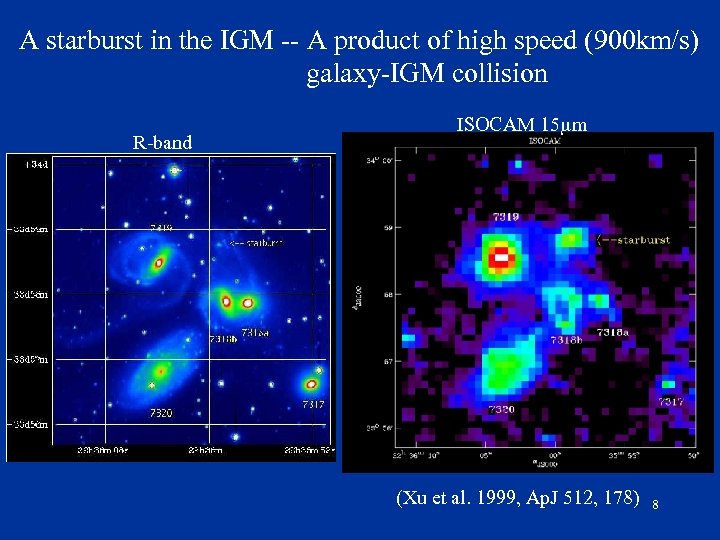 A starburst in the IGM -- A product of high speed (900 km/s) galaxy-IGM collision R-band ISOCAM 15 m (Xu et al. 1999, Ap. J 512, 178) 8
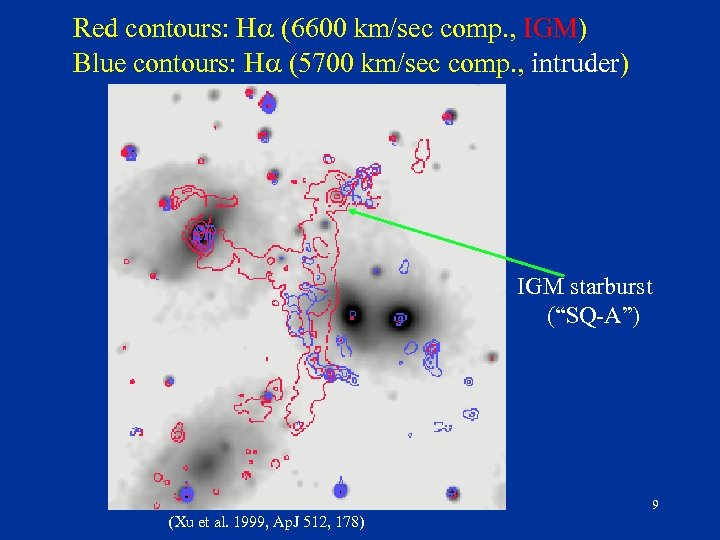 Red contours: H (6600 km/sec comp. , IGM) Blue contours: H (5700 km/sec comp. , intruder) IGM starburst (“SQ-A”) 9 (Xu et al. 1999, Ap. J 512, 178)
![H /[NII] Red contours: H (6600 km/sec comp. ) Blue contours: H (5700 km/sec](https://present5.com/presentation/eba57d2260c1197f86b6a6144e3c3e41/image-10.jpg "H /[NII] Red contours: H (6600 km/sec comp. ) Blue contours: H (5700 km/sec") H /[NII] Red contours: H (6600 km/sec comp. ) Blue contours: H (5700 km/sec comp. ) Shock front Regions: [SII] H /[NII] [OI] [SII] SQ-A region (IGM starburst) 10
H /[NII] Red contours: H (6600 km/sec comp. ) Blue contours: H (5700 km/sec comp. ) Shock front Regions: [SII] H /[NII] [OI] [SII] SQ-A region (IGM starburst) 10
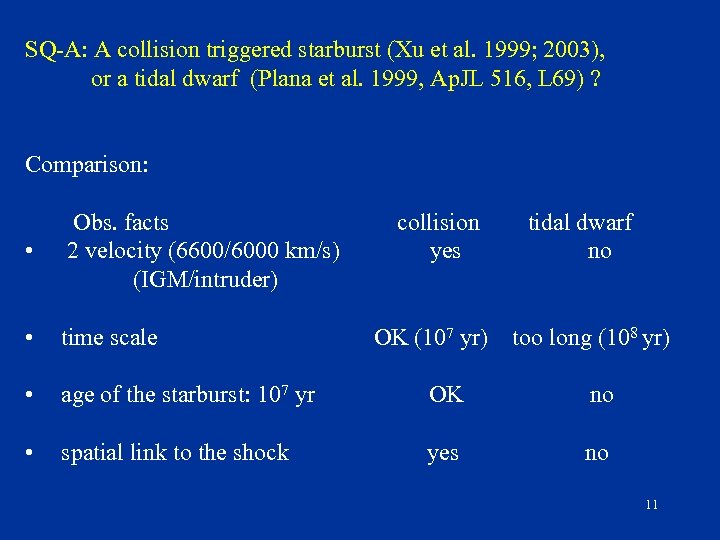 SQ-A: A collision triggered starburst (Xu et al. 1999; 2003), or a tidal dwarf (Plana et al. 1999, Ap. JL 516, L 69) ? Comparison: • Obs. facts 2 velocity (6600/6000 km/s) (IGM/intruder) collision yes • time scale • age of the starburst: 107 yr OK no • spatial link to the shock yes no OK (107 yr) tidal dwarf no too long (108 yr) 11
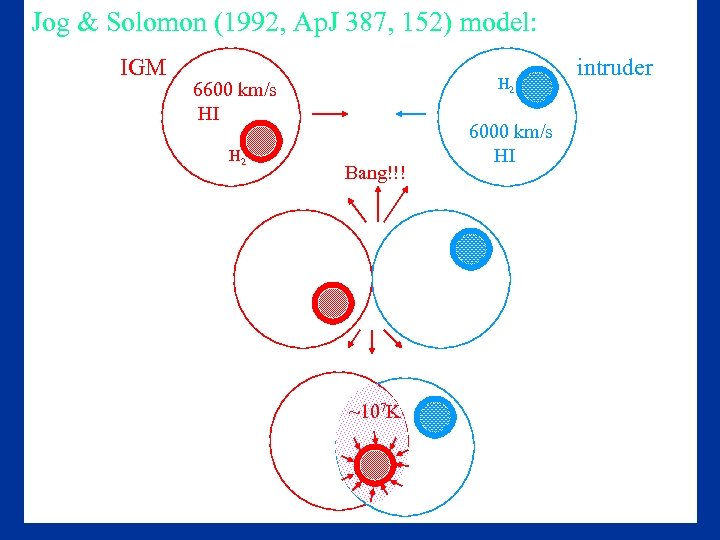 Jog & Solomon (1992, Ap. J 387, 152) model: IGM H 2 6600 km/s HI H 2 Bang!!! intruder 6000 km/s HI ~107 K 12
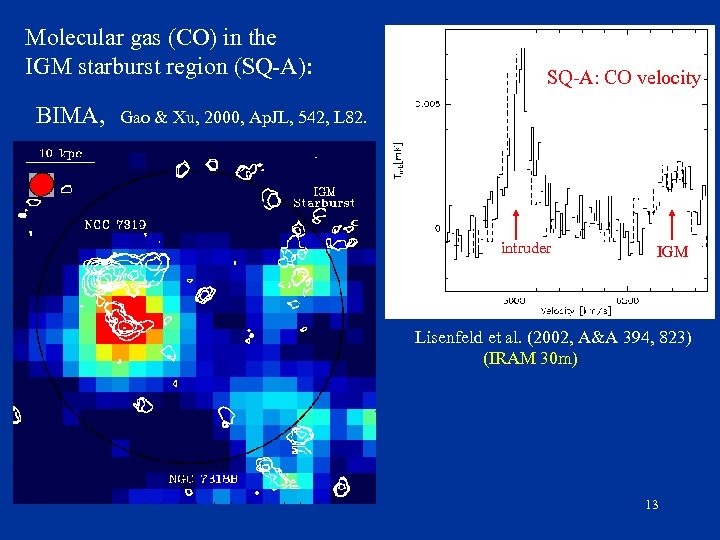 Molecular gas (CO) in the IGM starburst region (SQ-A): BIMA, SQ-A: CO velocity Gao & Xu, 2000, Ap. JL, 542, L 82. intruder IGM Lisenfeld et al. (2002, A&A 394, 823) (IRAM 30 m) 13
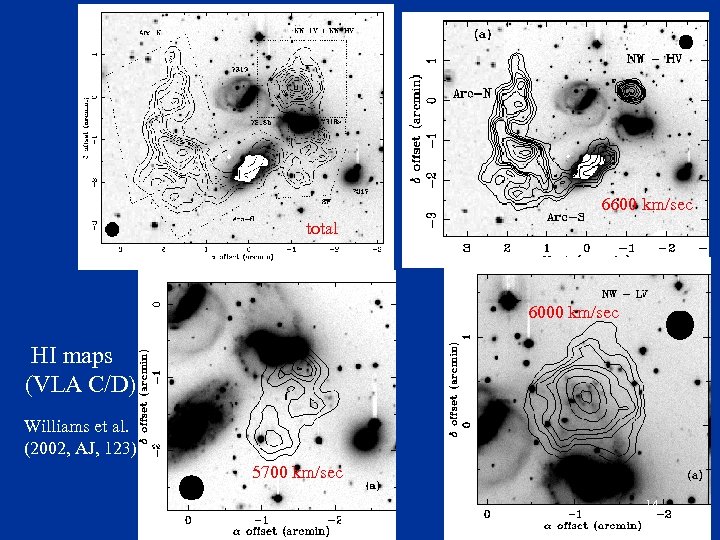 6600 km/sec total 6000 km/sec HI maps (VLA C/D) Williams et al. (2002, AJ, 123) 5700 km/sec 14
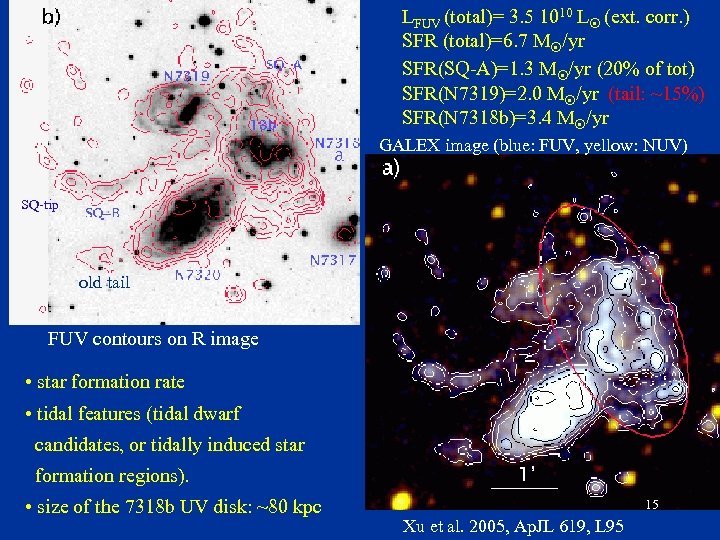 LFUV (total)= 3. 5 1010 L (ext. corr. ) SFR (total)=6. 7 M /yr SFR(SQ-A)=1. 3 M /yr (20% of tot) SFR(N 7319)=2. 0 M /yr (tail: ~15%) SFR(N 7318 b)=3. 4 M /yr GALEX image (blue: FUV, yellow: NUV) SQ-tip old tail FUV contours on R image • star formation rate • tidal features (tidal dwarf candidates, or tidally induced star formation regions). • size of the 7318 b UV disk: ~80 kpc 15 Xu et al. 2005, Ap. JL 619, L 95
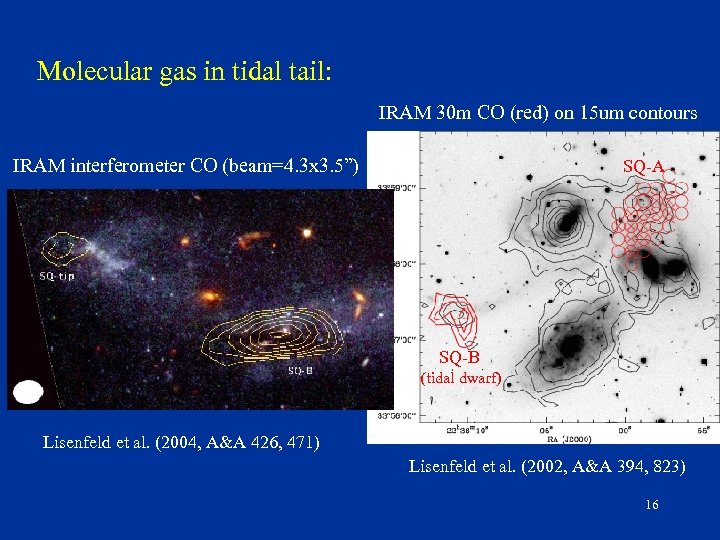 Molecular gas in tidal tail: IRAM 30 m CO (red) on 15 um contours IRAM interferometer CO (beam=4. 3 x 3. 5”) SQ-A SQ-B (tidal dwarf) Lisenfeld et al. (2004, A&A 426, 471) Lisenfeld et al. (2002, A&A 394, 823) 16
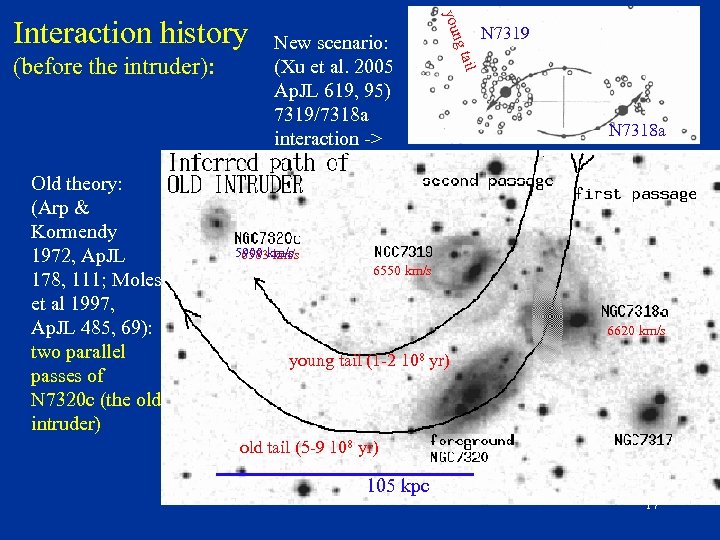 N 7319 ail Old theory: (Arp & Kormendy 1972, Ap. JL 178, 111; Moles et al 1997, Ap. JL 485, 69): two parallel passes of N 7320 c (the old intruder) ng t (before the intruder): New scenario: (Xu et al. 2005 Ap. JL 619, 95) 7319/7318 a interaction -> you Interaction history N 7318 a 5900 km/s 6583 km/s 6550 km/s 6620 km/s young tail (1 -2 108 yr) old tail (5 -9 108 yr) 105 kpc 17
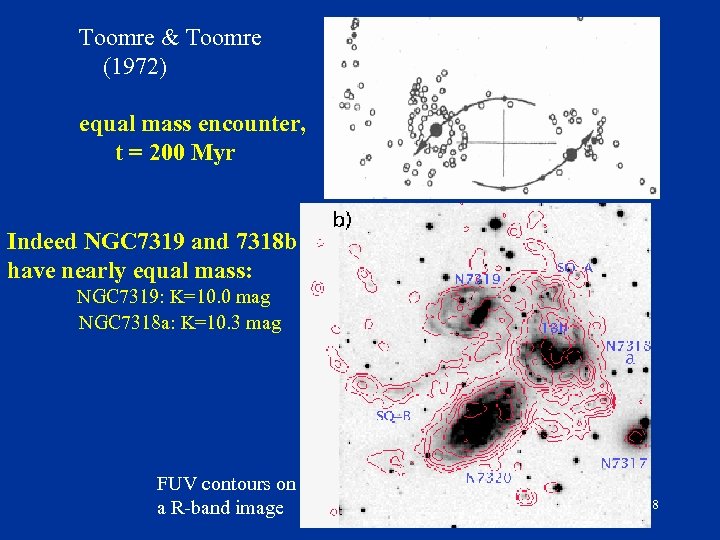 Toomre & Toomre (1972) equal mass encounter, t = 200 Myr Indeed NGC 7319 and 7318 b have nearly equal mass: NGC 7319: K=10. 0 mag NGC 7318 a: K=10. 3 mag FUV contours on a R-band image 18
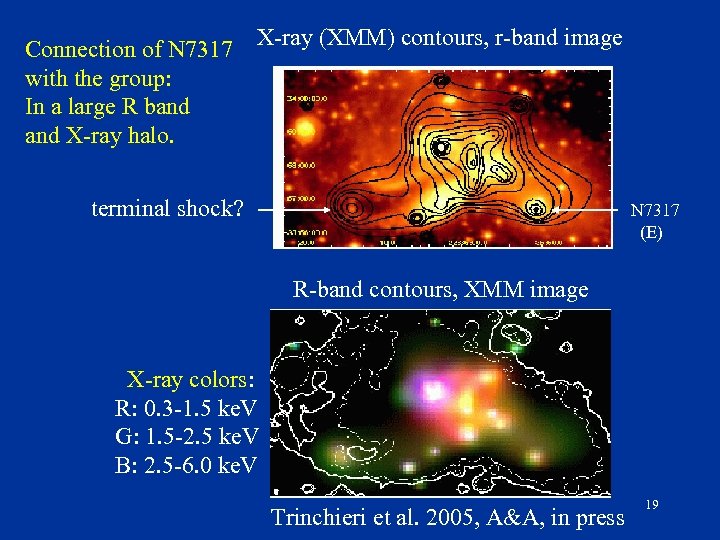 Connection of N 7317 X-ray (XMM) contours, r-band image with the group: In a large R band X-ray halo. terminal shock? N 7317 (E) R-band contours, XMM image X-ray colors: R: 0. 3 -1. 5 ke. V G: 1. 5 -2. 5 ke. V B: 2. 5 -6. 0 ke. V Trinchieri et al. 2005, A&A, in press 19
 One word summary: • we are just at the beginning of understanding SQ! Remaining Questions: • Fate of the IGM gas (~1010 M ): falling back to parent galaxies (ULIRG-to-be? ), or form new baby galaxies (tidal dwarfs)? • reason for the huge (80 kpc) UV/HI disk of the intruder: a head-on collision with 7318 a (E) ~108 yrs ago (‘ring galaxy’ scenario)? • will the ‘intruder’ N 7318 b be eventually captured by the group? • secular evolution of galaxies in SQ: were 7318 a (E) and 7320 c (S 0) late type galaxies ~ 1 Gyrs ago? Will N 7319 (Sbc) evolve into a early type soon (it has no HI gas in the disk)? • How is the type II AGN triggered? • Is there any circum-nuclear starburst associated with the type II AGN? Need high resolution (sub-arcsec) IR observations because of the very high extinction (AV~5). • A challenge to simulators: Can this extremely complex system 20 be eventually simulated?