


 Скачать презентацию Step up to Writing Training Workshop Jennifer Nehl
9ac1ab615f2ffda6774f442feb5ec5a8.ppt
- Количество слайдов: 131
 Step up to Writing Training Workshop Jennifer Nehl Innovative Education Solutions
 What is Step Up to Writing? • Grandma said when you come on something good, first thing to do is to share it with whoever you can find; that way, the good spreads out where no telling it will go. Which is right. -Forrest Carter, The Education of Little Tree (1. 1)
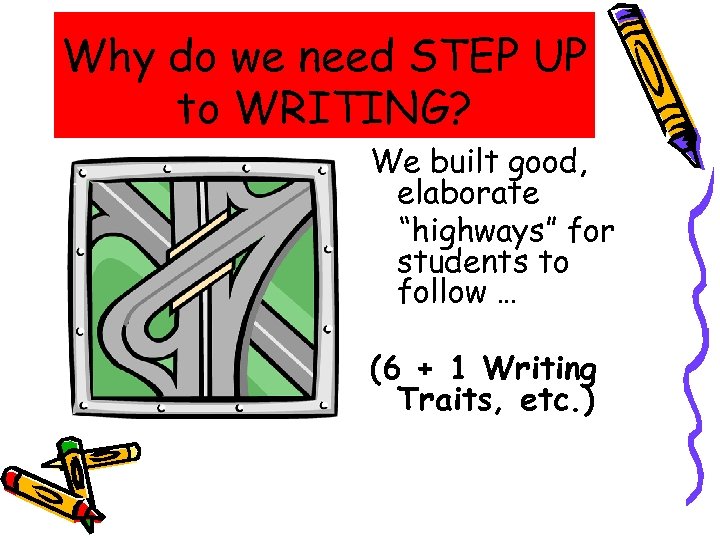 Why do we need STEP UP to WRITING? We built good, elaborate “highways” for students to follow … (6 + 1 Writing Traits, etc. )
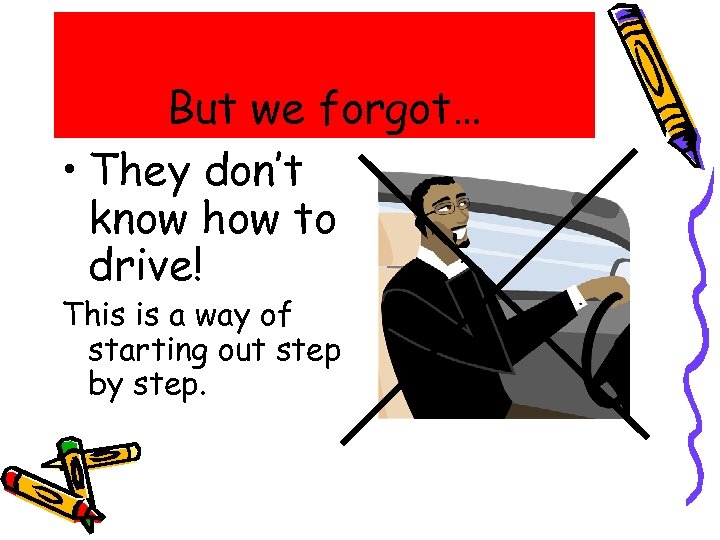 But we forgot… • They don’t know how to drive! This is a way of starting out step by step.
 Step Up to Writing is About: • Direct Instruction • Guided Practice • Opportunities for Independent Practice • If you expect it, you must teach it! (1. 2)
 How many golf balls has Tiger Woods hit? • 4 -14 repetitions to learn something new • Students with disabilities need 250 -350 repetitions over the years • STEP UP provides practice! (1. 2)
 Step Up to Writing is About Tools for your Teaching. Tool Box • Multisensory (folding paper) • Color (Strips, highlighters, dots) • Word Lists (transitions, topic sentences, etc. ) • Informal Outlines (Many forms) • Examples (Student & professional writers) • Small Steps (1. 1 -1. 5)
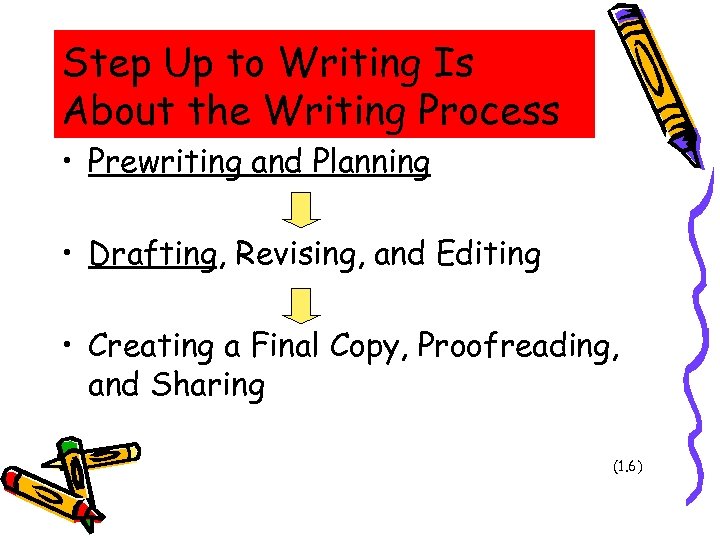 Step Up to Writing Is About the Writing Process • Prewriting and Planning • Drafting, Revising, and Editing • Creating a Final Copy, Proofreading, and Sharing (1. 6)
 Step Up to Writing is About Promoting the Traits of Good Writing • • Content Organization Style Idea • Vocabulary • Sentence Structure • Conventions • Presentation (1. 6 -1. 7)
 Step Up to Writing is About Common Expectations • Common Language – Same terminology – Builds on instruction • Common high expectations – Quality writing required in all classes – Cross curricular transference
 Why do we need to teach expository writing to all students at all grade levels? 1. Most school writing will be expository writing. 2. Expository writing teaches clear and logical thinking. 3. Expository writing helps students learn content. 4. Expository writing prepares students for the business world. 5. SUTW offers strategies and tools to teach expository writing if ‘we’ were never taught how!!
 The keys to an effective paragraph: Expository paragraphs need: • A title • A topic sentence • Transitions • Good explanations and examples • A conclusion
 Let’s say we will be writing about gangs. • What can we do to get ideas for our paragraph?
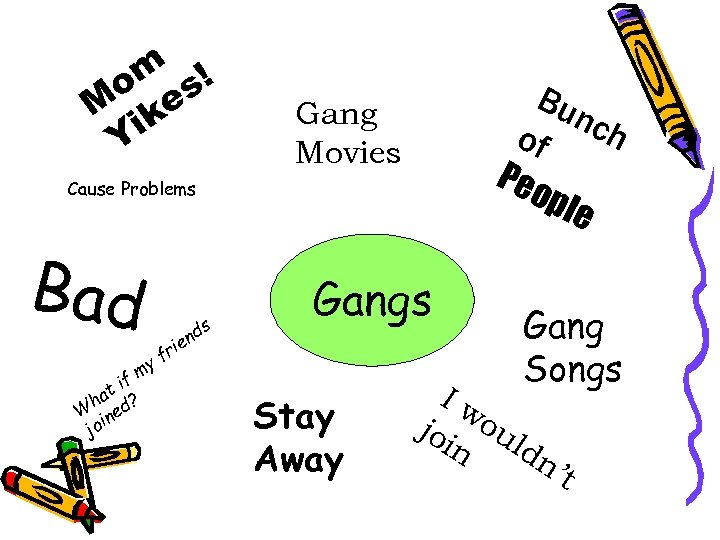 m s! o e M k i Y Bu nch of Peo ple Gang Movies Cause Problems Bad yf m f ti ha d? W ine jo s nd ie Gangs r Stay Away Gang Songs Iw joi ou n ld n’t
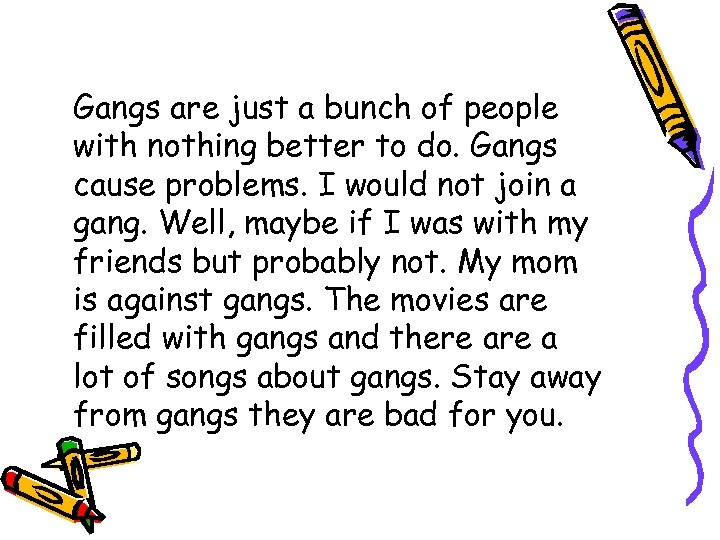 Gangs are just a bunch of people with nothing better to do. Gangs cause problems. I would not join a gang. Well, maybe if I was with my friends but probably not. My mom is against gangs. The movies are filled with gangs and there a lot of songs about gangs. Stay away from gangs they are bad for you.
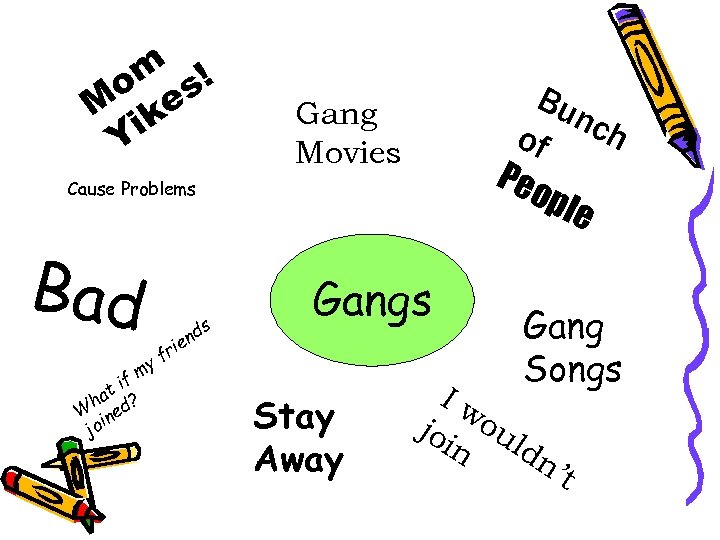 m s! o e M k i Y Bu nch of Peo ple Gang Movies Cause Problems Bad yf m f ti ha d? W ine jo s nd ie Gangs r Stay Away Gang Songs Iw joi ou n ld n’t
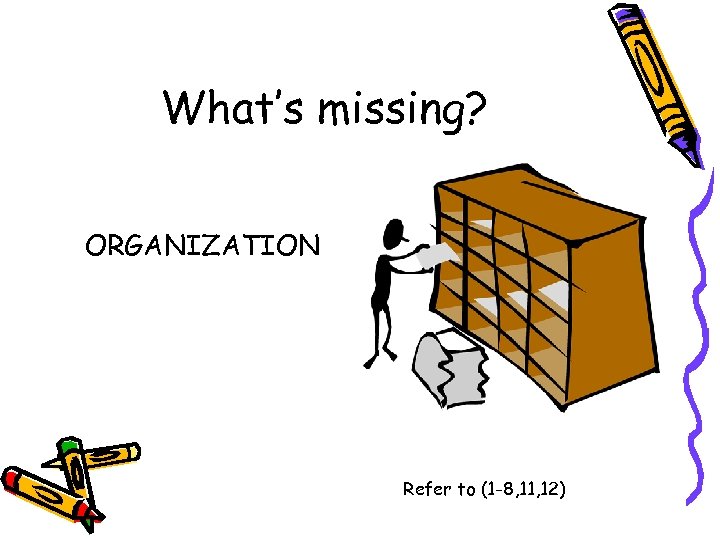 What’s missing? ORGANIZATION Refer to (1 -8, 11, 12)
 The keys to an effective paragraph: Expository paragraphs need: • A title • A topic sentence • Transitions • Good explanations and examples • A conclusion
 The Five Elements of Expository Writing • Organization is the key. • Topic sentences and thesis statements are the heart. • Transitions are the glue. • Examples, evidence, and explanations are the meat. • Conclusions tie it all together.
 Great Expository Paragraphs Organization is the key.
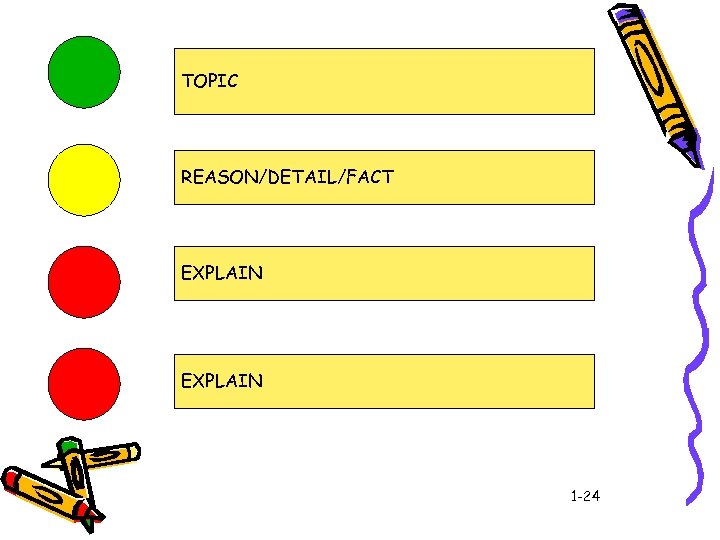
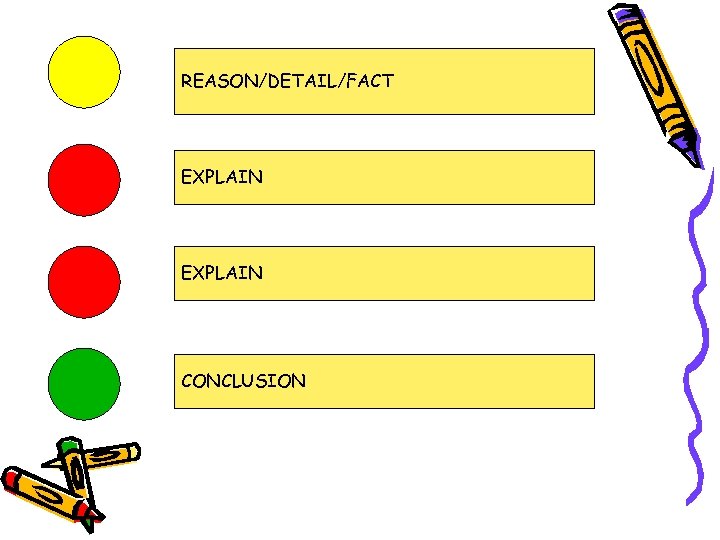
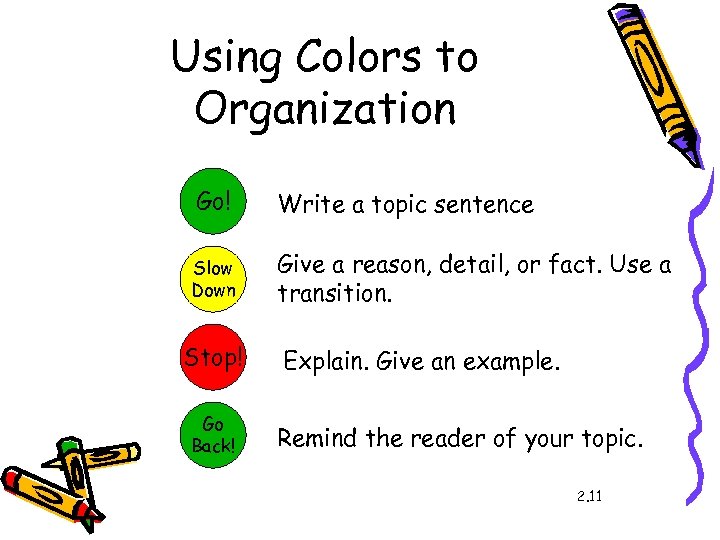 Using Colors to Organization Go! Write a topic sentence Slow Down Give a reason, detail, or fact. Use a transition. Stop! Go Back! Explain. Give an example. Remind the reader of your topic. 2. 11
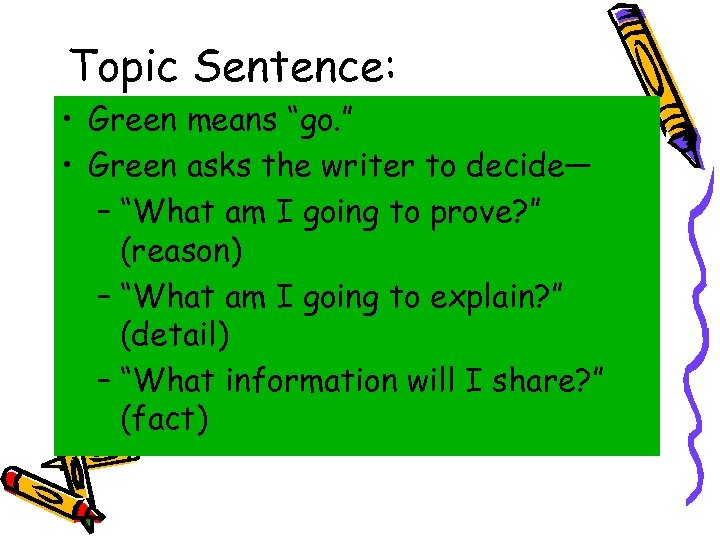 Topic Sentence: • Green means “go. ” • Green asks the writer to decide— – “What am I going to prove? ” (reason) – “What am I going to explain? ” (detail) – “What information will I share? ” (fact)
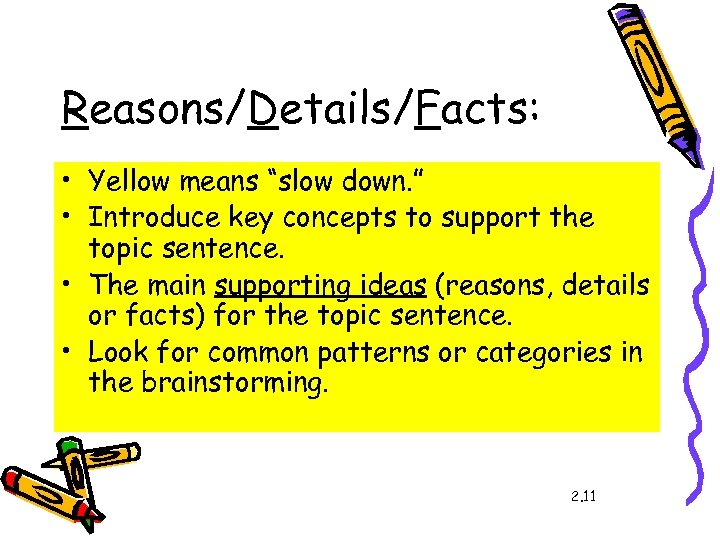 Reasons/Details/Facts: • Yellow means “slow down. ” • Introduce key concepts to support the topic sentence. • The main supporting ideas (reasons, details or facts) for the topic sentence. • Look for common patterns or categories in the brainstorming. 2. 11
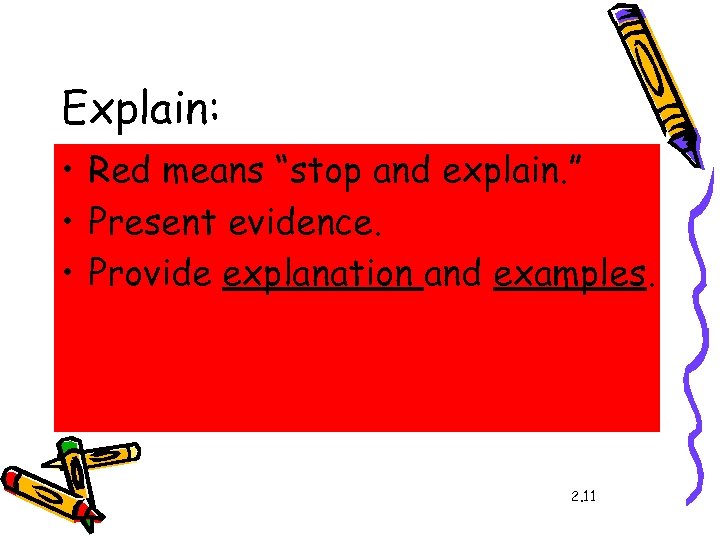 Explain: • Red means “stop and explain. ” • Present evidence. • Provide explanation and examples. 2. 11
 Conclusion: • • Green means “go back to your topic. ” Restate the topic and the position. Do not introduce new information. Use synonyms and leave your reader with something to remember. 2. 11
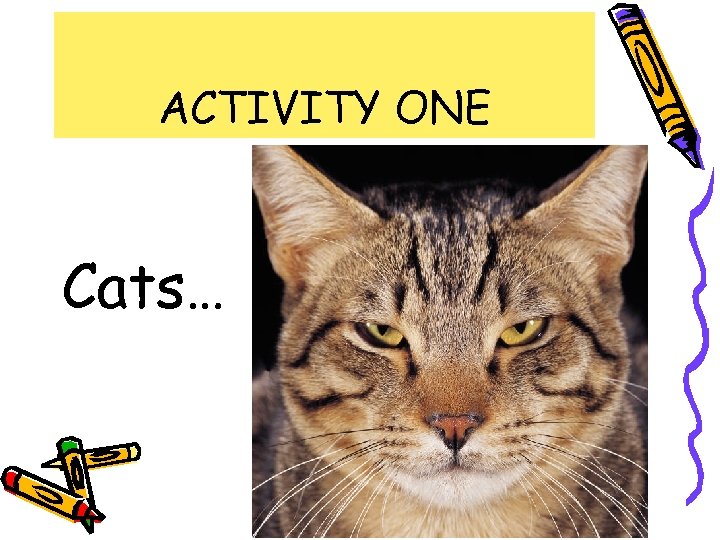 ACTIVITY ONE Cats…
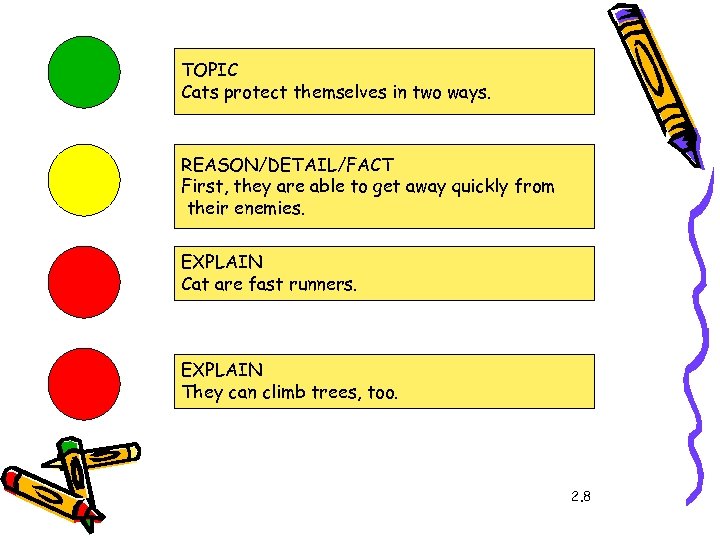
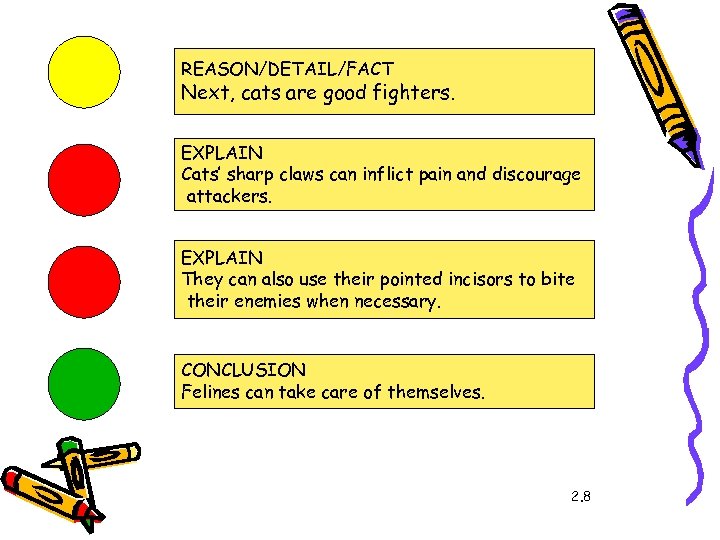
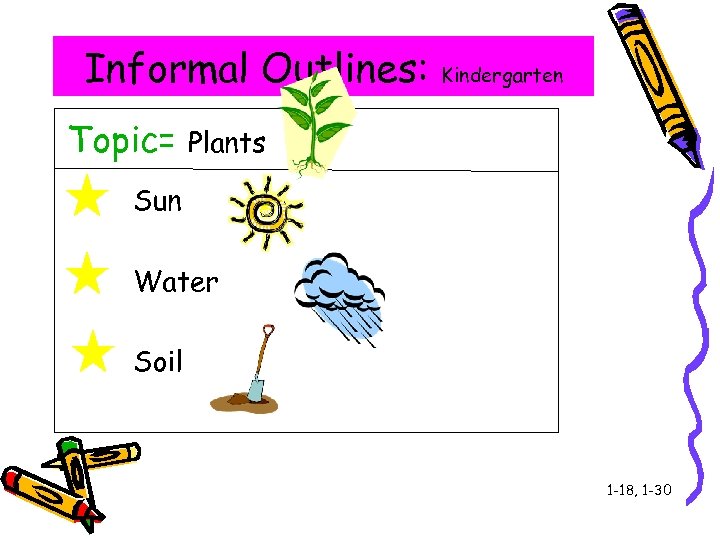
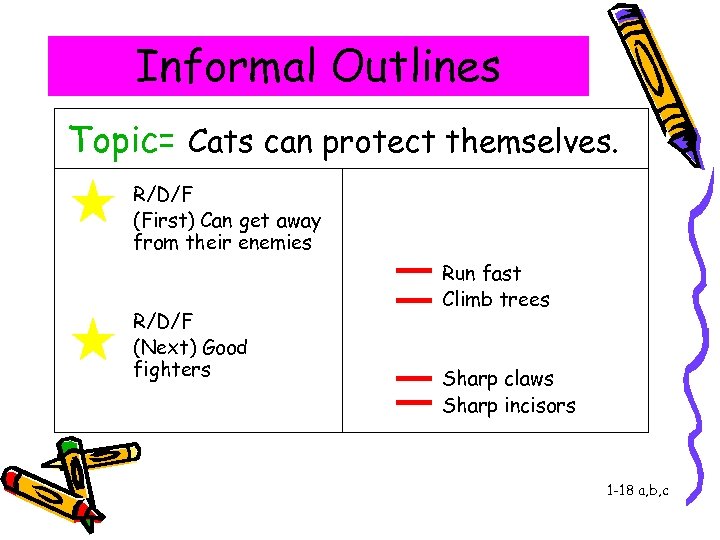 Informal Outlines Topic= Cats can protect themselves. R/D/F (First) Can get away from their enemies R/D/F (Next) Good fighters Run fast Climb trees Sharp claws Sharp incisors 1 -18 a, b, c
 Brainstorm: Ways cats protect themselves
 ACTIVITY 2 Practice Categorizing • To get students to select the yellows, they must be able to look at the exmaples (reds) and pick categories that the reds will fit into. • Practice categorizing “games. ”
 Activity 3 Informal Outline • Create an informal outline of your ideas using “cave man talk. ”
 Accordion Paragraph Increase paragraph length by adding more supporting main ideas and/or details. • Eight Sentence Paragraph • Nine Sentence Paragraph • Eleven Paragraph
 Activity 4 Accordion Paragraph Begin at 2 nd grade • When teaching, even to older students, keep the concept simple the first time. • Fold paper (hamburger, & again) • Add colored dots • Fill in complete sentences.
 TOPIC REASON/DETAIL/FACT EXPLAIN 1 -24
 REASON/DETAIL/FACT EXPLAIN CONCLUSION
 TOPIC Cats protect themselves in two ways. REASON/DETAIL/FACT First, they are able to get away quickly from their enemies. EXPLAIN Cat are fast runners. EXPLAIN They can climb trees, too. 2. 8
 REASON/DETAIL/FACT Next, cats are good fighters. EXPLAIN Cats’ sharp claws can inflict pain and discourage attackers. EXPLAIN They can also use their pointed incisors to bite their enemies when necessary. CONCLUSION Felines can take care of themselves. 2. 8
 Informal Outlines: Topic= Kindergarten Plants Sun Water Soil 1 -18, 1 -30
 Other Kinds of Outlines: Decimal • Topic=________ 1. 0__________ 1. 1__________ 1. 1. 1________ 1. 1. 2___________________ 1. 2. 1________ 1. 2. 2________
 Other Kinds of Outlines: Shapes Topic=__________ q ____________ q____________
 Other Kinds of Outlines: Numbers Topic=___________ 1_____________ 2____________ 3_____________________ 2____________ 3____________________
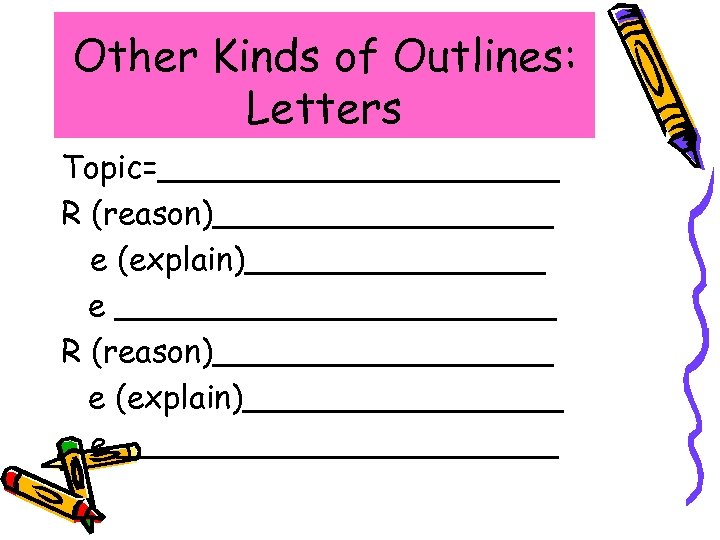 Other Kinds of Outlines: Letters Topic=__________ R (reason)_________ e (explain)________ e ___________
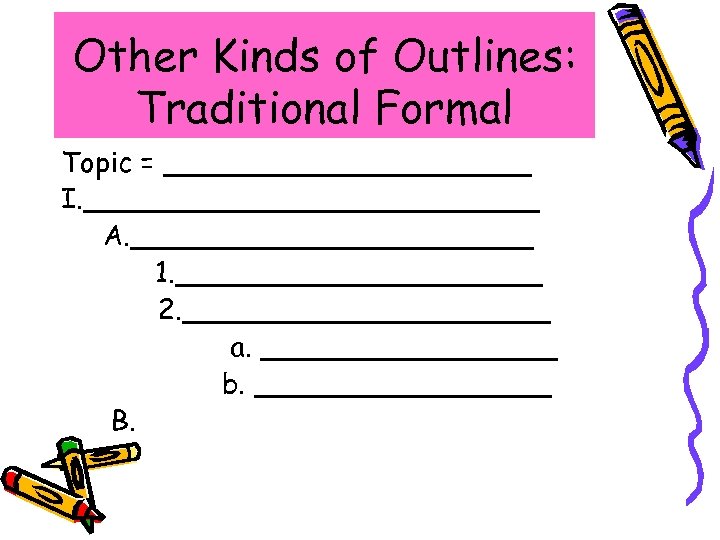 Other Kinds of Outlines: Traditional Formal Topic = ___________ I. _____________ A. ____________ 1. ___________ 2. ___________ a. _________ b. _________ B.
 Informal Outlines Topic= Fun ways to spend a million dollars 2. 9 -2. 13
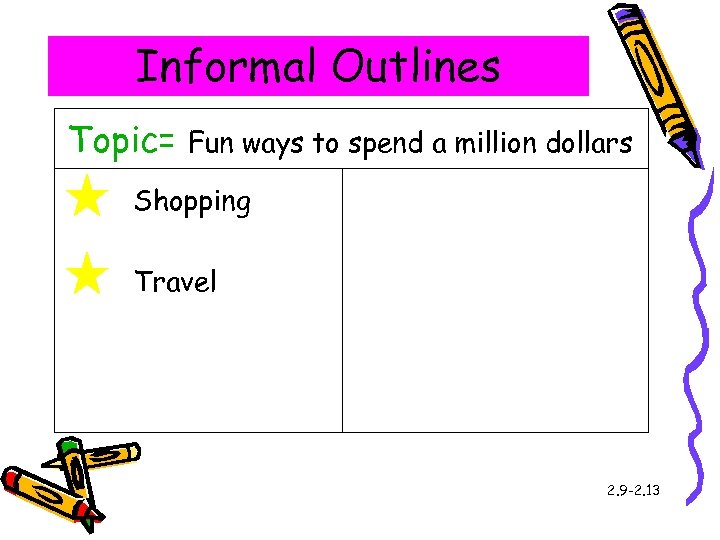 Informal Outlines Topic= Fun ways to spend a million dollars Shopping Travel 2. 9 -2. 13
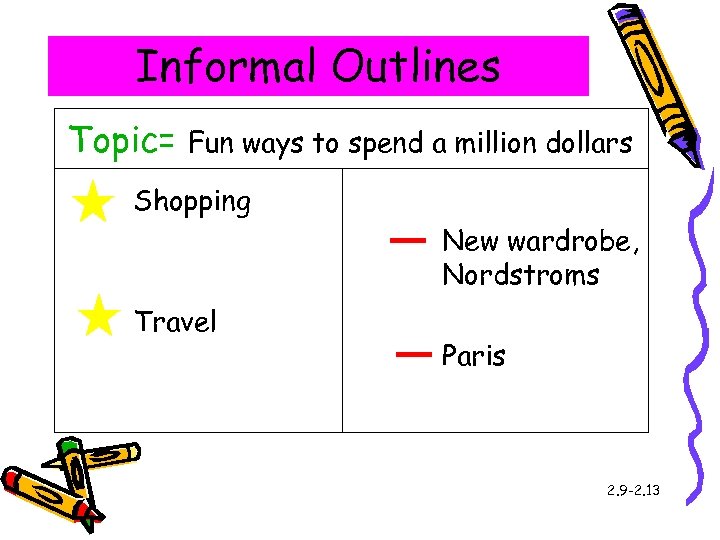 Informal Outlines Topic= Fun ways to spend a million dollars Shopping New wardrobe, Nordstroms Travel Paris 2. 9 -2. 13
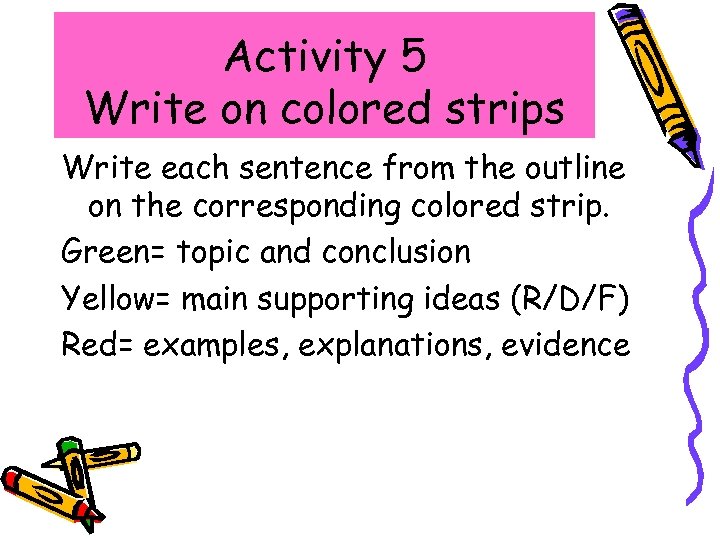 Activity 5 Write on colored strips Write each sentence from the outline on the corresponding colored strip. Green= topic and conclusion Yellow= main supporting ideas (R/D/F) Red= examples, explanations, evidence
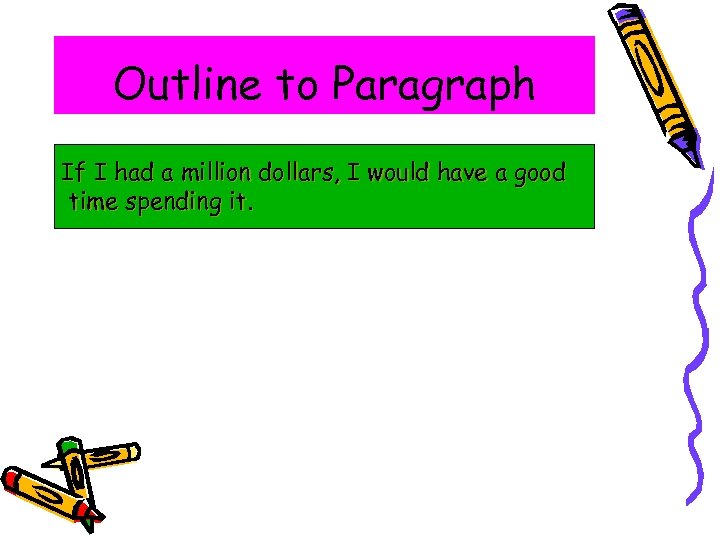 Outline to Paragraph If I had a million dollars, I would have a good time spending it.
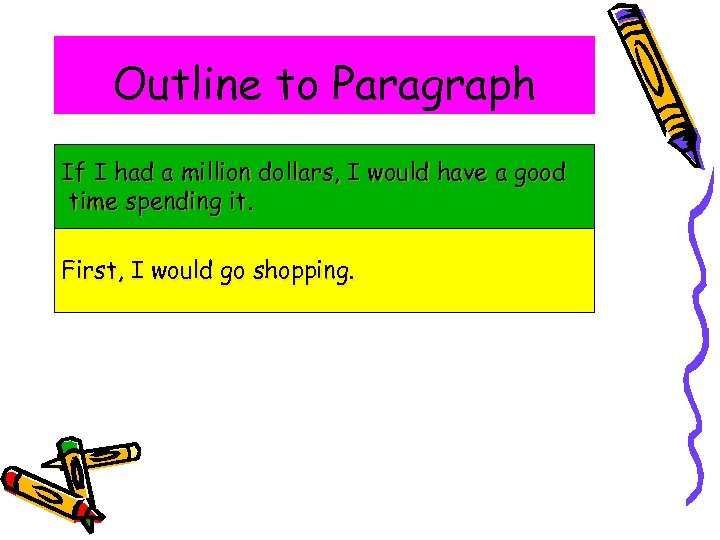 Outline to Paragraph If I had a million dollars, I would have a good time spending it. First, I would go shopping.
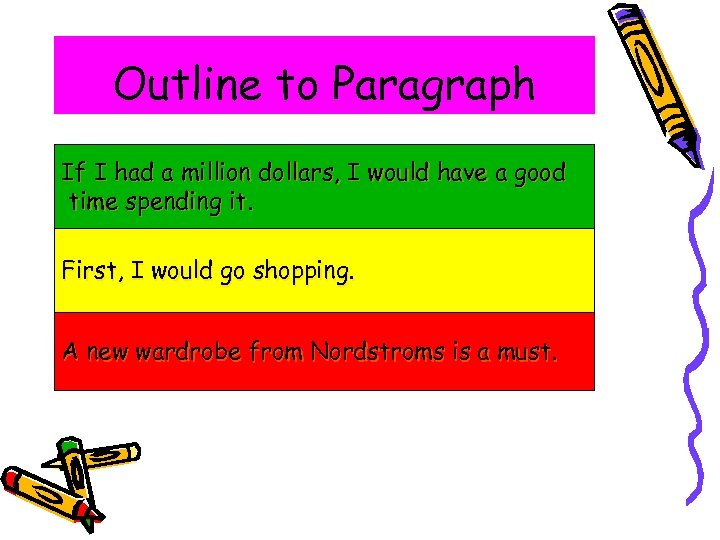 Outline to Paragraph If I had a million dollars, I would have a good time spending it. First, I would go shopping. A new wardrobe from Nordstroms is a must.
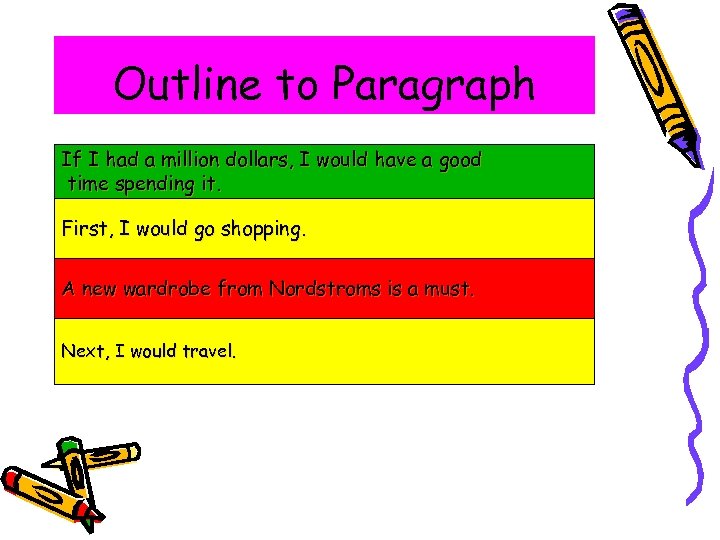 Outline to Paragraph If I had a million dollars, I would have a good time spending it. First, I would go shopping. A new wardrobe from Nordstroms is a must. Next, I would travel.
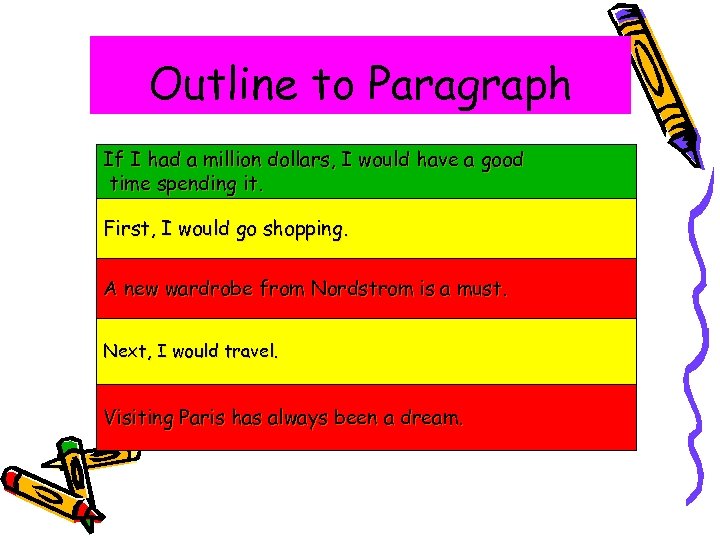 Outline to Paragraph If I had a million dollars, I would have a good time spending it. First, I would go shopping. A new wardrobe from Nordstrom is a must. Next, I would travel. Visiting Paris has always been a dream.
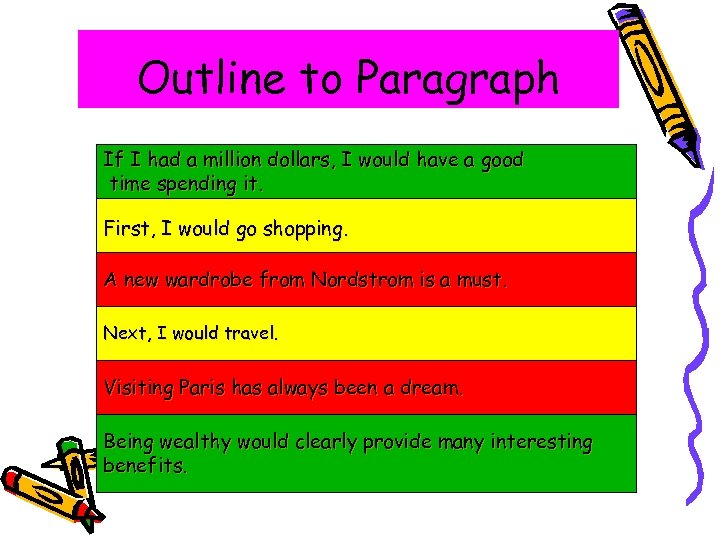 Outline to Paragraph If I had a million dollars, I would have a good time spending it. First, I would go shopping. A new wardrobe from Nordstrom is a must. Next, I would travel. Visiting Paris has always been a dream. Being wealthy would clearly provide many interesting benefits.
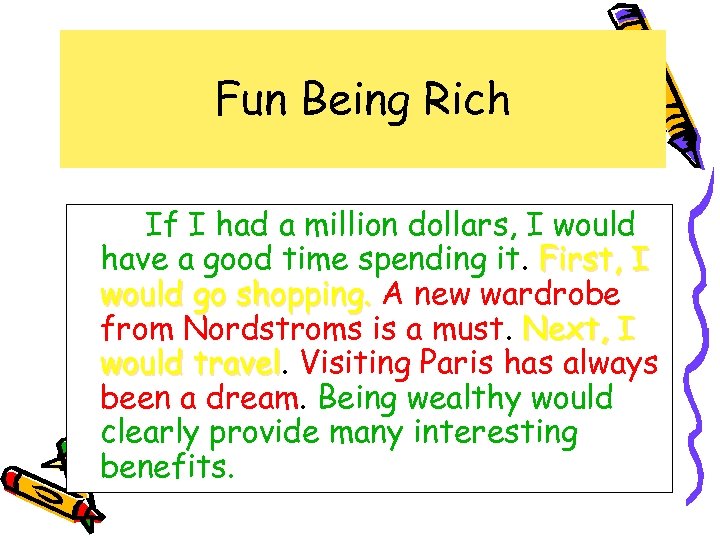 Fun Being Rich If I had a million dollars, I would have a good time spending it. First, I would go shopping. A new wardrobe from Nordstroms is a must. Next, I would travel. Visiting Paris has always travel been a dream. Being wealthy would clearly provide many interesting benefits.
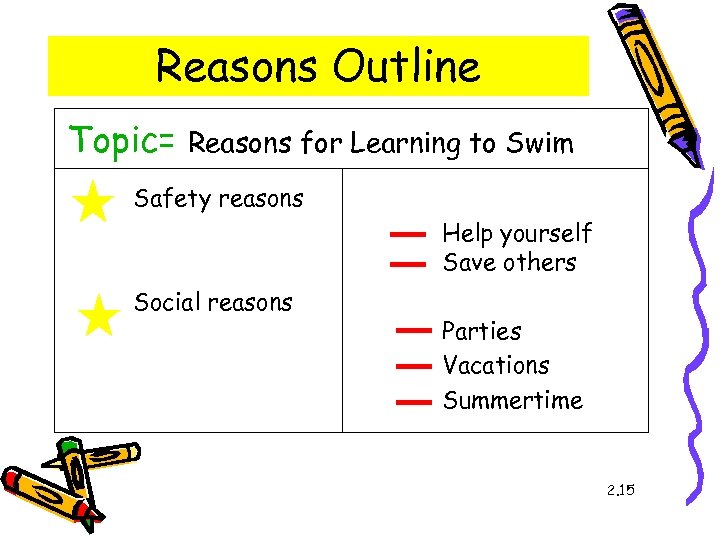 Reasons Outline Topic= Reasons for Learning to Swim Safety reasons Help yourself Save others Social reasons Parties Vacations Summertime 2. 15
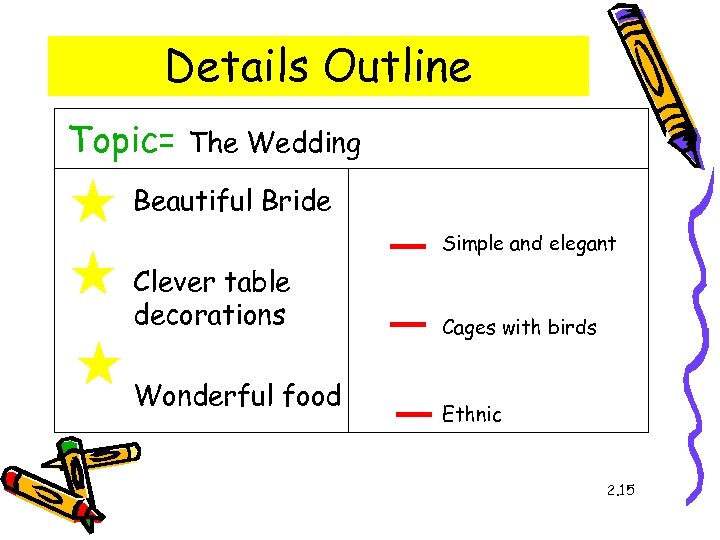 Details Outline Topic= The Wedding Beautiful Bride Simple and elegant Clever table decorations Wonderful food Cages with birds Ethnic 2. 15
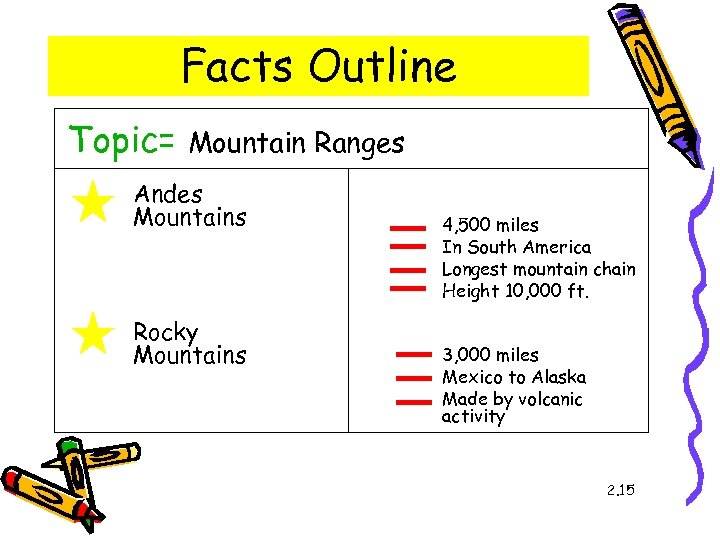 Facts Outline Topic= Mountain Ranges Andes Mountains Rocky Mountains 4, 500 miles In South America Longest mountain chain Height 10, 000 ft. 3, 000 miles Mexico to Alaska Made by volcanic activity 2. 15
 Fold paper: hotdog then hamburger fold = 4 parts • Create an informal outline of your own for the following ideas. • Remember, write quickly in “cave man talk. ” • Topic= in green • Main ideas Reasons/Details/Facts= yellow • Examples/explanations/evidence= red
 Differentiation Idea Example Same assignment: • Give students with disabilities a frame outline asking for 1 yellow and 2 red • Give students who need a challenge 3 yellow and 7 red • To begin, tell students how many yellow and red you want. Or you could have a minimum number. Later, they may decide.
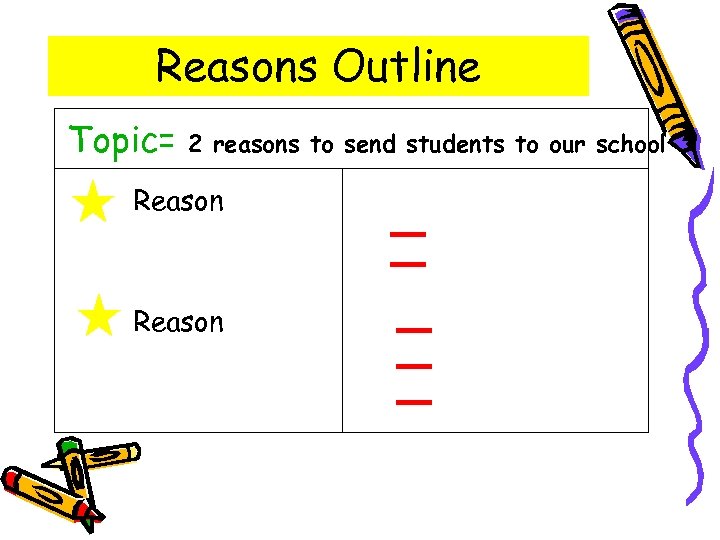 Reasons Outline Topic= 2 reasons to send students to our school Reason
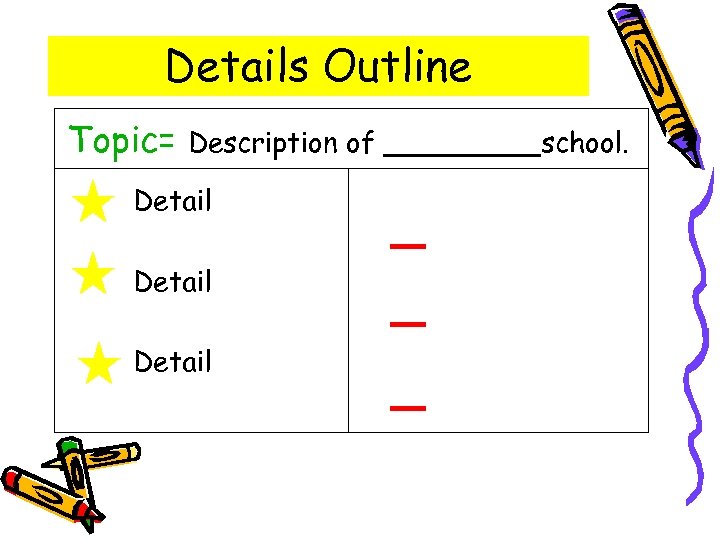 Details Outline Topic= Description of _____school. Detail
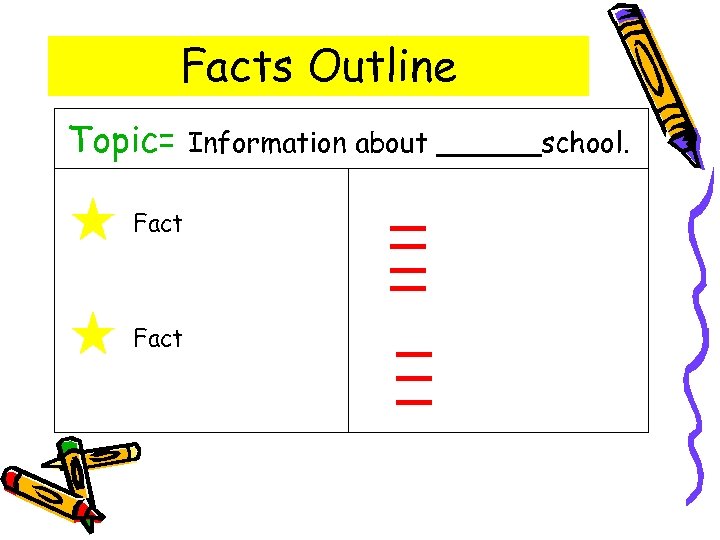 Facts Outline Topic= Fact Information about ______school.
 Great Expository Paragraphs Topic sentences and thesis statements are the heart
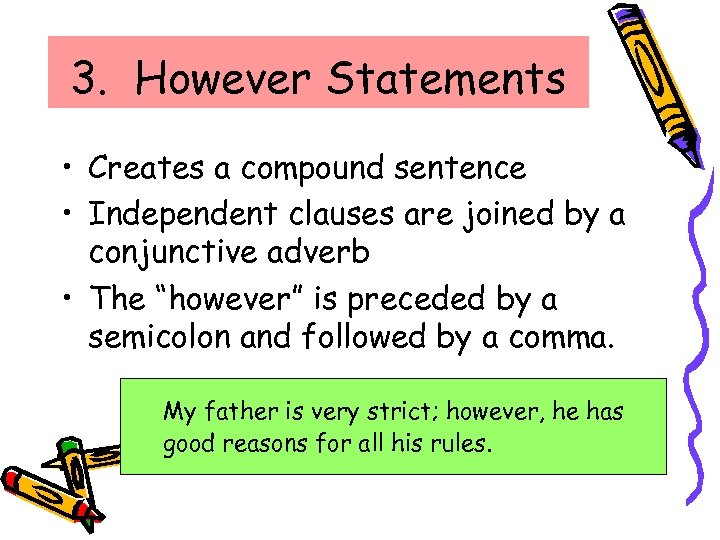 3. However Statements • Creates a compound sentence • Independent clauses are joined by a conjunctive adverb • The “however” is preceded by a semicolon and followed by a comma. My father is very strict; however, he has good reasons for all his rules.
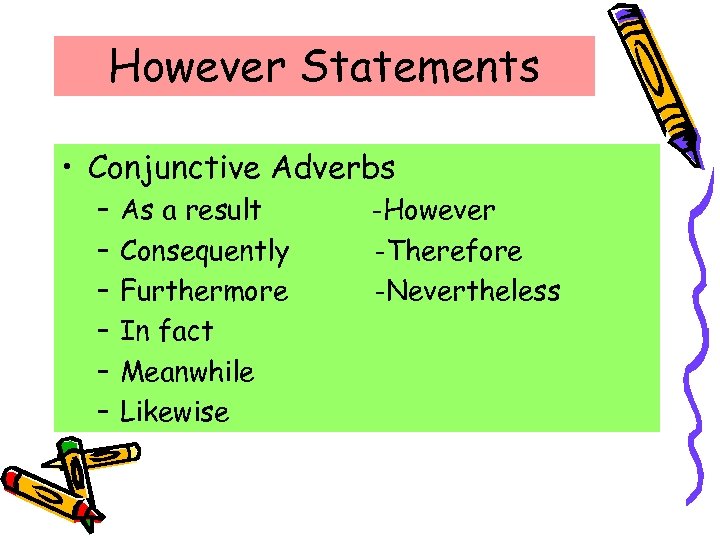 However Statements • Conjunctive Adverbs – – – As a result Consequently Furthermore In fact Meanwhile Likewise -However -Therefore -Nevertheless
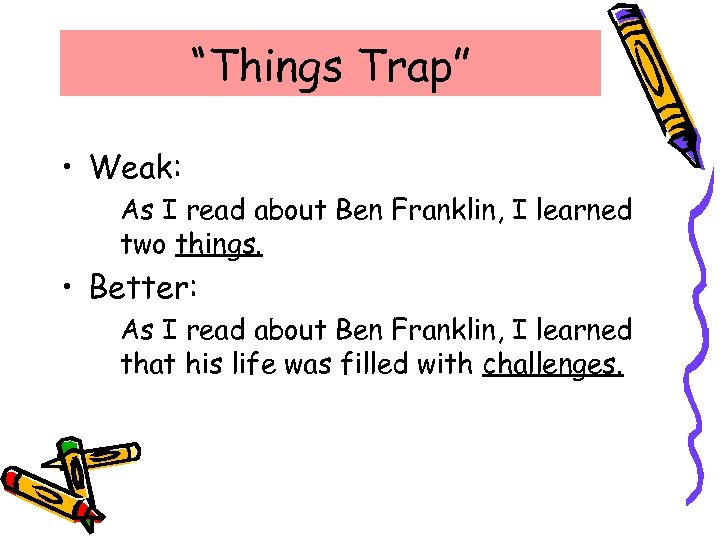 “Things Trap” • Weak: As I read about Ben Franklin, I learned two things. • Better: As I read about Ben Franklin, I learned that his life was filled with challenges.
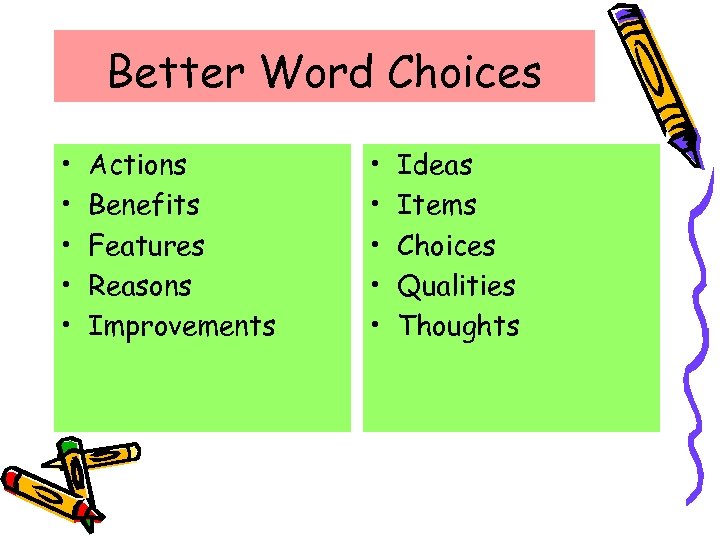 Better Word Choices • • • Actions Benefits Features Reasons Improvements • • • Ideas Items Choices Qualities Thoughts
 Expository Paragraphs Need Transitions are the glue for the key ideas Trans itions
 Expository Paragraphs Need Transitions • Transitions: (Direct attention like a ringmaster of the circus) • Without them, it is like beginning to drive a stick shift…jerky! – Introduce new key ideas – Connect reasons, details, or facts – Help the writer and the reader
 Placement of Transitions • The transition goes with each yellow idea. • On your outline, include the transition in the yellow section.
 Topic= Advice to a new teacher 4 -5, 6, 7, 8, 9
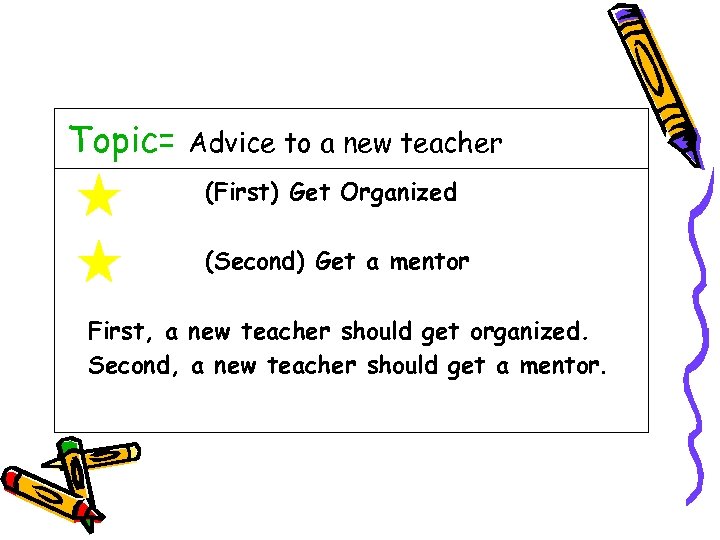 Topic= Advice to a new teacher (First) Get Organized (Second) Get a mentor First, a new teacher should get organized. Second, a new teacher should get a mentor.
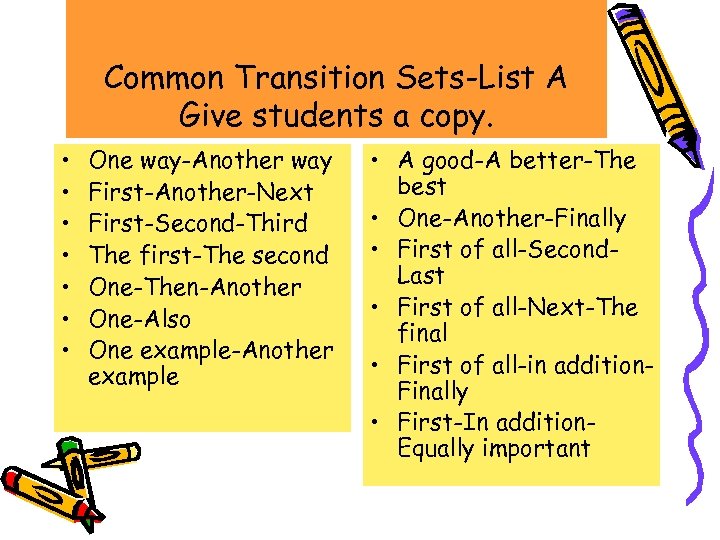 Common Transition Sets-List A Give students a copy. • • One way-Another way First-Another-Next First-Second-Third The first-The second One-Then-Another One-Also One example-Another example • A good-A better-The best • One-Another-Finally • First of all-Second. Last • First of all-Next-The final • First of all-in addition. Finally • First-In addition. Equally important
 More Transition Sets • • • At first-After One-Equally important The first-The second To begin-Then consequently It started when-As a result-Then-Thereafter At the beginning-Then-Following this-Finally One important-Another important-The most important Initially-Then-After that As soon as-Next-Later-In the end To begin-At the same time-Finally To start-Furthermore-Additionally-Last
 Vary Your Transitions First, a new teacher should get organized. Change to: One important idea is for a new teacher to get organized.
 Bury Your Transitions • Instead of: Second, a new teacher should get a mentor. • Try: Getting a mentor is a second key to success.
 Vary and Bury Your Transitions • Instead of: Second, a new teacher should get a mentor. • Instead of: Getting a mentor is a second key to success. – Try: Finding a mentor is another key to success.
 Transitional Expressions • Transitions for a specific text structure – To explain a cause or an effect • • Because of As a result Since Consequently
 Great Expository Paragraphs • Examples, evidence, and explanations are the meat. – Information to back up your reasons, details, or facts.
 The “E”s • The E’s support your topic sentence. • E’s make your writing interesting and believable: -Examples -Explanations -Elaborations -Evidence -Everyday life -Events -Experiences -Expert opinions -Effective Illustrations
 Guided Highlighting A good way to have students check their writing for sufficient detail is to have them highlight their paragraphs. If there is not enough red, there is not enough E’s, and the development is lacking.
 Guided Highlighting Creatures of all sizes find ways to keep themselves clean. Large animals like elephants head to rivers to cool off and clean up. After bathing in the cool water the elephant powders itself. Elephants use dust as powder to keep the bugs from biting. Smaller animals like rabbits also take time to clean. They often lick their ears and scrub them to keep them clean. Finally, little creatures like birds enjoy bathing in puddles. When they finish, they comb their feathers. This is called preening. Bath time, it seems, isn’t just for you and me.
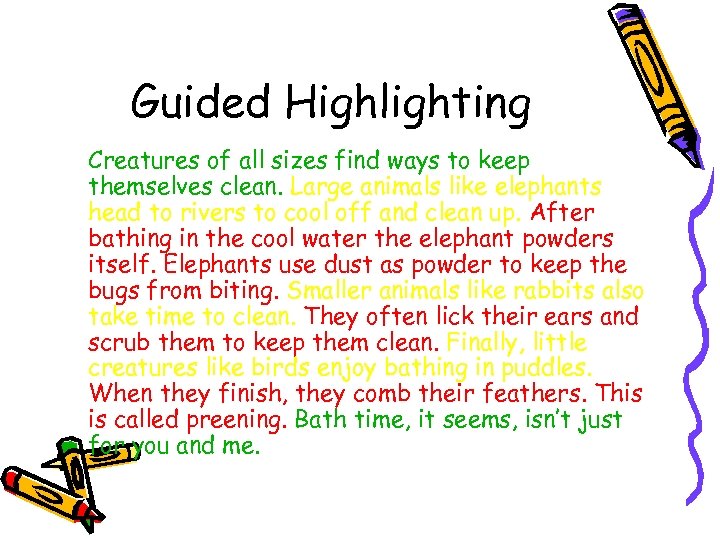 Guided Highlighting Creatures of all sizes find ways to keep themselves clean. Large animals like elephants head to rivers to cool off and clean up. After bathing in the cool water the elephant powders itself. Elephants use dust as powder to keep the bugs from biting. Smaller animals like rabbits also take time to clean. They often lick their ears and scrub them to keep them clean. Finally, little creatures like birds enjoy bathing in puddles. When they finish, they comb their feathers. This is called preening. Bath time, it seems, isn’t just for you and me.
 Writing Great Conclusions tie it all together.
 Tips for Writing Conclusions Restate the position using different words. Use the same idea as the topic sentence, but state it differently.
 Tips for Writing Conclusions Avoid: (Weakens statement) As I have said As I have proved As you can see
 Tips for Writing Conclusions 6. Vary the sentence structure 7. Use a quotation 8. Imitate the professionals (Use literature for examples)
 Group Activity: Summing it up T= Wyoming, a great place to live. Get in groups of 6. (One note card for each. ) #1 - Write topic sentence (Remember to use one of the 3 types) #2 1 st yellow with transition #3 Red for 1 st yellow idea #4 2 nd yellow with transition #5 Red for 2 nd yellow idea #6 Writes concluding sentence
 Share with a partner Within the content and grade level that you teach, in what way could you have students write each of these types of paragraphs that follow?
 Different Kinds of Paragraphs Use the Accordion method for writing: • • Summaries Process paragraph List paragraph Compare & Contrast • Persuasive • • Information Cause & effect Problem/solution Entertaining Current events Math processes Descriptive
 Writing Summaries Reflects the yellows 1. A summary is a shortened, condensed version. 2. The purpose of a summary is to share the main ideas. 3. Summaries keep the same tone as the original piece and do not contain opinion. 4. Summaries do not require a formal conclusion.
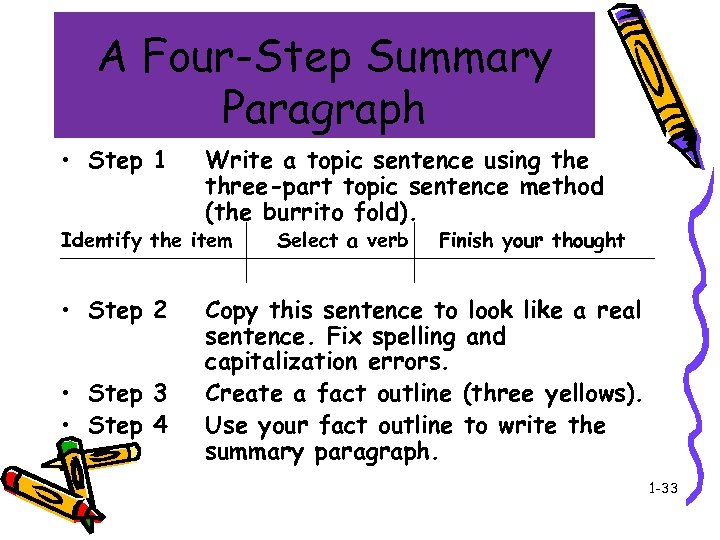 A Four-Step Summary Paragraph • Step 1 Write a topic sentence using the three-part topic sentence method (the burrito fold). Identify the item • Step 2 • Step 3 • Step 4 Select a verb Finish your thought Copy this sentence to look like a real sentence. Fix spelling and capitalization errors. Create a fact outline (three yellows). Use your fact outline to write the summary paragraph. 1 -33
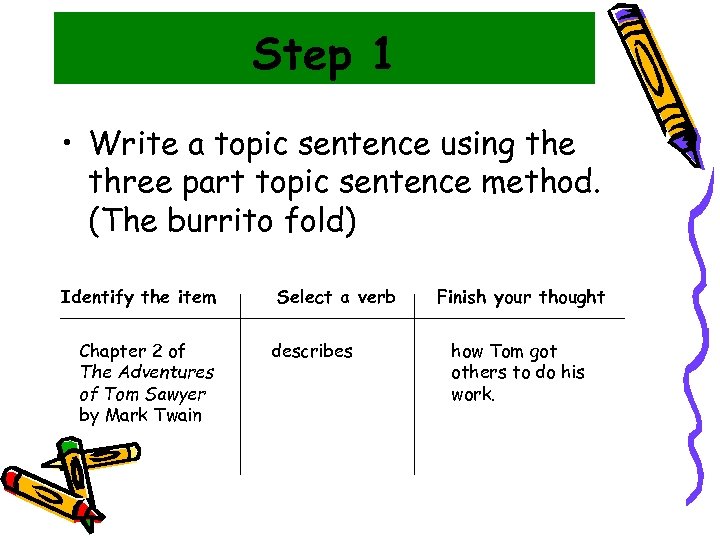 Step 1 • Write a topic sentence using the three part topic sentence method. (The burrito fold) Identify the item Chapter 2 of The Adventures of Tom Sawyer by Mark Twain Select a verb describes Finish your thought how Tom got others to do his work.
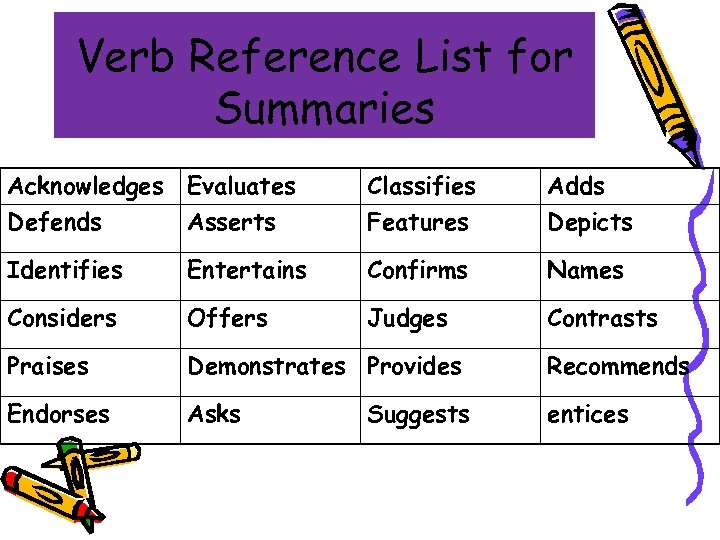 Verb Reference List for Summaries Acknowledges Evaluates Defends Asserts Classifies Features Adds Depicts Identifies Entertains Confirms Names Considers Offers Judges Contrasts Praises Demonstrates Provides Recommends Endorses Asks entices Suggests
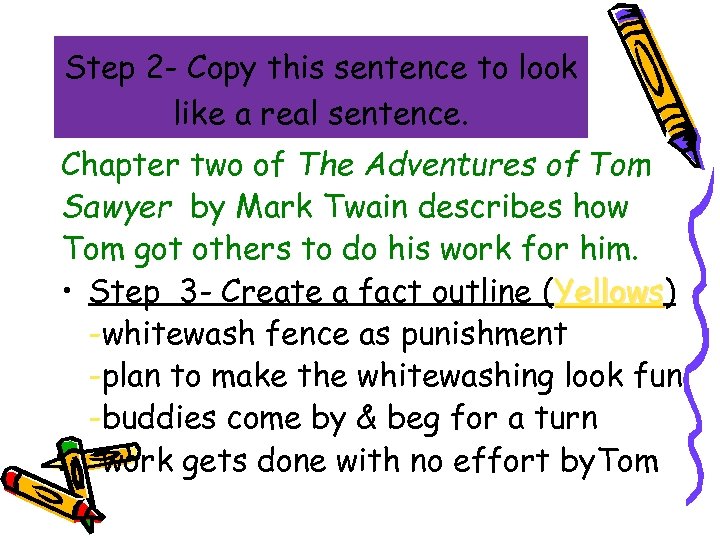 Step 2 - Copy this sentence to look like a real sentence. Chapter two of The Adventures of Tom Sawyer by Mark Twain describes how Tom got others to do his work for him. • Step 3 - Create a fact outline (Yellows) Yellows -whitewash fence as punishment -plan to make the whitewashing look fun -buddies come by & beg for a turn -work gets done with no effort by. Tom
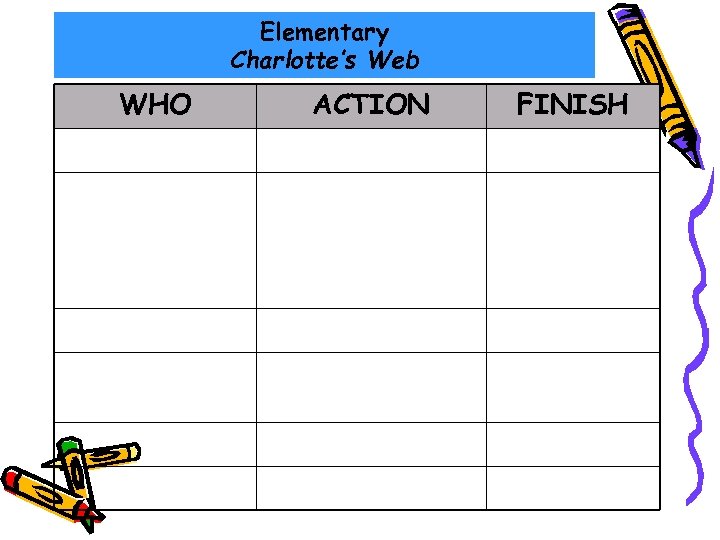 Elementary Charlotte’s Web WHO ACTION FINISH
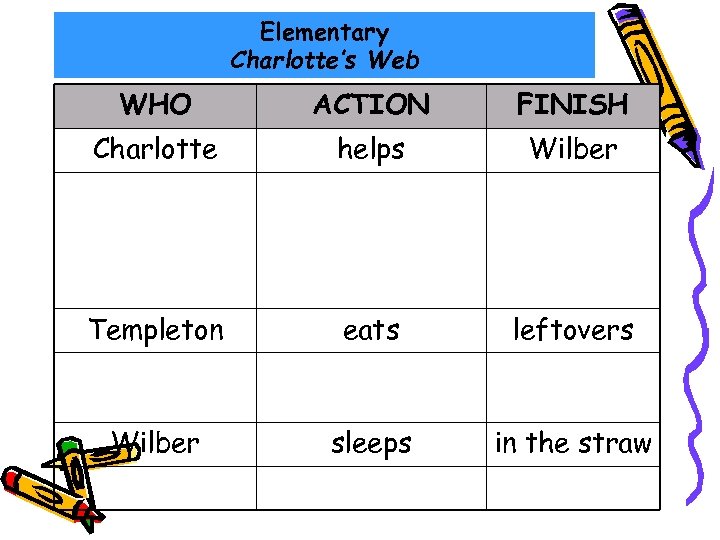 Elementary Charlotte’s Web WHO ACTION FINISH Charlotte helps Wilber Templeton eats leftovers Wilber sleeps in the straw
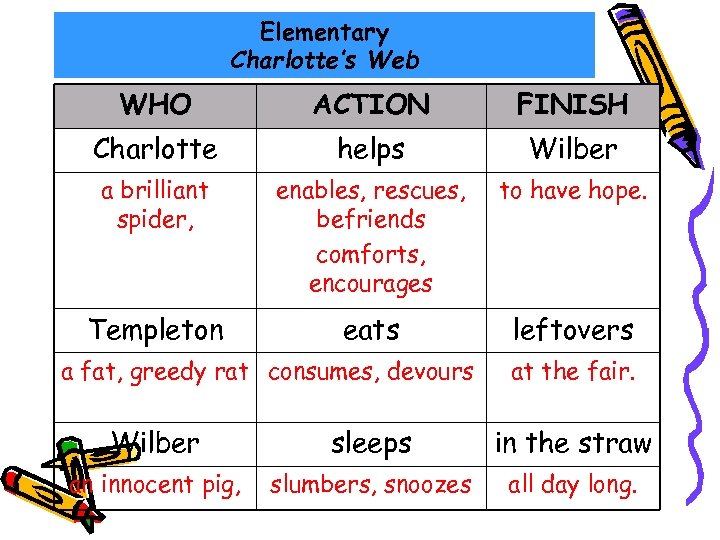 Elementary Charlotte’s Web WHO ACTION FINISH Charlotte helps Wilber a brilliant spider, enables, rescues, befriends comforts, encourages to have hope. Templeton eats leftovers a fat, greedy rat consumes, devours at the fair. Wilber sleeps in the straw an innocent pig, slumbers, snoozes all day long.
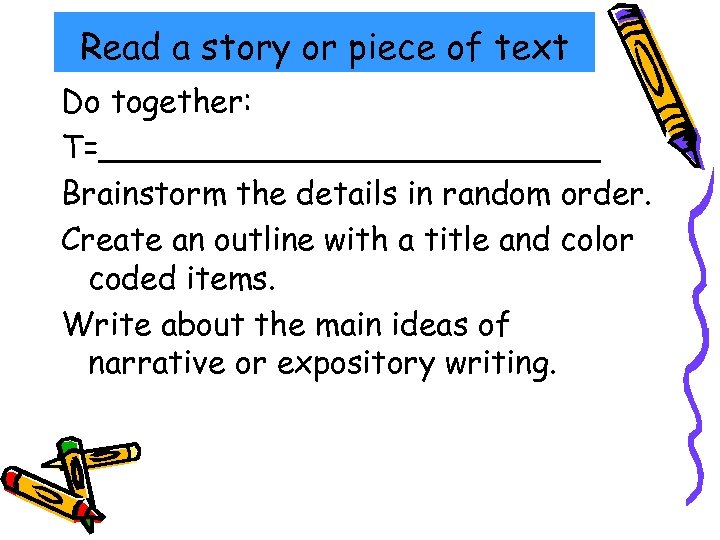 Read a story or piece of text Do together: T=_____________ Brainstorm the details in random order. Create an outline with a title and color coded items. Write about the main ideas of narrative or expository writing.
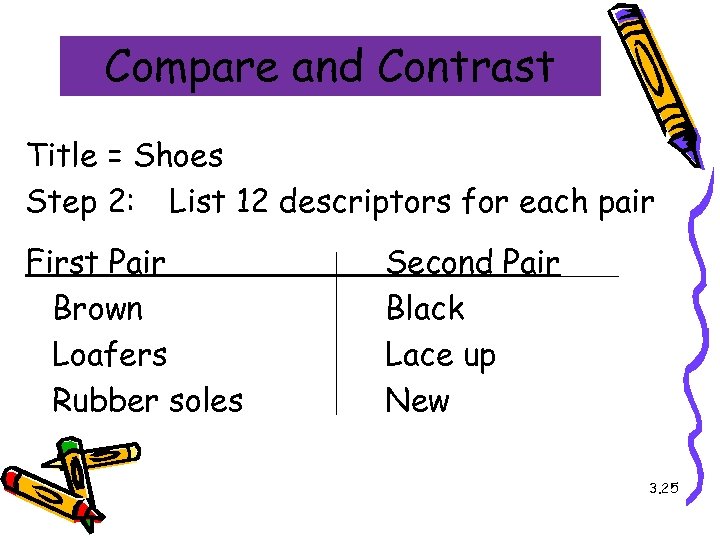 Compare and Contrast Title = Shoes Step 2: List 12 descriptors for each pair First Pair Brown Loafers Rubber soles Second Pair Black Lace up New 3. 25
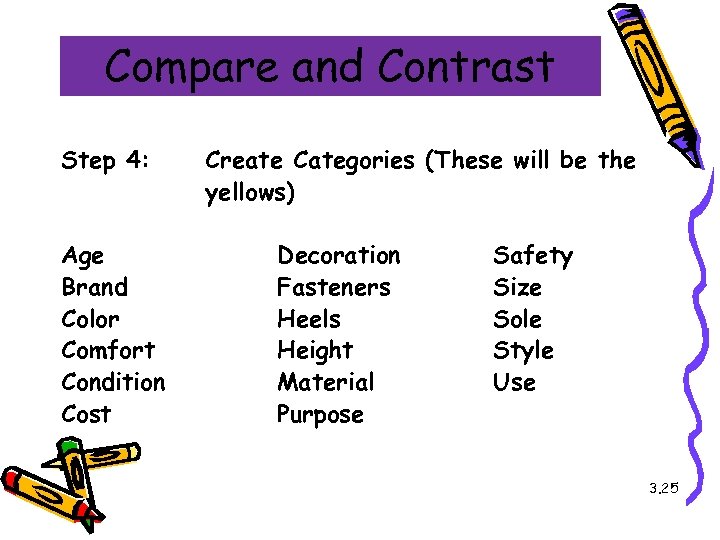 Compare and Contrast Step 4: Age Brand Color Comfort Condition Cost Create Categories (These will be the yellows) Decoration Fasteners Heels Height Material Purpose Safety Size Sole Style Use 3. 25
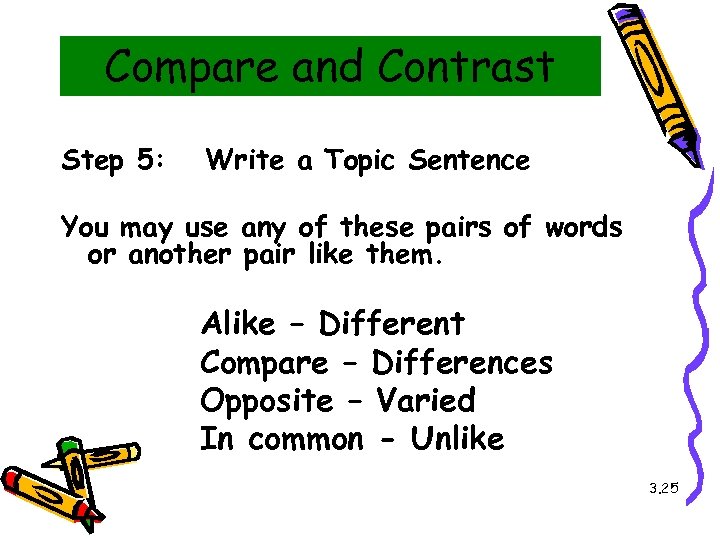 Compare and Contrast Step 5: Write a Topic Sentence You may use any of these pairs of words or another pair like them. Alike – Different Compare – Differences Opposite – Varied In common - Unlike 3. 25
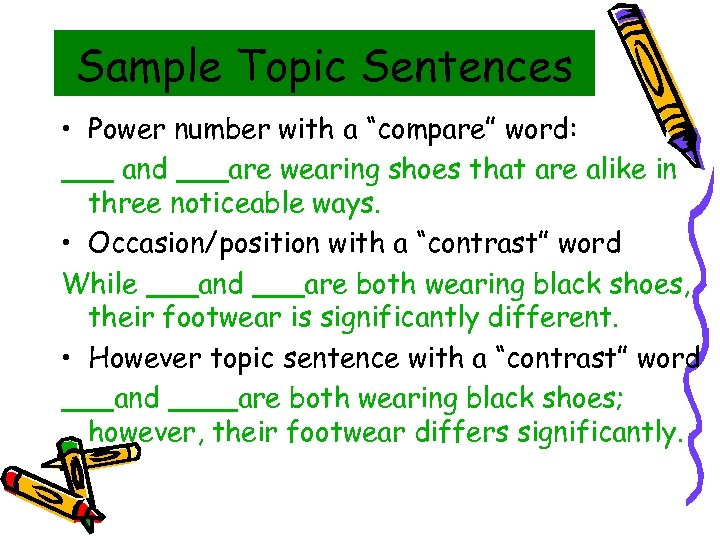 Sample Topic Sentences • Power number with a “compare” word: ___ and ___are wearing shoes that are alike in three noticeable ways. • Occasion/position with a “contrast” word While ___and ___are both wearing black shoes, their footwear is significantly different. • However topic sentence with a “contrast” word ___and ____are both wearing black shoes; however, their footwear differs significantly.
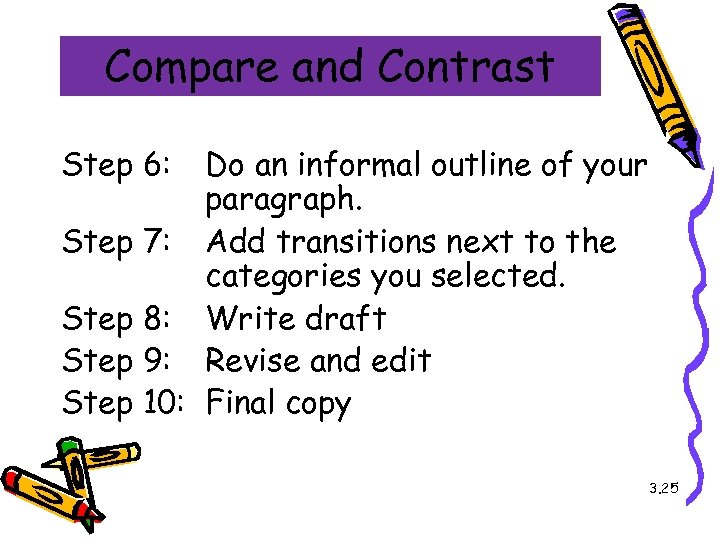 Compare and Contrast Step 6: Do an informal outline of your paragraph. Step 7: Add transitions next to the categories you selected. Step 8: Write draft Step 9: Revise and edit Step 10: Final copy 3. 25
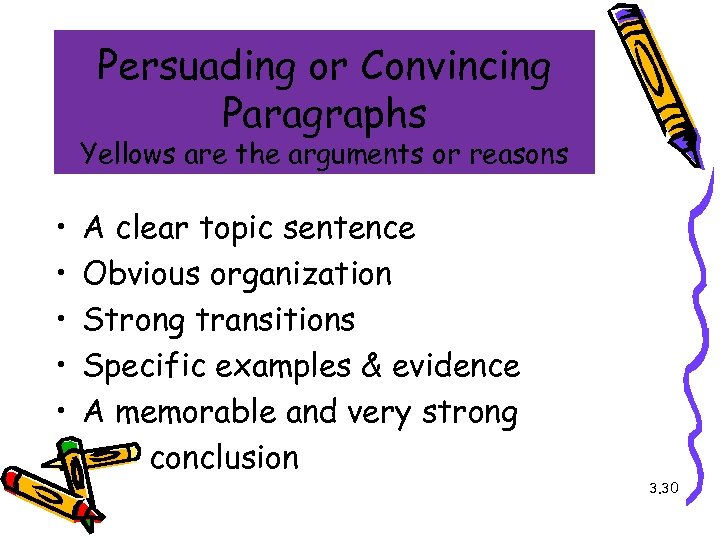 Persuading or Convincing Paragraphs Yellows are the arguments or reasons • • • A clear topic sentence Obvious organization Strong transitions Specific examples & evidence A memorable and very strong conclusion 3. 30
 Persuade or Convince • Who is my audience? • What will my reader need to know? • What emotions do I want my reader to feel? • What do I want my reader to do? 3. 31
 Persuade or Convince • • Start with a strong point. Transition into a weaker point. End with your strongest point. If writer begins with a weak point or ends with a weak point, they will loose their audience. 3. 31
 Other kinds of organizers There a variety of ways to helps students organize their thinking that may be used in many different content areas.
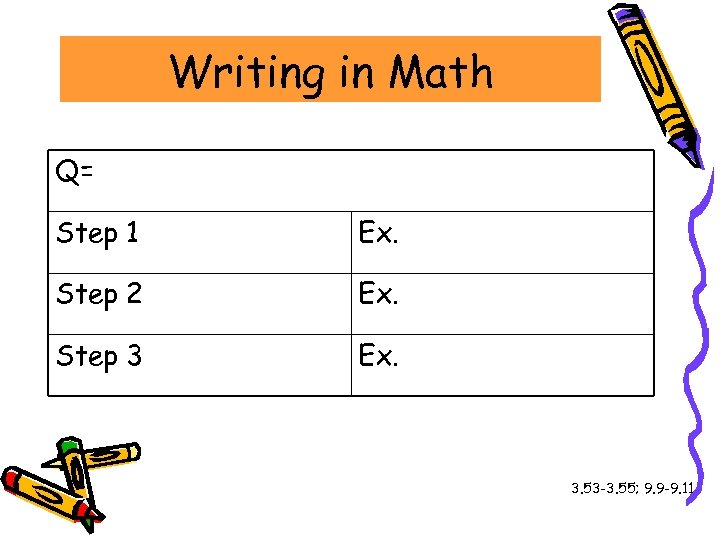 Writing in Math Q= Step 1 Ex. Step 2 Ex. Step 3 Ex. 3. 53 -3. 55; 9. 9 -9. 11
 Content Learning Logs • Adding fractions is easy if you just follow these four instructions. • _______, the main character in ______, is involved in two conflicts. • The Civil War occurred for three reasons. • The water cycle has three parts. 3. 56 -3. 57
 Framed Paragraphs Framed paragraphs are great. You can use them for science, history, art, and social studies. You can even leave them with a substitute teacher. Try them! You will like them! 3. 59
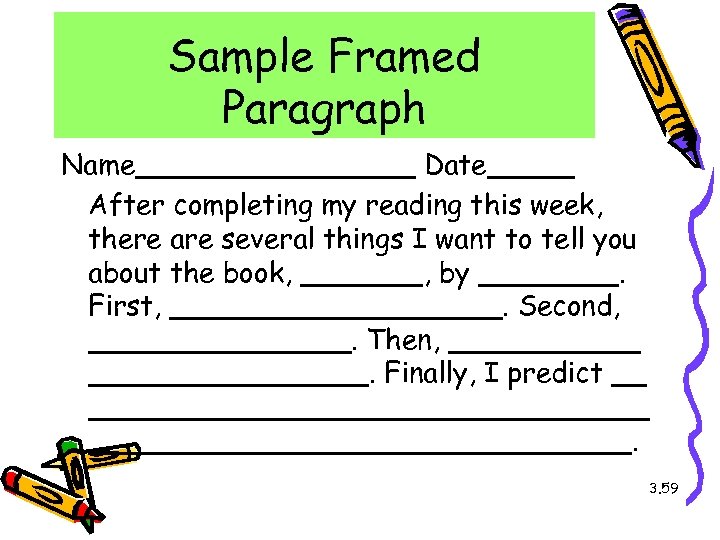 Sample Framed Paragraph Name________ Date_____ After completing my reading this week, there are several things I want to tell you about the book, _______, by ____. First, __________. Second, ________. Then, ________________. Finally, I predict __ _______________________________. 3. 59
 A Thesis Statement (Step 2) • • Is the heart of your paper Gives the main idea of an essay Contains key words Presents a general idea that will be supported • Might be called your position statement 4. 17 -4. 31
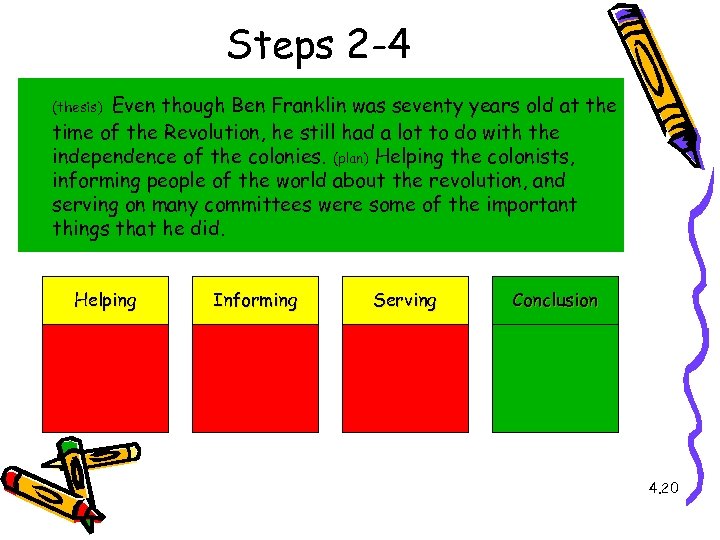 Steps 2 -4 Even though Ben Franklin was seventy years old at the time of the Revolution, he still had a lot to do with the independence of the colonies. (plan) Helping the colonists, informing people of the world about the revolution, and serving on many committees were some of the important things that he did. (thesis) Helping Informing Serving Conclusion 4. 20
 Expository Vs. Narrative • Purposes and processes are different in these two kinds of writing.
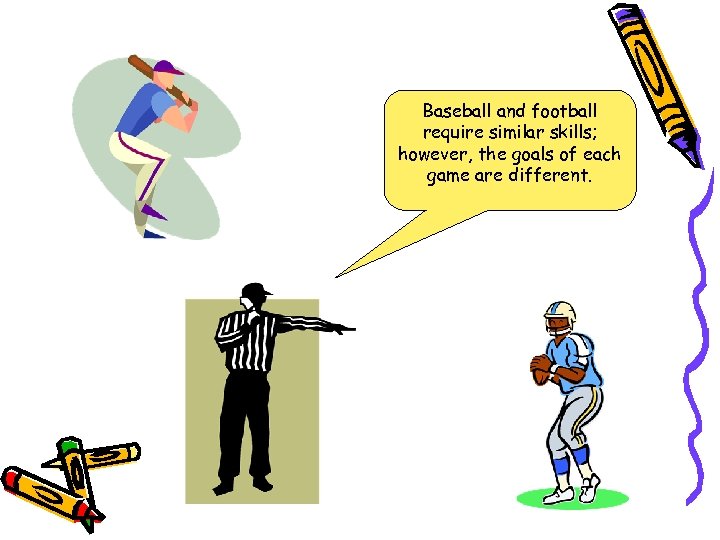 Baseball and football require similar skills; however, the goals of each game are different.
 Quick Sketch Stories • • Step 1 Step 2 Step 3 Step 4 Step 5 Step 6 Step 7 Title Quick Sketch Quick Notes Get the Story Rolling Story transitions Smooth stop Revise, Edit, Proofread
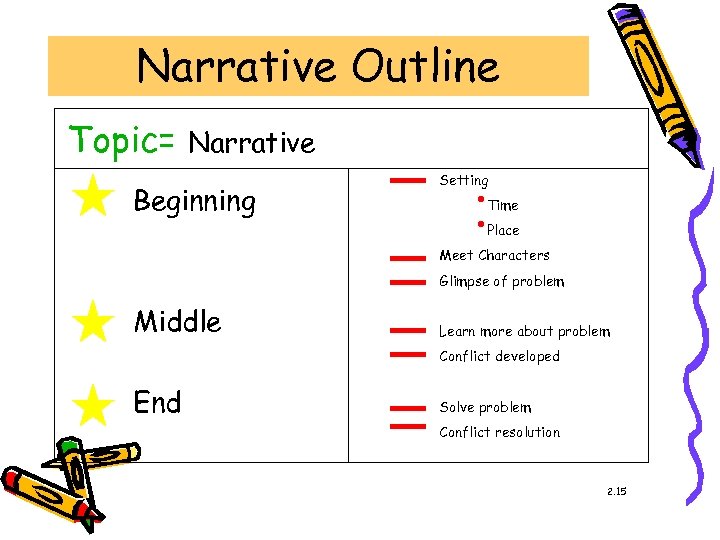 Narrative Outline Topic= Narrative Beginning Setting • Time • Place Meet Characters Glimpse of problem Middle Learn more about problem Conflict developed End Solve problem Conflict resolution 2. 15
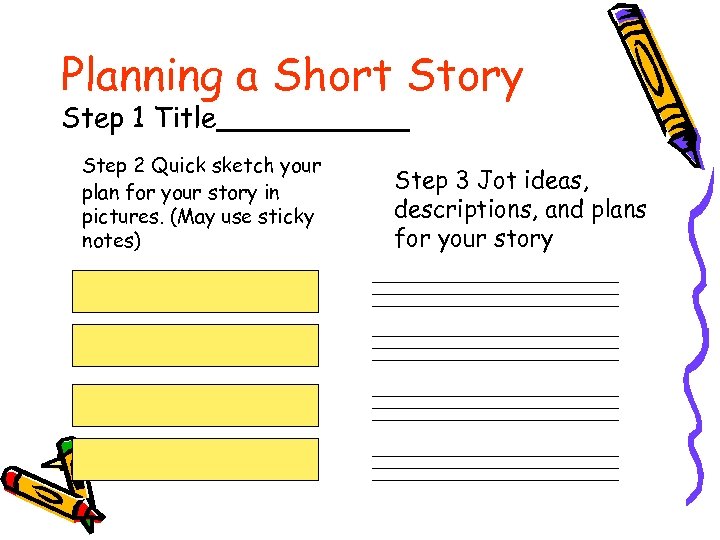 Planning a Short Story Step 1 Title______ Step 2 Quick sketch your plan for your story in pictures. (May use sticky notes) Step 3 Jot ideas, descriptions, and plans for your story
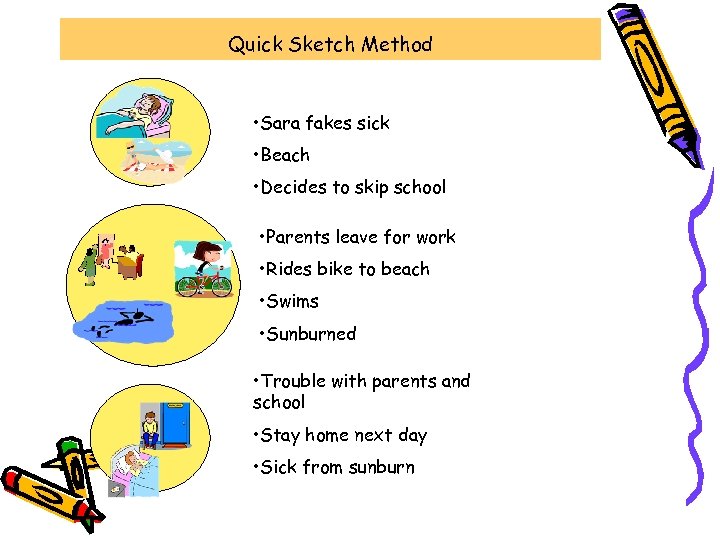 Quick Sketch Method • Sara fakes sick • Beach • Decides to skip school • Parents leave for work • Rides bike to beach • Swims • Sunburned • Trouble with parents and school • Stay home next day • Sick from sunburn
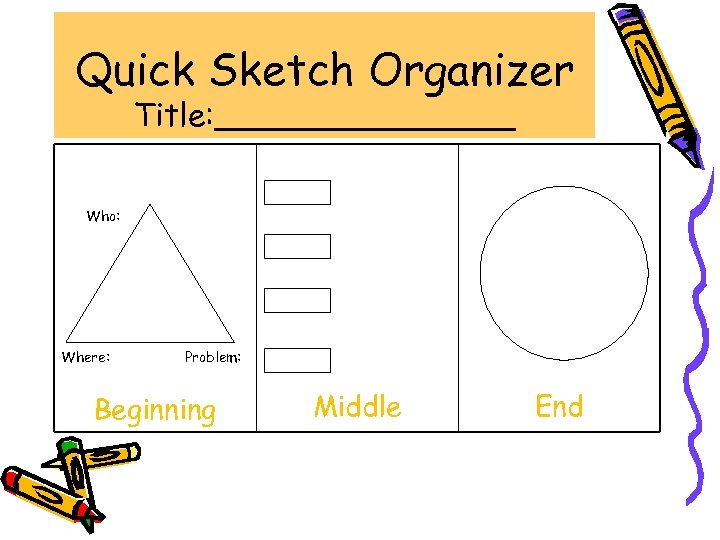 Quick Sketch Organizer Title: ________ Who: Where: Problem: Beginning Middle End
 OK, so I have my story sketched out. How do I begin writing? • Try one of these ideas to hook your reader into reading on.
 Get the Story Rolling Provide a Where • Step 4 – – – Near the park… Below the surface of the water… In Chicago… Behind the old shed near mother’s rake… Beyond the city limits… Throughout the crowded room…
 Get the Story Rolling Provide a When • Step 4 – Just as the bell rang… – After we left the movie… – Before I turned six… – Before my eighth birthday… - When the alarm went off… – When the firefighters arrived…
 Get the Story Rolling Other Options • Step 4 – Provide an Action Verb —run for your life!) (Run. That’s all I could think – Introduce a Character (Uncle Charlie tops the list of weird folks I know. As a matter of fact, he is WAY at the top!) – Interesting Comment staring me in the face. ) (I glanced up and saw Death – Dialogue ( with younger students limit this) (“Mom, I think I’m going to be sick, ” Timmy whined from the back seat. ) – Sound effect (Br-r-r-ring!)
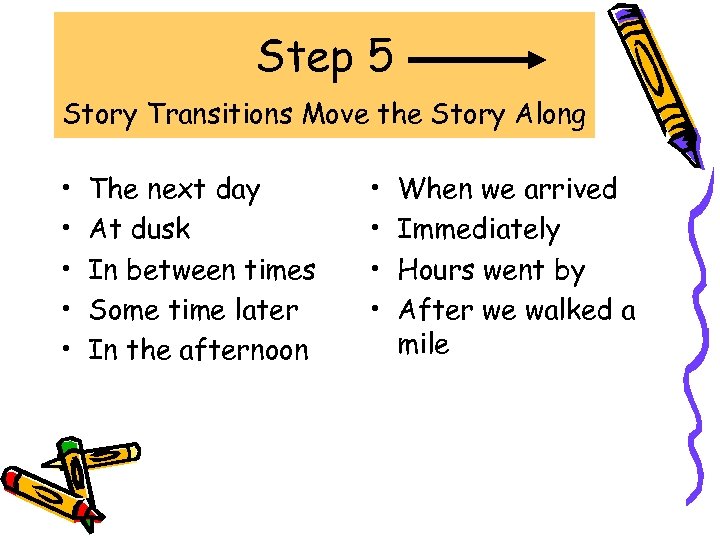 Step 5 Story Transitions Move the Story Along • • • The next day At dusk In between times Some time later In the afternoon • • When we arrived Immediately Hours went by After we walked a mile
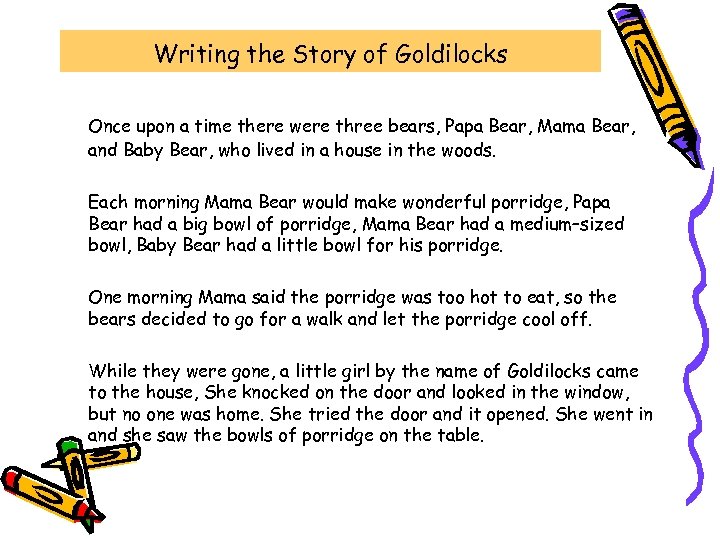 Writing the Story of Goldilocks Once upon a time there were three bears, Papa Bear, Mama Bear, and Baby Bear, who lived in a house in the woods. Each morning Mama Bear would make wonderful porridge, Papa Bear had a big bowl of porridge, Mama Bear had a medium–sized bowl, Baby Bear had a little bowl for his porridge. One morning Mama said the porridge was too hot to eat, so the bears decided to go for a walk and let the porridge cool off. While they were gone, a little girl by the name of Goldilocks came to the house, She knocked on the door and looked in the window, but no one was home. She tried the door and it opened. She went in and she saw the bowls of porridge on the table.
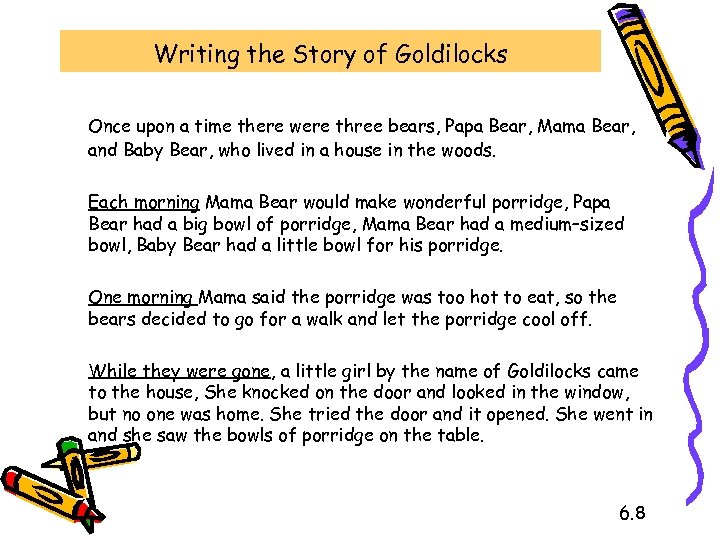 Writing the Story of Goldilocks Once upon a time there were three bears, Papa Bear, Mama Bear, and Baby Bear, who lived in a house in the woods. Each morning Mama Bear would make wonderful porridge, Papa Bear had a big bowl of porridge, Mama Bear had a medium–sized bowl, Baby Bear had a little bowl for his porridge. One morning Mama said the porridge was too hot to eat, so the bears decided to go for a walk and let the porridge cool off. While they were gone, a little girl by the name of Goldilocks came to the house, She knocked on the door and looked in the window, but no one was home. She tried the door and it opened. She went in and she saw the bowls of porridge on the table. 6. 8
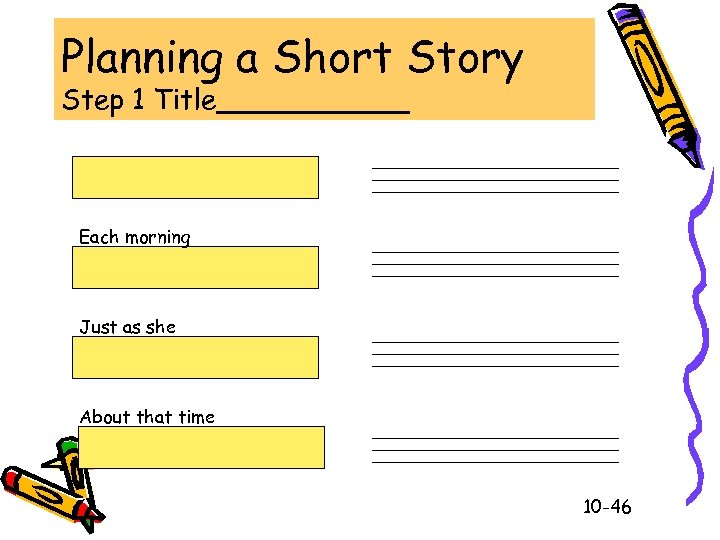 Planning a Short Story Step 1 Title______ Each morning Just as she About that time 10 -46
 Step 6: Come to a Smooth Stop Don’t write “THE END. ” Instead, finish with a strong sentence that will help your reader • Feel a feeling ending – Tori lived in Mobridge for the next fifteen years, and she never forgot the kindness that the children shared that first day. • Remember a character ending – No one spoke up, but everyone knew that it was Edgar, the class clown, who gave Mrs. Anderson the flowers and the thank-you card. • Get your point ending – The children finally understood what the police officer said about hitchhiking. • Think about the story ending – Sometimes it pays to help someone, even if they don’t appreciate it! 6. 9; 10 -47
 Editing with CUPS • • Capitalization Usage Punctuation Spelling
 Head, Heart, Feet • Head- Write down one thought you have that relates to what you learned today. • Heart- How do you feel about that new learning? • Feet- What will you do differently because of what you learned?