


 Скачать презентацию Stennis Space Center Assessing Potential of VIIRS Data
aff2d8e4f37a961a9f5e4b90ef6b48e9.ppt
- Количество слайдов: 22
 Stennis Space Center Assessing Potential of VIIRS Data for Contribution to a Forest Threat Early Warning System Presented by Joseph P. Spruce NASA Stennis Space Center Presented at MRC RPC Review July 11, 2007
 Technical Contributors Stennis Space Center • SSAI – Bob Ryan (Co-PI), James Smoot, Philip Kuper, Roxzana Moore, Kent Ross • CSC – Don Prados, Jeff Russell • Lockheed Martin – Jerry Gasser • University of Maine – Steve Sader National Aeronautics and Space Administration Healthy Forest RPC Project Update 2
 Stennis Space Center • • • Outline Background on Healthy Forest RPC Experiment Project Rational and Study Area Selection Experiment Methodology Results (Representative Sample) Concluding Remarks National Aeronautics and Space Administration Healthy Forest RPC Project Update 3
 Forest Threat Early Warning System Stennis Space Center • The Healthy Forest Restoration Act of 2003 mandates development of national Early Warning System (EWS) forest threat monitoring and mitigation • NASA Stennis is working with the US Forest Service to develop needed components of this EWS • One component regards use of MODIS data for monitoring forest disturbance at broad regional scales • This RPC experiment was initiated to assess potential of the MODIS follow-on, VIIRS, for monitoring forest disturbance at broad scales and thereby contributing to the EWS – MODIS 250 -meter NDVI products differ from 400 -meter VIIRS products; such differences can be application dependent National Aeronautics and Space Administration Healthy Forest RPC Project Update 4
 Stennis Space Center Selection of Case Study • The monitoring of gypsy moth defoliation was selected for the RPC study using an area prone to such defoliation – One of the largest threats to eastern U. S. hardwood forests – One of eight insect threats mentioned in Healthy Forest Restoration Act of 2003 • The study area includes portions of West Virginia, Pennsylvania, and Maryland • Gypsy moth defoliation occurred in this area in multiple years during MODIS era (2000–Present) • Cloud statistics challenging – area frequently cloudy • Area contains significant topographic relief, complicating spectral response of remotely sensed data National Aeronautics and Space Administration Healthy Forest RPC Project Update 5
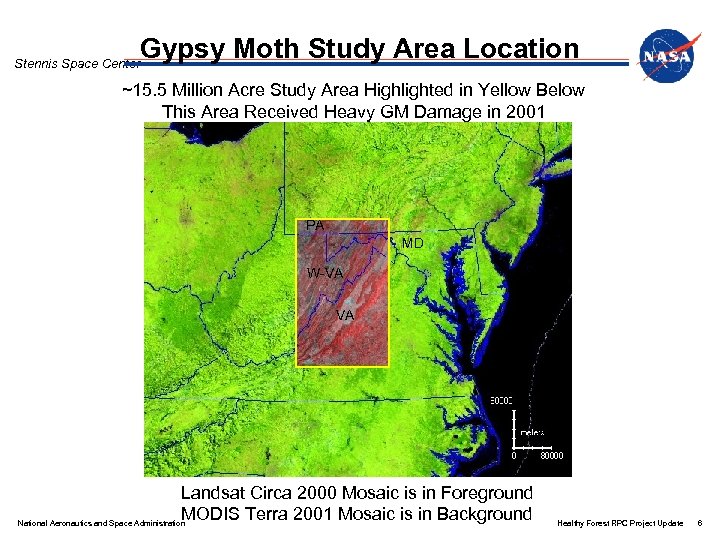 Gypsy Moth Study Area Location Stennis Space Center ~15. 5 Million Acre Study Area Highlighted in Yellow Below This Area Received Heavy GM Damage in 2001 PA MD W-VA VA Landsat Circa 2000 Mosaic is in Foreground MODIS Terra 2001 Mosaic is in Background National Aeronautics and Space Administration Healthy Forest RPC Project Update 6
 Stennis Space Center Objectives of RPC Experiment 1. Compute and validate simulated VIIRS products from MODIS data – – Use Hyperion data to assess ability of MODIS data to simulate VIIRS radiance and planetary reflectances Use of Application Research Toolbox and Time Series Product Tool to simulate VIIRS Time Series 2. Assess results of simulated VIIRS gypsy moth defoliation detection products – Examine utility of standard anomaly detection approaches utilizing pest vegetation phenology • • – Multitemporal image classification Percent change in maximum NDVI during the peak defoliation period of a given year compared to maximum peak defoliation NDVI across the entire 2000 -2006 time frame (considers defoliated and non-defoliated years) Compare results to reference data • • High-resolution NASA satellite data (Landsat, ASTER, ALI, Hyperion) USFS data (defoliation sketch maps and trap count GIS data) National Aeronautics and Space Administration Healthy Forest RPC Project Update 7
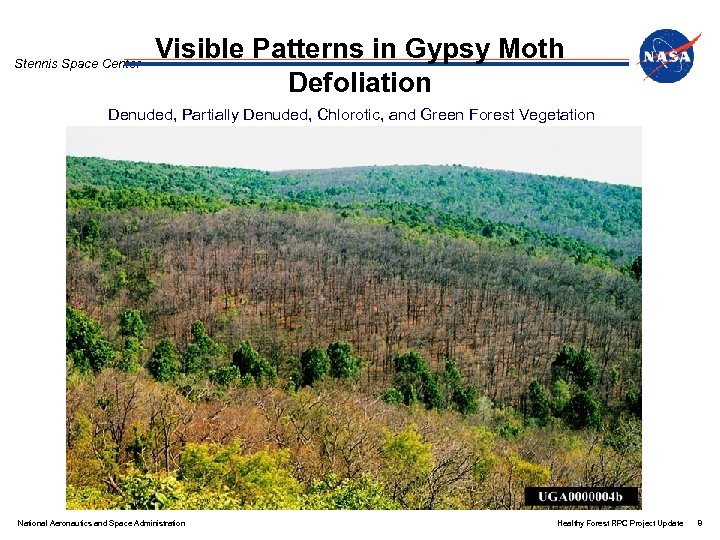 Stennis Space Center Visible Patterns in Gypsy Moth Defoliation Denuded, Partially Denuded, Chlorotic, and Green Forest Vegetation National Aeronautics and Space Administration Healthy Forest RPC Project Update 8
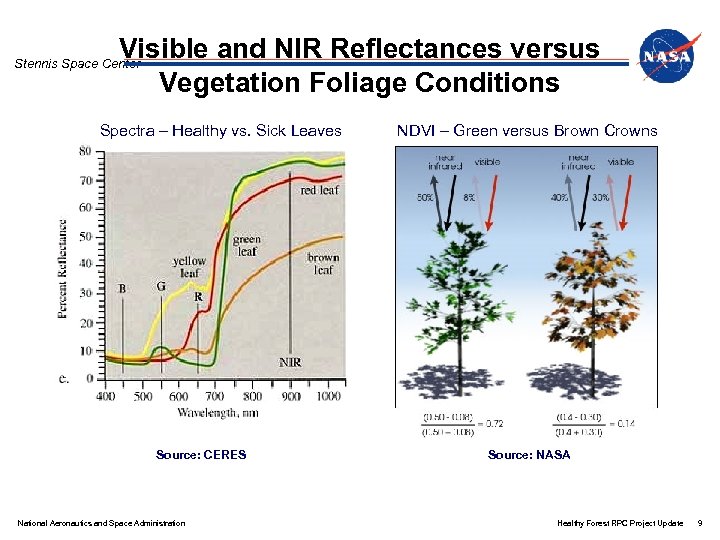 Visible and NIR Reflectances versus Vegetation Foliage Conditions Stennis Space Center Spectra – Healthy vs. Sick Leaves Source: CERES National Aeronautics and Space Administration NDVI – Green versus Brown Crowns Source: NASA Healthy Forest RPC Project Update 9
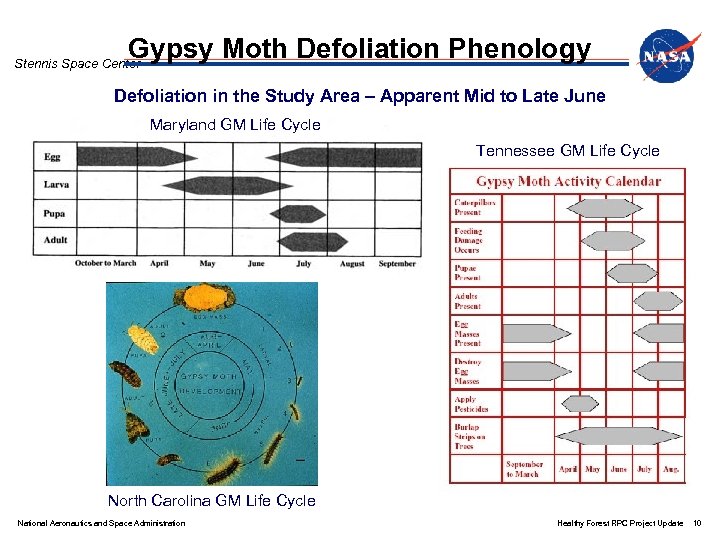 Gypsy Moth Defoliation Phenology Stennis Space Center Defoliation in the Study Area – Apparent Mid to Late June Maryland GM Life Cycle Tennessee GM Life Cycle North Carolina GM Life Cycle National Aeronautics and Space Administration Healthy Forest RPC Project Update 10
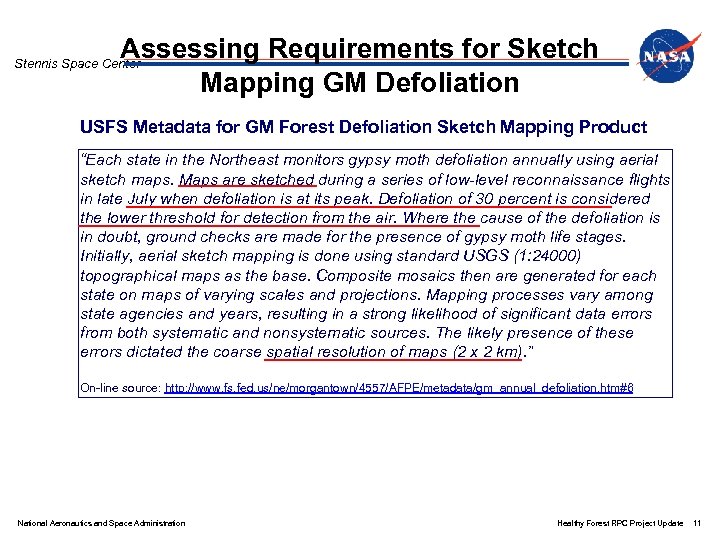 Assessing Requirements for Sketch Mapping GM Defoliation Stennis Space Center USFS Metadata for GM Forest Defoliation Sketch Mapping Product “Each state in the Northeast monitors gypsy moth defoliation annually using aerial sketch maps. Maps are sketched during a series of low-level reconnaissance flights in late July when defoliation is at its peak. Defoliation of 30 percent is considered the lower threshold for detection from the air. Where the cause of the defoliation is in doubt, ground checks are made for the presence of gypsy moth life stages. Initially, aerial sketch mapping is done using standard USGS (1: 24000) topographical maps as the base. Composite mosaics then are generated for each state on maps of varying scales and projections. Mapping processes vary among state agencies and years, resulting in a strong likelihood of significant data errors from both systematic and nonsystematic sources. The likely presence of these errors dictated the coarse spatial resolution of maps (2 x 2 km). ” On-line source: http: //www. fs. fed. us/ne/morgantown/4557/AFPE/metadata/gm_annual_defoliation. htm#6 National Aeronautics and Space Administration Healthy Forest RPC Project Update 11
 Sketch Mapping GM Defoliation in WV and VA Stennis Space Center Defoliation surveys were conducted from the air during June 2001 by the Virginia Department of Forestry and the West Virginia Department of Agriculture. On-line source: http: //www. fs. fed. us/r 8/gwj/projects_plans/monitoring/011101_Gypsy_Moth_Report. pdf State of Virginia collected defoliation sketch map data in late June – early July for 2001. On-line source: http: //www. dof. virginia. gov/resinfo/gypsy-moth-2001 -index. shtml National Aeronautics and Space Administration Healthy Forest RPC Project Update 12
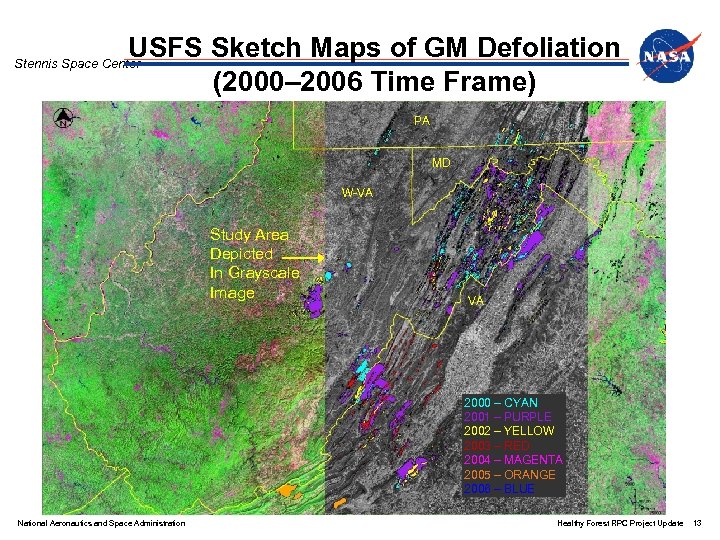 USFS Sketch Maps of GM Defoliation (2000– 2006 Time Frame) Stennis Space Center PA MD W-VA Study Area Depicted In Grayscale Image VA 2000 – CYAN 2001 – PURPLE 2002 – YELLOW 2003 – RED 2004 – MAGENTA 2005 – ORANGE 2006 – BLUE National Aeronautics and Space Administration Healthy Forest RPC Project Update 13
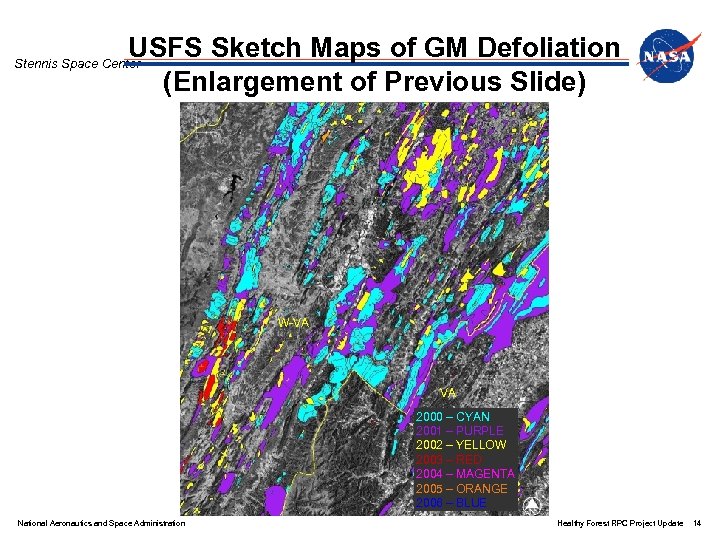 USFS Sketch Maps of GM Defoliation (Enlargement of Previous Slide) Stennis Space Center W-VA VA 2000 – CYAN 2001 – PURPLE 2002 – YELLOW 2003 – RED 2004 – MAGENTA 2005 – ORANGE 2006 – BLUE National Aeronautics and Space Administration Healthy Forest RPC Project Update 14
 Stennis Space Center Development of Gypsy Moth Defoliation Detection Products • Computing GM Defoliation Maps from MODIS-Simulated VIIRS Data – Multitemporal Image Classification – Percent Change in Maximum NDVI During the Peak Defoliation Period of a Given Year Compared to Maximum Peak Defoliation NDVI Across the Entire 2000 -2006 Time Frame • Comparing MODIS/VIIRS GM Defoliation Maps to Reference Data – Landsat Data – USFS Sketch Maps – Available In-situ Data (e. g. , GM Trap Data)
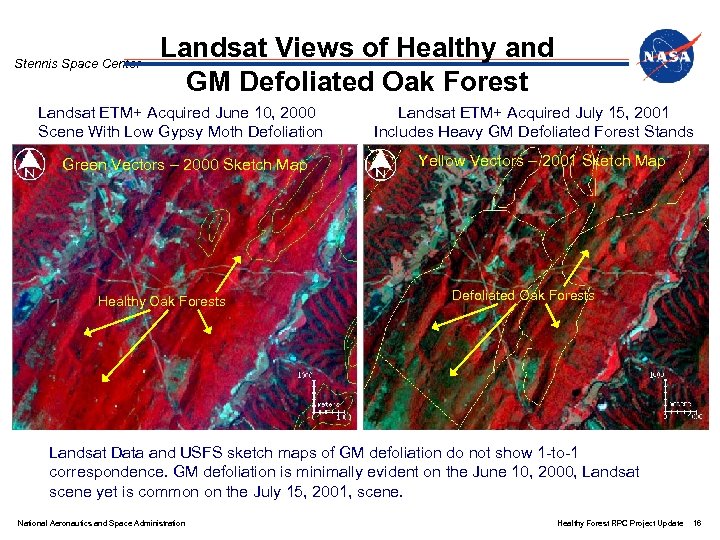 Stennis Space Center Landsat Views of Healthy and GM Defoliated Oak Forest Landsat ETM+ Acquired June 10, 2000 Scene With Low Gypsy Moth Defoliation Green Vectors – 2000 Sketch Map Healthy Oak Forests Landsat ETM+ Acquired July 15, 2001 Includes Heavy GM Defoliated Forest Stands Yellow Vectors – 2001 Sketch Map Defoliated Oak Forests Landsat Data and USFS sketch maps of GM defoliation do not show 1 -to-1 correspondence. GM defoliation is minimally evident on the June 10, 2000, Landsat scene yet is common on the July 15, 2001, scene. National Aeronautics and Space Administration Healthy Forest RPC Project Update 16
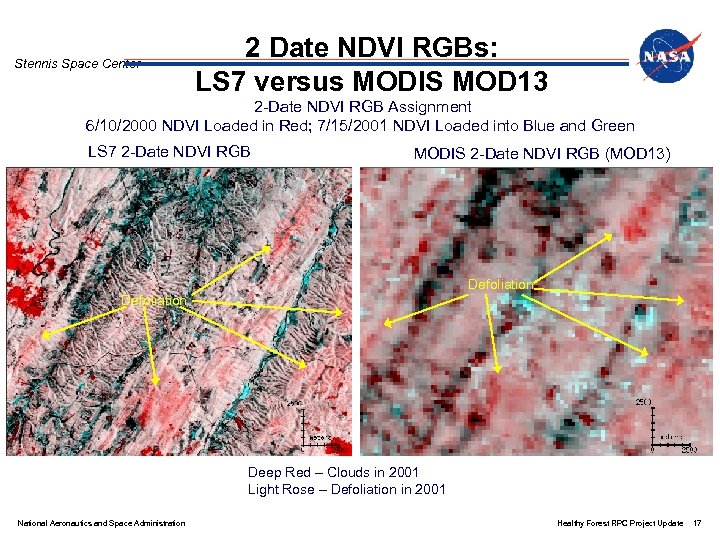 Stennis Space Center 2 Date NDVI RGBs: LS 7 versus MODIS MOD 13 2 -Date NDVI RGB Assignment 6/10/2000 NDVI Loaded in Red; 7/15/2001 NDVI Loaded into Blue and Green LS 7 2 -Date NDVI RGB MODIS 2 -Date NDVI RGB (MOD 13) Defoliation Deep Red – Clouds in 2001 Light Rose – Defoliation in 2001 National Aeronautics and Space Administration Healthy Forest RPC Project Update 17
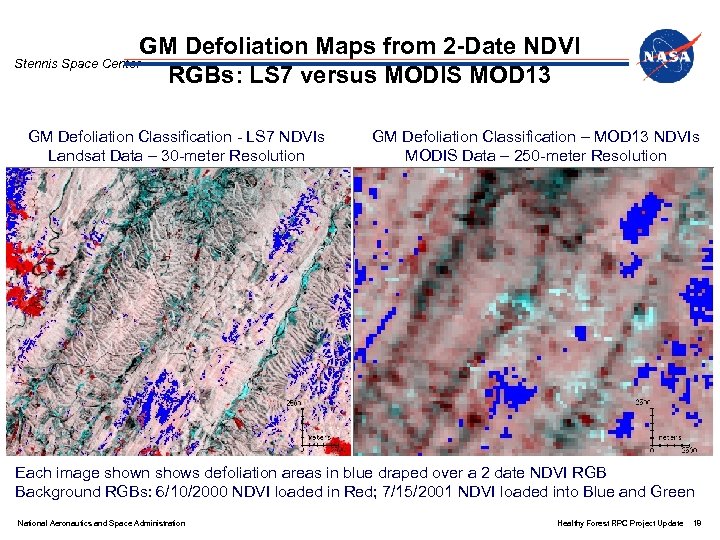 GM Defoliation Maps from 2 -Date NDVI RGBs: LS 7 versus MODIS MOD 13 Stennis Space Center GM Defoliation Classification - LS 7 NDVIs Landsat Data – 30 -meter Resolution GM Defoliation Classification – MOD 13 NDVIs MODIS Data – 250 -meter Resolution Each image shown shows defoliation areas in blue draped over a 2 date NDVI RGB Background RGBs: 6/10/2000 NDVI loaded in Red; 7/15/2001 NDVI loaded into Blue and Green National Aeronautics and Space Administration Healthy Forest RPC Project Update 18
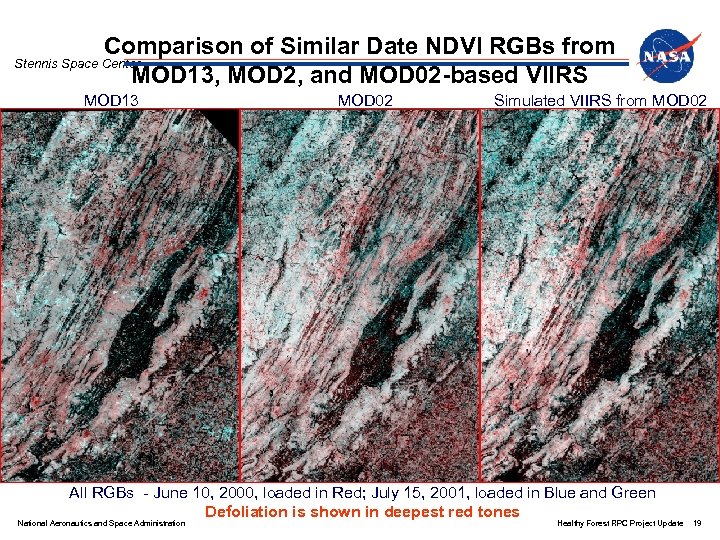 Comparison of Similar Date NDVI RGBs from MOD 13, MOD 2, and MOD 02 -based VIIRS Stennis Space Center MOD 13 MOD 02 Simulated VIIRS from MOD 02 All RGBs - June 10, 2000, loaded in Red; July 15, 2001, loaded in Blue and Green Defoliation is shown in deepest red tones National Aeronautics and Space Administration Healthy Forest RPC Project Update 19
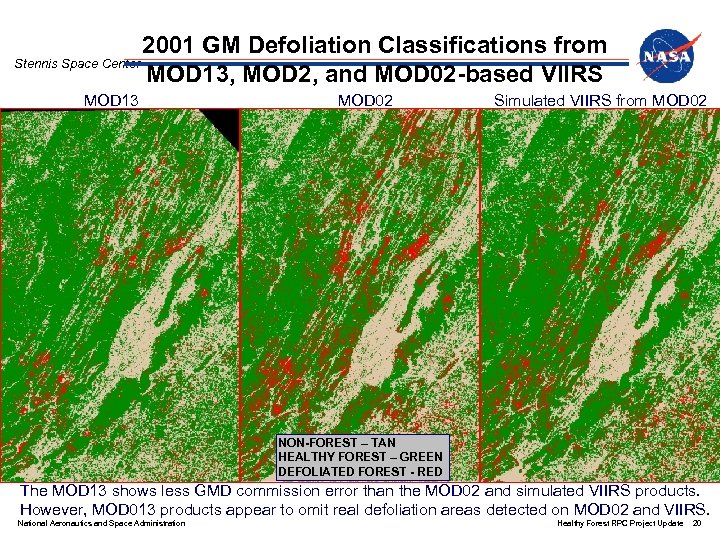 Stennis Space Center 2001 GM Defoliation Classifications from MOD 13, MOD 2, and MOD 02 -based VIIRS MOD 13 MOD 02 Simulated VIIRS from MOD 02 NON-FOREST – TAN HEALTHY FOREST – GREEN DEFOLIATED FOREST - RED The MOD 13 shows less GMD commission error than the MOD 02 and simulated VIIRS products. However, MOD 013 products appear to omit real defoliation areas detected on MOD 02 and VIIRS. National Aeronautics and Space Administration Healthy Forest RPC Project Update 20
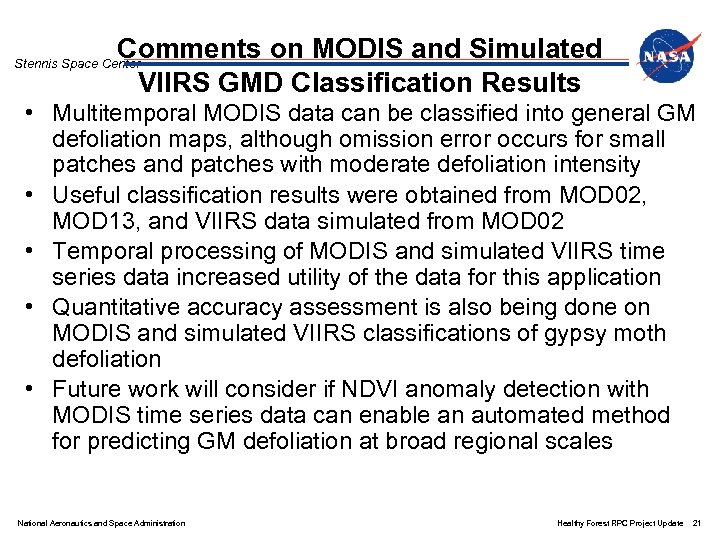 Comments on MODIS and Simulated VIIRS GMD Classification Results Stennis Space Center • Multitemporal MODIS data can be classified into general GM defoliation maps, although omission error occurs for small patches and patches with moderate defoliation intensity • Useful classification results were obtained from MOD 02, MOD 13, and VIIRS data simulated from MOD 02 • Temporal processing of MODIS and simulated VIIRS time series data increased utility of the data for this application • Quantitative accuracy assessment is also being done on MODIS and simulated VIIRS classifications of gypsy moth defoliation • Future work will consider if NDVI anomaly detection with MODIS time series data can enable an automated method for predicting GM defoliation at broad regional scales National Aeronautics and Space Administration Healthy Forest RPC Project Update 21
 Some Issues and Lessons Learned Stennis Space Center • The planned 6 month schedule is difficult to implement, given delays in receiving needed MODIS data and software revisions need to most realistically simulate VIIRS data • Issues were also encountered in hiring consultant for the project • Project was aided by the Healthy Forest Initiative project that was concurrent • This study should be replicated with other pests and study areas National Aeronautics and Space Administration Healthy Forest RPC Project Update 22