 Скачать презентацию STEMI Stroke Boot Camp Lessons from the Trenches
e904de860f4f6705985687a9588d88b5.ppt
- Количество слайдов: 103



STEMI/Stroke Boot Camp Lessons from the Trenches
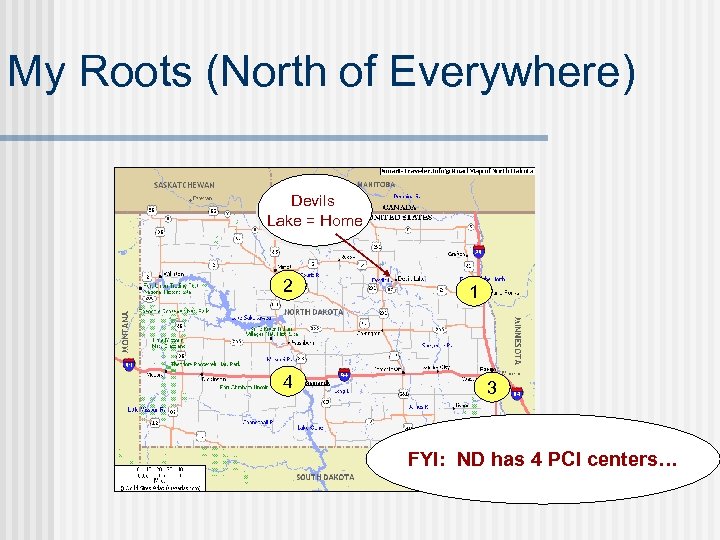
My Roots (North of Everywhere) Devils Lake = Home 2 4 1 3 FYI: ND has 4 PCI centers…
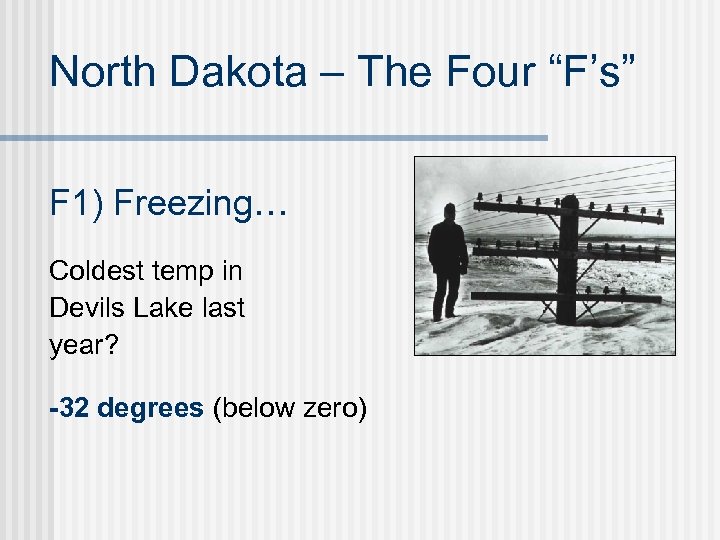
North Dakota – The Four “F’s” F 1) Freezing… Coldest temp in Devils Lake last year? -32 degrees (below zero)

North Dakota – The Four “F’s” F 2) Farming… Life in the “Vast Lane”
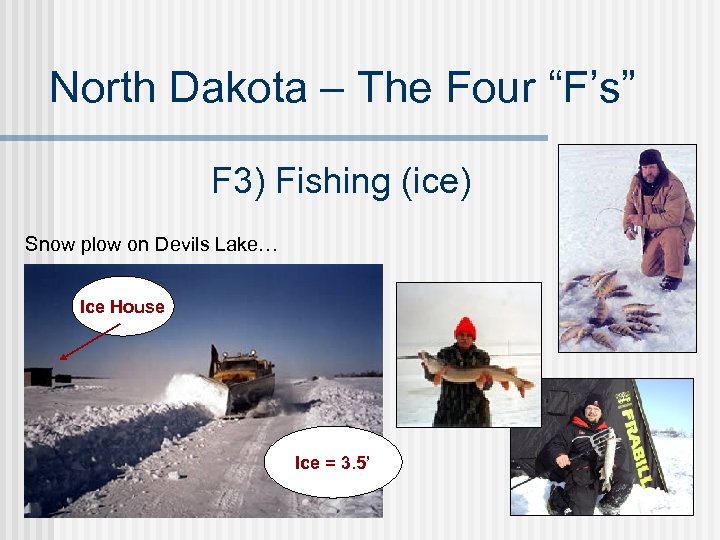
North Dakota – The Four “F’s” F 3) Fishing (ice) Snow plow on Devils Lake… Ice House Ice = 3. 5’

North Dakota – The Four “F’s” F 4) And Flooding… n 1997 Red River of the North flooding Grand Forks, ND n Photo: “Come Hell or High Water” (left) won Pulitzer Prize
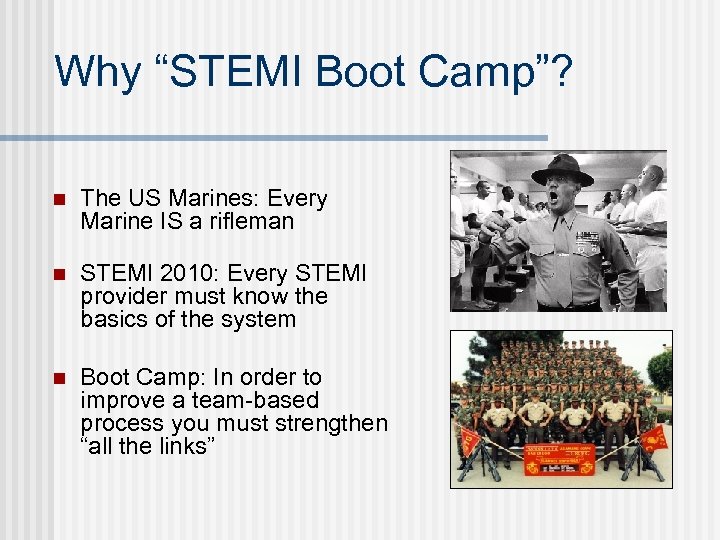
Why “STEMI Boot Camp”? n The US Marines: Every Marine IS a rifleman n STEMI 2010: Every STEMI provider must know the basics of the system n Boot Camp: In order to improve a team-based process you must strengthen “all the links”
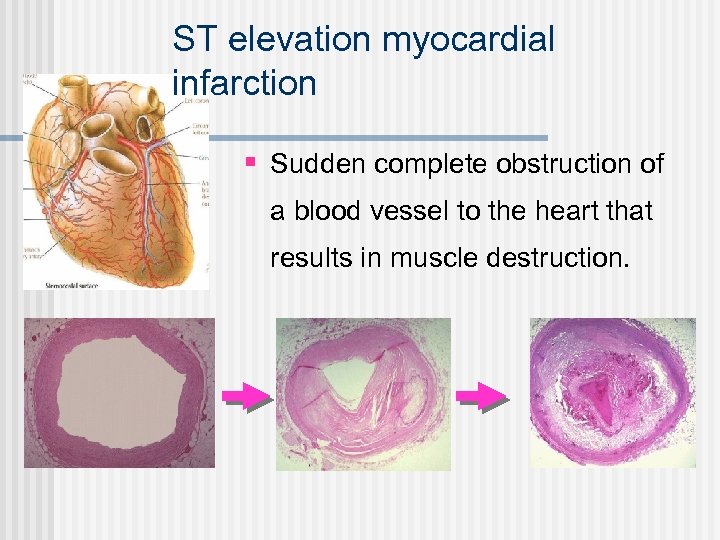
ST elevation myocardial infarction § Sudden complete obstruction of a blood vessel to the heart that results in muscle destruction.
STEMI: Flagship Product or “Canary in a Coal Mine? ” Got STEMI? STEMI patients: Small numbers but highly visible versus a barometer of the entire system? . . . or both?
Today’s Goal: n We are going to discuss STEMI Systems Engineering: This involves a discussion of the optimization of the Essential Elements of Reperfusion as they relate to pre-hospital STEMI Care. GOAL: Optimization, NOT improvement!
In simpler words…… “Git -Rdone!” Larry the Cable Guy’s opinion about STEMI treatment decision making at a non-PCI center.
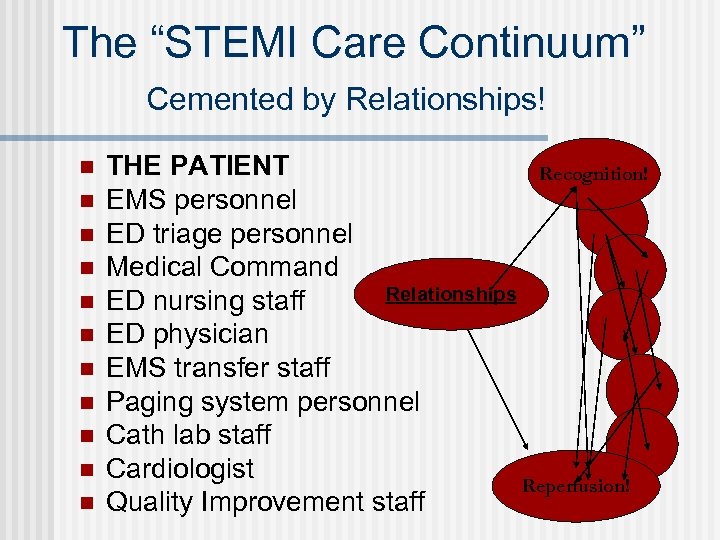
The “STEMI Care Continuum” Cemented by Relationships! n n n THE PATIENT Recognition! EMS personnel ED triage personnel Medical Command Relationships ED nursing staff ED physician EMS transfer staff Paging system personnel Cath lab staff Cardiologist Reperfusion! Quality Improvement staff
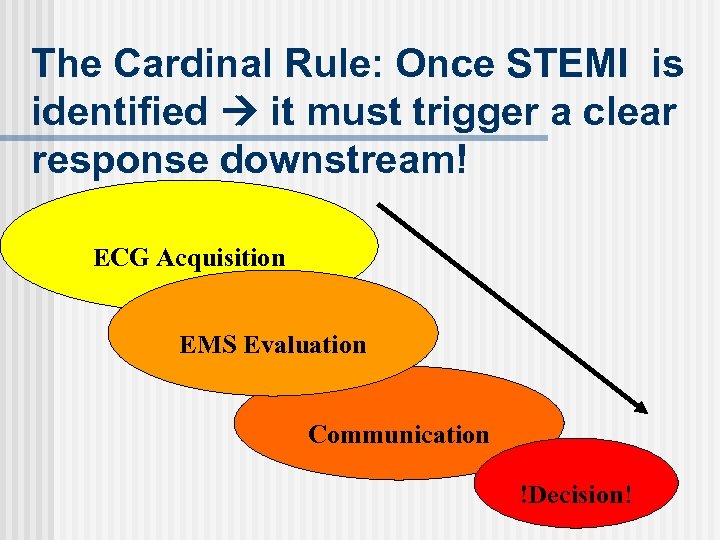
The Cardinal Rule: Once STEMI is identified it must trigger a clear response downstream! ECG Acquisition EMS Evaluation Communication !Decision!
I. Remember…Most of the Time …the easy ones are easy! So, make more of them easy!
II. STEMI Fact: If it Can Go Wrong, it Will (sooner or later) Leave nothing to chance! Approach STEMI systems building like a system’s engineer… Don’t try to errorproof your providers. Error-proof your system!
III. STEMI 2010: There is NO New Frontier! n Every STEMI case has the same fixed endpoints (R 2 R) n Model success, but don’t copy it! (? ? ? ) n Adapt principles to the situations not vice versa!
So, what's new in STEMI? ? ? n 2011: ACC/AHA update on STEMI n So, what has changed in STEMI science?
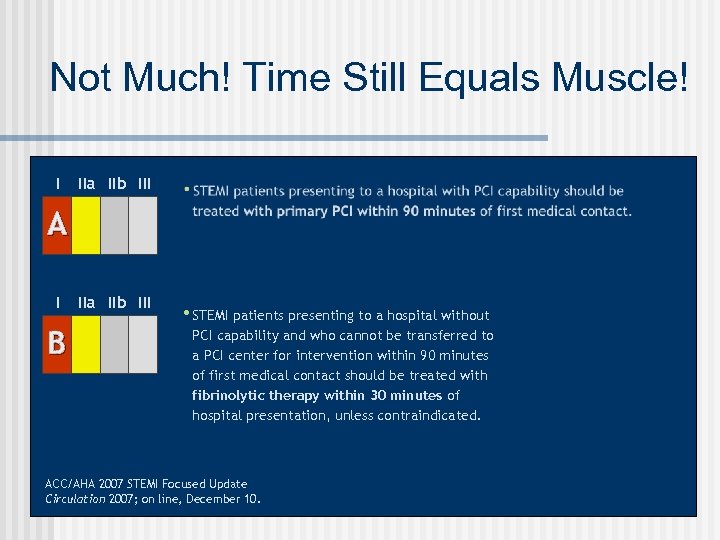
Not Much! Time Still Equals Muscle! I IIa IIb III A I B IIa IIb III • STEMI patients presenting to a hospital without PCI capability and who cannot be transferred to a PCI center for intervention within 90 minutes of first medical contact should be treated with fibrinolytic therapy within 30 minutes of hospital presentation, unless contraindicated. ACC/AHA 2007 STEMI Focused Update Circulation 2007; on line, December 10.
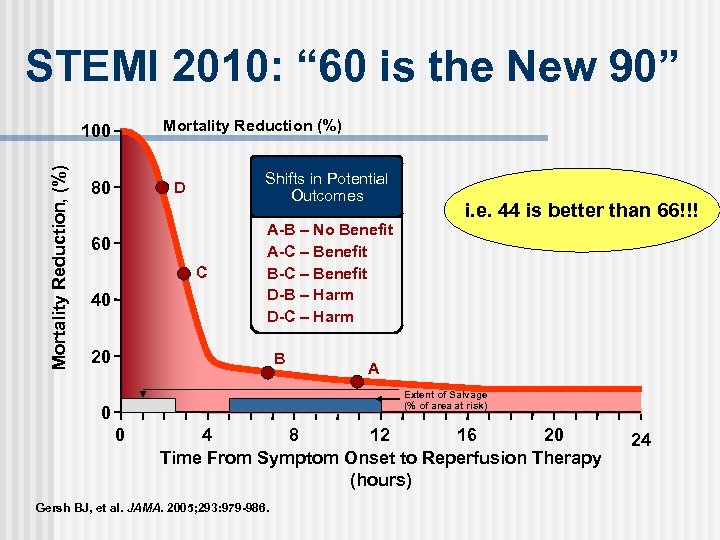
STEMI 2010: “ 60 is the New 90” Mortality Reduction (%) Mortality Reduction, (%) 100 80 Shifts in Potential Outcomes D 60 C 40 A-B – No Benefit A-C – Benefit B-C – Benefit D-B – Harm D-C – Harm 20 B i. e. 44 is better than 66!!! A Extent of Salvage (% of area at risk) 0 0 4 8 12 16 20 Time From Symptom Onset to Reperfusion Therapy (hours) Gersh BJ, et al. JAMA. 2005; 293: 979 -986. JAMA. 24
Recognition to Reperfusion (R 2 R) STEMI Engineering Lingo: n Time interval from STEMI Recognition (regardless of location) to Reperfusion (regardless of the chosen strategy)! n Focused on actions not location n Engineers: Think “Before the Door” and “Options Beyond Angiography”
Recognition to Reperfusion n TRUTH: Without early recognition there can be no progress towards early reperfusion n The focus must be on the earliest possible recognition followed by fast and precise reperfusion n Again, it all begins with Recognition!
Thought Provoking Question As far as your next potential STEMI patient is concerned, who is THE most important person in the STEMI Care Continuum?
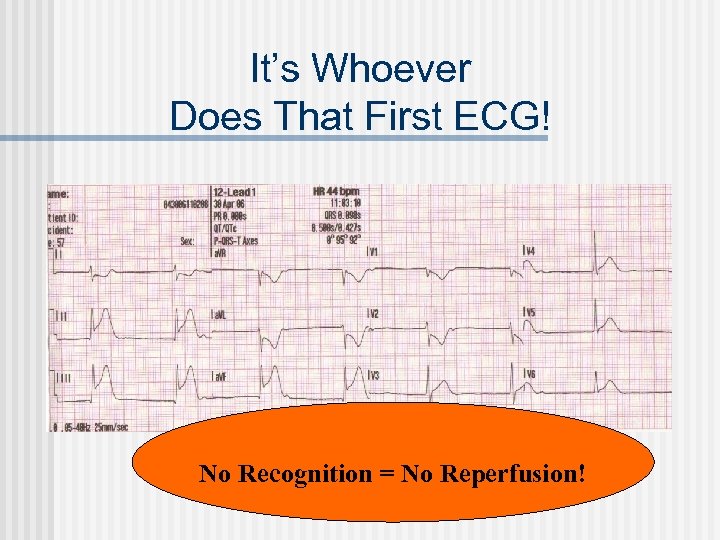
It’s Whoever Does That First ECG! No Recognition = No Reperfusion!
Use of the prehospital ECG improves door-to-balloon times in ST segment elevation myocardial infarction irrespective of time of day or day of week. n n n Cleveland Clinic Florida Hypothesis: use of the prehospital ECG, coupled with an emergency department initiated "Cath Alert" system, could neutralize OLD NEWS! D 2 B delays related to time of day or day of week. RESULTS: n D 2 B - mean 69 mins. n 78% achieving the recommended D 2 B of 90 Afolabi BA , et al mins.
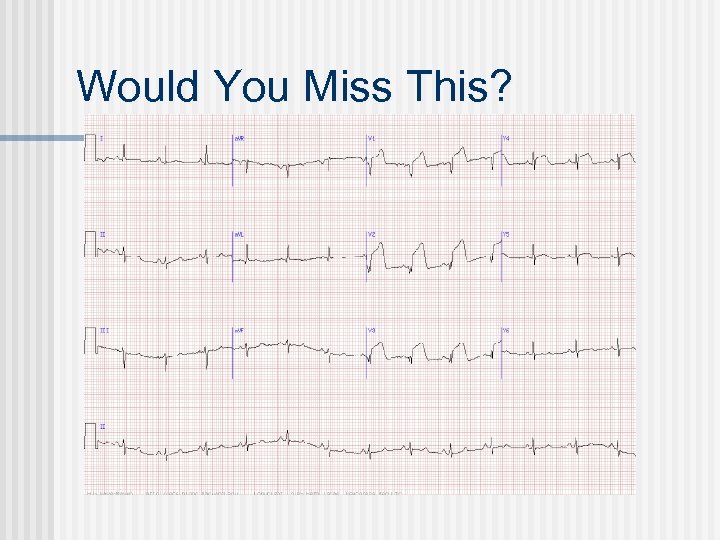
Would You Miss This?
Recognition: How is Your System Doing? 1) 2) 3) 4) 5) 6) Do you have a written “Screening ECG Protocol” within your institution & system –including EMS? Is it visibly posted in your ED/triage areas & EMS vehicles? Do ED, EMS and triage staff follow it 25/8? Have you specifically trained your staff regarding their key role in obtaining the screening ECG? Do you have multiple backup pathways in place to ensure that the screening ECG gets done during busy times? Is each ECG immediately shown to a physician?
However, it is as it is…. Several reasons why pre-hospital STEMI care will always remain a challenge…

All Americans are Not Distributed Equally! Rokos et al. J Am Coll Cardiol Intv, 2009; 2: 339 -346
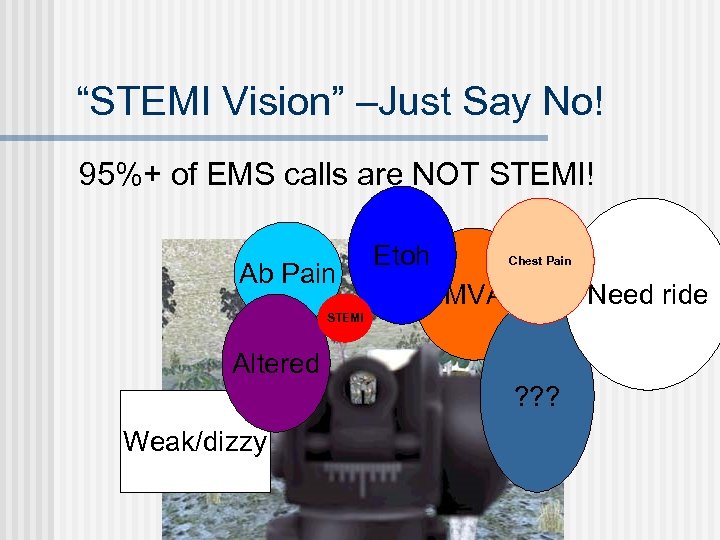
“STEMI Vision” –Just Say No! 95%+ of EMS calls are NOT STEMI! Ab Pain Etoh Chest Pain MVA Need ride STEMI Altered ? ? ? Weak/dizzy
Quiz: STEMI Finances 101 1) How much is an EMS provider in Missouri reimbursed for: A) Learning to do an ECG? B) Completing an ECG on Grandma? C) Interpreting an ECG D) Discussing the ECG with Med. Com? 2) How much does a helicopter flight cost?
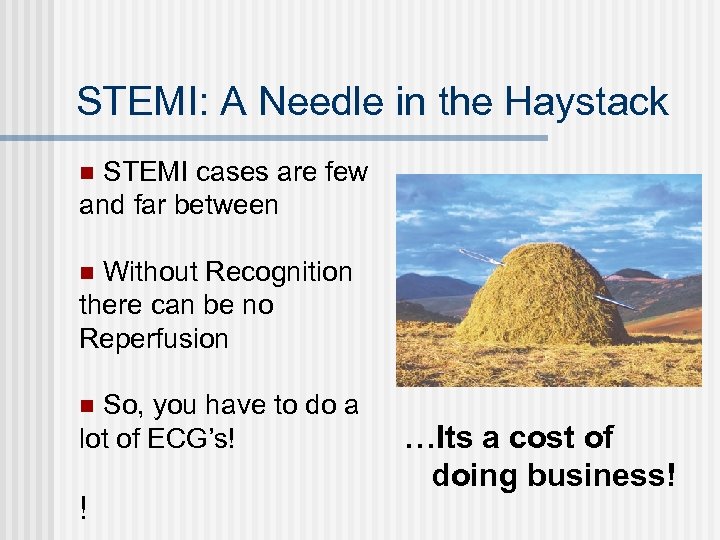
STEMI: A Needle in the Haystack STEMI cases are few and far between n Without Recognition there can be no Reperfusion n So, you have to do a lot of ECG’s! n ! …Its a cost of doing business!
The “STEMI/Sick Patient” Paradox… Sick EMS patients (usually) look sick (trauma, VFIB, hypoxia, asystole) Motto: Keep ‘em alive, & diagnose ‘em after arrival! …Not so with STEMI!
The EMS Environment…Chaos Theory Run Rampant! Multiple patients types and illnesses n Everyone thinks they are the “emergency” n Dramatic does not mean emergent n Constant provider turnover n Improvising is often an essential skill n Multitasking required n
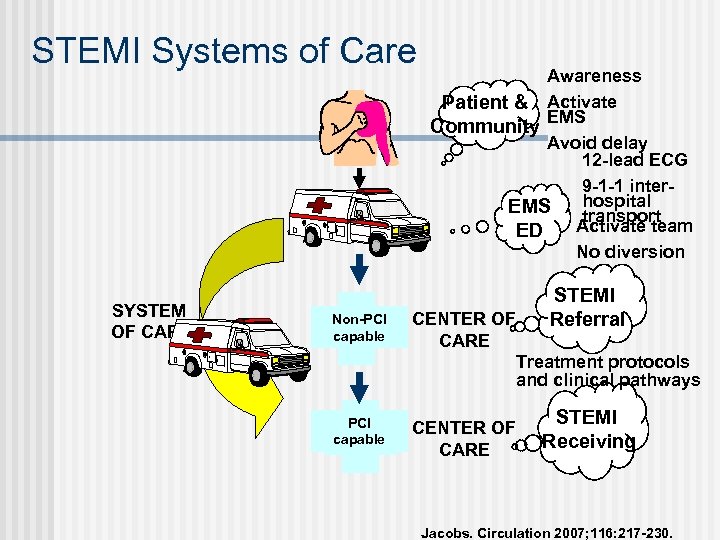
STEMI Systems of Care SYSTEM OF CARE Awareness Patient & Activate Community EMS Avoid delay 12 -lead ECG 9 -1 -1 interhospital EMS transport Activate team ED No diversion STEMI Referral Non-PCI capable CENTER OF CARE Treatment protocols and clinical pathways PCI capable CENTER OF CARE STEMI Receiving Jacobs. Circulation 2007; 116: 217 -230.
Transport Time: “Jokers Wild!” Transportation issues n Air vs. ground n Local EMS issues Inter-facility issues n Weather n People factors n
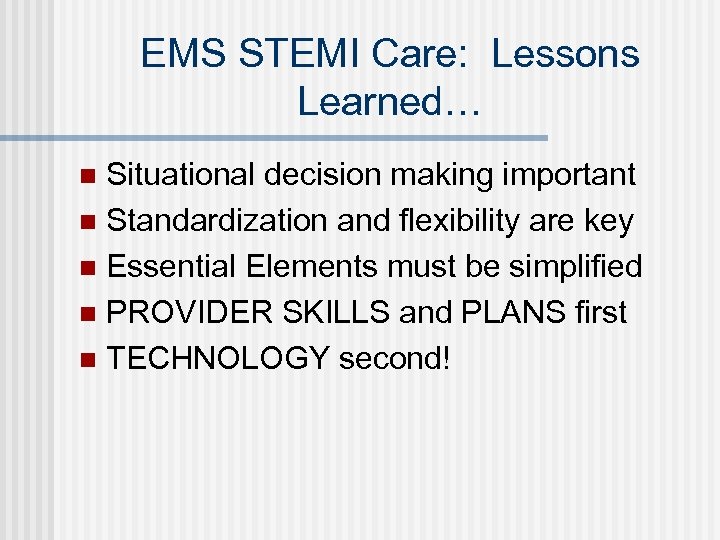
EMS STEMI Care: Lessons Learned… Situational decision making important n Standardization and flexibility are key n Essential Elements must be simplified n PROVIDER SKILLS and PLANS first n TECHNOLOGY second! n
Think Globally, Act Locally n EMS STEMI solutions must be locally driven based on national suggestions n Change items that really matter.
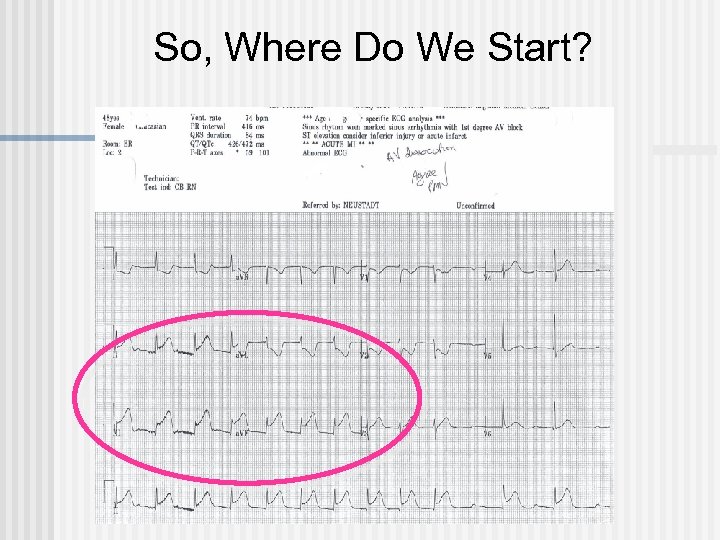
So, Where Do We Start?
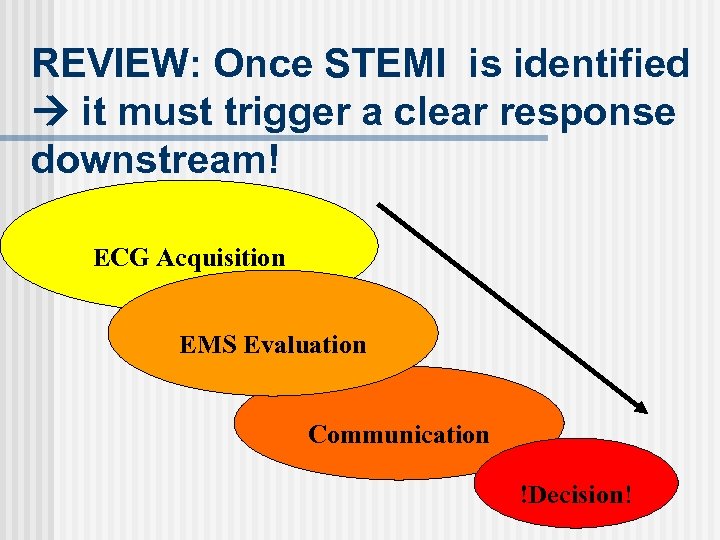
REVIEW: Once STEMI is identified it must trigger a clear response downstream! ECG Acquisition EMS Evaluation Communication !Decision!
EMS: The Big Picture Ensure that every patient has timely access to an EMS provider who has: n ECG equipment… n ECG acquisition training, n A Screening ECG Protocol to follow n A Downstream communication plan n A STEMI ALERT plan to activate
STEMI Engineering: Recognition Rigid adherence to a Screening ECG Protocol is crucial! “All portals at All times” Forgetting the screening ECG is simply not permitted!
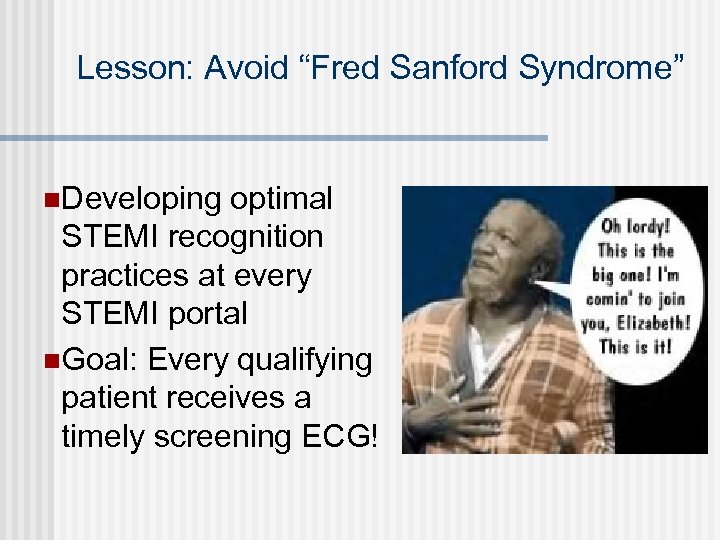
Lesson: Avoid “Fred Sanford Syndrome” n. Developing optimal STEMI recognition practices at every STEMI portal n. Goal: Every qualifying patient receives a timely screening ECG!
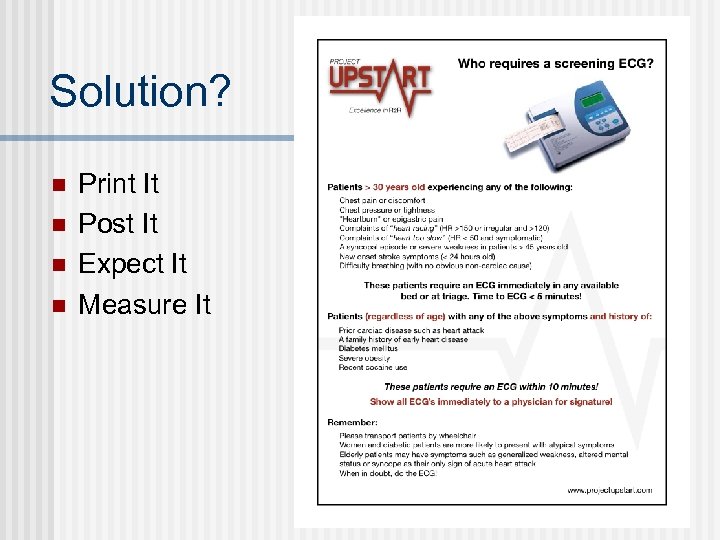
Solution? n n Print It Post It Expect It Measure It
All Patients (in Your EMS Catchment Area)…Do They… have timely access to an EMS provider with: n ECG equipment…? n ECG acquisition training…? n A Screening ECG Protocol to follow…? n A downstream communication plan…? n An area-specific STEMI ALERT plan to activate…?
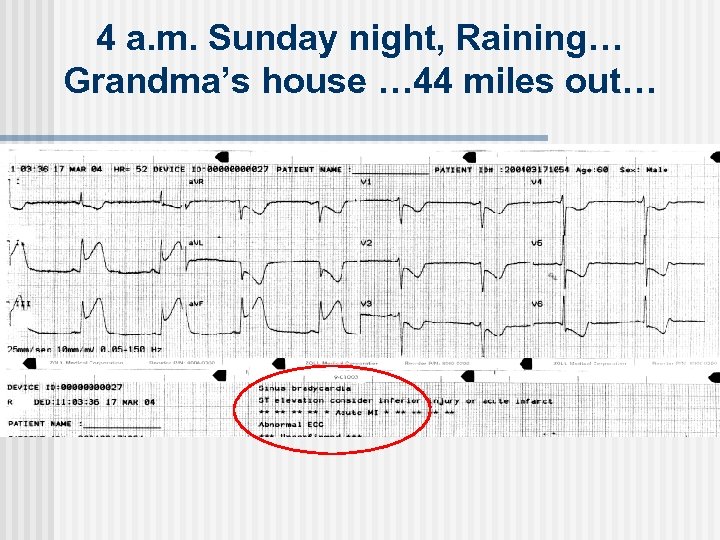
4 a. m. Sunday night, Raining… Grandma’s house … 44 miles out…
ECG done! Three key questions now matter! How is the ECG interpreted? How is this info relayed ahead? How will this info change the destination facility or facility response?
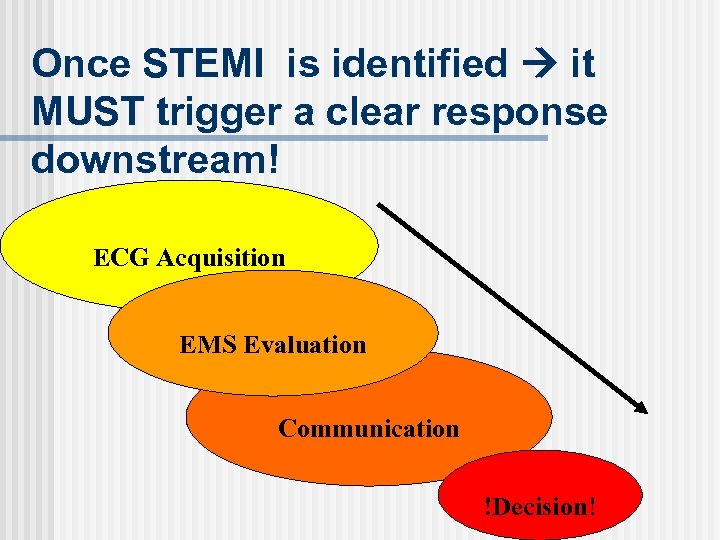
Once STEMI is identified it MUST trigger a clear response downstream! ECG Acquisition EMS Evaluation Communication !Decision!
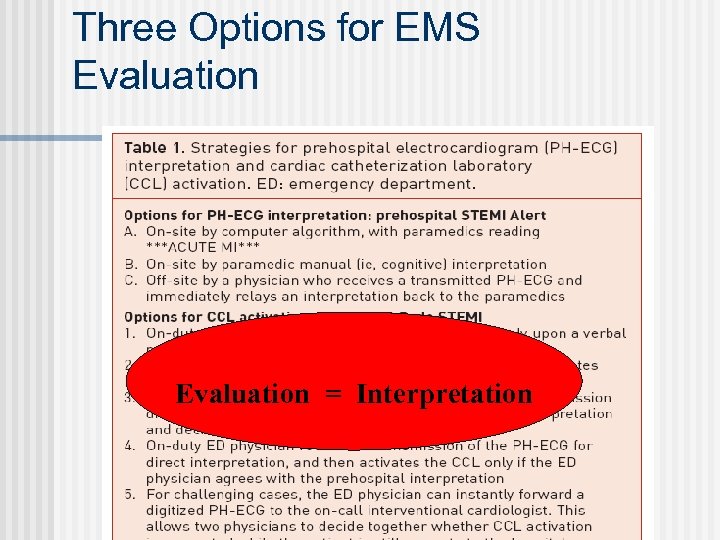
Three Options for EMS Evaluation = Interpretation
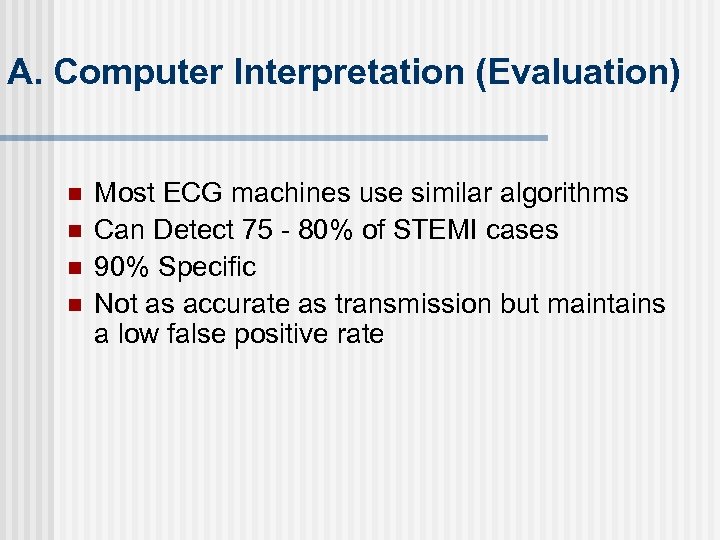
A. Computer Interpretation (Evaluation) n n Most ECG machines use similar algorithms Can Detect 75 - 80% of STEMI cases 90% Specific Not as accurate as transmission but maintains a low false positive rate
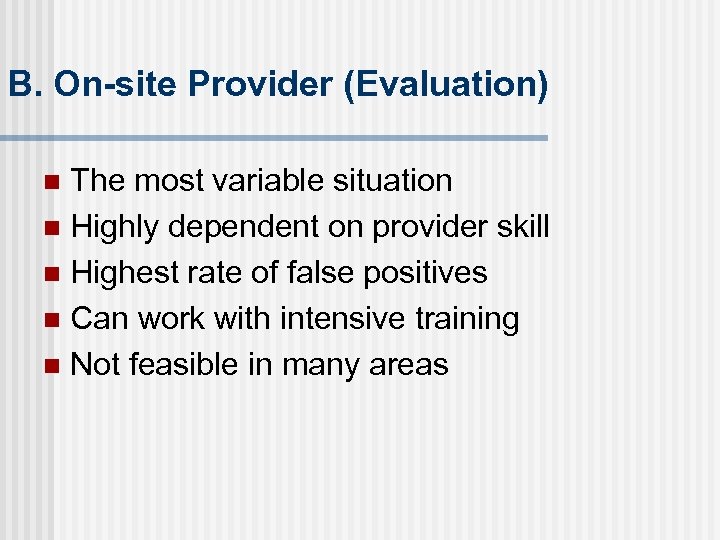
B. On-site Provider (Evaluation) The most variable situation n Highly dependent on provider skill n Highest rate of false positives n Can work with intensive training n Not feasible in many areas n
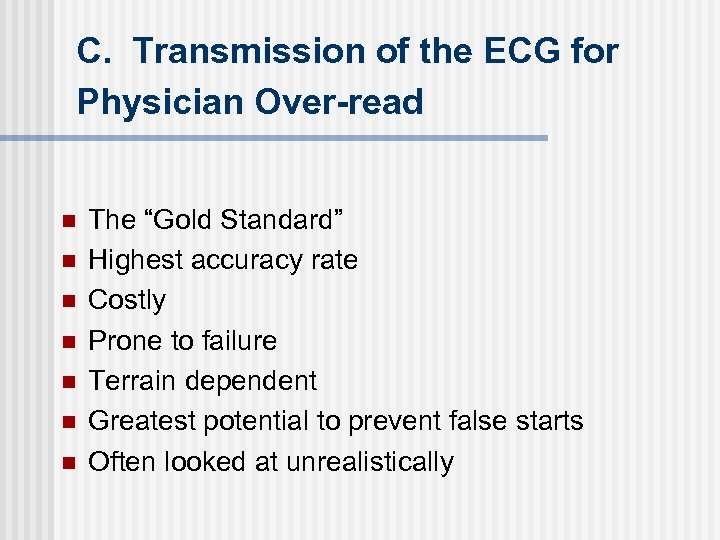
C. Transmission of the ECG for Physician Over-read n n n n The “Gold Standard” Highest accuracy rate Costly Prone to failure Terrain dependent Greatest potential to prevent false starts Often looked at unrealistically
Which is Better? All three options are appropriate, depending on: n EMS provider availability n Financial resources n EMS ECG recognition skills n Location of local PCI centers, etc n Geography and terrain
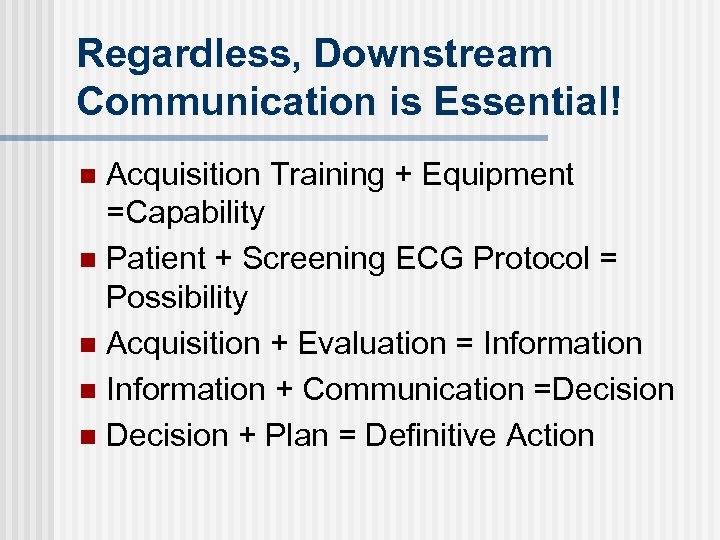
Regardless, Downstream Communication is Essential! Acquisition Training + Equipment =Capability n Patient + Screening ECG Protocol = Possibility n Acquisition + Evaluation = Information n Information + Communication =Decision n Decision + Plan = Definitive Action n
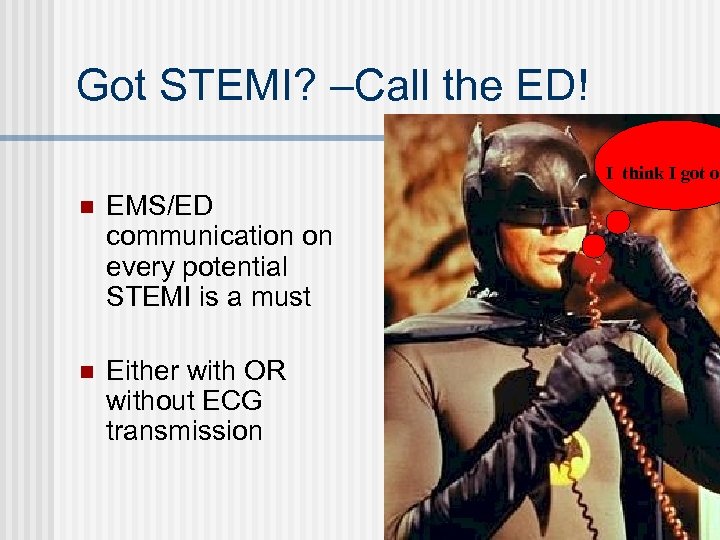
Got STEMI? –Call the ED! I think I got on n EMS/ED communication on every potential STEMI is a must n Either with OR without ECG transmission
Downstream Communication EMS direct activation of the cath lab n EMS/ED discussion via radio n Transmission of the ECG for physician over-read n EMS Diverts to a PCI center n EMS/EMS rendezvous n
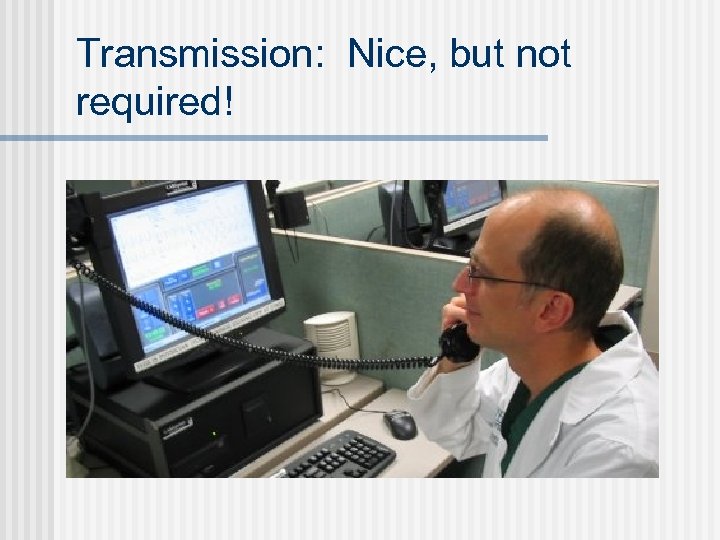
Transmission: Nice, but not required!
Next Step? n After downstream communication is attempted or complete procede with a pre -determined STEMI ALERT plan.
D: Logging, Bad Burgers & “Angels” n n n 34 year-old male is logging trees in remote area Increased heartburn after “gut bomb” lunch Later, his boss starts driving him to the hospital Pain worsens; His boss calls rural EMS, who arrange to meet them at a local “Kwik. Mart”. EMS does ECG in parking lot: it looks “bad” Idea: fax ECG to Med. Com before departure
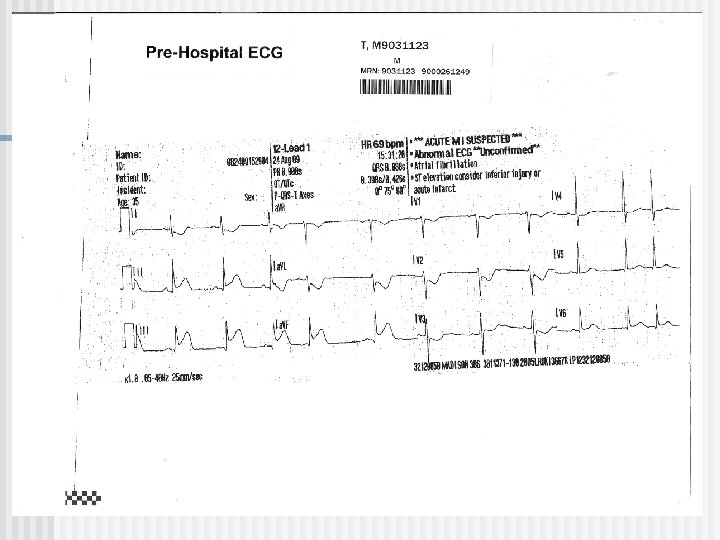
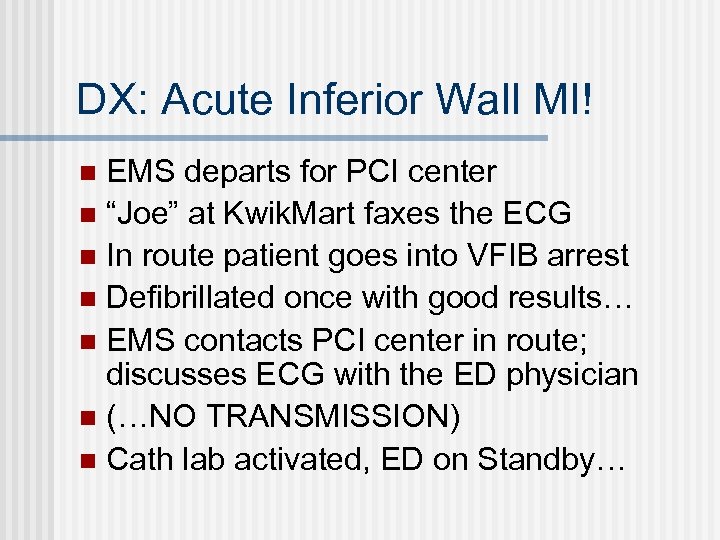
DX: Acute Inferior Wall MI! EMS departs for PCI center n “Joe” at Kwik. Mart faxes the ECG n In route patient goes into VFIB arrest n Defibrillated once with good results… n EMS contacts PCI center in route; discusses ECG with the ED physician n (…NO TRANSMISSION) n Cath lab activated, ED on Standby… n
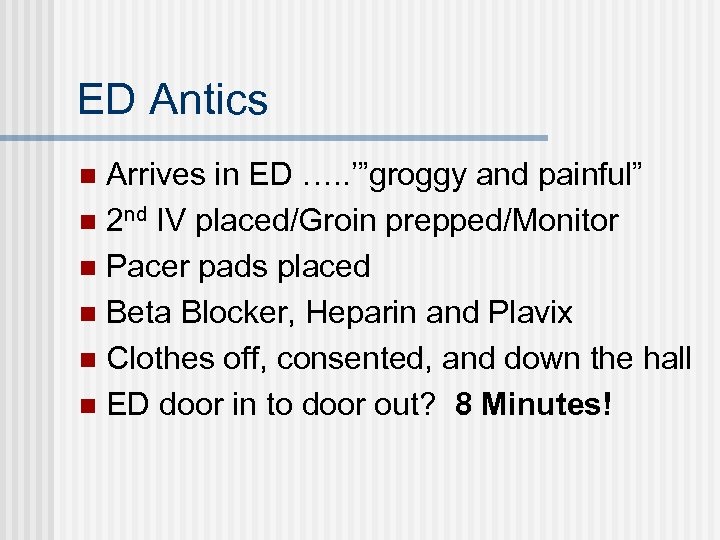
ED Antics Arrives in ED …. . ’”groggy and painful” n 2 nd IV placed/Groin prepped/Monitor n Pacer pads placed n Beta Blocker, Heparin and Plavix n Clothes off, consented, and down the hall n ED door in to door out? 8 Minutes! Minutes n
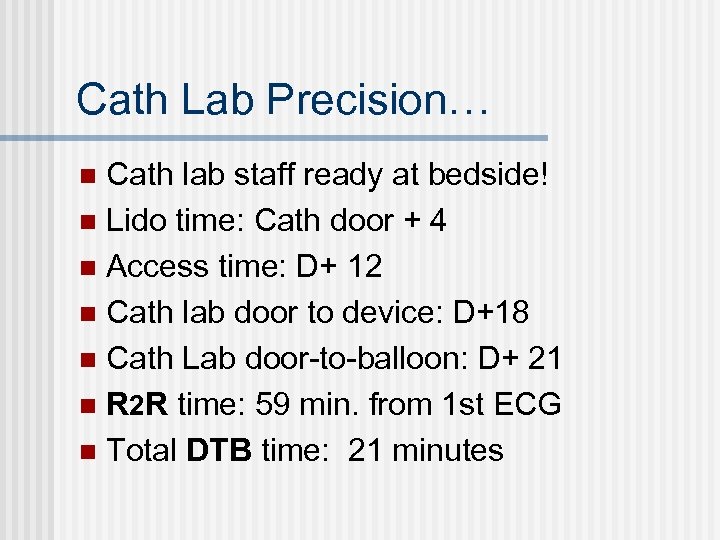
Cath Lab Precision… Cath lab staff ready at bedside! n Lido time: Cath door + 4 n Access time: D+ 12 n Cath lab door to device: D+18 n Cath Lab door-to-balloon: D+ 21 n R 2 R time: 59 min. from 1 st ECG n Total DTB time: 21 minutes n
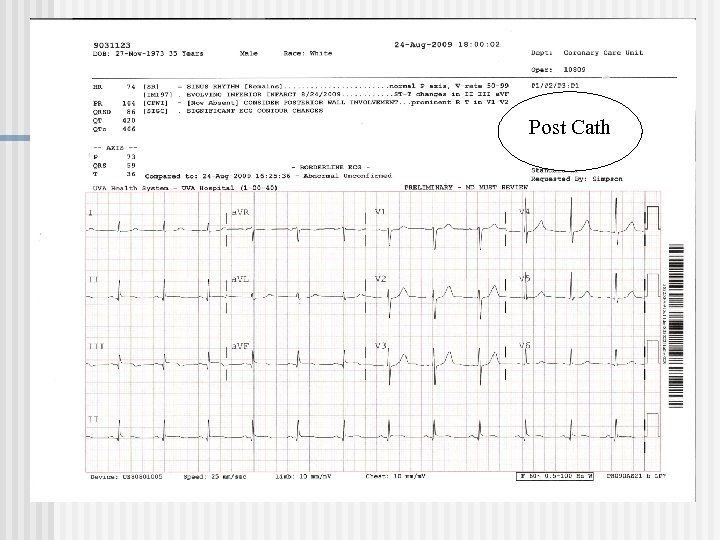
Post Cath
Post Cath… Cardiac echo shows only a minimally depressed ejection fraction n Patient feeling much better! n Admits to 5 days of increasing “heartburn” n PMH: Dad died at 50 of massive MI… n Refers to his EMS providers as the “two special angels who saved his life!” n
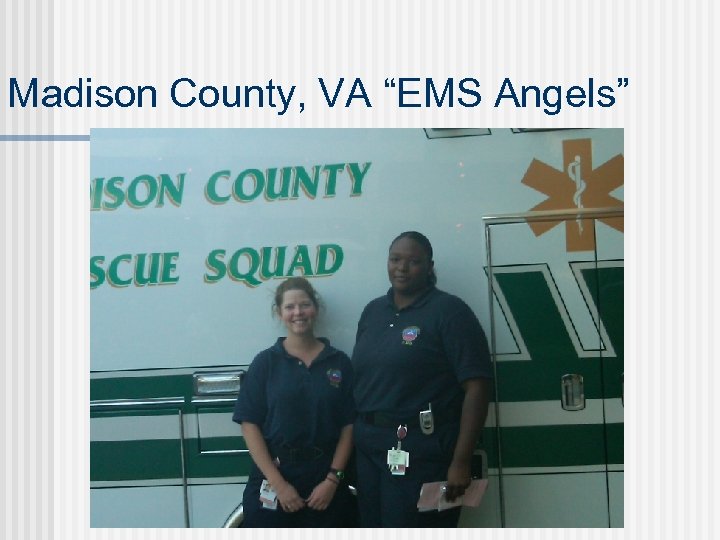
Madison County, VA “EMS Angels”
EMS and STEMI: A review Ensure that every patient has timely access to an EMS provider who has: ECG equipment… n ECG acquisition training, n A Screening ECG Protocol to follow n A Downstream communication plan n A STEMI ALERT plan to activate n
Systems Engineering Science n Is a precise application of the Pareto Effect (the 80/20 rule)! n Concentrate the majority of effort on optimizing those actions most critical for sustained success in your process n STEMI systems of care improvement has clearly care has defined essential elements 68 www. projectupstart. com
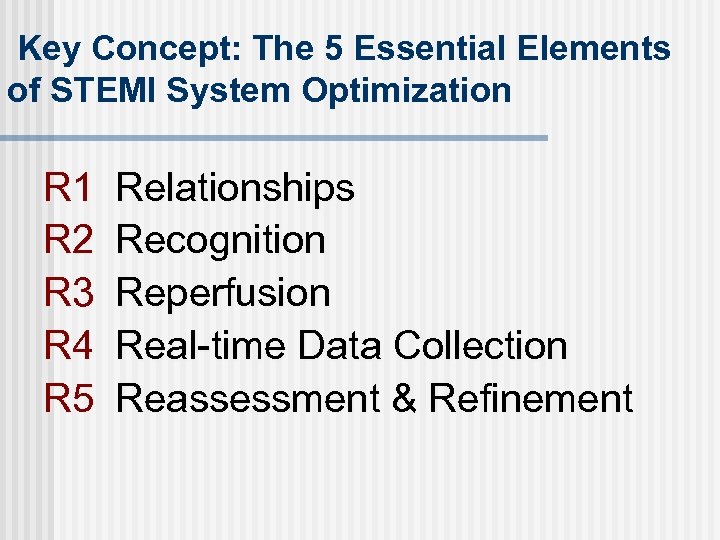
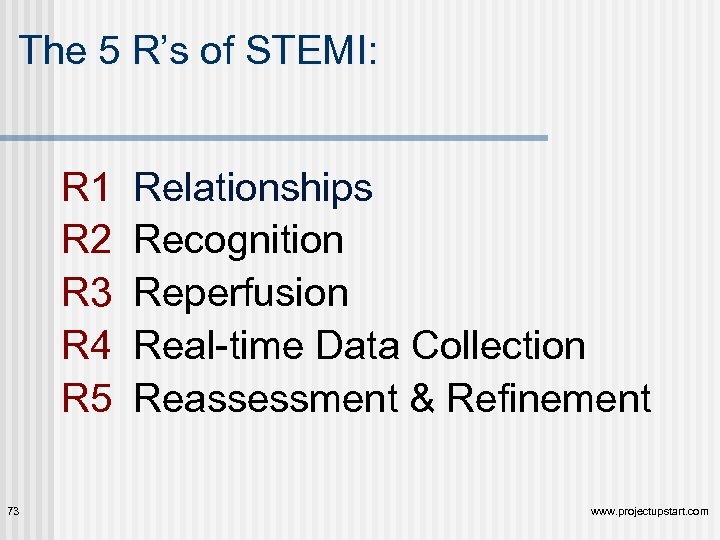
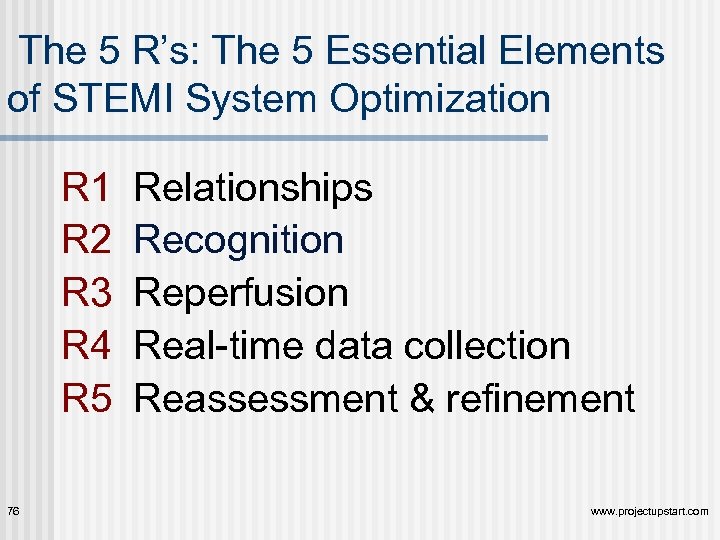
Key Concept: The 5 Essential Elements of STEMI System Optimization R 1 R 2 R 3 R 4 R 5 Relationships Recognition Reperfusion Real-time Data Collection Reassessment & Refinement
The “ 5 R’s”: Essential Elements n n 70 Are true “Essential Elements” of STEMI care Perfecting each of these five processes is critical in optimizing any local STEMI system Incorporate everything we have learned today Provide focus for improvement www. projectupstart. com
Optimize each R! n A focus on optimizing each one of the “ 5 R’s” will allow rapid improvement of any local STEMI system (ESS) in the most efficient manner possible n A precise application of the Pareto Effect (the 80/20 rule)! 71 www. projectupstart. com
Optimizing Each Essential Element is Critical n n 72 Failure to optimize each of the 5 R’s will lead to error at some later time Each step is critical to sustainable success Failure to implement systematic change sets the stage for provider error at some later stage An optimized system minimizes provider error and enhances provider excellence www. projectupstart. com
The 5 R’s of STEMI: R 1 R 2 R 3 R 4 R 5 73 Relationships Recognition Reperfusion Real-time Data Collection Reassessment & Refinement www. projectupstart. com
R 1) Relationships: The Most Important R! Without question, the most important factors in successful optimization of a local STEMI systems is development of strong relationships at all levels. 74 www. projectupstart. com
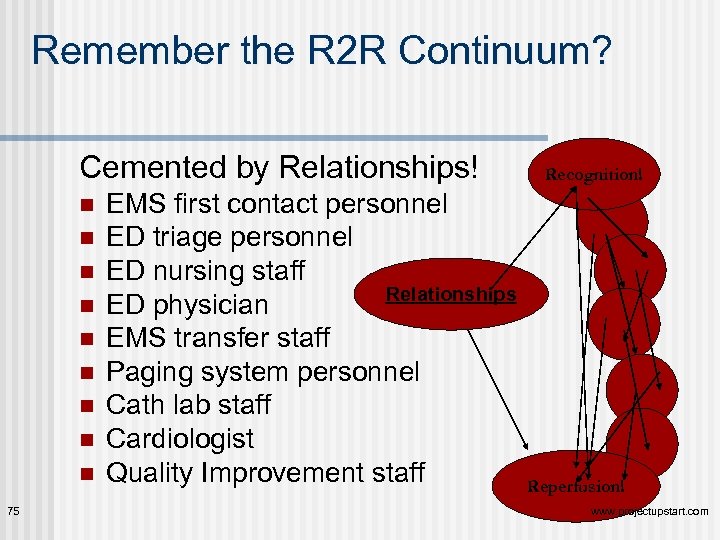
Remember the R 2 R Continuum? Cemented by Relationships! n n n n n 75 EMS first contact personnel ED triage personnel ED nursing staff Relationships ED physician EMS transfer staff Paging system personnel Cath lab staff Cardiologist Quality Improvement staff Recognition! Reperfusion! www. projectupstart. com
The 5 R’s: The 5 Essential Elements of STEMI System Optimization R 1 R 2 R 3 R 4 R 5 76 Relationships Recognition Reperfusion Real-time data collection Reassessment & refinement www. projectupstart. com
The “ 5 R’s”: Essential Elements R 2) Recognition: Implement an optimal STEMI screening process at each “STEMI portal” Goal: Each qualifying patient receives a timely screening ECG! All portals fixed or floating 77 www. projectupstart. com
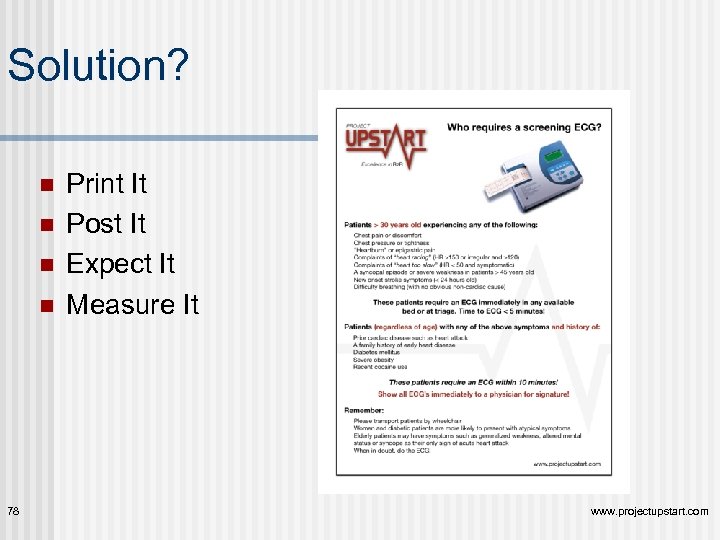
Solution? n n 78 Print It Post It Expect It Measure It www. projectupstart. com
The 5 R’s: The 5 Essential Elements of STEMI System Optimization R 1 R 2 R 3 R 4 R 5 79 Relationships Recognition Reperfusion Real-time data collection Reassessment & refinement www. projectupstart. com
The “ 5 R’s” R 3) Reperfusion: A concise reperfusion plan in place for each STEMI portal A “STEMI ALERT Process for every portal” -including pre-hospital portals -including interfacility transfers 80 www. projectupstart. com
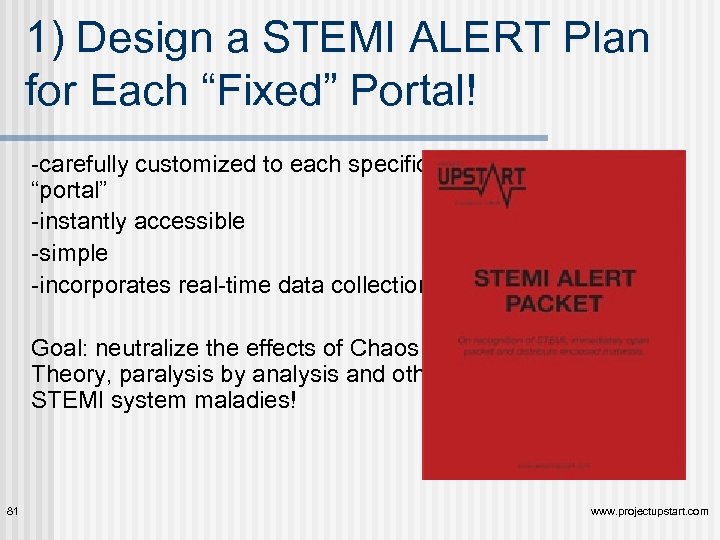
1) Design a STEMI ALERT Plan for Each “Fixed” Portal! -carefully customized to each specific “portal” -instantly accessible -simple -incorporates real-time data collection Goal: neutralize the effects of Chaos Theory, paralysis by analysis and other STEMI system maladies! 81 www. projectupstart. com
2) Work with EMS to Design a Pre-hospital STEMI ALERT Protocol n n 82 Consider EMS a floating “STEMI portal” Up to 50% of STEMI patients may use this “prehospital portal system” Simple protocols will address most needs More on this later www. projectupstart. com
The 5 R’s: R 1 R 2 R 3 R 4 R 5 83 Relationships Recognition Reperfusion Real-time data collection Reassessment & refinement www. projectupstart. com
The “ 5 R’s”: Essential Elements R 4) Real-time Data Collection: Real-time data collection to measure and assess each STEMI Alert You can’t improve what you don’t measure 84 www. projectupstart. com
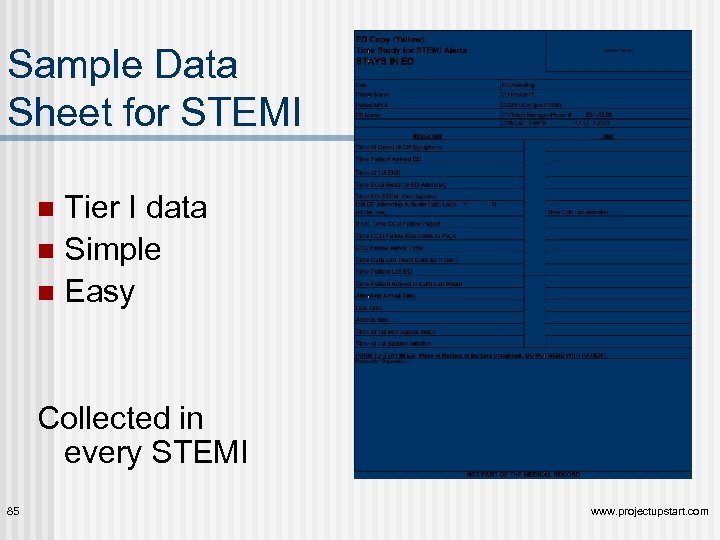
Sample Data Sheet for STEMI Tier I data n Simple n Easy n Collected in every STEMI 85 www. projectupstart. com
The 5 R’s: R 1 R 2 R 3 R 4 R 5 86 Relationships Recognition Reperfusion Real-time data collection Reassessment & Refinement www. projectupstart. com
The “ 5 Rs”: R 5) Reassessment and Refinement: Continual process improvement based on accurate data collected during a standardized & finely-tuned process is now possible! And, a standardized process + ongoing measurement allows for rapid and sustainable improvement 87 www. projectupstart. com
Quality Improvement Science A standardized process (if accurately measured) allows for rapid and sustainable improvement n. If the data is acted on! n. No action will limit improvement! n. Improvement occurs via relationships! 88 www. projectupstart. com
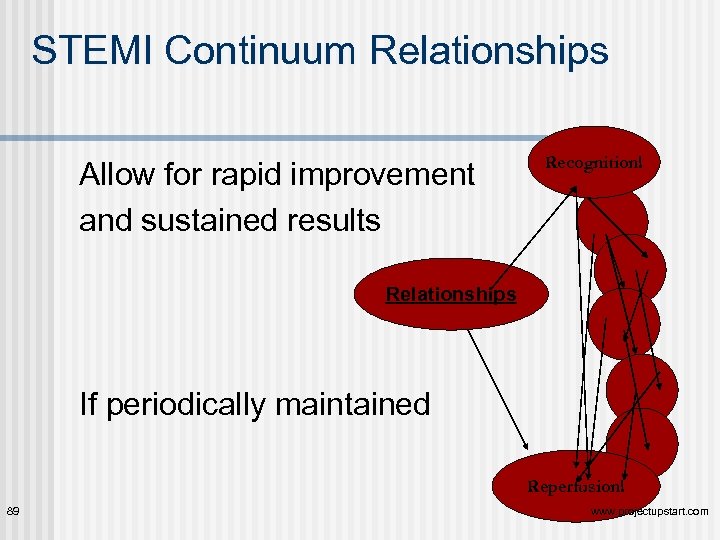
STEMI Continuum Relationships Allow for rapid improvement and sustained results Recognition! Relationships If periodically maintained Reperfusion! 89 www. projectupstart. com
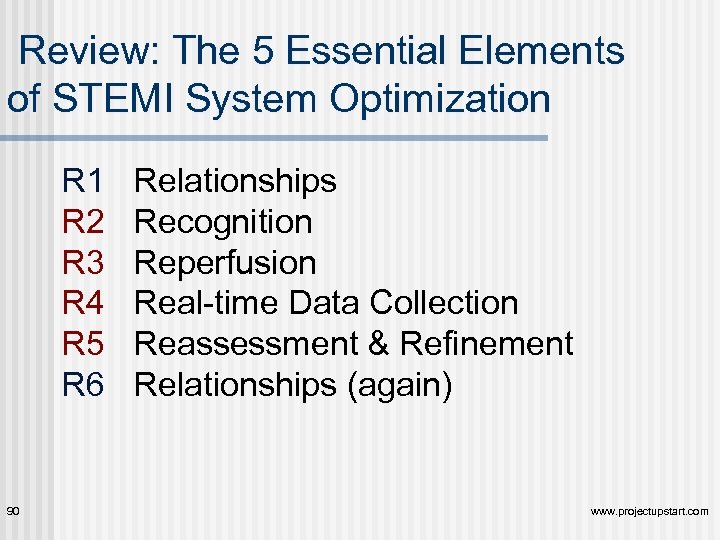
Review: The 5 Essential Elements of STEMI System Optimization R 1 R 2 R 3 R 4 R 5 R 6 90 Relationships Recognition Reperfusion Real-time Data Collection Reassessment & Refinement Relationships (again) www. projectupstart. com
Questions That Drive Relationship Development n Is your hospital a part of a formal regional STEMI system? n Does regular scheduled meetings occur involving all levels of providers and participating facilities of your regional STEMI system? n Can you name your major partner facilities? n Does your hospital have a contact person within each of these facilities? 91 www. projectupstart. com
Questions that Drive Relationship Development n Do you have mechanisms (such as an EMS STEMI Story Board) to constantly let EMS know about cases gone right? n Do you involve patient advocates (STEMI survivors) to help improve your STEMI system? n Do you provide feedback to your EMS providers regarding the pre-hospital ECG process within your system? n Does your system have a formalized method of providing case specific feedback to providers of the entire STEMI care continuum – including EMS/ED/Cardiology/the Cath Lab/QI? 92 www. projectupstart. com
STEMI: The Big Picture n What's going on outside of Bath County?
Mission: Lifeline – The Umbrella
Improving the System of Care for STEMI Patients 95
http: //www. americanheart. org/downloadable/heart/1238103222717 ML_Criteria. pdf 96
virginiaheartattackcoalition. org
To work collaboratively to improve systems of care for the early recognition and treatment of all Virginia residents having heart attacks
virginiaheartattackcoalition. com American Heart Association n EMS n Cardiology n Emergency Medicine n Individuals n Institutions n …. . Everyone working together! n
VHAC Regions
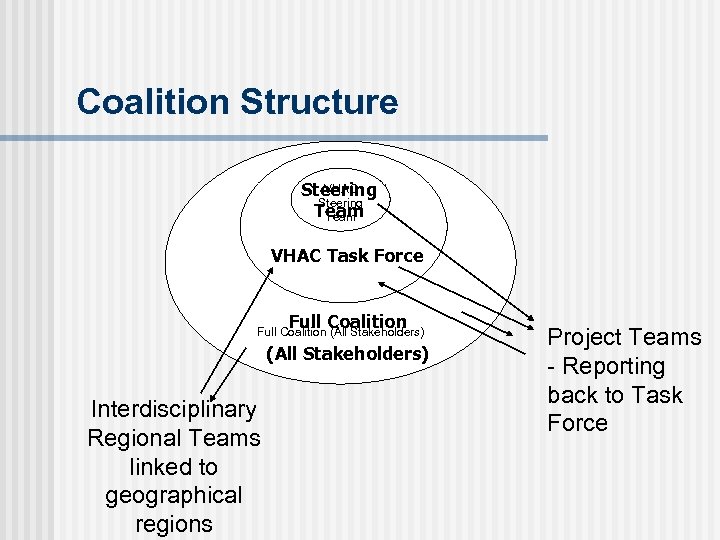
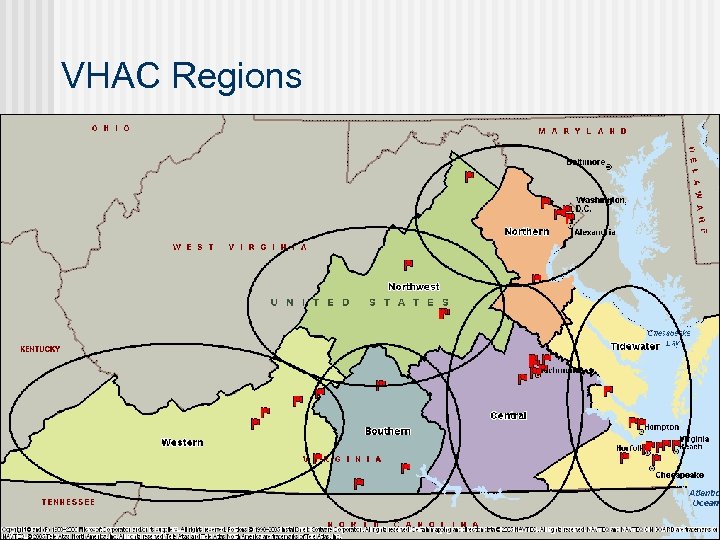
Coalition Structure VHAC Task Steering Force Team VHAC Task Force Full Coalition (All Stakeholders) Interdisciplinary Regional Teams linked to geographical regions Project Teams - Reporting back to Task Force
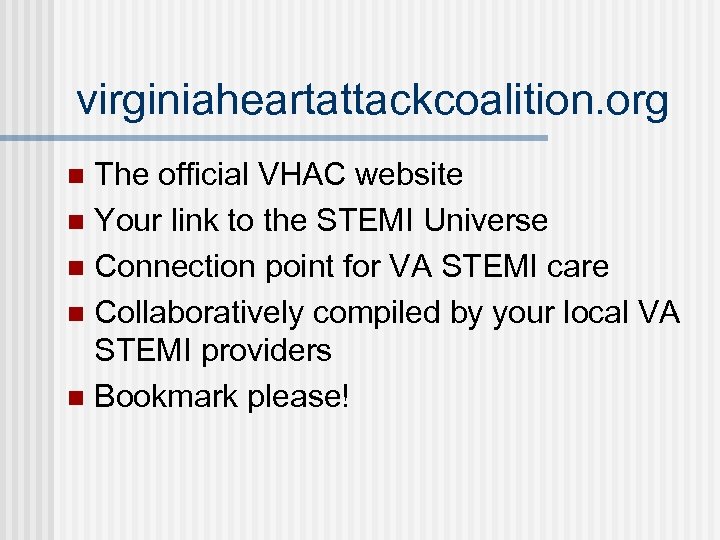
virginiaheartattackcoalition. org The official VHAC website n Your link to the STEMI Universe n Connection point for VA STEMI care n Collaboratively compiled by your local VA STEMI providers n Bookmark please! n

Graduation - Congratulations! Reperfusion Recognition Bath County STEMI Boot Camp!
Questions? ? ? David R. Burt, MD University of Virginia Health System Assistant Professor of Emergency Medicine drb 5 p@virginia. edu 434. 924. 2428
Скачать презентацию STEMI Stroke Boot Camp Lessons from the Trenches
e904de860f4f6705985687a9588d88b5.ppt