


 Скачать презентацию Stefan Schulz Medical Informatics Research Group University Medical
051192a2b035cc1708106628b7859ab4.ppt
- Количество слайдов: 97
 Stefan Schulz Medical Informatics Research Group University Medical Center Freiburg, Germany Biomedical Ontologies What are they (for) ?
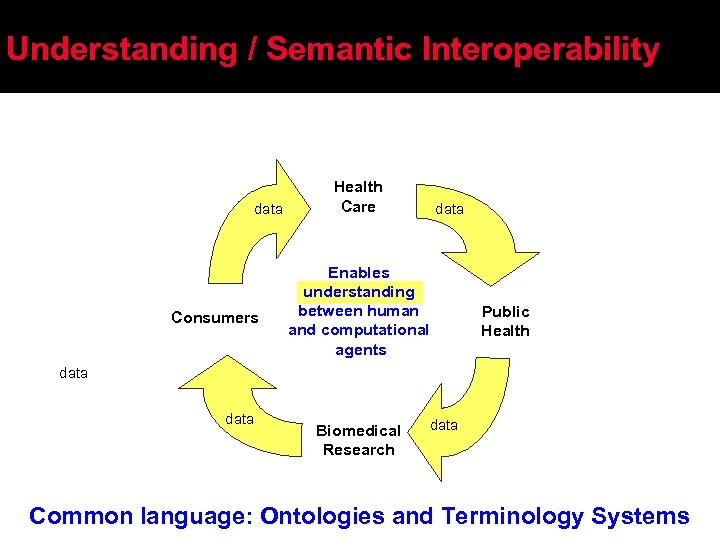 Understanding / Semantic Interoperability data Consumers Health Care data Enables understanding between human and computational agents Public Health data Biomedical Research data Common language: Ontologies and Terminology Systems
 Ontologies and Terminology Systems § aka Knowledge Organization Systems: Systems that support semantic interoperability by communicating and processing information: § § § In a structured form Well-defined Unambiguous Processable by machines Understandable by humans § Life Sciences: major focus for the development of ontologies and terminological systems
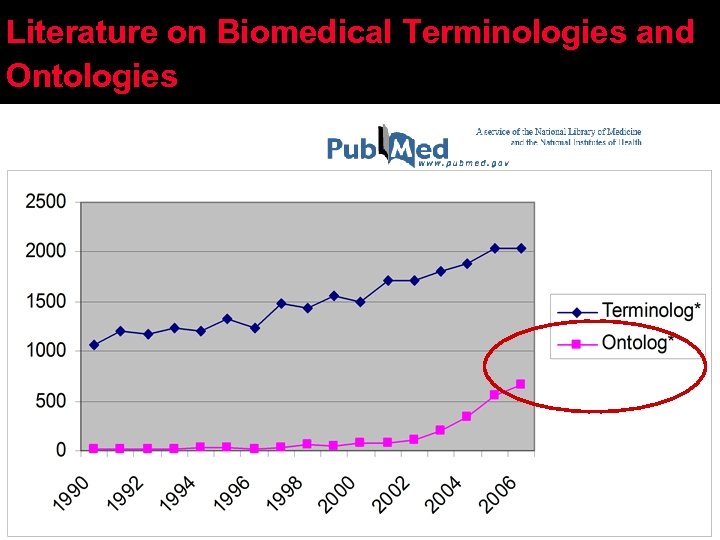 Literature on Biomedical Terminologies and Ontologies
 Purpose of this Talk Formal § What are Ontologies § What are they for ?
 Structure of this talk § Introduction - Current Systems § Terminological Clarification § What do Formal Ontologies Represent ? § Terminologies vs. Formal Ontologies § Practice of Good Ontology § Outlook
 Structure of this talk § Introduction - Current Systems § Terminological Clarification § What do Formal Ontologies Represent ? § Terminologies vs. Formal Ontologies § Practice of Good Ontology § Outlook
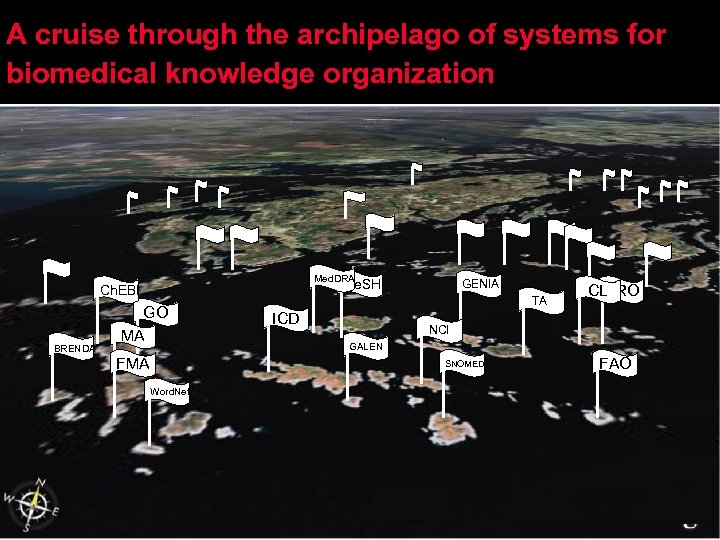 A cruise through the archipelago of systems for biomedical knowledge organization FBcv Med. DRA Me. SH Ch. EBI BRENDA GO MA FMA Word. Net GENIA TA ICD CL GRO NCI GALEN SNOMED FAO
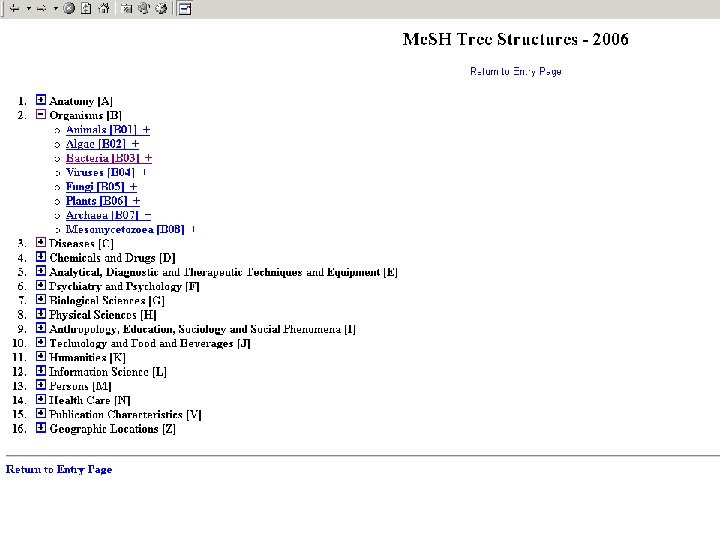
 Me. SH: Medical Subject Headings Me. SH Medical Subject Headings
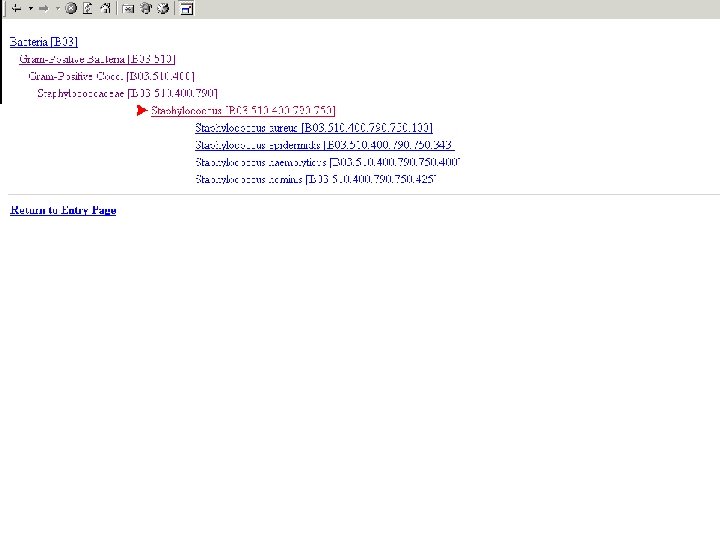
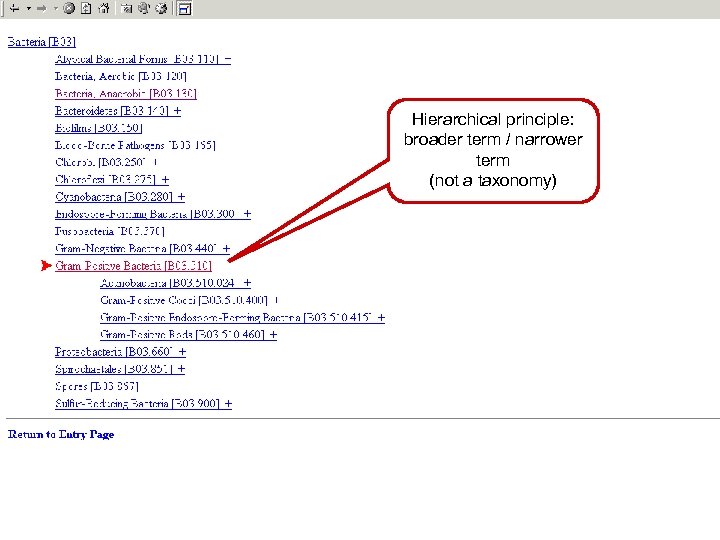 Hierarchical principle: broader term / narrower term (not a taxonomy)
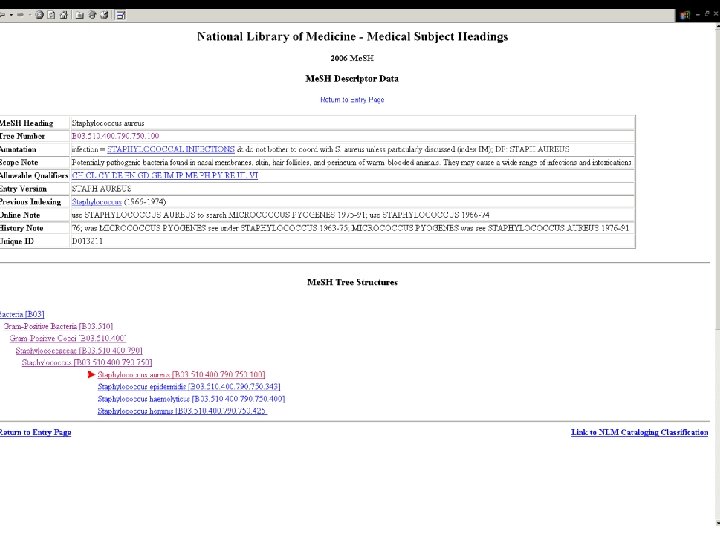
 Me. SH: Medical Subject Headings GO Gene Ontology
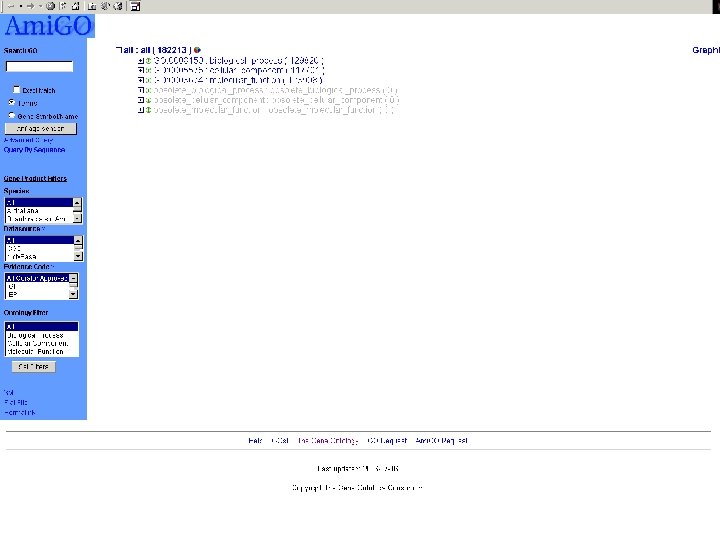
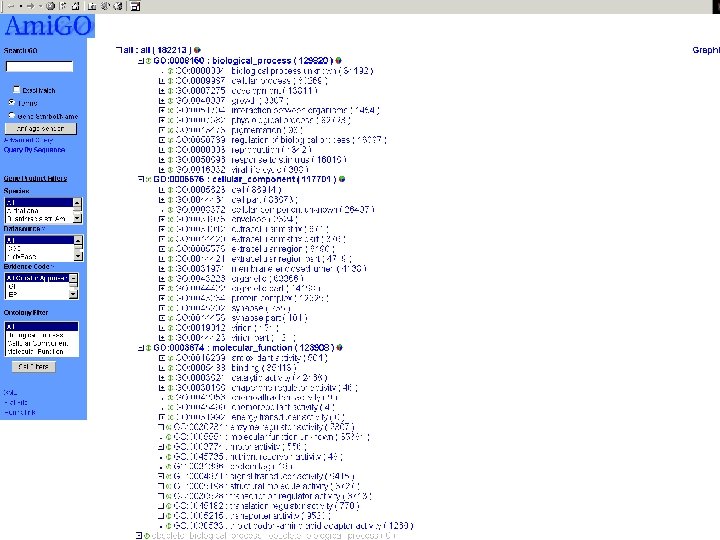
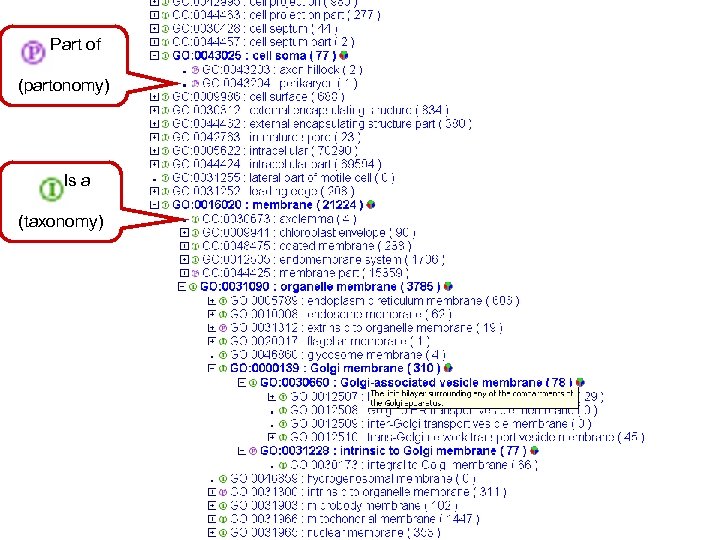 Part of (partonomy) Is a (taxonomy)
 Me. SH: Medical Subject Headings ICD International Classification of Diseases
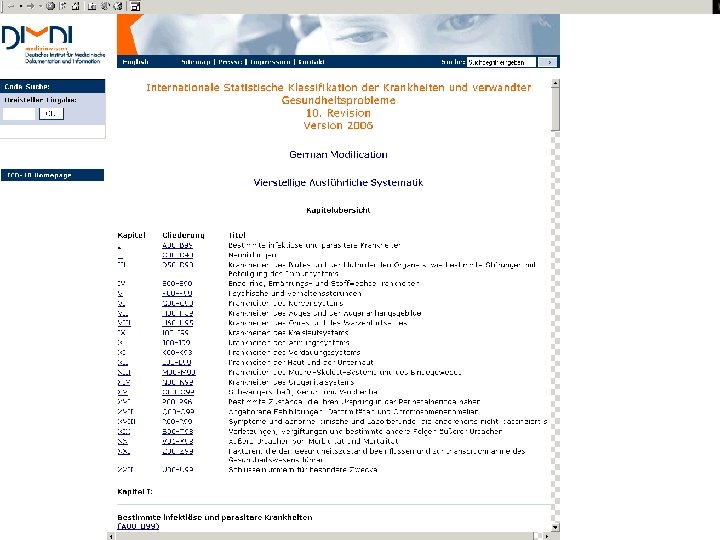
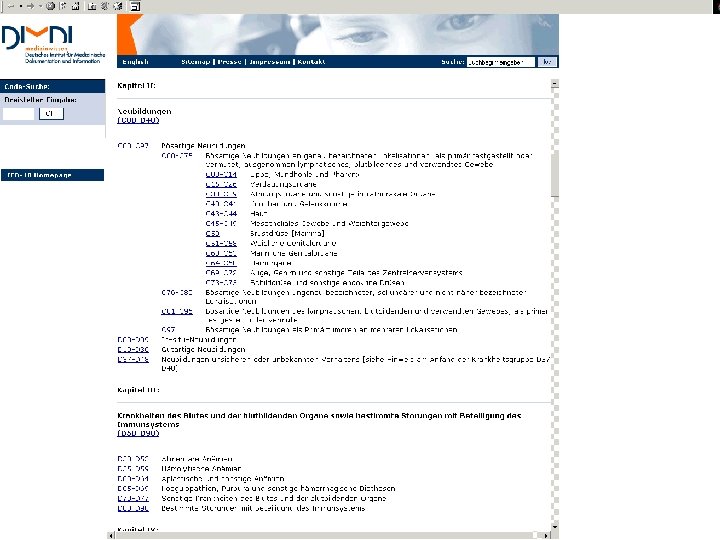
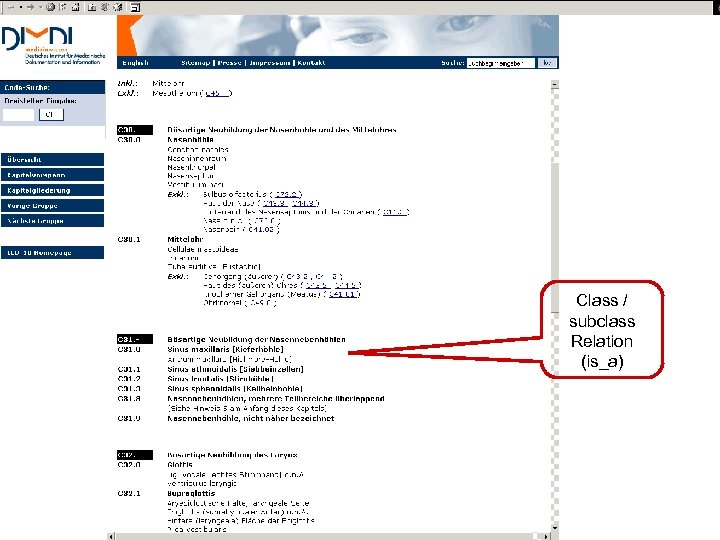 Class / subclass Relation (is_a)
 Me. SH: Medical Subject Headings SNOMED Clinical Terms
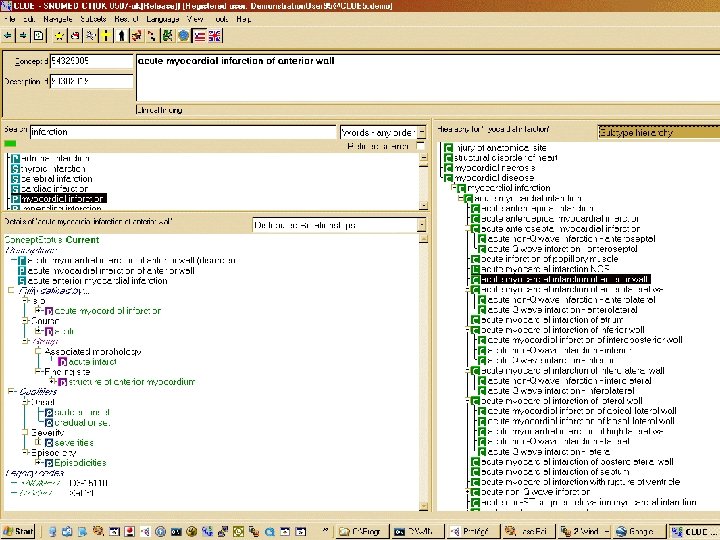
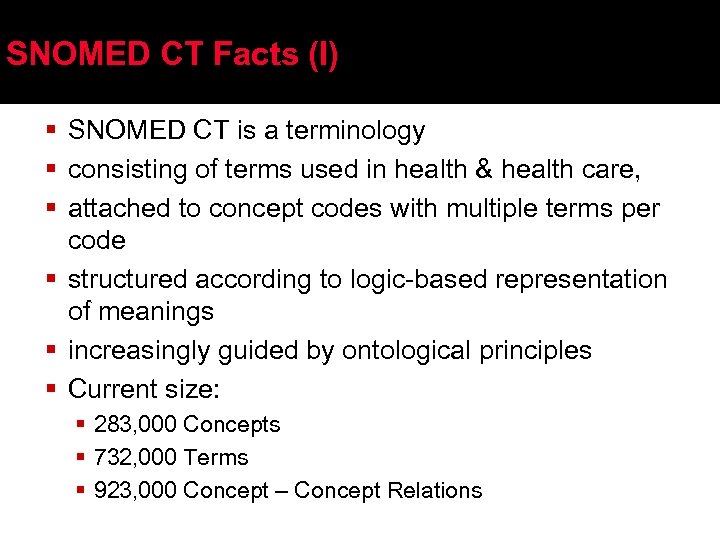 SNOMED CT Facts (I) § SNOMED CT is a terminology § consisting of terms used in health & health care, § attached to concept codes with multiple terms per code § structured according to logic-based representation of meanings § increasingly guided by ontological principles § Current size: § 283, 000 Concepts § 732, 000 Terms § 923, 000 Concept – Concept Relations
 SNOMED CT Facts (II) § Since 2007: Maintained by IHTSDO (International Health Terminology standards development organization) § Members: Australia, Canada, Denmark, Lithuania, The Netherlands, New Zealand, Sweden, UK, USA. § Annual budget ~ 5 M€
 Different Purposes – Heterogeneous Approaches
![Different Purposes – Heterogeneous Approaches § Me. SH [Medical Subject Headings]: Hierarchy (broader /](https://present5.com/presentation/051192a2b035cc1708106628b7859ab4/image-27.jpg "Different Purposes – Heterogeneous Approaches § Me. SH [Medical Subject Headings]: Hierarchy (broader /") Different Purposes – Heterogeneous Approaches § Me. SH [Medical Subject Headings]: Hierarchy (broader / narrower) of descriptors, used for indexing biomedical publications for literature retrieval support § GO [Gene Ontology]: Hierarchy (is_a / part_of) of controlled terms for describing gene an gene product properties § ICD [International Classification of Diseases]: Strict Hierarchy of non-overlapping classes for classifying statistically relevant health conditions § SNOMED CT [Systematized Nomenclature of Medicine – Clinical Terms ]: Hierarchical system of concepts with (partially) logicbased concept definitions
Different Purposes – Heterogeneous Approaches § Me. SH [Medical Subject Headings]: Hierarchy (broader / narrower) of descriptors, used for indexing biomedical publications for literature retrieval support § GO [Gene Ontology]: Hierarchy (is_a / part_of) of controlled terms for describing gene an gene product properties § ICD [International Classification of Diseases]: Strict Hierarchy of non-overlapping classes for classifying statistically relevant health conditions § SNOMED CT [Systematized Nomenclature of Medicine – Clinical Terms ]: Hierarchical system of concepts with (partially) logicbased concept definitions
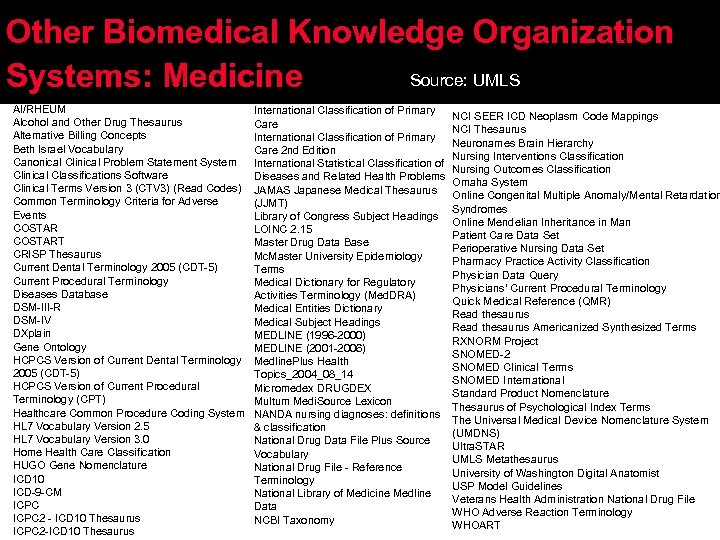 Other Biomedical Knowledge Organization Source: UMLS Systems: Medicine AI/RHEUM Alcohol and Other Drug Thesaurus Alternative Billing Concepts Beth Israel Vocabulary Canonical Clinical Problem Statement System Clinical Classifications Software Clinical Terms Version 3 (CTV 3) (Read Codes) Common Terminology Criteria for Adverse Events COSTART CRISP Thesaurus Current Dental Terminology 2005 (CDT-5) Current Procedural Terminology Diseases Database DSM-III-R DSM-IV DXplain Gene Ontology HCPCS Version of Current Dental Terminology 2005 (CDT-5) HCPCS Version of Current Procedural Terminology (CPT) Healthcare Common Procedure Coding System HL 7 Vocabulary Version 2. 5 HL 7 Vocabulary Version 3. 0 Home Health Care Classification HUGO Gene Nomenclature ICD 10 ICD-9 -CM ICPC 2 - ICD 10 Thesaurus ICPC 2 -ICD 10 Thesaurus International Classification of Primary Care 2 nd Edition International Statistical Classification of Diseases and Related Health Problems JAMAS Japanese Medical Thesaurus (JJMT) Library of Congress Subject Headings LOINC 2. 15 Master Drug Data Base Mc. Master University Epidemiology Terms Medical Dictionary for Regulatory Activities Terminology (Med. DRA) Medical Entities Dictionary Medical Subject Headings MEDLINE (1996 -2000) MEDLINE (2001 -2006) Medline. Plus Health Topics_2004_08_14 Micromedex DRUGDEX Multum Medi. Source Lexicon NANDA nursing diagnoses: definitions & classification National Drug Data File Plus Source Vocabulary National Drug File - Reference Terminology National Library of Medicine Medline Data NCBI Taxonomy NCI SEER ICD Neoplasm Code Mappings NCI Thesaurus Neuronames Brain Hierarchy Nursing Interventions Classification Nursing Outcomes Classification Omaha System Online Congenital Multiple Anomaly/Mental Retardation Syndromes Online Mendelian Inheritance in Man Patient Care Data Set Perioperative Nursing Data Set Pharmacy Practice Activity Classification Physician Data Query Physicians' Current Procedural Terminology Quick Medical Reference (QMR) Read thesaurus Americanized Synthesized Terms RXNORM Project SNOMED-2 SNOMED Clinical Terms SNOMED International Standard Product Nomenclature Thesaurus of Psychological Index Terms The Universal Medical Device Nomenclature System (UMDNS) Ultra. STAR UMLS Metathesaurus University of Washington Digital Anatomist USP Model Guidelines Veterans Health Administration National Drug File WHO Adverse Reaction Terminology WHOART
 Other Biomedical Knowledge Organization Systems: Biology (OBO)
 Structure of this talk § Introduction - Current Systems § Terminological Clarification § What do Formal Ontologies Represent ? § Terminologies vs. Formal Ontologies § Practice of Good Ontology § Outlook
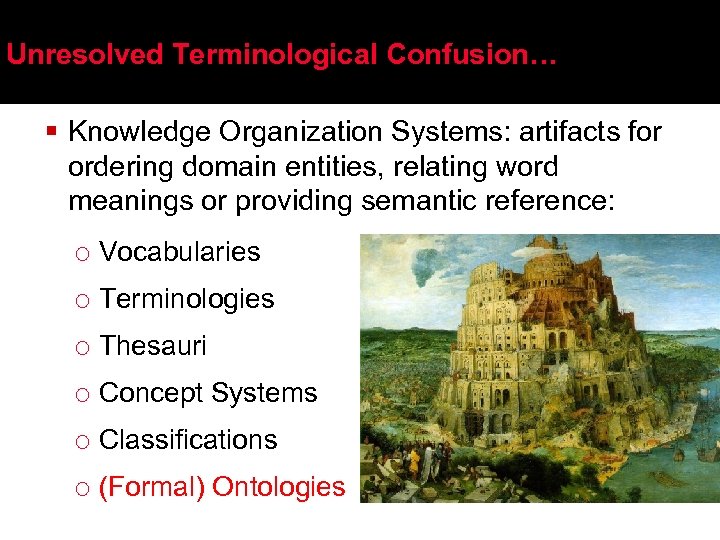 Unresolved Terminological Confusion… § Knowledge Organization Systems: artifacts for ordering domain entities, relating word meanings or providing semantic reference: ¡ Vocabularies ¡ Terminologies ¡ Thesauri ¡ Concept Systems ¡ Classifications ¡ (Formal) Ontologies
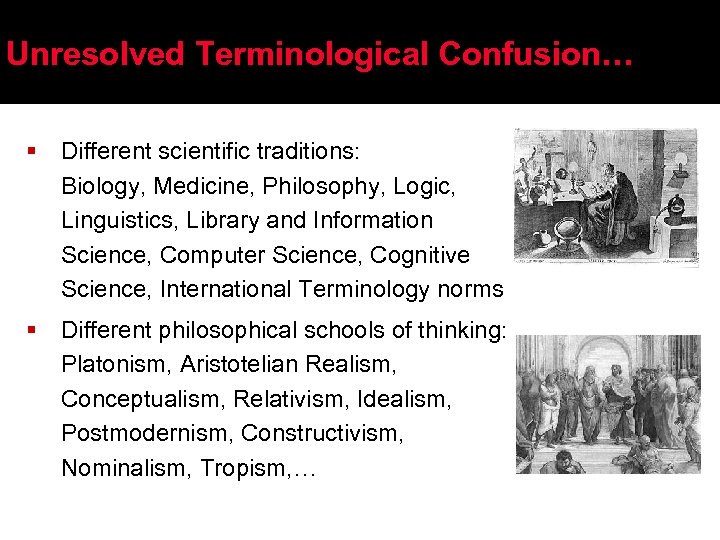 Unresolved Terminological Confusion… § Different scientific traditions: Biology, Medicine, Philosophy, Logic, Linguistics, Library and Information Science, Computer Science, Cognitive Science, International Terminology norms § Different philosophical schools of thinking: Platonism, Aristotelian Realism, Conceptualism, Relativism, Idealism, Postmodernism, Constructivism, Nominalism, Tropism, …
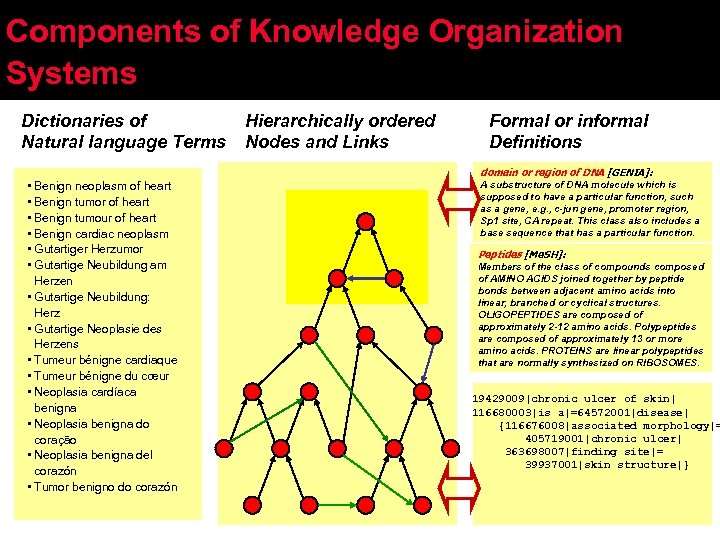 Components of Knowledge Organization Systems Dictionaries of Natural language Terms Hierarchically ordered Nodes and Links Formal or informal Definitions domain or region of DNA [GENIA]: • Benign neoplasm of heart • Benign tumor of heart • Benign tumour of heart • Benign cardiac neoplasm • Gutartiger Herzumor • Gutartige Neubildung am Herzen • Gutartige Neubildung: Herz • Gutartige Neoplasie des Herzens • Tumeur bénigne cardiaque • Tumeur bénigne du cœur • Neoplasia cardíaca benigna • Neoplasia benigna do coração • Neoplasia benigna del corazón • Tumor benigno do corazón A substructure of DNA molecule which is supposed to have a particular function, such as a gene, e. g. , c-jun gene, promoter region, Sp 1 site, CA repeat. This class also includes a base sequence that has a particular function. Peptides [Me. SH]: Members of the class of compounds composed of AMINO ACIDS joined together by peptide bonds between adjacent amino acids into linear, branched or cyclical structures. OLIGOPEPTIDES are composed of approximately 2 -12 amino acids. Polypeptides are composed of approximately 13 or more amino acids. PROTEINS are linear polypeptides that are normally synthesized on RIBOSOMES. 19429009|chronic ulcer of skin| 116680003|is a|=64572001|disease| {116676008|associated morphology|= 405719001|chronic ulcer| 363698007|finding site|= 39937001|skin structure|}
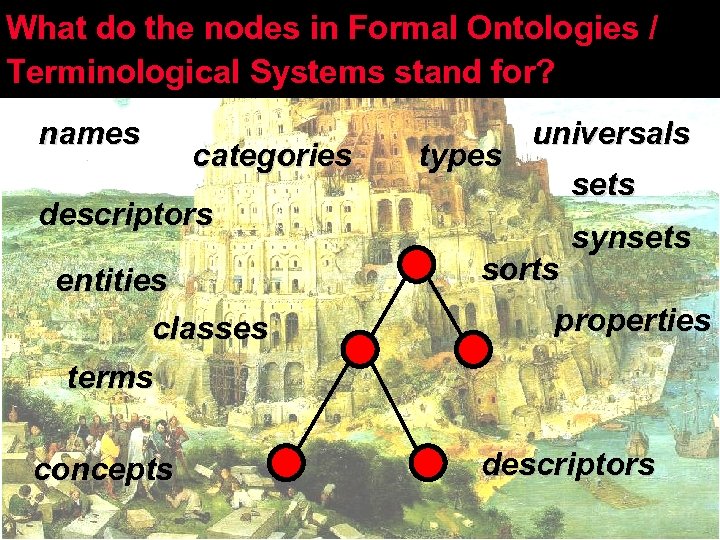 What do the nodes in Formal Ontologies / Terminological Systems stand for? names categories types universals sets descriptors entities classes sorts synsets properties terms concepts descriptors
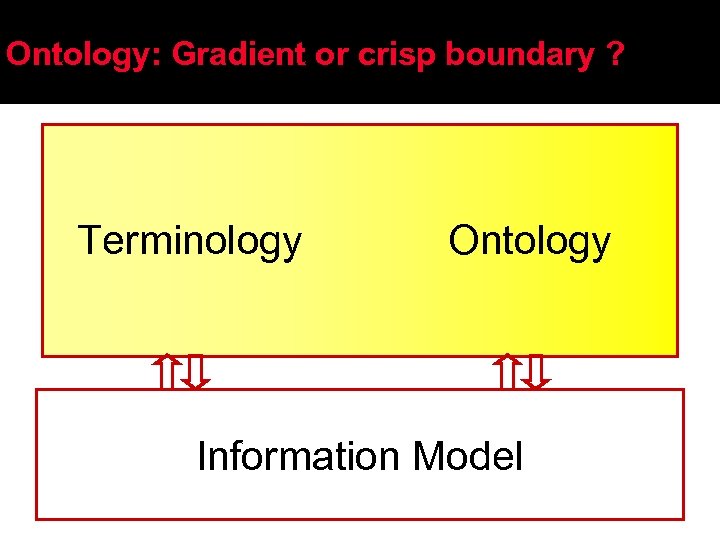 Ontology: Gradient or crisp boundary ? Terminology Ontology Information Model
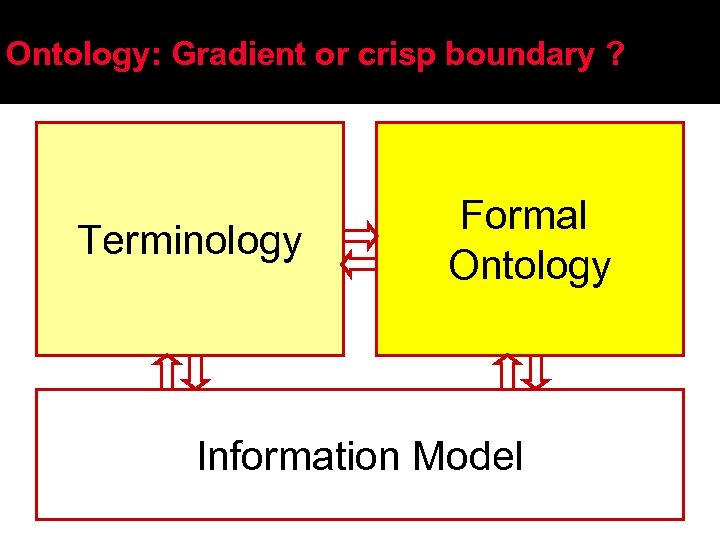 Ontology: Gradient or crisp boundary ? Terminology Formal Ontology Information Model
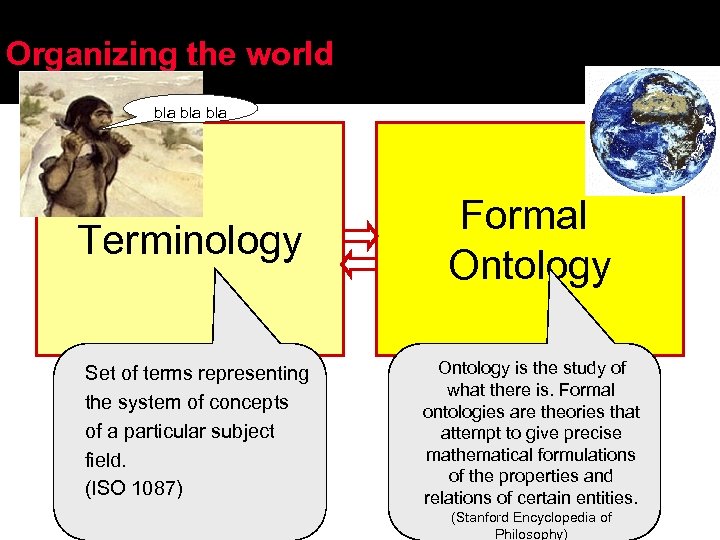 Organizing the world bla bla Terminology Set of terms representing the system of concepts of a particular subject field. (ISO 1087) Formal Ontology is the study of what there is. Formal ontologies are theories that attempt to give precise mathematical formulations of the properties and relations of certain entities. (Stanford Encyclopedia of Philosophy)
 Structure of this talk § Introduction - Current Systems § Terminological Clarification § What do Formal Ontologies Represent ? § Terminologies vs. Formal Ontologies § Practice of Good Ontology § Outlook
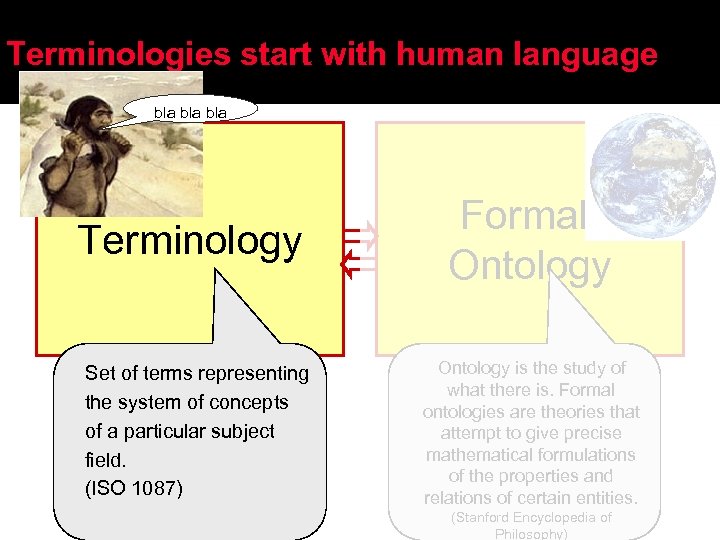 Terminologies start with human language bla bla Terminology Set of terms representing the system of concepts of a particular subject field. (ISO 1087) Formal Ontology is the study of what there is. Formal ontologies are theories that attempt to give precise mathematical formulations of the properties and relations of certain entities. (Stanford Encyclopedia of Philosophy)
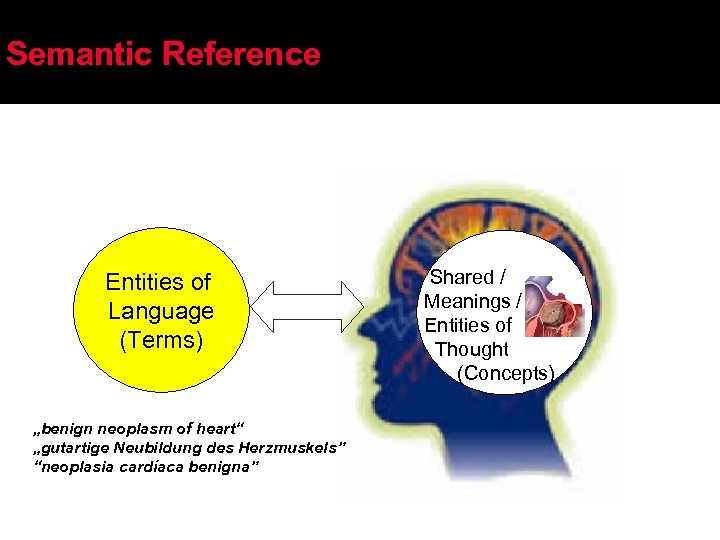 Semantic Reference Entities of Language (Terms) „benign neoplasm of heart“ „gutartige Neubildung des Herzmuskels” “neoplasia cardíaca benigna” Shared / Meanings / Entities of Thought (Concepts)
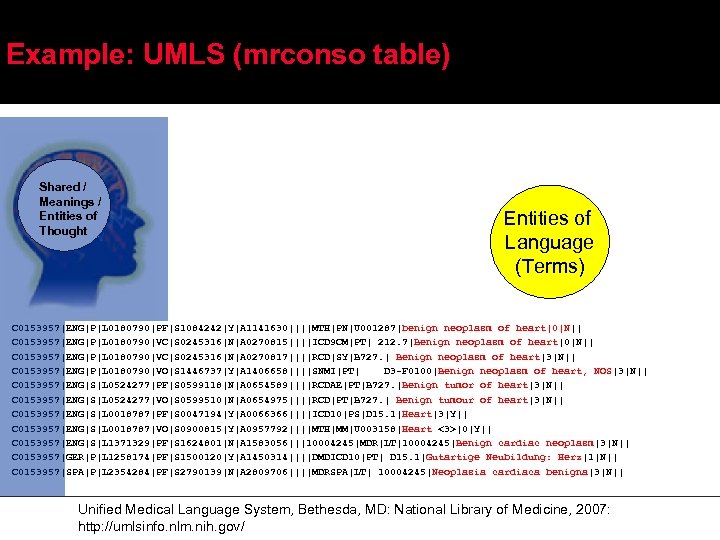 Example: UMLS (mrconso table) Shared / Meanings / Entities of Thought Entities of Language (Terms) C 0153957|ENG|P|L 0180790|PF|S 1084242|Y|A 1141630||||MTH|PN|U 001287|benign neoplasm of heart|0|N|| C 0153957|ENG|P|L 0180790|VC|S 0245316|N|A 0270815||||ICD 9 CM|PT| 212. 7|Benign neoplasm of heart|0|N|| C 0153957|ENG|P|L 0180790|VC|S 0245316|N|A 0270817||||RCD|SY|B 727. | Benign neoplasm of heart|3|N|| C 0153957|ENG|P|L 0180790|VO|S 1446737|Y|A 1406658||||SNMI|PT| D 3 -F 0100|Benign neoplasm of heart, NOS|3|N|| C 0153957|ENG|S|L 0524277|PF|S 0599118|N|A 0654589||||RCDAE|PT|B 727. |Benign tumor of heart|3|N|| C 0153957|ENG|S|L 0524277|VO|S 0599510|N|A 0654975||||RCD|PT|B 727. | Benign tumour of heart|3|N|| C 0153957|ENG|S|L 0018787|PF|S 0047194|Y|A 0066366||||ICD 10|PS|D 15. 1|Heart|3|Y|| C 0153957|ENG|S|L 0018787|VO|S 0900815|Y|A 0957792||||MTH|MM|U 003158|Heart <3>|0|Y|| C 0153957|ENG|S|L 1371329|PF|S 1624801|N|A 1583056|||10004245|MDR|LT|10004245|Benign cardiac neoplasm|3|N|| C 0153957|GER|P|L 1258174|PF|S 1500120|Y|A 1450314||||DMDICD 10|PT| D 15. 1|Gutartige Neubildung: Herz|1|N|| C 0153957|SPA|P|L 2354284|PF|S 2790139|N|A 2809706||||MDRSPA|LT| 10004245|Neoplasia cardiaca benigna|3|N|| Unified Medical Language System, Bethesda, MD: National Library of Medicine, 2007: http: //umlsinfo. nlm. nih. gov/
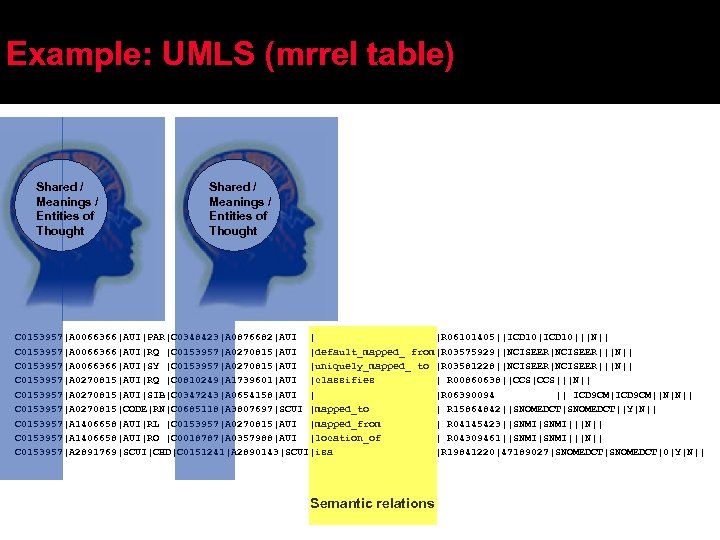 Example: UMLS (mrrel table) Shared / Meanings / Entities of Thought C 0153957|A 0066366|AUI|PAR|C 0348423|A 0876682|AUI | |R 06101405||ICD 10|||N|| C 0153957|A 0066366|AUI|RQ |C 0153957|A 0270815|AUI |default_mapped_ from|R 03575929||NCISEER|||N|| C 0153957|A 0066366|AUI|SY |C 0153957|A 0270815|AUI |uniquely_mapped_ to |R 03581228||NCISEER|||N|| C 0153957|A 0270815|AUI|RQ |C 0810249|A 1739601|AUI |classifies | R 00860638||CCS|||N|| C 0153957|A 0270815|AUI|SIB|C 0347243|A 0654158|AUI | |R 06390094 || ICD 9 CM||N|N|| C 0153957|A 0270815|CODE|RN|C 0685118|A 3807697|SCUI |mapped_to | R 15864842||SNOMEDCT||Y|N|| C 0153957|A 1406658|AUI|RL |C 0153957|A 0270815|AUI |mapped_from | R 04145423||SNMI|||N|| C 0153957|A 1406658|AUI|RO |C 0018787|A 0357988|AUI |location_of | R 04309461||SNMI|||N|| C 0153957|A 2891769|SCUI|CHD|C 0151241|A 2890143|SCUI|isa |R 19841220|47189027|SNOMEDCT|0|Y|N|| Semantic relations
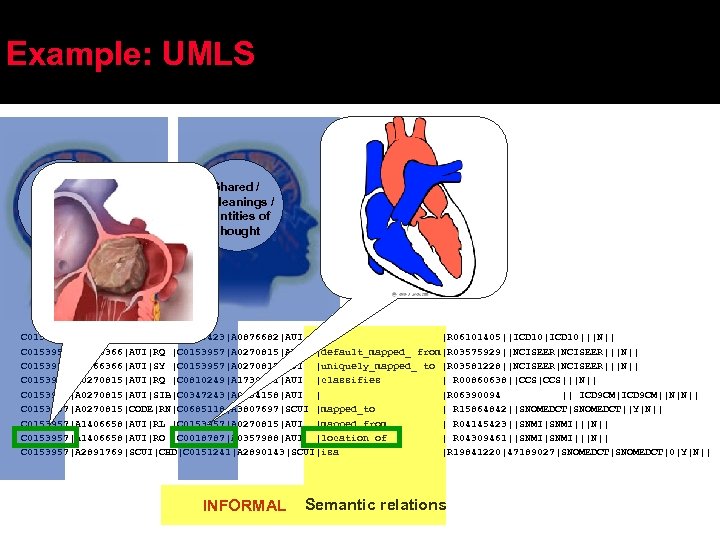 Example: UMLS Shared / Meanings / Entities of Thought C 0153957|A 0066366|AUI|PAR|C 0348423|A 0876682|AUI | |R 06101405||ICD 10|||N|| C 0153957|A 0066366|AUI|RQ |C 0153957|A 0270815|AUI |default_mapped_ from|R 03575929||NCISEER|||N|| C 0153957|A 0066366|AUI|SY |C 0153957|A 0270815|AUI |uniquely_mapped_ to |R 03581228||NCISEER|||N|| C 0153957|A 0270815|AUI|RQ |C 0810249|A 1739601|AUI |classifies | R 00860638||CCS|||N|| C 0153957|A 0270815|AUI|SIB|C 0347243|A 0654158|AUI | |R 06390094 || ICD 9 CM||N|N|| C 0153957|A 0270815|CODE|RN|C 0685118|A 3807697|SCUI |mapped_to | R 15864842||SNOMEDCT||Y|N|| C 0153957|A 1406658|AUI|RL |C 0153957|A 0270815|AUI |mapped_from | R 04145423||SNMI|||N|| C 0153957|A 1406658|AUI|RO |C 0018787|A 0357988|AUI |location_of | R 04309461||SNMI|||N|| C 0153957|A 2891769|SCUI|CHD|C 0151241|A 2890143|SCUI|isa |R 19841220|47189027|SNOMEDCT|0|Y|N|| INFORMAL Semantic relations
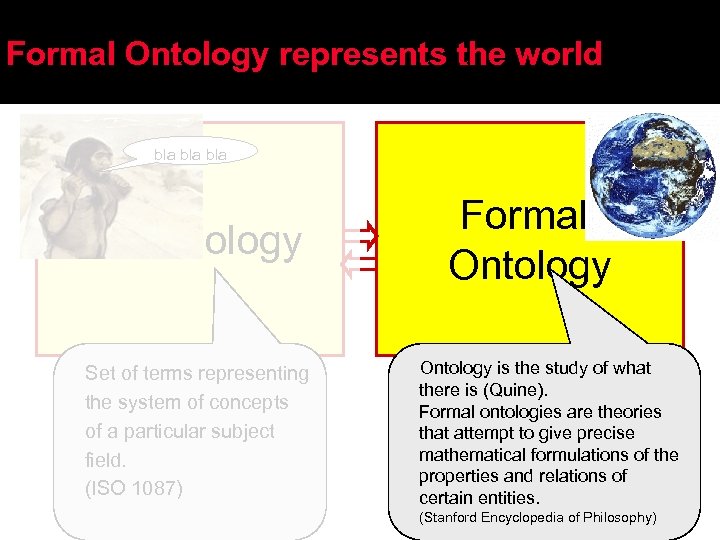 Formal Ontology represents the world bla bla Terminology Set of terms representing the system of concepts of a particular subject field. (ISO 1087) Formal Ontology is the study of what there is (Quine). Formal ontologies are theories that attempt to give precise mathematical formulations of the properties and relations of certain entities. (Stanford Encyclopedia of Philosophy)
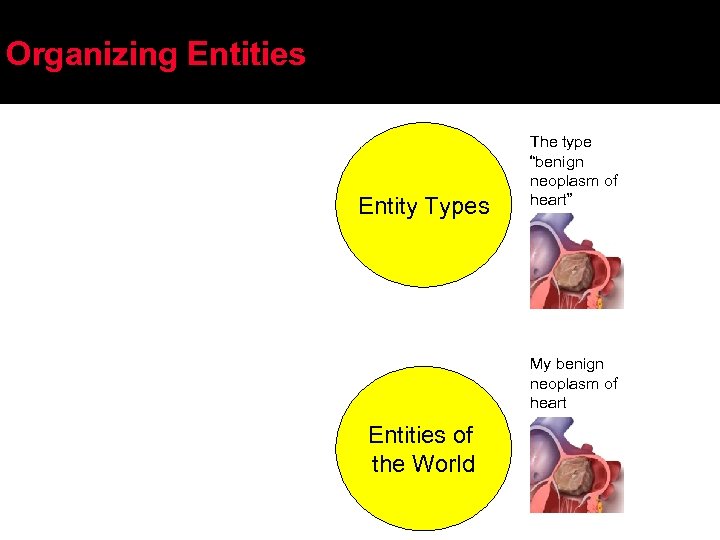 Organizing Entities Entity Types The type “benign neoplasm of heart” My benign neoplasm of heart Entities of the World
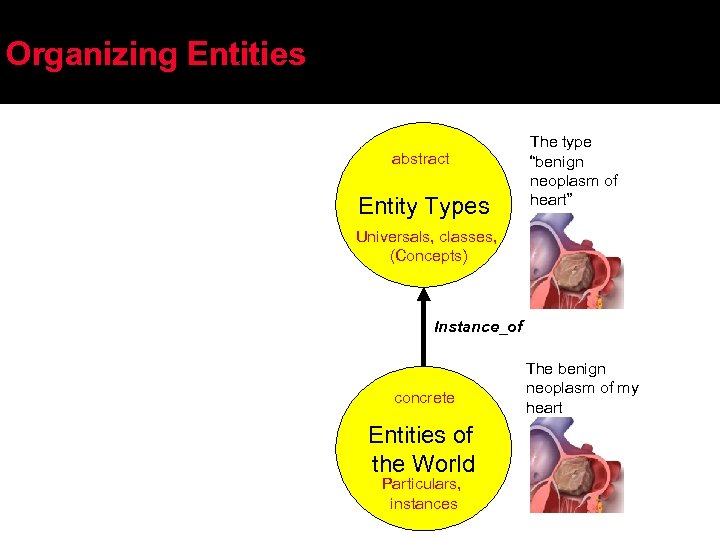 Organizing Entities abstract Entity Types The type “benign neoplasm of heart” Universals, classes, (Concepts) Instance_of concrete Entities of the World Particulars, instances The benign neoplasm of my heart
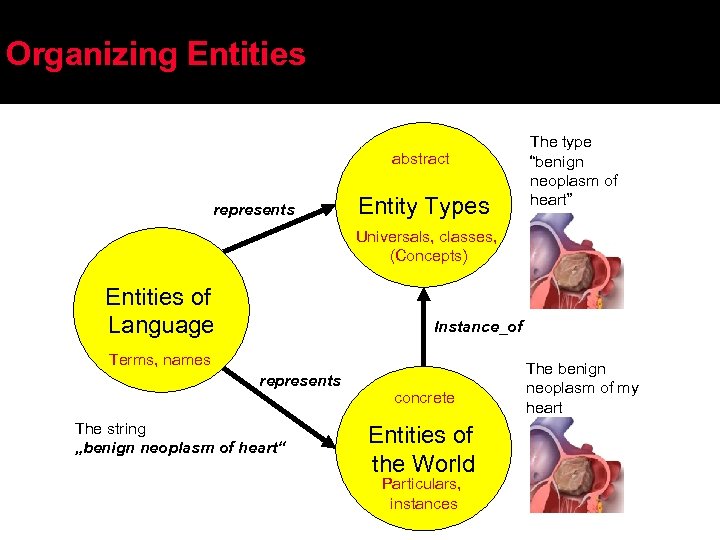 Organizing Entities abstract represents Entity Types The type “benign neoplasm of heart” Universals, classes, (Concepts) Entities of Language Instance_of Terms, names represents The string „benign neoplasm of heart“ concrete Entities of the World Particulars, instances The benign neoplasm of my heart
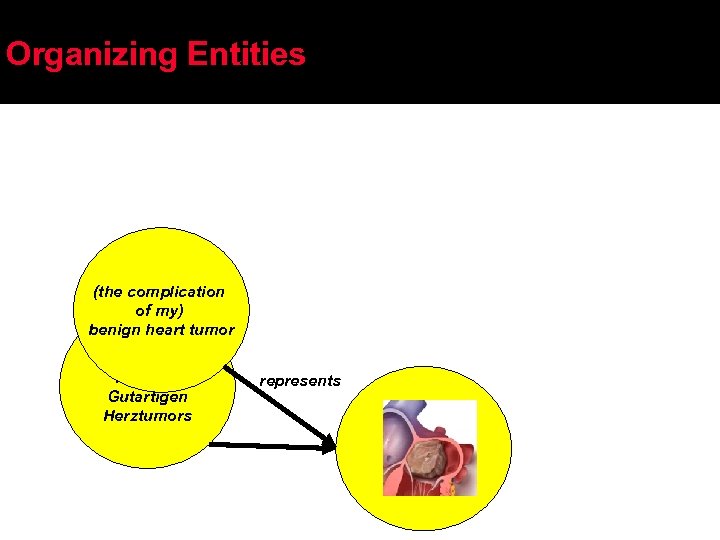 Organizing Entities (the complication of my) benign heart tumor (die Komplikation meines) Gutartigen Herztumors represents
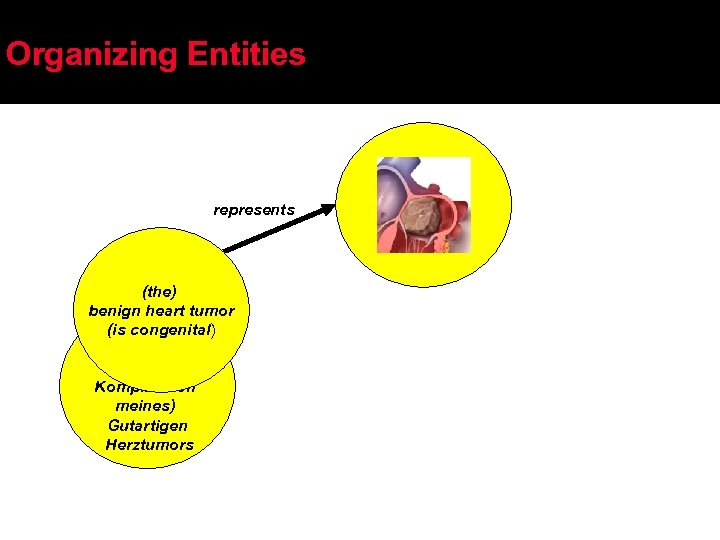 Organizing Entities represents (the) benign heart tumor (is congenital) Terms, names (die Komplikation meines) Gutartigen Herztumors
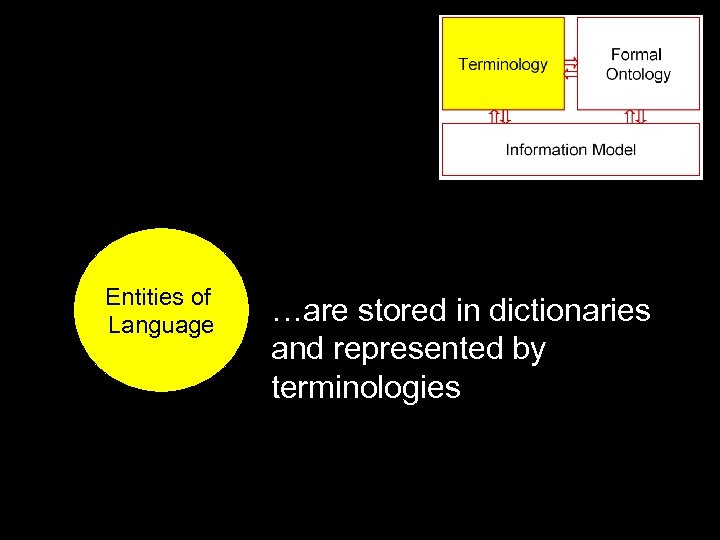 Entities of Language …are stored in dictionaries and represented by terminologies
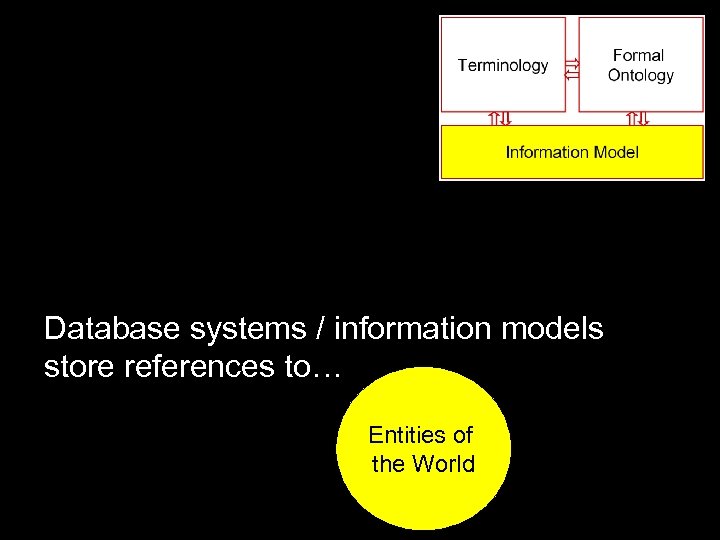 Database systems / information models store references to… Entities of the World
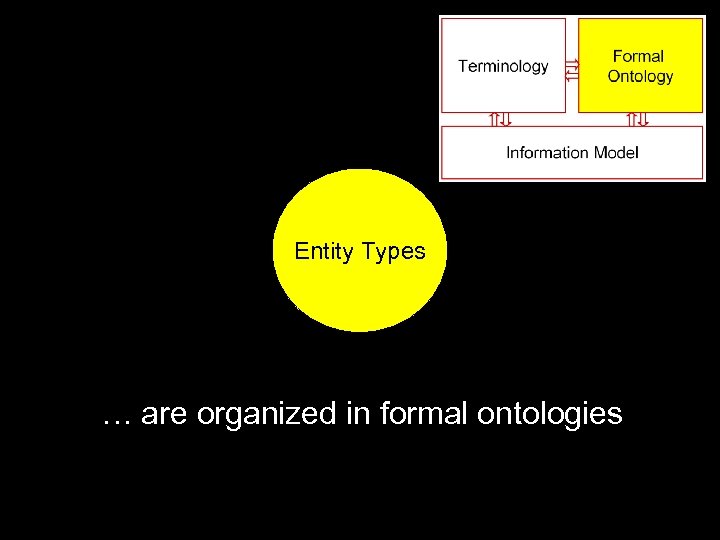 Entity Types … are organized in formal ontologies
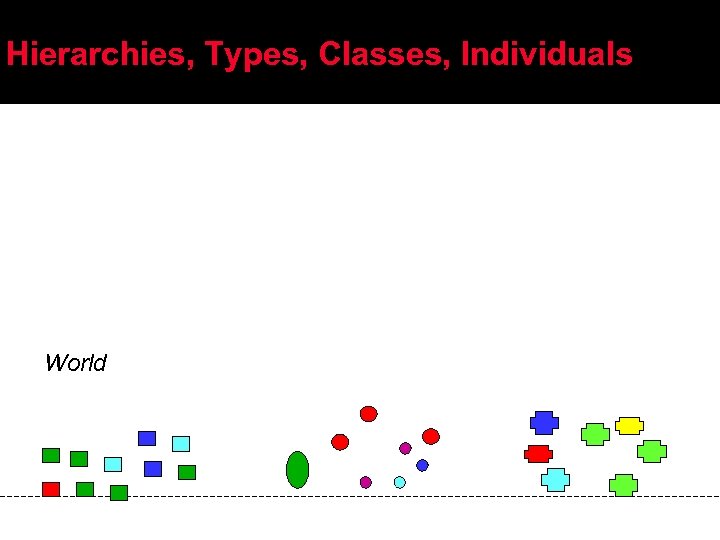
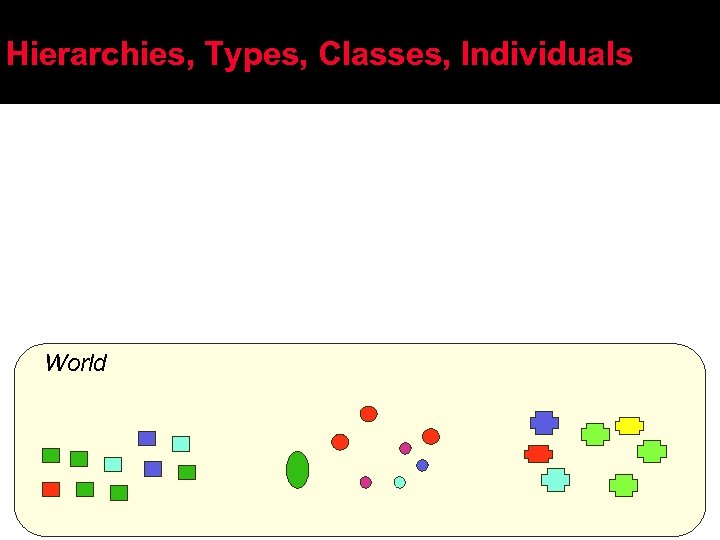
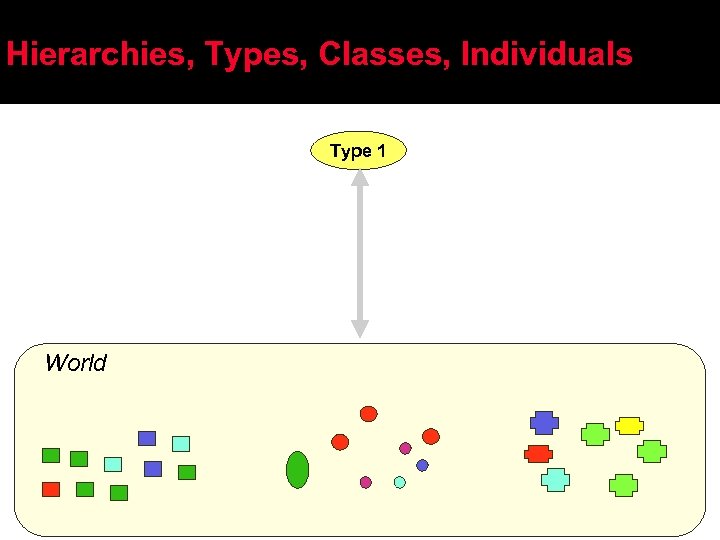
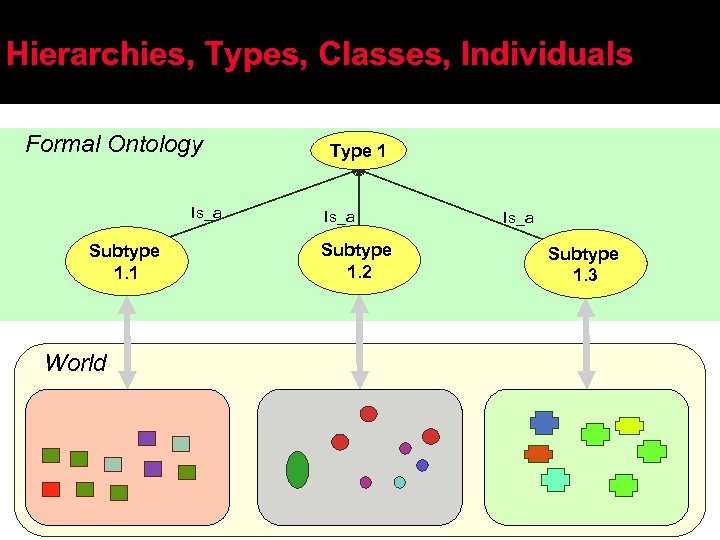
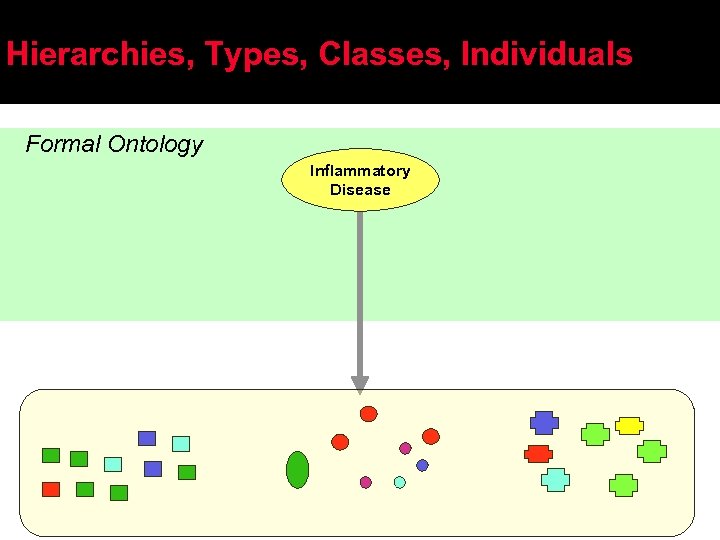
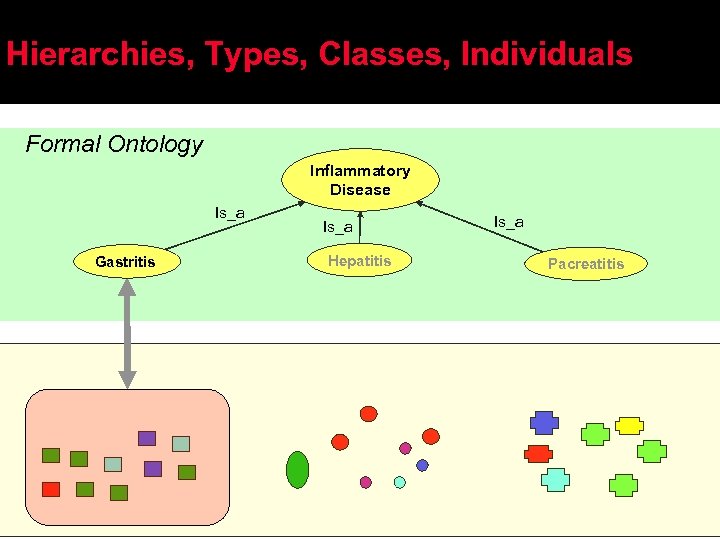
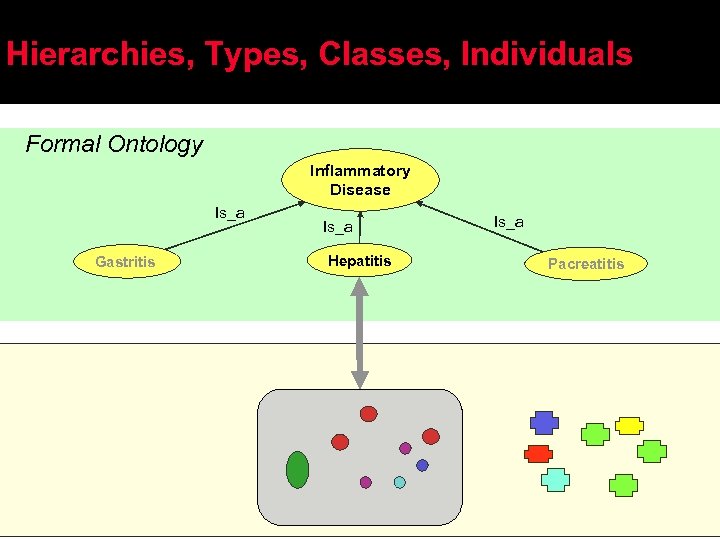
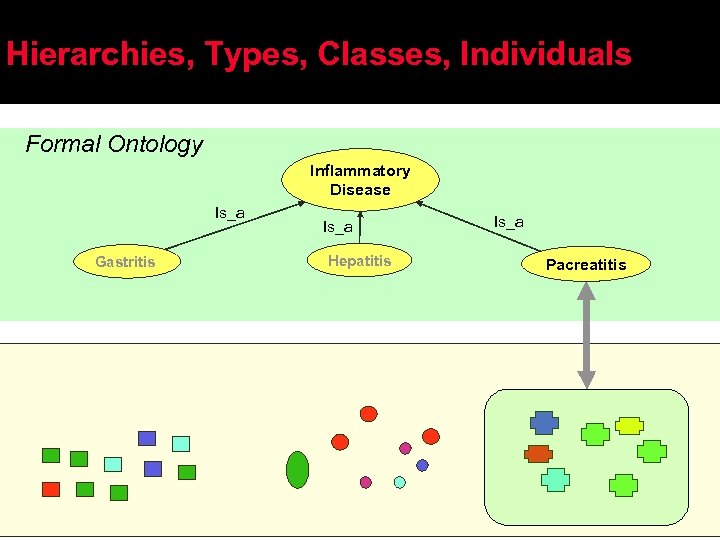
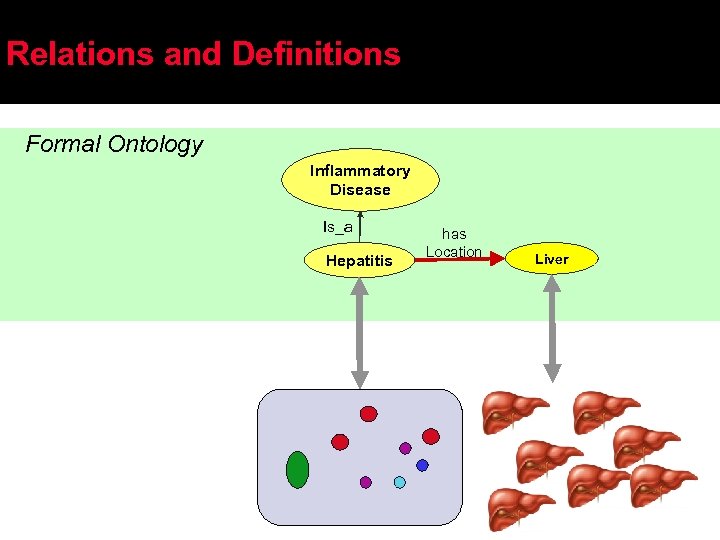
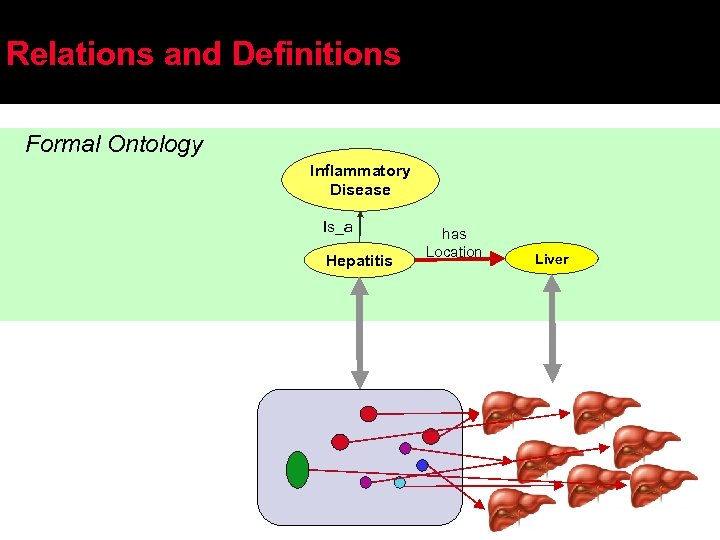
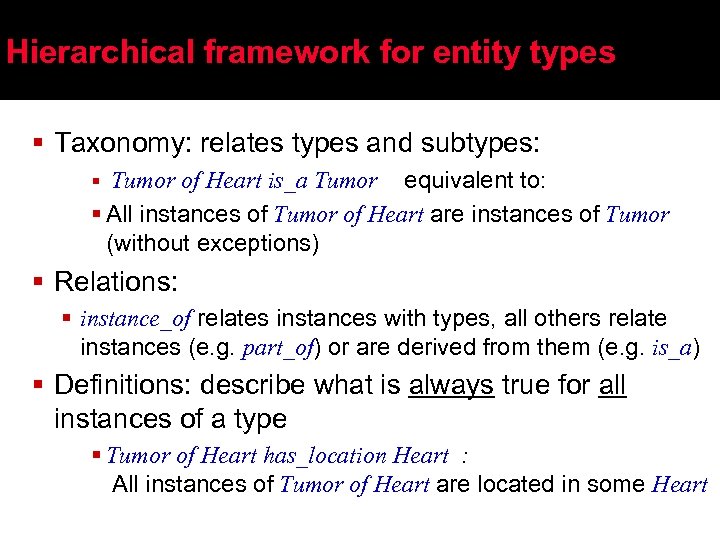 Hierarchical framework for entity types § Taxonomy: relates types and subtypes: § Tumor of Heart is_a Tumor equivalent to: § All instances of Tumor of Heart are instances of Tumor (without exceptions) § Relations: § instance_of relates instances with types, all others relate instances (e. g. part_of) or are derived from them (e. g. is_a) § Definitions: describe what is always true for all instances of a type § Tumor of Heart has_location Heart : All instances of Tumor of Heart are located in some Heart
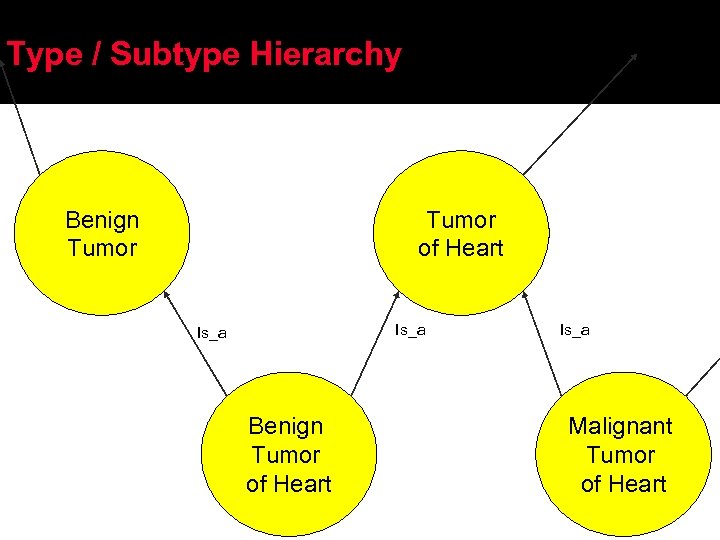 Type / Subtype Hierarchy Benign Tumor of Heart Is_a Malignant Tumor of Heart
 A classification view on Formal Ontologies World
 Hierarchies, Types, Classes, Individuals World
 Hierarchies, Types, Classes, Individuals World
 Hierarchies, Types, Classes, Individuals Type 1 World
 Hierarchies, Types, Classes, Individuals Formal Ontology Is_a Subtype 1. 1 World Type 1 Is_a Subtype 1. 2 Is_a Subtype 1. 3
 Hierarchies, Types, Classes, Individuals Formal Ontology Inflammatory Disease
 Hierarchies, Types, Classes, Individuals Formal Ontology Inflammatory Disease Is_a Gastritis Is_a Hepatitis Is_a Pacreatitis
 Hierarchies, Types, Classes, Individuals Formal Ontology Inflammatory Disease Is_a Gastritis Is_a Hepatitis Is_a Pacreatitis
 Hierarchies, Types, Classes, Individuals Formal Ontology Inflammatory Disease Is_a Gastritis Is_a Hepatitis Is_a Pacreatitis
 Relations and Definitions Formal Ontology Inflammatory Disease Is_a Hepatitis has Location Liver
 Relations and Definitions Formal Ontology Inflammatory Disease Is_a Hepatitis has Location Liver
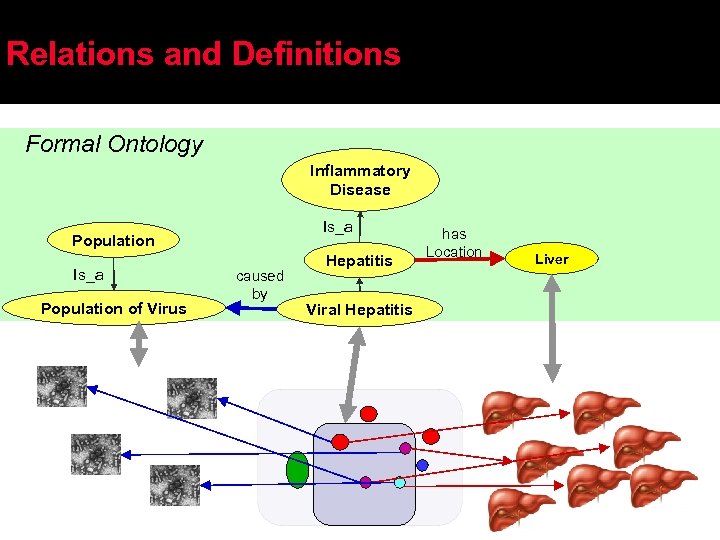 Relations and Definitions Formal Ontology Inflammatory Disease Is_a Population of Virus caused by Hepatitis Viral Hepatitis has Location Liver
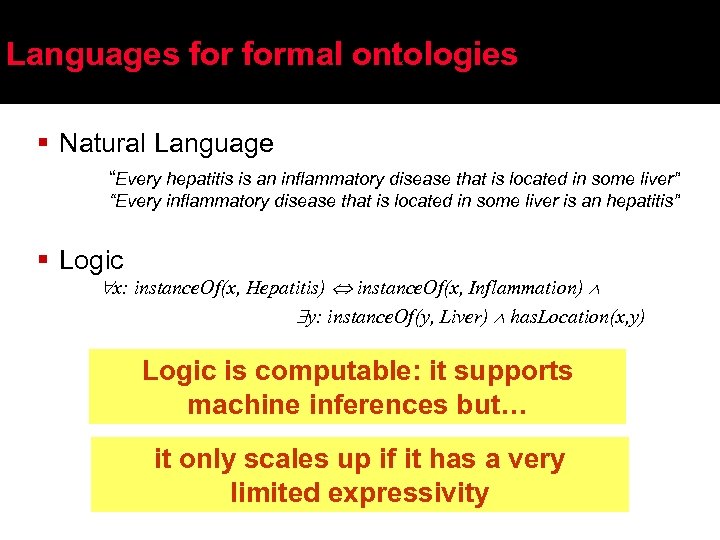 Languages formal ontologies § Natural Language “Every hepatitis is an inflammatory disease that is located in some liver” “Every inflammatory disease that is located in some liver is an hepatitis” § Logic x: instance. Of(x, Hepatitis) instance. Of(x, Inflammation) y: instance. Of(y, Liver) has. Location(x, y) Logic is computable: it supports machine inferences but… it only scales up if it has a very limited expressivity
 Structure of this talk § Introduction - Current Systems § Terminological Clarification § What do Formal Ontologies Represent ? § Terminologies vs. Formal Ontologies § Practice of Good Ontology § Outlook
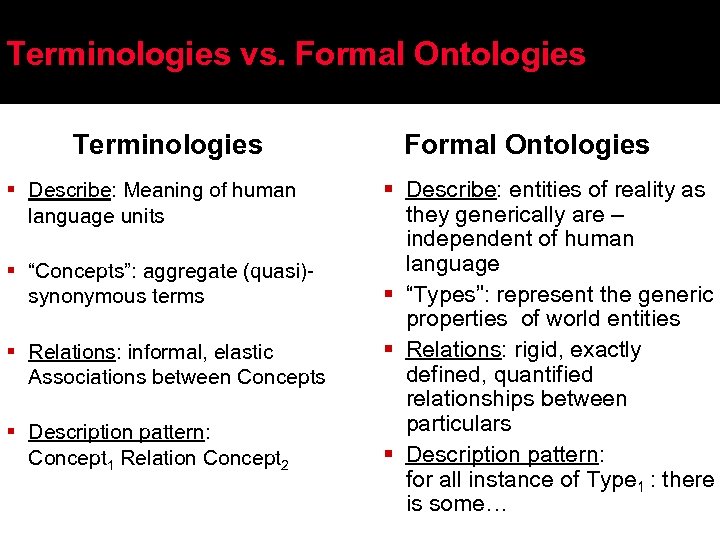 Terminologies vs. Formal Ontologies Terminologies Formal Ontologies § Describe: Meaning of human language units § “Concepts”: aggregate (quasi)synonymous terms § Relations: informal, elastic Associations between Concepts ……. . § Description pattern: Concept 1 Relation Concept 2 § Describe: entities of reality as they generically are – independent of human language § “Types”: represent the generic properties of world entities § Relations: rigid, exactly defined, quantified relationships between particulars § Description pattern: for all instance of Type 1 : there is some…
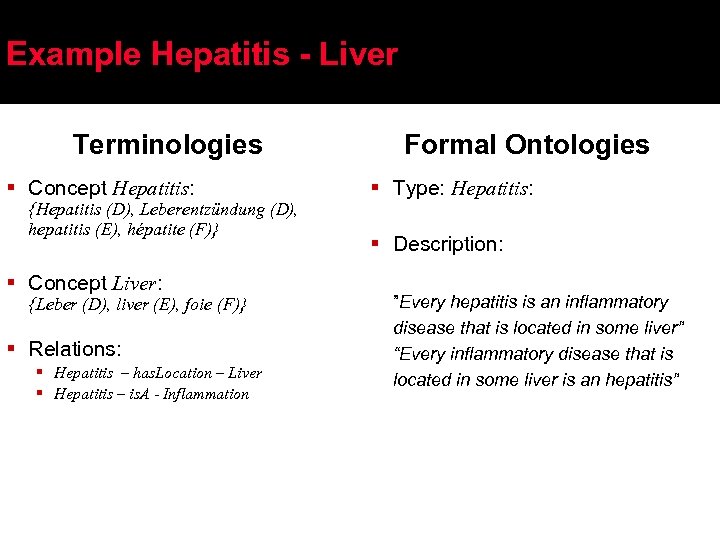 Example Hepatitis - Liver Terminologies Formal Ontologies § Concept Hepatitis: {Hepatitis (D), Leberentzündung (D), hepatitis (E), hépatite (F)} § Concept Liver: {Leber (D), liver (E), foie (F)} § Relations: § Hepatitis – has. Location – Liver § Hepatitis – is. A - Inflammation § Type: Hepatitis: § Description: ”Every hepatitis is an inflammatory disease that is located in some liver” “Every inflammatory disease that is located in some liver is an hepatitis”
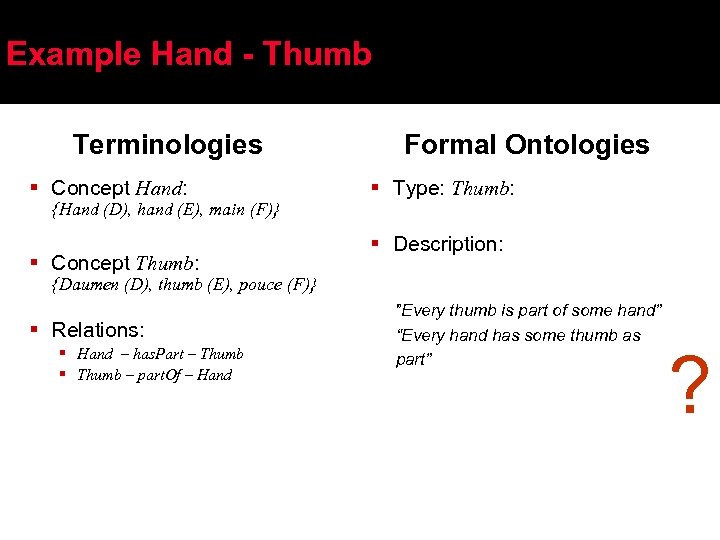 Example Hand - Thumb Terminologies Formal Ontologies § Concept Hand: {Hand (D), hand (E), main (F)} § Concept Thumb: § Type: Thumb: § Description: {Daumen (D), thumb (E), pouce (F)} § Relations: § Hand – has. Part – Thumb § Thumb – part. Of – Hand ”Every thumb is part of some hand” “Every hand has some thumb as part” ?
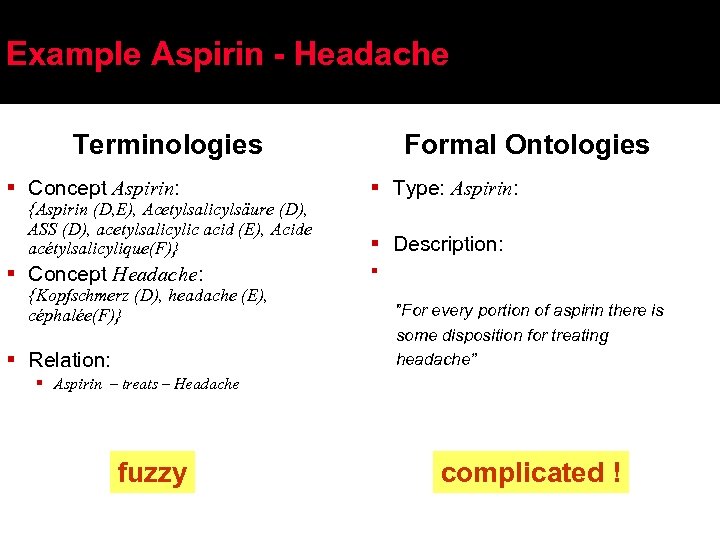 Example Aspirin - Headache Terminologies Formal Ontologies § Concept Aspirin: {Aspirin (D, E), Acetylsalicylsäure (D), ASS (D), acetylsalicylic acid (E), Acide acétylsalicylique(F)} § Concept Headache: {Kopfschmerz (D), headache (E), céphalée(F)} § Relation: § Type: Aspirin: § Description: § ”For every portion of aspirin there is some disposition for treating headache” § Aspirin – treats – Headache fuzzy complicated !
 Strengths of Formal Ontologies § Exact, logic-based descriptions of entity types that are instantiated by real-world objects, processes, states § Representation of stable, context-independent accounts of reality § Use of formal reasoning methods using tools and approaches from the AI / Semantic Web community
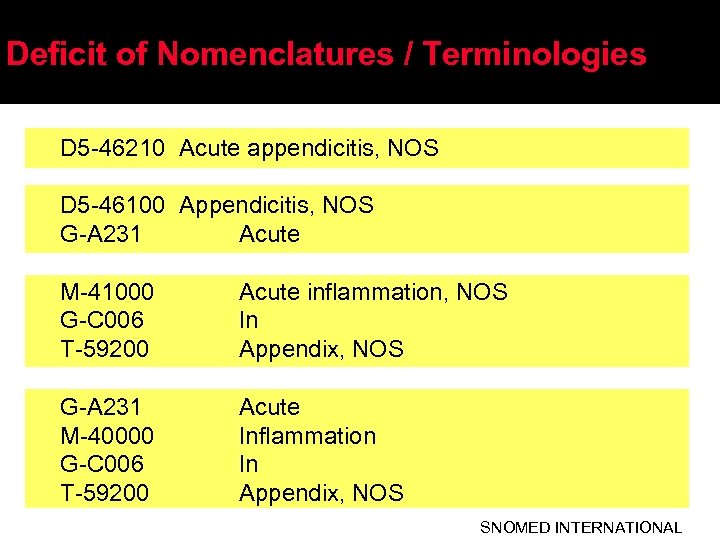 Deficit of Nomenclatures / Terminologies D 5 -46210 Acute appendicitis, NOS D 5 -46100 Appendicitis, NOS G-A 231 Acute M-41000 G-C 006 T-59200 Acute inflammation, NOS In Appendix, NOS G-A 231 M-40000 G-C 006 T-59200 Acute Inflammation In Appendix, NOS SNOMED INTERNATIONAL
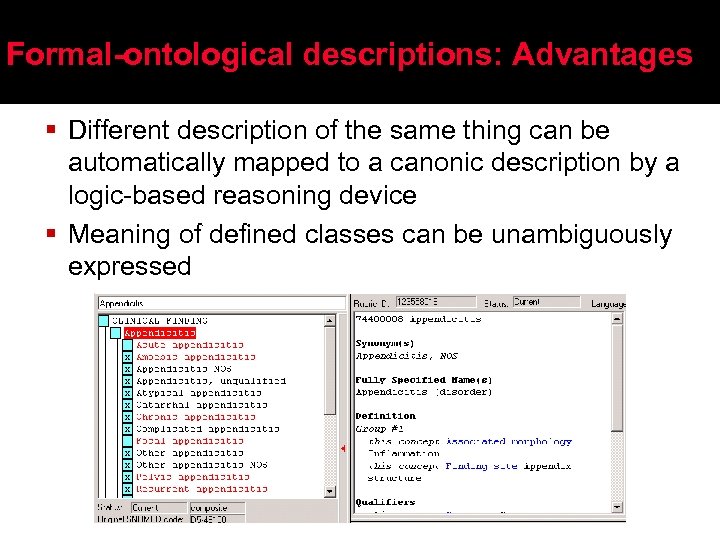 Formal-ontological descriptions: Advantages § Different description of the same thing can be automatically mapped to a canonic description by a logic-based reasoning device § Meaning of defined classes can be unambiguously expressed
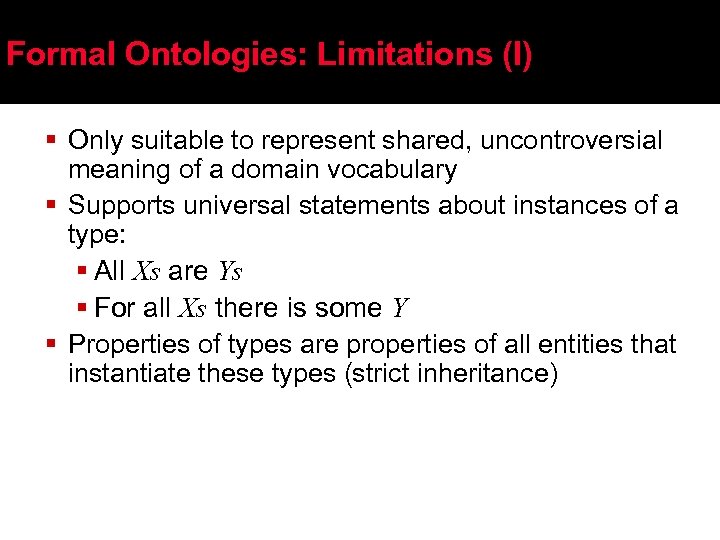 Formal Ontologies: Limitations (I) § Only suitable to represent shared, uncontroversial meaning of a domain vocabulary § Supports universal statements about instances of a type: § All Xs are Ys § For all Xs there is some Y § Properties of types are properties of all entities that instantiate these types (strict inheritance)
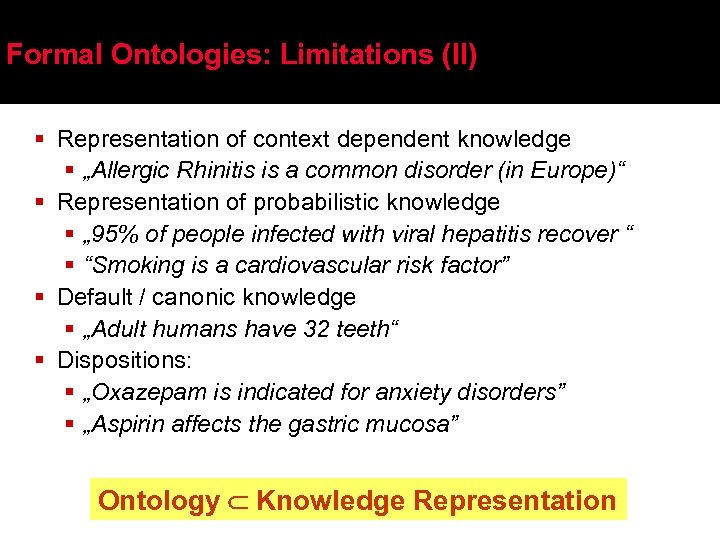 Formal Ontologies: Limitations (II) § Representation of context dependent knowledge § „Allergic Rhinitis is a common disorder (in Europe)“ § Representation of probabilistic knowledge § „ 95% of people infected with viral hepatitis recover “ § “Smoking is a cardiovascular risk factor” § Default / canonic knowledge § „Adult humans have 32 teeth“ § Dispositions: § „Oxazepam is indicated for anxiety disorders” § „Aspirin affects the gastric mucosa” Ontology Knowledge Representation
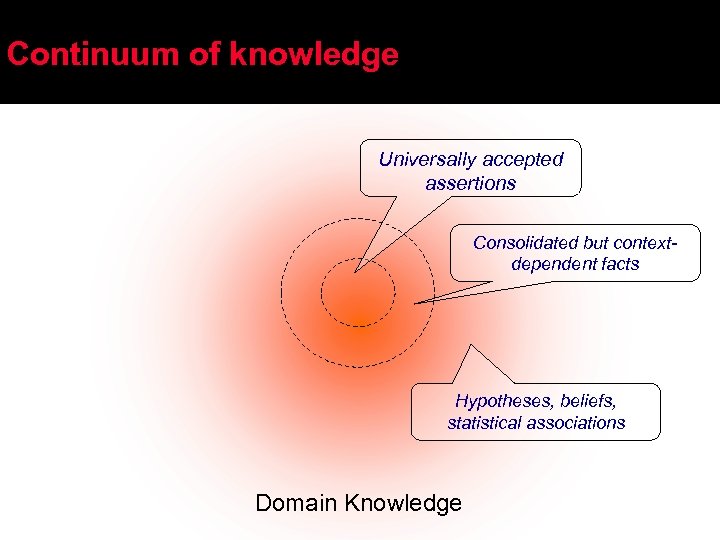 Continuum of knowledge Universally accepted assertions Consolidated but contextdependent facts Hypotheses, beliefs, statistical associations Domain Knowledge
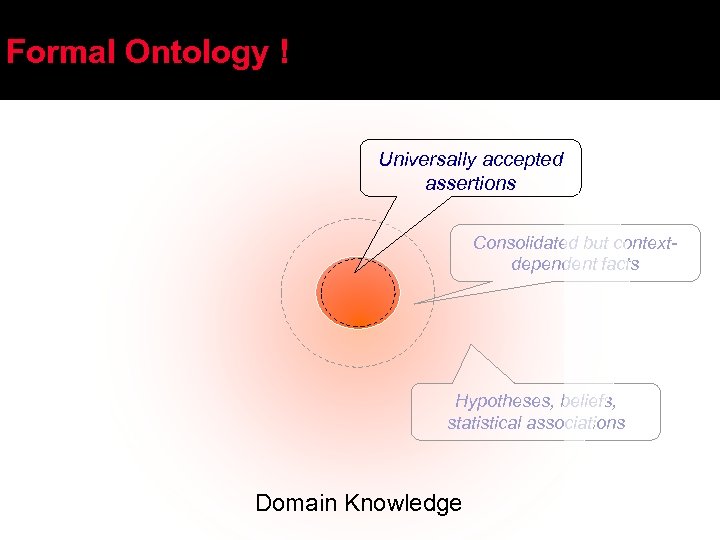 Formal Ontology ! Universally accepted assertions Consolidated but contextdependent facts Hypotheses, beliefs, statistical associations Domain Knowledge
 Structure of this talk § Introduction - Current Systems § Terminological Clarification § What do Formal Ontologies Represent ? § Terminologies vs. Formal Ontologies § Practice of Good Ontology § Outlook
 Practice of Good Ontology Learning good ontology practice from bad ontologies…
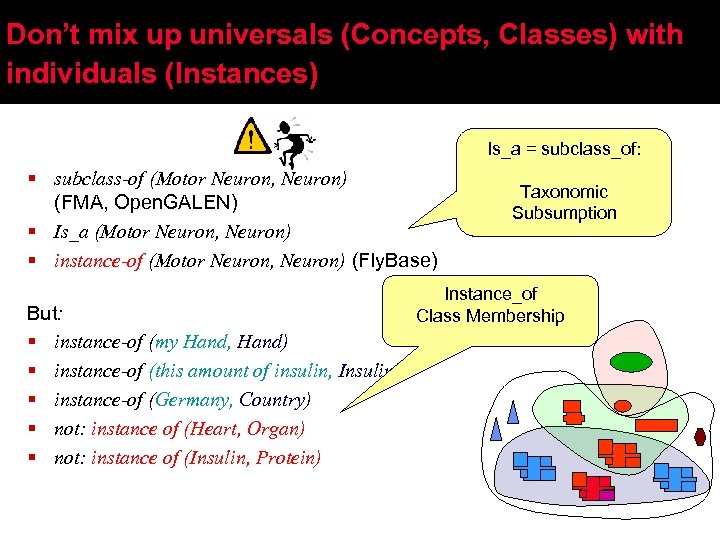 Don’t mix up universals (Concepts, Classes) with individuals (Instances) Is_a = subclass_of: § subclass-of (Motor Neuron, Neuron) (FMA, Open. GALEN) § Is_a (Motor Neuron, Neuron) § instance-of (Motor Neuron, Neuron) (Fly. Base) But: § instance-of (my Hand, Hand) § instance-of (this amount of insulin, Insulin) § instance-of (Germany, Country) § not: instance of (Heart, Organ) § not: instance of (Insulin, Protein) Taxonomic Subsumption Instance_of Class Membership
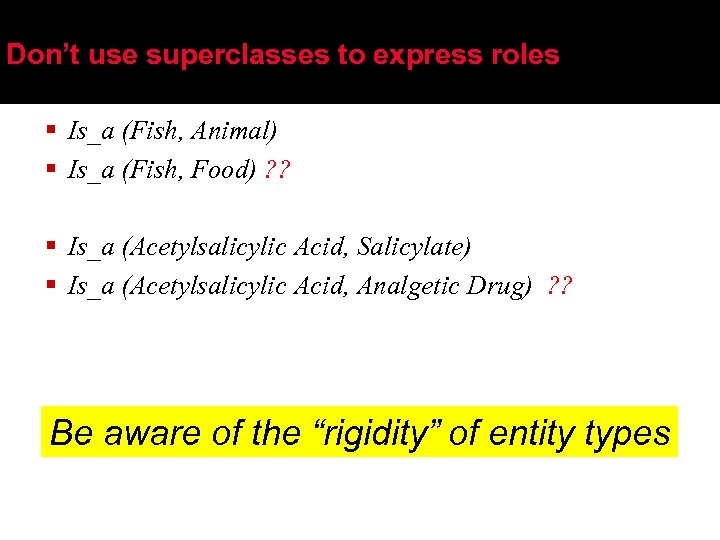 Don’t use superclasses to express roles § Is_a (Fish, Animal) § Is_a (Fish, Food) ? ? § Is_a (Acetylsalicylic Acid, Salicylate) § Is_a (Acetylsalicylic Acid, Analgetic Drug) ? ? Be aware of the “rigidity” of entity types
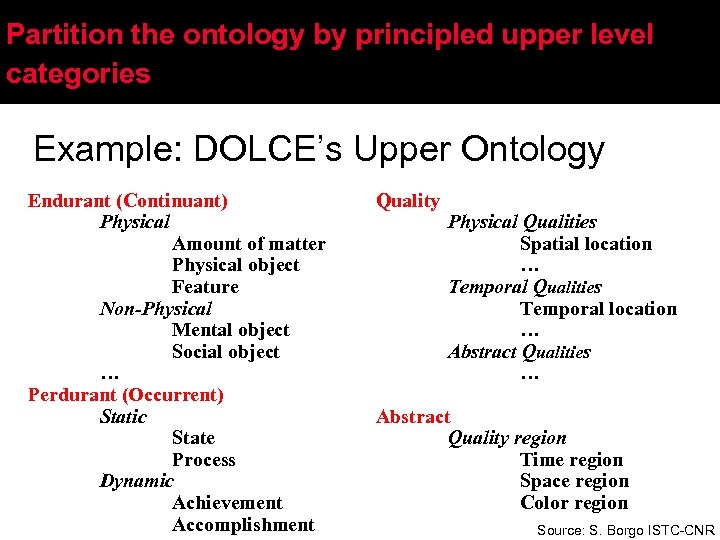 Partition the ontology by principled upper level categories Example: DOLCE’s Upper Ontology Endurant (Continuant) Physical Amount of matter Physical object Feature Non-Physical Mental object Social object … Perdurant (Occurrent) Static State Process Dynamic Achievement Accomplishment Quality Physical Qualities Spatial location … Temporal Qualities Temporal location … Abstract Qualities … Abstract Quality region Time region Space region Color region Source: S. Borgo ISTC-CNR
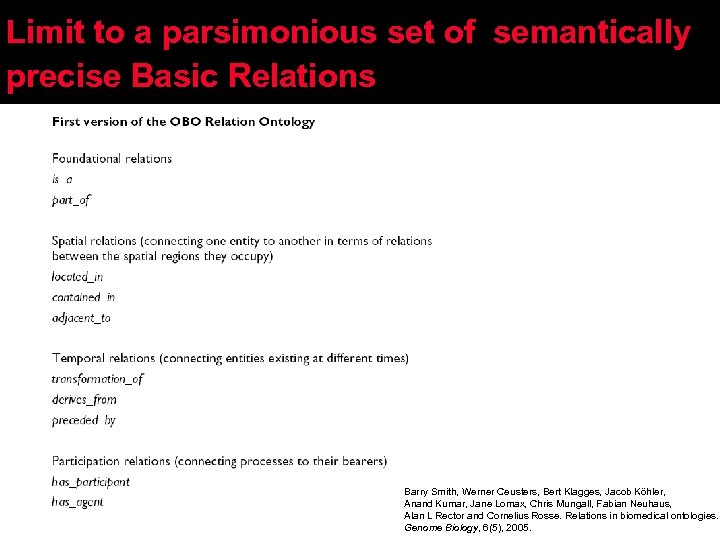 Limit to a parsimonious set of semantically precise Basic Relations Barry Smith, Werner Ceusters, Bert Klagges, Jacob Köhler, Anand Kumar, Jane Lomax, Chris Mungall, Fabian Neuhaus, Alan L Rector and Cornelius Rosse. Relations in biomedical ontologies. Genome Biology, 6(5), 2005.
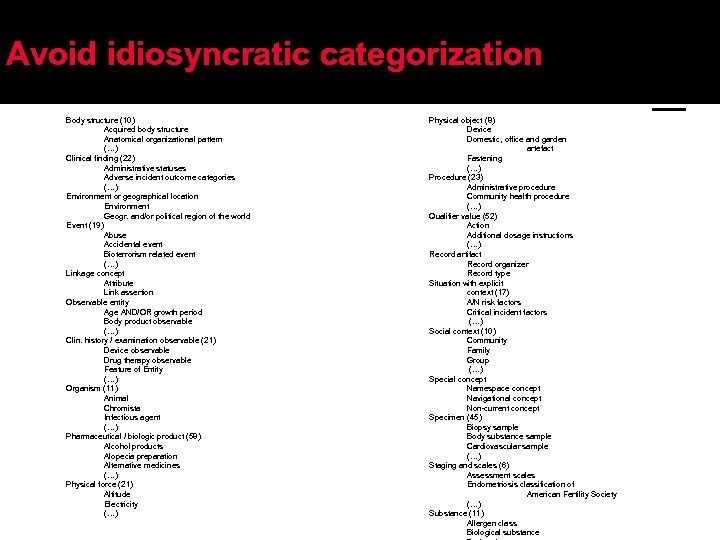 Avoid idiosyncratic categorization Body structure (10) Acquired body structure Anatomical organizational pattern (…) Clinical finding (22) Administrative statuses Adverse incident outcome categories (…) Environment or geographical location Environment Geogr. and/or political region of the world Event (19) Abuse Accidental event Bioterrorism related event (…) Linkage concept Attribute Link assertion Observable entity Age AND/OR growth period Body product observable (…) Clin. history / examination observable (21) Device observable Drug therapy observable Feature of Entity (…) Organism (11) Animal Chromista Infectious agent (…) Pharmaceutical / biologic product (58) Alcohol products Alopecia preparation Alternative medicines (…) Physical force (21) Altitude Electricity (…) Physical object (8) Device Domestic, office and garden artefact Fastening (…) Procedure (23) Administrative procedure Community health procedure (…) Qualifier value (52) Action Additional dosage instructions (…) Record artifact Record organizer Record type Situation with explicit context (17) A/N risk factors Critical incident factors (…) Social context (10) Community Family Group (…) Special concept Namespace concept Navigational concept Non-current concept Specimen (45) Biopsy sample Body substance sample Cardiovascular sample (…) Staging and scales (6) Assessment scales Endometriosis classification of American Fertility Society (…) Substance (11) Allergen class Biological substance
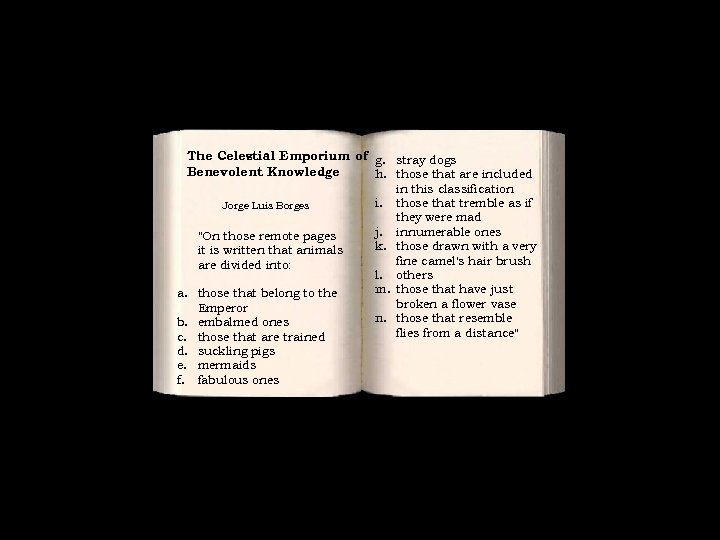 The Celestial Emporium of g. stray dogs Benevolent Knowledge h. those that are included Jorge Luis Borges "On those remote pages it is written that animals are divided into: a. those that belong to the Emperor b. embalmed ones c. those that are trained d. suckling pigs e. mermaids f. fabulous ones in this classification those that tremble as if they were mad j. innumerable ones k. those drawn with a very fine camel's hair brush l. others m. those that have just broken a flower vase n. those that resemble flies from a distance" i.
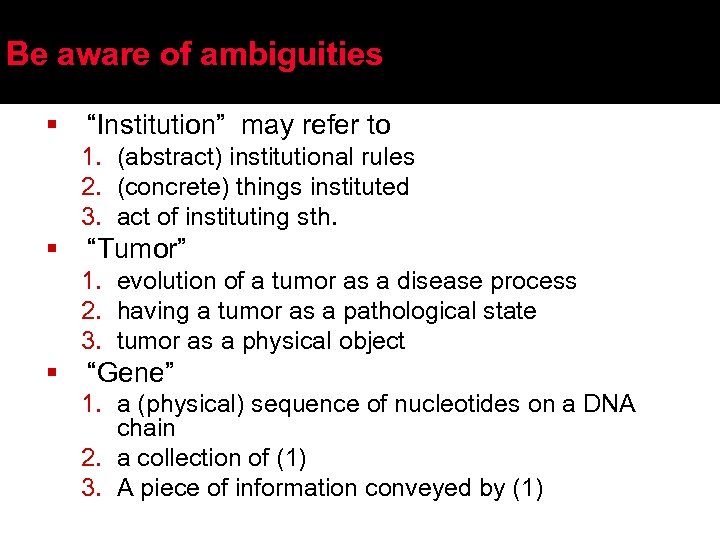 Be aware of ambiguities § “Institution” may refer to 1. (abstract) institutional rules 2. (concrete) things instituted 3. act of instituting sth. § “Tumor” 1. evolution of a tumor as a disease process 2. having a tumor as a pathological state 3. tumor as a physical object § “Gene” 1. a (physical) sequence of nucleotides on a DNA chain 2. a collection of (1) 3. A piece of information conveyed by (1)
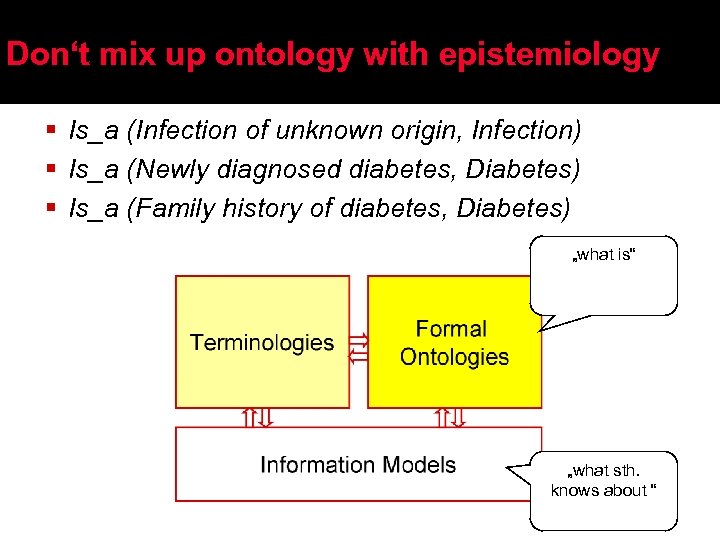 Don‘t mix up ontology with epistemiology § Is_a (Infection of unknown origin, Infection) § Is_a (Newly diagnosed diabetes, Diabetes) § Is_a (Family history of diabetes, Diabetes) „what is“ „what sth. knows about “
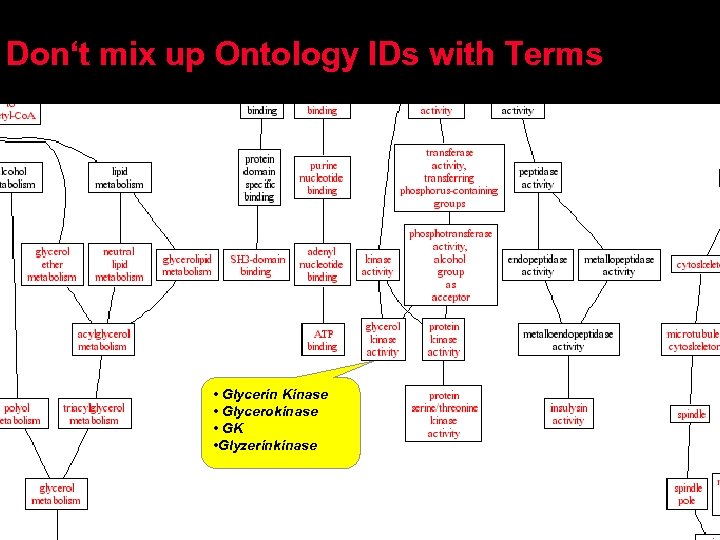 Don‘t mix up Ontology IDs with Terms • Glycerin Kinase • Glycerokinase • GK • Glyzerinkinase
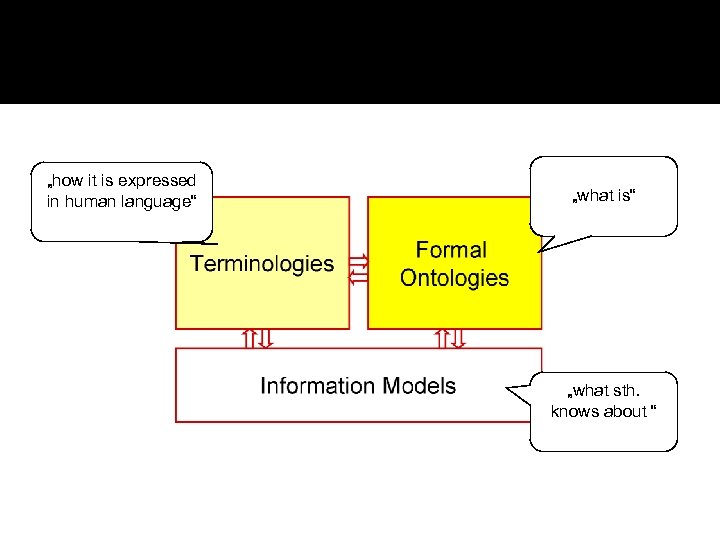 „how it is expressed in human language“ „what is“ „what sth. knows about “
 Don’t underestimate Ontology Maintenance § Formal Ontologies must always be maintained § consistent (free of logic contradiction): prerequisite for machine reasoning § adequate (correctly describe the domain) prerequisite to prevent erroneous deductions § Maintenance load is much higher than with terminologies. § Ontology maintenance is mainly task of domain experts. IT staff has supportive function § Typical design and maintenance errors
 Structure of this talk § Introduction - Current Systems § Terminological Clarification § What do Formal Ontologies Represent ? § Terminologies vs. Formal Ontologies § Practice of Good Ontology § Outlook
 Outlook § Ontology often used a buzzword for nontologies but… § Formal ontological principles increasingly govern the construction of Life Science Knowledge Organization Systems § Users / domain expert must be heavily involved into ontology engineering and maintenance § Insufficient evidence: § § § Which use cases require formal ontologies In which cases informal terminology systems are sufficient? Which cases require both ? Can existing terminologies be ontologized? Can terminologies and ontologies co-exist ? § The outcome of the existing legacy systems’ move toward principled ontologies is still open
 SNOMED CT § § § One huge system Impressive domain coverage Considerable investments, important stakeholders Increasing number of (clinical) users Other use cases mainly unexplored (basic research, clinical trials) Increasing mappings to existing terminologies Legacy: hybrid of terminology, ontology, information model Overall structure idiosyncratic, disorganized Some major architectural weaknesses Unreflected use of logic, unintended entailments Major redesign necessary: formal foundations, editing guidelines, quality control procedures § Risk: uncontrollable proliferation, loss of expressiveness, § Chances: Positive input by user groups
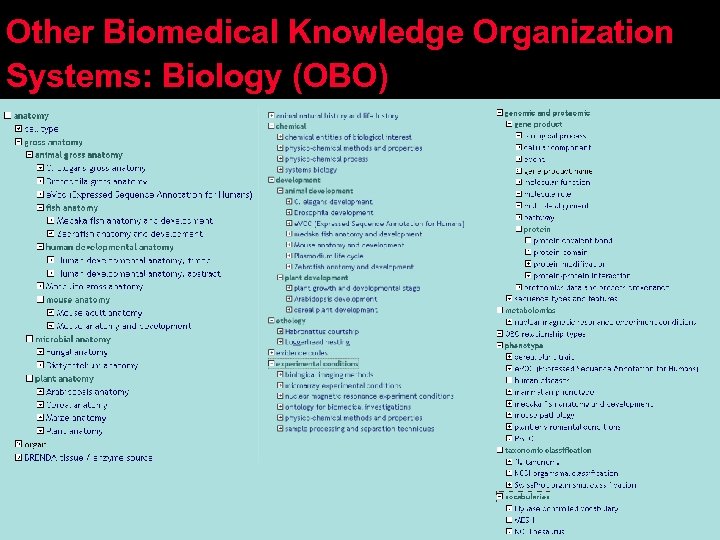
 Open Biomedical Ontologies (OBO) § Many focused ontologies § Increasing number of annotated sources § Broad range: organisms – anatomies (plants, animals) – pathways – biomedical investigations – cells – development – protein – sequence … § Convergence to standardized syntax and semantics § Increasingly using formal ontology principles § Public
 Stefan Schulz Medical Informatics Research Group University Medical Center Freiburg, Germany Thank you! Contact: stschulz@uni-freiburg. de