


 Скачать презентацию STEELS Professor in Metals Studies Priit Kulu Department
3748389076104c9cfdb1a76e13c7da6b.ppt
- Количество слайдов: 28
 STEELS Professor in Metals Studies Priit Kulu Department of Materials Engineering
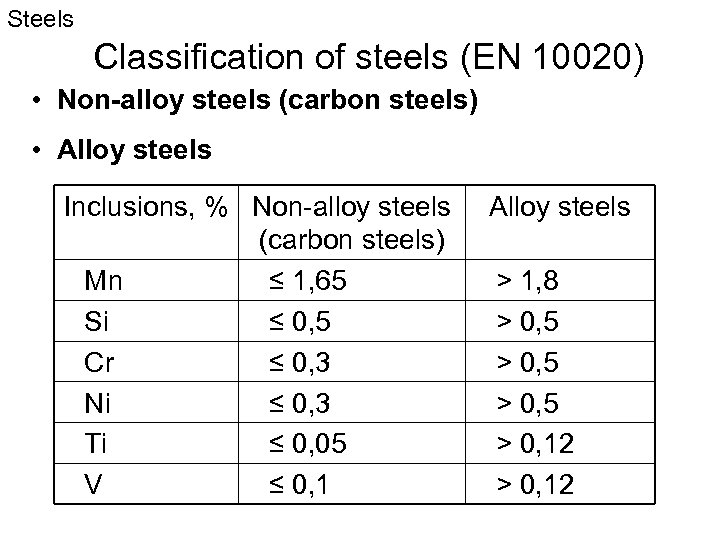 Steels Classification of steels (EN 10020) • Non-alloy steels (carbon steels) • Alloy steels Inclusions, % Non-alloy steels (carbon steels) Mn ≤ 1, 65 Si ≤ 0, 5 Cr ≤ 0, 3 Ni ≤ 0, 3 Ti ≤ 0, 05 V ≤ 0, 1 Alloy steels > 1, 8 > 0, 5 > 0, 12
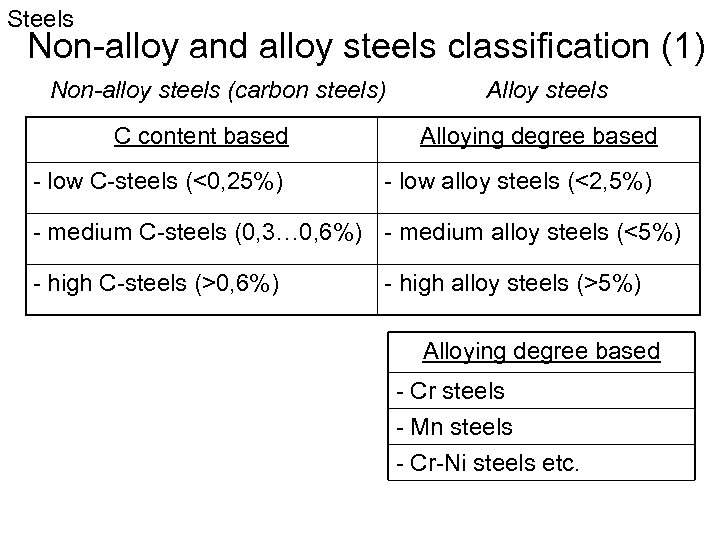 Steels Non-alloy and alloy steels classification (1) Non-alloy steels (carbon steels) Alloy steels C content based Alloying degree based - low C-steels (<0, 25%) - low alloy steels (<2, 5%) - medium C-steels (0, 3… 0, 6%) - medium alloy steels (<5%) - high C-steels (>0, 6%) - high alloy steels (>5%) Alloying degree based - Cr steels - Mn steels - Cr-Ni steels etc.
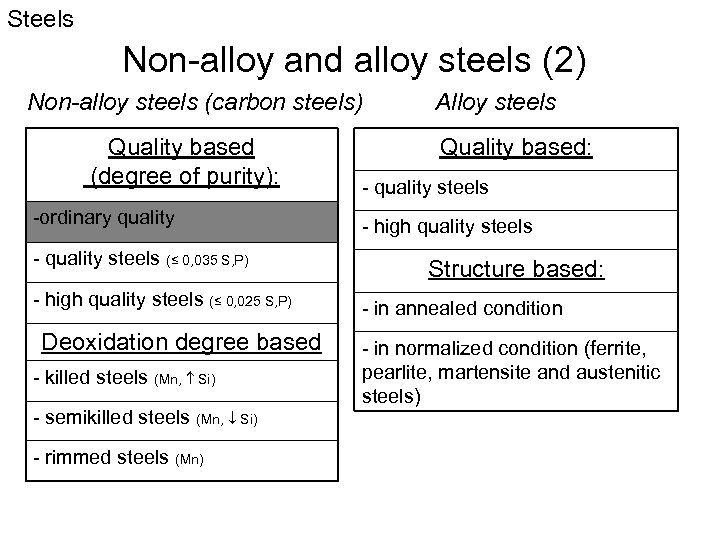 Steels Non-alloy and alloy steels (2) Non-alloy steels (carbon steels) Quality based (degree of purity): -ordinary quality - quality steels (≤ 0, 035 S, P) - high quality steels (≤ 0, 025 S, P) Deoxidation degree based - killed steels (Mn, Si) - semikilled steels (Mn, Si) - rimmed steels (Mn) Alloy steels Quality based: - quality steels - high quality steels Structure based: - in annealed condition - in normalized condition (ferrite, pearlite, martensite and austenitic steels)
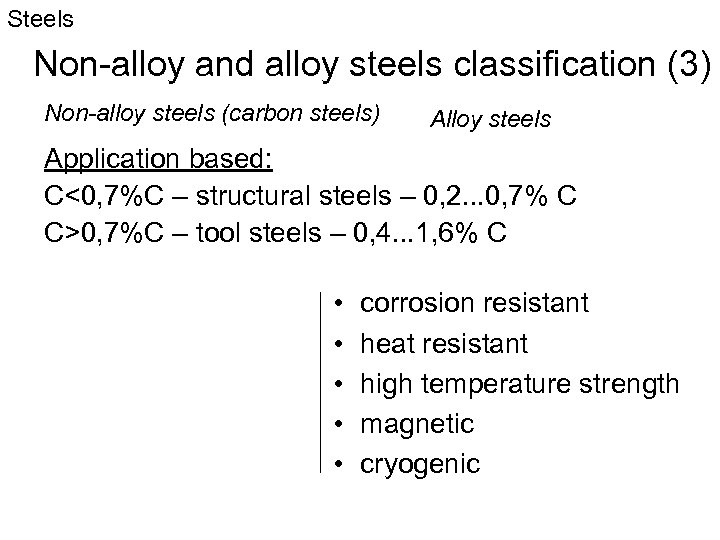 Steels Non-alloy and alloy steels classification (3) Non-alloy steels (carbon steels) Alloy steels Application based: C<0, 7%C – structural steels – 0, 2. . . 0, 7% C C>0, 7%C – tool steels – 0, 4. . . 1, 6% C • • • corrosion resistant heat resistant high temperature strength magnetic cryogenic
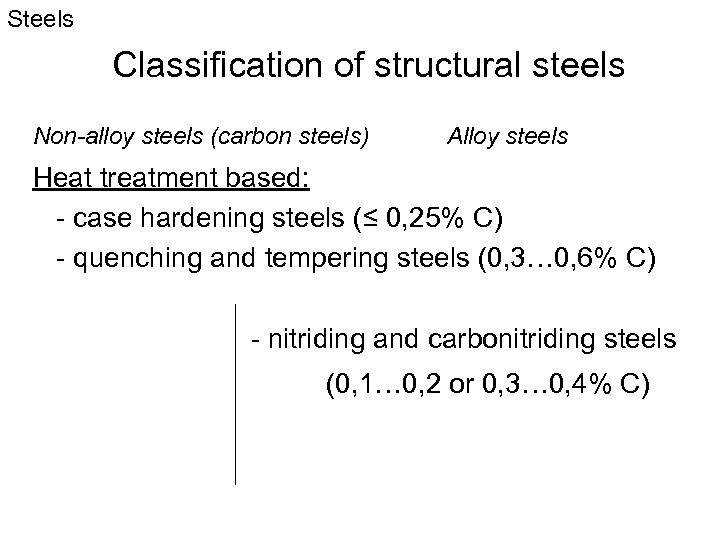 Steels Classification of structural steels Non-alloy steels (carbon steels) Alloy steels Heat treatment based: - case hardening steels (≤ 0, 25% C) - quenching and tempering steels (0, 3… 0, 6% C) - nitriding and carbonitriding steels (0, 1… 0, 2 or 0, 3… 0, 4% C)
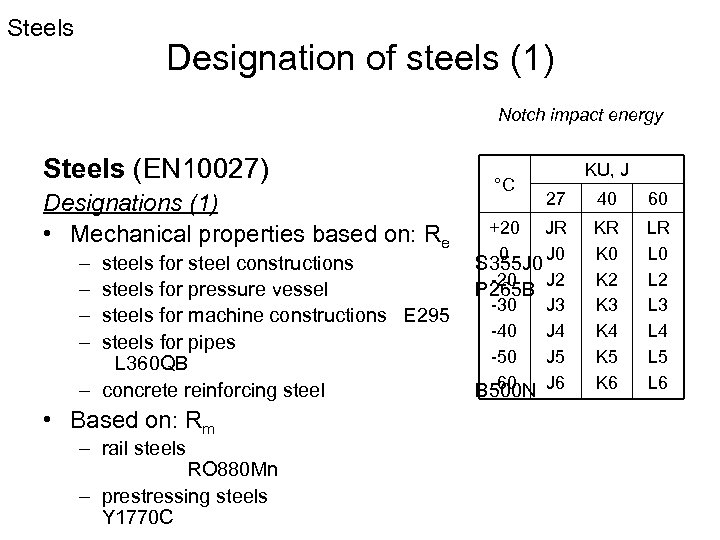 Steels Designation of steels (1) Notch impact energy Steels (EN 10027) Designations (1) • Mechanical properties based on: Re – – steels for steel constructions steels for pressure vessel steels for machine constructions E 295 steels for pipes L 360 QB – concrete reinforcing steel • Based on: Rm – rail steels RO 880 Mn – prestressing steels Y 1770 C °C KU, J 27 40 60 +20 JR 0 S 355 J 0 -20 J 2 P 265 B -30 J 3 -40 J 4 -50 J 5 -60 B 500 N J 6 KR K 0 K 2 K 3 K 4 K 5 K 6 LR L 0 L 2 L 3 L 4 L 5 L 6
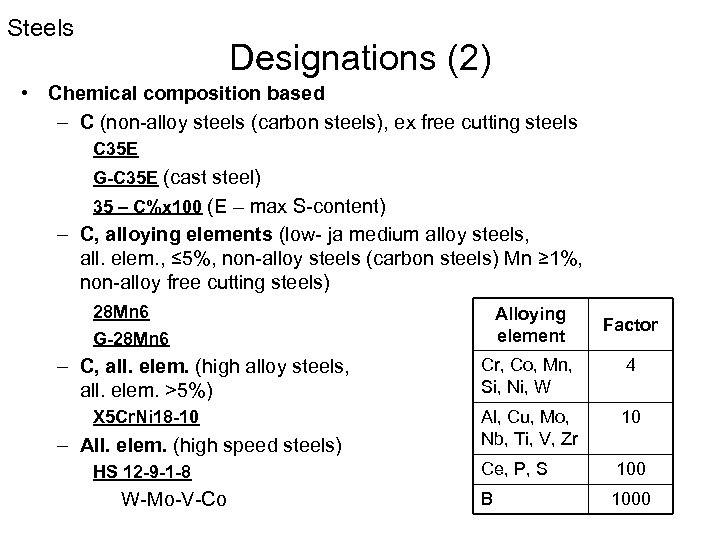 Steels Designations (2) • Chemical composition based – C (non-alloy steels (carbon steels), ex free cutting steels C 35 E G-C 35 E (cast steel) 35 – C%x 100 (E – max S-content) – C, alloying elements (low- ja medium alloy steels, all. elem. , ≤ 5%, non-alloy steels (carbon steels) Mn ≥ 1%, non-alloy free cutting steels) 28 Mn 6 G-28 Mn 6 – C, all. elem. (high alloy steels, all. elem. >5%) X 5 Cr. Ni 18 -10 – All. elem. (high speed steels) HS 12 -9 -1 -8 W-Mo-V-Co Alloying element Factor Cr, Co, Mn, Si, Ni, W 4 Al, Cu, Mo, Nb, Ti, V, Zr 10 Ce, P, S 100 B 1000
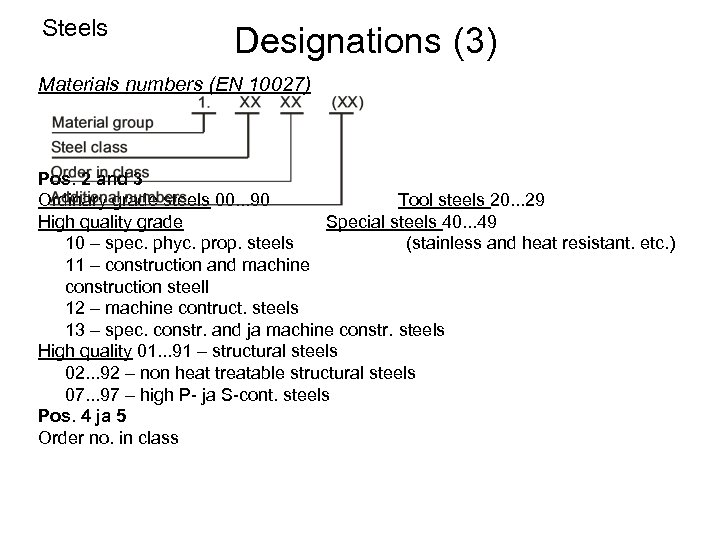 Steels Designations (3) Materials numbers (EN 10027) Pos. 2 and 3 Ordinary grade steels 00. . . 90 Tool steels 20. . . 29 High quality grade Special steels 40. . . 49 10 – spec. phyc. prop. steels (stainless and heat resistant. etc. ) 11 – construction and machine construction steell 12 – machine contruct. steels 13 – spec. constr. and ja machine constr. steels High quality 01. . . 91 – structural steels 02. . . 92 – non heat treatable structural steels 07. . . 97 – high P- ja S-cont. steels Pos. 4 ja 5 Order no. in class
 Steels Structural steels (1) Non-alloy structural steels (C = 0, 2. . . 0, 65%) • ordinary (quality) steels • quality steels C 15 E (max S), C 15 R (S range) • high quality steels (S, P ≤ 0, 025%) • Free cutting steels (C = 0, 12. . . 0, 4%; g 0, 2% S) – 10 S 20, 35 S 20 • Cast steels (C = 0, 15. . . 0, 55%) – GE 250, G 28 Mn 6
 Steels Structural steels (2) Alloy structural steels (C = 0, 2. . . 0, 7%, wear resistant steels 0, 9. . . 1, 3%) • low alloy steels (all. elem. g 2, 5%) – – structural steels cold forming steels spring steels (C = 0, 5. . . 0, 7%, Si = 1. . . 2%) ball bearing steels (C ≈ 1%, Cr = 0, 5. . . 0, 6%) • medium alloy steels (all. elem. 2, 5. . . 5%) – cementizing steels – quenching and tempering steels – nitriding steels • high alloy steels (leg. el. > 5%) – steels with specific properties – corrosion resistant steels – high temperature strength steels – wear resistant steels
 Steels Structural steels (3) Low alloy steels (1) Steels for structural construction Low alloy carbon steels C≤ 0, 22%; 1. . . 2% Si, Mn Requirements: • Cold brittleness: low TBCT, T 50 high toughness (h impact energy KU, KV) • Weldability CE%=C%+Mn%/6+(Cr%+Mo%+V%)/5+(Ni%+Cu%)/15 CE≤ 0, 40% - satisfactory weldability CE≥ 0, 40% - special means: preheating, low annealing. Alloying principles: i. P, S gi TBCT Simultaneous alloying with V, Ng. TBCT -80°C
 Steels Structural steels (4) Low alloy steels (2) Cold forming steels Requirements • low yield strength ratio (Rp 0, 2/Rm = 0, 5. . . 0, 65) • high plasticity (A ≥ 40%) Principles of alloying: C and Si%h Rp 0, 2 gi formability; Mn% h Rm, Rp 0, 2≈ g good formability Preferred: – rimmed steels (Si ≈ 0%) – dual phase steels (F + 20. . . 30% M or B) (C = 0, 06. . . 0, 12%, partial-hardening g Rp 0, 2/Rm = 0, 5) g good deep drawability at 10% degree of deformation Rp 0, 2/Rm = 0, 8. . . 0, 9 • • Ballon steels Pressure vessel steels Seamless pipes Welded pipes
 Steels Structural steels (5) Low alloy steels (3) Spring steels high Re, σR, modulus of elasticity E C = 0, 5. . . 0, 7% Mn-steels (1. . . 2% Mn) Si-steels (2. . . 3% Si) Cr-V-steels TT: Hardening + mid. temp. (300. . . 400°C) g Trostite structure Ball bearing steels High hardness (≥ 62 HRC) C ≈ 1%; Cr = 0, 6. . . 1, 5% – 105 Cr 6 Ball races (63. . . 64 HRC), balls (61. . . 62 HRC)
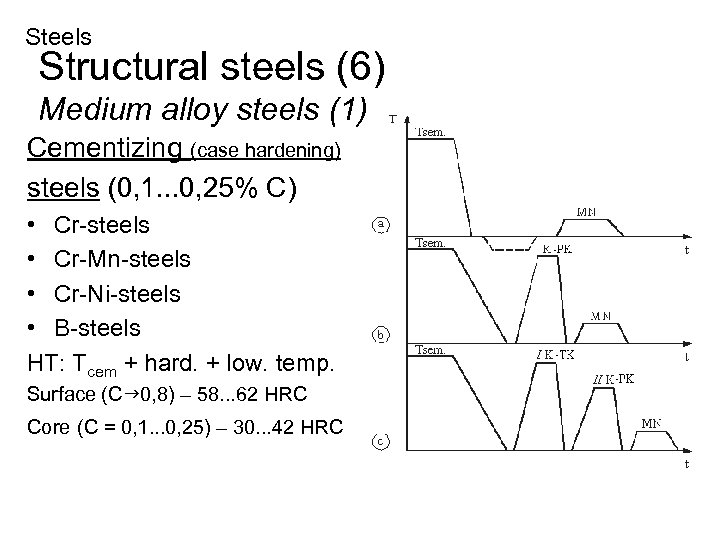 Steels Structural steels (6) Medium alloy steels (1) Cementizing (case hardening) steels (0, 1. . . 0, 25% C) • Cr-steels • Cr-Mn-steels • Cr-Ni-steels • B-steels HT: Tcem + hard. + low. temp. Surface (Cg 0, 8) – 58. . . 62 HRC Core (C = 0, 1. . . 0, 25) – 30. . . 42 HRC
 Steels Structural steels (7) Medium alloy steels (2) Quenching and tempering steels Requirements: • • Reliability ( Rm, Rp 0, 2; acceptable KU and TBCT) High hardenability (D 50, D 95, T 50) Principles pf alloying: • • Alloying hardenability ( Ma, Ml) (all exc. Al and Co) At solution in F, Rm and TBCT, alloying degree as low as possible (for D 50)
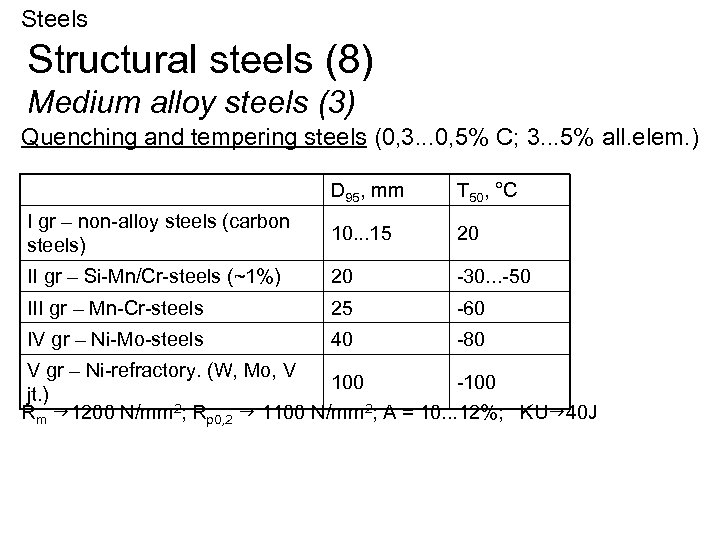 Steels Structural steels (8) Medium alloy steels (3) Quenching and tempering steels (0, 3. . . 0, 5% C; 3. . . 5% all. elem. ) D 95, mm T 50, °C I gr – non-alloy steels (carbon steels) 10. . . 15 20 II gr – Si-Mn/Cr-steels (~1%) 20 -30. . . -50 III gr – Mn-Cr-steels 25 -60 IV gr – Ni-Mo-steels 40 -80 V gr – Ni-refractory. (W, Mo, V 100 -100 jt. ) Rm g 1200 N/mm 2; Rp 0, 2 g 1100 N/mm 2; A = 10. . . 12%; KUg 40 J
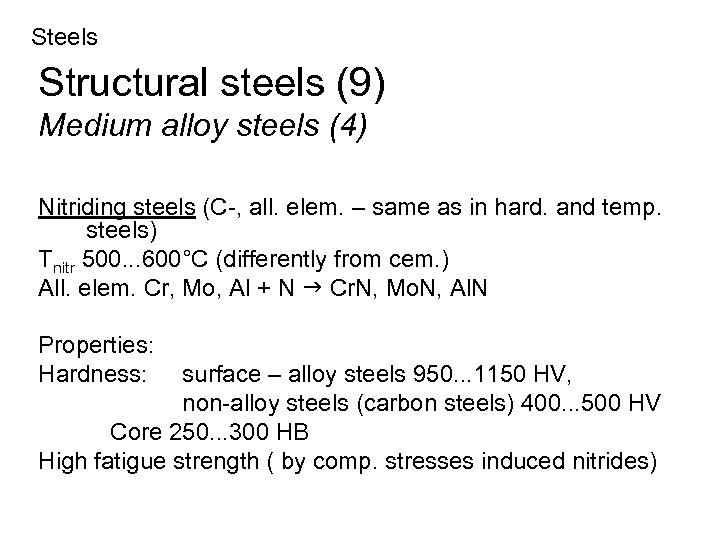 Steels Structural steels (9) Medium alloy steels (4) Nitriding steels (C-, all. elem. – same as in hard. and temp. steels) Tnitr 500. . . 600°C (differently from cem. ) All. elem. Cr, Mo, Al + N g Cr. N, Mo. N, Al. N Properties: Hardness: surface – alloy steels 950. . . 1150 HV, non-alloy steels (carbon steels) 400. . . 500 HV Core 250. . . 300 HB High fatigue strength ( by comp. stresses induced nitrides)
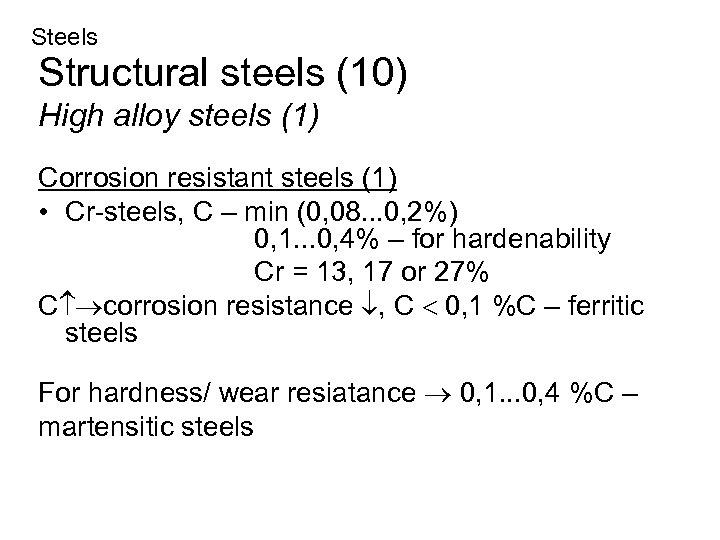 Steels Structural steels (10) High alloy steels (1) Corrosion resistant steels (1) • Cr-steels, C – min (0, 08. . . 0, 2%) 0, 1. . . 0, 4% – for hardenability Cr = 13, 17 or 27% C corrosion resistance , C 0, 1 %C – ferritic steels For hardness/ wear resiatance 0, 1. . . 0, 4 %C – martensitic steels
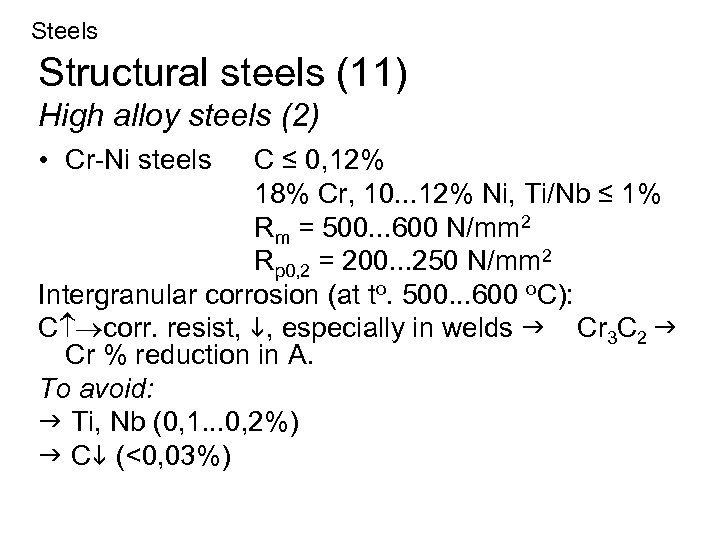 Steels Structural steels (11) High alloy steels (2) • Cr-Ni steels C ≤ 0, 12% 18% Cr, 10. . . 12% Ni, Ti/Nb ≤ 1% Rm = 500. . . 600 N/mm 2 Rp 0, 2 = 200. . . 250 N/mm 2 Intergranular corrosion (at to. 500. . . 600 o. C): C corr. resist, i, especially in welds g Cr 3 C 2 g Cr % reduction in A. To avoid: g Ti, Nb (0, 1. . . 0, 2%) g Ci (<0, 03%)
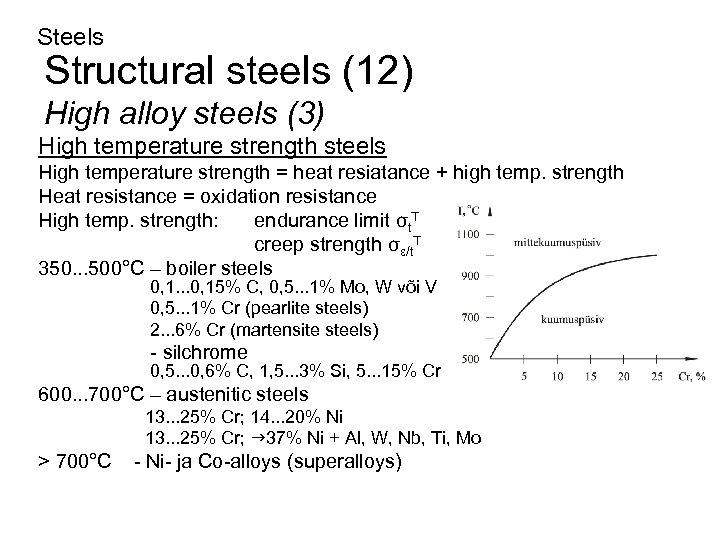 Steels Structural steels (12) High alloy steels (3) High temperature strength steels High temperature strength = heat resiatance + high temp. strength Heat resistance = oxidation resistance High temp. strength: endurance limit σt. T creep strength σε/t. T 350. . . 500°C – boiler steels 0, 1. . . 0, 15% C, 0, 5. . . 1% Mo, W või V 0, 5. . . 1% Cr (pearlite steels) 2. . . 6% Cr (martensite steels) - silchrome 0, 5. . . 0, 6% C, 1, 5. . . 3% Si, 5. . . 15% Cr 600. . . 700°C – austenitic steels 13. . . 25% Cr; 14. . . 20% Ni 13. . . 25% Cr; g 37% Ni + Al, W, Nb, Ti, Mo > 700°C - Ni- ja Co-alloys (superalloys)
 Steels Structural steels (13) High alloy steels (4) Wear resistant steels Requirements: High surface hardness Principles of alloying: – through alloying (uneffective – 2. . . 3% /Ø 100 mm) – surface alloying • Non-alloy- and alloy steels (Cr, Mn, W jt. ) • Cementizing steels • Mn-steels (Hadfield steel) (1, 1. . . 1, 3% C, 12. . . 13% Mn) HT: H (1050. . . 1100°C) g A-structure Rm=800. . . 1000, Rp 0, 2=250. . . 350 N/mm 2, A = 40. . . 50%, 180. . . 220 HB In cold worked conditions g 50. . . 55 HRC – self hardening
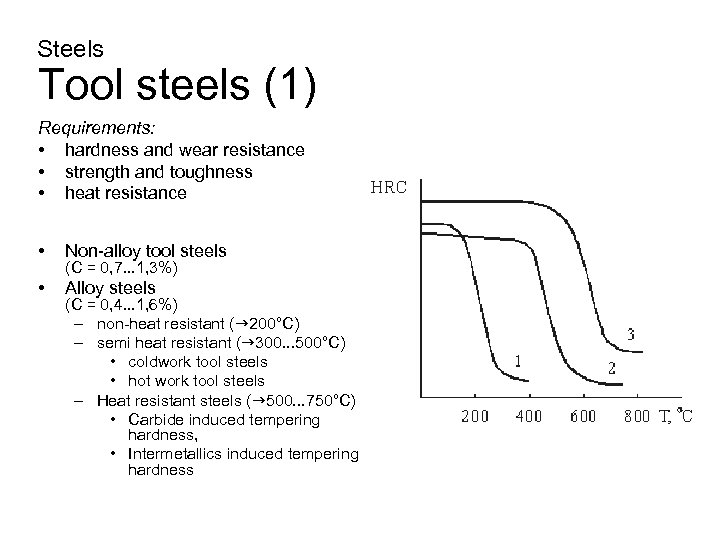 Steels Tool steels (1) Requirements: • hardness and wear resistance • strength and toughness • heat resistance • Non-alloy tool steels • Alloy steels (C = 0, 7. . . 1, 3%) (C = 0, 4. . . 1, 6%) – non-heat resistant (g 200°C) – semi heat resistant (g 300. . . 500°C) • coldwork tool steels • hot work tool steels – Heat resistant steels (g 500. . . 750°C) • Carbide induced tempering hardness, • Intermetallics induced tempering hardness
 Steels Tool steels (2) Non heat resistant steels (200. . . 250°C) • non-alloy tool steels (0, 7. . . 1, 2% C) • low alloy steels (Cr, W, Mn) Semi heat resistant steels (300. . . 500°C) • Cold work tool steels (150. . . 200°C) Cr-steels (1, 2. . . 2, 3% C; 12% Cr + Mo, V) Structure: M + 13. . . 20% carbides C = 0, 6. . . 0, 7 – cutting- ja impact tools • Hot work tool steels Requirements: • high temperature strength, • heat resistance ja thermal resistance • high hardenability and not prone to tempering brittleness • low adhesion Steels 0, 5. . . 0, 6% C g good toughness 1, 5. . . 2% Ni, Mo g high hardenability
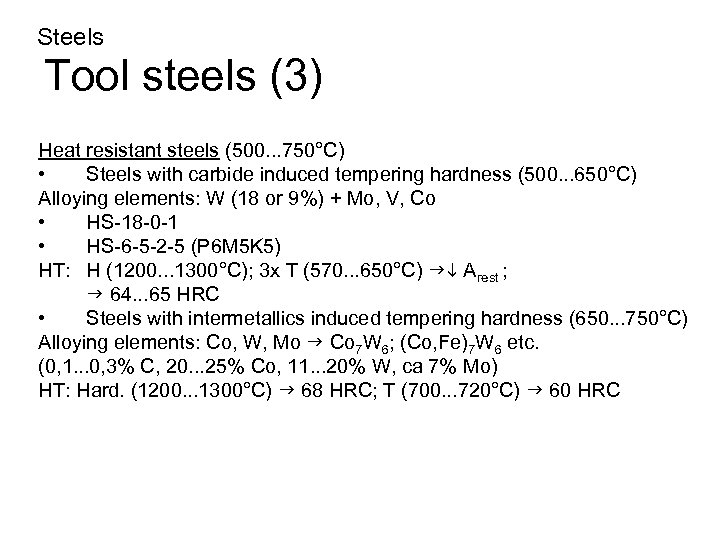 Steels Tool steels (3) Heat resistant steels (500. . . 750°C) • Steels with carbide induced tempering hardness (500. . . 650°C) Alloying elements: W (18 or 9%) + Mo, V, Co • HS-18 -0 -1 • HS-6 -5 -2 -5 (P 6 M 5 K 5) HT: H (1200. . . 1300°C); 3 x T (570. . . 650°C) gi Arest ; g 64. . . 65 HRC • Steels with intermetallics induced tempering hardness (650. . . 750°C) Alloying elements: Co, W, Mo g Co 7 W 6; (Co, Fe)7 W 6 etc. (0, 1. . . 0, 3% C, 20. . . 25% Co, 11. . . 20% W, ca 7% Mo) HT: Hard. (1200. . . 1300°C) g 68 HRC; T (700. . . 720°C) g 60 HRC
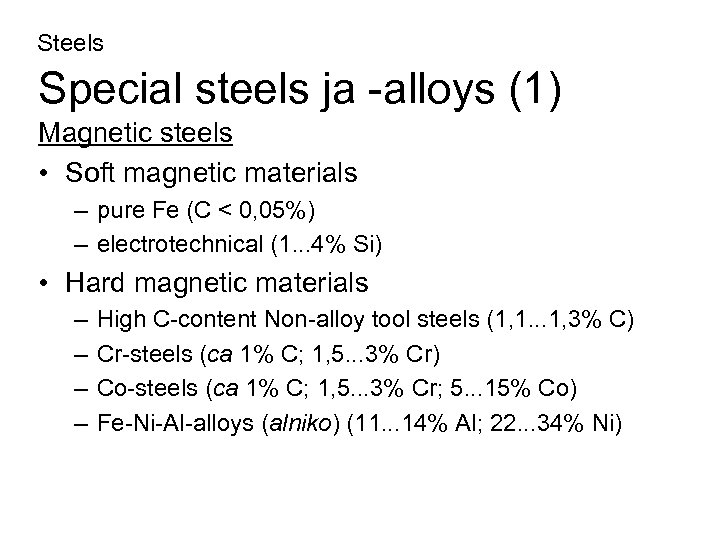 Steels Special steels ja -alloys (1) Magnetic steels • Soft magnetic materials – pure Fe (C < 0, 05%) – electrotechnical (1. . . 4% Si) • Hard magnetic materials – – High C-content Non-alloy tool steels (1, 1. . . 1, 3% C) Cr-steels (ca 1% C; 1, 5. . . 3% Cr) Co-steels (ca 1% C; 1, 5. . . 3% Cr; 5. . . 15% Co) Fe-Ni-Al-alloys (alniko) (11. . . 14% Al; 22. . . 34% Ni)
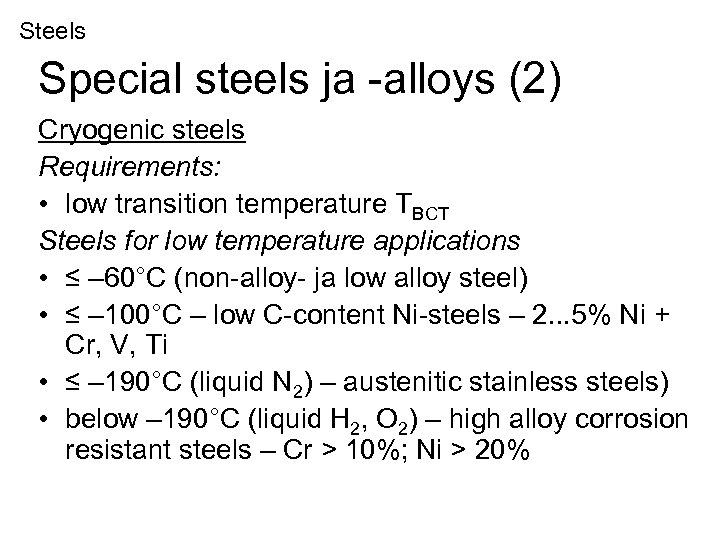 Steels Special steels ja -alloys (2) Cryogenic steels Requirements: • low transition temperature TBCT Steels for low temperature applications • ≤ – 60°C (non-alloy- ja low alloy steel) • ≤ – 100°C – low C-content Ni-steels – 2. . . 5% Ni + Cr, V, Ti • ≤ – 190°C (liquid N 2) – austenitic stainless steels) • below – 190°C (liquid H 2, O 2) – high alloy corrosion resistant steels – Cr > 10%; Ni > 20%
 Thank You for attention! priit. kulu@ttu. ee