


 Скачать презентацию Status Update for Algorithm Transition for the RPKI
7a985a584bd4340793c68dbcd6c4f67c.ppt
- Количество слайдов: 11
 Status Update for Algorithm Transition for the RPKI (draft-ietf-sidr-algorithm-agility) Steve Kent Roque Gagliano Sean Turner
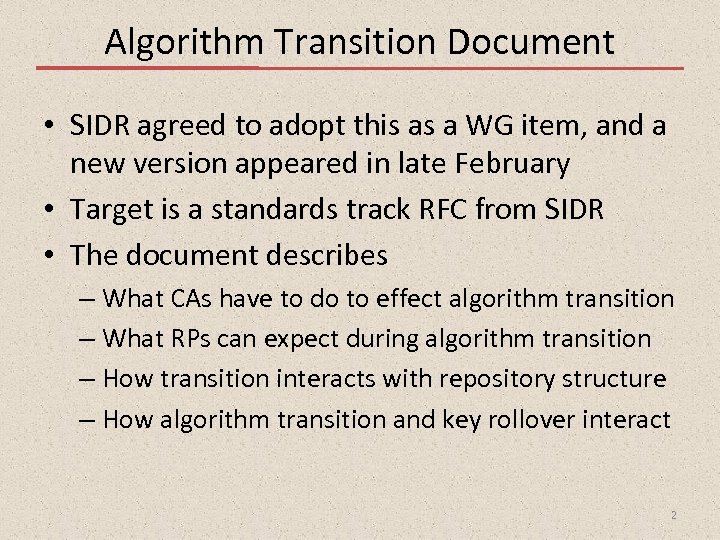 Algorithm Transition Document • SIDR agreed to adopt this as a WG item, and a new version appeared in late February • Target is a standards track RFC from SIDR • The document describes – What CAs have to do to effect algorithm transition – What RPs can expect during algorithm transition – How transition interacts with repository structure – How algorithm transition and key rollover interact 2
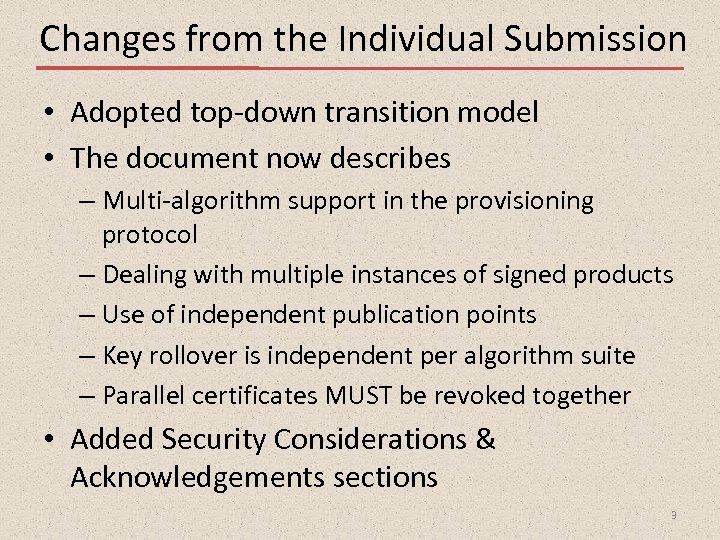 Changes from the Individual Submission • Adopted top-down transition model • The document now describes – Multi-algorithm support in the provisioning protocol – Dealing with multiple instances of signed products – Use of independent publication points – Key rollover is independent per algorithm suite – Parallel certificates MUST be revoked together • Added Security Considerations & Acknowledgements sections 3
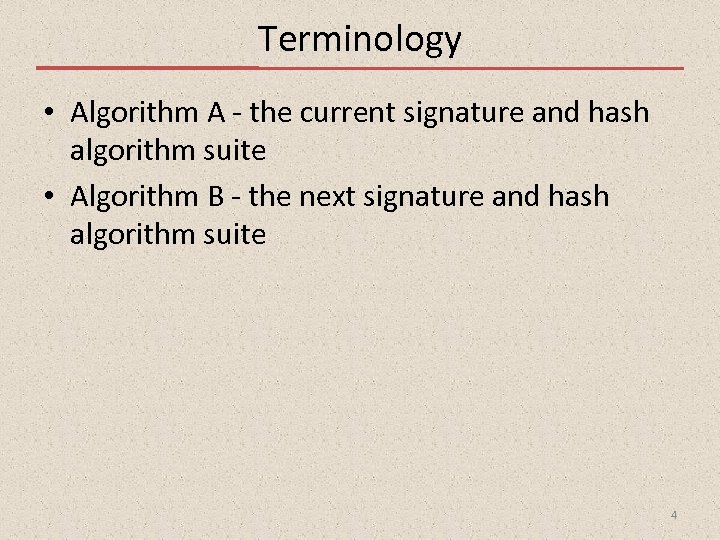 Terminology • Algorithm A - the current signature and hash algorithm suite • Algorithm B - the next signature and hash algorithm suite 4
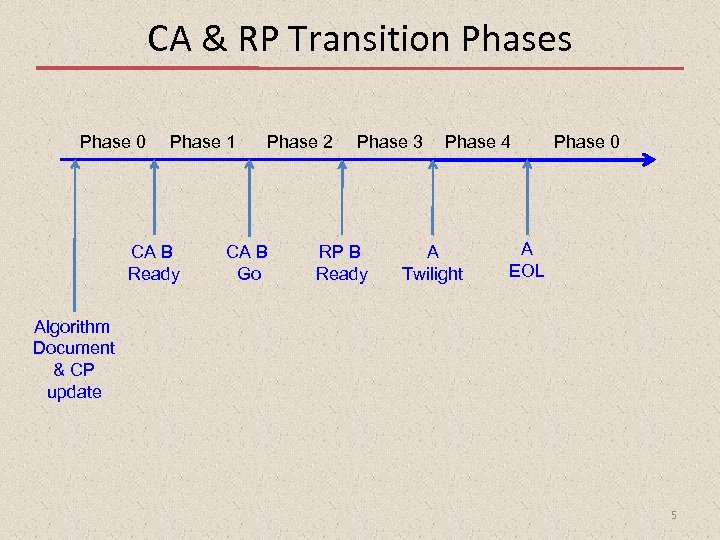 CA & RP Transition Phases Phase 0 Phase 1 CA B Ready Phase 2 CA B Go Phase 3 RP B Ready Phase 4 A Twilight Phase 0 A EOL Algorithm Document & CP update 5
 Algorithm Transition Milestones (1/2) • Steady state (using algorithm A) • Update algorithm specification and CP • CA Algorithm B Ready – all CAs are ready to process a certificate request for a certificate containing an Algorithm B key, signed under Algorithm B • CA Algorithm B Go – all CAs reissue all signed products under Algorithm B (and continue issuing under Algorithm A) 6
 Algorithm Transition Milestones (2/2) • RP Ready Algorithm B – all RPs are ready to process signed products using Algorithm B • Twilight Algorithm A – CAs MAY stop issuing signed products using Algorithm A, and RPs MAY cease validating signed products under Algorithm A • EOL Algorithm A – CAs no longer issue signed products using Algorithm A, and RPs reject any signed product under Algorithm A 7
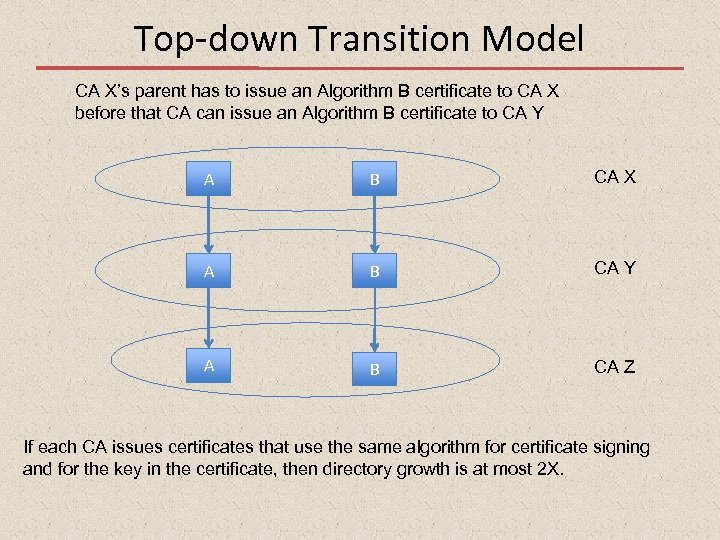 Top-down Transition Model CA X’s parent has to issue an Algorithm B certificate to CA X before that CA can issue an Algorithm B certificate to CA Y A B CA X A B CA Y A B CA Z If each CA issues certificates that use the same algorithm for certificate signing and for the key in the certificate, then directory growth is at most 2 X.
 Repository Management • The transition process requires CAs to publish signed products under both algorithms • During “CA Algorithm B Ready” there may be only a few products (CA certificates) under Algorithm B, so the duplication is not complete • By “CA Algorithm B Go” a full, duplicate product set exists, 2 X repository size • Using separate publication points makes life simpler 9
 Relying Parties • This design provides RPs with signed products under the current and new algorithms for a while, because we assume that it will take a while for ALL RPs to be able to make the transition • This imposes a burden on CAs to maintain parallel signed product sets from “CA Algorithm B Go” until “Algorithm A Twilight” • If an RP fetches both product sets, and either set is OK, then that’s good enough! 10
 Observations • This is still a new document, and thus needs review and comments from the WG • It is only a 25 page document, but the process is complex, so it calls for careful reading • We have had almost no comments from the broad WG population so far Please read and provide feedback! 11