


 Скачать презентацию Status Report Avian Influenza Emergency Preparedness Plan for
544ff2c53672052cb1cc8f85fed88ece.ppt
- Количество слайдов: 31
 Status Report: Avian Influenza Emergency Preparedness Plan for Malawi
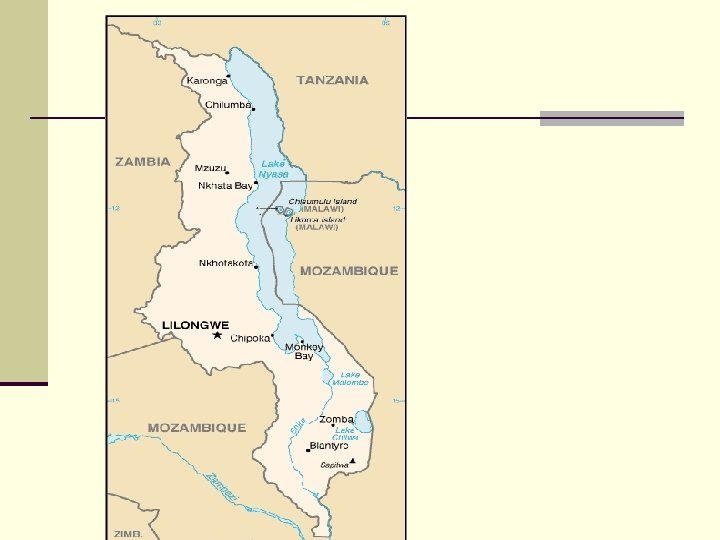
 Avian Influenza Risk for Malawi n Major risks: through migratory birds (Dec – March). n The wetlands serve as important areas for resident & migratory birds. n Wetlands lie on the north-south migratory routes along the rift valley. n Transboundary movements
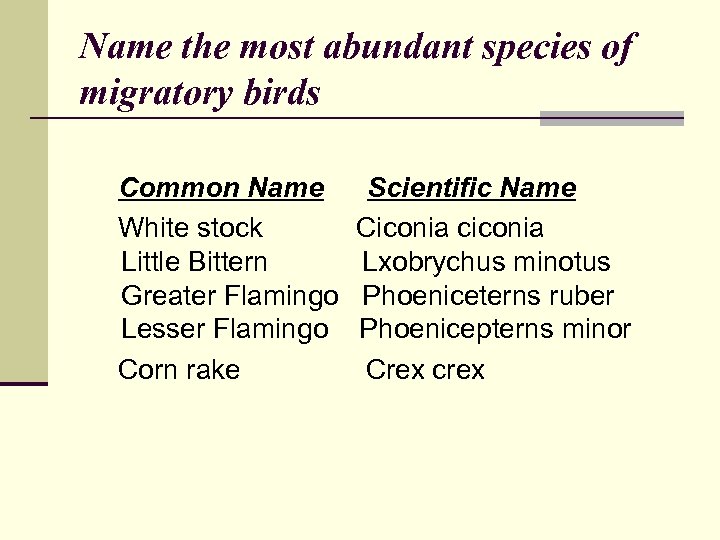 Name the most abundant species of migratory birds Common Name Scientific Name White stock Ciconia ciconia Little Bittern Lxobrychus minotus Greater Flamingo Phoeniceterns ruber Lesser Flamingo Phoenicepterns minor Corn rake Crex crex
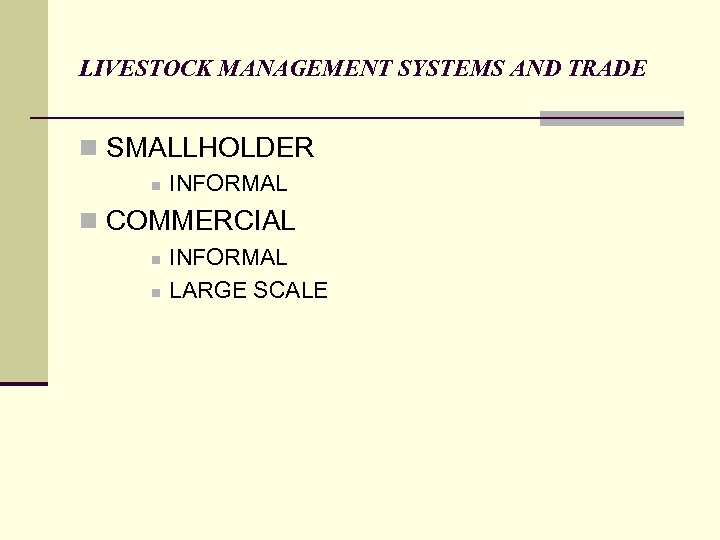 LIVESTOCK MANAGEMENT SYSTEMS AND TRADE n SMALLHOLDER n INFORMAL n COMMERCIAL n n INFORMAL LARGE SCALE
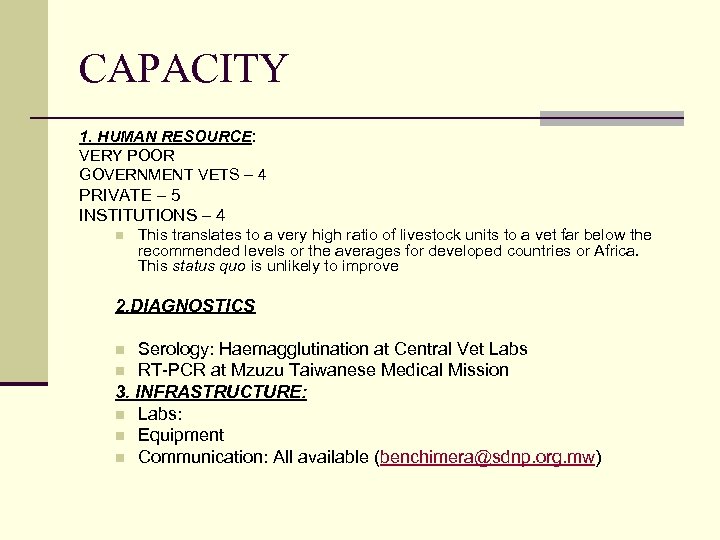 CAPACITY 1. HUMAN RESOURCE: VERY POOR GOVERNMENT VETS – 4 PRIVATE – 5 INSTITUTIONS – 4 n This translates to a very high ratio of livestock units to a vet far below the recommended levels or the averages for developed countries or Africa. This status quo is unlikely to improve 2. DIAGNOSTICS Serology: Haemagglutination at Central Vet Labs n RT-PCR at Mzuzu Taiwanese Medical Mission 3. INFRASTRUCTURE: n Labs: n Equipment n Communication: All available (benchimera@sdnp. org. mw) n
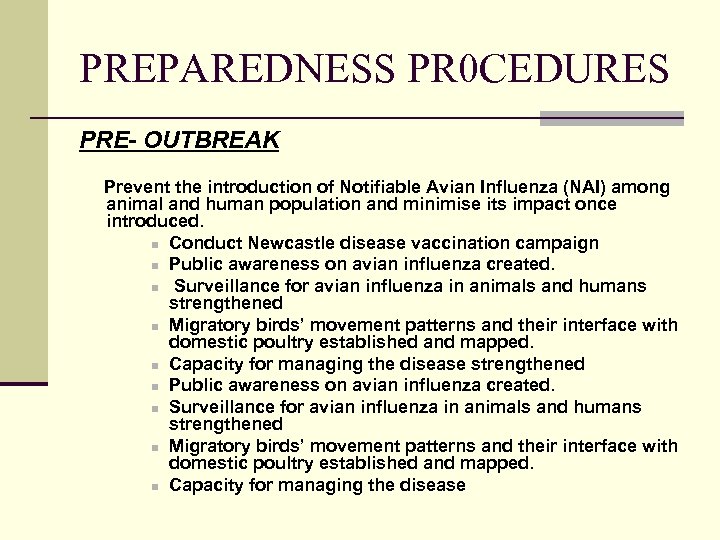 PREPAREDNESS PR 0 CEDURES PRE- OUTBREAK Prevent the introduction of Notifiable Avian Influenza (NAI) among animal and human population and minimise its impact once introduced. n Conduct Newcastle disease vaccination campaign n Public awareness on avian influenza created. n Surveillance for avian influenza in animals and humans strengthened n Migratory birds’ movement patterns and their interface with domestic poultry established and mapped. n Capacity for managing the disease strengthened n Public awareness on avian influenza created. n Surveillance for avian influenza in animals and humans strengthened n Migratory birds’ movement patterns and their interface with domestic poultry established and mapped. n Capacity for managing the disease
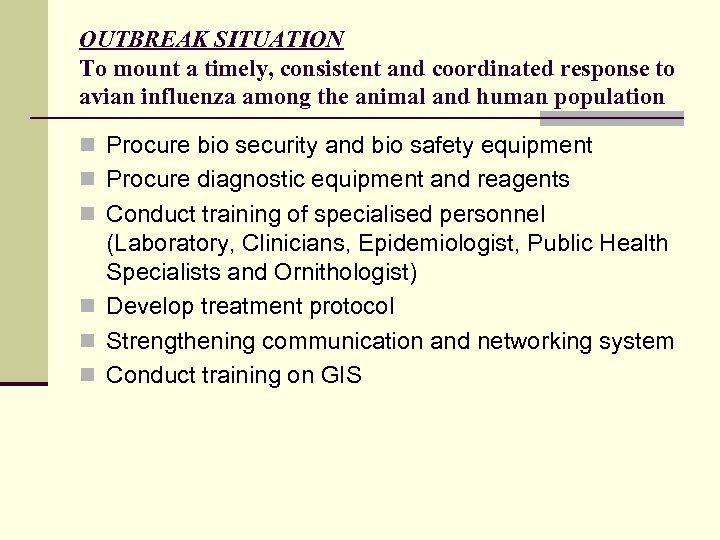 OUTBREAK SITUATION To mount a timely, consistent and coordinated response to avian influenza among the animal and human population n Procure bio security and bio safety equipment n Procure diagnostic equipment and reagents n Conduct training of specialised personnel (Laboratory, Clinicians, Epidemiologist, Public Health Specialists and Ornithologist) n Develop treatment protocol n Strengthening communication and networking system n Conduct training on GIS
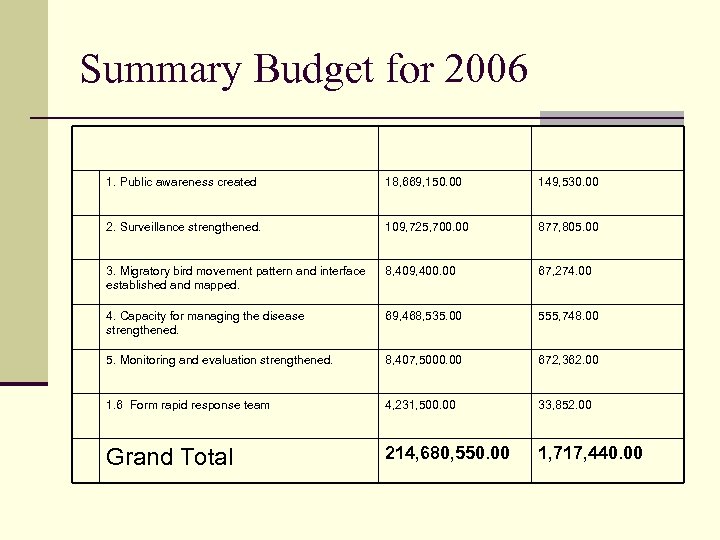 Summary Budget for 2006 1. Public awareness created 18, 669, 150. 00 149, 530. 00 2. Surveillance strengthened. 109, 725, 700. 00 877, 805. 00 3. Migratory bird movement pattern and interface established and mapped. 8, 409, 400. 00 67, 274. 00 4. Capacity for managing the disease strengthened. 69, 468, 535. 00 555, 748. 00 5. Monitoring and evaluation strengthened. 8, 407, 5000. 00 672, 362. 00 1. 6 Form rapid response team 4, 231, 500. 00 33, 852. 00 Grand Total 214, 680, 550. 00 1, 717, 440. 00
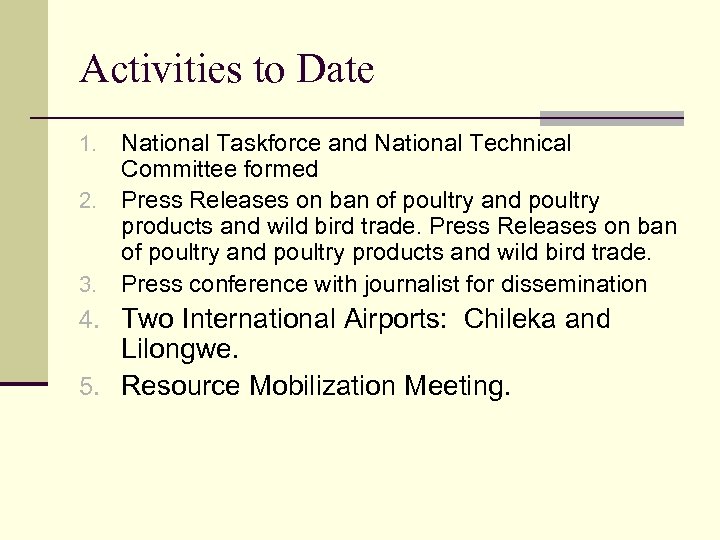 Activities to Date National Taskforce and National Technical Committee formed 2. Press Releases on ban of poultry and poultry products and wild bird trade. 3. Press conference with journalist for dissemination 1. 4. Two International Airports: Chileka and Lilongwe. 5. Resource Mobilization Meeting.
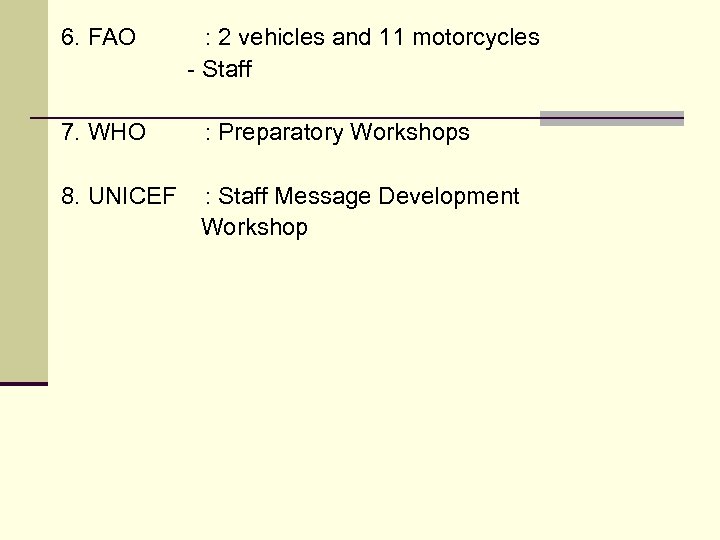 6. FAO : 2 vehicles and 11 motorcycles - Staff 7. WHO : Preparatory Workshops 8. UNICEF : Staff Message Development Workshop
 THANK YOU THE END
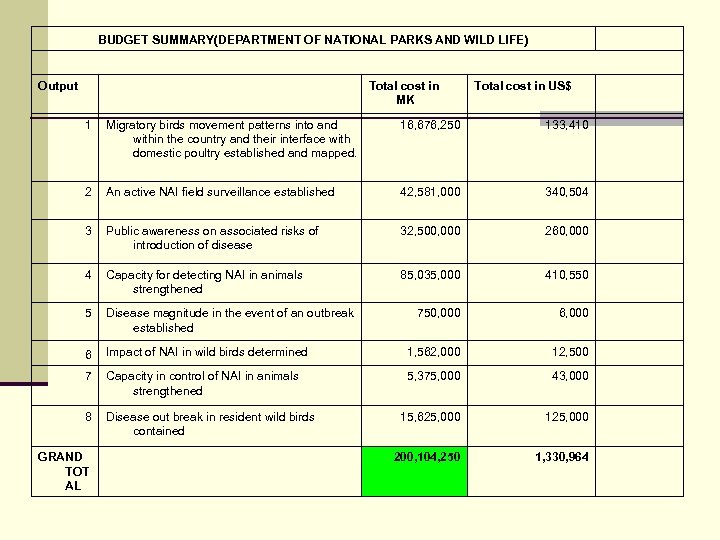 BUDGET SUMMARY(DEPARTMENT OF NATIONAL PARKS AND WILD LIFE) Output Total cost in MK Total cost in US$ 1 Migratory birds movement patterns into and within the country and their interface with domestic poultry established and mapped. 16, 676, 250 133, 410 2 An active NAI field surveillance established 42, 581, 000 340, 504 3 Public awareness on associated risks of introduction of disease 32, 500, 000 260, 000 4 Capacity for detecting NAI in animals strengthened 85, 035, 000 410, 550 5 Disease magnitude in the event of an outbreak established 750, 000 6 Impact of NAI in wild birds determined 1, 562, 000 12, 500 7 Capacity in control of NAI in animals strengthened 5, 375, 000 43, 000 8 Disease out break in resident wild birds contained 15, 625, 000 125, 000 200, 104, 250 1, 330, 964 GRAND TOT AL
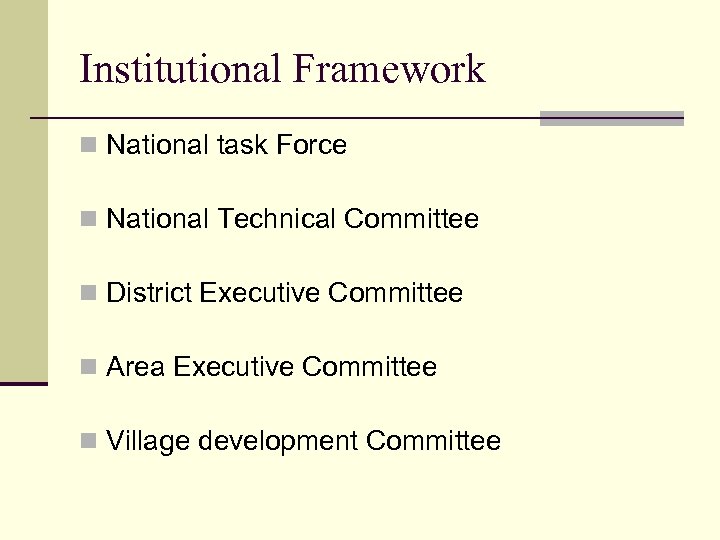 Institutional Framework n National task Force n National Technical Committee n District Executive Committee n Area Executive Committee n Village development Committee
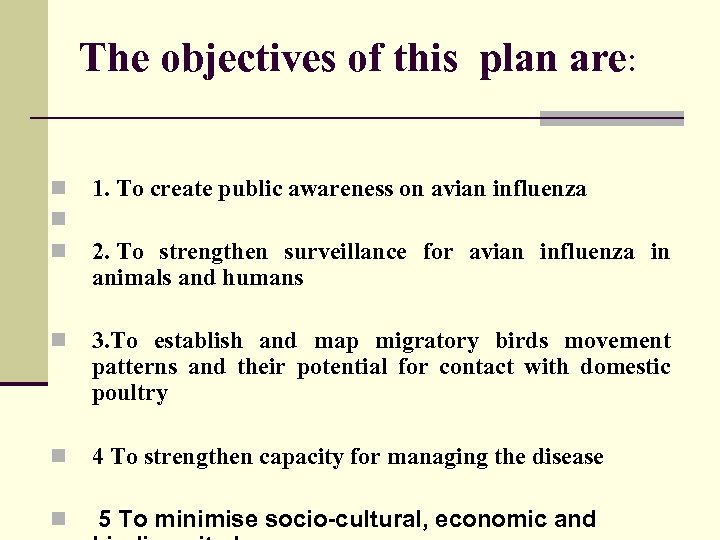 The objectives of this plan are: n n n 1. To create public awareness on avian influenza 2. To strengthen surveillance for avian influenza in animals and humans n 3. To establish and map migratory birds movement patterns and their potential for contact with domestic poultry n 4 To strengthen capacity for managing the disease n 5 To minimise socio-cultural, economic and
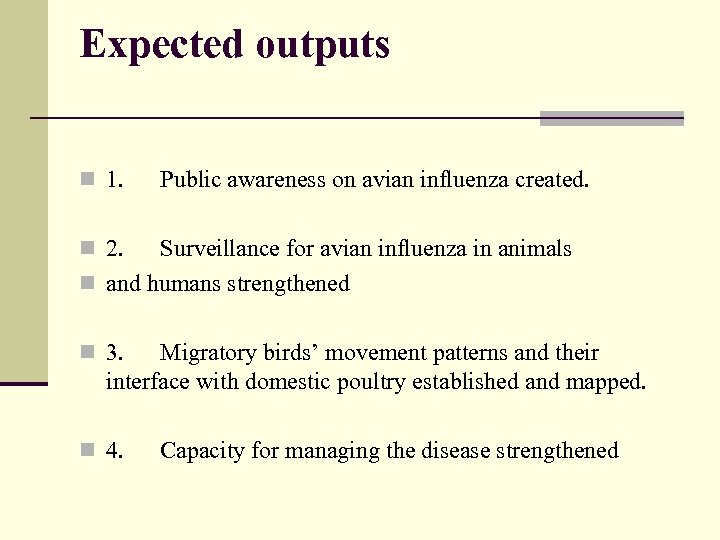 Expected outputs n 1. Public awareness on avian influenza created. n 2. Surveillance for avian influenza in animals n and humans strengthened n 3. Migratory birds’ movement patterns and their interface with domestic poultry established and mapped. n 4. Capacity for managing the disease strengthened
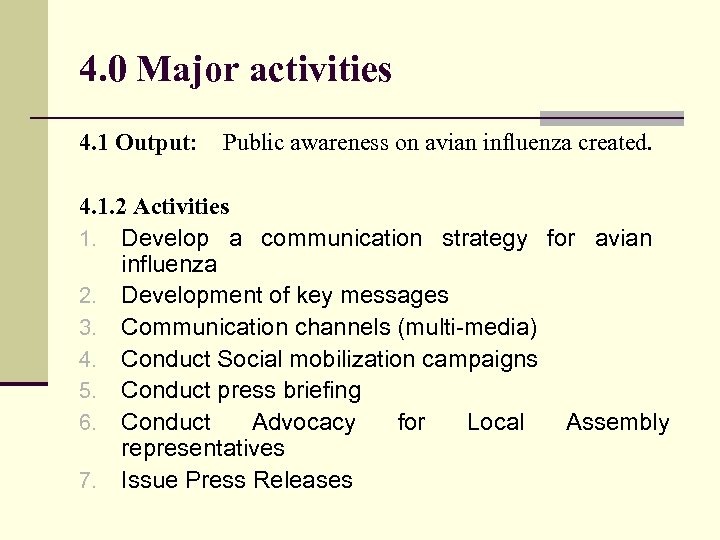 4. 0 Major activities 4. 1 Output: Public awareness on avian influenza created. 4. 1. 2 Activities 1. Develop a communication strategy for avian influenza 2. Development of key messages 3. Communication channels (multi-media) 4. Conduct Social mobilization campaigns 5. Conduct press briefing 6. Conduct Advocacy for Local Assembly representatives 7. Issue Press Releases
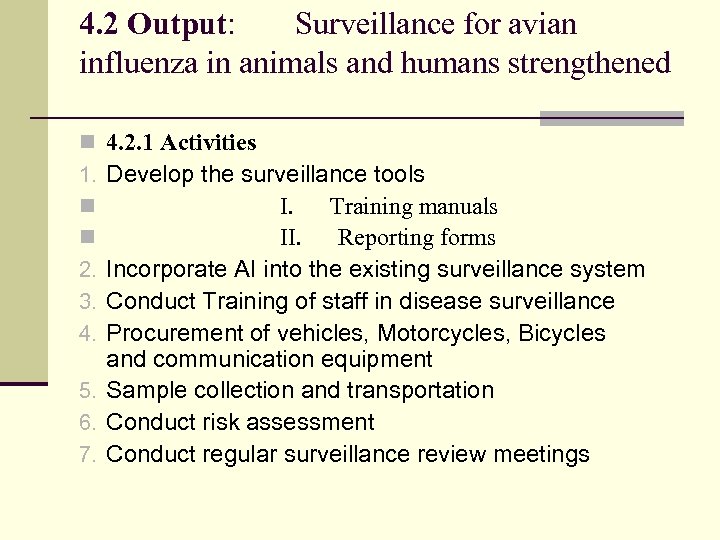 4. 2 Output: Surveillance for avian influenza in animals and humans strengthened 4. 2. 1 Activities Develop the surveillance tools I. Training manuals II. Reporting forms Incorporate AI into the existing surveillance system Conduct Training of staff in disease surveillance Procurement of vehicles, Motorcycles, Bicycles and communication equipment 5. Sample collection and transportation 6. Conduct risk assessment 7. Conduct regular surveillance review meetings n 1. n n 2. 3. 4.
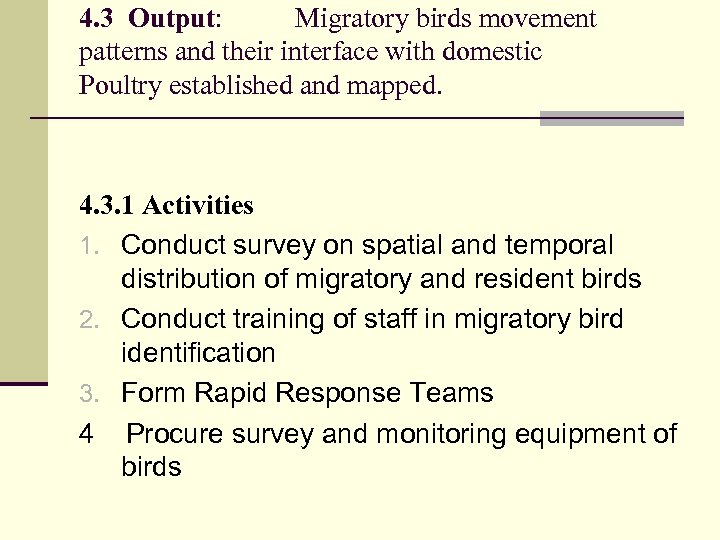 4. 3 Output: Migratory birds movement patterns and their interface with domestic Poultry established and mapped. 4. 3. 1 Activities 1. Conduct survey on spatial and temporal distribution of migratory and resident birds 2. Conduct training of staff in migratory bird identification 3. Form Rapid Response Teams 4 Procure survey and monitoring equipment of birds
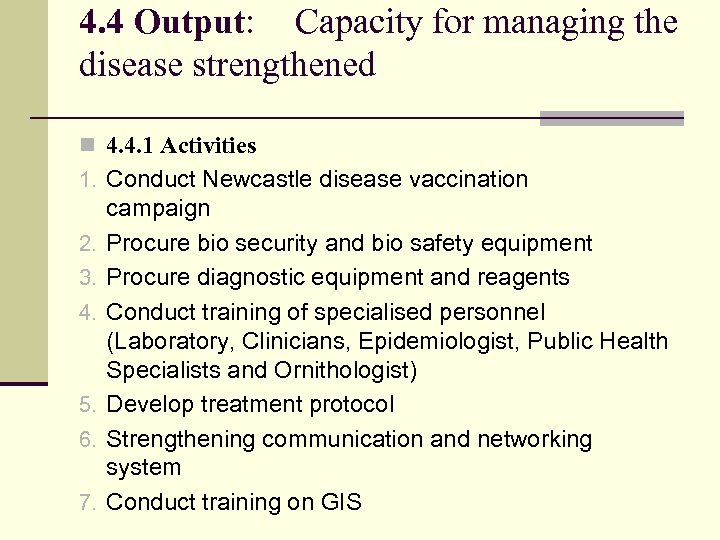 4. 4 Output: Capacity for managing the disease strengthened n 4. 4. 1 Activities 1. Conduct Newcastle disease vaccination 2. 3. 4. 5. 6. 7. campaign Procure bio security and bio safety equipment Procure diagnostic equipment and reagents Conduct training of specialised personnel (Laboratory, Clinicians, Epidemiologist, Public Health Specialists and Ornithologist) Develop treatment protocol Strengthening communication and networking system Conduct training on GIS
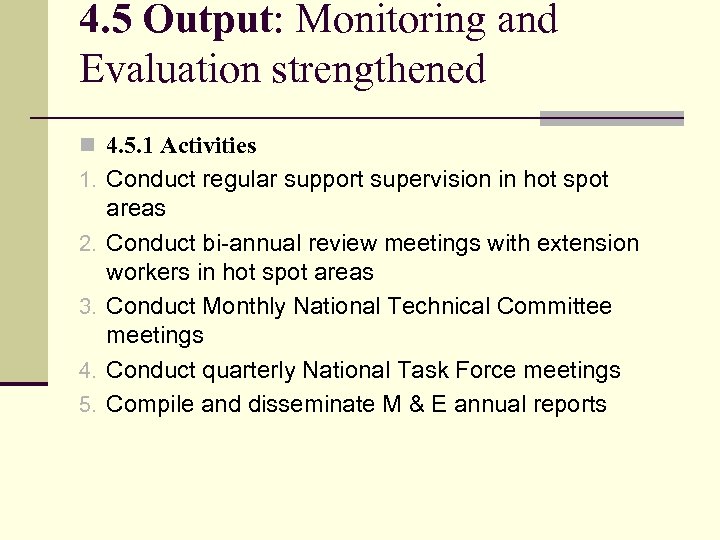 4. 5 Output: Monitoring and Evaluation strengthened n 4. 5. 1 Activities 1. Conduct regular support supervision in hot spot 2. 3. 4. 5. areas Conduct bi-annual review meetings with extension workers in hot spot areas Conduct Monthly National Technical Committee meetings Conduct quarterly National Task Force meetings Compile and disseminate M & E annual reports
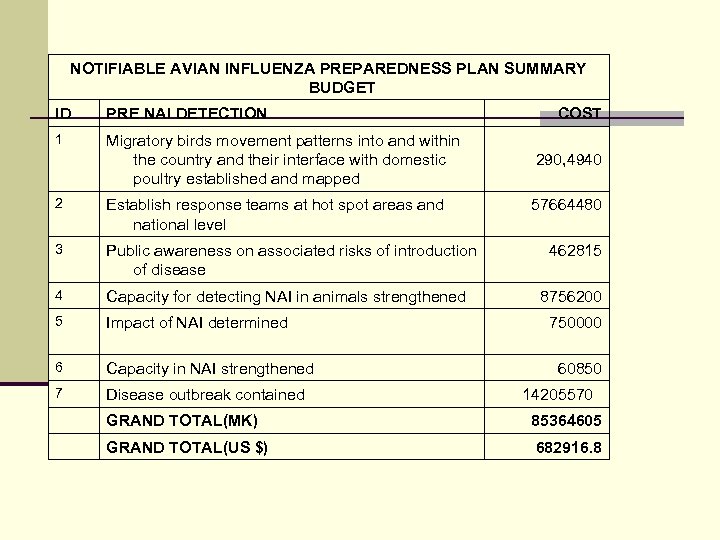 NOTIFIABLE AVIAN INFLUENZA PREPAREDNESS PLAN SUMMARY BUDGET ID PRE NAI DETECTION COST 1 Migratory birds movement patterns into and within the country and their interface with domestic poultry established and mapped 290, 4940 2 Establish response teams at hot spot areas and national level 57664480 3 Public awareness on associated risks of introduction of disease 4 Capacity for detecting NAI in animals strengthened 5 Impact of NAI determined 6 Capacity in NAI strengthened 7 Disease outbreak contained 462815 8756200 750000 60850 14205570 GRAND TOTAL(MK) 85364605 GRAND TOTAL(US $) 682916. 8
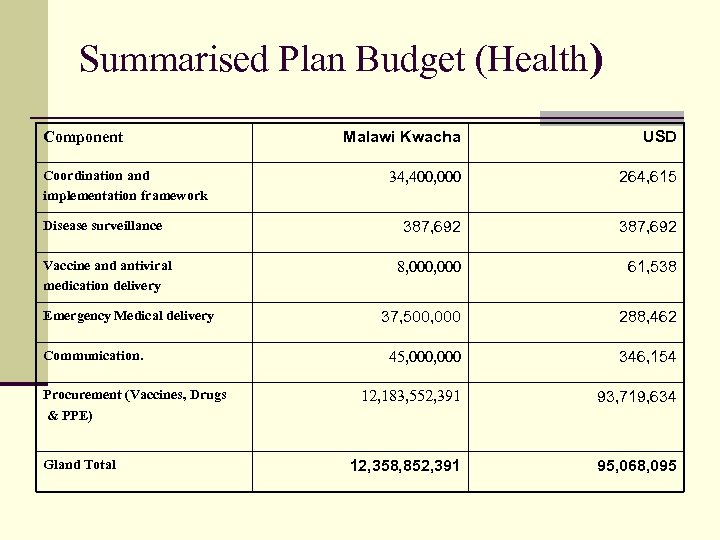 Summarised Plan Budget (Health) Component Coordination and implementation framework Disease surveillance Vaccine and antiviral medication delivery Emergency Medical delivery Communication. Procurement (Vaccines, Drugs & PPE) Gland Total Malawi Kwacha USD 34, 400, 000 264, 615 387, 692 8, 000 61, 538 37, 500, 000 288, 462 45, 000 346, 154 12, 183, 552, 391 93, 719, 634 12, 358, 852, 391 95, 068, 095
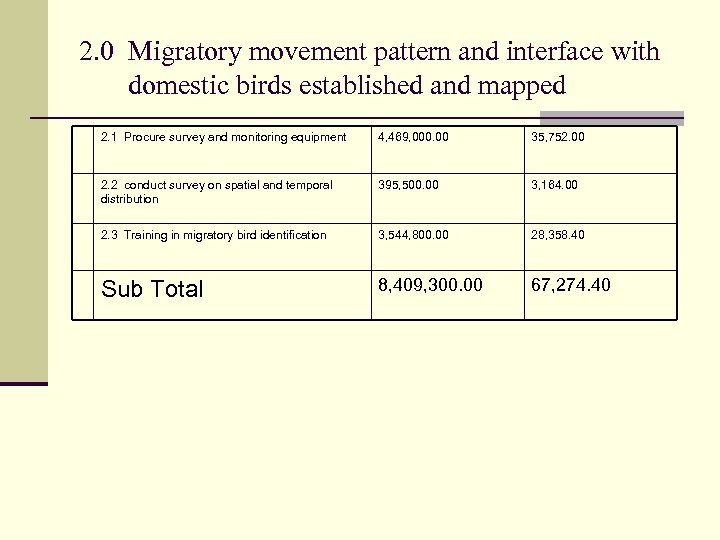 2. 0 Migratory movement pattern and interface with domestic birds established and mapped 2. 1 Procure survey and monitoring equipment 4, 469, 000. 00 35, 752. 00 2. 2 conduct survey on spatial and temporal distribution 395, 500. 00 3, 164. 00 2. 3 Training in migratory bird identification 3, 544, 800. 00 28, 358. 40 Sub Total 8, 409, 300. 00 67, 274. 40
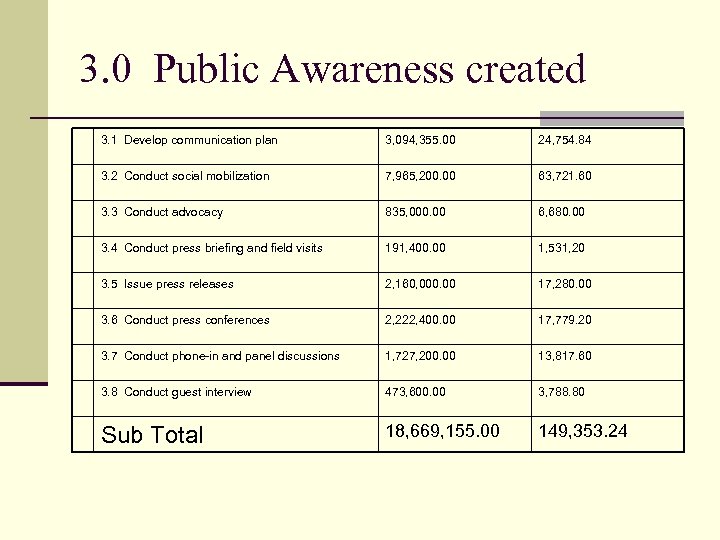 3. 0 Public Awareness created 3. 1 Develop communication plan 3, 094, 355. 00 24, 754. 84 3. 2 Conduct social mobilization 7, 965, 200. 00 63, 721. 60 3. 3 Conduct advocacy 835, 000. 00 6, 680. 00 3. 4 Conduct press briefing and field visits 191, 400. 00 1, 531, 20 3. 5 Issue press releases 2, 160, 000. 00 17, 280. 00 3. 6 Conduct press conferences 2, 222, 400. 00 17, 779. 20 3. 7 Conduct phone-in and panel discussions 1, 727, 200. 00 13, 817. 60 3. 8 Conduct guest interview 473, 600. 00 3, 788. 80 Sub Total 18, 669, 155. 00 149, 353. 24
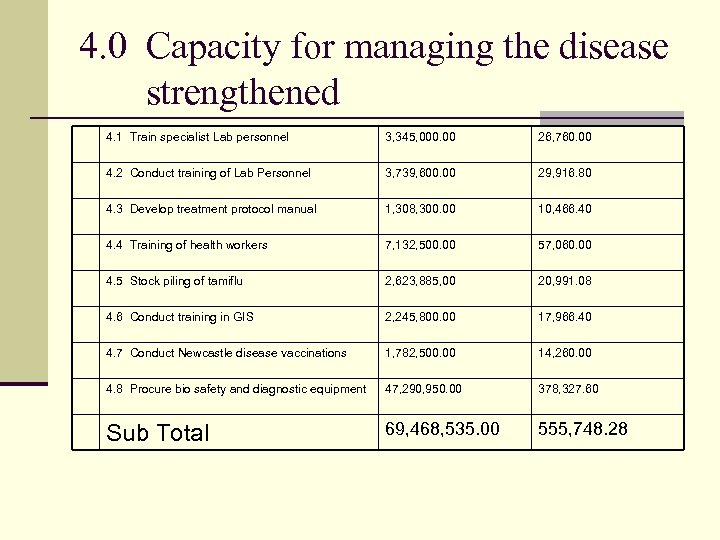 4. 0 Capacity for managing the disease strengthened 4. 1 Train specialist Lab personnel 3, 345, 000. 00 26, 760. 00 4. 2 Conduct training of Lab Personnel 3, 739, 600. 00 29, 916. 80 4. 3 Develop treatment protocol manual 1, 308, 300. 00 10, 466. 40 4. 4 Training of health workers 7, 132, 500. 00 57, 060. 00 4. 5 Stock piling of tamiflu 2, 623, 885, 00 20, 991. 08 4. 6 Conduct training in GIS 2, 245, 800. 00 17, 966. 40 4. 7 Conduct Newcastle disease vaccinations 1, 782, 500. 00 14, 260. 00 4. 8 Procure bio safety and diagnostic equipment 47, 290, 950. 00 378, 327. 60 Sub Total 69, 468, 535. 00 555, 748. 28
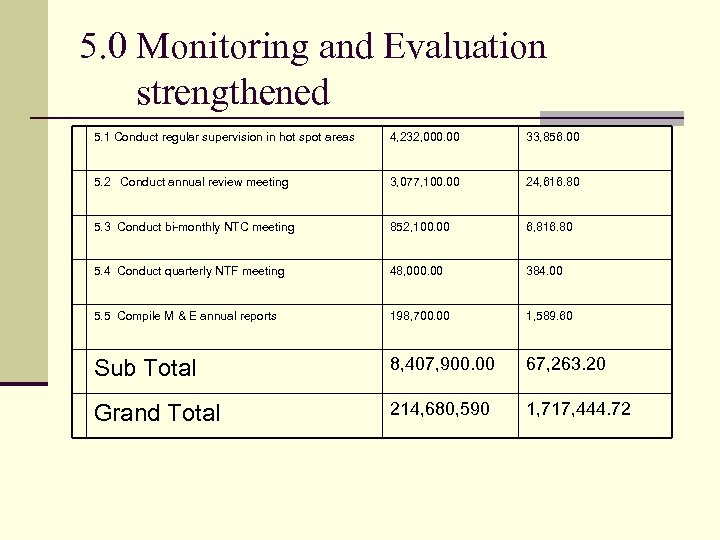 5. 0 Monitoring and Evaluation strengthened 5. 1 Conduct regular supervision in hot spot areas 4, 232, 000. 00 33, 856. 00 5. 2 Conduct annual review meeting 3, 077, 100. 00 24, 616. 80 5. 3 Conduct bi-monthly NTC meeting 852, 100. 00 6, 816. 80 5. 4 Conduct quarterly NTF meeting 48, 000. 00 384. 00 5. 5 Compile M & E annual reports 198, 700. 00 1, 589. 60 Sub Total 8, 407, 900. 00 67, 263. 20 Grand Total 214, 680, 590 1, 717, 444. 72
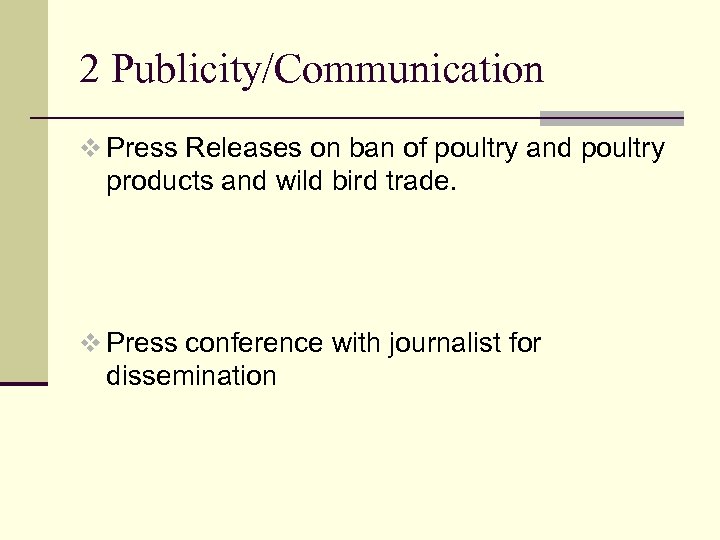 2 Publicity/Communication v Press Releases on ban of poultry and poultry products and wild bird trade. v Press conference with journalist for dissemination
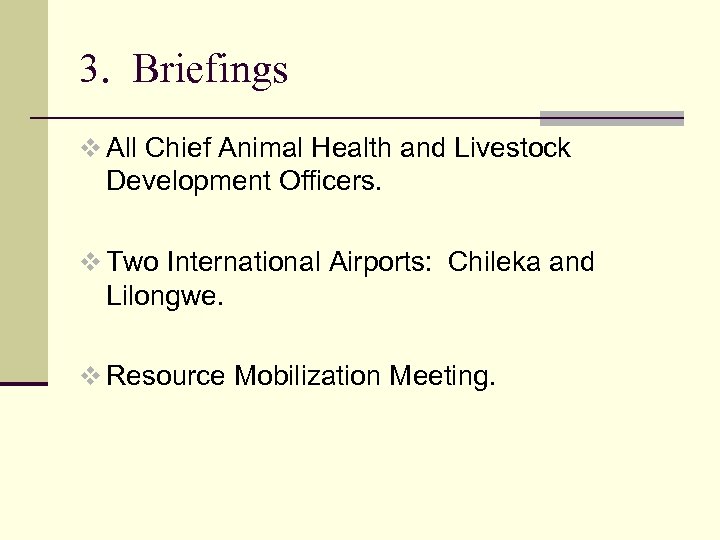 3. Briefings v All Chief Animal Health and Livestock Development Officers. v Two International Airports: Chileka and Lilongwe. v Resource Mobilization Meeting.
 4. Surveillance v Sample collection at Lake Chirwa with wetlands International /FAO.
 5. Partner Support v FAO : 2 vehicles and 11 motorcycles - Staff v WHO : Preparatory Workshops v UNICEF : Staff Message Development Workshop