


 Скачать презентацию Status of Universal Human Values in Higher Education
653bbeb4e15a97cc5afa14f673524210.ppt
- Количество слайдов: 19
 Status of Universal Human Values in Higher Education May 2013
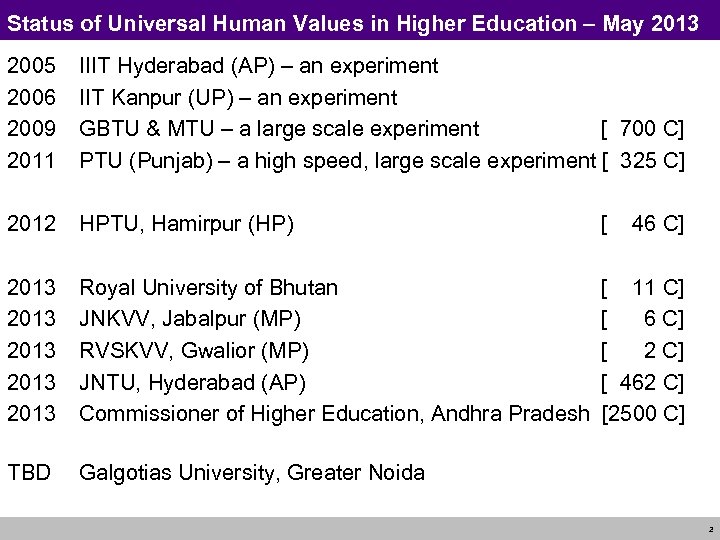 Status of Universal Human Values in Higher Education – May 2013 2005 2006 2009 2011 IIIT Hyderabad (AP) – an experiment IIT Kanpur (UP) – an experiment GBTU & MTU – a large scale experiment [ 700 C] PTU (Punjab) – a high speed, large scale experiment [ 325 C] 2012 HPTU, Hamirpur (HP) 2013 2013 Royal University of Bhutan [ 11 C] JNKVV, Jabalpur (MP) [ 6 C] RVSKVV, Gwalior (MP) [ 2 C] JNTU, Hyderabad (AP) [ 462 C] Commissioner of Higher Education, Andhra Pradesh [2500 C] TBD Galgotias University, Greater Noida [ 46 C] 2
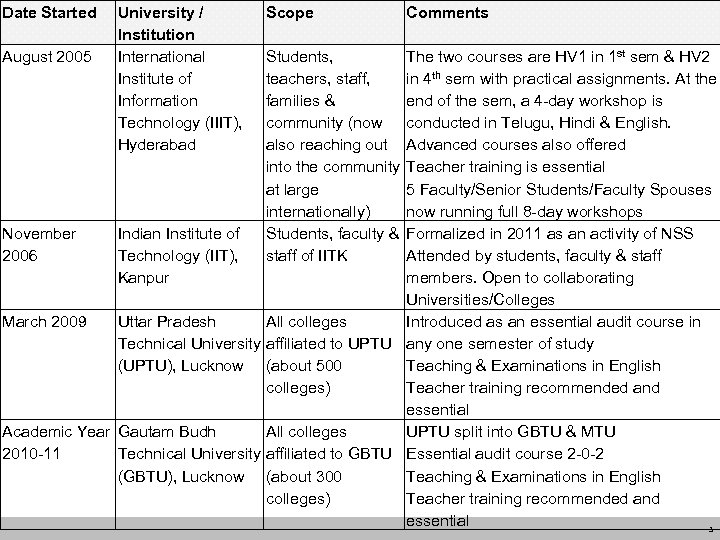 Date Started August 2005 University / Institution International Institute of Information Technology (IIIT), Hyderabad Scope Comments Students, The two courses are HV 1 in 1 st sem & HV 2 teachers, staff, in 4 th sem with practical assignments. At the families & end of the sem, a 4 -day workshop is community (now conducted in Telugu, Hindi & English. also reaching out Advanced courses also offered into the community Teacher training is essential at large 5 Faculty/Senior Students/Faculty Spouses internationally) now running full 8 -day workshops November Indian Institute of Students, faculty & Formalized in 2011 as an activity of NSS 2006 Technology (IIT), staff of IITK Attended by students, faculty & staff Kanpur members. Open to collaborating Universities/Colleges March 2009 Uttar Pradesh All colleges Introduced as an essential audit course in Technical University affiliated to UPTU any one semester of study (UPTU), Lucknow (about 500 Teaching & Examinations in English colleges) Teacher training recommended and essential Academic Year Gautam Budh All colleges UPTU split into GBTU & MTU 2010 -11 Technical University affiliated to GBTU Essential audit course 2 -0 -2 (GBTU), Lucknow (about 300 Teaching & Examinations in English colleges) Teacher training recommended and essential 3
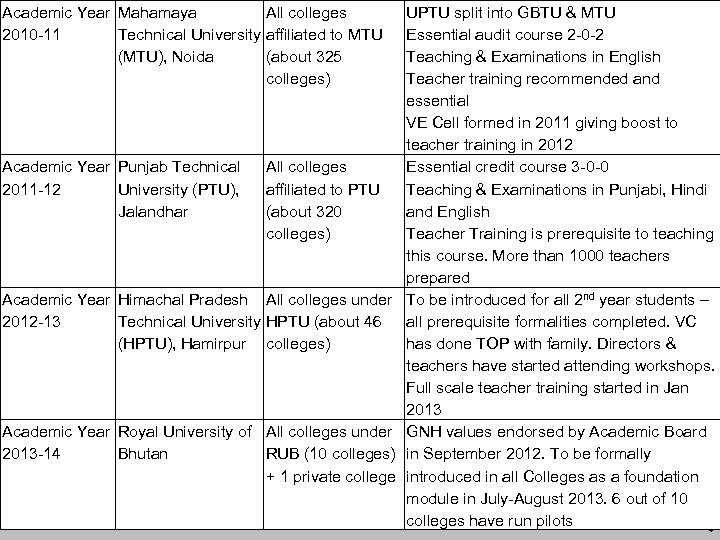 Academic Year Mahamaya All colleges 2010 -11 Technical University affiliated to MTU (MTU), Noida (about 325 colleges) Academic Year Punjab Technical 2011 -12 University (PTU), Jalandhar All colleges affiliated to PTU (about 320 colleges) Academic Year Himachal Pradesh All colleges under 2012 -13 Technical University HPTU (about 46 (HPTU), Hamirpur colleges) Academic Year Royal University of All colleges under 2013 -14 Bhutan RUB (10 colleges) + 1 private college UPTU split into GBTU & MTU Essential audit course 2 -0 -2 Teaching & Examinations in English Teacher training recommended and essential VE Cell formed in 2011 giving boost to teacher training in 2012 Essential credit course 3 -0 -0 Teaching & Examinations in Punjabi, Hindi and English Teacher Training is prerequisite to teaching this course. More than 1000 teachers prepared To be introduced for all 2 nd year students – all prerequisite formalities completed. VC has done TOP with family. Directors & teachers have started attending workshops. Full scale teacher training started in Jan 2013 GNH values endorsed by Academic Board in September 2012. To be formally introduced in all Colleges as a foundation module in July-August 2013. 6 out of 10 colleges have run pilots 4
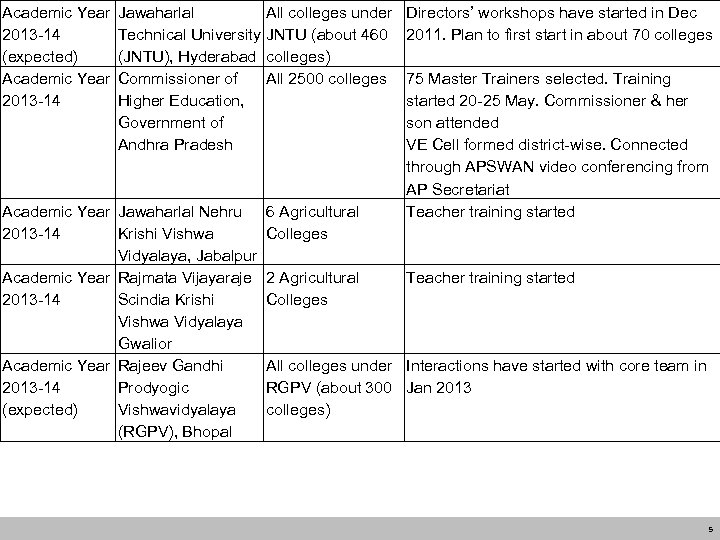 Academic Year Jawaharlal All colleges under 2013 -14 Technical University JNTU (about 460 (expected) (JNTU), Hyderabad colleges) Academic Year Commissioner of All 2500 colleges 2013 -14 Higher Education, Government of Andhra Pradesh Academic Year Jawaharlal Nehru 2013 -14 Krishi Vishwa Vidyalaya, Jabalpur Academic Year Rajmata Vijayaraje 2013 -14 Scindia Krishi Vishwa Vidyalaya Gwalior Academic Year Rajeev Gandhi 2013 -14 Prodyogic (expected) Vishwavidyalaya (RGPV), Bhopal 6 Agricultural Colleges 2 Agricultural Colleges Directors’ workshops have started in Dec 2011. Plan to first start in about 70 colleges 75 Master Trainers selected. Training started 20 -25 May. Commissioner & her son attended VE Cell formed district-wise. Connected through APSWAN video conferencing from AP Secretariat Teacher training started All colleges under Interactions have started with core team in RGPV (about 300 Jan 2013 colleges) 5
 DETAILS 6
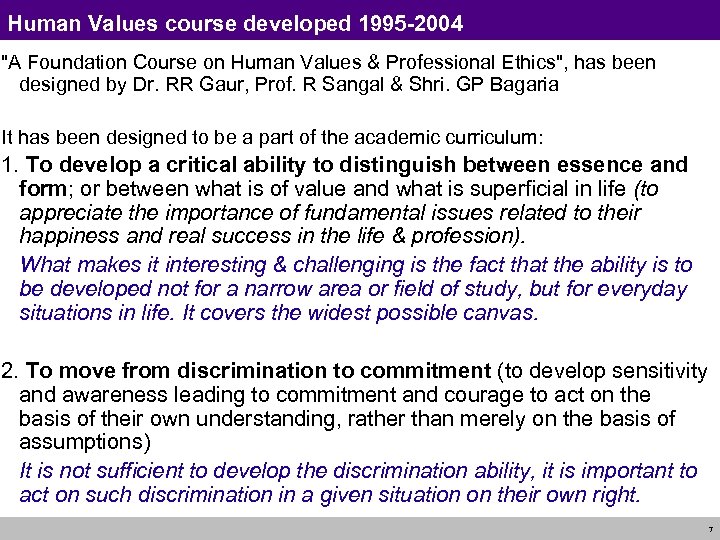 Human Values course developed 1995 -2004 "A Foundation Course on Human Values & Professional Ethics", has been designed by Dr. RR Gaur, Prof. R Sangal & Shri. GP Bagaria It has been designed to be a part of the academic curriculum: 1. To develop a critical ability to distinguish between essence and form; or between what is of value and what is superficial in life (to appreciate the importance of fundamental issues related to their happiness and real success in the life & profession). What makes it interesting & challenging is the fact that the ability is to be developed not for a narrow area or field of study, but for everyday situations in life. It covers the widest possible canvas. 2. To move from discrimination to commitment (to develop sensitivity and awareness leading to commitment and courage to act on the basis of their own understanding, rather than merely on the basis of assumptions) It is not sufficient to develop the discrimination ability, it is important to act on such discrimination in a given situation on their own right. 7
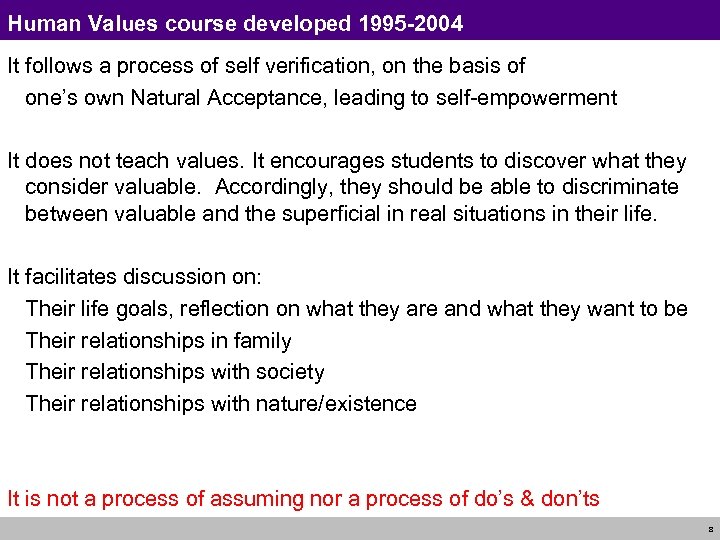 Human Values course developed 1995 -2004 It follows a process of self verification, on the basis of one’s own Natural Acceptance, leading to self-empowerment It does not teach values. It encourages students to discover what they consider valuable. Accordingly, they should be able to discriminate between valuable and the superficial in real situations in their life. It facilitates discussion on: Their life goals, reflection on what they are and what they want to be Their relationships in family Their relationships with society Their relationships with nature/existence It is not a process of assuming nor a process of do’s & don’ts 8
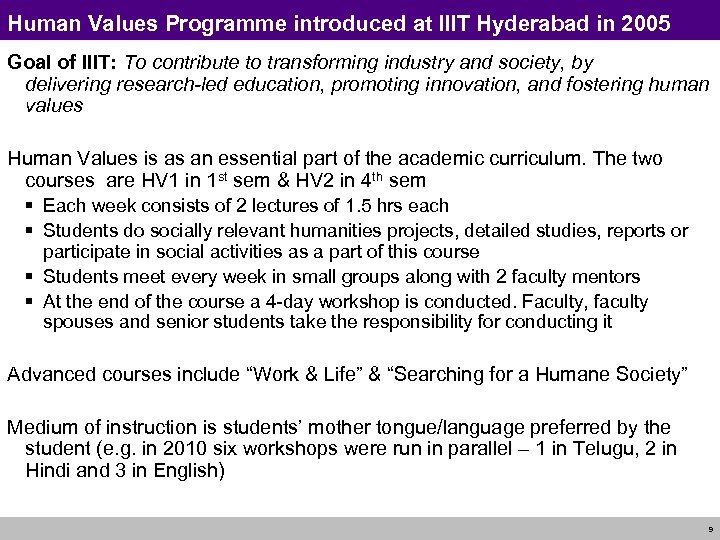 Human Values Programme introduced at IIIT Hyderabad in 2005 Goal of IIIT: To contribute to transforming industry and society, by delivering research-led education, promoting innovation, and fostering human values Human Values is as an essential part of the academic curriculum. The two courses are HV 1 in 1 st sem & HV 2 in 4 th sem § Each week consists of 2 lectures of 1. 5 hrs each § Students do socially relevant humanities projects, detailed studies, reports or participate in social activities as a part of this course § Students meet every week in small groups along with 2 faculty mentors § At the end of the course a 4 -day workshop is conducted. Faculty, faculty spouses and senior students take the responsibility for conducting it Advanced courses include “Work & Life” & “Searching for a Humane Society” Medium of instruction is students’ mother tongue/language preferred by the student (e. g. in 2010 six workshops were run in parallel – 1 in Telugu, 2 in Hindi and 3 in English) 9
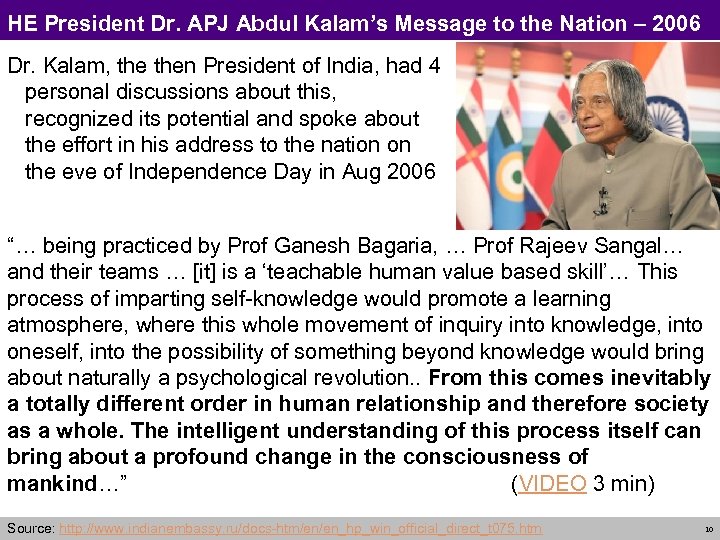 HE President Dr. APJ Abdul Kalam’s Message to the Nation – 2006 Dr. Kalam, then President of India, had 4 personal discussions about this, recognized its potential and spoke about the effort in his address to the nation on the eve of Independence Day in Aug 2006 “… being practiced by Prof Ganesh Bagaria, … Prof Rajeev Sangal… and their teams … [it] is a ‘teachable human value based skill’… This process of imparting self-knowledge would promote a learning atmosphere, where this whole movement of inquiry into knowledge, into oneself, into the possibility of something beyond knowledge would bring about naturally a psychological revolution. . From this comes inevitably a totally different order in human relationship and therefore society as a whole. The intelligent understanding of this process itself can bring about a profound change in the consciousness of mankind…” (VIDEO 3 min) Source: http: //www. indianembassy. ru/docs-htm/en/en_hp_win_official_direct_t 075. htm 10
 Implementation Resources for Large Scale Implementation – 2005. . . 1. 2. 3. 4. 5. 6. 7. 8. Syllabus Teachers Manual (Lecture Plan 28 Lectures & 14 Practice Sessions) Text Book Posters Presentations, including Practice Sessions, Tutorials & Videos, FAQ Video of Workshop Lectures Weekly Meeting (also through Web. Ex) Web Site http: //www. universalhumanvalues. info 9. 10. 11. 12. 8 -Day Teachers' Orientation Program How to Share Values Examination & Evaluation Social Projects & Social Internship 13. Process of Implementation (stage by stage) Advanced Study 1. PSL 2 … 11
 Teaching Material 1. 2. 3. 4. 5. 6. 7. 8. Syllabus (Module Descriptor) Teachers Manual (Lecture Plan 28 Lectures & 14 Practice Sessions) Text Book Posters Presentations, including Practice Sessions, Tutorials & Videos Frequently Asked Questions Video of Workshop Lectures (English & Hindi) Structure of Weekly Meeting 9. How to Share Values 10. Examination & Evaluation 11. Social Projects & Social Internship Workshops 1. 8 -Day Teachers' Orientation Program (PSL 1) 2. PSL 2 … 12
 Large scale implementation at UPTU – 2009 Introduced as an essential course in all affiliated professional colleges, after due process of management approval in 2009 8 -day Teachers’ Orientation Program (TOP) to prepare teachers. 12 workshops have been conducted through which 350 teachers from 300 colleges have attended Run as a regular course (2 -0 -2), i. e. 28 lecture-sessions and 14 tutorials (practice-sessions) spread across any one semester Course has been conducted in about 450 colleges for about 1, 20, 000 students since the academic year starting in July 2009 Over 35 short (1 to 3 -day) workshops have been conducted in every major city in UP. About 3, 000 participants (mostly teachers, members of management and administration) from over 200 colleges have attended these workshops. They have been quite effective in creating awareness Medium of instruction is English 13
 High speed, large scale implementation at PTU – 2011 Introduced in 2011 as an essential credit course in all affiliated professional colleges, after due process in Board of Studies Run as a regular course (3 -0 -0 to start with), i. e. 28 lecture-sessions and 14 tutorials (practice-sessions) Taught & examination conducted in Punjabi, Hindi and English 900+ teachers have been prepared through Teachers’ Orientation Program Results are encouraging 14
 Typical Response 1. There is a sense of prosperity 2. More attention toward relationship – with family, colleagues, students etc. 3. Better attitude of students, particularly towards academics and its impact on employability 4. Increased self discipline & sense of responsibility, reduced need for enforcement 5. Significant commitment toward teaching 15
 Natural Expansion of Human Values in Education – 2013 Considering Rajeev Gandhi Prodyogic Vishwavidyalaya, Bhopal (MP) Universities in Technical & Higher Education (Haryana) Several other universities… 16
 3 Key Challenges 1. Management Expectations, Involvement and Support 2. Preparation of teachers. There is a significant difference between teachers who have attended the Teachers’ Orientation Program & those who have not 3. Communication with Students – that this is an essential core course, not an “extra” subject that will increase their academic workload 17
 4 Key Learnings 1. Human Values are teachable - they can be communicated precisely and effectively. Specific, universal guidelines have been articulated and comprehensive formal teaching resources have been developed. This includes the syllabus, a teachers' manual, a text book, practice sessions, video of lectures as well as a web-site 2. There is a significant impact on students, faculty, management, staff, families the entire community of individuals associated with the institution – provided the teachers are prepared and environment is conducive 3. The 8 -day Teachers’ Orientation Program is effective in preparing teachers – to understand to teach. There is a significant difference in effectiveness of teachers who have attended the TOP & those who have not 4. A strong process required for implementation and scaling-up is evolving 18
 Human Values Course in Professional Education HV is essential for all It is introduced in professional education: 1. These students will step into society & start contributing soon. With an overview, some of them will be able to participate in the family and society in a more meaningful manner. Some of them can take the right understanding into education, as parents or teachers 2. In professional education, the system is active - there are students, teachers, curriculum, classes, exams take place and taken quite seriously. Only the content and process of education needs to be updated. So there is a possibility for right education to start 3. The syllabus of schools is influenced by what is taught in professional colleges 19