


 Скачать презентацию Status of the T 2 K TPC Laser
7b58c486dc4d614b5b176db39ddcae95.ppt
- Количество слайдов: 11
 Status of the T 2 K TPC Laser Calibration Christian Hansen Mike Roney Mark Lenckowski Fabrice Retiere UVic Triumf March 6, 2006, TPC Canada Meeting, UVic & Triumf 1
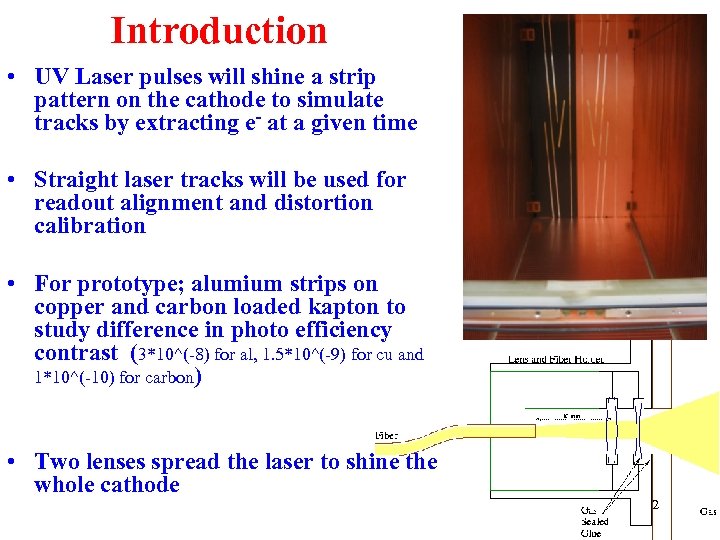 Introduction • UV Laser pulses will shine a strip pattern on the cathode to simulate tracks by extracting e- at a given time • Straight laser tracks will be used for readout alignment and distortion calibration • For prototype; alumium strips on copper and carbon loaded kapton to study difference in photo efficiency contrast (3*10^(-8) for al, 1. 5*10^(-9) for cu and 1*10^(-10) for carbon) • Two lenses spread the laser to shine the whole cathode 2
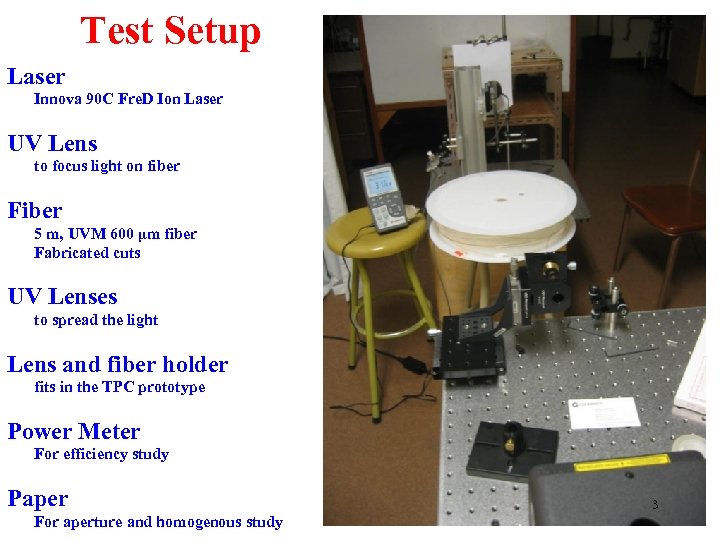 Test Setup Laser Innova 90 C Fre. D Ion Laser UV Lens to focus light on fiber Fiber 5 m, UVM 600 µm fiber Fabricated cuts UV Lenses to spread the light Lens and fiber holder fits in the TPC prototype Power Meter For efficiency study Paper For aperture and homogenous study 3
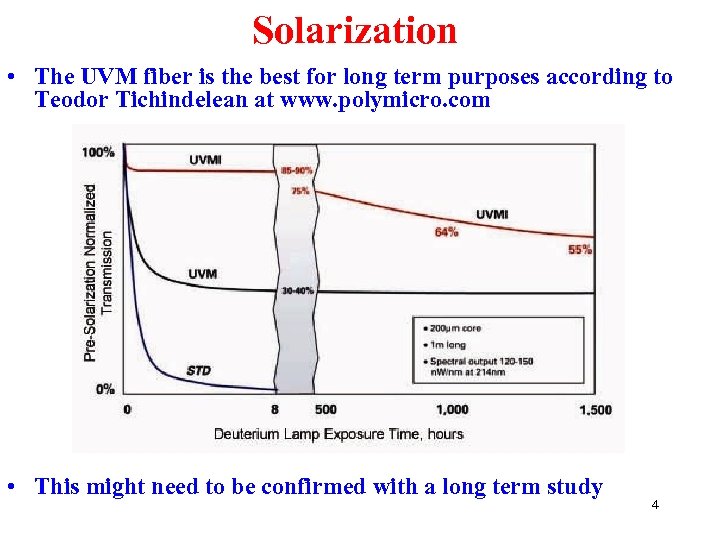 Solarization • The UVM fiber is the best for long term purposes according to Teodor Tichindelean at www. polymicro. com • This might need to be confirmed with a long term study 4
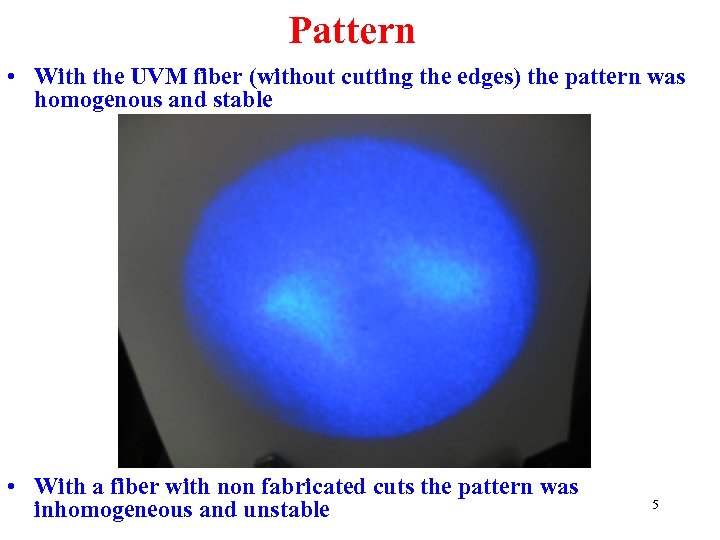 Pattern • With the UVM fiber (without cutting the edges) the pattern was homogenous and stable • With a fiber with non fabricated cuts the pattern was inhomogeneous and unstable 5
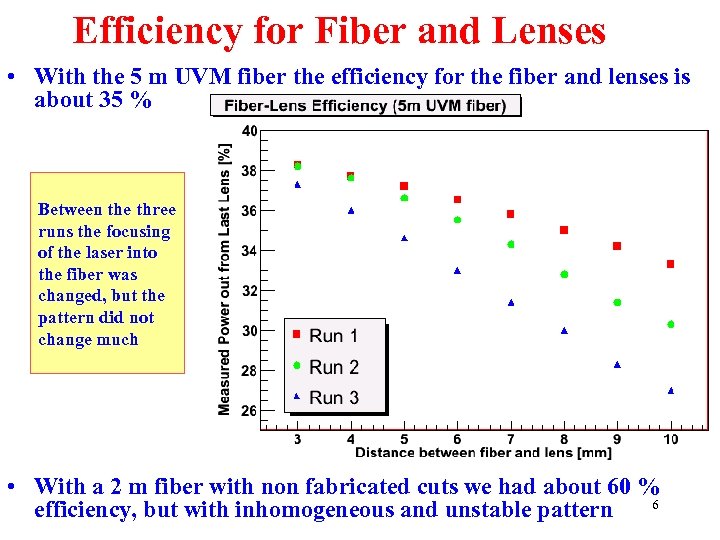 Efficiency for Fiber and Lenses • With the 5 m UVM fiber the efficiency for the fiber and lenses is about 35 % Between the three runs the focusing of the laser into the fiber was changed, but the pattern did not change much • With a 2 m fiber with non fabricated cuts we had about 60 % 6 efficiency, but with inhomogeneous and unstable pattern
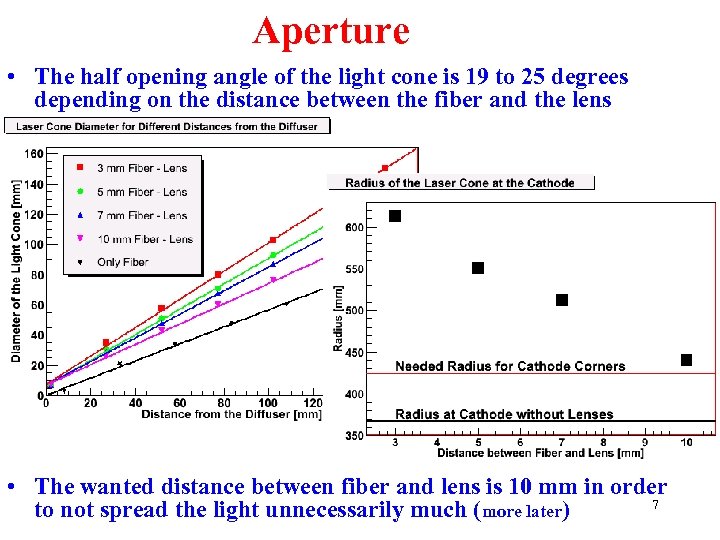 Aperture • The half opening angle of the light cone is 19 to 25 degrees depending on the distance between the fiber and the lens • The wanted distance between fiber and lens is 10 mm in order 7 to not spread the light unnecessarily much (more later)
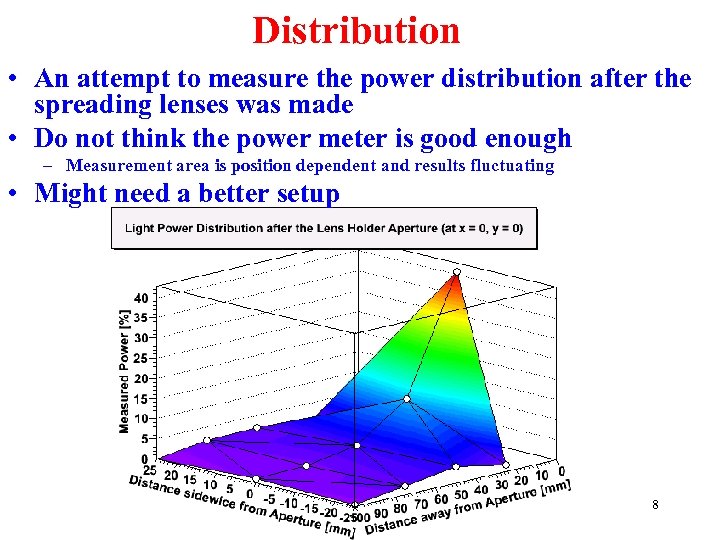 Distribution • An attempt to measure the power distribution after the spreading lenses was made • Do not think the power meter is good enough – Measurement area is position dependent and results fluctuating • Might need a better setup 8
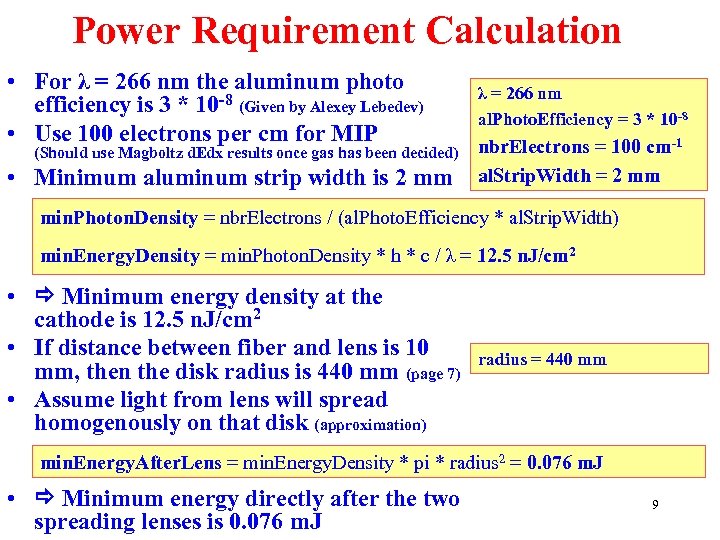 Power Requirement Calculation • For λ = 266 nm the aluminum photo efficiency is 3 * 10 -8 (Given by Alexey Lebedev) • Use 100 electrons per cm for MIP (Should use Magboltz d. Edx results once gas has been decided) • Minimum aluminum strip width is 2 mm λ = 266 nm al. Photo. Efficiency = 3 * 10 -8 nbr. Electrons = 100 cm-1 al. Strip. Width = 2 mm min. Photon. Density = nbr. Electrons / (al. Photo. Efficiency * al. Strip. Width) min. Energy. Density = min. Photon. Density * h * c / λ = 12. 5 n. J/cm 2 • Minimum energy density at the cathode is 12. 5 n. J/cm 2 • If distance between fiber and lens is 10 mm, then the disk radius is 440 mm (page 7) • Assume light from lens will spread homogenously on that disk (approximation) radius = 440 mm min. Energy. After. Lens = min. Energy. Density * pi * radius 2 = 0. 076 m. J • Minimum energy directly after the two spreading lenses is 0. 076 m. J 9
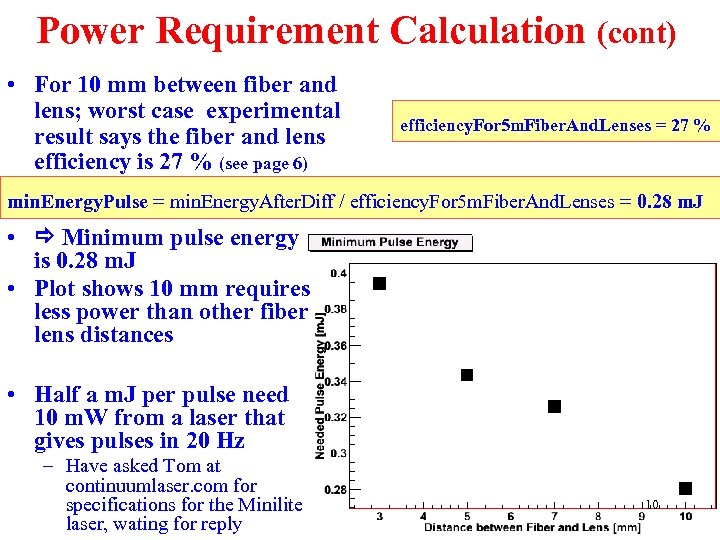 Power Requirement Calculation (cont) • For 10 mm between fiber and lens; worst case experimental result says the fiber and lens efficiency is 27 % (see page 6) efficiency. For 5 m. Fiber. And. Lenses = 27 % min. Energy. Pulse = min. Energy. After. Diff / efficiency. For 5 m. Fiber. And. Lenses = 0. 28 m. J • Minimum pulse energy is 0. 28 m. J • Plot shows 10 mm requires less power than other fiber lens distances • Half a m. J per pulse need 10 m. W from a laser that gives pulses in 20 Hz – Have asked Tom at continuumlaser. com for specifications for the Minilite laser, wating for reply 10
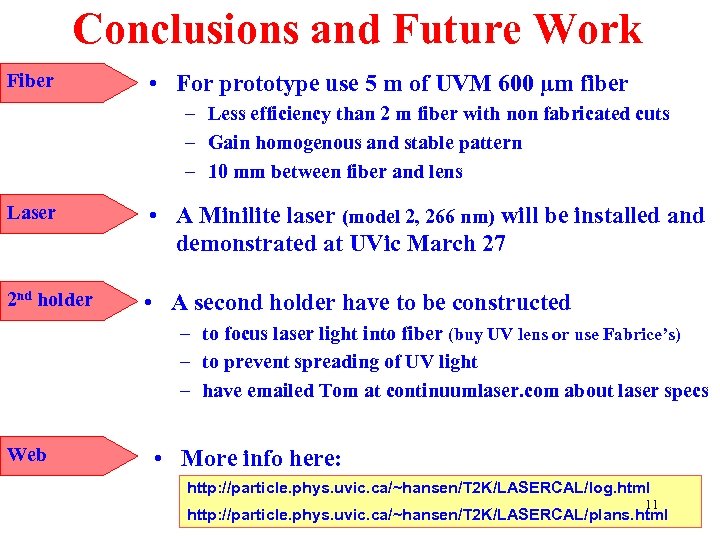 Conclusions and Future Work Fiber • For prototype use 5 m of UVM 600 µm fiber – Less efficiency than 2 m fiber with non fabricated cuts – Gain homogenous and stable pattern – 10 mm between fiber and lens Laser • A Minilite laser (model 2, 266 nm) will be installed and demonstrated at UVic March 27 2 nd holder • A second holder have to be constructed – to focus laser light into fiber (buy UV lens or use Fabrice’s) – to prevent spreading of UV light – have emailed Tom at continuumlaser. com about laser specs Web • More info here: http: //particle. phys. uvic. ca/~hansen/T 2 K/LASERCAL/log. html 11 http: //particle. phys. uvic. ca/~hansen/T 2 K/LASERCAL/plans. html