


 Скачать презентацию Status of the sensor development for future Super-Colliders
4ab2091213978c4cf2c015fbdb9e0aa1.ppt
- Количество слайдов: 45
 Status of the sensor development for future Super-Colliders G. Casse 1
 Outline • Requirements for detectors for future supercolliders • Vertex and tracker sensors • Definition of the challenges: speed and radiation hardness • Status • Conclusions 2 2
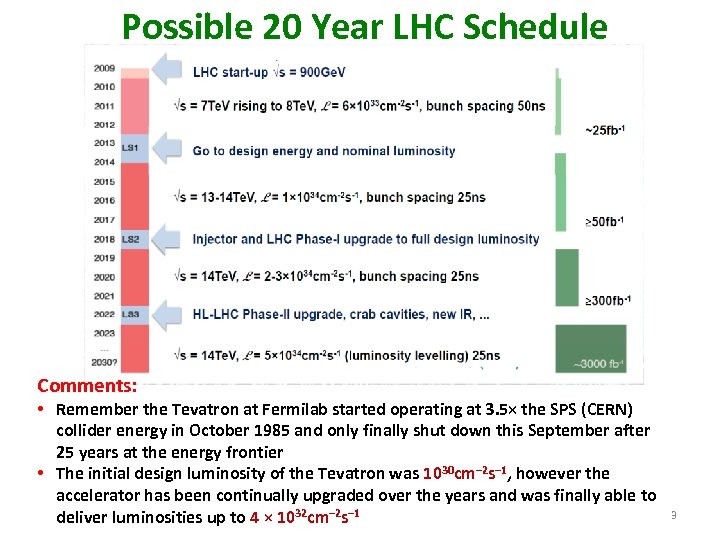 Possible 20 Year LHC Schedule Comments: • Remember the Tevatron at Fermilab started operating at 3. 5× the SPS (CERN) collider energy in October 1985 and only finally shut down this September after 25 years at the energy frontier • The initial design luminosity of the Tevatron was 1030 cm− 2 s− 1, however the accelerator has been continually upgraded over the years and was finally able to deliver luminosities up to 4 × 1032 cm− 2 s− 1 3
 Phase-0 (installation 2013 -14) - New Aluminum beam pipes to prevent activation problem and reduce BG New Insertable pixel B-Layer (IBL) (drives shutdown schedule) New pixel services (n. SQP) ( pending decision by mid 2012) New small Be pipe New evaporative cooling plant for Pixel and SCT + IBL CO 2 cooling plant Replace all calorimeter Low Voltage Power Supplies Finish the installation of the EE muon chambers staged in 2003 + additional chambers in the feet (new electronics) and elevators region Exchange all broken TGCs where possible Consolidate part of the LUCID system Upgrade the magnets cryogenics with a new spare main compressor and decouple toroid and solenoid cryogenics Add specific neutron shielding ( behind end-cap toroid, USA 15) Revisit the entire electricity supply network (UPS, …) Repairs and maintenance work in general !!! Preparations for Phase I upgrade (moveable b-pipe, AFP prototypes, … ) MBTS removal and possible replacement 4
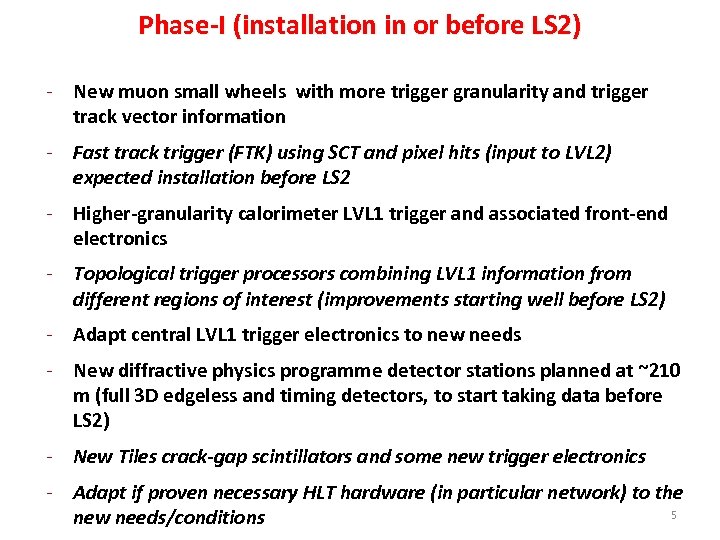 Phase-I (installation in or before LS 2) - New muon small wheels with more trigger granularity and trigger track vector information - Fast track trigger (FTK) using SCT and pixel hits (input to LVL 2) expected installation before LS 2 - Higher-granularity calorimeter LVL 1 trigger and associated front-end electronics - Topological trigger processors combining LVL 1 information from different regions of interest (improvements starting well before LS 2) - Adapt central LVL 1 trigger electronics to new needs - New diffractive physics programme detector stations planned at ~210 m (full 3 D edgeless and timing detectors, to start taking data before LS 2) - New Tiles crack-gap scintillators and some new trigger electronics - Adapt if proven necessary HLT hardware (in particular network) to the 5 new needs/conditions
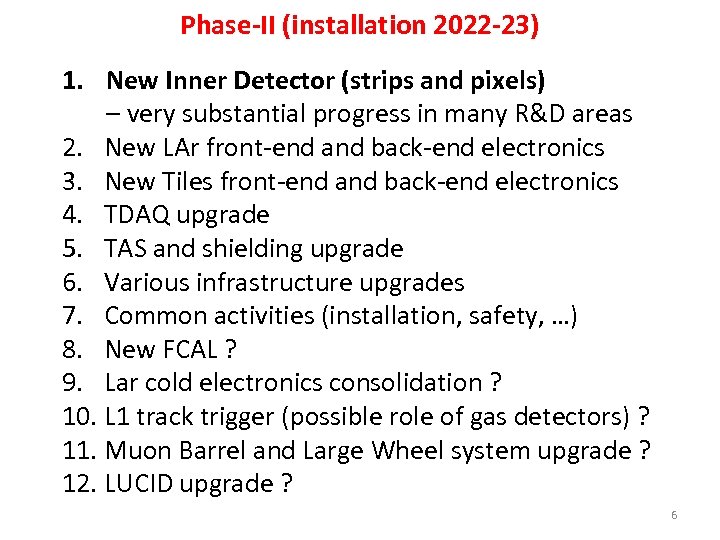 Phase-II (installation 2022 -23) 1. New Inner Detector (strips and pixels) − very substantial progress in many R&D areas 2. New LAr front-end and back-end electronics 3. New Tiles front-end and back-end electronics 4. TDAQ upgrade 5. TAS and shielding upgrade 6. Various infrastructure upgrades 7. Common activities (installation, safety, …) 8. New FCAL ? 9. Lar cold electronics consolidation ? 10. L 1 track trigger (possible role of gas detectors) ? 11. Muon Barrel and Large Wheel system upgrade ? 12. LUCID upgrade ? 6
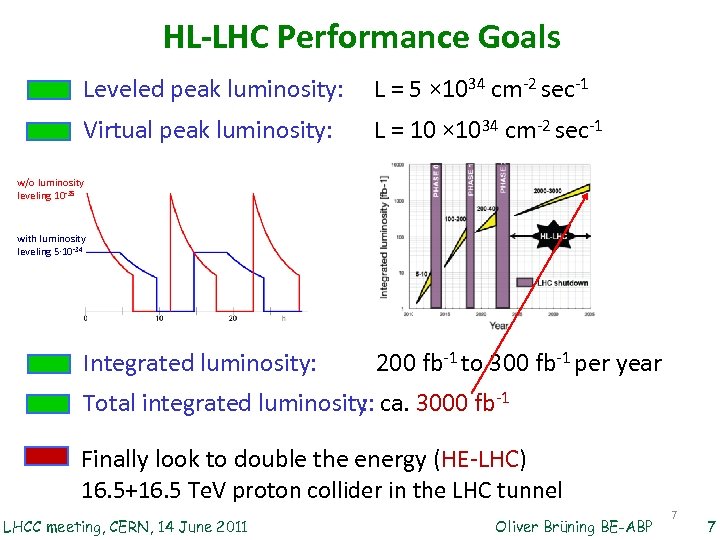 HL-LHC Performance Goals Leveled peak luminosity: L = 5 × 1034 cm-2 sec-1 Virtual peak luminosity: L = 10 × 1034 cm-2 sec-1 w/o luminosity leveling 10 -35 with luminosity leveling 5. 10 -34 Integrated luminosity: 200 fb-1 to 300 fb-1 per year : Total integrated luminosity: ca. 3000 fb-1 Finally look to double the energy (HE-LHC) 16. 5+16. 5 Te. V proton collider in the LHC tunnel LHCC meeting, CERN, 14 June 2011 Oliver Brüning BE-ABP 7 7
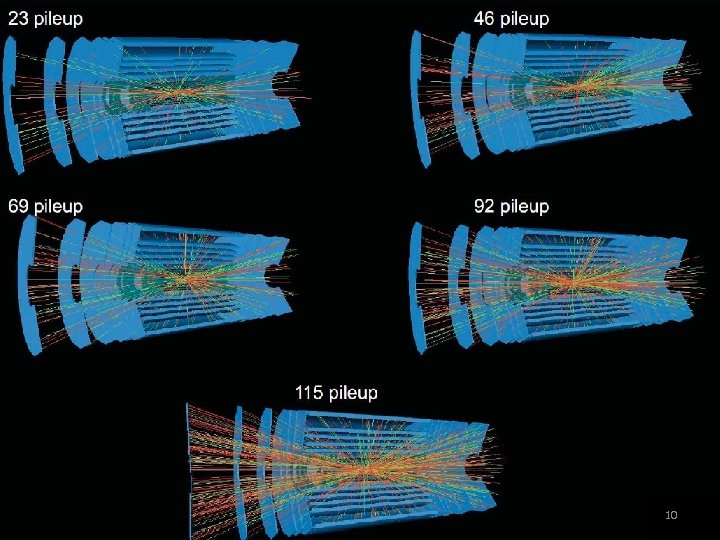
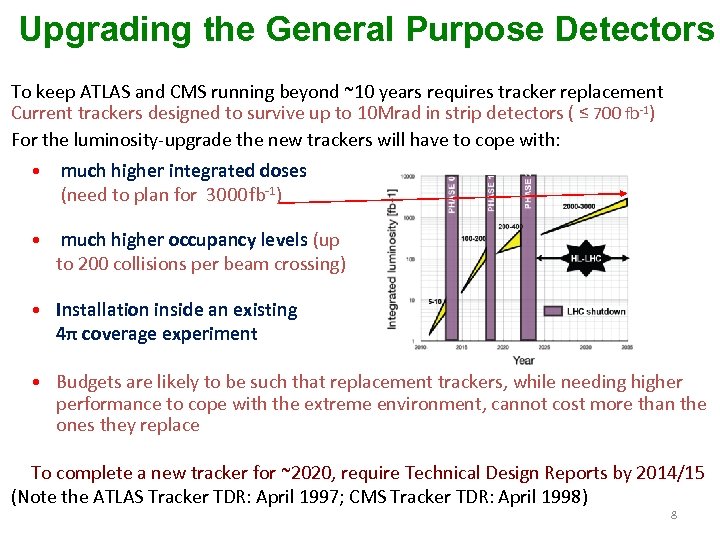 Upgrading the General Purpose Detectors To keep ATLAS and CMS running beyond ~10 years requires tracker replacement Current trackers designed to survive up to 10 Mrad in strip detectors ( ≤ 700 fb-1) For the luminosity-upgrade the new trackers will have to cope with: • much higher integrated doses (need to plan for 3000 fb-1) • much higher occupancy levels (up to 200 collisions per beam crossing) • Installation inside an existing 4π coverage experiment • Budgets are likely to be such that replacement trackers, while needing higher performance to cope with the extreme environment, cannot cost more than the ones they replace To complete a new tracker for ~2020, require Technical Design Reports by 2014/15 (Note the ATLAS Tracker TDR: April 1997; CMS Tracker TDR: April 1998) 8
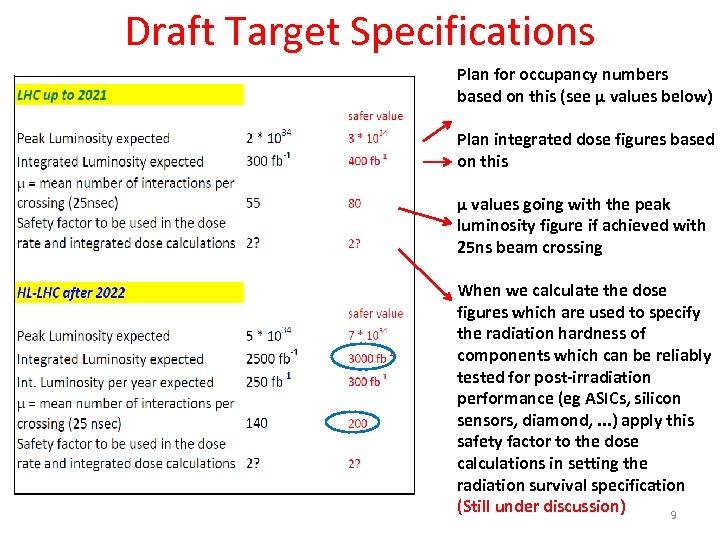 Draft Target Specifications Plan for occupancy numbers based on this (see µ values below) Plan integrated dose figures based on this µ values going with the peak luminosity figure if achieved with 25 ns beam crossing When we calculate the dose figures which are used to specify the radiation hardness of components which can be reliably tested for post-irradiation performance (eg ASICs, silicon sensors, diamond, . . . ) apply this safety factor to the dose calculations in setting the radiation survival specification (Still under discussion) 9
 10
10
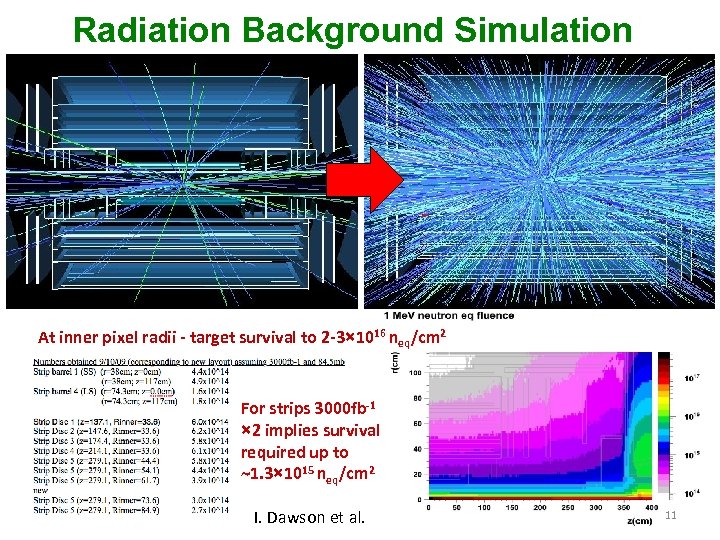 Radiation Background Simulation At inner pixel radii - target survival to 2 -3× 10¹⁶ neq/cm 2 For strips 3000 fb-1 × 2 implies survival required up to ~1. 3× 10¹⁵ neq/cm 2 I. Dawson et al. 11
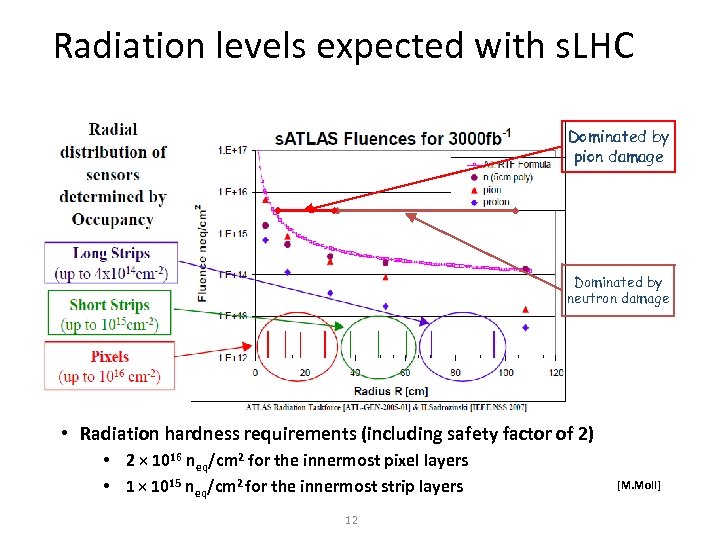 Radiation levels expected with s. LHC Dominated by pion damage Dominated by neutron damage • Radiation hardness requirements (including safety factor of 2) • 2 × 10¹⁶ neq/cm 2 for the innermost pixel layers • 1 × 10¹⁵ neq/cm 2 for the innermost strip layers 12 [M. Moll]
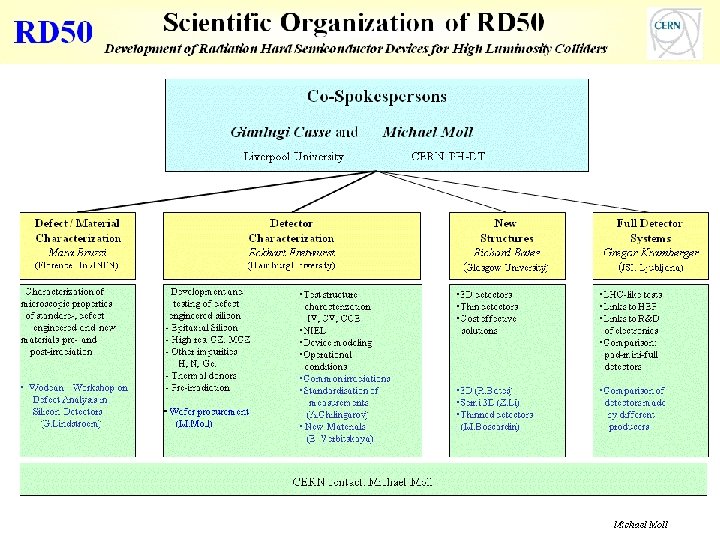
 Status of radiation hardness studies • Crucial point for Vertex and Tracker sensors • Silicon still the forefront runner, no serious possibility to change track within the timescale (possible exception, diamond for innermost layer. . ). • Dedicated R&D activity within the upgrading experiments and a dedicated community (CERN-RD 50). Most advanced results from this community. 13
 14
14
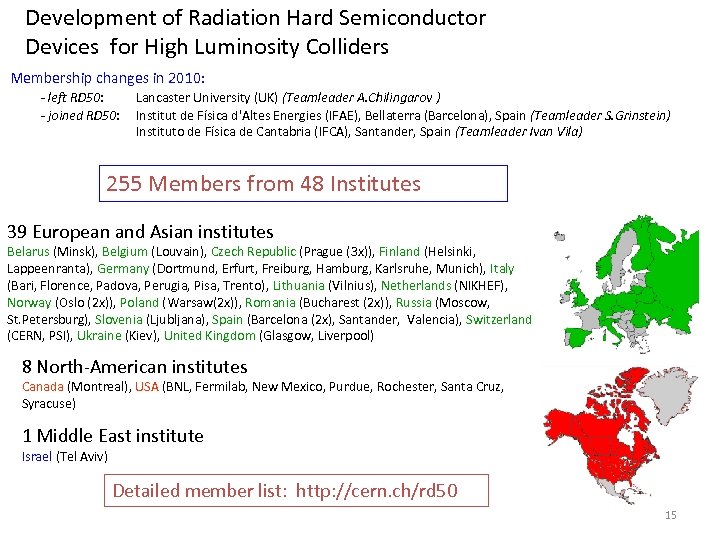 Development of Radiation Hard Semiconductor Devices for High Luminosity Colliders Membership changes in 2010: - left RD 50: - joined RD 50: Lancaster University (UK) (Teamleader A. Chilingarov ) Institut de Física d'Altes Energies (IFAE), Bellaterra (Barcelona), Spain (Teamleader S. Grinstein) Instituto de Física de Cantabria (IFCA), Santander, Spain (Teamleader Ivan Vila) 255 Members from 48 Institutes 39 European and Asian institutes Belarus (Minsk), Belgium (Louvain), Czech Republic (Prague (3 x)), Finland (Helsinki, Lappeenranta), Germany (Dortmund, Erfurt, Freiburg, Hamburg, Karlsruhe, Munich), Italy (Bari, Florence, Padova, Perugia, Pisa, Trento), Lithuania (Vilnius), Netherlands (NIKHEF), Norway (Oslo (2 x)), Poland (Warsaw(2 x)), Romania (Bucharest (2 x)), Russia (Moscow, St. Petersburg), Slovenia (Ljubljana), Spain (Barcelona (2 x), Santander, Valencia), Switzerland (CERN, PSI), Ukraine (Kiev), United Kingdom (Glasgow, Liverpool) 8 North-American institutes Canada (Montreal), USA (BNL, Fermilab, New Mexico, Purdue, Rochester, Santa Cruz, Syracuse) 1 Middle East institute Israel (Tel Aviv) Detailed member list: http: //cern. ch/rd 50 15
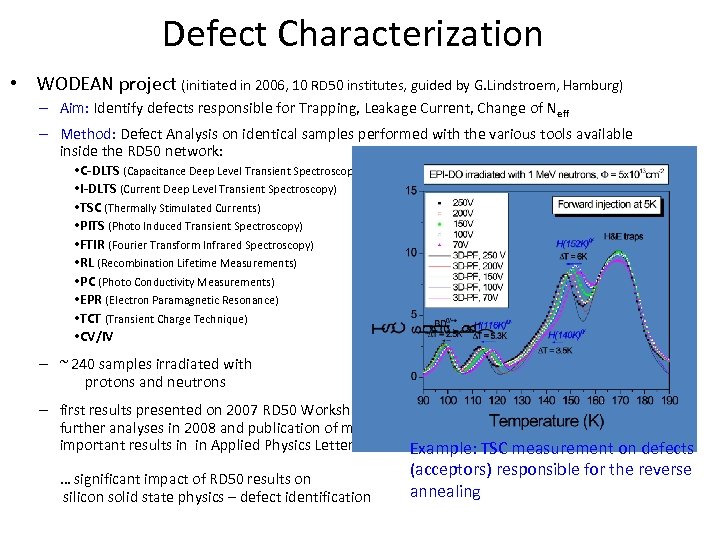 Defect Characterization • WODEAN project (initiated in 2006, 10 RD 50 institutes, guided by G. Lindstroem, Hamburg) – Aim: Identify defects responsible for Trapping, Leakage Current, Change of Neff – Method: Defect Analysis on identical samples performed with the various tools available inside the RD 50 network: • C-DLTS (Capacitance Deep Level Transient Spectroscopy) • I-DLTS (Current Deep Level Transient Spectroscopy) • TSC (Thermally Stimulated Currents) • PITS (Photo Induced Transient Spectroscopy) • FTIR (Fourier Transform Infrared Spectroscopy) • RL (Recombination Lifetime Measurements) • PC (Photo Conductivity Measurements) • EPR (Electron Paramagnetic Resonance) • TCT (Transient Charge Technique) • CV/IV – ~ 240 samples irradiated with protons and neutrons – first results presented on 2007 RD 50 Workshops, further analyses in 2008 and publication of most important results in in Applied Physics Letters … significant impact of RD 50 results on silicon solid state physics – defect identification Example: TSC measurement on defects (acceptors) responsible for the reverse annealing
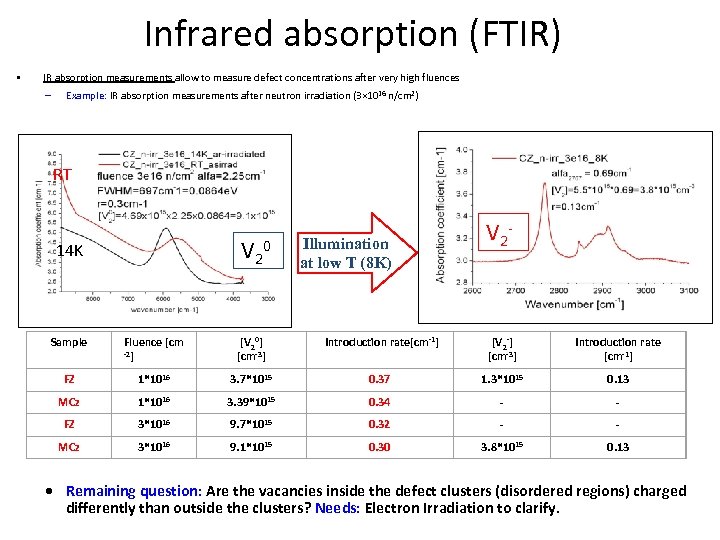 Infrared absorption (FTIR) • IR absorption measurements allow to measure defect concentrations after very high fluences – Example: IR absorption measurements after neutron irradiation (3× 10¹⁶ n/cm 2) RT V 2 0 14 K – Illumination at low T (8 K) V 2 - Same Vacancy concentration in CZ and FZ silicon. Sample Fluence [cm -2] [V 20] [cm-3] Introduction rate[cm-1] [V 2 -] [cm-3] Introduction rate [cm-1] FZ 1*1016 3. 7*1015 0. 37 1. 3*1015 0. 13 MCz 1*1016 3. 39*1015 0. 34 - - FZ 3*1016 9. 7*1015 0. 32 - - MCz 3*1016 9. 1*1015 0. 30 3. 8*1015 0. 13 · Remaining question: Are the vacancies inside the defect clusters (disordered regions) charged differently than outside the clusters? Needs: Electron Irradiation to clarify.
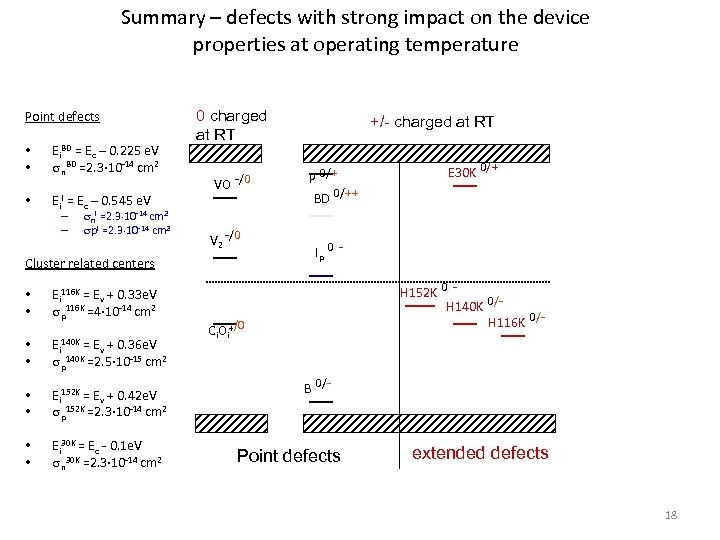 Summary – defects with strong impact on the device properties at operating temperature Point defects • • Ei. BD = Ec – 0. 225 e. V n. BD =2. 3 10 -14 cm 2 • Ei. I = Ec – 0. 545 e. V – – n. I =2. 3 10 -14 cm 2 p. I =2. 3 10 -14 cm 2 0 charged at RT VO -/0 V 2 -/0 Cluster related centers • • Ei 116 K = Ev + 0. 33 e. V p 116 K =4 10 -14 cm 2 • • Ei 140 K = Ev + 0. 36 e. V p 140 K =2. 5 10 -15 cm 2 • • Ei 152 K = Ev + 0. 42 e. V p 152 K =2. 3 10 -14 cm 2 • • Ei 30 K = Ec - 0. 1 e. V n 30 K =2. 3 10 -14 cm 2 +/- charged at RT P 0/+ BD 0/++ E 30 K 0/+ Ip 0/H 152 K 0/H 140 K 0/H 116 K 0/- Ci. Oi+/0 B 0/- Point defects extended defects 18
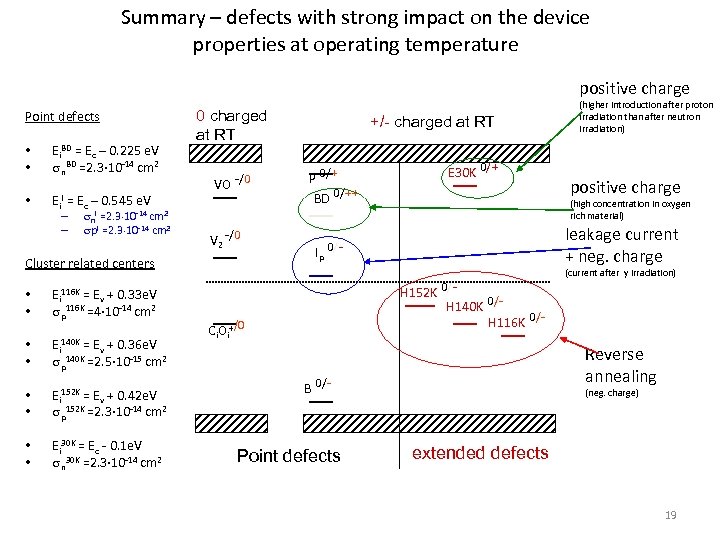 Summary – defects with strong impact on the device properties at operating temperature positive charge Point defects • • Ei. BD = Ec – 0. 225 e. V n. BD =2. 3 10 -14 cm 2 • Ei. I = Ec – 0. 545 e. V – – n. I =2. 3 10 -14 0 charged at RT VO -/0 +/- charged at RT P 0/+ BD 0/++ E 30 K 0/+ V 2 -/0 Cluster related centers • • Ei 116 K = Ev + 0. 33 e. V p 116 K =4 10 -14 cm 2 • • Ei 140 K = Ev + 0. 36 e. V p 140 K =2. 5 10 -15 cm 2 • • Ei 152 K = Ev + 0. 42 e. V p 152 K =2. 3 10 -14 cm 2 • • Ei 30 K = Ec - 0. 1 e. V n 30 K =2. 3 10 -14 cm 2 positive charge (high concentration in oxygen rich material) cm 2 p. I =2. 3 10 -14 cm 2 (higher introduction after proton irradiation than after neutron irradiation) leakage current + neg. charge Ip 0/- (current after irradiation) H 152 K 0/H 140 K 0/H 116 K 0/- Ci. Oi+/0 Reverse annealing B 0/- Point defects (neg. charge) extended defects 19
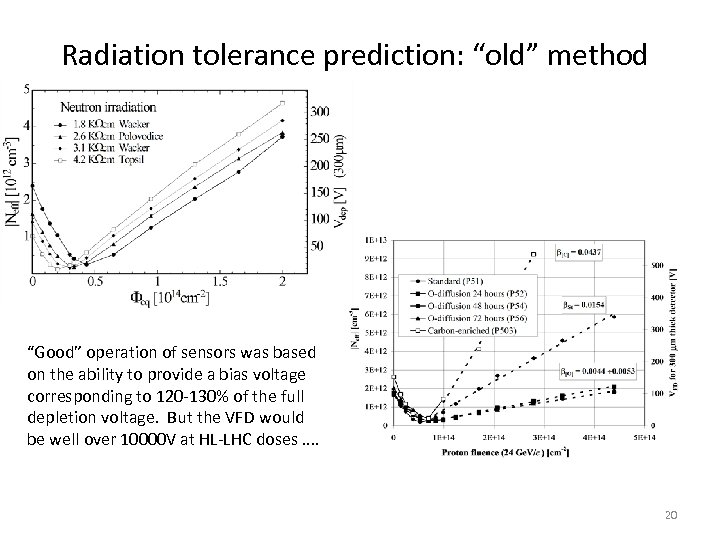 Radiation tolerance prediction: “old” method “Good” operation of sensors was based on the ability to provide a bias voltage corresponding to 120 -130% of the full depletion voltage. But the VFD would be well over 10000 V at HL-LHC doses. . 20
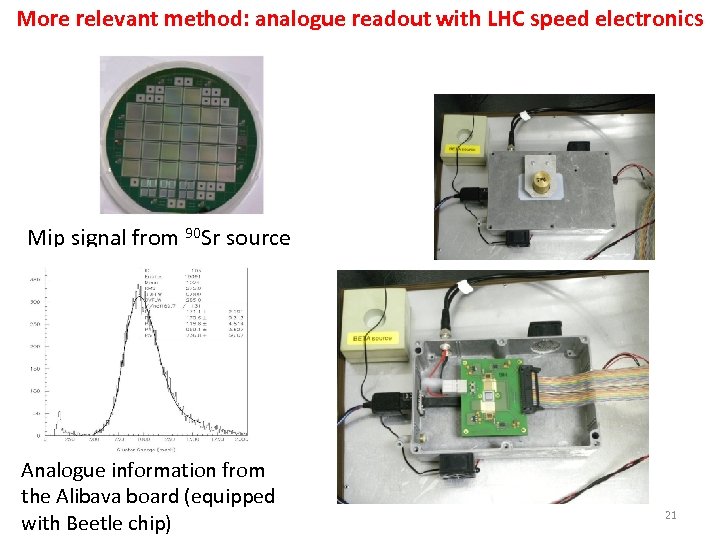 More relevant method: analogue readout with LHC speed electronics Mip signal from 90 Sr source Analogue information from the Alibava board (equipped with Beetle chip) 21
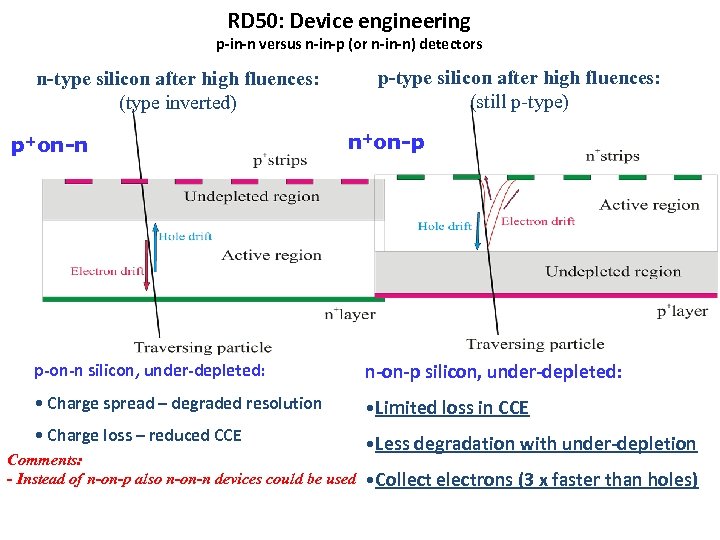 RD 50: Device engineering p-in-n versus n-in-p (or n-in-n) detectors p-type silicon after high fluences: (still p-type) n-type silicon after high fluences: (type inverted) p+on-n n+on-p p-on-n silicon, under-depleted: n-on-p silicon, under-depleted: • Charge spread – degraded resolution • Limited loss in CCE • Charge loss – reduced CCE • Less degradation with under-depletion Comments: - Instead of n-on-p also n-on-n devices could be used • Collect electrons (3 x faster than holes)
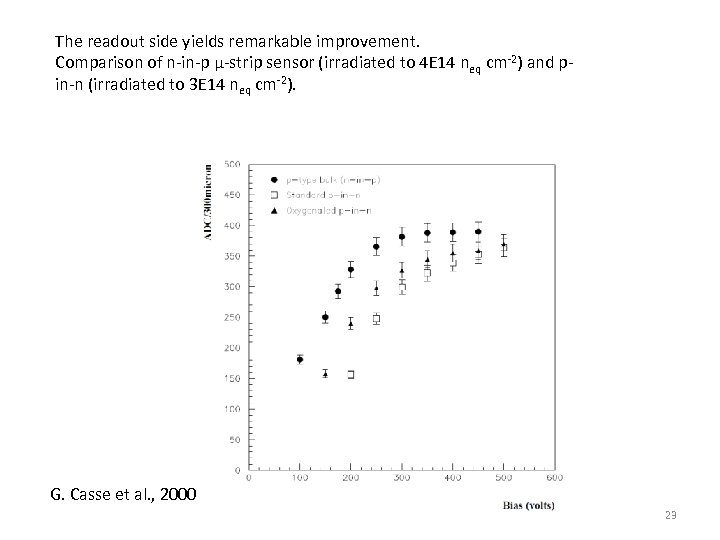 The readout side yields remarkable improvement. Comparison of n-in-p µ-strip sensor (irradiated to 4 E 14 neq cm-2) and pin-n (irradiated to 3 E 14 neq cm-2). G. Casse et al. , 2000 23
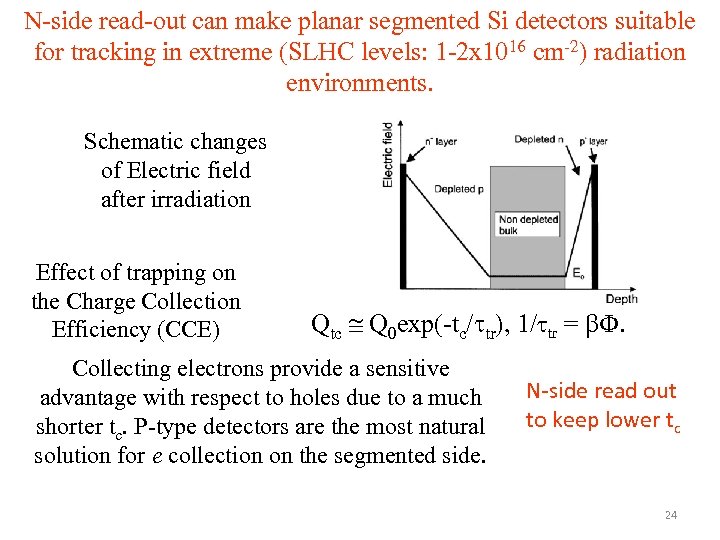 N-side read-out can make planar segmented Si detectors suitable for tracking in extreme (SLHC levels: 1 -2 x 1016 cm-2) radiation environments. Schematic changes of Electric field after irradiation Effect of trapping on the Charge Collection Efficiency (CCE) Qtc Q 0 exp(-tc/ttr), 1/ttr = b. F. Collecting electrons provide a sensitive advantage with respect to holes due to a much shorter tc. P-type detectors are the most natural solution for e collection on the segmented side. N-side read out to keep lower tc 24
 Effect of trapping on the Charge Collection Distance Qtc Q 0 exp(-tc/ttr), 1/ttr = b. F. vsat, e x ttr = lav be = 4. 2 E-16 cm-2/ns G. Kramberger et al. , NIMA 476(2002), 645 After heavy irradiation the bh = 6. 1 E-16 cm-2/ns 651. charge collection distance (CCD) l. Max, n (F=1 e 14) 2400µm of thin detectors should have a similar (better? ) charge l. Max, n (F=1 e 16) 24µm collection efficiency (CCE) as l. Max, p (F=1 e 14) 1600µm thicker ones. l. Max, p (F=1 e 16) 16µm The reverse current is proportional to the depleted volume in irradiated detectors. Do thin sensors offer an advantage in term of reduced reverse current compared to thicker ones (this aspect is particularly important for the inner layer detectors of SLHC, where significant contribution to power consuption is expected from the sensors themselves)? 25
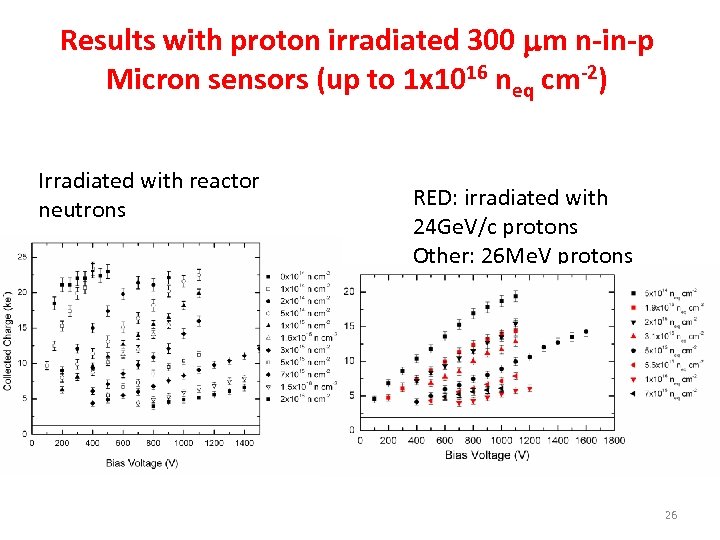 Results with proton irradiated 300 mm n-in-p Micron sensors (up to 1 x 10¹⁶ neq cm-2) Irradiated with reactor neutrons RED: irradiated with 24 Ge. V/c protons Other: 26 Me. V protons 26
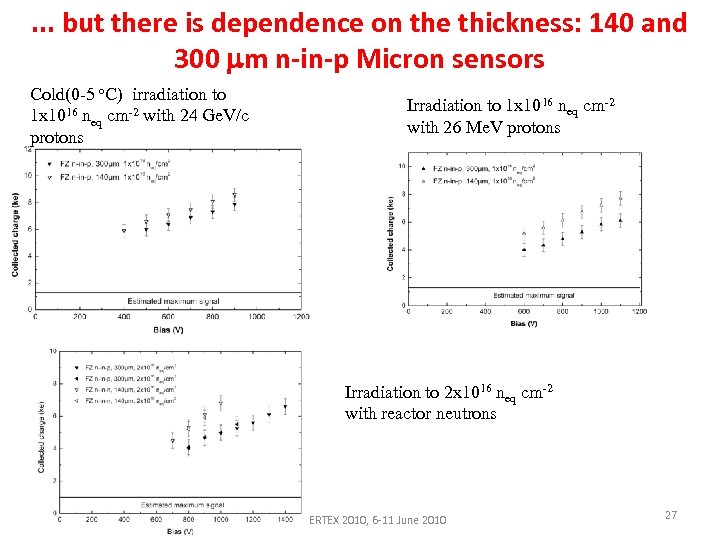 . . . but there is dependence on the thickness: 140 and 300 mm n-in-p Micron sensors Cold(0 -5 o. C) irradiation to 1 x 10¹⁶ neq cm-2 with 24 Ge. V/c protons Irradiation to 1 x 10¹⁶ neq cm-2 with 26 Me. V protons Irradiation to 2 x 10¹⁶ neq cm-2 with reactor neutrons G. Casse, VERTEX 2010, 6 -11 June 2010 27
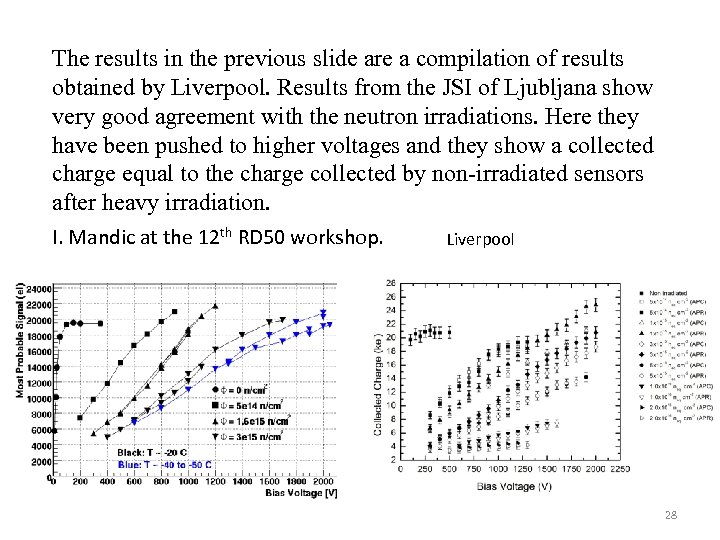 The results in the previous slide are a compilation of results obtained by Liverpool. Results from the JSI of Ljubljana show very good agreement with the neutron irradiations. Here they have been pushed to higher voltages and they show a collected charge equal to the charge collected by non-irradiated sensors after heavy irradiation. I. Mandic at the 12 th RD 50 workshop. Liverpool 28
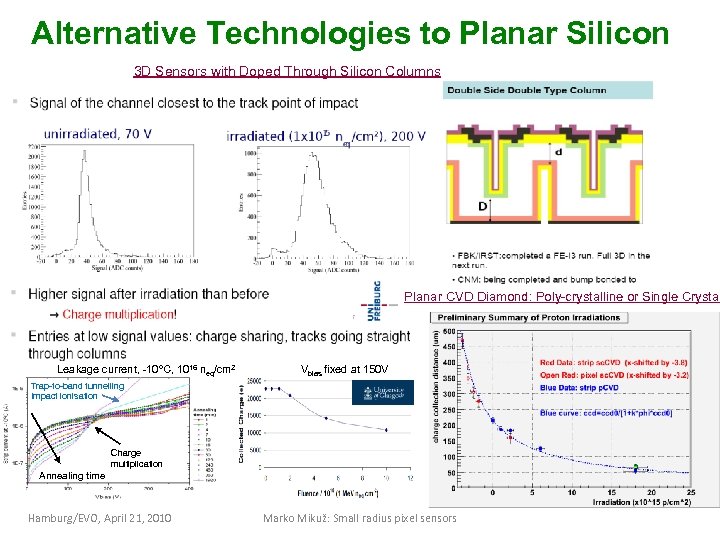
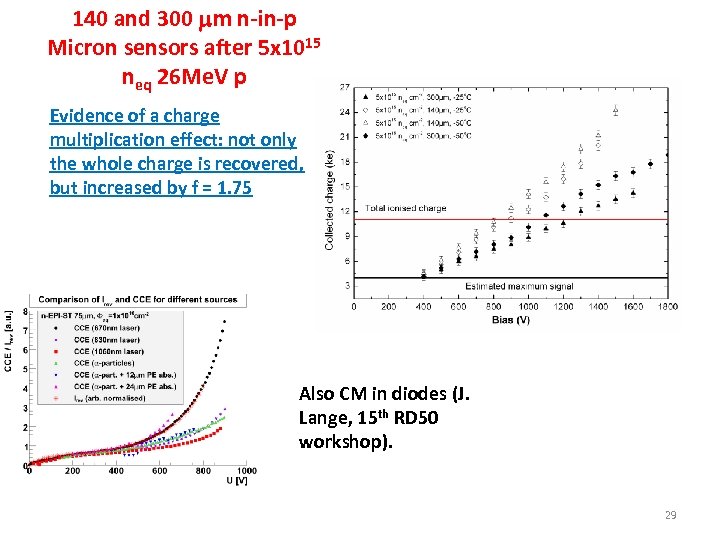 140 and 300 mm n-in-p Micron sensors after 5 x 10¹⁵ neq 26 Me. V p Evidence of a charge multiplication effect: not only the whole charge is recovered, but increased by f = 1. 75 Also CM in diodes (J. Lange, 15 th RD 50 workshop). 29
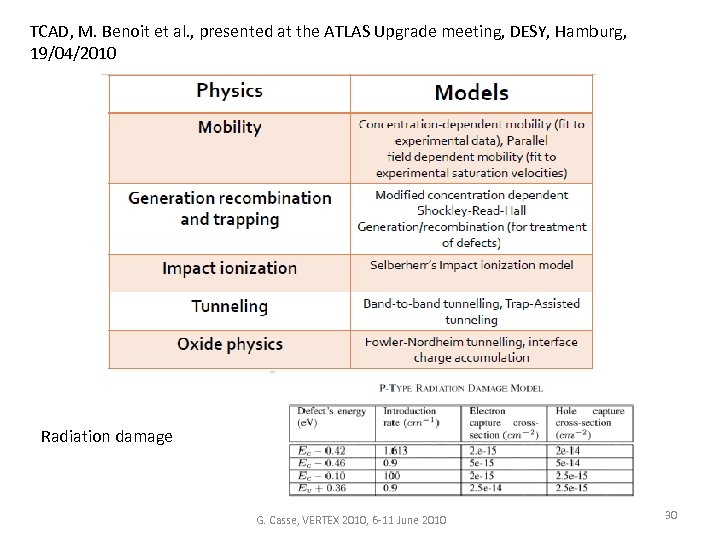 TCAD, M. Benoit et al. , presented at the ATLAS Upgrade meeting, DESY, Hamburg, 19/04/2010 Radiation damage G. Casse, VERTEX 2010, 6 -11 June 2010 30
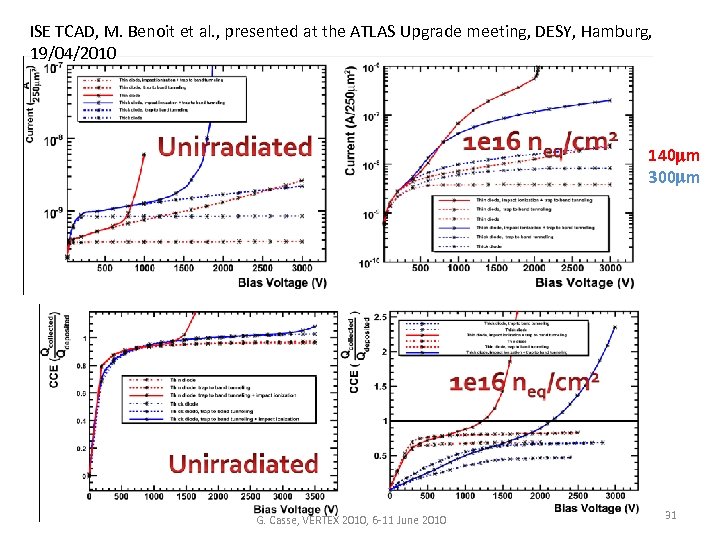 ISE TCAD, M. Benoit et al. , presented at the ATLAS Upgrade meeting, DESY, Hamburg, 19/04/2010 140 mm 300 mm G. Casse, VERTEX 2010, 6 -11 June 2010 31
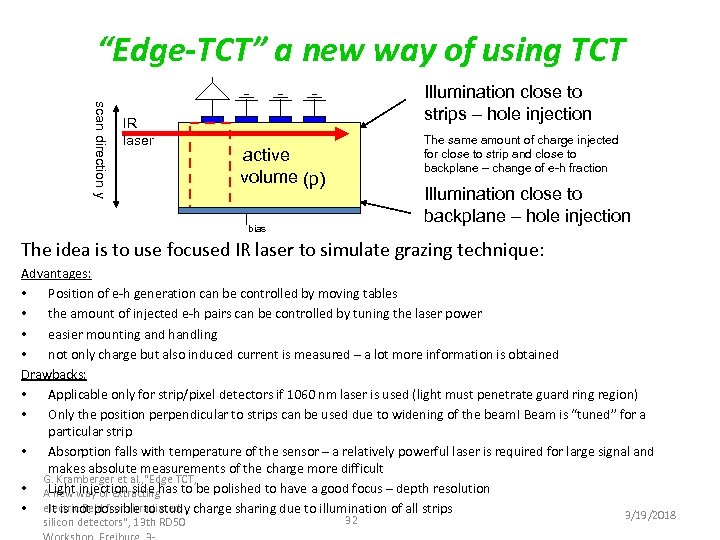 “Edge-TCT” a new way of using TCT scan direction y IR laser Illumination close to strips – hole injection The same amount of charge injected for close to strip and close to backplane – change of e-h fraction active volume (p) Illumination close to backplane – hole injection bias The idea is to use focused IR laser to simulate grazing technique: Advantages: • Position of e-h generation can be controlled by moving tables • the amount of injected e-h pairs can be controlled by tuning the laser power • easier mounting and handling • not only charge but also induced current is measured – a lot more information is obtained Drawbacks: • Applicable only for strip/pixel detectors if 1060 nm laser is used (light must penetrate guard ring region) • Only the position perpendicular to strips can be used due to widening of the beam! Beam is “tuned” for a particular strip • Absorption falls with temperature of the sensor – a relatively powerful laser is required for large signal and makes absolute measurements of the charge more difficult G. Kramberger et al. , "Edge TCT, • ALightway of extractinghas to be polished to have a good focus – depth resolution new injection side • electric field from irradiated charge sharing due to illumination of all strips It is not possible to study 3/19/2018 silicon detectors", 13 th RD 50 32
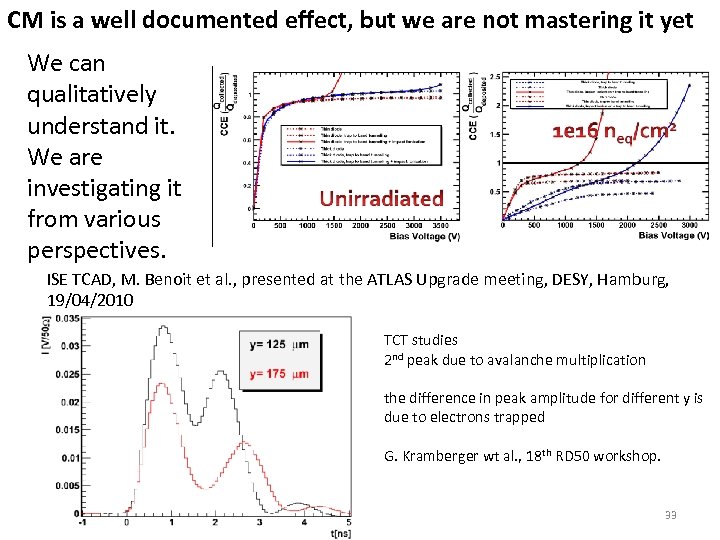 CM is a well documented effect, but we are not mastering it yet We can qualitatively understand it. We are investigating it from various perspectives. ISE TCAD, M. Benoit et al. , presented at the ATLAS Upgrade meeting, DESY, Hamburg, 19/04/2010 TCT studies 2 nd peak due to avalanche multiplication the difference in peak amplitude for different y is due to electrons trapped G. Kramberger wt al. , 18 th RD 50 workshop. 33
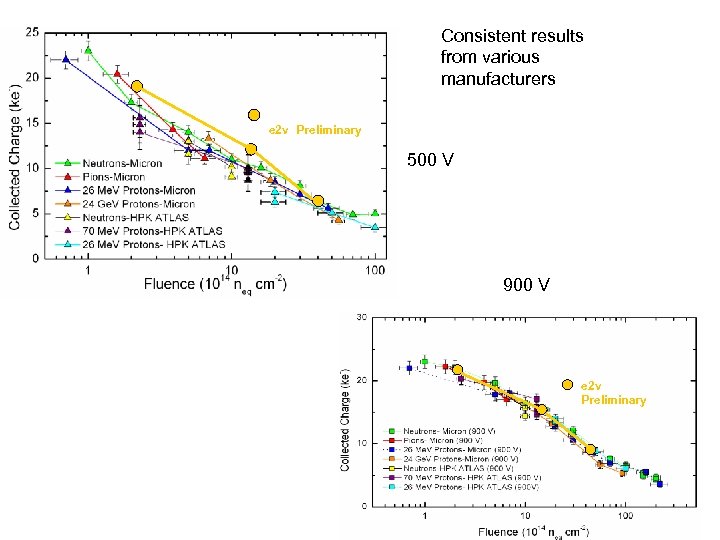 Consistent results from various manufacturers e 2 v Preliminary 500 V 900 V e 2 v Preliminary 34
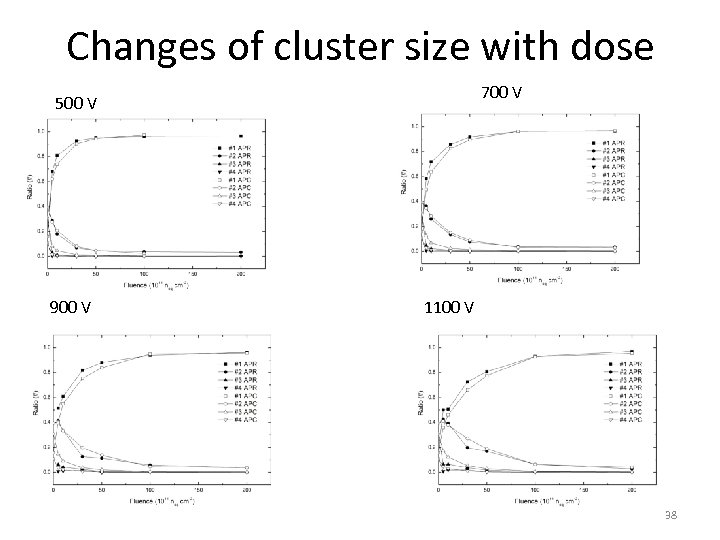
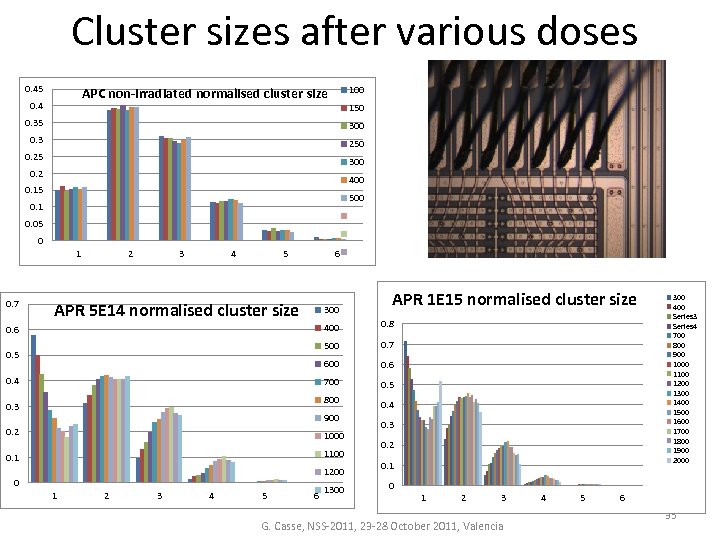 Cluster sizes after various doses 0. 45 100 APC non-irradiated normalised cluster size 0. 4 150 0. 35 300 Seed cut = 3. 5*ENC Cluster = 2. 5*ENC 0. 3 0. 25 250 300 0. 2 400 0. 15 500 0. 1 0. 05 0 1 0. 7 2 3 4 5 6 APR 5 E 14 normalised cluster size 300 APR 1 E 15 normalised cluster size 400 0. 5 800 0. 3 0. 6 700 0. 4 0. 7 600 0. 5 0. 8 500 0. 6 0. 4 900 0. 2 1000 0. 1 1100 1200 0 1 2 3 4 5 6 1300 0. 3 0. 2 0. 1 300 400 Series 3 Series 4 700 800 900 1000 1100 1200 1300 1400 1500 1600 1700 1800 1900 2000 0 1 2 3 G. Casse, NSS-2011, 23 -28 October 2011, Valencia 4 5 6 35
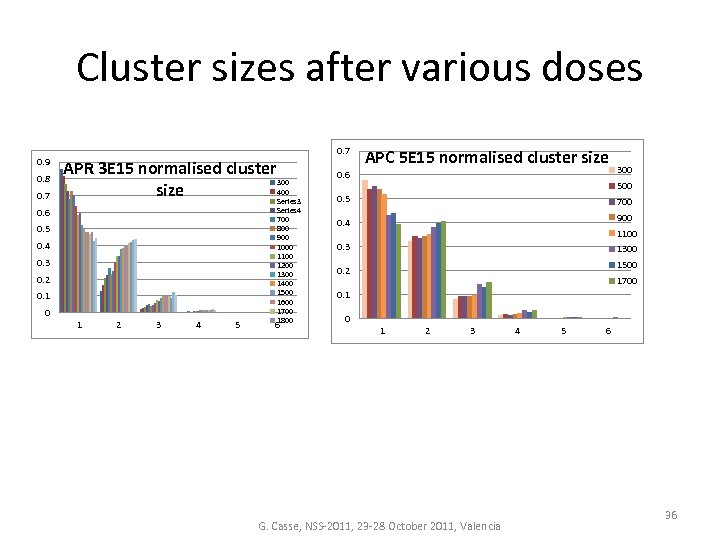 Cluster sizes after various doses 0. 9 0. 8 0. 7 APR 3 E 15 normalised cluster 300 400 size Series 3 0. 6 0. 5 0. 4 0. 3 0. 2 0. 1 0 1 2 3 4 5 Series 4 700 800 900 1000 1100 1200 1300 1400 1500 1600 1700 1800 6 0. 7 APC 5 E 15 normalised cluster size 0. 6 300 0. 5 700 500 900 0. 4 1100 0. 3 1300 1500 0. 2 1700 0. 1 0 1 2 3 G. Casse, NSS-2011, 23 -28 October 2011, Valencia 4 5 6 36
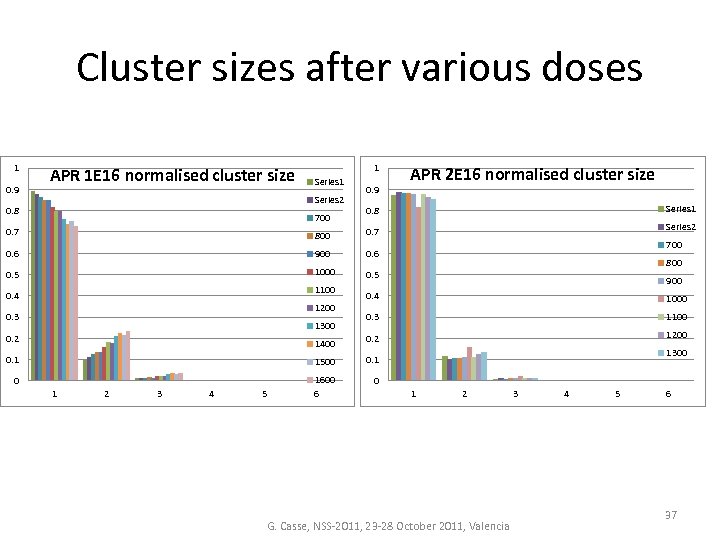 Cluster sizes after various doses 1 0. 9 APR 1 E 16 normalised cluster size 1 Series 2 0. 8 700 0. 9 APR 2 E 16 normalised cluster size Series 1 0. 8 0. 7 800 0. 6 900 0. 6 0. 5 1000 Series 2 0. 7 0. 5 1100 0. 4 1200 0. 3 1300 0. 2 1400 700 800 900 0. 4 1000 0. 3 1100 0. 2 1200 0. 1 1500 0 1600 6 1300 0. 1 0 1 2 3 4 5 1 2 G. Casse, NSS-2011, 23 -28 October 2011, Valencia 3 4 5 6 37
 Changes of cluster size with dose 700 V 500 V 900 V 1100 V 38
 Alternative Technologies to Planar Silicon 3 D Sensors with Doped Through Silicon Columns Planar CVD Diamond: Poly-crystalline or Single Crystal Diamond Leakage current, -10ºC, 1016 neq/cm 2 Vbias fixed at 150 V Trap-to-band tunnelling Impact ionisation Charge multiplication Annealing time Hamburg/EVO, April 21, 2010 Marko Mikuž: Small radius pixel sensors
 Current ATLAS SCT Module Designs ATLAS Tracker Based on Barrel and Disc Supports Effectively two styles of double-sided modules (12 cm long) each sensor ~6 cm wide (768 strips of 80μm pitch per side) Sensor Hybrid cards carrying readout chips and multilayer interconnect circuit Barrel Modules (Hybridge above sensors) Sensor Forward Modules (Hybrid at module end)
 Stave Prototypes and Powering Concepts Full Length 12 Module Mock-up Stave 2. 5 V 0 V 5 V 7. 5 V 12. 5 V 10 V cm 75 9. Concept based on singlesided modules sandwiched around a carbon fibre core with integrated cooling and bus-tape (more similar to current pixels) tested Glue Targets low mass and large-scale Glue production Serial Powered Chain of Hybrids Extra Noise compared to Reference Data Shield H 2 H 3 100 mm Cu H 1 62 60 11 26 140 mm Cu 58 46 8 24 ENC H 0 ENC ENC Liverpool Hybrid and Module Design 4 module fully working SP stave Both powering schemes can be made to work in this configuration and tested built DC-DC Stavelet (CF core made at Liverpool) 41
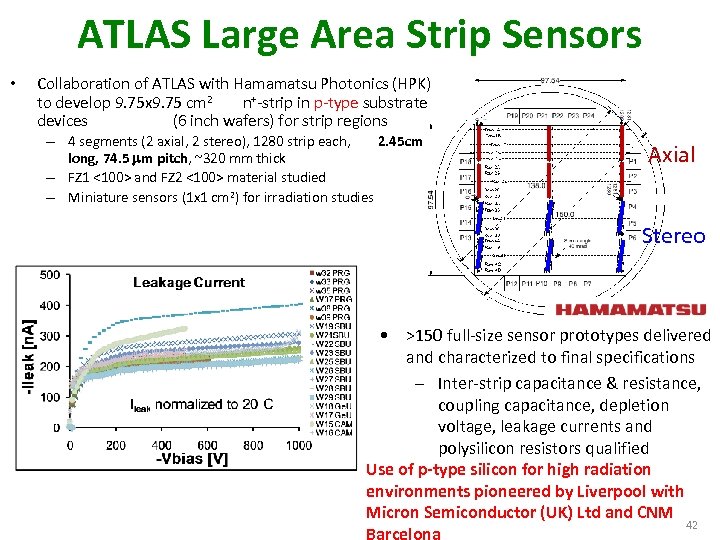 ATLAS Large Area Strip Sensors • Collaboration of ATLAS with Hamamatsu Photonics (HPK) to develop 9. 75 x 9. 75 cm 2 n+-strip in p-type substrate devices (6 inch wafers) for strip regions – 4 segments (2 axial, 2 stereo), 1280 strip each, 2. 45 cm long, 74. 5 mm pitch, ~320 mm thick – FZ 1 <100> and FZ 2 <100> material studied – Miniature sensors (1 x 1 cm 2) for irradiation studies Axial Stereo • >150 full-size sensor prototypes delivered and characterized to final specifications – Inter-strip capacitance & resistance, coupling capacitance, depletion voltage, leakage currents and polysilicon resistors qualified Use of p-type silicon for high radiation environments pioneered by Liverpool with Micron Semiconductor (UK) Ltd and CNM 42 Barcelona
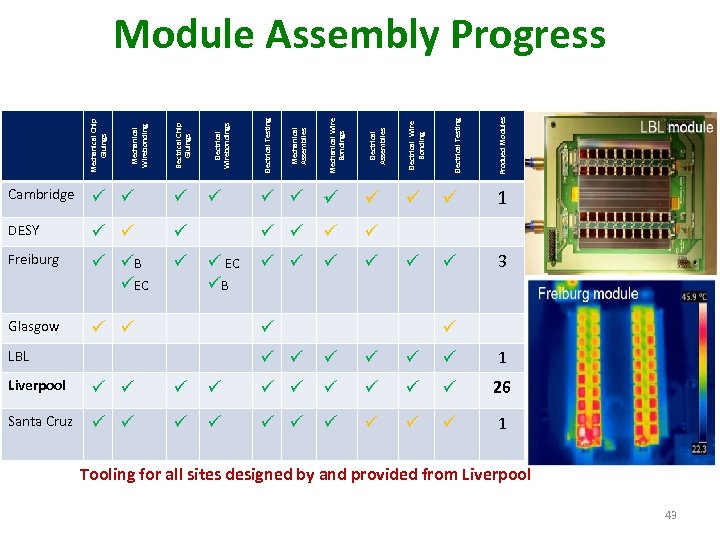 Cambridge DESY Freiburg B EC Glasgow EC B LBL Produed Modules Electrical Testing Electrical Wire Bonding Electrical Assemblies Mechanical Wire Bondings Mechanical Assemblies Electrical Testing Electrical Wirebondings Electrical Chip Gluings Mechanical Wirebonding Mechanical Chip Gluings Module Assembly Progress 1 3 1 Liverpool 26 Santa Cruz 1 Tooling for all sites designed by and provided from Liverpool 43
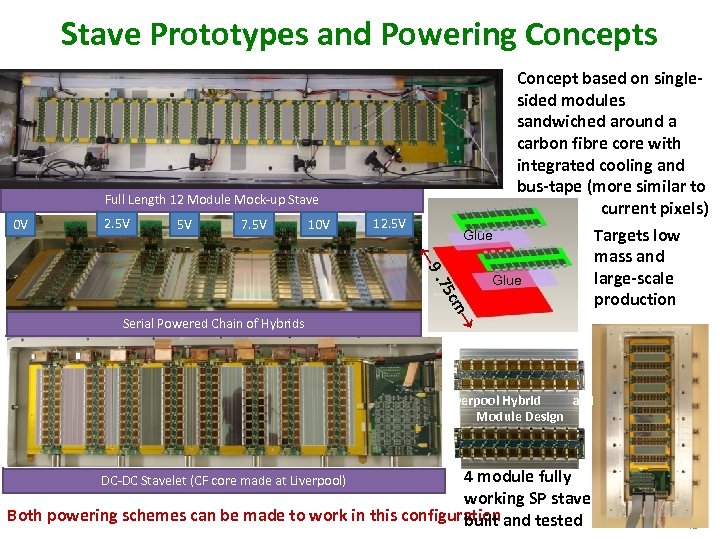
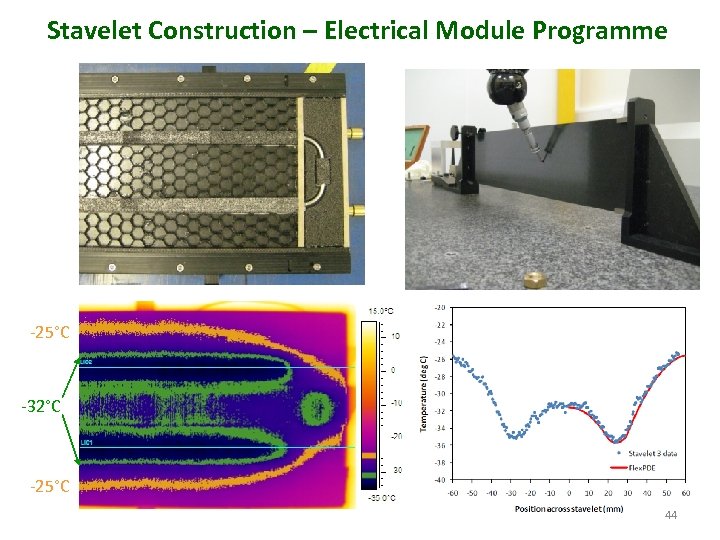 Stavelet Construction – Electrical Module Programme -25°C -32°C -25°C 44
 Conclusions The progress of Si sensor technology make possible to equip the future HL colliders with efficient sensors (to 3000 fb-1) to the innermost layers. Still a big challenge are services (cooling, powering. . . ) and cost. . . . 45