


 Скачать презентацию Status of the Mu Cool Cavity Prototype MICE
1f5569f945020b1462059ed0041df0d2.ppt
- Количество слайдов: 18
 Status of the Mu. Cool Cavity Prototype MICE Collaboration Meeting October 21, 2005 Steve Virostek Lawrence Berkeley National Laboratory
 Progress Since Last Year • Leak check of all e-beam welds was performed • Cooling tubes were TIG brazed to cavity exterior • A final mechanical buff of the interior was completed • Cavity interior surfaces were electropolished • RF couplers were fabricated and conditioned • First 201 MHz beryllium window delivered to LBNL • Cavity manual tuner and support stand were fabricated • Final assembly and leak check performed at J-Lab • Cavity was shipped to the MTA, assembled and leak checked RF Module Fabrication Steve Virostek - LBNL 2
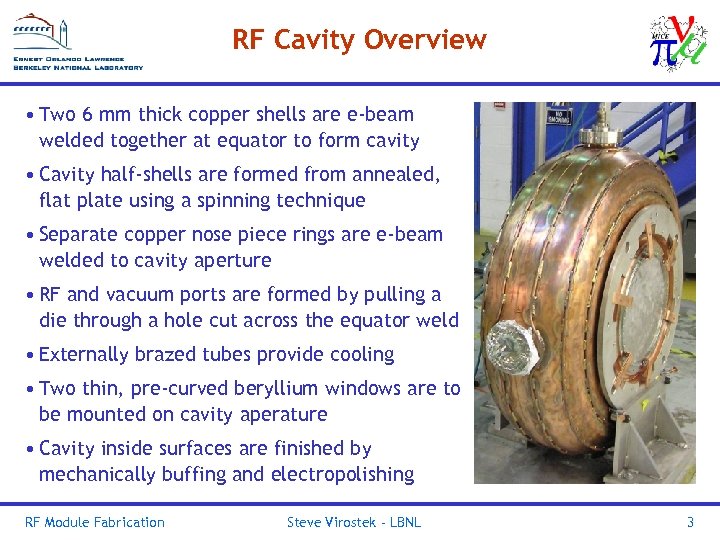 RF Cavity Overview • Two 6 mm thick copper shells are e-beam welded together at equator to form cavity • Cavity half-shells are formed from annealed, flat plate using a spinning technique • Separate copper nose piece rings are e-beam welded to cavity aperture • RF and vacuum ports are formed by pulling a die through a hole cut across the equator weld • Externally brazed tubes provide cooling • Two thin, pre-curved beryllium windows are to be mounted on cavity aperature • Cavity inside surfaces are finished by mechanically buffing and electropolishing RF Module Fabrication Steve Virostek - LBNL 3
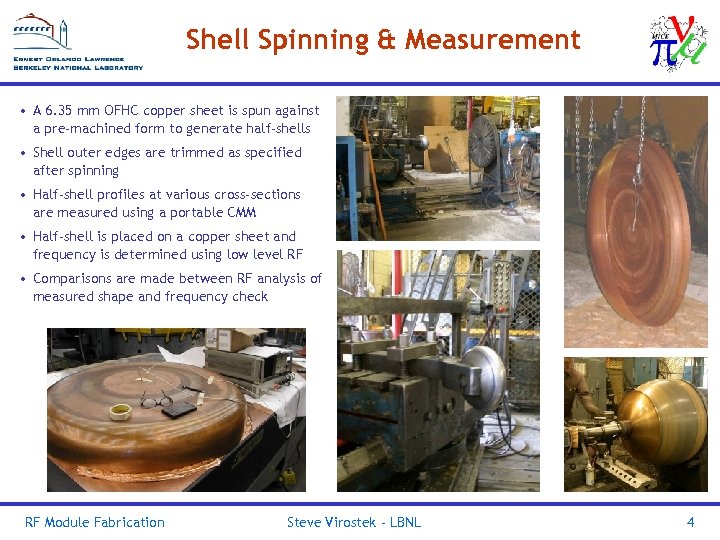 Shell Spinning & Measurement • A 6. 35 mm OFHC copper sheet is spun against a pre-machined form to generate half-shells • Shell outer edges are trimmed as specified after spinning • Half-shell profiles at various cross-sections are measured using a portable CMM • Half-shell is placed on a copper sheet and frequency is determined using low level RF • Comparisons are made between RF analysis of measured shape and frequency check RF Module Fabrication Steve Virostek - LBNL 4
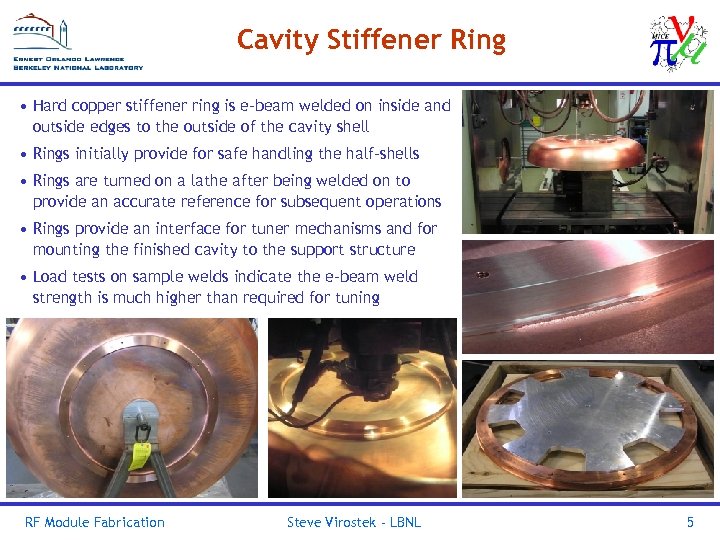 Cavity Stiffener Ring • Hard copper stiffener ring is e-beam welded on inside and outside edges to the outside of the cavity shell • Rings initially provide for safe handling the half-shells • Rings are turned on a lathe after being welded on to provide an accurate reference for subsequent operations • Rings provide an interface for tuner mechanisms and for mounting the finished cavity to the support structure • Load tests on sample welds indicate the e-beam weld strength is much higher than required for tuning RF Module Fabrication Steve Virostek - LBNL 5
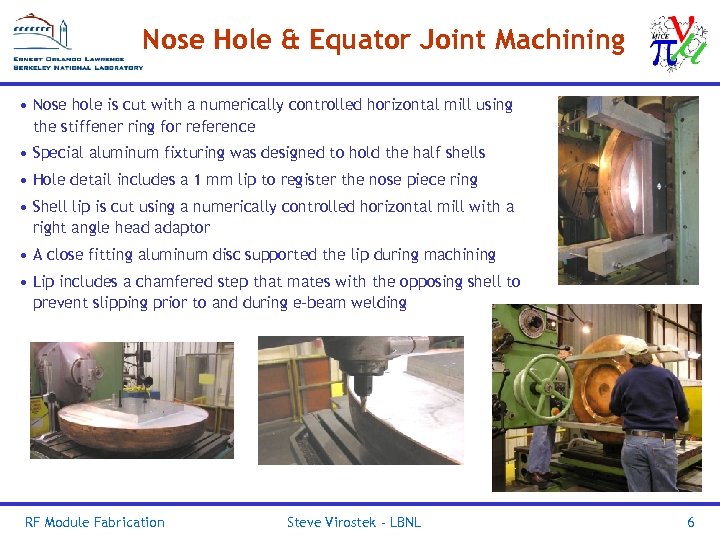 Nose Hole & Equator Joint Machining • Nose hole is cut with a numerically controlled horizontal mill using the stiffener ring for reference • Special aluminum fixturing was designed to hold the half shells • Hole detail includes a 1 mm lip to register the nose piece ring • Shell lip is cut using a numerically controlled horizontal mill with a right angle head adaptor • A close fitting aluminum disc supported the lip during machining • Lip includes a chamfered step that mates with the opposing shell to prevent slipping prior to and during e-beam welding RF Module Fabrication Steve Virostek - LBNL 6
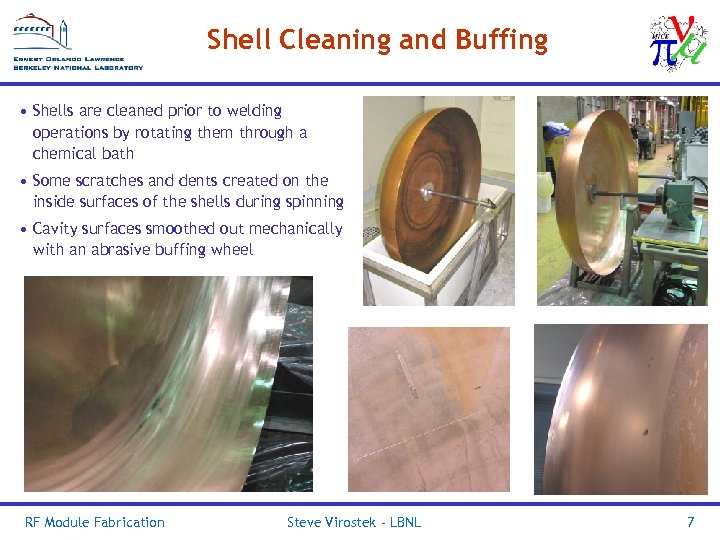 Shell Cleaning and Buffing • Shells are cleaned prior to welding operations by rotating them through a chemical bath • Some scratches and dents created on the inside surfaces of the shells during spinning • Cavity surfaces smoothed out mechanically with an abrasive buffing wheel RF Module Fabrication Steve Virostek - LBNL 7
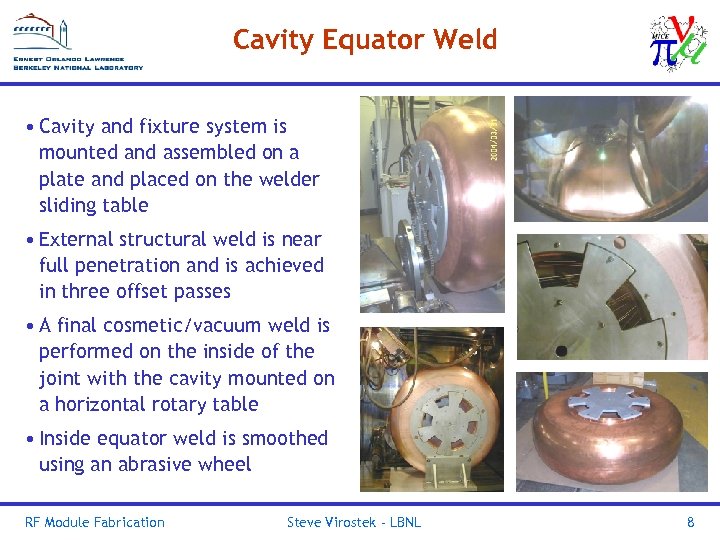 Cavity Equator Weld • Cavity and fixture system is mounted and assembled on a plate and placed on the welder sliding table • External structural weld is near full penetration and is achieved in three offset passes • A final cosmetic/vacuum weld is performed on the inside of the joint with the cavity mounted on a horizontal rotary table • Inside equator weld is smoothed using an abrasive wheel RF Module Fabrication Steve Virostek - LBNL 8
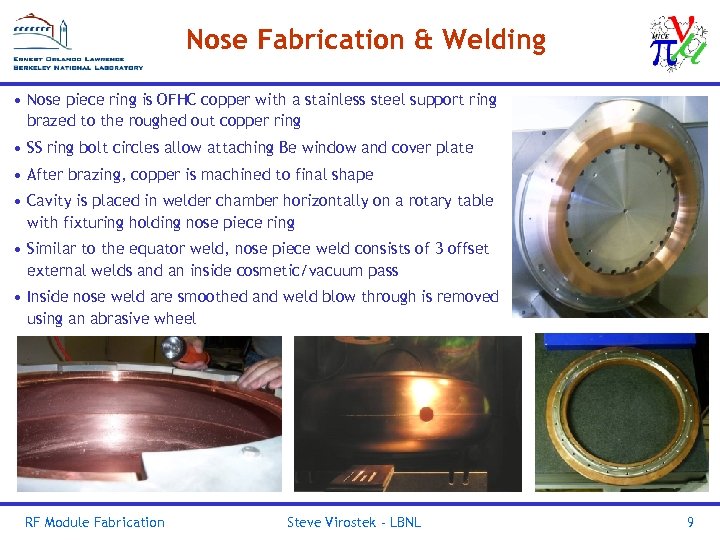 Nose Fabrication & Welding • Nose piece ring is OFHC copper with a stainless steel support ring brazed to the roughed out copper ring • SS ring bolt circles allow attaching Be window and cover plate • After brazing, copper is machined to final shape • Cavity is placed in welder chamber horizontally on a rotary table with fixturing holding nose piece ring • Similar to the equator weld, nose piece weld consists of 3 offset external welds and an inside cosmetic/vacuum pass • Inside nose weld are smoothed and weld blow through is removed using an abrasive wheel RF Module Fabrication Steve Virostek - LBNL 9
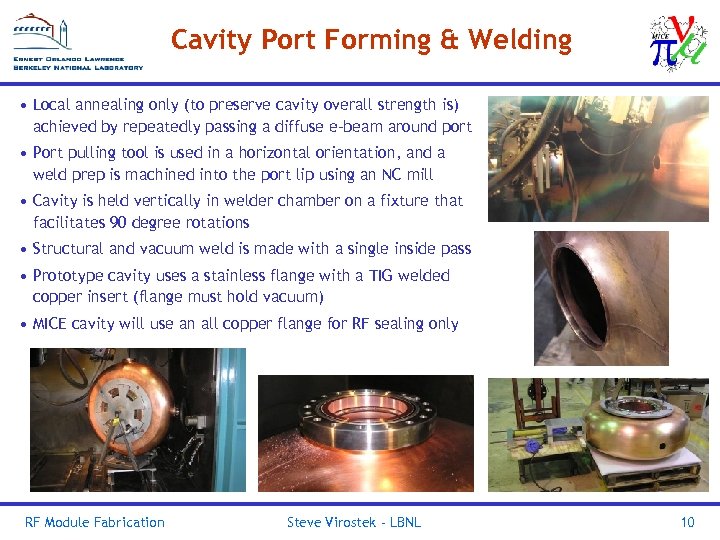 Cavity Port Forming & Welding • Local annealing only (to preserve cavity overall strength is) achieved by repeatedly passing a diffuse e-beam around port • Port pulling tool is used in a horizontal orientation, and a weld prep is machined into the port lip using an NC mill • Cavity is held vertically in welder chamber on a fixture that facilitates 90 degree rotations • Structural and vacuum weld is made with a single inside pass • Prototype cavity uses a stainless flange with a TIG welded copper insert (flange must hold vacuum) • MICE cavity will use an all copper flange for RF sealing only RF Module Fabrication Steve Virostek - LBNL 10
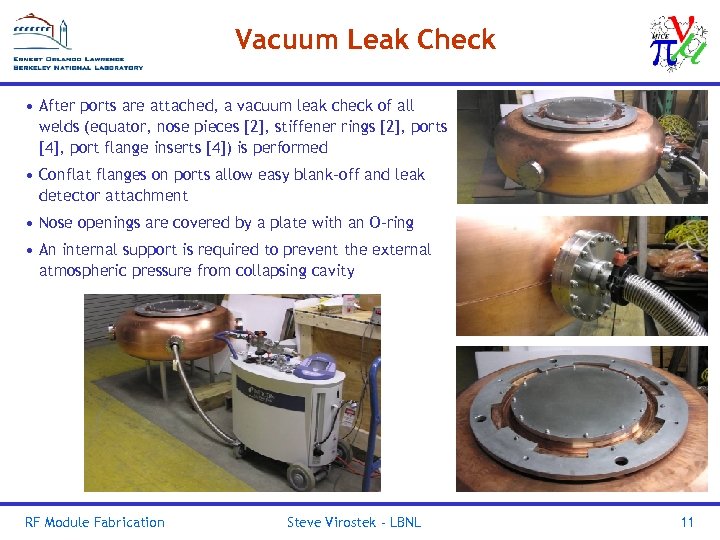 Vacuum Leak Check • After ports are attached, a vacuum leak check of all welds (equator, nose pieces [2], stiffener rings [2], ports [4], port flange inserts [4]) is performed • Conflat flanges on ports allow easy blank-off and leak detector attachment • Nose openings are covered by a plate with an O-ring • An internal support is required to prevent the external atmospheric pressure from collapsing cavity RF Module Fabrication Steve Virostek - LBNL 11
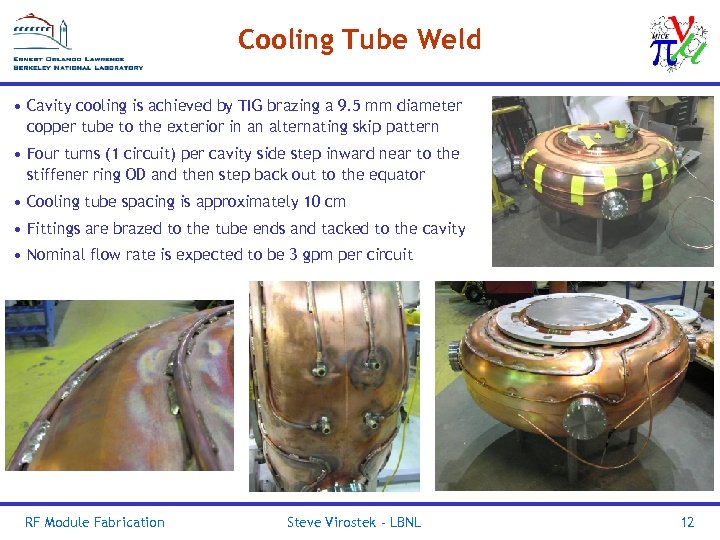 Cooling Tube Weld • Cavity cooling is achieved by TIG brazing a 9. 5 mm diameter copper tube to the exterior in an alternating skip pattern • Four turns (1 circuit) per cavity side step inward near to the stiffener ring OD and then step back out to the equator • Cooling tube spacing is approximately 10 cm • Fittings are brazed to the tube ends and tacked to the cavity • Nominal flow rate is expected to be 3 gpm per circuit RF Module Fabrication Steve Virostek - LBNL 12
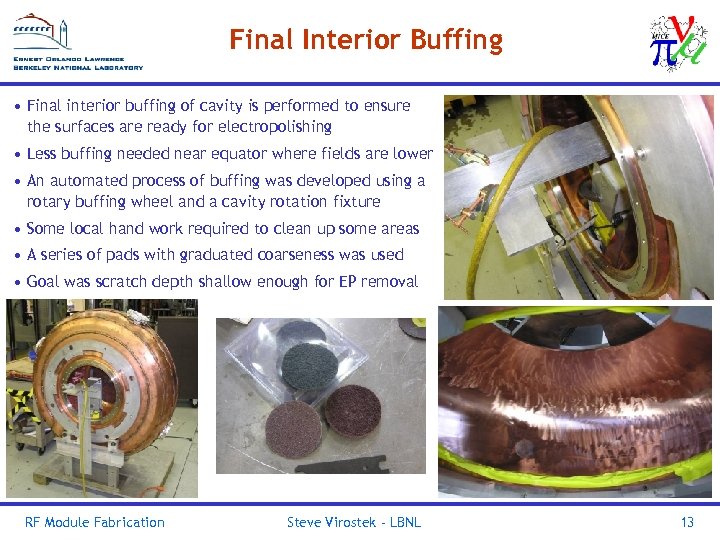 Final Interior Buffing • Final interior buffing of cavity is performed to ensure the surfaces are ready for electropolishing • Less buffing needed near equator where fields are lower • An automated process of buffing was developed using a rotary buffing wheel and a cavity rotation fixture • Some local hand work required to clean up some areas • A series of pads with graduated coarseness was used • Goal was scratch depth shallow enough for EP removal RF Module Fabrication Steve Virostek - LBNL 13
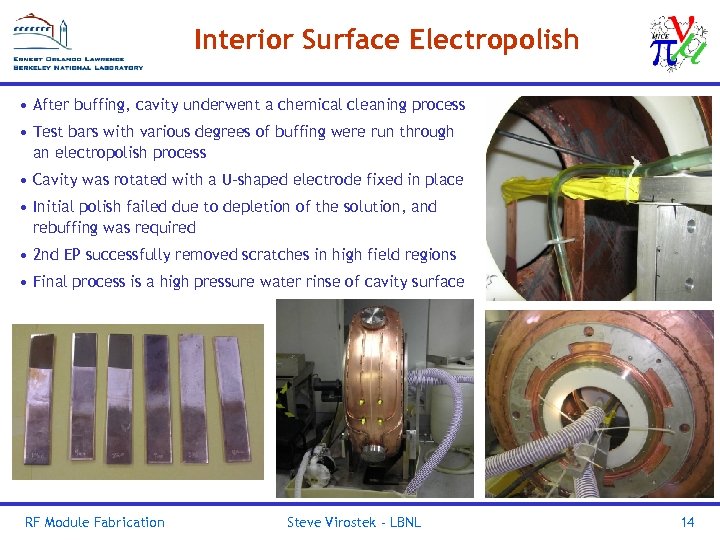 Interior Surface Electropolish • After buffing, cavity underwent a chemical cleaning process • Test bars with various degrees of buffing were run through an electropolish process • Cavity was rotated with a U-shaped electrode fixed in place • Initial polish failed due to depletion of the solution, and rebuffing was required • 2 nd EP successfully removed scratches in high field regions • Final process is a high pressure water rinse of cavity surface RF Module Fabrication Steve Virostek - LBNL 14
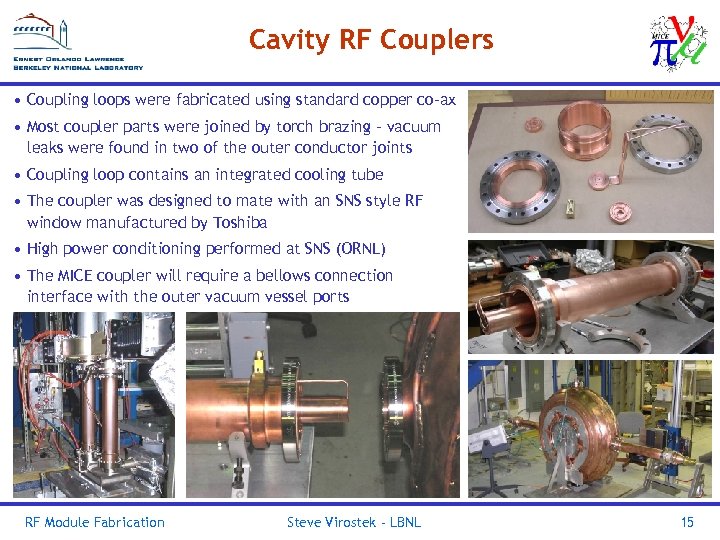 Cavity RF Couplers • Coupling loops were fabricated using standard copper co-ax • Most coupler parts were joined by torch brazing – vacuum leaks were found in two of the outer conductor joints • Coupling loop contains an integrated cooling tube • The coupler was designed to mate with an SNS style RF window manufactured by Toshiba • High power conditioning performed at SNS (ORNL) • The MICE coupler will require a bellows connection interface with the outer vacuum vessel ports RF Module Fabrication Steve Virostek - LBNL 15
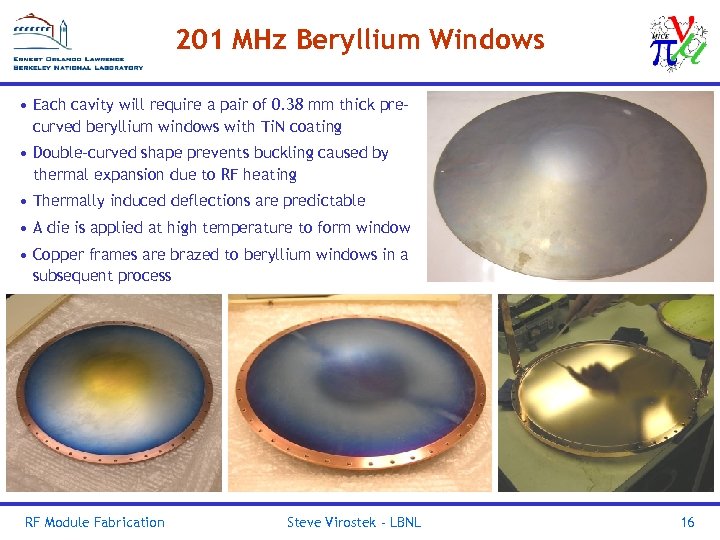 201 MHz Beryllium Windows • Each cavity will require a pair of 0. 38 mm thick precurved beryllium windows with Ti. N coating • Double-curved shape prevents buckling caused by thermal expansion due to RF heating • Thermally induced deflections are predictable • A die is applied at high temperature to form window • Copper frames are brazed to beryllium windows in a subsequent process RF Module Fabrication Steve Virostek - LBNL 16
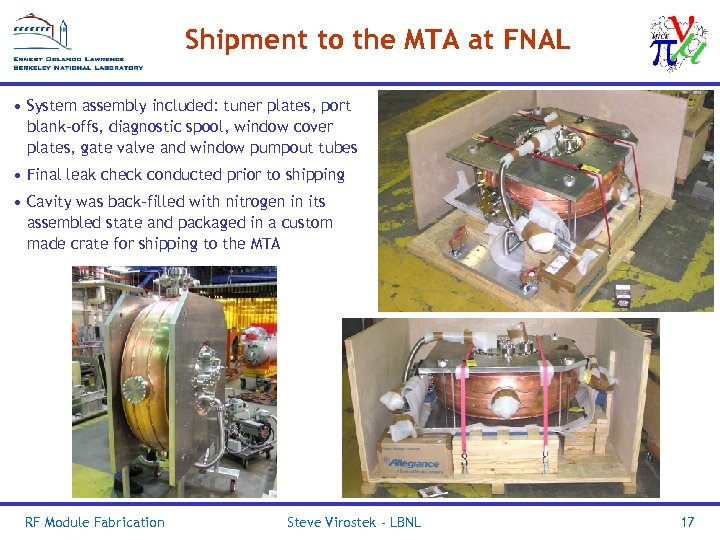 Shipment to the MTA at FNAL • System assembly included: tuner plates, port blank-offs, diagnostic spool, window cover plates, gate valve and window pumpout tubes • Final leak check conducted prior to shipping • Cavity was back-filled with nitrogen in its assembled state and packaged in a custom made crate for shipping to the MTA RF Module Fabrication Steve Virostek - LBNL 17
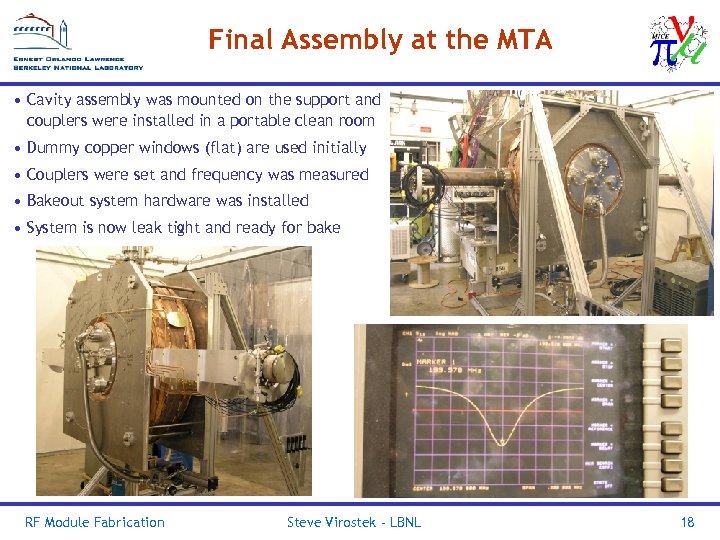 Final Assembly at the MTA • Cavity assembly was mounted on the support and couplers were installed in a portable clean room • Dummy copper windows (flat) are used initially • Couplers were set and frequency was measured • Bakeout system hardware was installed • System is now leak tight and ready for bake RF Module Fabrication Steve Virostek - LBNL 18