 Скачать презентацию Status of the LHCb experiment Andrei Golutvin
68028ff3f27fb981a471a72f75f6c894.ppt
- Количество слайдов: 30



Status of the LHCb experiment Andrei Golutvin ( Imperial & CERN & ITEP ) on behalf of the LHCb Collaboration Outline: Ø Ø Ø Ø Introduction Detector Subsystems Trigger/Online/Computing First Look at the data Cost and funding issues Collaboration matters Preparation for LHCb upgrade Physics goals in 2010 RRB April 2010 1
Brief Summary q Commissioning of LHCb with data was the main activity since last RRB q Detector is time aligned to optimal working point within 1– 2 ns. Data taken with and without magnetic field for position alignment q A total of 300 k collision events at 900 Ge. V recorded in 2009. Overall operation went very smoothly. Due to beam optics Vertex Detector (VELO) modules can approach only ± 15 mm from the beam. The VELO powering and closing procedures have been optimized and commissioned q In 2010, from first collisions onwards, LHCb is taking successfully data at 7 Te. V with high efficiency q LHCb is in excellent shape for the Physics Run in 2010 -2011 RRB April 2010 2
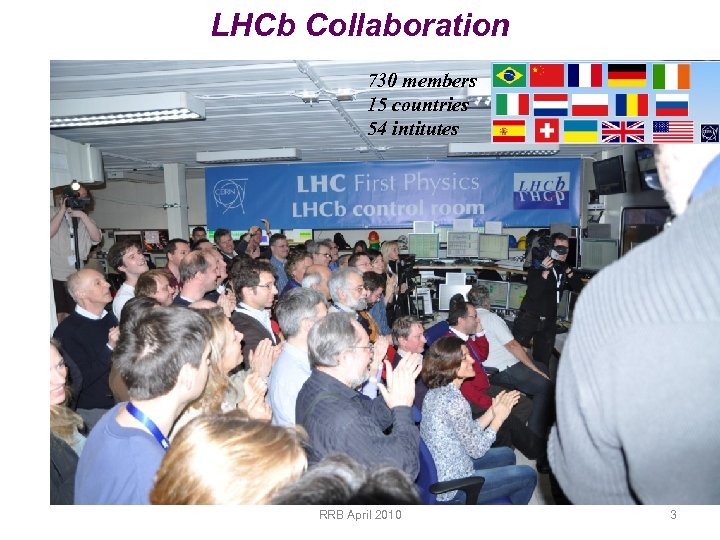
LHCb Collaboration 730 members 15 countries 54 intitutes RRB April 2010 3
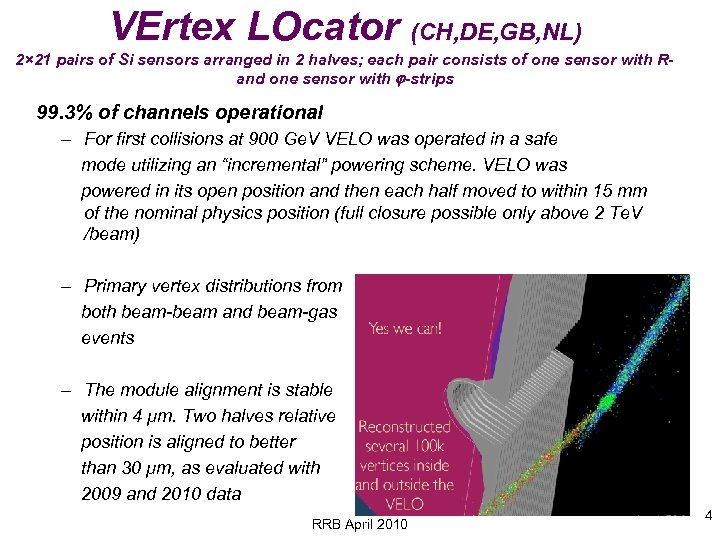
VErtex LOcator (CH, DE, GB, NL) 2× 21 pairs of Si sensors arranged in 2 halves; each pair consists of one sensor with Rand one sensor with -strips 99. 3% of channels operational – For first collisions at 900 Ge. V VELO was operated in a safe mode utilizing an “incremental” powering scheme. VELO was powered in its open position and then each half moved to within 15 mm of the nominal physics position (full closure possible only above 2 Te. V /beam) – Primary vertex distributions from both beam-beam and beam-gas events – The module alignment is stable within 4 μm. Two halves relative position is aligned to better than 30 μm, as evaluated with 2009 and 2010 data RRB April 2010 4
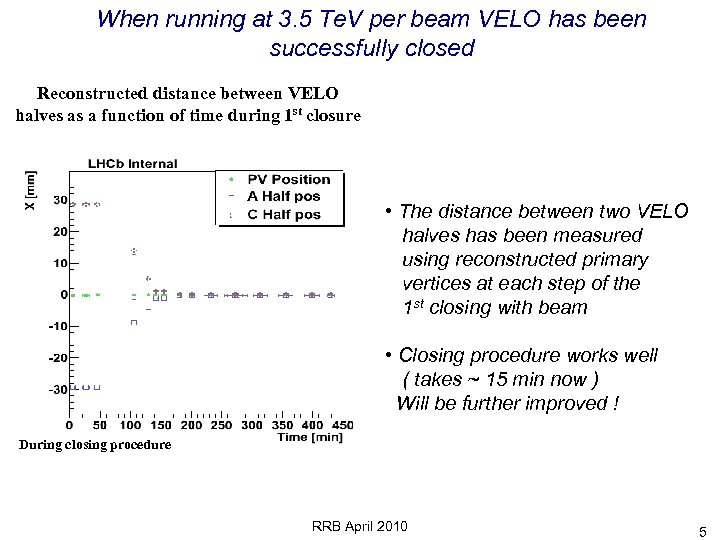
When running at 3. 5 Te. V per beam VELO has been successfully closed Reconstructed distance between VELO halves as a function of time during 1 st closure • The distance between two VELO halves has been measured using reconstructed primary vertices at each step of the 1 st closing with beam • Closing procedure works well ( takes ~ 15 min now ) Will be further improved ! During closing procedure RRB April 2010 5
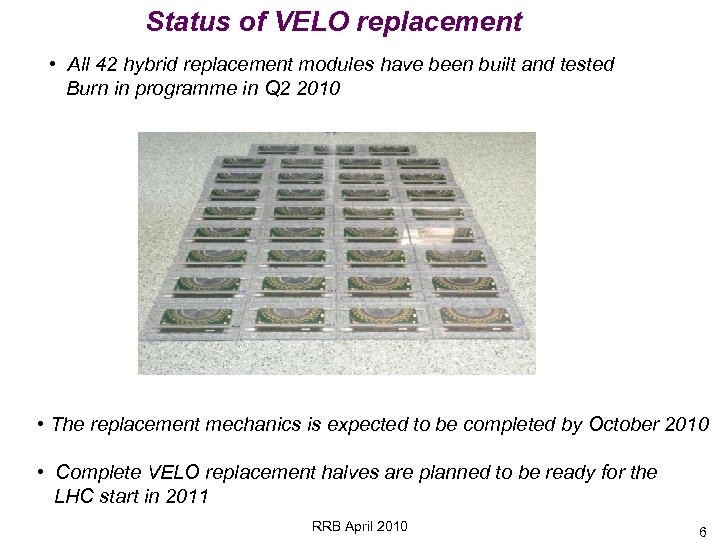
Status of VELO replacement • All 42 hybrid replacement modules have been built and tested Burn in programme in Q 2 2010 • The replacement mechanics is expected to be completed by October 2010 • Complete VELO replacement halves are planned to be ready for the LHC start in 2011 RRB April 2010 6
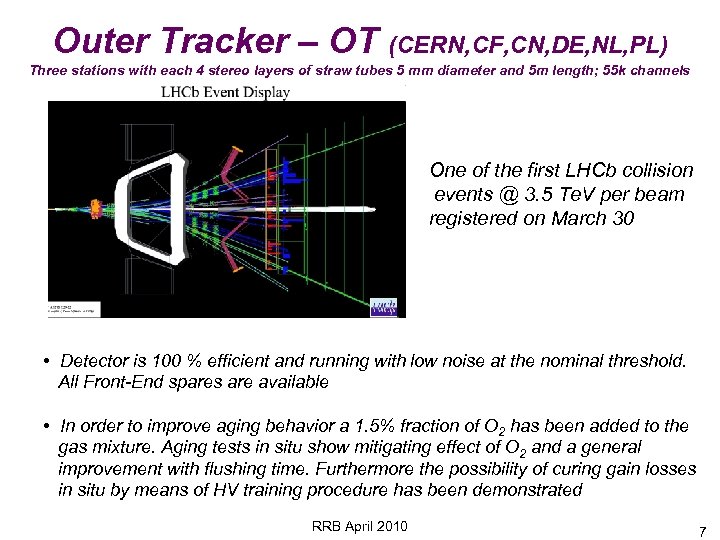
Outer Tracker – OT (CERN, CF, CN, DE, NL, PL) Three stations with each 4 stereo layers of straw tubes 5 mm diameter and 5 m length; 55 k channels One of the first LHCb collision events @ 3. 5 Te. V per beam registered on March 30 Calo Muon OT • Detector is 100 % efficient and running with low noise at the nominal threshold. All Front-End spares are available • In order to improve aging behavior a 1. 5% fraction of O 2 has been added to the gas mixture. Aging tests in situ show mitigating effect of O 2 and a general improvement with flushing time. Furthermore the possibility of curing gain losses in situ by means of HV training procedure has been demonstrated RRB April 2010 7
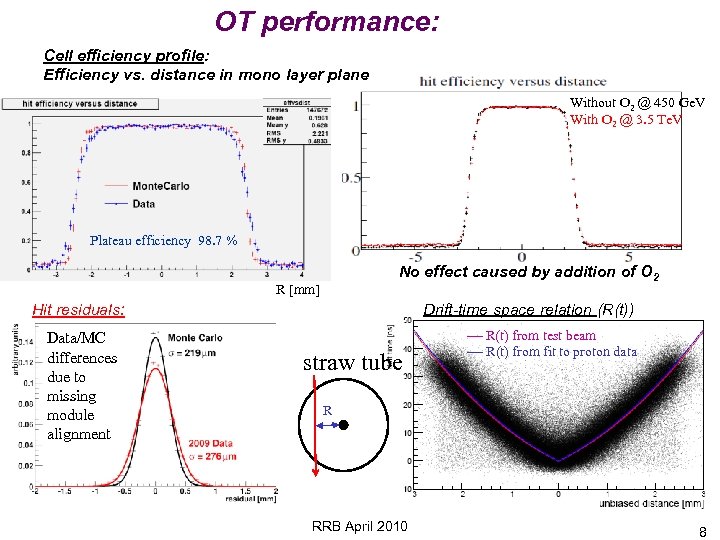
OT performance: Cell efficiency profile: Efficiency vs. distance in mono layer plane Without O 2 @ 450 Ge. V With O 2 @ 3. 5 Te. V Plateau efficiency 98. 7 % No effect caused by addition of O 2 R [mm] Drift-time space relation (R(t)) Hit residuals: Data/MC differences due to missing module alignment straw tube R(t) from test beam R(t) from fit to proton data R RRB April 2010 8
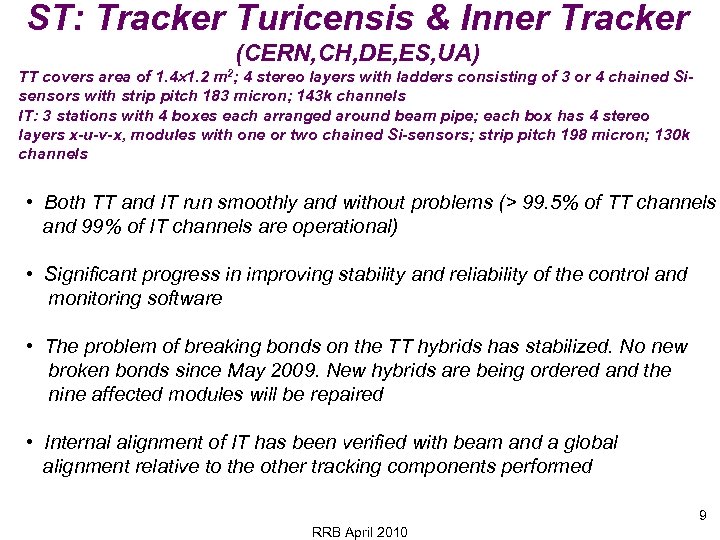
ST: Tracker Turicensis & Inner Tracker (CERN, CH, DE, ES, UA) TT covers area of 1. 4 1. 2 m 2; 4 stereo layers with ladders consisting of 3 or 4 chained Sisensors with strip pitch 183 micron; 143 k channels IT: 3 stations with 4 boxes each arranged around beam pipe; each box has 4 stereo layers x-u-v-x, modules with one or two chained Si-sensors; strip pitch 198 micron; 130 k channels • Both TT and IT run smoothly and without problems (> 99. 5% of TT channels and 99% of IT channels are operational) • Significant progress in improving stability and reliability of the control and monitoring software • The problem of breaking bonds on the TT hybrids has stabilized. No new broken bonds since May 2009. New hybrids are being ordered and the nine affected modules will be repaired • Internal alignment of IT has been verified with beam and a global alignment relative to the other tracking components performed 9 RRB April 2010
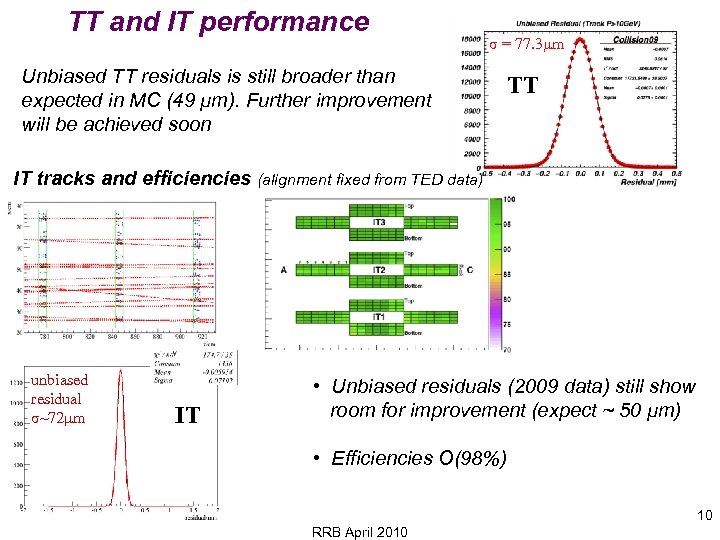
TT and IT performance Unbiased TT residuals is still broader than expected in MC (49 μm). Further improvement will be achieved soon σ = 77. 3µm TT IT tracks and efficiencies (alignment fixed from TED data) unbiased residual σ~72μm IT • Unbiased residuals (2009 data) still show room for improvement (expect ~ 50 μm) • Efficiencies O(98%) 10 RRB April 2010
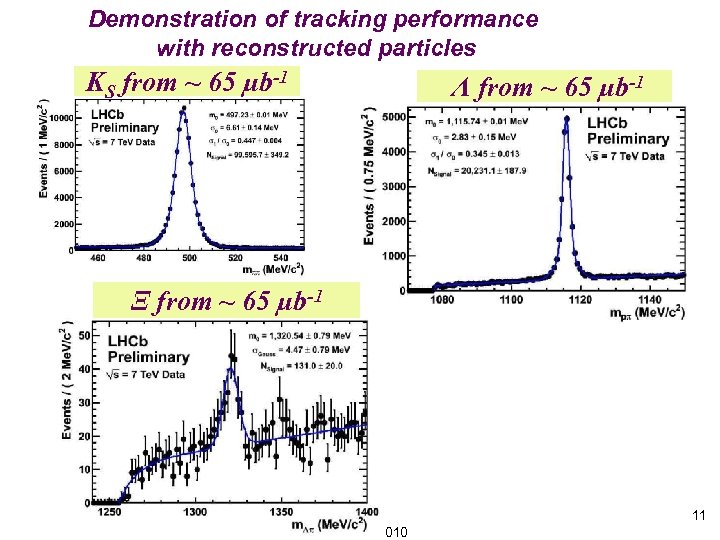
Demonstration of tracking performance with reconstructed particles KS from ~ 65 µb-1 Λ from ~ 65 µb-1 Ξ from ~ 65 µb-1 11 RRB April 2010
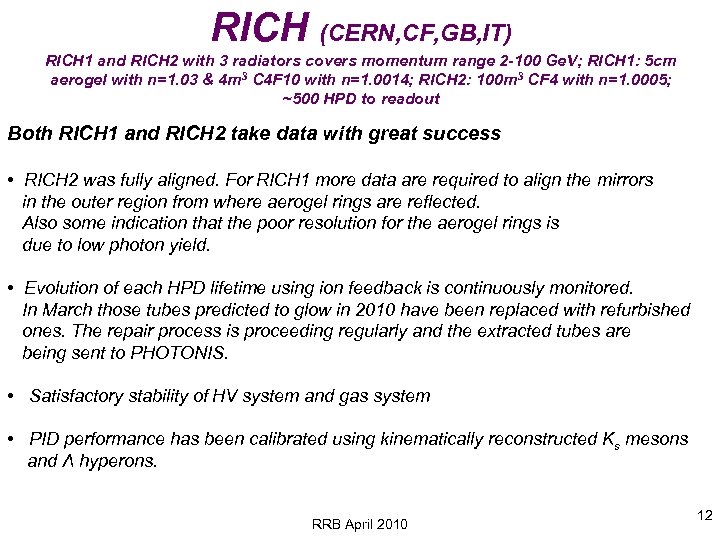
RICH (CERN, CF, GB, IT) RICH 1 and RICH 2 with 3 radiators covers momentum range 2 -100 Ge. V; RICH 1: 5 cm aerogel with n=1. 03 & 4 m 3 C 4 F 10 with n=1. 0014; RICH 2: 100 m 3 CF 4 with n=1. 0005; ~500 HPD to readout Both RICH 1 and RICH 2 take data with great success • RICH 2 was fully aligned. For RICH 1 more data are required to align the mirrors in the outer region from where aerogel rings are reflected. Also some indication that the poor resolution for the aerogel rings is due to low photon yield. • Evolution of each HPD lifetime using ion feedback is continuously monitored. In March those tubes predicted to glow in 2010 have been replaced with refurbished ones. The repair process is proceeding regularly and the extracted tubes are being sent to PHOTONIS. • Satisfactory stability of HV system and gas system • PID performance has been calibrated using kinematically reconstructed Ks mesons and Λ hyperons. RRB April 2010 12
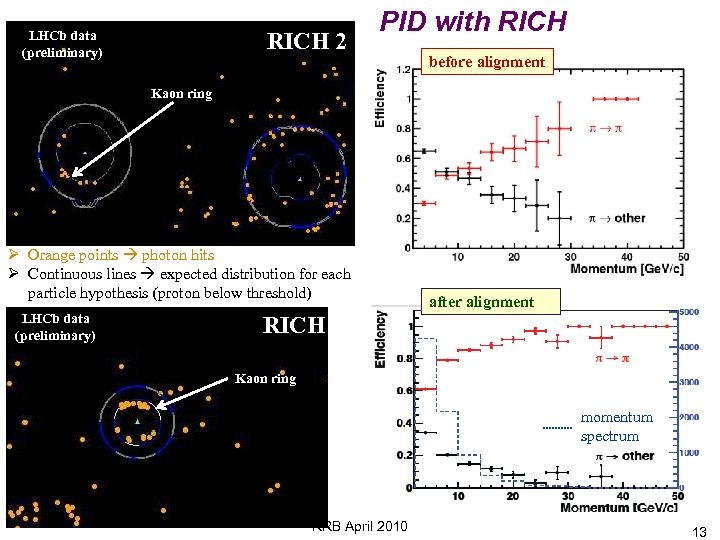
LHCb data (preliminary) RICH 2 PID with RICH before alignment Kaon ring Ø Orange points photon hits Ø Continuous lines expected distribution for each particle hypothesis (proton below threshold) LHCb data (preliminary) after alignment RICH 1 Kaon ring momentum spectrum RRB April 2010 13
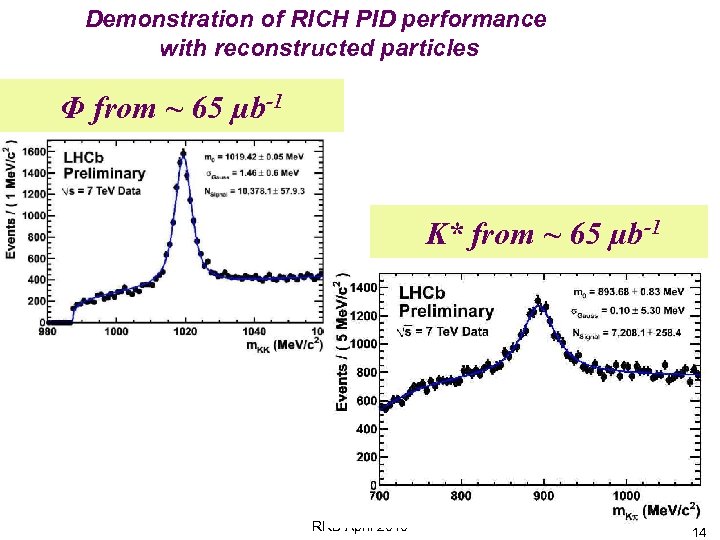
Demonstration of RICH PID performance with reconstructed particles Φ from ~ 65 µb-1 K* from ~ 65 µb-1 RRB April 2010 14
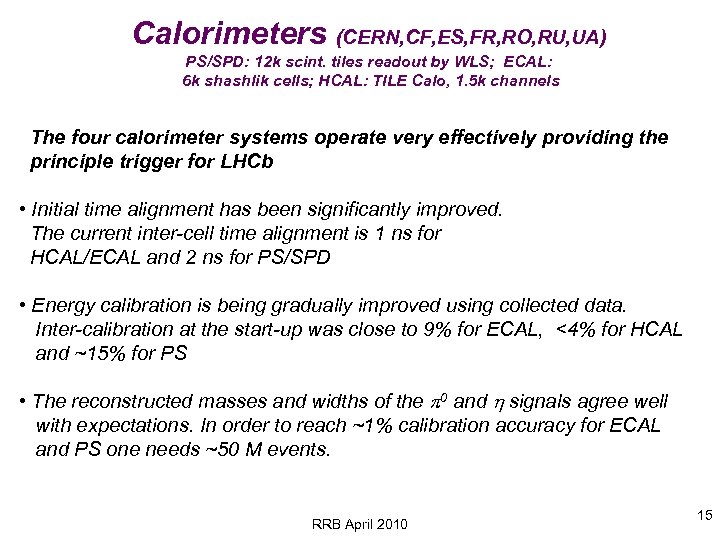
Calorimeters (CERN, CF, ES, FR, RO, RU, UA) PS/SPD: 12 k scint. tiles readout by WLS; ECAL: 6 k shashlik cells; HCAL: TILE Calo, 1. 5 k channels The four calorimeter systems operate very effectively providing the principle trigger for LHCb • Initial time alignment has been significantly improved. The current inter-cell time alignment is 1 ns for HCAL/ECAL and 2 ns for PS/SPD • Energy calibration is being gradually improved using collected data. Inter-calibration at the start-up was close to 9% for ECAL, <4% for HCAL and ~15% for PS • The reconstructed masses and widths of the p 0 and h signals agree well with expectations. In order to reach ~1% calibration accuracy for ECAL and PS one needs ~50 M events. RRB April 2010 15
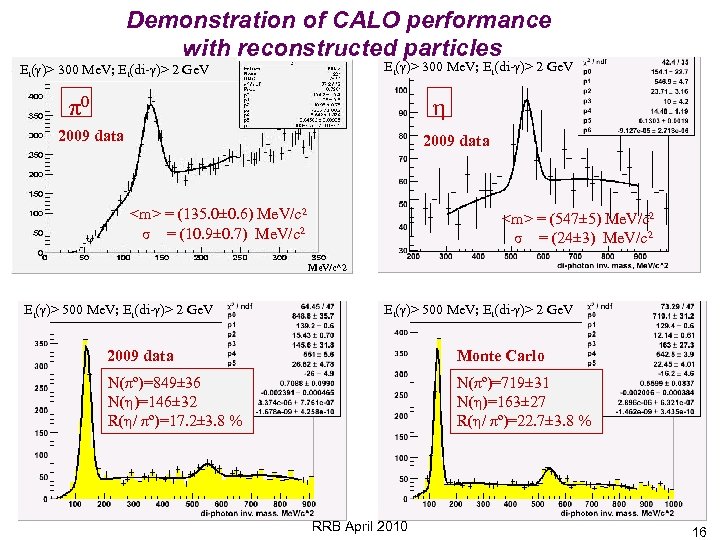
Demonstration of CALO performance with reconstructed particles Et(γ)> 300 Me. V; Et(di-γ)> 2 Ge. V π0 η 2009 data <m> = (135. 0± 0. 6) Me. V/c 2 σ = (10. 9± 0. 7) Me. V/c 2 <m> = (547± 5) Me. V/c 2 σ = (24± 3) Me. V/c 2 Me. V/c^2 Et(γ)> 500 Me. V; Et(di-γ)> 2 Ge. V 2009 data Monte Carlo N(πº)=849± 36 N(η)=146± 32 R(η/ πº)=17. 2± 3. 8 % N(πº)=719± 31 N(η)=163± 27 R(η/ πº)=22. 7± 3. 8 % RRB April 2010 16
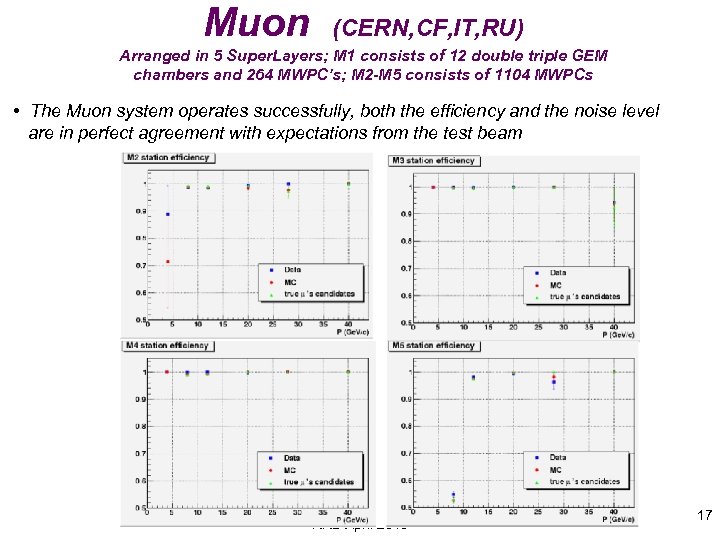
Muon (CERN, CF, IT, RU) Arranged in 5 Super. Layers; M 1 consists of 12 double triple GEM chambers and 264 MWPC’s; M 2 -M 5 consists of 1104 MWPCs • The Muon system operates successfully, both the efficiency and the noise level are in perfect agreement with expectations from the test beam RRB April 2010 17
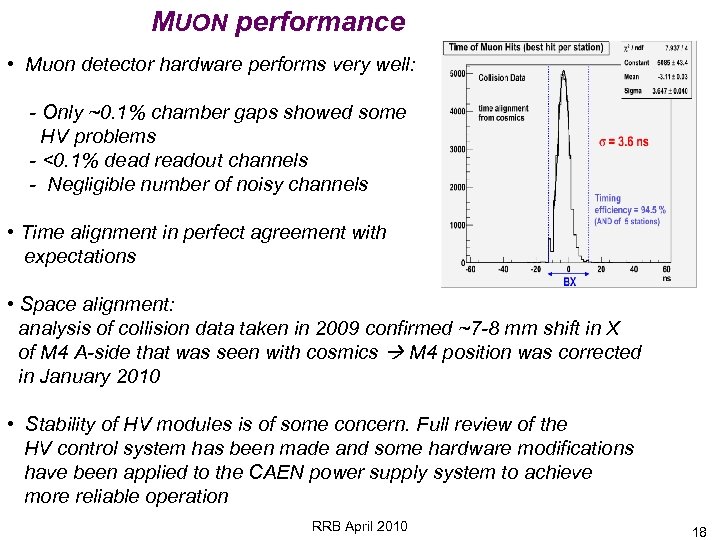
MUON performance • Muon detector hardware performs very well: - Only ~0. 1% chamber gaps showed some HV problems - <0. 1% dead readout channels - Negligible number of noisy channels • Time alignment in perfect agreement with expectations • Space alignment: analysis of collision data taken in 2009 confirmed ~7 -8 mm shift in X of M 4 A-side that was seen with cosmics M 4 position was corrected in January 2010 • Stability of HV modules is of some concern. Full review of the HV control system has been made and some hardware modifications have been applied to the CAEN power supply system to achieve more reliable operation RRB April 2010 18
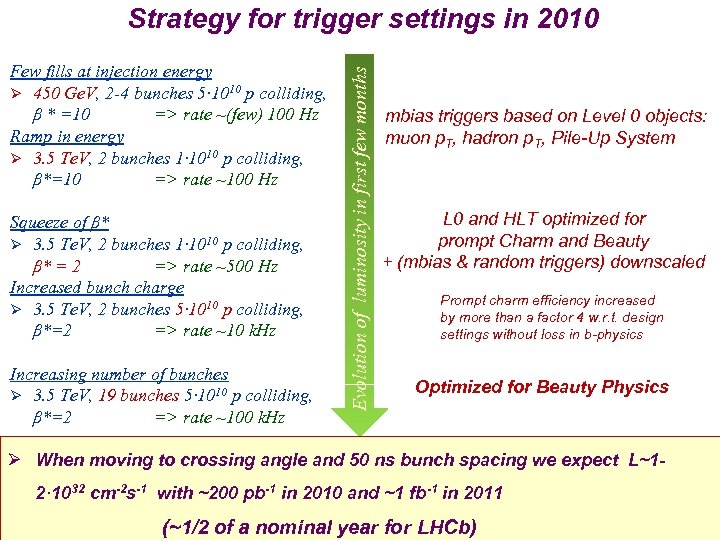
Few fills at injection energy Ø 450 Ge. V, 2 -4 bunches 5· 1010 p colliding, β * =10 => rate ~(few) 100 Hz Ramp in energy Ø 3. 5 Te. V, 2 bunches 1· 1010 p colliding, β*=10 => rate ~100 Hz Squeeze of β* Ø 3. 5 Te. V, 2 bunches 1· 1010 p colliding, β* = 2 => rate ~500 Hz Increased bunch charge Ø 3. 5 Te. V, 2 bunches 5· 1010 p colliding, β*=2 => rate ~10 k. Hz Increasing number of bunches Ø 3. 5 Te. V, 19 bunches 5· 1010 p colliding, β*=2 => rate ~100 k. Hz Evolution of luminosity in first few months Strategy for trigger settings in 2010 mbias triggers based on Level 0 objects: muon p. T, hadron p. T, Pile-Up System L 0 and HLT optimized for prompt Charm and Beauty + (mbias & random triggers) downscaled Prompt charm efficiency increased by more than a factor 4 w. r. t. design settings without loss in b-physics Optimized for Beauty Physics Ø When moving to crossing angle and 50 ns bunch spacing we expect L~12· 1032 cm-2 s-1 with ~200 pb-1 in 2010 and ~1 fb-1 in 2011 RRB April 2010 (~1/2 of a nominal year for LHCb) 19
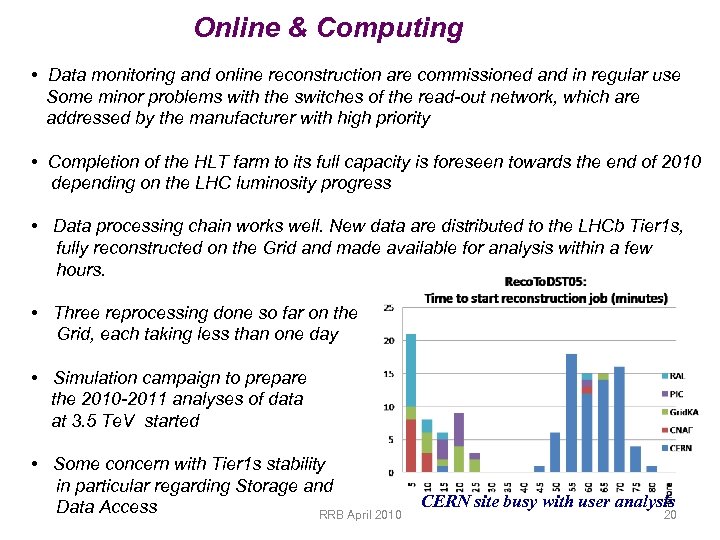
Online & Computing • Data monitoring and online reconstruction are commissioned and in regular use Some minor problems with the switches of the read-out network, which are addressed by the manufacturer with high priority • Completion of the HLT farm to its full capacity is foreseen towards the end of 2010 depending on the LHC luminosity progress • Data processing chain works well. New data are distributed to the LHCb Tier 1 s, fully reconstructed on the Grid and made available for analysis within a few hours. • Three reprocessing done so far on the Grid, each taking less than one day • Simulation campaign to prepare the 2010 -2011 analyses of data at 3. 5 Te. V started • Some concern with Tier 1 s stability in particular regarding Storage and Data Access RRB April 2010 CERN site busy with user analysis 20
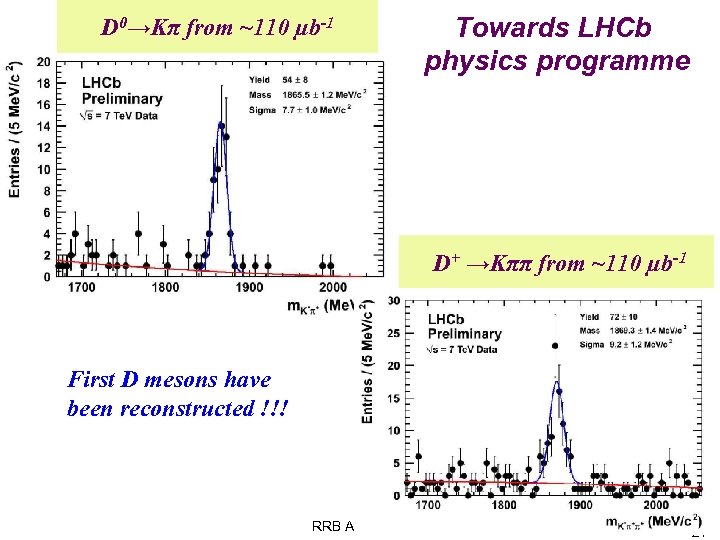
D 0→Kπ from ~110 µb-1 Towards LHCb physics programme D+ →Kππ from ~110 µb-1 First D mesons have been reconstructed !!! RRB April 2010 21
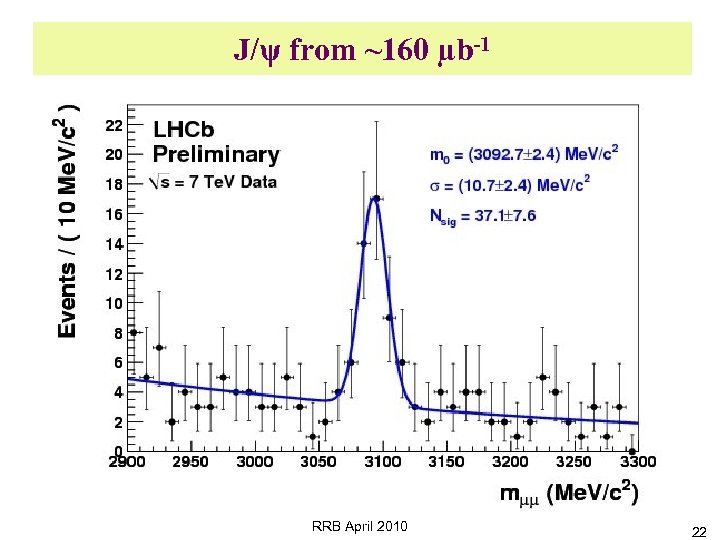
J/ψ from ~160 µb-1 RRB April 2010 22
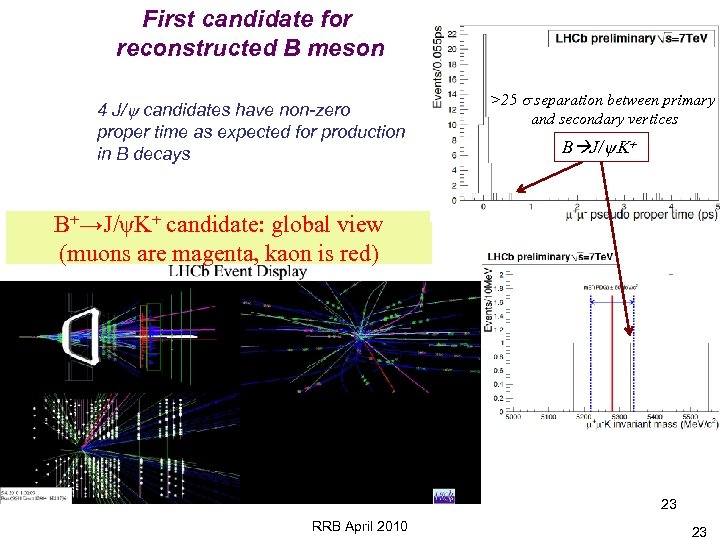
First candidate for reconstructed B meson 4 J/y candidates have non-zero proper time as expected for production in B decays >25 s separation between primary and secondary vertices B J/y. K+ B+→J/ψK+ candidate: global view (muons are magenta, kaon is red) 23 RRB April 2010 23
![B→J/ψK candidate: YZ vertex zoom [x 0. 2 mm] YZ Projection Tracks from primary](https://present5.com/presentation/68028ff3f27fb981a471a72f75f6c894/image-24.jpg "B→J/ψK candidate: YZ vertex zoom [x 0. 2 mm] YZ Projection Tracks from primary")
B→J/ψK candidate: YZ vertex zoom [x 0. 2 mm] YZ Projection Tracks from primary vertex Primary vertex B+ m+ B decay vertex J/ψ K+ RRB April 2010 m- [mm] 24
Cost and Funding • Overall situation is healthy; no cash flow problem foreseen • VELO replacement financing mechanism works well • Prepare for important interventions on sub-detectors and infrastructure during long shutdown in 2012 Collaboration Matters • Two new institutes accepted as Technical Associates: - Catholic University of Rio de Janeiro, Brazil - Tier-1 centre CCIN 2 P 3, Lyon, France • Guy Wilkinson (Oxford) is the Physics Coordinator for a term of 1 year as from January 1, 2010 • Rolf Lindner has been appointed as the Technical Coordinator for a term of 3 years starting from July 1, 2010 • Marco Cattaneo (CERN) has been appointed as the Computing Project Leader for 2 years starting from January 1, 2010 • Chris Parkes (Glasgow) has been appointed as the Vertex Detector Project Leader for 2 years starting from June 15, 2010 RRB April 2010 25
LHCb Upgrade activities A Letter of Intent for the LHCb upgrade is under preparation The strongest part of the LHCb physics case is the flexibility to be prepared for the exploration of New Physics Staged approach: First stage – Full software trigger - Upgrade to 40 MHz readout keeping sub-detectors unchanged wherever is possible - Construct NEW VELO RRB April 2010 26
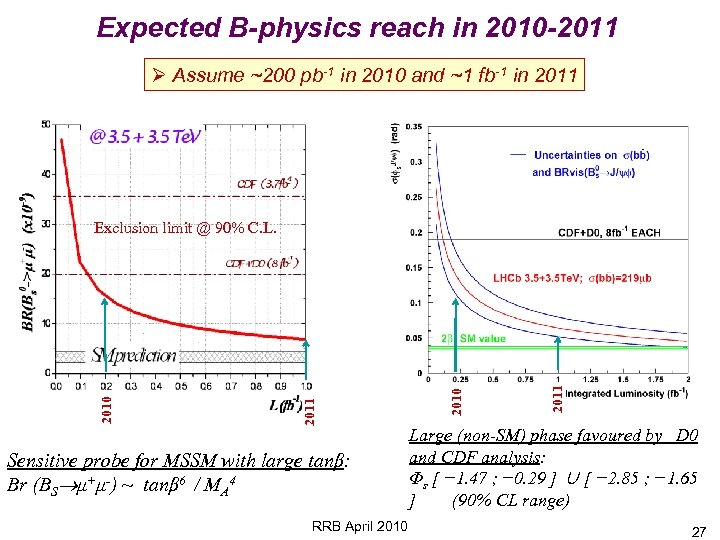
Expected B-physics reach in 2010 -2011 Ø Assume ~200 pb-1 in 2010 and ~1 fb-1 in 2011 Sensitive probe for MSSM with large tanβ: Br (BS μ+μ-) ~ tanβ 6 / MA 4 RRB April 2010 2011 2010 Exclusion limit @ 90% C. L. Large (non-SM) phase favoured by D 0 and CDF analysis: Φs [ − 1. 47 ; − 0. 29 ] ∪ [ − 2. 85 ; − 1. 65 ] (90% CL range) 27
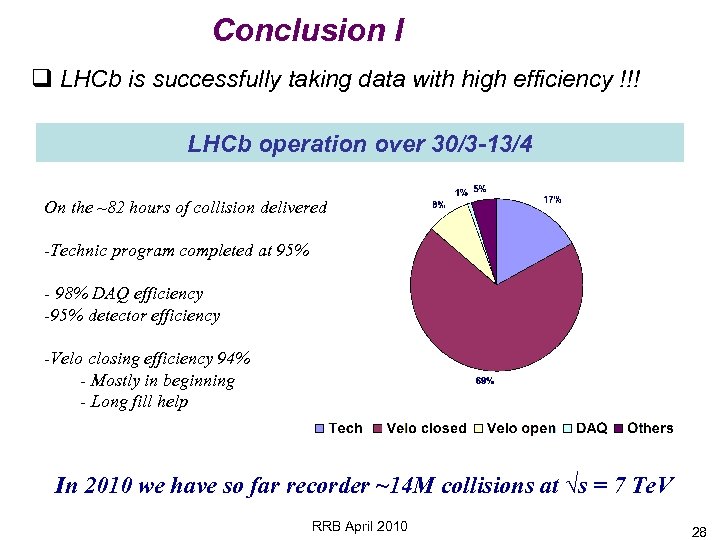
Conclusion I q LHCb is successfully taking data with high efficiency !!! LHCb operation over 30/3 -13/4 On the ~82 hours of collision delivered -Technic program completed at 95% - 98% DAQ efficiency -95% detector efficiency -Velo closing efficiency 94% - Mostly in beginning - Long fill help In 2010 we have so far recorder ~14 M collisions at √s = 7 Te. V RRB April 2010 28
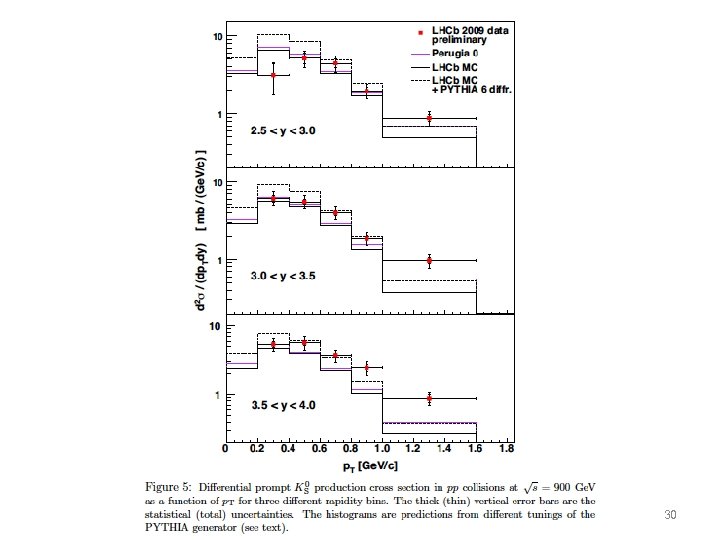
Conclusion II q First data are being used for calibration of the detector and trigger in particular. - First results of low Pt physics are available at LHC energies - Some high class measurements in the charm sector may be possible with 50 pb-1. Charm resonances have been reconstructed. q With ~ 200 pb-1 data sample LHCb will reach Tevatron sensitivity in a few golden channels in the beauty sector q Further consolidation is important prerequisite for efficient long term operation (e. g. R&D on improved reliability of readout cards in EPFL) RRB April 2010 29
RRB April 2010 30
Скачать презентацию Status of the LHCb experiment Andrei Golutvin
68028ff3f27fb981a471a72f75f6c894.ppt