


 Скачать презентацию Status of the Judicial Power Justice in
judicial power, const council.ppt
- Количество слайдов: 9
 Status of the Judicial Power • Justice in the RK is exercised only by the court. – (The Constitution also provides that criminal procedure may be carried out with participation of jurymen) • The objectives of judicial power are: – to protect the rights, freedoms, and legal interests of the citizens and organizations; – to ensure the observance of the Constitution, laws, other regulatory legal acts, and international treaties of RK. • Judicial power is extended to all cases and disputes arising on the basis: – – Constitution of RK, Laws of RK, Other regulatory legal acts of RK, International treaties of RK.
 Status of Judicial Power • Judgments (decisions & sentences) of courts have an obligatory force on the entire territory of the Republic. • The courts may not apply legal acts infringing human rights. – – • If a court finds a such law, it must suspend legal proceedings and address the Constitutional Council with a proposal to declare that law unconstitutional. Financing of courts, provision of judges with housing – – is performed from the republican budget and must ensure the possibility of complete and free exercise of justice.
 Judicial System • The courts of the Republic are: – the Supreme Court of the Republic and – local courts of the Republic: • Regional (Oblast) Courts of RK and Equal Courts; • District Courts of RK and Equal Courts. • The establishment of special and extraordinary courts under any name shall not be allowed.
 Formation of Courts • The Chairperson and judges of the Supreme Court of the RK are: – elected by the Senate; – at the proposal of the President of the Republic; – based on a recommendation of the Highest Judicial Council of the RK. • The Chairpersons and judges of the oblast and equivalent courts are: – appointed by the President; – at the recommendation of the Highest Judicial Council of the Republic. • The Chairperson and judges of district and equivalent courts of the Republic are: – appointed by the President; – at the proposal of the Minister of Justice; – based on a recommendation of the Qualification Collegium of Justice.
 Status of Judges • Courts consist of permanent judges whose independence is protected by the Constitution and law. • A judge when executing justice is independent and subordinate only to the Constitution and the law. • Any interference in the activity of the court in the exercise of justice is inadmissible and accountable by the law. • A judge may not be: – arrested, detained, – arraigned on a criminal charge without the consent of the President except for the cases of being apprehended on the scene of a crime or committing grave crimes. • Note: judges of the Supreme Court may not be arraigned on a criminal charge without the consent of the Senate except for the cases of being apprehended on the scene of a crime or committing grave crimes.
 Constitutional Council n Constitutional Council is the state organ which ensures the supremacy of the Constitution on the entire territory of RK. n The Constitutional Council consists of 7 members (the Chairperson and 6 other members) appointed for 6 years. The Chairperson is appointed by the President and in case the votes are equally divided, his vote is decisive. Two members are appointed by the President, two - by the Chairperson of Senate, and two - by the Chairperson of the Mazhilis. n The ex-Presidents of RK have the right to be life-long members of the Constitutional Council.
 Status of Members of Constitutional Council • The members of the Constitutional Council may not: – – • be deputies, hold paid offices except teaching, scientific or other creative activities, engage in entrepreneurial activity, enter a governing body or a supervisory board of a commercial organization. The members of the Constitutional Council during their term in office may not be: – arrested or detained, – arraigned on a criminal charge without the consent of Parliament, except in cases of being apprehended on the scene of a crime or committing grave crimes.
 Appeal to Constitutional Council The Constitutional Council may be appealed by: • the President, • the Chairpersons of the Senate and the Mazhilis • 1/5 of the total number of deputies of Parliament as well as • the Prime Minister
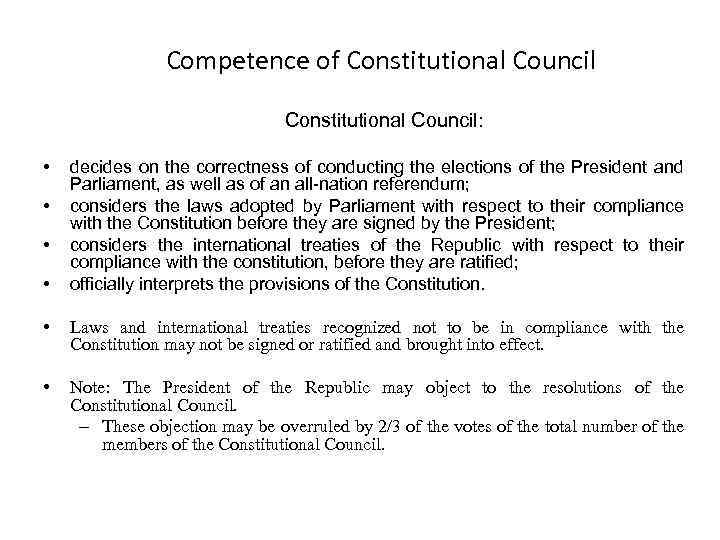 Competence of Constitutional Council: • • decides on the correctness of conducting the elections of the President and Parliament, as well as of an all-nation referendum; considers the laws adopted by Parliament with respect to their compliance with the Constitution before they are signed by the President; considers the international treaties of the Republic with respect to their compliance with the constitution, before they are ratified; officially interprets the provisions of the Constitution. • Laws and international treaties recognized not to be in compliance with the Constitution may not be signed or ratified and brought into effect. • Note: The President of the Republic may object to the resolutions of the Constitutional Council. – These objection may be overruled by 2/3 of the votes of the total number of the members of the Constitutional Council.