


 Скачать презентацию Status of Target Injection and Tracking Ronald Petzoldt
fe13b3bfcb22d592d904ce5371f67f3b.ppt
- Количество слайдов: 20
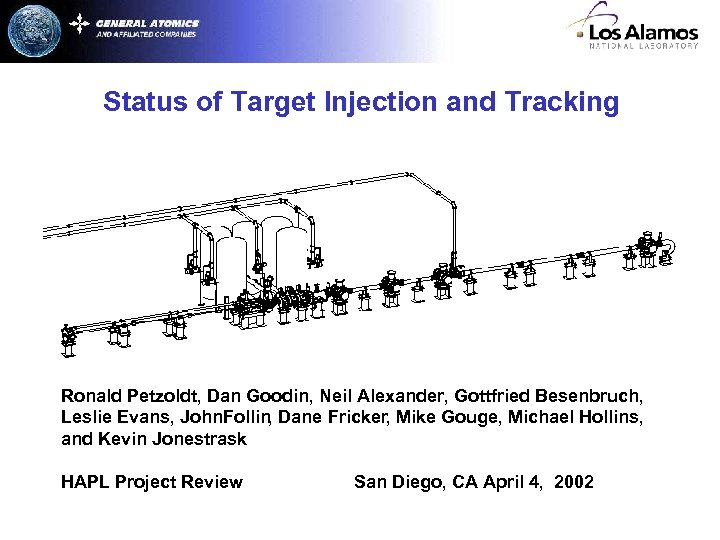 Status of Target Injection and Tracking Ronald Petzoldt, Dan Goodin, Neil Alexander, Gottfried Besenbruch, Leslie Evans, John. Follin, Dane Fricker, Mike Gouge, Michael Hollins, and Kevin Jonestrask HAPL Project Review San Diego, CA April 4, 2002
 Overview/Summary Status of injector • Design status • Gas valve • Schedule overview Interferometrictracking Gas effect on target heating Droplet effect on target tracking and beam propagation
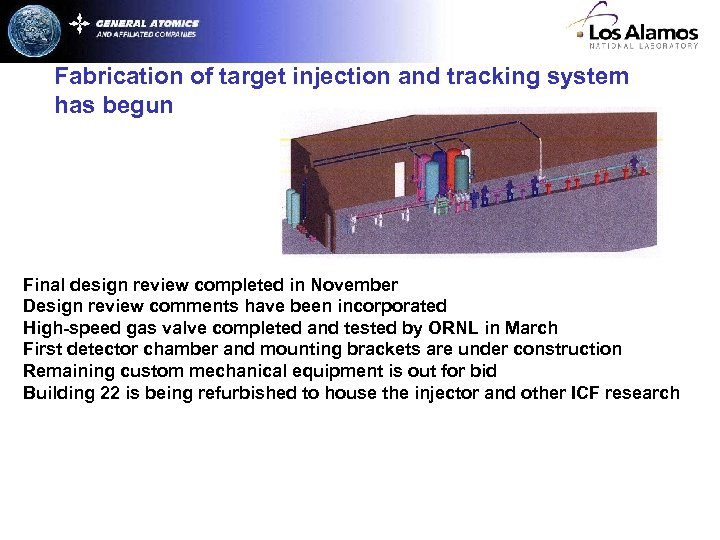 Fabrication of target injection and tracking system has begun Final design review completed in November Design review comments have been incorporated High-speed gas valve completed and tested by ORNL in March First detector chamber and mounting brackets are under construction Remaining custom mechanical equipment is out for bid Building 22 is being refurbished to house the injector and other ICF research
 Example design review recommended change Adjustable sabot deflector stand to allow injection path hole alignment
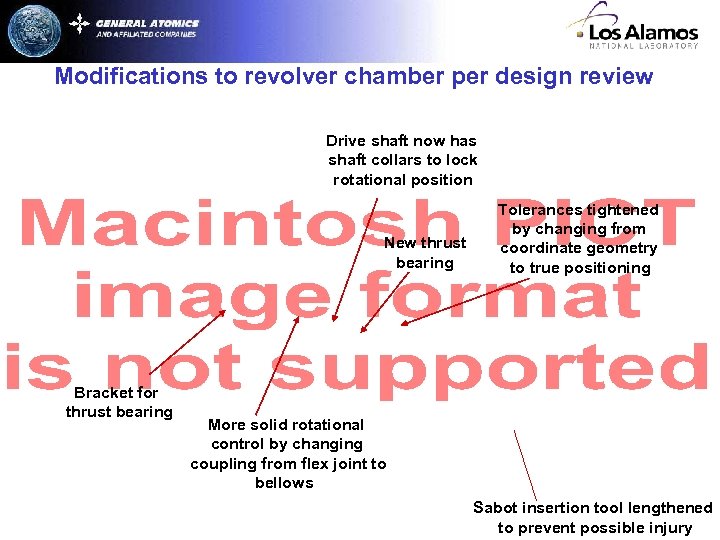 Modifications to revolver chamber per design review Drive shaft now has shaft collars to lock rotational position New thrust bearing Bracket for thrust bearing Tolerances tightened by changing from coordinate geometry to true positioning More solid rotational control by changing coupling from flex joint to bellows Sabot insertion tool lengthened to prevent possible injury
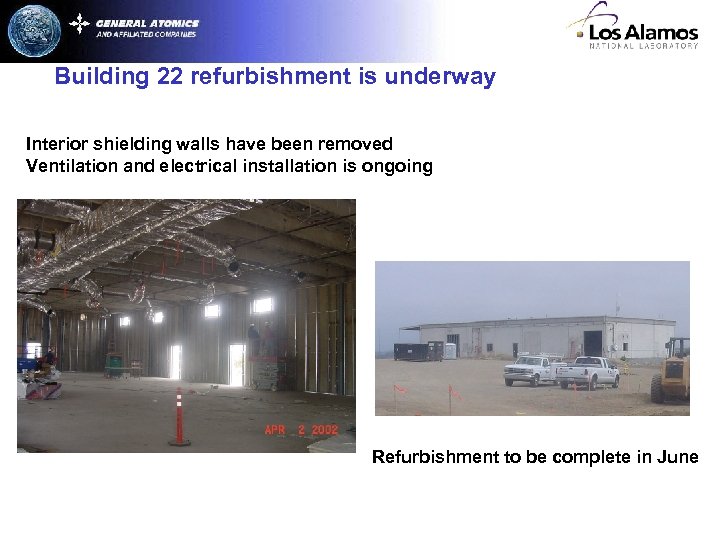 Building 22 refurbishment is underway Interior shielding walls have been removed Ventilation and electrical installation is ongoing Refurbishment to be complete in June
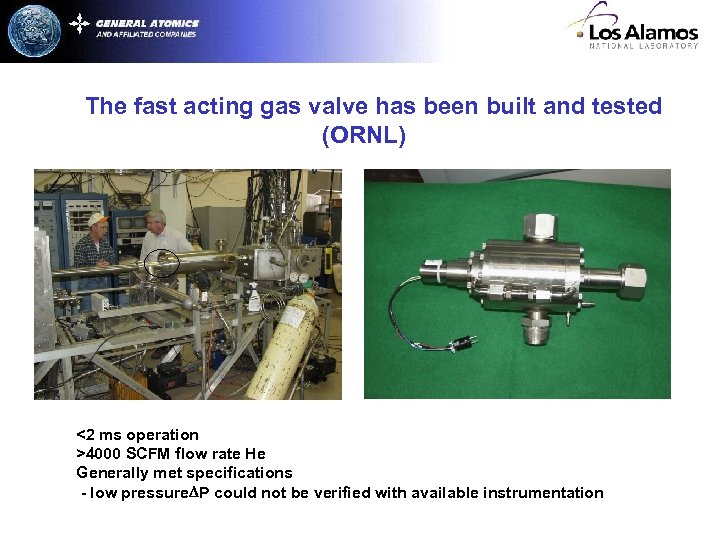 The fast acting gas valve has been built and tested (ORNL) <2 ms operation >4000 SCFM flow rate He Generally met specifications - low pressure P could not be verified with available instrumentation
 A three part approach is planned for Phase I testing Phase I A (present through July) • Revolver chamber construction and operational testing • Line scan camera with laser functional testing (first on bench top at UCSD - then in tracking chamber) Phase I B (May through September - overlap for procurement) • Tests all equipment through first detector chamber (gas valve, revolver, gun barrel, sabot deflector, position detector) Phase I C (August into 2003) • Single shot, single axis position prediction with timing position (remaining position detectors and position prediction hardware/software testing)
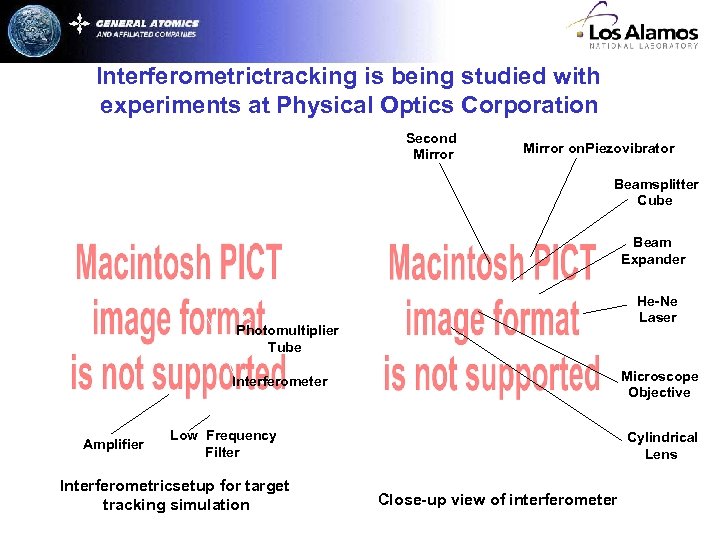 Interferometrictracking is being studied with experiments at Physical Optics Corporation Second Mirror Target Simulator Translator Mirror on Piezovibrator Beamsplitter Cube Beam Expander He-Ne Laser Photomultiplier Tube Microscope Objective Interferometer Amplifier Low Frequency Filter Interferometricsetup for target tracking simulation Cylindrical Lens Close-up view of interferometer
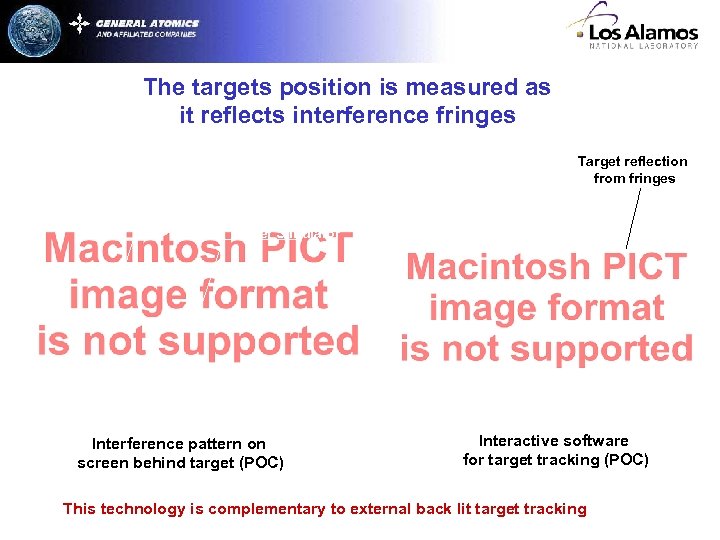 The targets position is measured as it reflects interference fringes Interference Pattern on Screen Behind Target reflection from fringes Target Simulator Interference pattern on screen behind target (POC) Interactive software for target tracking (POC) This technology is complementary to external back lit target tracking
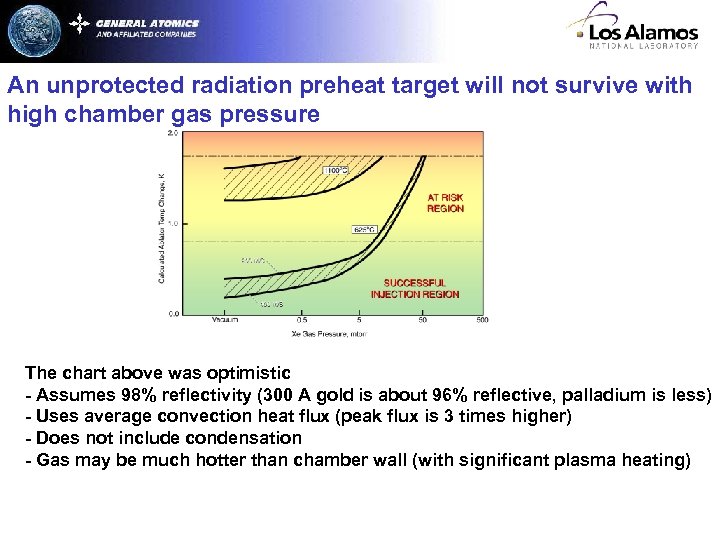 An unprotected radiation preheat target will not survive with high chamber gas pressure The chart above was optimistic - Assumes 98% reflectivity (300 A gold is about 96% reflective, palladium is less) - Uses average convection heat flux (peak flux is 3 times higher) - Does not include condensation - Gas may be much hotter than chamber wall (with significant plasma heating)
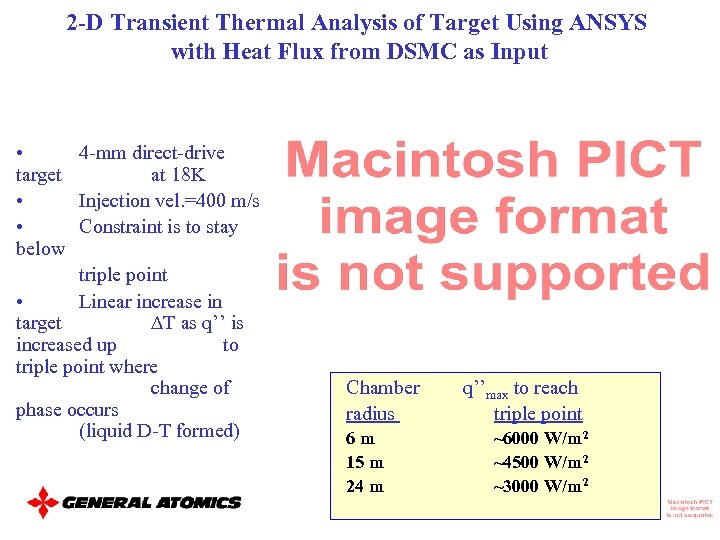 2 -D Transient Thermal Analysis of Target Using ANSYS with Heat Flux from DSMC as Input • 4 -mm direct-drive target at 18 K • Injection vel. =400 m/s • Constraint is to stay below triple point • Linear increase in target DT as q’’ is increased up to triple point where change of phase occurs (liquid D-T formed) Chamber radius 6 m 15 m 24 m q’’max to reach triple point ~6000 W/m 2 ~4500 W/m 2 ~3000 W/m 2
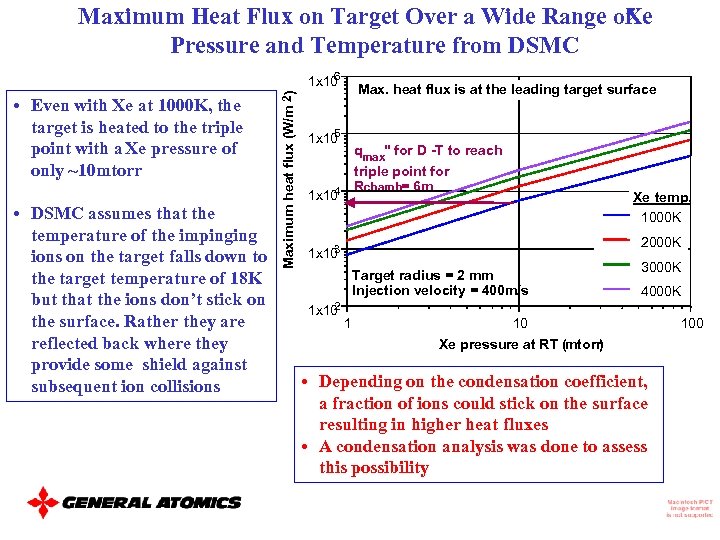 Maximum Heat Flux on Target Over a Wide Range of Xe Pressure and Temperature from DSMC • Even with Xe at 1000 K, the target is heated to the triple point with a Xe pressure of only ~10 mtorr • DSMC assumes that the temperature of the impinging ions on the target falls down to the target temperature of 18 K but that the ions don’t stick on the surface. Rather they are reflected back where they provide some shield against subsequent ion collisions Maximum heat flux (W/m 2 ) 6 1 x 10 Max. heat flux is at the leading target surface 5 1 x 10 qmax'' for D -T to reach triple point for Rchamb= 6 m 4 1 x 10 Xe temp. 1000 K 2000 K 3 1 x 10 Target radius = 2 mm Injection velocity = 400 m/s 3000 K 4000 K 2 1 x 10 1 10 Xe pressure at RT (mtorr) • Depending on the condensation coefficient, a fraction of ions could stick on the surface resulting in higher heat fluxes • A condensation analysis was done to assess this possibility 100
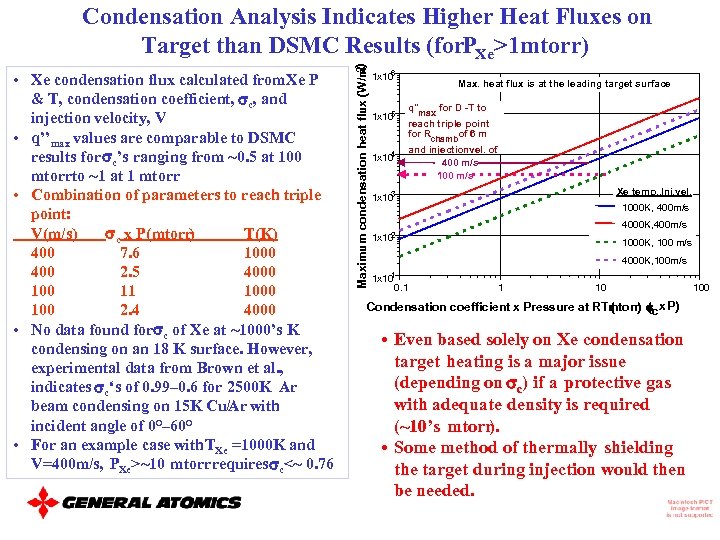 • Xe condensation flux calculated from. Xe P & T, condensation coefficient, sc, and injection velocity, V • q’’max values are comparable to DSMC results for sc’s ranging from ~0. 5 at 100 mtorrto ~1 at 1 mtorr • Combination of parameters to reach triple point: V(m/s) sc x P(mtorr ) T(K) 400 7. 6 1000 400 2. 5 4000 11 1000 100 2. 4 4000 • No data found forsc of Xe at ~1000’s K condensing on an 18 K surface. However, experimental data from Brown et al. , indicates sc‘s of 0. 99– 0. 6 for 2500 K Ar beam condensing on 15 K Cu/Ar with incident angle of 0°– 60° • For an example case with TXe =1000 K and V=400 m/s, PXe>~10 mtorrrequires sc<~ 0. 76 2 Maximum condensation heat flux (W/m) Condensation Analysis Indicates Higher Heat Fluxes on Target than DSMC Results (for. PXe>1 mtorr) 6 1 x 10 5 1 x 10 4 1 x 10 Max. heat flux is at the leading target surface q''max for D -T to reach triple point for Rchambof 6 m and injectionvel. of : 400 m/s 100 m/s Xe temp. , Inj. vel. 3 1 x 10 1000 K, 400 m/s 4000 K, 400 m/s 2 1 x 10 1000 K, 100 m/s 4000 K, 100 m/s 1 1 x 10 0. 1 1 10 Condensation coefficient x Pressure at RTmtorr) sc x P) ( ( • Even based solely on Xe condensation target heating is a major issue (depending on sc) if a protective gas with adequate density is required (~10’s mtorr ). • Some method of thermally shielding the target during injection would then be needed. 100
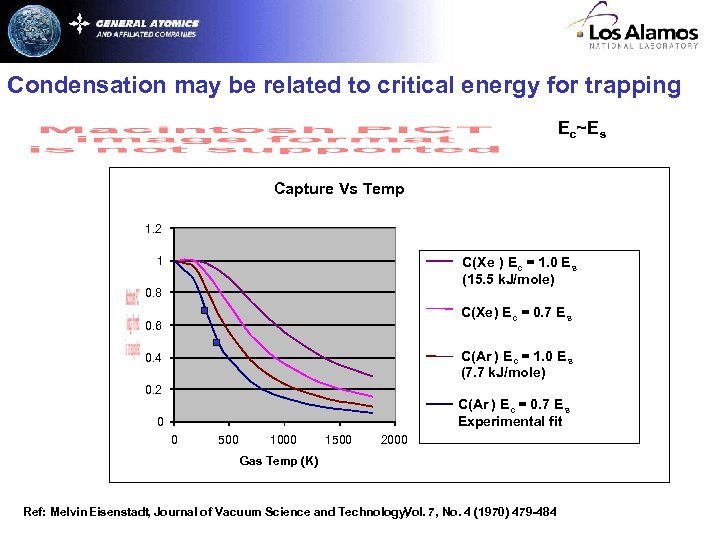 Condensation may be related to critical energy for trapping Ec~E s Capture Vs Temp 1. 2 1 C(Xe ) Ec = 1. 0 E s (15. 5 k. J/mole) 0. 8 C(Xe) Ec = 0. 7 E s 0. 6 C(Ar ) Ec = 1. 0 E s (7. 7 k. J/mole) 0. 4 0. 2 C(Ar ) Ec = 0. 7 E s Experimental fit 0 0 500 1000 1500 2000 Gas Temp (K) Ref: Melvin Eisenstadt, Journal of Vacuum Science and Technology, Vol. 7, No. 4 (1970) 479 -484
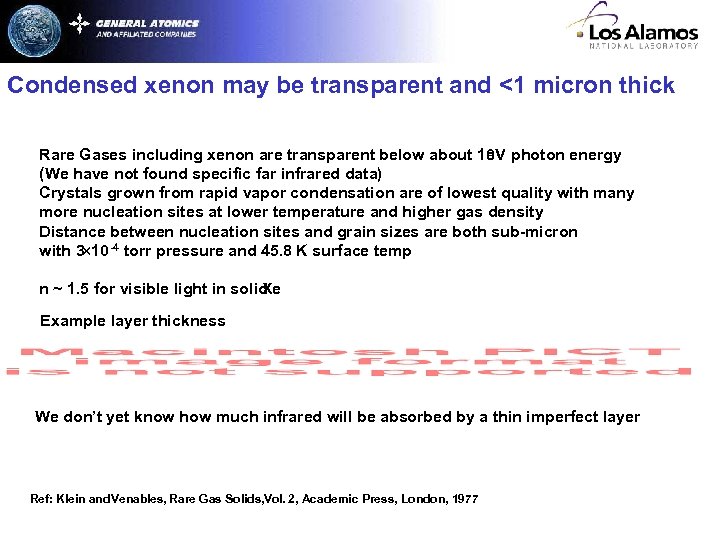 Condensed xenon may be transparent and <1 micron thick Rare Gases including xenon are transparent below about 10 photon energy e. V (We have not found specific far infrared data) Crystals grown from rapid vapor condensation are of lowest quality with many more nucleation sites at lower temperature and higher gas density Distance between nucleation sites and grain sizes are both sub-micron with 3 10 -4 torr pressure and 45. 8 K surface temp n ~ 1. 5 for visible light in solid Xe Example layer thickness We don’t yet know how much infrared will be absorbed by a thin imperfect layer Ref: Klein and Venables, Rare Gas Solids, Vol. 2, Academic Press, London, 1977
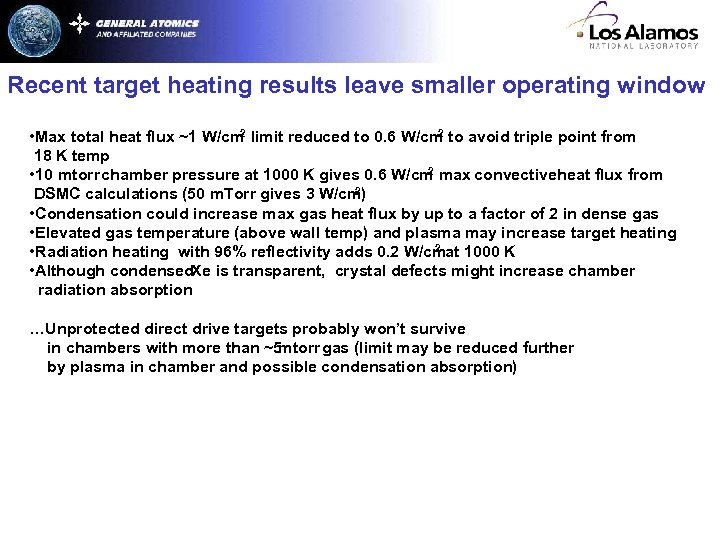 Recent target heating results leave smaller operating window 2 2 • Max total heat flux ~1 W/cm limit reduced to 0. 6 W/cm to avoid triple point from 18 K temp 2 • 10 mtorr chamber pressure at 1000 K gives 0. 6 W/cm max convective heat flux from 2 DSMC calculations (50 m. Torr gives 3 W/cm) • Condensation could increase max gas heat flux by up to a factor of 2 in dense gas • Elevated gas temperature (above wall temp) and plasma may increase target heating 2 • Radiation heating with 96% reflectivity adds 0. 2 W/cmat 1000 K • Although condensed. Xe is transparent, crystal defects might increase chamber radiation absorption …Unprotected direct drive targets probably won’t survive in chambers with more than ~5 mtorr gas (limit may be reduced further by plasma in chamber and possible condensation absorption)
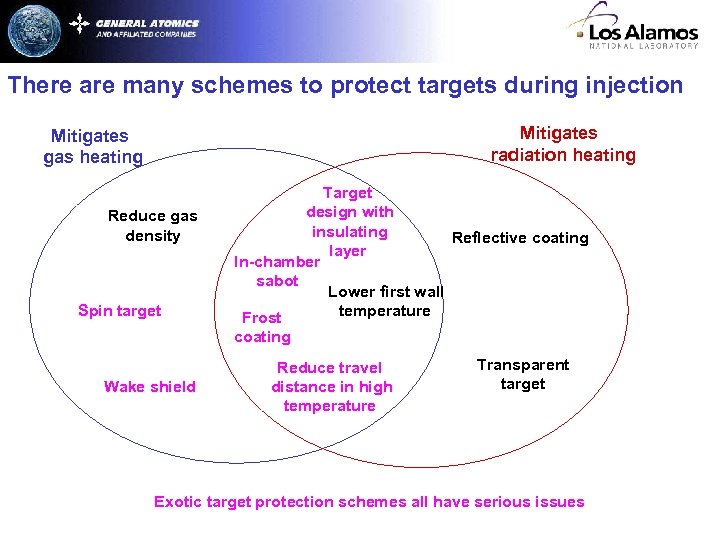 There are many schemes to protect targets during injection Mitigates radiation heating Mitigates gas heating Reduce gas density Spin target Target design with insulating Reflective coating layer In-chamber sabot Lower first wall temperature Frost coating Wake shield Reduce travel distance in high temperature Transparent target Exotic target protection schemes all have serious issues
 Beam extinction places a limit on particle density These calculations may also be useful for driver beam aerosol limits Assumes Pb particles and 0. 3 micron wavelength and 90% beam propagation through 6. 5 m More detail to be given at ARIES meeting
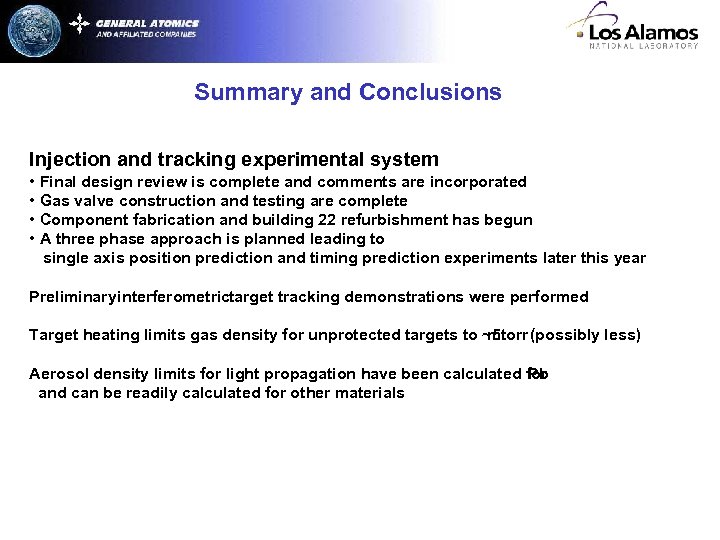 Summary and Conclusions Injection and tracking experimental system • Final design review is complete and comments are incorporated • Gas valve construction and testing are complete • Component fabrication and building 22 refurbishment has begun • A three phase approach is planned leading to single axis position prediction and timing prediction experiments later this year Preliminary interferometrictarget tracking demonstrations were performed Target heating limits gas density for unprotected targets to ~5 mtorr (possibly less) Aerosol density limits for light propagation have been calculated for Pb and can be readily calculated for other materials