


 Скачать презентацию Status of Swift Operations Instruments John Nousek
dd111e9db4c509c9afba063fad336e53.ppt
- Количество слайдов: 27
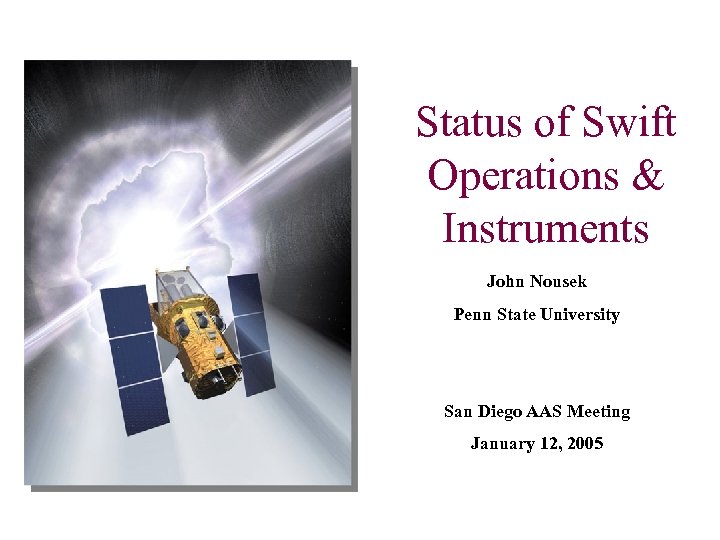 Status of Swift Operations & Instruments John Nousek Penn State University San Diego AAS Meeting January 12, 2005
 Outline • Operational status • Spacecraft status • Instrument status • Burst Alert Telescope (BAT) • X-Ray Telescope (XRT) • UV/Optical Telescope (UVOT) • Science Operations plans
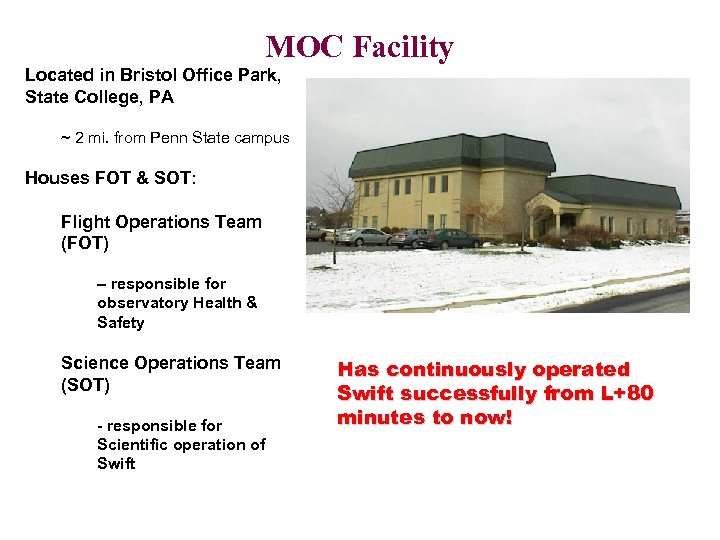 MOC Facility Located in Bristol Office Park, State College, PA ~ 2 mi. from Penn State campus Houses FOT & SOT: Flight Operations Team (FOT) – responsible for observatory Health & Safety Science Operations Team (SOT) - responsible for Scientific operation of Swift Has continuously operated Swift successfully from L+80 minutes to now!
 Mission Operations Personnel • Flight Operations Team – Mark Hilliard (Lead) • • Spectrum. Astro Spacecraft Team – Lisa Nelson (L&EO Director) • • Frank Marshall, Tim Gehringer, Renan Borelli, Dave Bundas, John Ong Swift Mission Operations Manager – Lou Parkinson (Mission Readiness Lead) Swift Mission Director – John Nousek • • Phil Smith, Barry Hancock, Pat Broos, Scott Koch, Howard Huckle, Mary Carter NASA Swift Project Team – Joe Dezio (Project Manager) • • • Joe Hill, Tony Abbey, Andy Beardmore, Claudio Pagani, Jaime Kennea UV/Optical Telescope Team – Pete Roming (UVOT Lead) • • D. Palmer, E. Fenimore, C. Markwardt, J. Cummings, A. Parsons, J. Tueller, H. Krimm X-Ray Telescope Team – David Burrows (XRT Lead) • • Sally Hunsberger, Jaime Kennea, Judy Racusin, David Morris, Mariya Ivanushkina Burst Alert Telescope Team – Scott Barthelmy (BAT Lead) • • Jeff Schieler, Kent Mitterer, John Jordan, Eric Orrill, Igor Lazbin Science Operations Team – David Burrows (SOT Lead) • • Harry Anderson, Chuck Cooper, Rob La. Verghetta, Justin Knavel, Doug Spiegel Margaret Chester, Tom Taylor, Alan Wells Swift Principal Investigator – Neil Gehrels
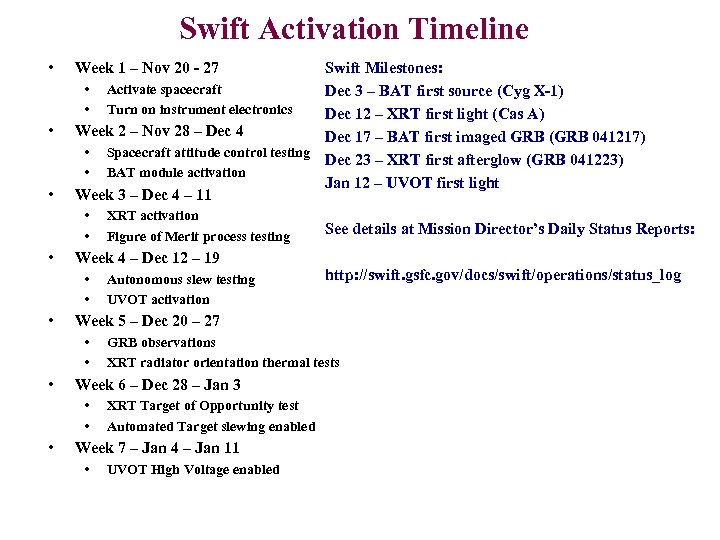 Swift Activation Timeline • • • Week 1 – Nov 20 - 27 Swift Milestones: • Activate spacecraft Dec 3 – BAT first source (Cyg X-1) • Turn on instrument electronics Dec 12 – XRT first light (Cas A) Week 2 – Nov 28 – Dec 4 Dec 17 – BAT first imaged GRB (GRB 041217) • Spacecraft attitude control testing Dec 23 – XRT first afterglow (GRB 041223) • BAT module activation Jan 12 – UVOT first light Week 3 – Dec 4 – 11 • • • Week 4 – Dec 12 – 19 • • • http: //swift. gsfc. gov/docs/swift/operations/status_log GRB observations XRT radiator orientation thermal tests Week 6 – Dec 28 – Jan 3 • • • Autonomous slew testing UVOT activation See details at Mission Director’s Daily Status Reports: Week 5 – Dec 20 – 27 • • • XRT activation Figure of Merit process testing XRT Target of Opportunity test Automated Target slewing enabled Week 7 – Jan 4 – Jan 11 • UVOT High Voltage enabled
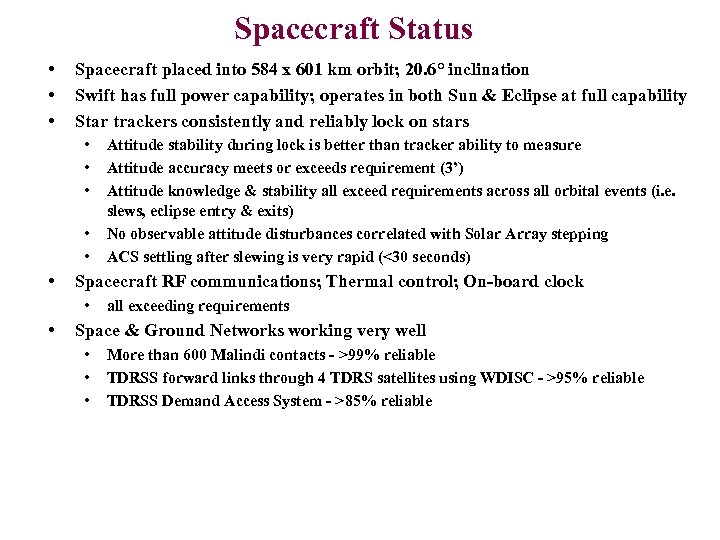 Spacecraft Status • • • Spacecraft placed into 584 x 601 km orbit; 20. 6° inclination Swift has full power capability; operates in both Sun & Eclipse at full capability Star trackers consistently and reliably lock on stars • • • Spacecraft RF communications; Thermal control; On-board clock • • Attitude stability during lock is better than tracker ability to measure Attitude accuracy meets or exceeds requirement (3’) Attitude knowledge & stability all exceed requirements across all orbital events (i. e. slews, eclipse entry & exits) No observable attitude disturbances correlated with Solar Array stepping ACS settling after slewing is very rapid (<30 seconds) all exceeding requirements Space & Ground Networks working very well • • • More than 600 Malindi contacts - >99% reliable TDRSS forward links through 4 TDRS satellites using WDISC - >95% reliable TDRSS Demand Access System - >85% reliable
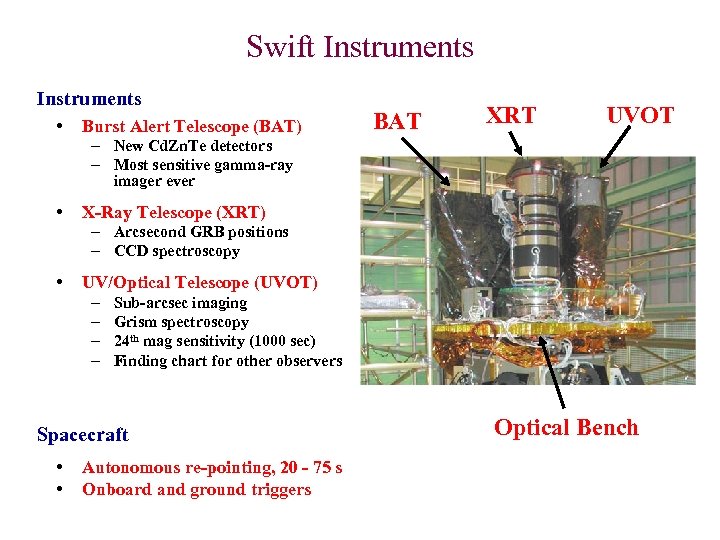 Swift Instruments Burst Alert Telescope (BAT) XRT UVOT X-Ray Telescope (XRT) BAT UV/Optical Telescope (UVOT) - New Cd. Zn. Te detectors - Most sensitive gamma-ray imager ever - Arcsecond GRB positions - CCD spectroscopy - Sub-arcsec imaging Grism spectroscopy 24 th mag sensitivity (1000 sec) Finding chart for other observers Spacecraft Autonomous re-pointing, 20 - 75 s Onboard and ground triggers Optical Bench
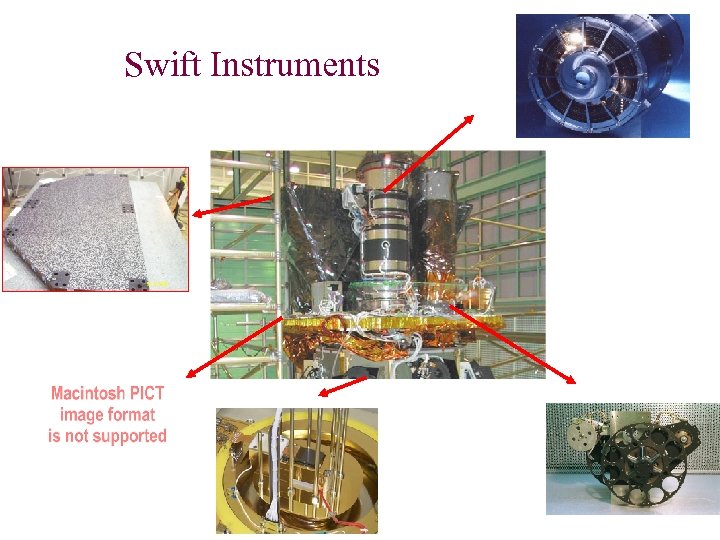 Swift Instruments
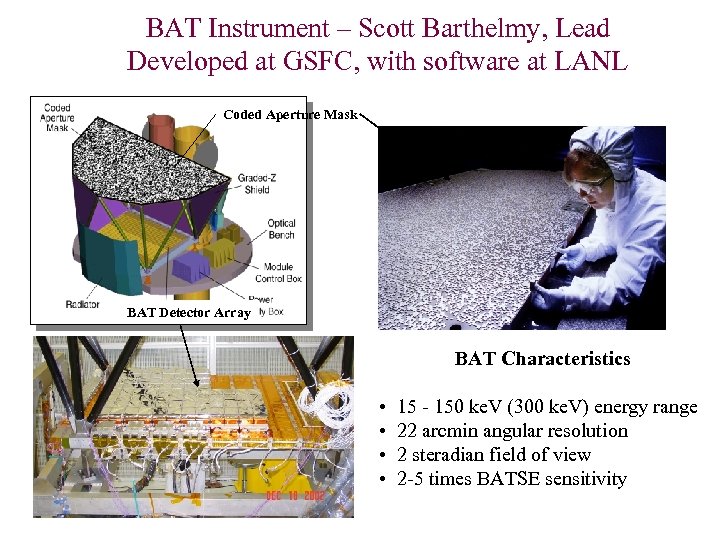 BAT Instrument – Scott Barthelmy, Lead Developed at GSFC, with software at LANL Coded Aperture Mask BAT Detector Array BAT Characteristics • • 15 - 150 ke. V (300 ke. V) energy range 22 arcmin angular resolution 2 steradian field of view 2 -5 times BATSE sensitivity
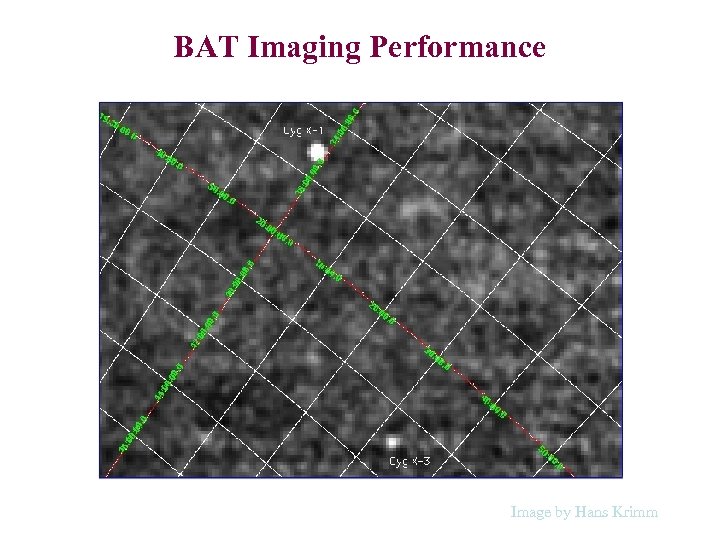 BAT Imaging Performance Image by Hans Krimm
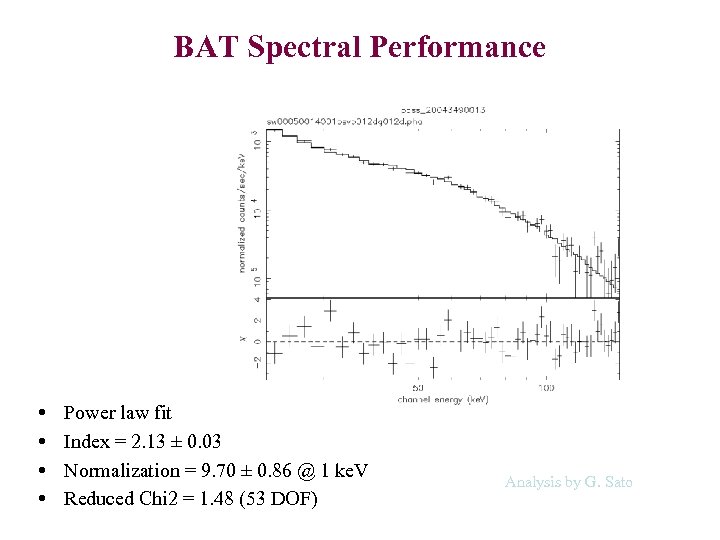 BAT Spectral Performance Power law fit Index = 2. 13 ± 0. 03 Normalization = 9. 70 ± 0. 86 @ 1 ke. V Reduced Chi 2 = 1. 48 (53 DOF) Analysis by G. Sato
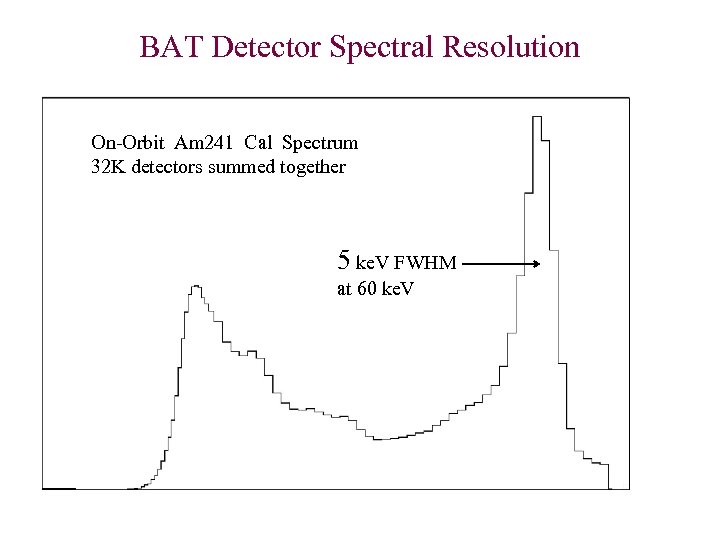 BAT Detector Spectral Resolution On-Orbit Am 241 Cal Spectrum 32 K detectors summed together 5 ke. V FWHM at 60 ke. V
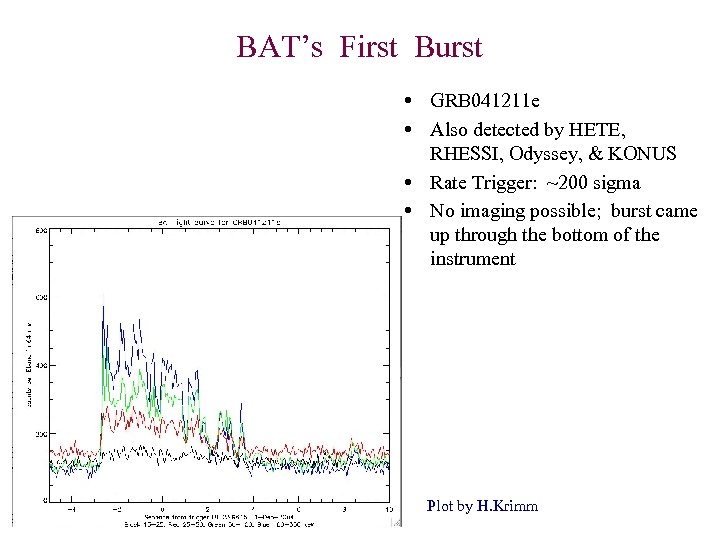 BAT’s First Burst GRB 041211 e Also detected by HETE, RHESSI, Odyssey, & KONUS Rate Trigger: ~200 sigma No imaging possible; burst came up through the bottom of the instrument Plot by H. Krimm
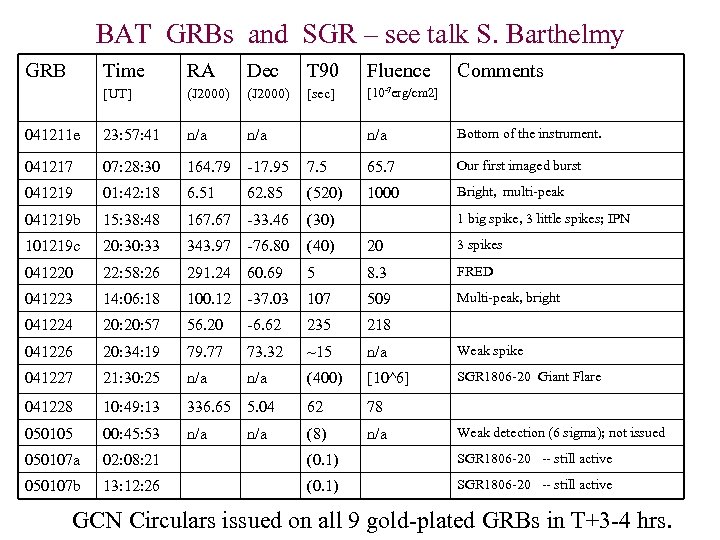 BAT GRBs and SGR – see talk S. Barthelmy GRB Time RA Dec T 90 Fluence [UT] (J 2000) [sec] [10 -7 erg/cm 2] 041211 e 23: 57: 41 n/a 041217 07: 28: 30 164. 79 -17. 95 041219 01: 42: 18 6. 51 041219 b 15: 38: 48 101219 c Comments n/a Bottom of the instrument. 7. 5 65. 7 Our first imaged burst 62. 85 (520) 1000 Bright, multi-peak 167. 67 -33. 46 (30) 20: 33 343. 97 -76. 80 (40) 20 3 spikes 041220 22: 58: 26 291. 24 60. 69 5 8. 3 FRED 041223 14: 06: 18 100. 12 -37. 03 107 509 Multi-peak, bright 041224 20: 57 56. 20 -6. 62 235 218 041226 20: 34: 19 79. 77 73. 32 ~15 n/a Weak spike 041227 21: 30: 25 n/a (400) [10^6] SGR 1806 -20 Giant Flare 041228 10: 49: 13 336. 65 5. 04 62 78 050105 00: 45: 53 n/a (8) n/a 050107 a 02: 08: 21 (0. 1) SGR 1806 -20 -- still active 050107 b 13: 12: 26 (0. 1) SGR 1806 -20 -- still active 1 big spike, 3 little spikes; IPN Weak detection (6 sigma); not issued GCN Circulars issued on all 9 gold-plated GRBs in T+3 -4 hrs.
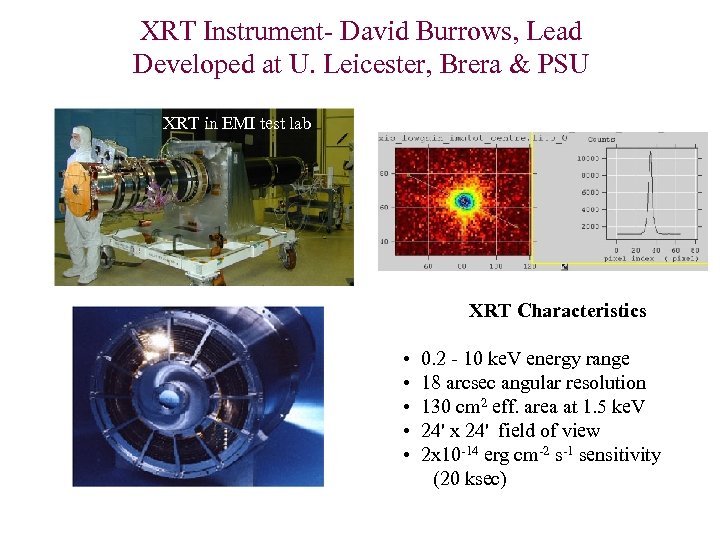 XRT Instrument- David Burrows, Lead Developed at U. Leicester, Brera & PSU XRT in EMI test lab XRT Characteristics • • • 0. 2 - 10 ke. V energy range 18 arcsec angular resolution 130 cm 2 eff. area at 1. 5 ke. V 24' x 24' field of view 2 x 10 -14 erg cm-2 s-1 sensitivity (20 ksec)
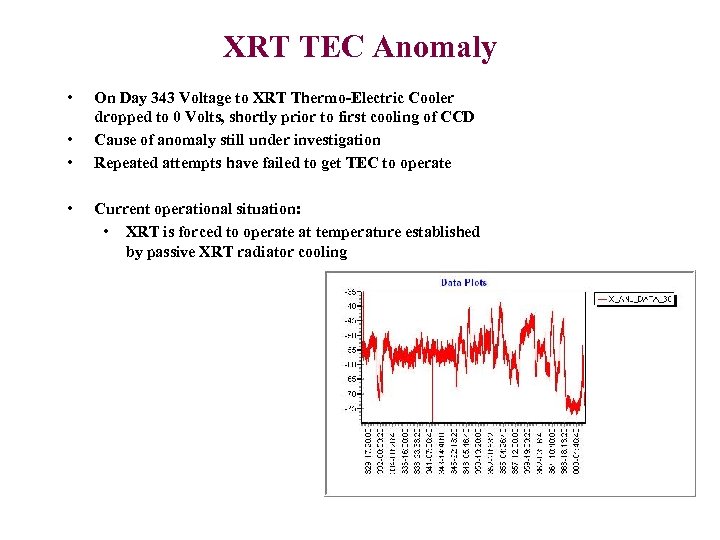 XRT TEC Anomaly • • On Day 343 Voltage to XRT Thermo-Electric Cooler dropped to 0 Volts, shortly prior to first cooling of CCD Cause of anomaly still under investigation Repeated attempts have failed to get TEC to operate Current operational situation: • XRT is forced to operate at temperature established by passive XRT radiator cooling
 XRT TEC Anomaly Impacts • • • Passive XRT radiator cooling will result in CCD temperatures in range of -40 to -75 C XRT flight parameters have been adjusted to give satisfactory results for T < -50 C Operational management can result in CCD temperatures reliably below -50 C • Impacts: • • • XRT will require more in-flight calibration data & ground analysis to produce calibration products for the new operating parameters Science planning tools will need modification to constrain target observations to ensembles which result in cool CCD thermal orientations Summary: • • XRT will be able to accurately position GRB counterparts & measure their spectra TEC Anomaly will not reduce the portion of the sky viewable by XRT
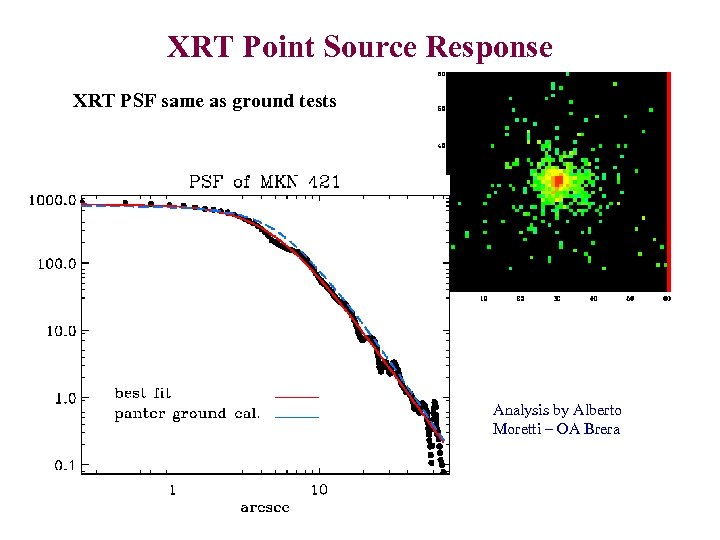 XRT Point Source Response XRT PSF same as ground tests Analysis by Alberto Moretti – OA Brera
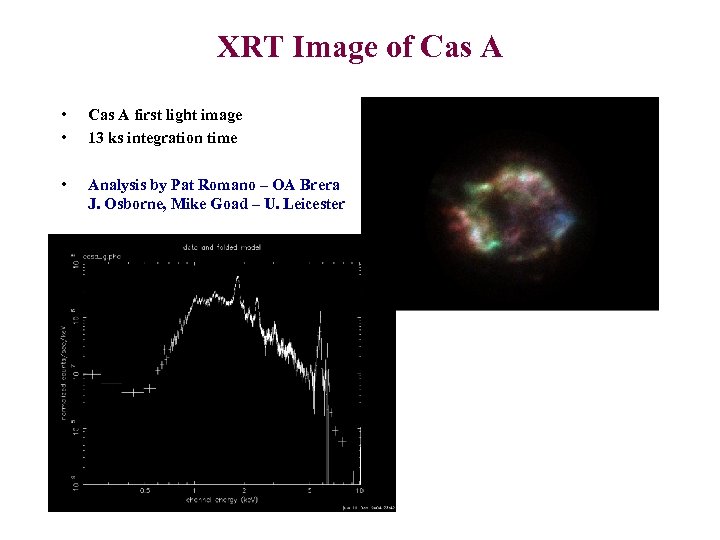 XRT Image of Cas A • • Cas A first light image 13 ks integration time • Analysis by Pat Romano – OA Brera J. Osborne, Mike Goad – U. Leicester
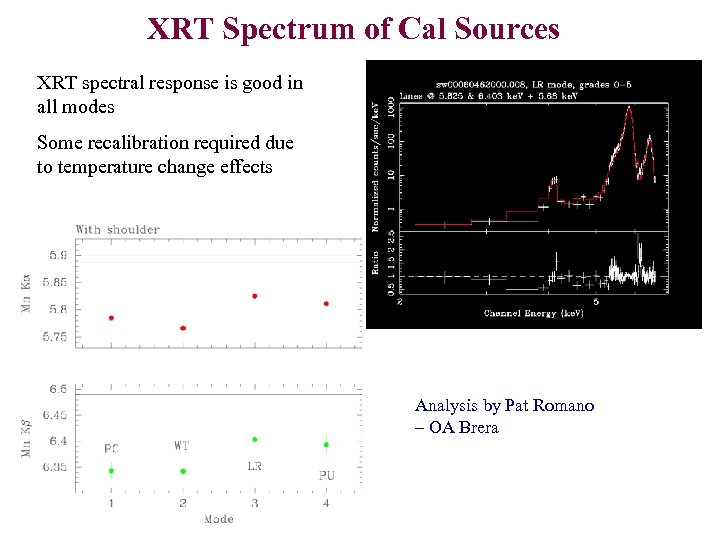 XRT Spectrum of Cal Sources XRT spectral response is good in all modes Some recalibration required due to temperature change effects Analysis by Pat Romano – OA Brera
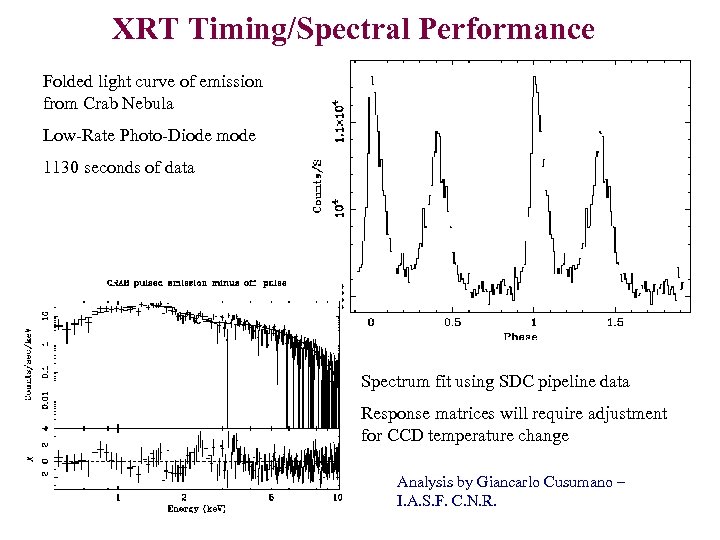 XRT Timing/Spectral Performance Folded light curve of emission from Crab Nebula Low-Rate Photo-Diode mode 1130 seconds of data Spectrum fit using SDC pipeline data Response matrices will require adjustment for CCD temperature change Analysis by Giancarlo Cusumano – I. A. S. F. C. N. R.
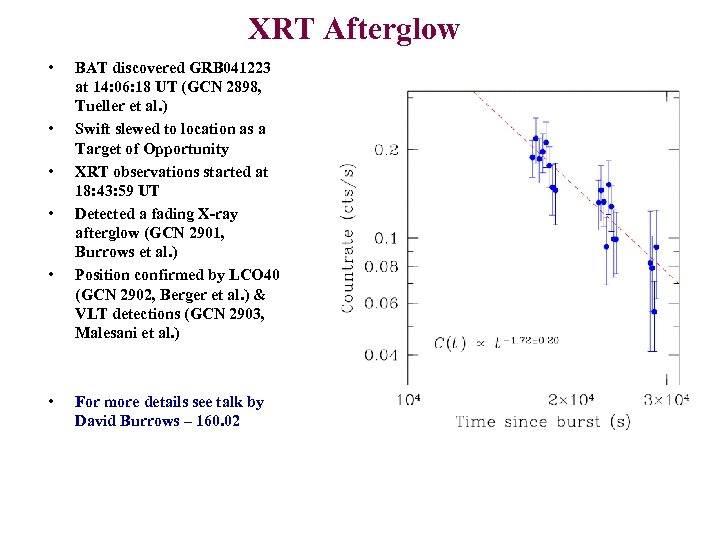 XRT Afterglow • • • BAT discovered GRB 041223 at 14: 06: 18 UT (GCN 2898, Tueller et al. ) Swift slewed to location as a Target of Opportunity XRT observations started at 18: 43: 59 UT Detected a fading X-ray afterglow (GCN 2901, Burrows et al. ) Position confirmed by LCO 40 (GCN 2902, Berger et al. ) & VLT detections (GCN 2903, Malesani et al. ) For more details see talk by David Burrows – 160. 02
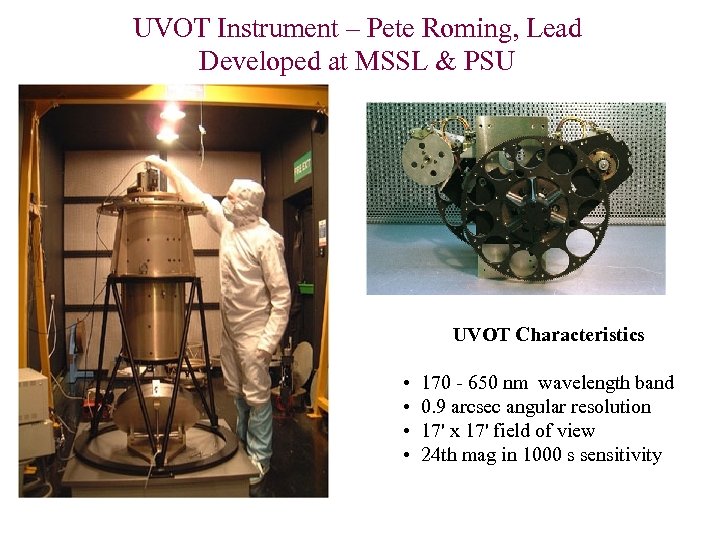 UVOT Instrument – Pete Roming, Lead Developed at MSSL & PSU Installation of UVOT onto Swift S/C UVOT Characteristics • • 170 - 650 nm wavelength band 0. 9 arcsec angular resolution 17' x 17' field of view 24 th mag in 1000 s sensitivity
 UVOT Performance • UVOT Preliminary afterglow location capability first tested on Monday • UVOT activation still in progress includes focus testing & adjustment to PSF • UVOT sensitivity & grism calibration will be conducted following detailed validation and adjustment of safety circuit • UVOT activation planned to be completed in about two more weeks • UVOT imaging positions may require ‘shift & add’ software • • • Parameters to be determined from flight experience Build 7 software has been developed, will be implemented during Verification Phase See talk by Pete Roming – 160. 03
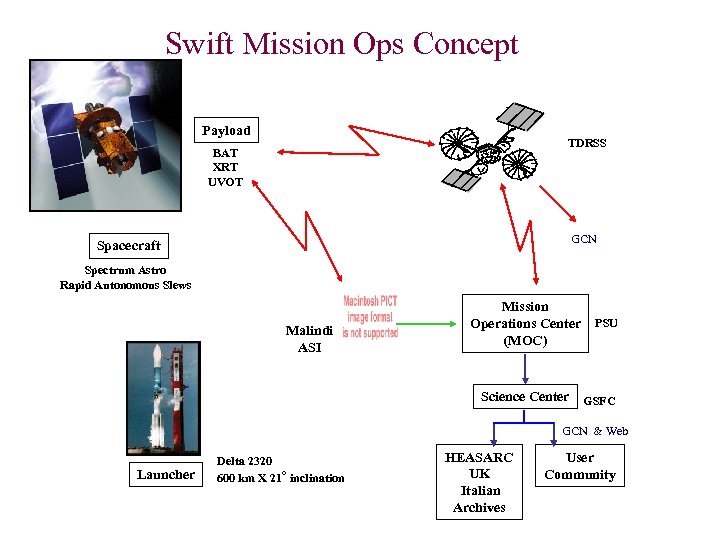 Swift Mission Ops Concept Payload TDRSS BAT XRT UVOT GCN Spacecraft Spectrum Astro Rapid Autonomous Slews Malindi ASI Mission Operations Center (MOC) PSU Science Center GSFC GCN & Web Launcher Delta 2320 o 600 km X 21 inclination HEASARC UK Italian Archives User Community
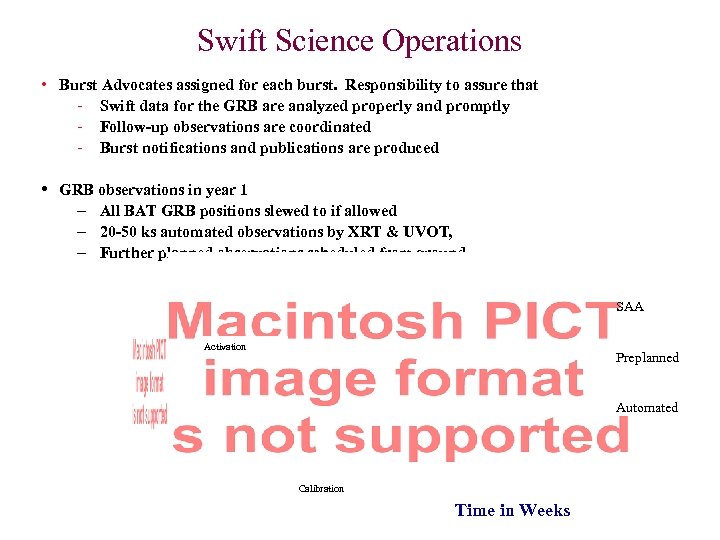 Swift Science Operations • Burst Advocates assigned for each burst. Responsibility to assure that - Swift data for the GRB are analyzed properly and promptly - Follow-up observations are coordinated - Burst notifications and publications are produced GRB observations in year 1 - All BAT GRB positions slewed to if allowed - 20 -50 ks automated observations by XRT & UVOT, - Further planned observations scheduled from ground SAA Activation Preplanned Automated Calibration Time in Weeks
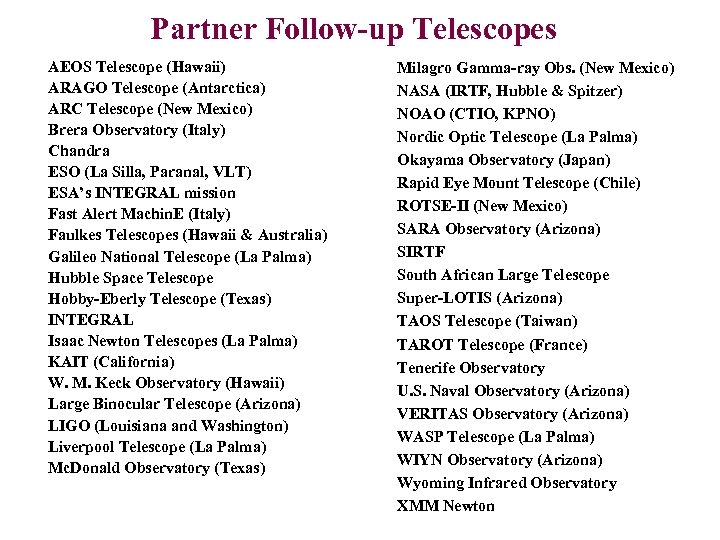 Partner Follow-up Telescopes AEOS Telescope (Hawaii) ARAGO Telescope (Antarctica) ARC Telescope (New Mexico) Brera Observatory (Italy) Chandra ESO (La Silla, Paranal, VLT) ESA’s INTEGRAL mission Fast Alert Machin. E (Italy) Faulkes Telescopes (Hawaii & Australia) Galileo National Telescope (La Palma) Hubble Space Telescope Hobby-Eberly Telescope (Texas) INTEGRAL Isaac Newton Telescopes (La Palma) KAIT (California) W. M. Keck Observatory (Hawaii) Large Binocular Telescope (Arizona) LIGO (Louisiana and Washington) Liverpool Telescope (La Palma) Mc. Donald Observatory (Texas) Milagro Gamma-ray Obs. (New Mexico) NASA (IRTF, Hubble & Spitzer) NOAO (CTIO, KPNO) Nordic Optic Telescope (La Palma) Okayama Observatory (Japan) Rapid Eye Mount Telescope (Chile) ROTSE-II (New Mexico) SARA Observatory (Arizona) SIRTF South African Large Telescope Super-LOTIS (Arizona) TAOS Telescope (Taiwan) TAROT Telescope (France) Tenerife Observatory U. S. Naval Observatory (Arizona) VERITAS Observatory (Arizona) WASP Telescope (La Palma) WIYN Observatory (Arizona) Wyoming Infrared Observatory XMM Newton