


 Скачать презентацию Status of security in XROOTD Introduction
803b6a0d5a3ed79d75fc430c5f14d453.ppt
- Количество слайдов: 16
 Status of security in XROOTD • Introduction • Xrd. Sec • Status of plug-ins - password-based, key-based - GSI • Future plans G. Ganis, CERN / PH-SFT , XROOTD mini-workshop, 15 February 2005
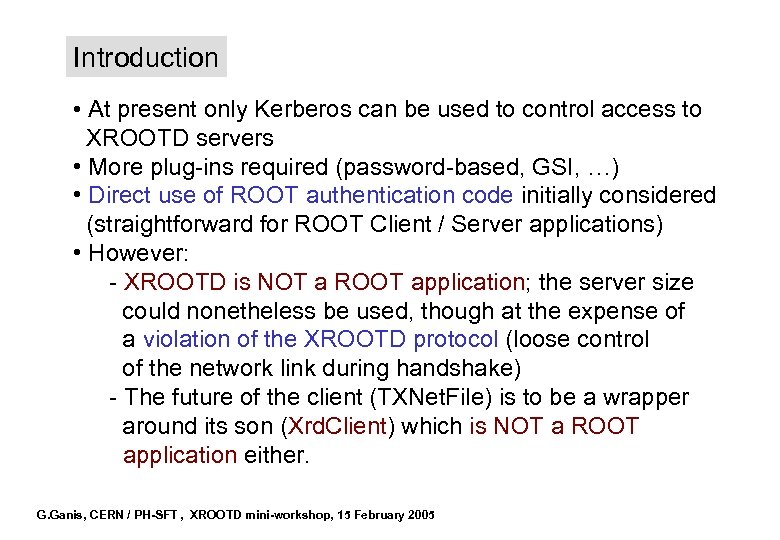 Introduction • At present only Kerberos can be used to control access to XROOTD servers • More plug-ins required (password-based, GSI, …) • Direct use of ROOT authentication code initially considered (straightforward for ROOT Client / Server applications) • However: - XROOTD is NOT a ROOT application; the server size could nonetheless be used, though at the expense of a violation of the XROOTD protocol (loose control of the network link during handshake) - The future of the client (TXNet. File) is to be a wrapper around its son (Xrd. Client) which is NOT a ROOT application either. G. Ganis, CERN / PH-SFT , XROOTD mini-workshop, 15 February 2005
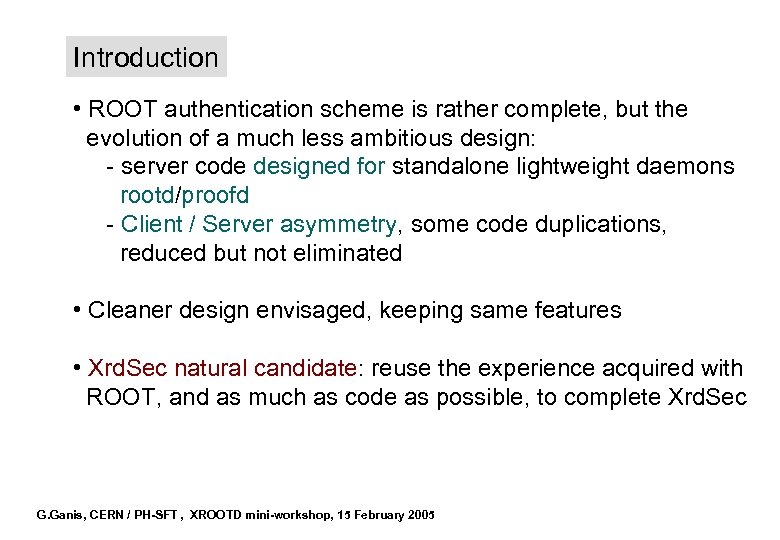 Introduction • ROOT authentication scheme is rather complete, but the evolution of a much less ambitious design: - server code designed for standalone lightweight daemons rootd/proofd - Client / Server asymmetry, some code duplications, reduced but not eliminated • Cleaner design envisaged, keeping same features • Xrd. Sec natural candidate: reuse the experience acquired with ROOT, and as much as code as possible, to complete Xrd. Sec G. Ganis, CERN / PH-SFT , XROOTD mini-workshop, 15 February 2005
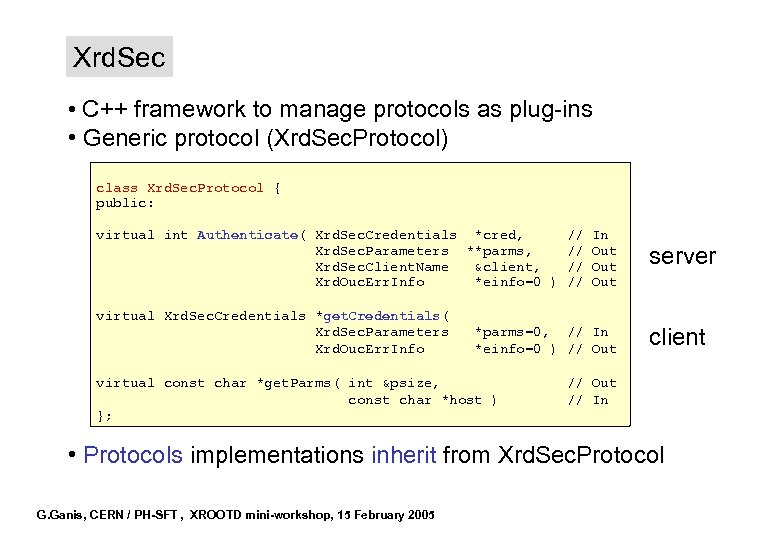 Xrd. Sec • C++ framework to manage protocols as plug-ins • Generic protocol (Xrd. Sec. Protocol) class Xrd. Sec. Protocol { public: virtual int Authenticate( Xrd. Sec. Credentials *cred, Xrd. Sec. Parameters **parms, Xrd. Sec. Client. Name &client, Xrd. Ouc. Err. Info *einfo=0 ) virtual Xrd. Sec. Credentials *get. Credentials( Xrd. Sec. Parameters Xrd. Ouc. Err. Info // // In Out Out *parms=0, // In *einfo=0 ) // Out virtual const char *get. Parms( int &psize, const char *host ) }; server client // Out // In • Protocols implementations inherit from Xrd. Sec. Protocol G. Ganis, CERN / PH-SFT , XROOTD mini-workshop, 15 February 2005
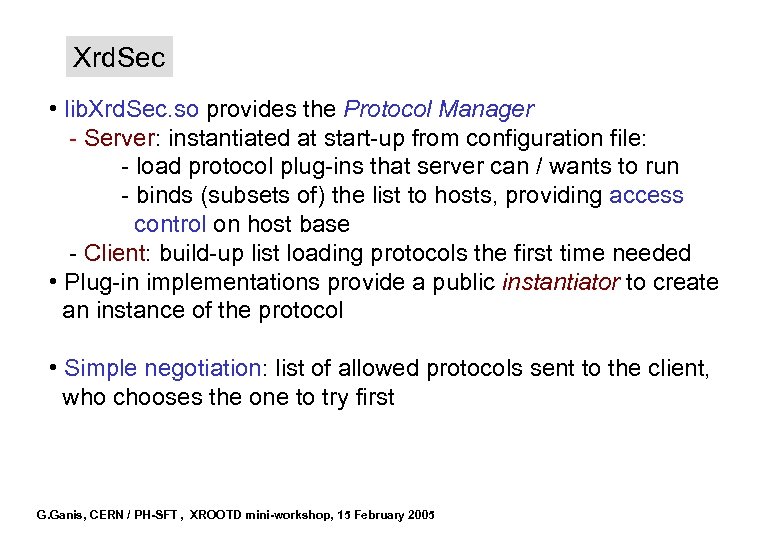 Xrd. Sec • lib. Xrd. Sec. so provides the Protocol Manager - Server: instantiated at start-up from configuration file: - load protocol plug-ins that server can / wants to run - binds (subsets of) the list to hosts, providing access control on host base - Client: build-up list loading protocols the first time needed • Plug-in implementations provide a public instantiator to create an instance of the protocol • Simple negotiation: list of allowed protocols sent to the client, who chooses the one to try first G. Ganis, CERN / PH-SFT , XROOTD mini-workshop, 15 February 2005
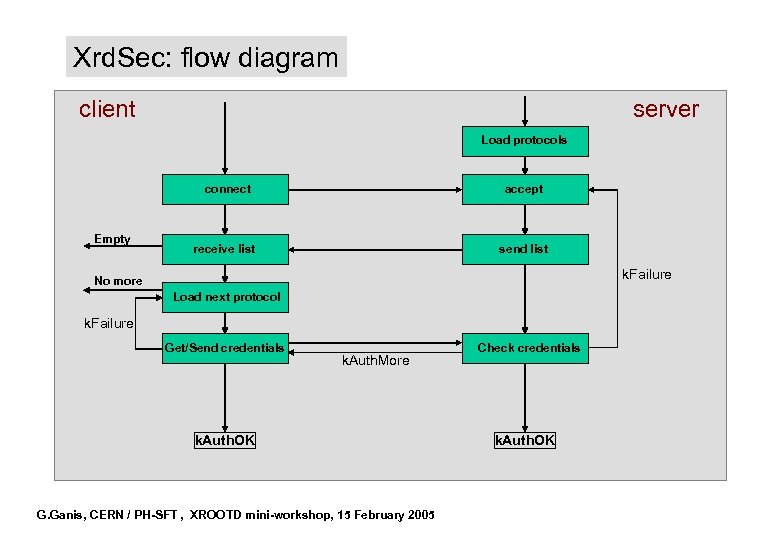 Xrd. Sec: flow diagram client server Load protocols connect Empty accept receive list send list k. Failure No more Load next protocol k. Failure Get/Send credentials k. Auth. More k. Auth. OK G. Ganis, CERN / PH-SFT , XROOTD mini-workshop, 15 February 2005 Check credentials k. Auth. OK
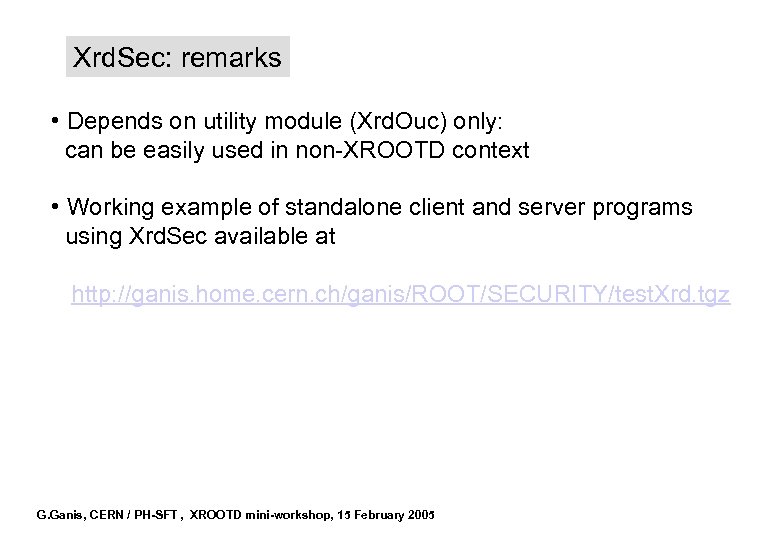 Xrd. Sec: remarks • Depends on utility module (Xrd. Ouc) only: can be easily used in non-XROOTD context • Working example of standalone client and server programs using Xrd. Sec available at http: //ganis. home. cern. ch/ganis/ROOT/SECURITY/test. Xrd. tgz G. Ganis, CERN / PH-SFT , XROOTD mini-workshop, 15 February 2005
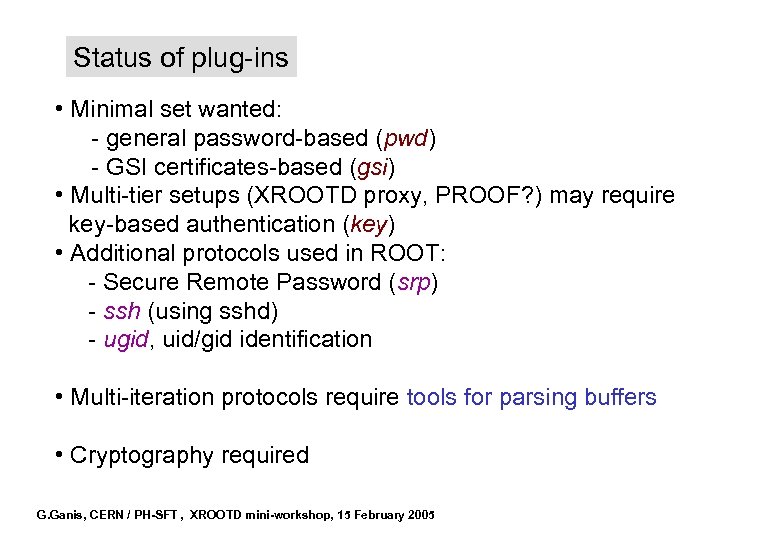 Status of plug-ins • Minimal set wanted: - general password-based (pwd) - GSI certificates-based (gsi) • Multi-tier setups (XROOTD proxy, PROOF? ) may require key-based authentication (key) • Additional protocols used in ROOT: - Secure Remote Password (srp) - ssh (using sshd) - ugid, uid/gid identification • Multi-iteration protocols require tools for parsing buffers • Cryptography required G. Ganis, CERN / PH-SFT , XROOTD mini-workshop, 15 February 2005
 Password-based plug-in • Derived from existing ROOT code • Important addition: centrally administrated credential file - Independence from system usernames and password files - Can grant access to users w/o an account on the system • Full encryption with session key and systematic use of hashing: - password never leaves the client machine - information exchanged or stored in central file cannot be used to break in, if compromised • Several features as options: - auto-registration, max failures, expiration time, user-defined credential file, use of system password file, auto-login, … • ROOT compatible: can use $HOME/. rootdpass • Soon available for testing (end of this week) G. Ganis, CERN / PH-SFT , XROOTD mini-workshop, 15 February 2005
 GSI • Globus Tool Kit infrastructure heavy for pure authentication • Grid. Site (http: //www. gridsite. org/) provides “a toolkit for Grid credentials, GACL access control lists, … “ • Approach appealing: - Light layer based directly upon Open. SSL - VOMS / GACL compatible - really light: libgridsite. a is 42 kb. • Set of C APIs to handle exchanged information (certificates, challenges, …) fits well into multi-iteration framework G. Ganis, CERN / PH-SFT , XROOTD mini-workshop, 15 February 2005
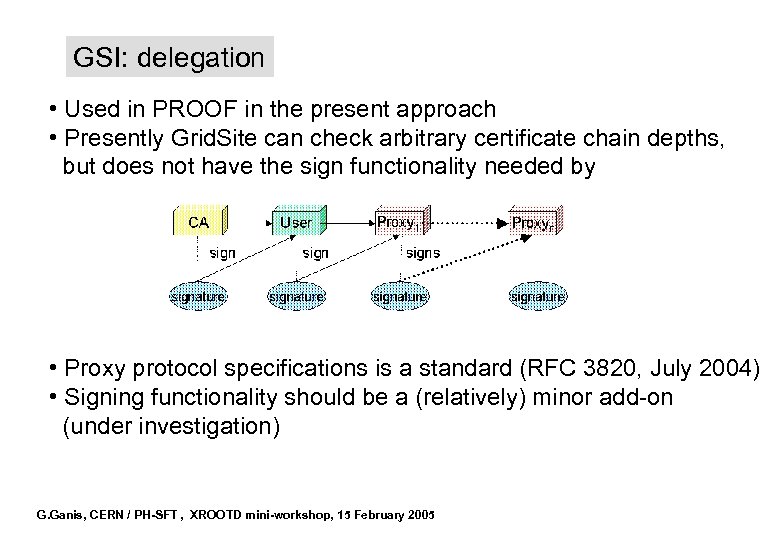 GSI: delegation • Used in PROOF in the present approach • Presently Grid. Site can check arbitrary certificate chain depths, but does not have the sign functionality needed by • Proxy protocol specifications is a standard (RFC 3820, July 2004) • Signing functionality should be a (relatively) minor add-on (under investigation) G. Ganis, CERN / PH-SFT , XROOTD mini-workshop, 15 February 2005
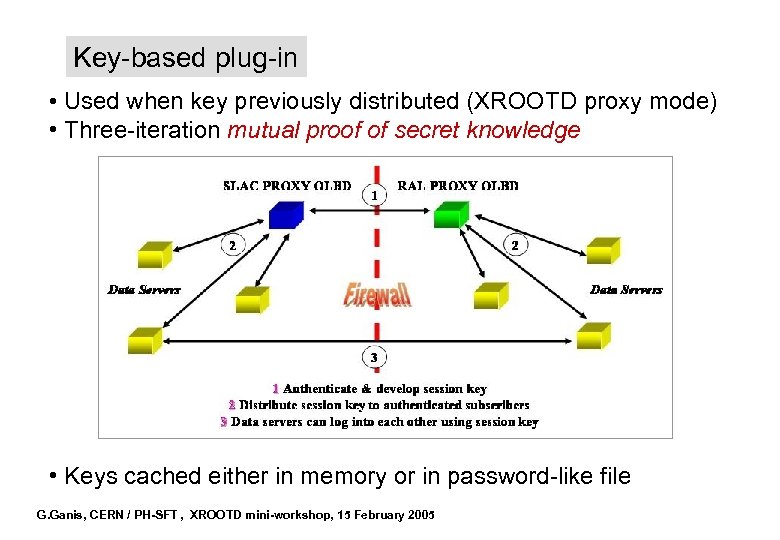 Key-based plug-in • Used when key previously distributed (XROOTD proxy mode) • Three-iteration mutual proof of secret knowledge • Keys cached either in memory or in password-like file G. Ganis, CERN / PH-SFT , XROOTD mini-workshop, 15 February 2005
 Other protocols used by ROOT • SRP (Secure Remote Password): - requires external package from SLAC - multi-step mechanism for shared secret setup fits well multi-iteration framework • SSH, fast identification with Uid. Gid: - require user account on server machine - no need of additional setup operations • Will be provided for ROOT backward compatibility G. Ganis, CERN / PH-SFT , XROOTD mini-workshop, 15 February 2005
 Pluggable cryptography • Why? -To easy switching between different implementations (Open. SSL, Crypto. API, Botan, …) - Fits XRD philosophy. • How? - Abstract interface for crypto factory to get access to relevant crypto functionality: key-agreement, symmetric ciphers, one-way hash, message digest, PKI, handling of X 509, … - Dynamic choice: client / server agree on implementation to use and load / get-handle-of related factory. • Implementations available: - Ssl, based on Open. SSL - Local, limited functionality for pwd, key (no ext packages) G. Ganis, CERN / PH-SFT , XROOTD mini-workshop, 15 February 2005
 Future plans • Security Context - Presently nothing saved out of successful handshake - Will be made available upon request with: - an opaque object with secret, … - an expiration time -… - Provide protocol methods for encryption / decryption • Integration in ROOT - initially as an alternative - require porting on Windows (Unices and Mac. OS X basically OK) G. Ganis, CERN / PH-SFT , XROOTD mini-workshop, 15 February 2005
 Summary • Xrd. Sec full activation advancing • Tools for multi-iterations implemented • Minimal cryptography available • Password-based plug-in almost ready • Other plug-ins (starting with GSI) should follow shortly G. Ganis, CERN / PH-SFT , XROOTD mini-workshop, 15 February 2005