


 Скачать презентацию Status of Radiation Proposal Focus on Amendment
e5eaa656f75a95b0c751fa52ed1c0bd9.ppt
- Количество слайдов: 15
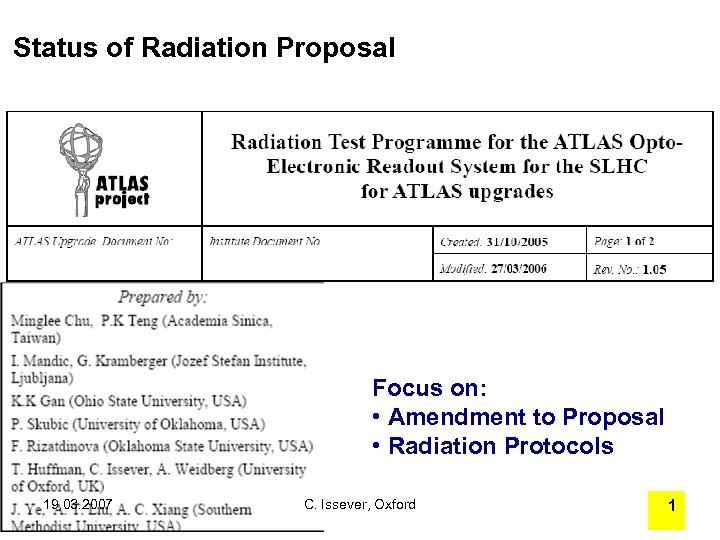 Status of Radiation Proposal Focus on: • Amendment to Proposal • Radiation Protocols 19. 03. 2007 C. Issever, Oxford 1
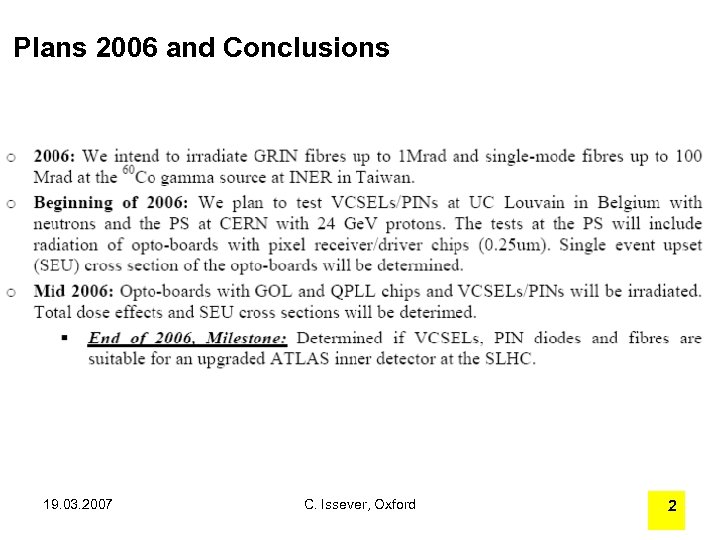 Plans 2006 and Conclusions 19. 03. 2007 C. Issever, Oxford 2
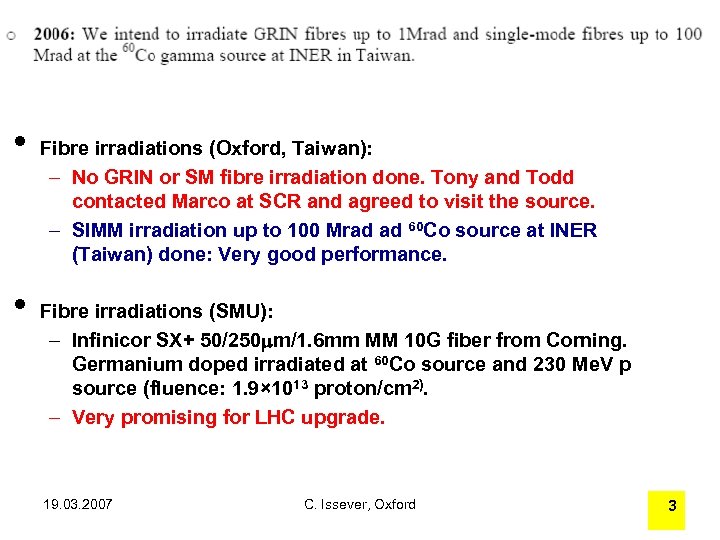 • • Fibre irradiations (Oxford, Taiwan): – No GRIN or SM fibre irradiation done. Tony and Todd contacted Marco at SCR and agreed to visit the source. – SIMM irradiation up to 100 Mrad ad 60 Co source at INER (Taiwan) done: Very good performance. Fibre irradiations (SMU): – Infinicor SX+ 50/250 m/1. 6 mm MM 10 G fiber from Corning. Germanium doped irradiated at 60 Co source and 230 Me. V p source (fluence: 1. 9× 10¹³ proton/cm 2). – Very promising for LHC upgrade. 19. 03. 2007 C. Issever, Oxford 3
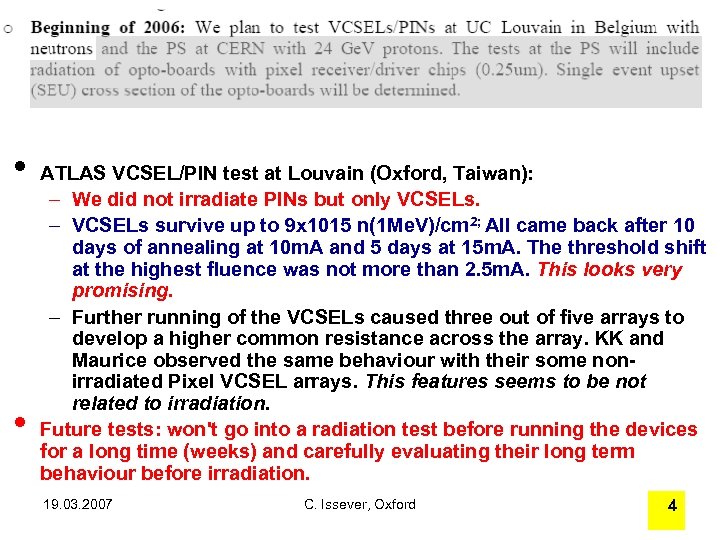 • • ATLAS VCSEL/PIN test at Louvain (Oxford, Taiwan): – We did not irradiate PINs but only VCSELs. – VCSELs survive up to 9 x 10¹⁵ n(1 Me. V)/cm 2; All came back after 10 days of annealing at 10 m. A and 5 days at 15 m. A. The threshold shift at the highest fluence was not more than 2. 5 m. A. This looks very promising. – Further running of the VCSELs caused three out of five arrays to develop a higher common resistance across the array. KK and Maurice observed the same behaviour with their some nonirradiated Pixel VCSEL arrays. This features seems to be not related to irradiation. Future tests: won't go into a radiation test before running the devices for a long time (weeks) and carefully evaluating their long term behaviour before irradiation. 19. 03. 2007 C. Issever, Oxford 4
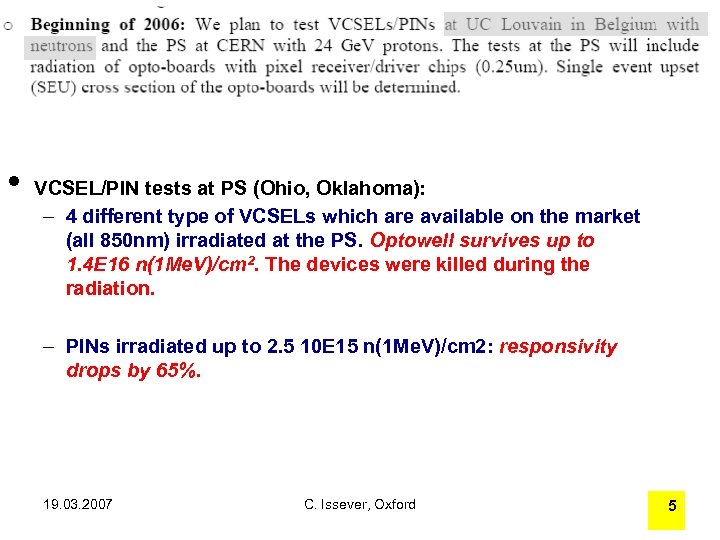 • VCSEL/PIN tests at PS (Ohio, Oklahoma): – 4 different type of VCSELs which are available on the market (all 850 nm) irradiated at the PS. Optowell survives up to 1. 4 E 16 n(1 Me. V)/cm 2. The devices were killed during the radiation. – PINs irradiated up to 2. 5 10 E 15 n(1 Me. V)/cm 2: responsivity drops by 65%. 19. 03. 2007 C. Issever, Oxford 5
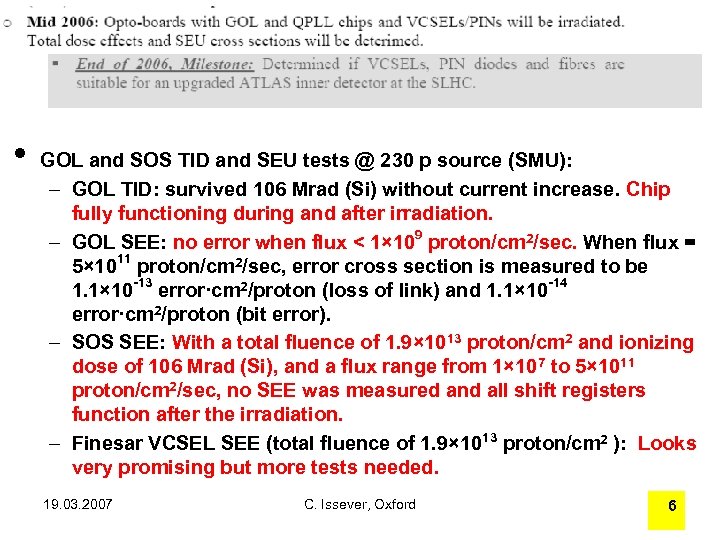 • GOL and SOS TID and SEU tests @ 230 p source (SMU): – GOL TID: survived 106 Mrad (Si) without current increase. Chip fully functioning during and after irradiation. – GOL SEE: no error when flux < 1× 10⁹ proton/cm 2/sec. When flux = 5× 10¹¹ proton/cm 2/sec, error cross section is measured to be 1. 1× 10 -13 error·cm 2/proton (loss of link) and 1. 1× 10 -14 error·cm 2/proton (bit error). – SOS SEE: With a total fluence of 1. 9× 10¹³ proton/cm 2 and ionizing dose of 106 Mrad (Si), and a flux range from 1× 10⁷ to 5× 10¹¹ proton/cm 2/sec, no SEE was measured and all shift registers function after the irradiation. – Finesar VCSEL SEE (total fluence of 1. 9× 10¹³ proton/cm 2 ): Looks very promising but more tests needed. 19. 03. 2007 C. Issever, Oxford 6
 • Milestone not reached: – VCSEL(850 nm) tests most progressed and all three groups show conclude that the results are promising. – PIN tests just started – Fibre tests just started and promising – GRIN fibre tests are missing. 19. 03. 2007 C. Issever, Oxford 7
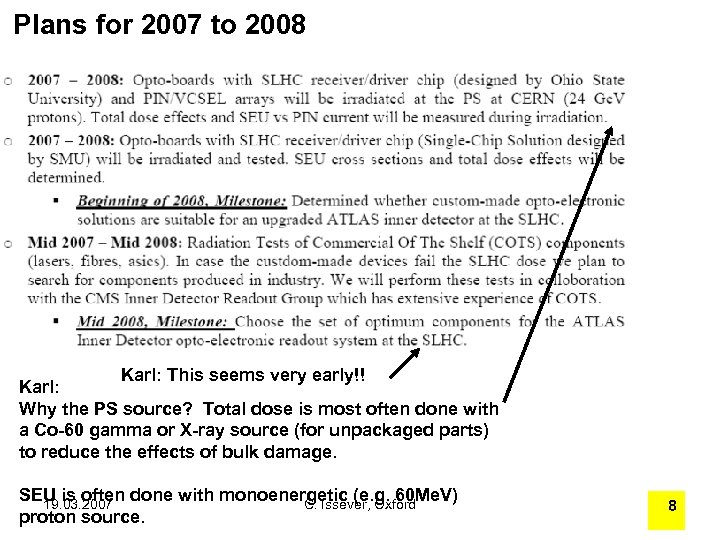 Plans for 2007 to 2008 • xxxx Karl: This seems very early!! Karl: Why the PS source? Total dose is most often done with a Co-60 gamma or X-ray source (for unpackaged parts) to reduce the effects of bulk damage. SEU is often done with monoenergetic (e. g. 60 Me. V) 19. 03. 2007 C. Issever, Oxford proton source. 8
 Problems • Funding not yet available for some groups. • Delays in the current ID installation and commissioning are effecting R&D: – No ATLAS VCSEL or PIN arrays from Taiwan for at least a year! – Man power is very critical given the vast amount of work to be done. – Proposal shifted at least by one year. Hence: Need to adjust current proposal and include CMS and CERN. 19. 03. 2007 C. Issever, Oxford 9
 Plan for irradiation tests by CERN optolinks group (K. Gill) • Focus limited resources currently available on SEE tests instead of total bulk/ionising damage • Higher radiation flux + higher data rates – greater SEE rates • Qualifying best, i. e. least sensitive parts may not be sufficient – Need to look into error characteristics and coding schemes with error correction • Aim is to make SEE tests (first since 2000) on p-i-n photodiodes – Start with In. Ga. As but later possibly Si and Ga. As (MSM) 19. 03. 2007 C. Issever, Oxford 10
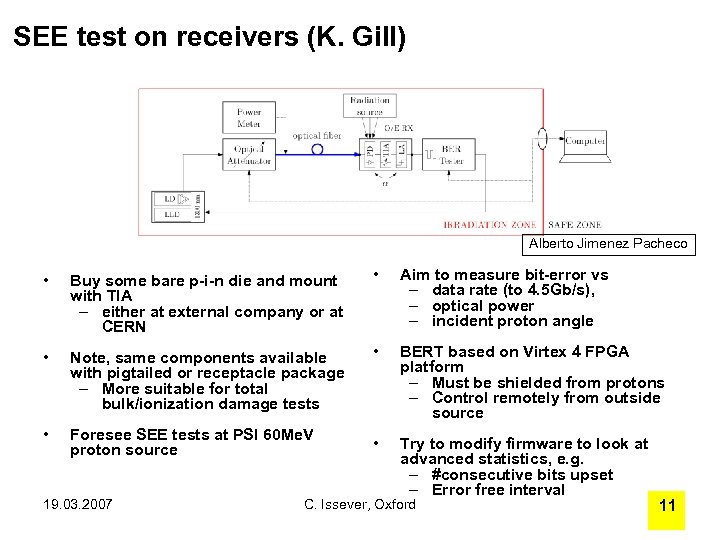 SEE test on receivers (K. Gill) Alberto Jimenez Pacheco • Buy some bare p-i-n die and mount with TIA – either at external company or at CERN • Aim to measure bit-error vs – data rate (to 4. 5 Gb/s), – optical power – incident proton angle • Note, same components available with pigtailed or receptacle package – More suitable for total bulk/ionization damage tests • BERT based on Virtex 4 FPGA platform – Must be shielded from protons – Control remotely from outside source • Foresee SEE tests at PSI 60 Me. V proton source • Try to modify firmware to look at advanced statistics, e. g. – #consecutive bits upset – Error free interval 19. 03. 2007 C. Issever, Oxford 11
 Amendments to the existing Proposal -- Discussion • Milestones and plans need to be revisited. – e. g: 1310 nm VCSEL? • Development of common radiation procedures. • CMS and CERN plans needs to be included. Timescale of these changes: end of 2007? 19. 03. 2007 C. Issever, Oxford 12
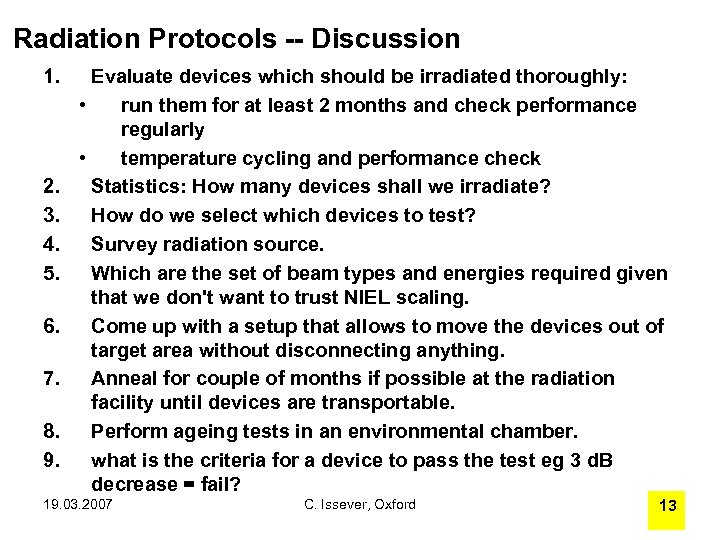 Radiation Protocols -- Discussion 1. 2. 3. 4. 5. 6. 7. 8. 9. Evaluate devices which should be irradiated thoroughly: • run them for at least 2 months and check performance regularly • temperature cycling and performance check Statistics: How many devices shall we irradiate? How do we select which devices to test? Survey radiation source. Which are the set of beam types and energies required given that we don't want to trust NIEL scaling. Come up with a setup that allows to move the devices out of target area without disconnecting anything. Anneal for couple of months if possible at the radiation facility until devices are transportable. Perform ageing tests in an environmental chamber. what is the criteria for a device to pass the test eg 3 d. B decrease = fail? 19. 03. 2007 C. Issever, Oxford 13
 Man Power -- Discussion • How do we manage all this work with so few people? • One way forward is to define a minimal set of tests required to select a baseline option and then concentrate on this unless it fails. ie drop all work on other options. 19. 03. 2007 C. Issever, Oxford 14
 What can we achieve realistically in 2007 -- Discussion • Make changes to proposal – Radiation Protocols – Include Plans of CMS/CERN – Survey markets and decide which components to test. …. . 19. 03. 2007 C. Issever, Oxford 15