


 Скачать презентацию Status of Nu Tel — a Neutrino Telescope
af8fb5e1ea9a6c381d7c90c4ddbbc5d4.ppt
- Количество слайдов: 41
 Status of Nu. Tel - a Neutrino Telescope for Observing Pe. V from AGN Yee Bob Hsiung National Taiwan University for Nu. Tel group UHE workshop April 23 -26, 2006 IHEP, Beijing Introduction Feasibility Study Detector Status Conclusion High Energy Physics Group, National Taiwan University
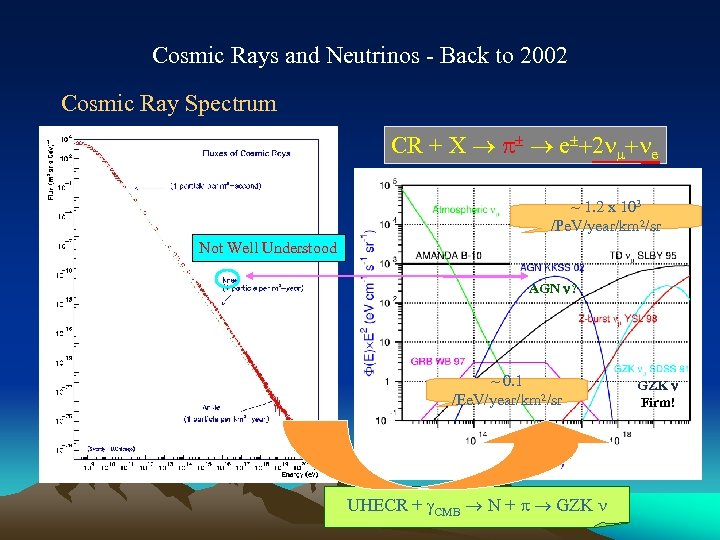 Cosmic Rays and Neutrinos - Back to 2002 Cosmic Ray Spectrum CR + X e 2 e ~ 1. 2 x 10³ /Pe. V/year/km 2/sr Not Well Understood AGN ? ~ 0. 1 /Ee. V/year/km 2/sr UHECR + CMB N + GZK Firm!
 Protons AGN Jets, CRs and ? ?
 Window of Opportunity Conventional Detector ? UHECR Detector
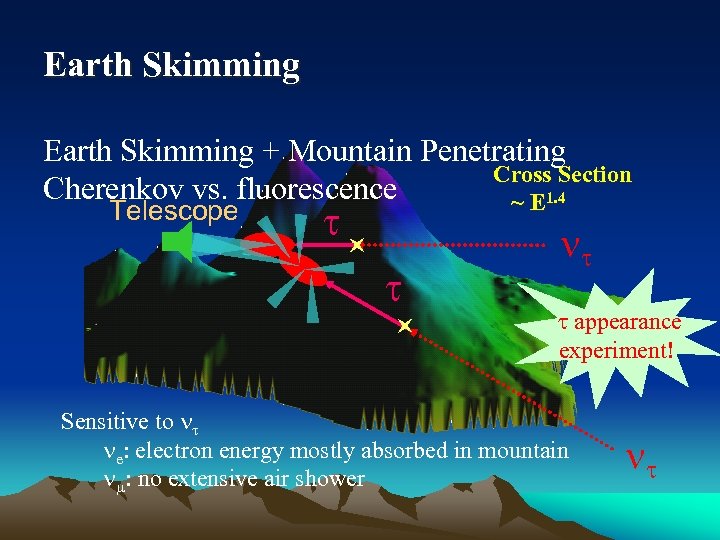 Earth Skimming + Mountain Penetrating Cross Section Cherenkov vs. fluorescence ~ E 1. 4 Telescope appearance experiment! Sensitive to e: electron energy mostly absorbed in mountain : no extensive air shower
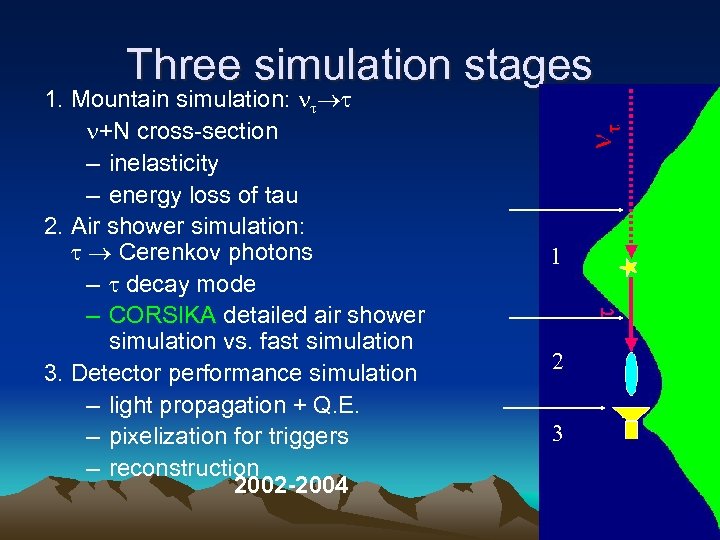 Three simulation stages 1. Mountain simulation: +N cross-section – inelasticity – energy loss of tau 2. Air shower simulation: Cerenkov photons – decay mode – CORSIKA detailed air shower simulation vs. fast simulation 3. Detector performance simulation – light propagation + Q. E. – pixelization for triggers – reconstruction 2002 -2004 1 2 3
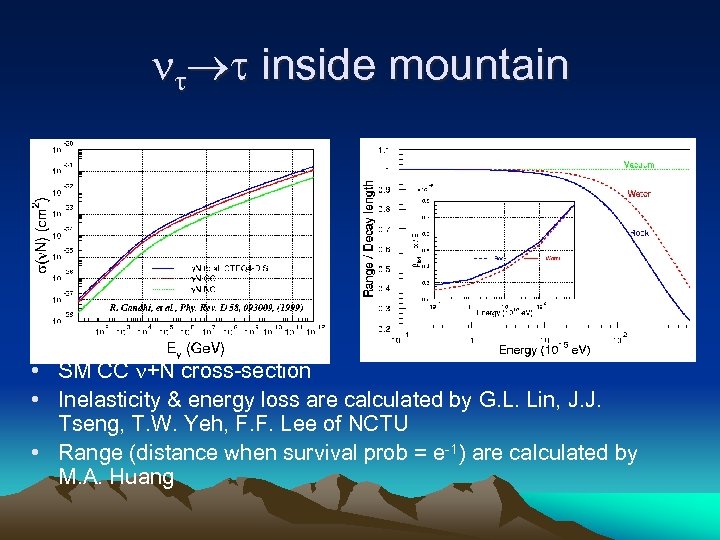 inside mountain • SM CC +N cross-section • Inelasticity & energy loss are calculated by G. L. Lin, J. J. Tseng, T. W. Yeh, F. F. Lee of NCTU • Range (distance when survival prob = e-1) are calculated by M. A. Huang
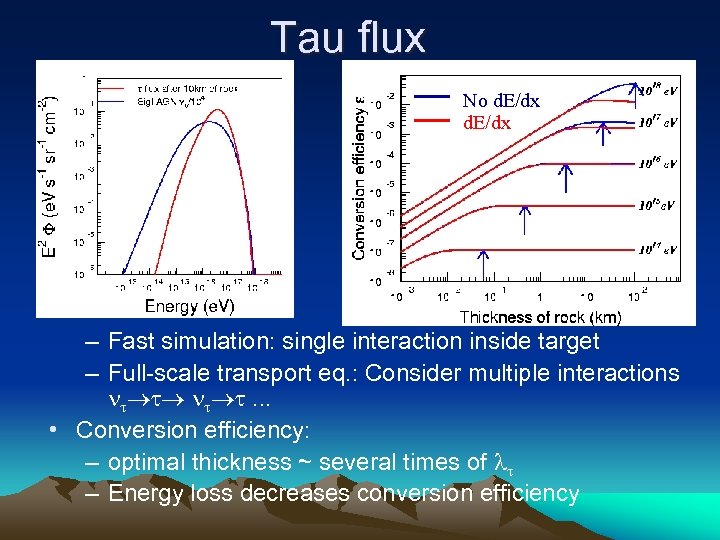 Tau flux No d. E/dx • Tau flux: – Fast simulation: single interaction inside target – Full-scale transport eq. : Consider multiple interactions . . . • Conversion efficiency: – optimal thickness ~ several times of – Energy loss decreases conversion efficiency
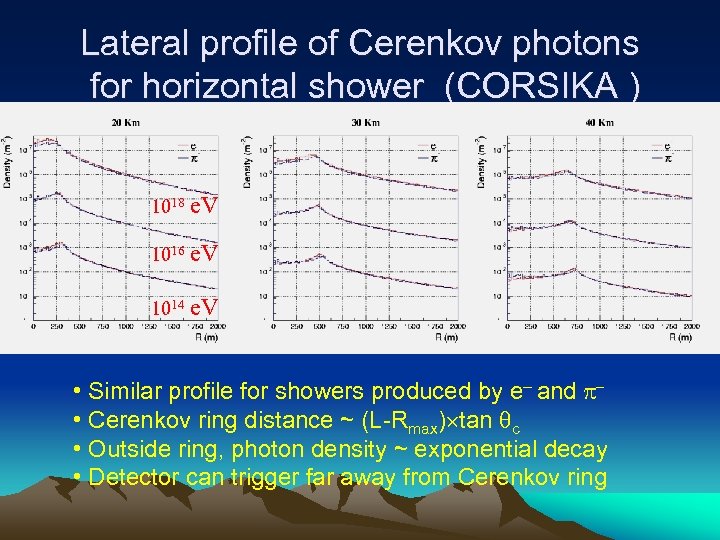 Lateral profile of Cerenkov photons for horizontal shower (CORSIKA ) 1018 e. V 1016 e. V 1014 e. V • Similar profile for showers produced by e– and • Cerenkov ring distance ~ (L-Rmax) tan c • Outside ring, photon density ~ exponential decay • Detector can trigger far away from Cerenkov ring
 Photons numbers vs opening angle Photon density l 1 Pe. V shower l. Shower core to detector plane 30 km away l. Serious drop with attenuation No atten. Atten. =15 km Opening angle (radian)
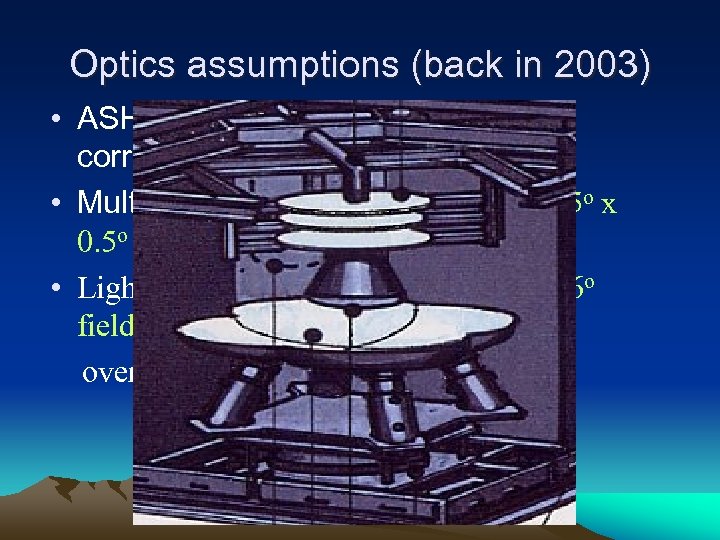 Optics assumptions (back in 2003) • ASHRA-type Mirror + a simple correction lens • Multi-Anode Photomultiplier with 0. 5 o x 0. 5 o pixel span • Light collection : 1 m 2 aperture, 8 o x 16 o field of view, over all 10% efficiency for γ→ p. e.
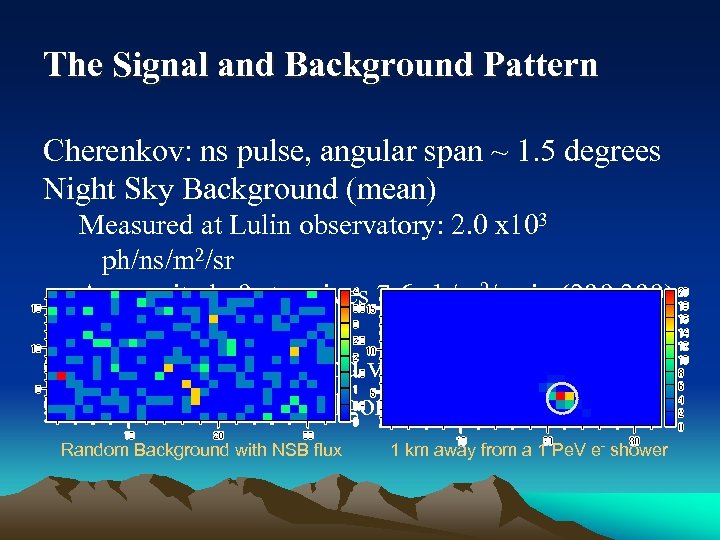 The Signal and Background Pattern Cherenkov: ns pulse, angular span ~ 1. 5 degrees Night Sky Background (mean) Measured at Lulin observatory: 2. 0 x 103 ph/ns/m 2/sr A magnitude 0 star gives 7. 6 ph/m 2/ns in (290, 390) nm Cosmic Ray background very small Cluster-based trigger algorithm Random Background with NSB flux 1 km away from a 1 Pe. V e- shower
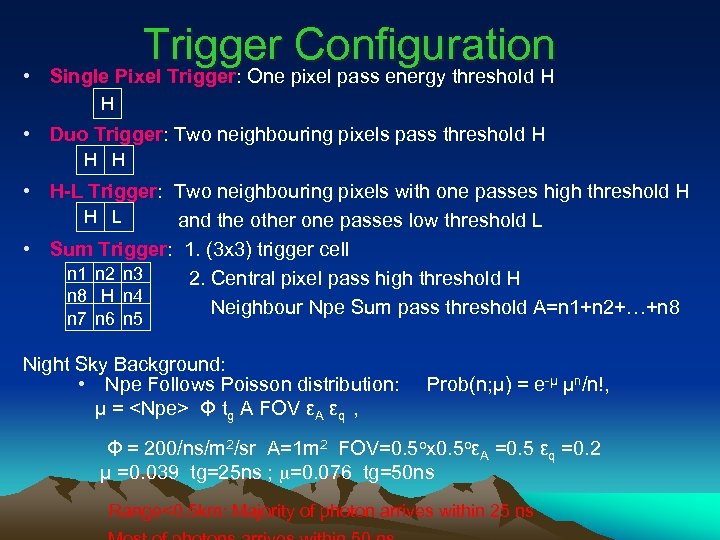 Trigger Configuration • Single Pixel Trigger: One pixel pass energy threshold H H • Duo Trigger: Two neighbouring pixels pass threshold H H H • H-L Trigger: Two neighbouring pixels with one passes high threshold H H L and the other one passes low threshold L • Sum Trigger: 1. (3 x 3) trigger cell n 1 n 2 n 3 2. Central pixel pass high threshold H n 8 H n 4 Neighbour Npe Sum pass threshold A=n 1+n 2+…+n 8 n 7 n 6 n 5 Night Sky Background: • Npe Follows Poisson distribution: μ =
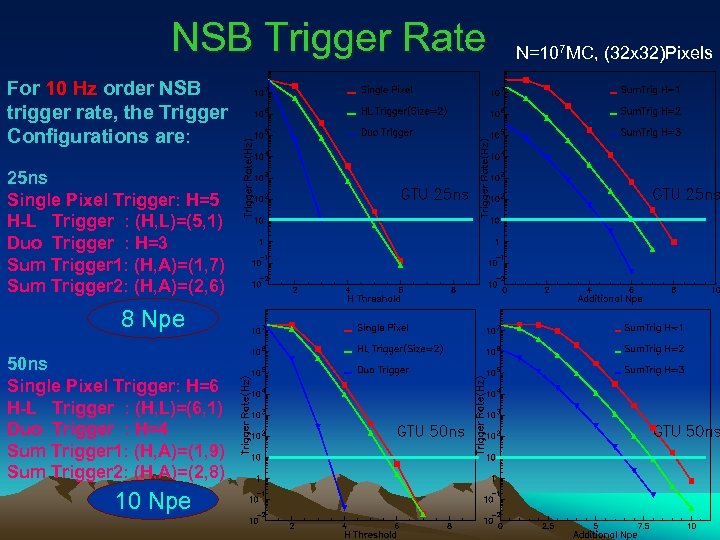 NSB Trigger Rate For 10 Hz order NSB trigger rate, the Trigger Configurations are: 25 ns Single Pixel Trigger: H=5 H-L Trigger : (H, L)=(5, 1) Duo Trigger : H=3 Sum Trigger 1: (H, A)=(1, 7) Sum Trigger 2: (H, A)=(2, 6) 8 Npe 50 ns Single Pixel Trigger: H=6 H-L Trigger : (H, L)=(6, 1) Duo Trigger : H=4 Sum Trigger 1: (H, A)=(1, 9) Sum Trigger 2: (H, A)=(2, 8) 10 Npe N=107 MC, (32 x 32)Pixels
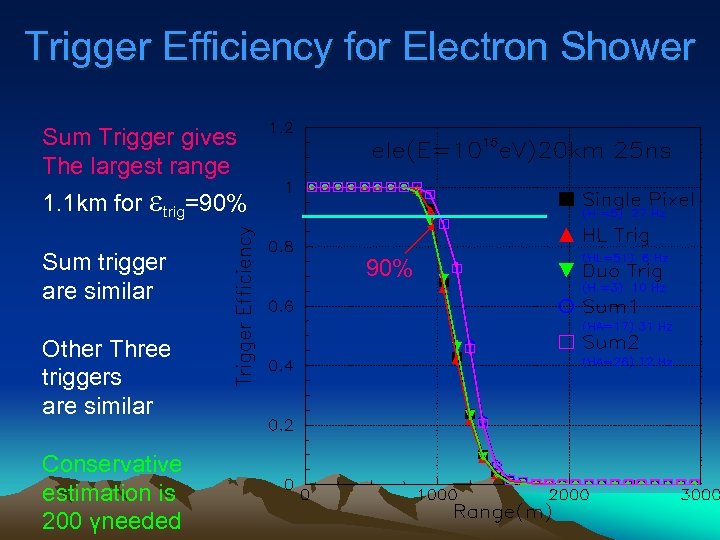 Trigger Efficiency for Electron Shower Sum Trigger gives The largest range 1. 1 km for etrig=90% Sum trigger are similar Other Three triggers are similar Conservative estimation is 200 γneeded 90%
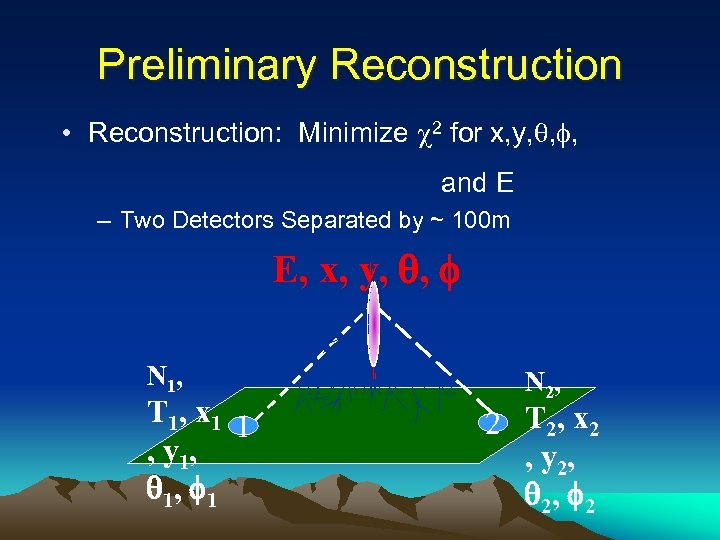 Preliminary Reconstruction • Reconstruction: Minimize 2 for x, y, , , and E – Two Detectors Separated by ~ 100 m E, x, y, , N 1, T 1, x 1 1 , y 1, 1 N 2, 2 T 2, x 2 , y 2, 2
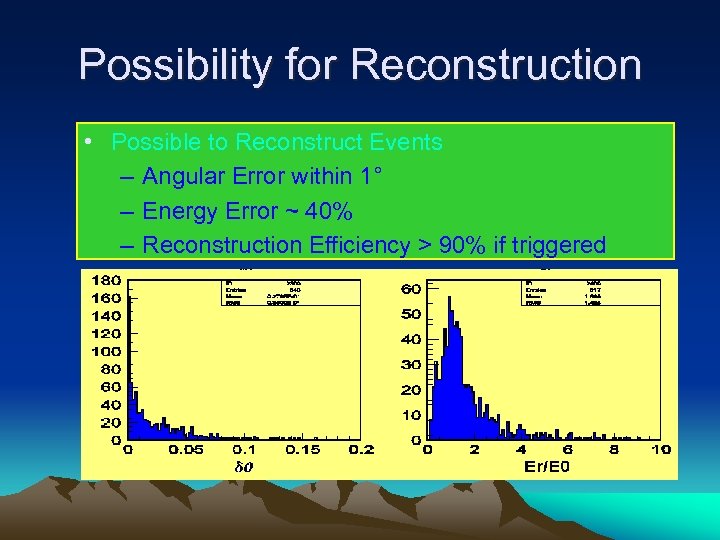 Possibility for Reconstruction • Possible to Reconstruct Events – Angular Error within 1° – Energy Error ~ 40% – Reconstruction Efficiency > 90% if triggered
 Acceptance Determination Integration of efficiencies in phase space Three independent methods for crosschecking All three got consistent results
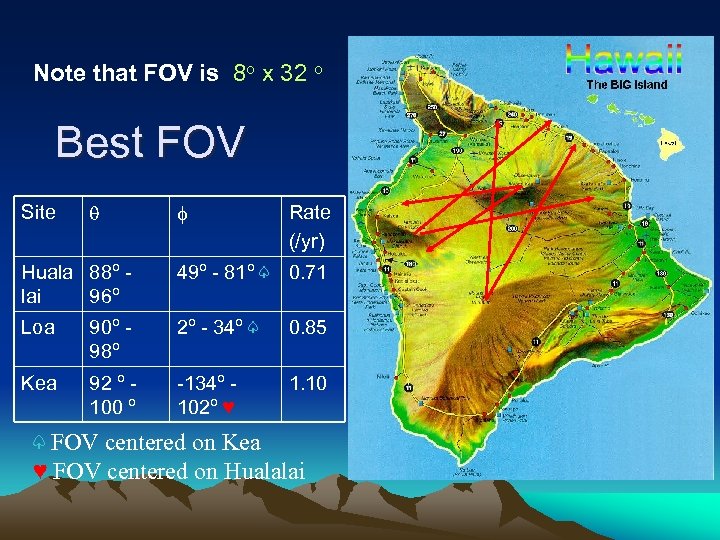 Note that FOV is 8 o x 32 o Best FOV Site Rate (/yr) Huala 88º lai 96º 49º - 81º ♤ 0. 71 Loa 90º 98º 2º - 34º ♤ 0. 85 Kea 92 º 100 º -134º 102º ♥ 1. 10 ♤ FOV centered on Kea ♥ FOV centered on Hualalai
 MIME • Pick τ energy • Put detector on top of Loa • Pick τ position randomly on a 20 km by 20 km vertical plane located 25 km north of Loa • Emit τ randomly in 60 o cone • Trace the track to find the exit point of τ • Find τ decay point • Assume e/π took away ½ of τ energy and find the shower core position (air density 10 -3 g/cm 3) • Make sure shower core is above 1. 5 km cloud level Big Island contour plot l. Loa
 MIME l. Make sure the pathway is clear between τ exit point and shower core l. Find the angle and distance between shower core and detector l. Determine the number of photons in the solid angle covered by detector and apply attenuation effect (18 km attenuation length) l. Set the threshold at 200 γ ’s and check the shower core in the FOV (vertical -8 o-0 o and horizontal -4 o- 12 o) l. Event rate = 7. 5 x 400 x π x 0. 1(duty) x 0. 8(BF) x eff l. The obtained rate for Loa is 0. 46 per year
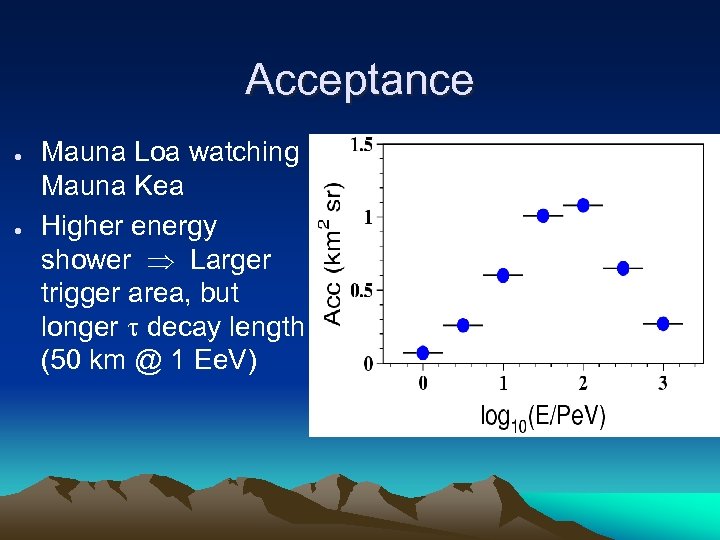 Acceptance ● ● Mauna Loa watching Mauna Kea Higher energy shower Þ Larger trigger area, but longer decay length (50 km @ 1 Ee. V)
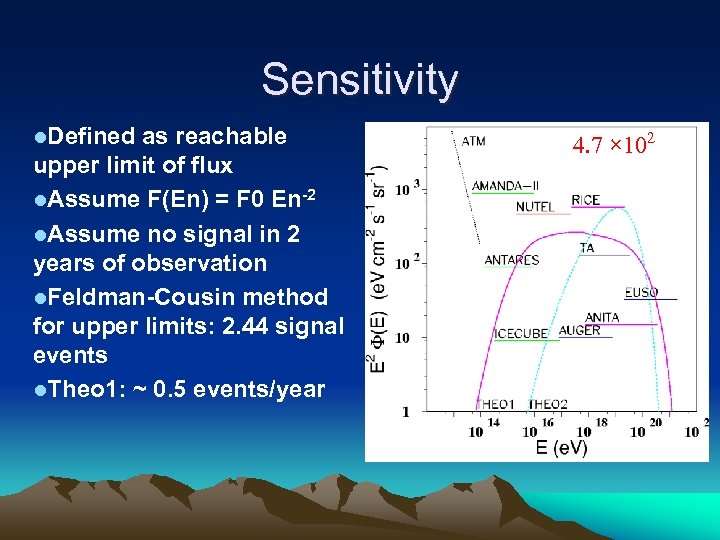 Sensitivity l. Defined as reachable upper limit of flux l. Assume F(En) = F 0 En-2 l. Assume no signal in 2 years of observation l. Feldman-Cousin method for upper limits: 2. 44 signal events l. Theo 1: ~ 0. 5 events/year 4. 7 × 10²
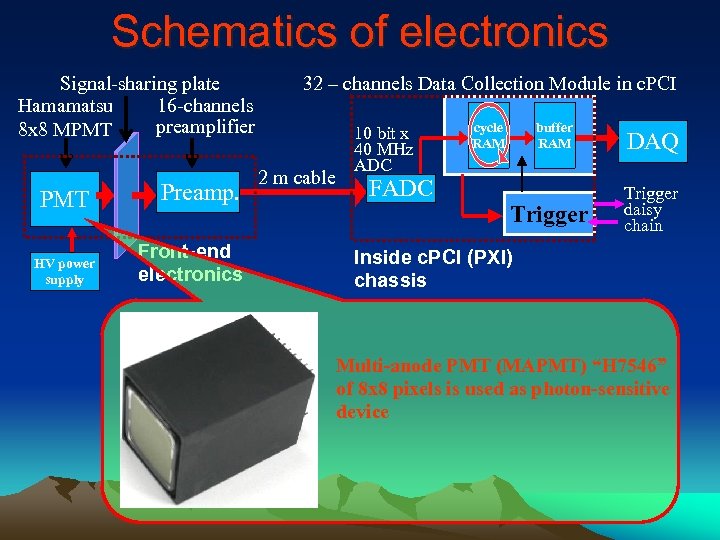 Schematics of electronics Signal-sharing plate Hamamatsu 16 -channels preamplifier 8 x 8 MPMT HV power supply Preamp. Front-end electronics 32 – channels Data Collection Module in c. PCI 2 m cable 10 bit x 40 MHz ADC FADC cycle RAM buffer RAM Trigger DAQ Trigger daisy chain Inside c. PCI (PXI) chassis Multi-anode PMT (MAPMT) “H 7546” of 8 x 8 pixels is used as photon-sensitive device
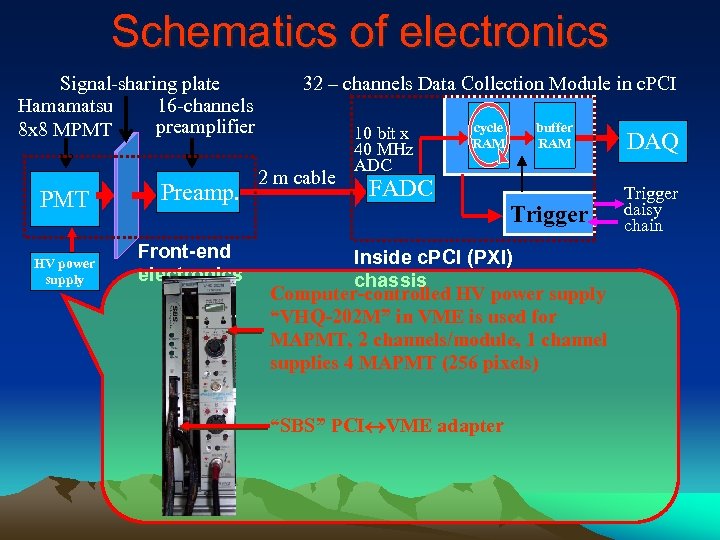 Schematics of electronics Signal-sharing plate Hamamatsu 16 -channels preamplifier 8 x 8 MPMT HV power supply Preamp. Front-end electronics 32 – channels Data Collection Module in c. PCI 2 m cable 10 bit x 40 MHz ADC cycle RAM FADC buffer RAM Trigger Inside c. PCI (PXI) chassis Computer-controlled HV power supply “VHQ-202 M” in VME is used for MAPMT, 2 channels/module, 1 channel supplies 4 MAPMT (256 pixels) “SBS” PCI VME adapter DAQ Trigger daisy chain
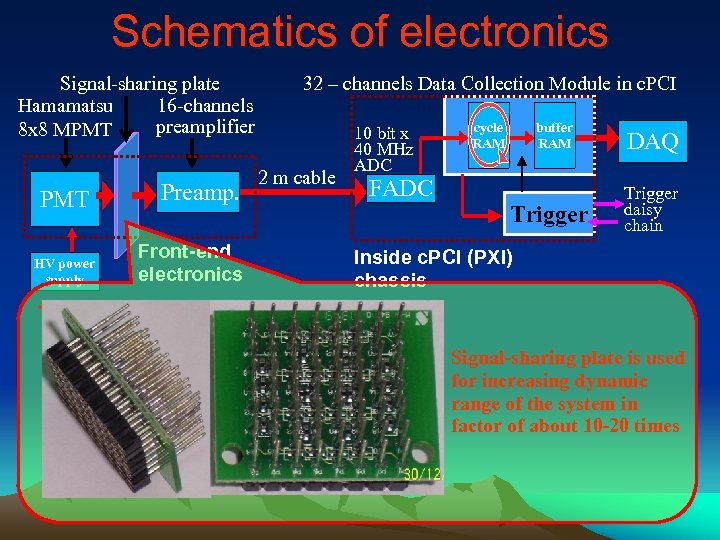 Schematics of electronics Signal-sharing plate Hamamatsu 16 -channels preamplifier 8 x 8 MPMT HV power supply Preamp. 32 – channels Data Collection Module in c. PCI 2 m cable Front-end electronics 10 bit x 40 MHz ADC FADC cycle RAM buffer RAM Trigger DAQ Trigger daisy chain Inside c. PCI (PXI) chassis “SBS” PCI VME adapter Signal-sharing plate is used for increasing dynamic range of the system in factor of about 10 -20 times
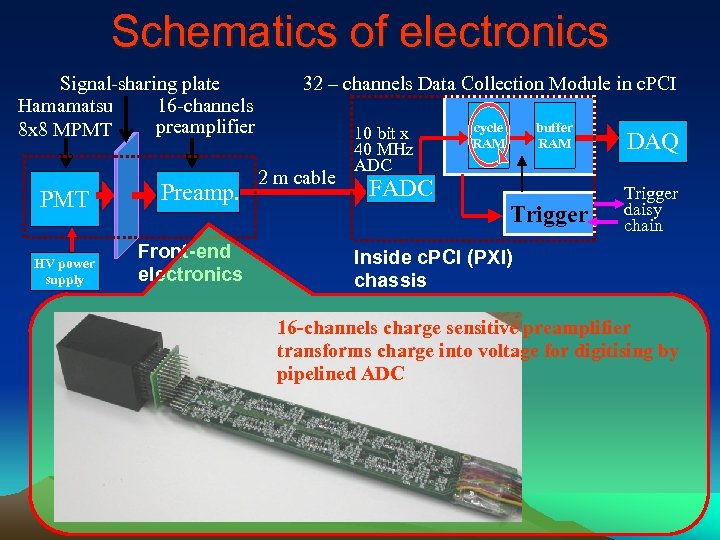 Schematics of electronics Signal-sharing plate Hamamatsu 16 -channels preamplifier 8 x 8 MPMT HV power supply Preamp. Front-end electronics 32 – channels Data Collection Module in c. PCI 2 m cable 10 bit x 40 MHz ADC FADC cycle RAM buffer RAM Trigger DAQ Trigger daisy chain Inside c. PCI (PXI) chassis 16 -channels charge sensitive preamplifier transforms charge into voltage for digitising by pipelined ADC
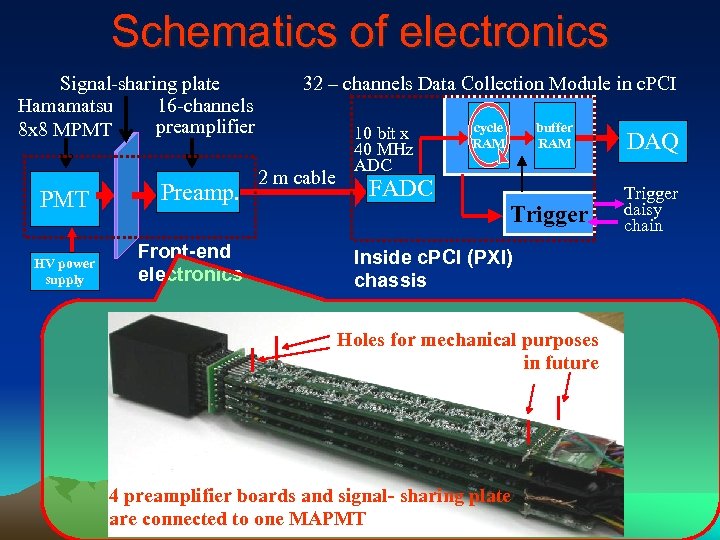 Schematics of electronics Signal-sharing plate Hamamatsu 16 -channels preamplifier 8 x 8 MPMT HV power supply Preamp. Front-end electronics 32 – channels Data Collection Module in c. PCI 2 m cable 10 bit x 40 MHz ADC FADC cycle RAM buffer RAM Trigger Inside c. PCI (PXI) chassis Holes for mechanical purposes in future 4 preamplifier boards and signal- sharing plate are connected to one MAPMT DAQ Trigger daisy chain
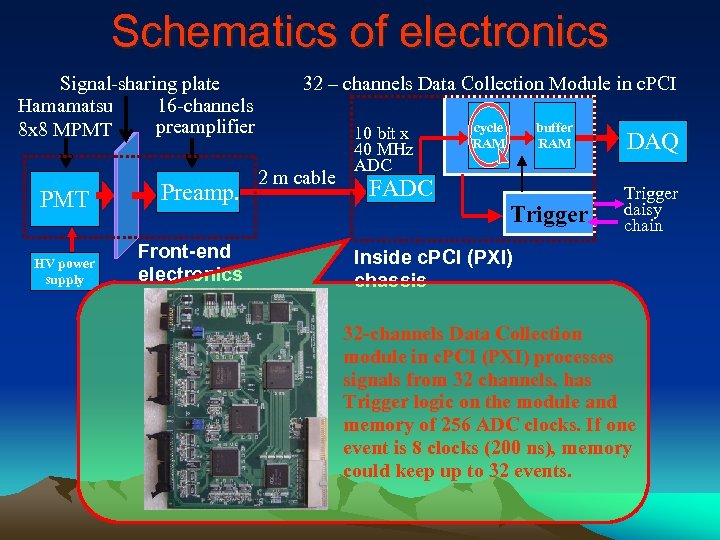 Schematics of electronics Signal-sharing plate Hamamatsu 16 -channels preamplifier 8 x 8 MPMT HV power supply Preamp. Front-end electronics 32 – channels Data Collection Module in c. PCI 2 m cable 10 bit x 40 MHz ADC FADC cycle RAM buffer RAM Trigger DAQ Trigger daisy chain Inside c. PCI (PXI) chassis 32 -channels Data Collection module in c. PCI (PXI) processes signals from 32 channels, has Trigger logic on the module and memory of 256 ADC clocks. If one event is 8 clocks (200 ns), memory could keep up to 32 events.
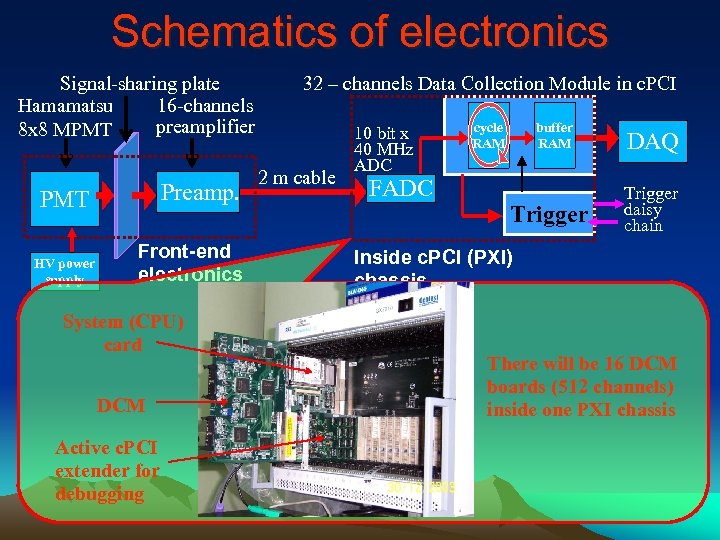 Schematics of electronics Signal-sharing plate Hamamatsu 16 -channels preamplifier 8 x 8 MPMT Preamp. PMT HV power supply Front-end electronics System (CPU) card DCM Active c. PCI extender for debugging 32 – channels Data Collection Module in c. PCI 2 m cable 10 bit x 40 MHz ADC FADC cycle RAM buffer RAM Trigger DAQ Trigger daisy chain Inside c. PCI (PXI) chassis There will be 16 DCM boards (512 channels) inside one PXI chassis
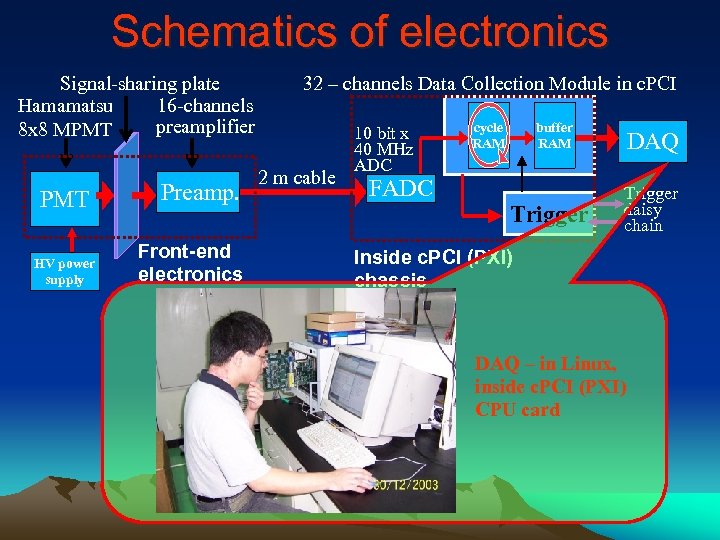 Schematics of electronics Signal-sharing plate Hamamatsu 16 -channels preamplifier 8 x 8 MPMT HV power supply Preamp. Front-end electronics 32 – channels Data Collection Module in c. PCI 2 m cable 10 bit x 40 MHz ADC FADC cycle RAM buffer RAM Trigger DAQ Trigger daisy chain Inside c. PCI (PXI) chassis DAQ – in Linux, inside c. PCI (PXI) CPU card
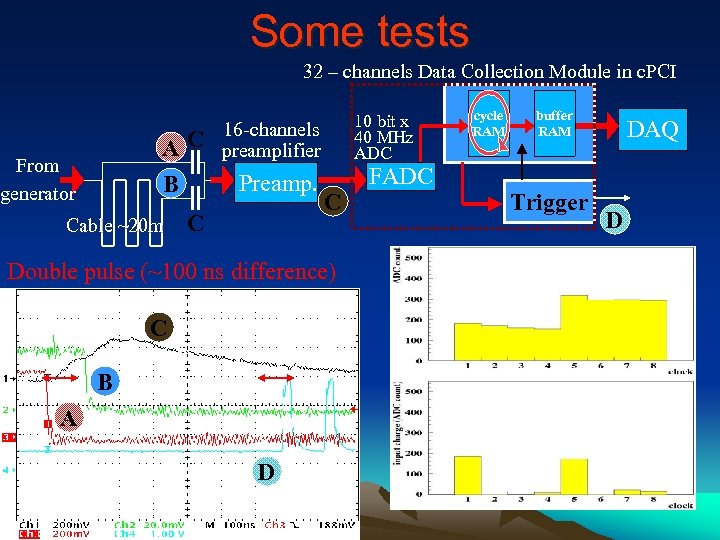 Some tests 32 – channels Data Collection Module in c. PCI 16 -channels C preamplifier A Preamp. B From generator Cable ~20 m C 10 bit x 40 MHz ADC C Double pulse (~100 ns difference) C B A D FADC cycle RAM buffer RAM Trigger DAQ D
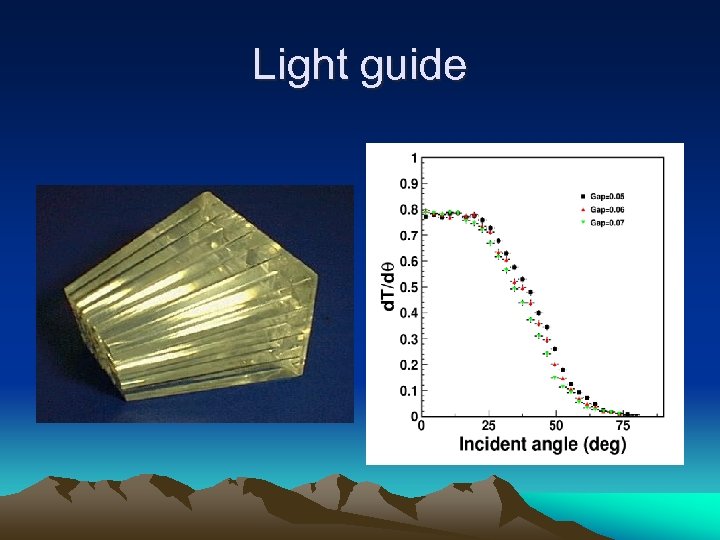
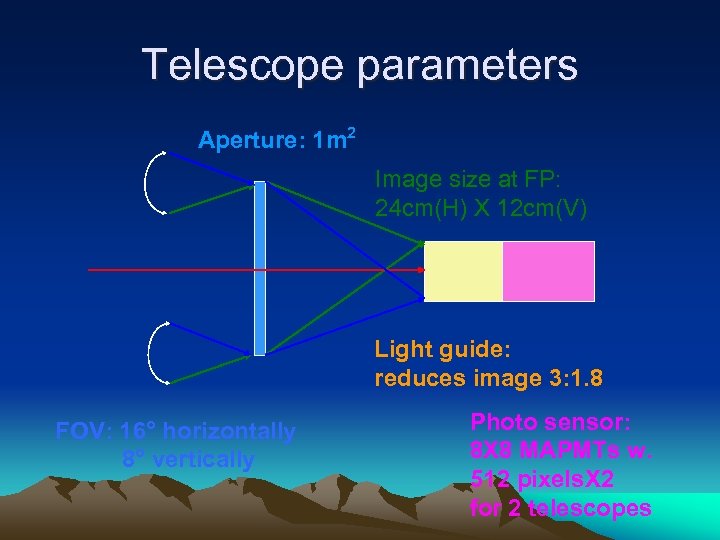 Telescope parameters Aperture: 1 m 2 Image size at FP: 24 cm(H) X 12 cm(V) Light guide: reduces image 3: 1. 8 FOV: 16 o horizontally 8 o vertically Photo sensor: 8 X 8 MAPMTs w. 512 pixels. X 2 for 2 telescopes
 Three-fresnel surface telescope ---: 8 o ---: 4 o ---: 0 o Front side: fresnel 1. 1 m Both sides: fresnel A fresnel-edge loss: 17%
 Spot image of 3 -fresnel telescope
 Telescope w. two-identical fresnel lens Tow fresnel lens are identical Front side: fresnel 1. 1 m ---: 8 o ---: 4 o ---: 0 o Aspheric lens 0. 4 m Back side: fresnel A fresel-edge loss: 11%
 Spot image of two-identical fresnel telescope
 Light guide simulation
 Light guide
 Conclusion • Nu. Tel is an experiment dedicated to Earth skimming / mountaing watching • The Pe. V cosmic rate is ~ 1 event/year • The cost is low: O(1) million US dollars to build it • Very good project for training students • However, lack of funding support in last two years • Ceased collaboration with ASHRA last year • Look for new funding support from
 People who worked on Nu. Tel before • Italy: IASF, CNR, Palermo – N. La Barbera, O. Catalano, G. Cusumano, T. Mineo, B. Sacco • France: Paris, France F. Vannucci, S. Bouaissi • USA: Hawaii J. G. Learned • Japan: ICRR M. Sasaki • Taiwan: – NCTS/Cos. PA 3 – G. L. Lin, H. Athar (Faculty) From 2002 -2005 NTUHEP/Cos. PA 2 PIs: W. S. Hou & Y. B. Hsiung Hardware Team: K. Ueno (Optics) Y. K. Chi (Electronics) Y. S. Velikzhanin (Electronics) J. G. Shiu (DAQ) M. W. C. Lin (Technician) Master students Simulation Team: M. Z. Wang (Faculty) P. Yeh (Faculty) C. C. Hsu (Ph. D. student) master students NUU M. A. Huang + students (Faculty)