 Скачать презентацию Status of Jefferson Lab FEL high voltage photoemission
8ab9980e9d5e7049f4546afea8aa864c.ppt
- Количество слайдов: 33



Status of Jefferson Lab FEL high voltage photoemission guns Workshop on Sources of Polarized Electrons and High Brightness Electron Beams C. Hernandez-Garcia for the FEL team Jefferson Lab, Newport News, VA, USA October 1 -3 2008
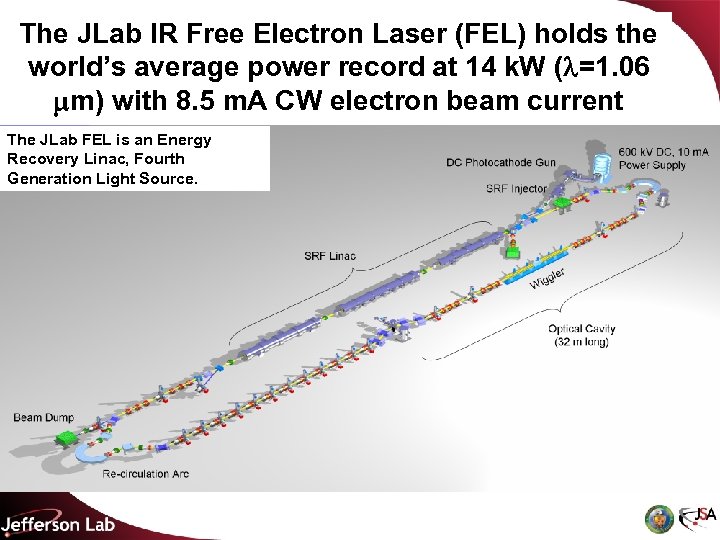
The JLab IR Free Electron Laser (FEL) holds the world’s average power record at 14 k. W (l=1. 06 mm) with 8. 5 m. A CW electron beam current The JLab FEL is an Energy Recovery Linac, Fourth Generation Light Source.
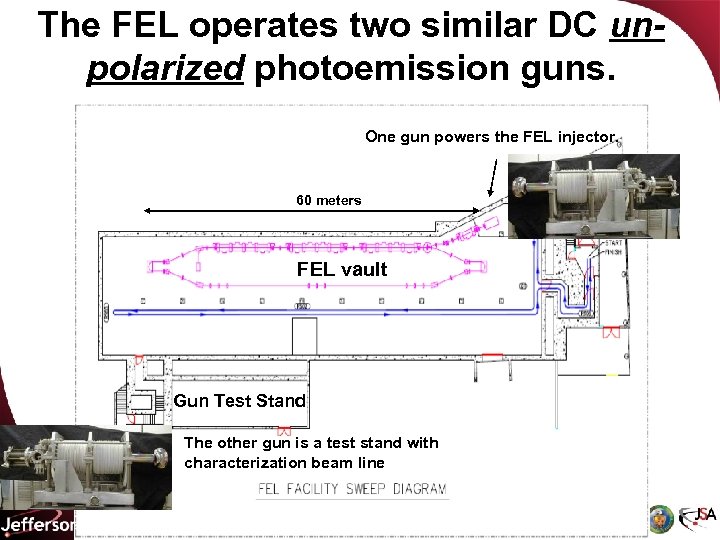
The FEL operates two similar DC unpolarized photoemission guns. One gun powers the FEL injector. 60 meters FEL vault Gun Test Stand The other gun is a test stand with characterization beam line
Outline • General description of the FEL-type photoguns • FEL gun operated at 350 k. V and ~10 m. A CW for FEL operations – Photocathode performance – High voltage performance • GTS gun operated at >350 k. V and 10 Hz rep rate for beam characterization – Photocathode performance – High voltage performance • Concepts for next generation design – Load-lock chamber – Inverted insulator?
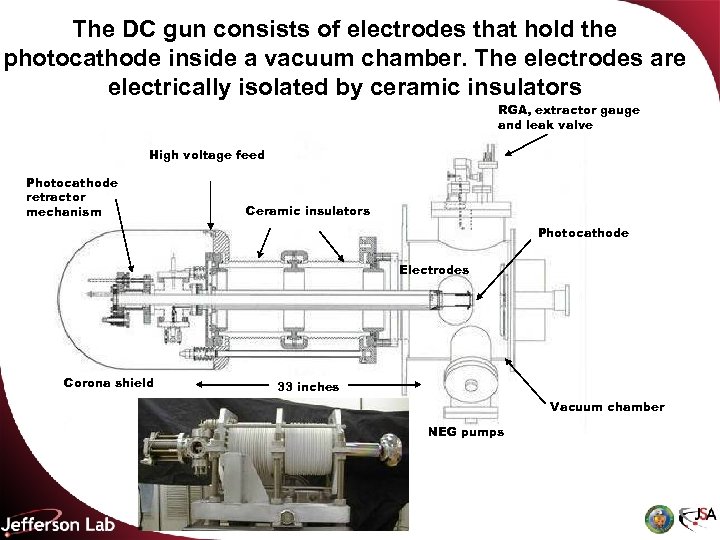
The DC gun consists of electrodes that hold the photocathode inside a vacuum chamber. The electrodes are electrically isolated by ceramic insulators RGA, extractor gauge and leak valve High voltage feed Photocathode retractor mechanism Ceramic insulators Photocathode Electrodes Corona shield 33 inches Vacuum chamber NEG pumps
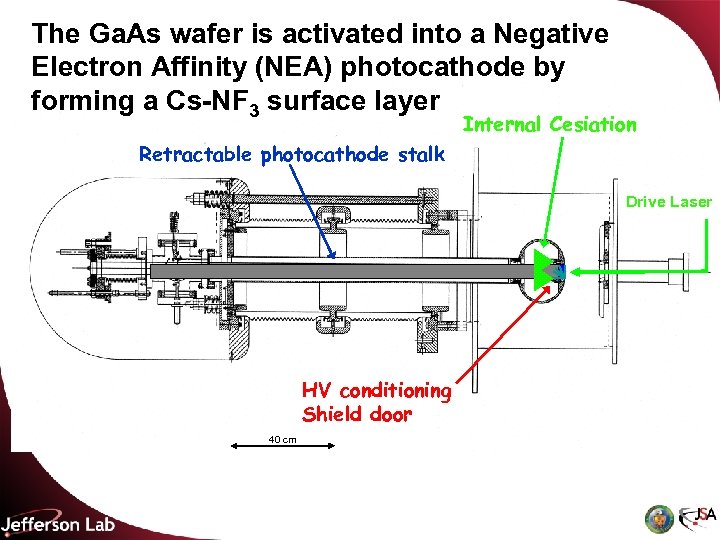
The Ga. As wafer is activated into a Negative Electron Affinity (NEA) photocathode by forming a Cs-NF 3 surface layer Internal Cesiation Retractable photocathode stalk Drive Laser HV conditioning Shield door 40 cm
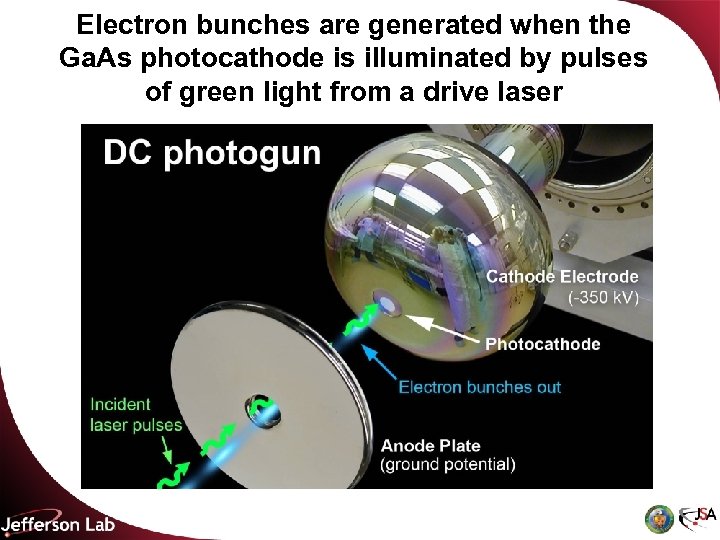
Electron bunches are generated when the Ga. As photocathode is illuminated by pulses of green light from a drive laser
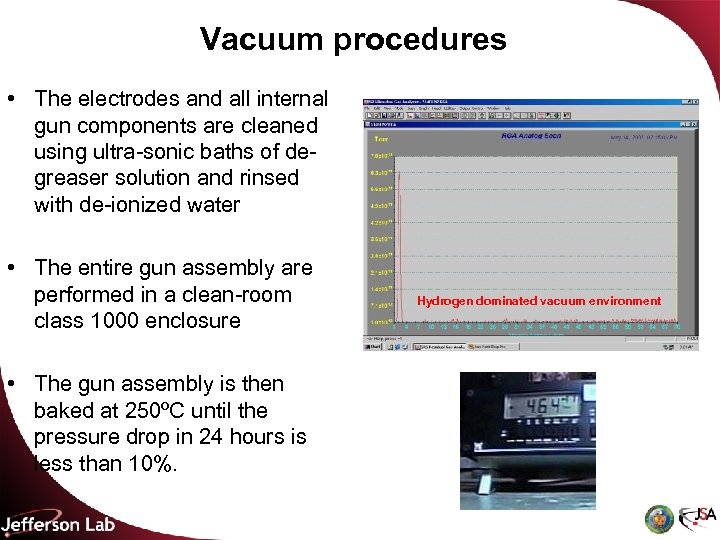
Vacuum procedures • The electrodes and all internal gun components are cleaned using ultra-sonic baths of degreaser solution and rinsed with de-ionized water • The entire gun assembly are performed in a clean-room class 1000 enclosure • The gun assembly is then baked at 250ºC until the pressure drop in 24 hours is less than 10%. Hydrogen dominated vacuum environment
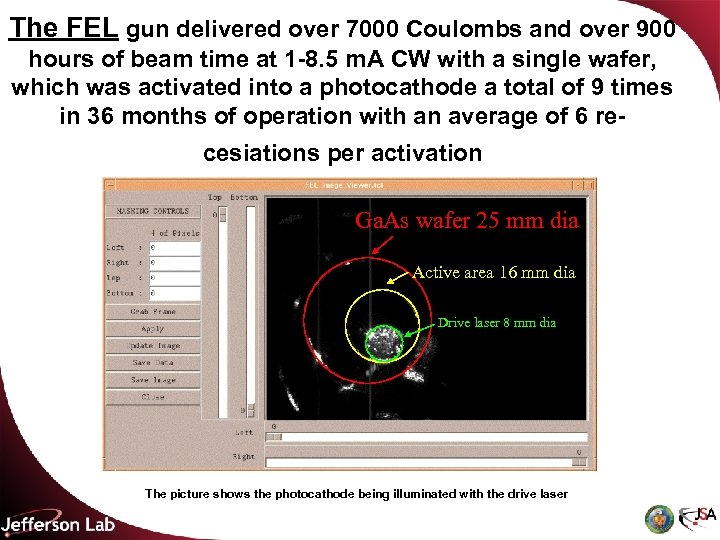
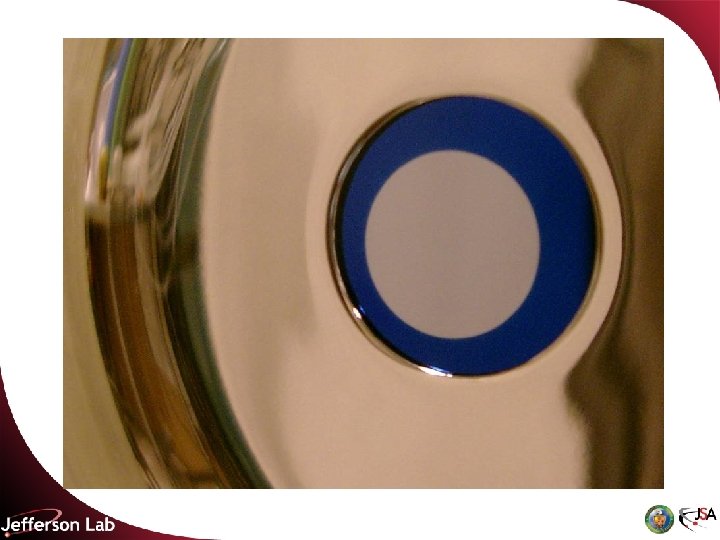
The FEL gun delivered over 7000 Coulombs and over 900 hours of beam time at 1 -8. 5 m. A CW with a single wafer, which was activated into a photocathode a total of 9 times in 36 months of operation with an average of 6 recesiations per activation Ga. As wafer 25 mm dia Active area 16 mm dia Drive laser 8 mm dia The picture shows the photocathode being illuminated with the drive laser
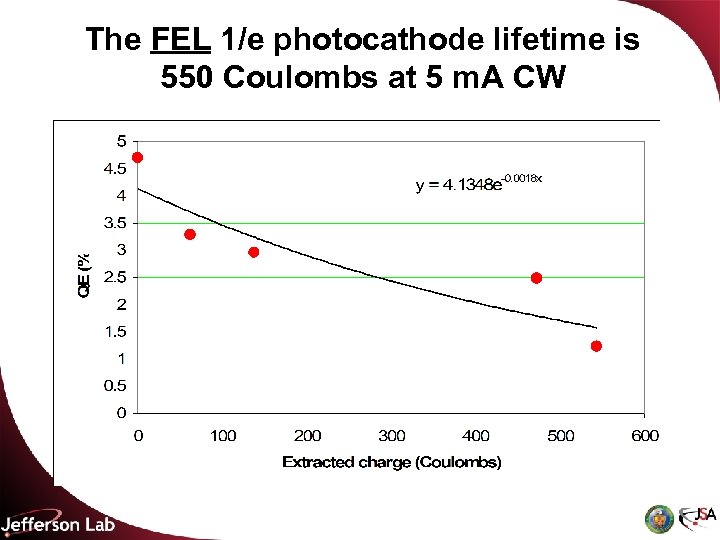
The FEL 1/e photocathode lifetime is 550 Coulombs at 5 m. A CW
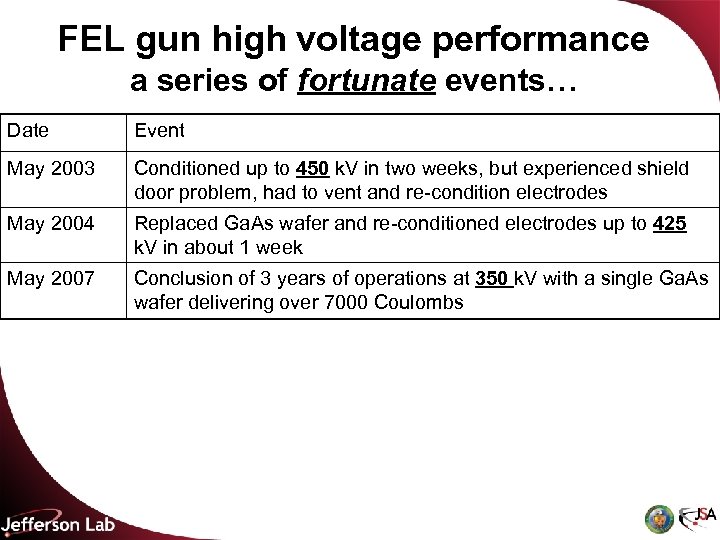
FEL gun high voltage performance a series of fortunate events… Date Event May 2003 Conditioned up to 450 k. V in two weeks, but experienced shield door problem, had to vent and re-condition electrodes May 2004 Replaced Ga. As wafer and re-conditioned electrodes up to 425 k. V in about 1 week May 2007 Conclusion of 3 years of operations at 350 k. V with a single Ga. As wafer delivering over 7000 Coulombs
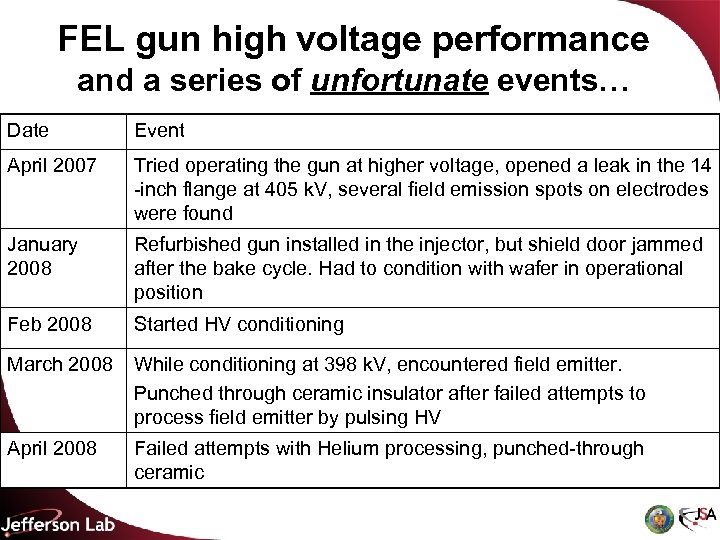
FEL gun high voltage performance and a series of unfortunate events… Date Event April 2007 Tried operating the gun at higher voltage, opened a leak in the 14 -inch flange at 405 k. V, several field emission spots on electrodes were found January 2008 Refurbished gun installed in the injector, but shield door jammed after the bake cycle. Had to condition with wafer in operational position Feb 2008 Started HV conditioning March 2008 While conditioning at 398 k. V, encountered field emitter. Punched through ceramic insulator after failed attempts to process field emitter by pulsing HV April 2008 Failed attempts with Helium processing, punched-through ceramic
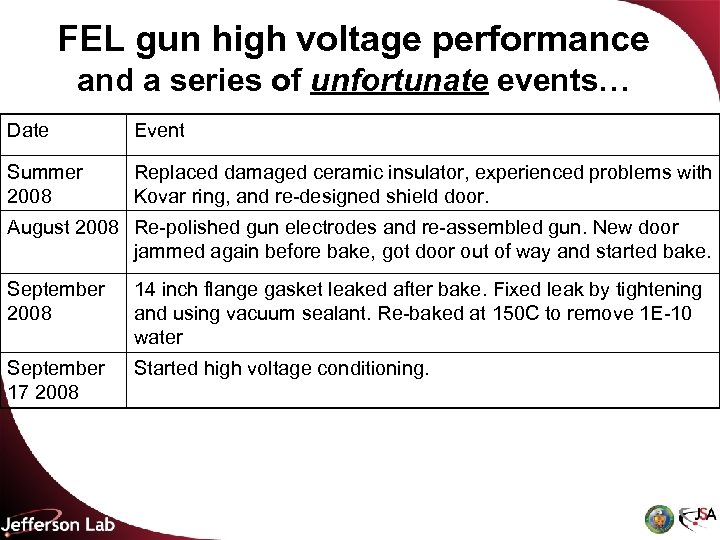
FEL gun high voltage performance and a series of unfortunate events… Date Event Summer 2008 Replaced damaged ceramic insulator, experienced problems with Kovar ring, and re-designed shield door. August 2008 Re-polished gun electrodes and re-assembled gun. New door jammed again before bake, got door out of way and started bake. September 2008 14 inch flange gasket leaked after bake. Fixed leak by tightening and using vacuum sealant. Re-baked at 150 C to remove 1 E-10 water September 17 2008 Started high voltage conditioning.
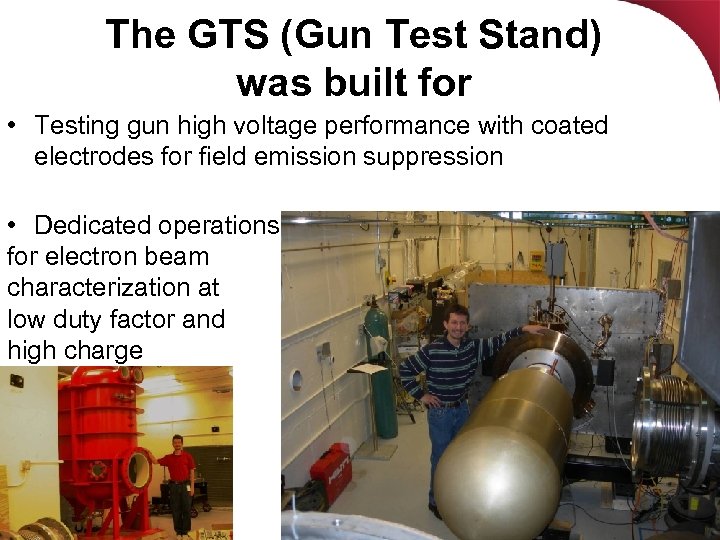
The GTS (Gun Test Stand) was built for • Testing gun high voltage performance with coated electrodes for field emission suppression • Dedicated operations for electron beam characterization at low duty factor and high charge
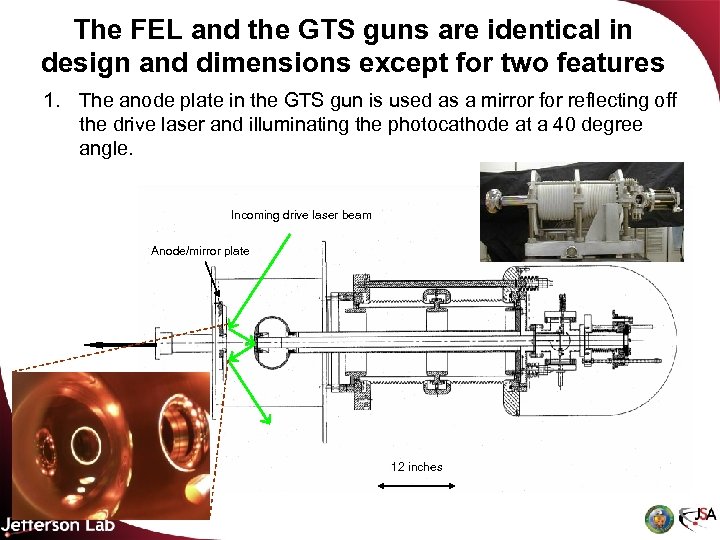
The FEL and the GTS guns are identical in design and dimensions except for two features 1. The anode plate in the GTS gun is used as a mirror for reflecting off the drive laser and illuminating the photocathode at a 40 degree angle. Incoming drive laser beam Anode/mirror plate 12 inches
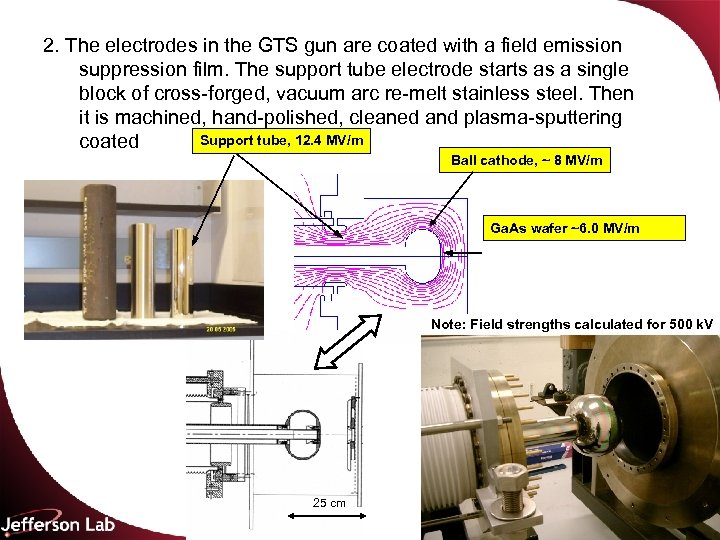
2. The electrodes in the GTS gun are coated with a field emission suppression film. The support tube electrode starts as a single block of cross-forged, vacuum arc re-melt stainless steel. Then it is machined, hand-polished, cleaned and plasma-sputtering Support tube, 12. 4 MV/m coated Ball cathode, ~ 8 MV/m Ga. As wafer ~6. 0 MV/m Note: Field strengths calculated for 500 k. V 25 cm
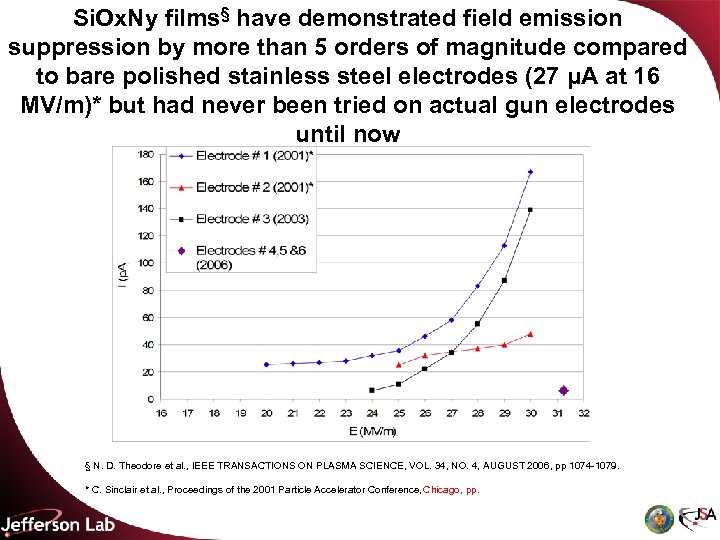
Si. Ox. Ny films§ have demonstrated field emission suppression by more than 5 orders of magnitude compared to bare polished stainless steel electrodes (27 μA at 16 MV/m)* but had never been tried on actual gun electrodes until now § N. D. Theodore et al. , IEEE TRANSACTIONS ON PLASMA SCIENCE, VOL. 34, NO. 4, AUGUST 2006, pp 1074 -1079. * C. Sinclair et al. , Proceedings of the 2001 Particle Accelerator Conference, Chicago, pp.
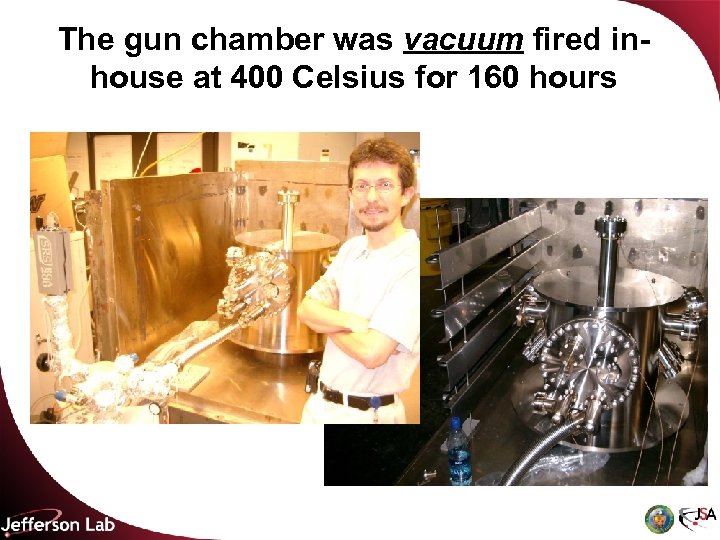
The gun chamber was vacuum fired inhouse at 400 Celsius for 160 hours
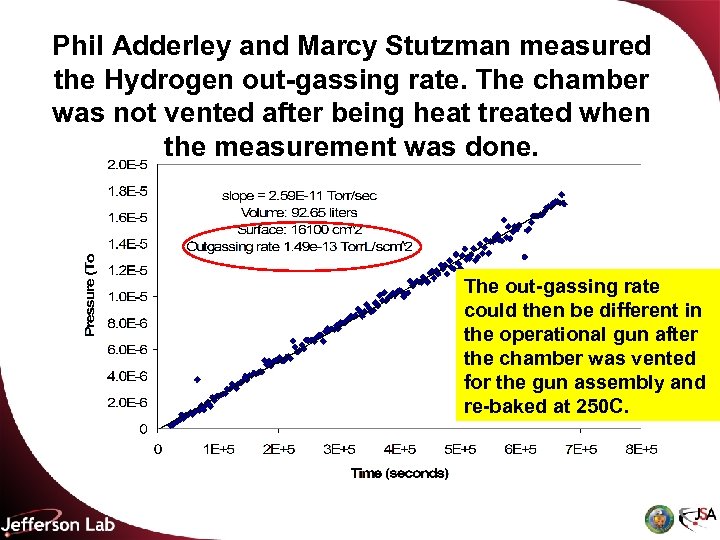
Phil Adderley and Marcy Stutzman measured the Hydrogen out-gassing rate. The chamber was not vented after being heat treated when the measurement was done. The out-gassing rate could then be different in the operational gun after the chamber was vented for the gun assembly and re-baked at 250 C.
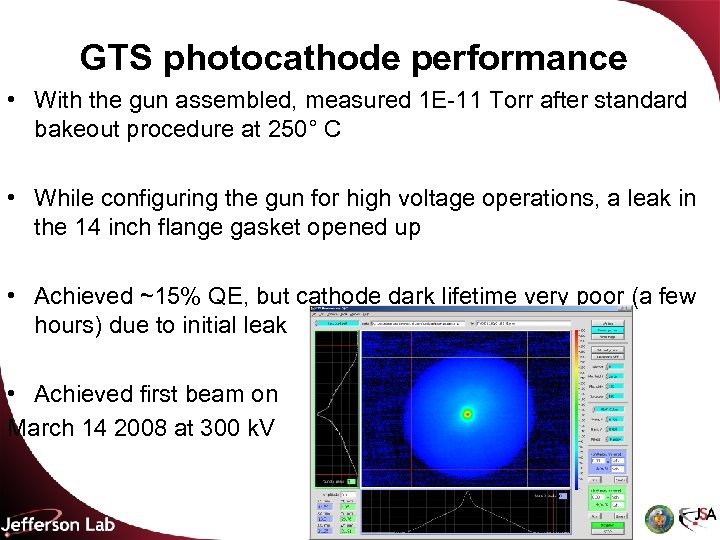
GTS photocathode performance • With the gun assembled, measured 1 E-11 Torr after standard bakeout procedure at 250° C • While configuring the gun for high voltage operations, a leak in the 14 inch flange gasket opened up • Achieved ~15% QE, but cathode dark lifetime very poor (a few hours) due to initial leak • Achieved first beam on March 14 2008 at 300 k. V
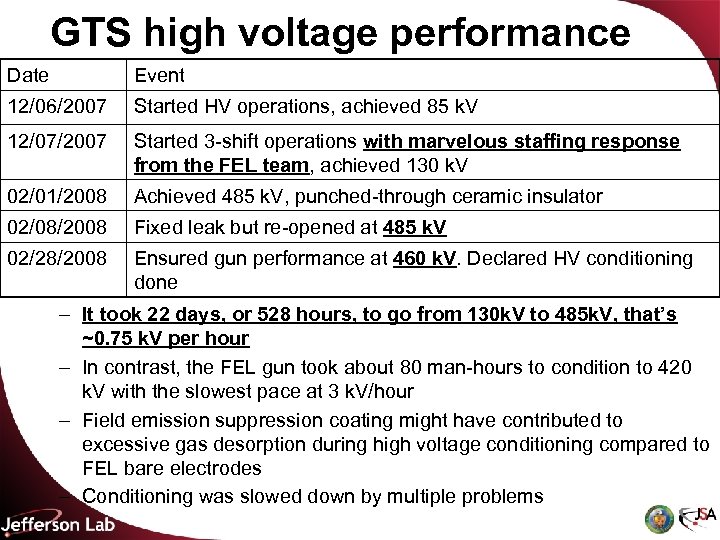
GTS high voltage performance Date Event 12/06/2007 Started HV operations, achieved 85 k. V 12/07/2007 Started 3 -shift operations with marvelous staffing response from the FEL team, achieved 130 k. V 02/01/2008 Achieved 485 k. V, punched-through ceramic insulator 02/08/2008 Fixed leak but re-opened at 485 k. V 02/28/2008 Ensured gun performance at 460 k. V. Declared HV conditioning done – It took 22 days, or 528 hours, to go from 130 k. V to 485 k. V, that’s ~0. 75 k. V per hour – In contrast, the FEL gun took about 80 man-hours to condition to 420 k. V with the slowest pace at 3 k. V/hour – Field emission suppression coating might have contributed to excessive gas desorption during high voltage conditioning compared to FEL bare electrodes – Conditioning was slowed down by multiple problems
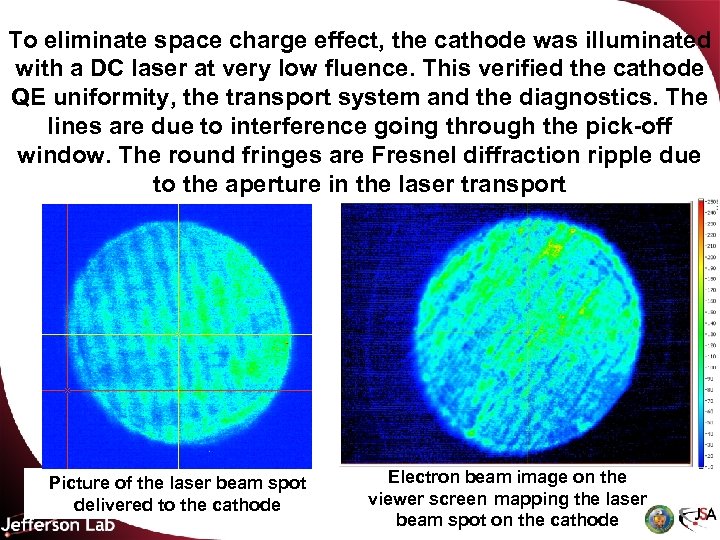
To eliminate space charge effect, the cathode was illuminated with a DC laser at very low fluence. This verified the cathode QE uniformity, the transport system and the diagnostics. The lines are due to interference going through the pick-off window. The round fringes are Fresnel diffraction ripple due to the aperture in the laser transport Picture of the laser beam spot delivered to the cathode Electron beam image on the viewer screen mapping the laser beam spot on the cathode
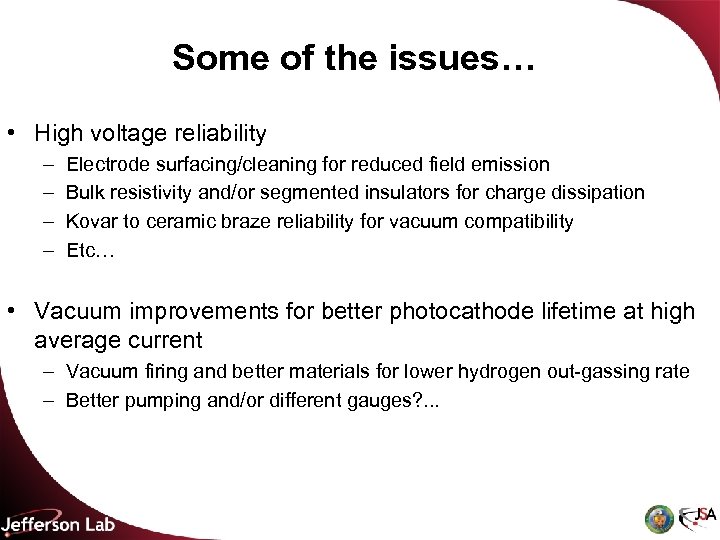
Some of the issues… • High voltage reliability – – Electrode surfacing/cleaning for reduced field emission Bulk resistivity and/or segmented insulators for charge dissipation Kovar to ceramic braze reliability for vacuum compatibility Etc… • Vacuum improvements for better photocathode lifetime at high average current – Vacuum firing and better materials for lower hydrogen out-gassing rate – Better pumping and/or different gauges? . . .
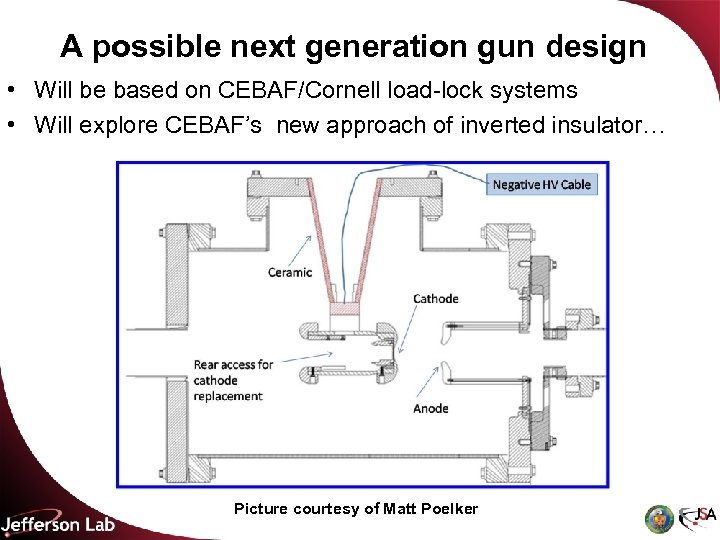
A possible next generation gun design • Will be based on CEBAF/Cornell load-lock systems • Will explore CEBAF’s new approach of inverted insulator… Picture courtesy of Matt Poelker
More details towards more robust, next generation DC photoemission guns to be discussed later today THANK YOU
BACKUP SLIDES
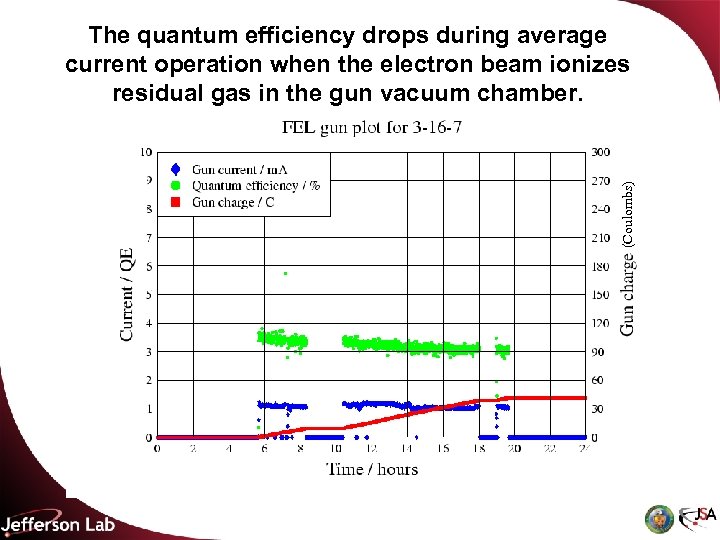
(Coulombs) The quantum efficiency drops during average current operation when the electron beam ionizes residual gas in the gun vacuum chamber.
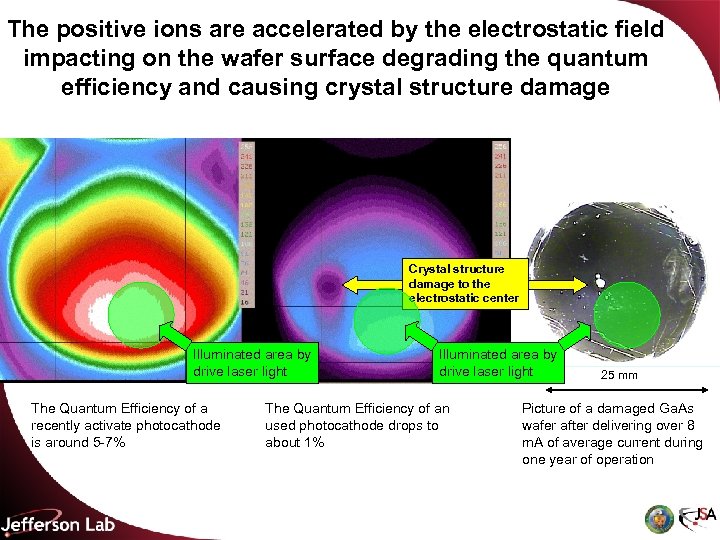
The positive ions are accelerated by the electrostatic field impacting on the wafer surface degrading the quantum efficiency and causing crystal structure damage Crystal structure damage to the electrostatic center Illuminated area by drive laser light The Quantum Efficiency of a recently activate photocathode is around 5 -7% Illuminated area by drive laser light The Quantum Efficiency of an used photocathode drops to about 1% 25 mm Picture of a damaged Ga. As wafer after delivering over 8 m. A of average current during one year of operation
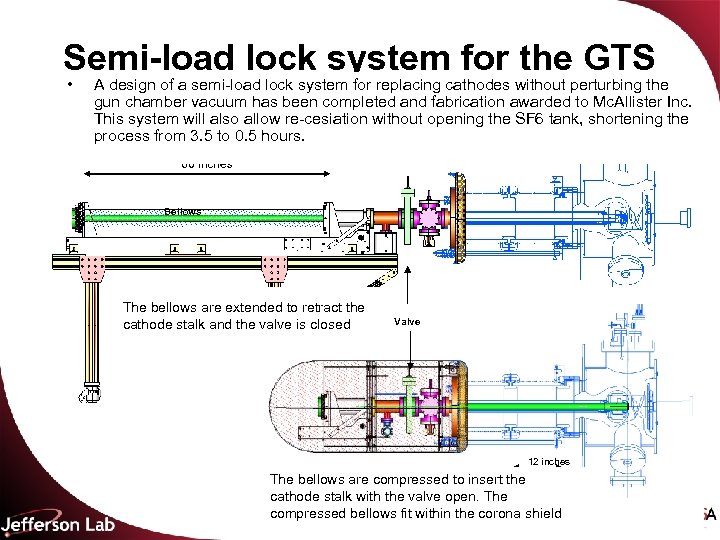
Semi-load lock system for the GTS • A design of a semi-load lock system for replacing cathodes without perturbing the gun chamber vacuum has been completed and fabrication awarded to Mc. Allister Inc. This system will also allow re-cesiation without opening the SF 6 tank, shortening the process from 3. 5 to 0. 5 hours. 60 inches Bellows The bellows are extended to retract the cathode stalk and the valve is closed Valve 12 inches The bellows are compressed to insert the cathode stalk with the valve open. The compressed bellows fit within the corona shield
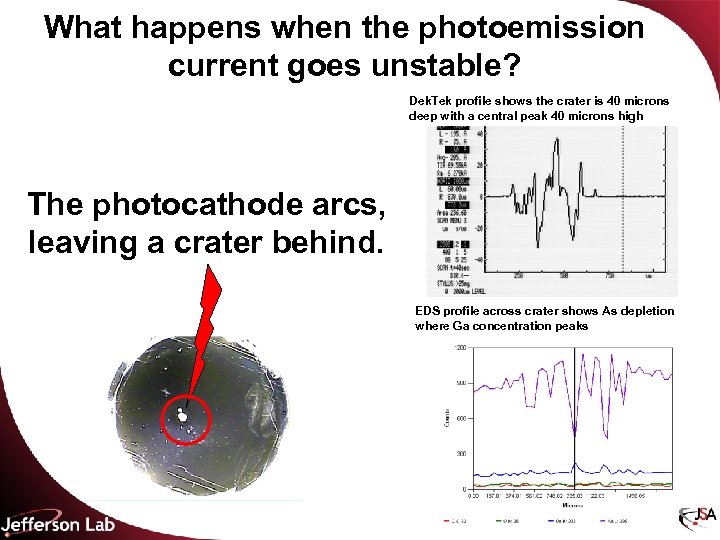
What happens when the photoemission current goes unstable? Dek. Tek profile shows the crater is 40 microns deep with a central peak 40 microns high The photocathode arcs, leaving a crater behind. EDS profile across crater shows As depletion where Ga concentration peaks
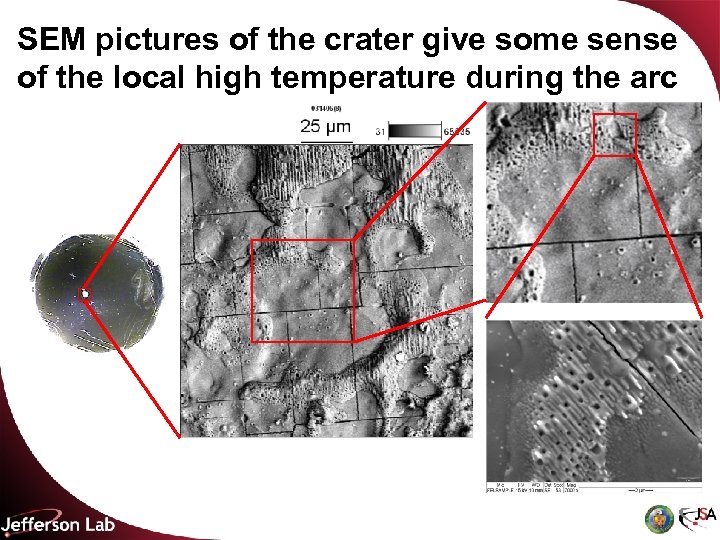
SEM pictures of the crater give some sense of the local high temperature during the arc
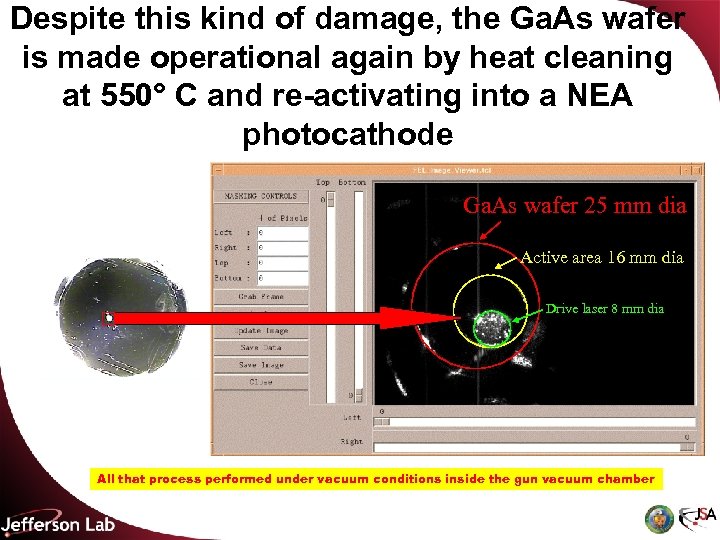
Despite this kind of damage, the Ga. As wafer is made operational again by heat cleaning at 550° C and re-activating into a NEA photocathode Ga. As wafer 25 mm dia Active area 16 mm dia Drive laser 8 mm dia All that process performed under vacuum conditions inside the gun vacuum chamber
Скачать презентацию Status of Jefferson Lab FEL high voltage photoemission
8ab9980e9d5e7049f4546afea8aa864c.ppt