 Скачать презентацию Status of FRIB design plans cavity and cryomodule
ad5407f646dcab34dfc4b1440faeec1b.ppt
- Количество слайдов: 32



Status of FRIB: design plans, cavity and cryomodule development NSCL Professor, SRF Department Manager Kenji Saito TTC Meeting November 5 2012 TTC meeting @ Jlab K. Saito, 5 Nov 2012, Slide 1
Outline § Overview FRIB and Re. A Projects at MSU § Design Plans § Cavity and Cryomodule Development , Slide 2 FRIB ASD, 19 June 2012 TTC meeting @ Jlab K. Saito, 5 Nov 2012, Slide 2
, Slide 3
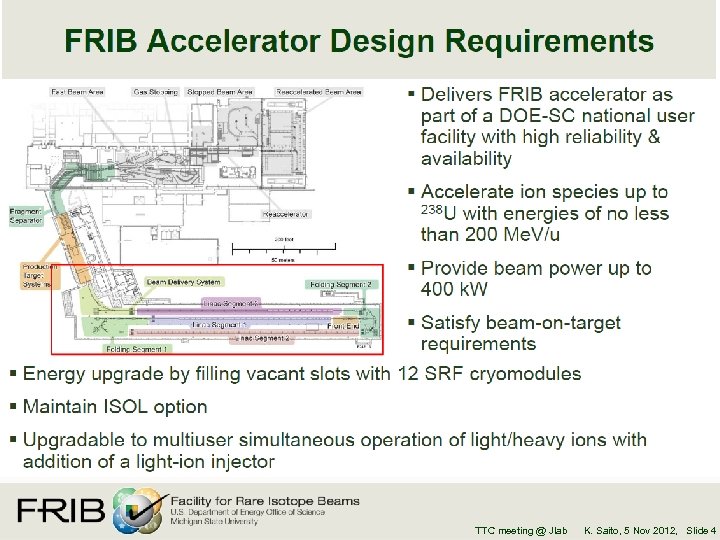
TTC meeting @ Jlab K. Saito, 5 Nov 2012, Slide 4
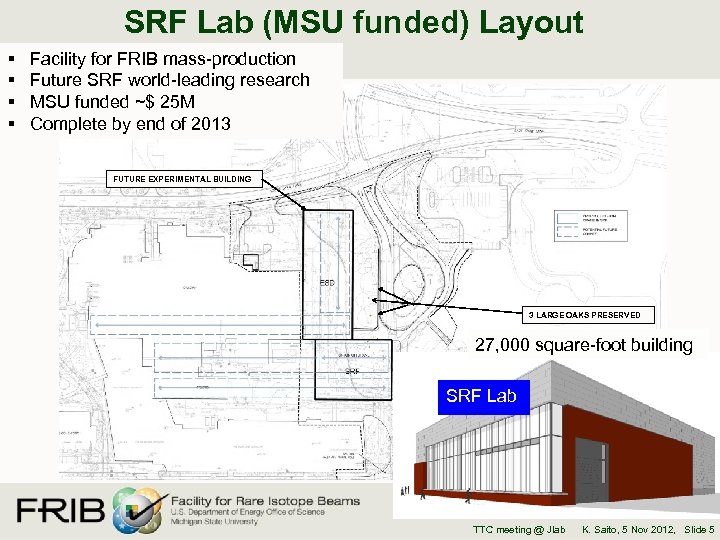
SRF Lab (MSU funded) Layout § § Facility for FRIB mass-production Future SRF world-leading research MSU funded ~$ 25 M Complete by end of 2013 FUTURE EXPERIMENTAL BUILDING 3 LARGE OAKS PRESERVED 27, 000 square-foot building SRF Lab TTC meeting @ Jlab K. Saito, 5 Nov 2012, Slide 5
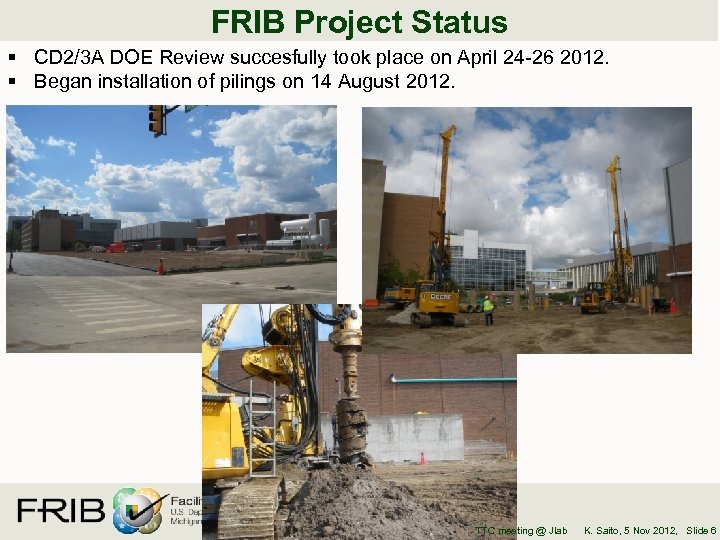
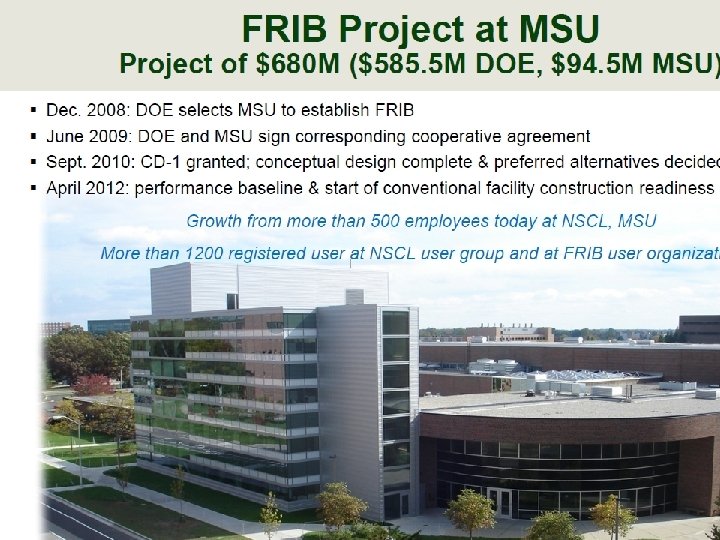
FRIB Project Status § CD 2/3 A DOE Review succesfully took place on April 24 -26 2012. § Began installation of pilings on 14 August 2012. TTC meeting @ Jlab K. Saito, 5 Nov 2012, Slide 6
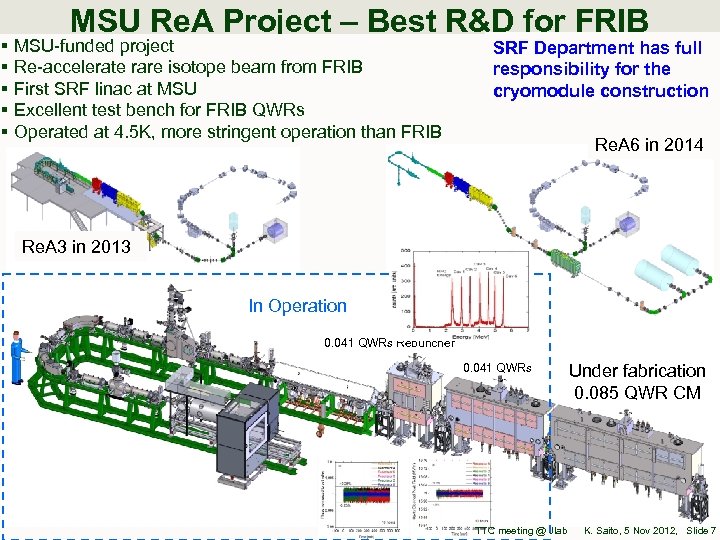
§ § § MSU Re. A Project – Best R&D for FRIB MSU-funded project Re-accelerate rare isotope beam from FRIB First SRF linac at MSU Excellent test bench for FRIB QWRs Operated at 4. 5 K, more stringent operation than FRIB SRF Department has full responsibility for the cryomodule construction Re. A 6 in 2014 Re. A 3 in 2013 In Operation 0. 041 QWRs Rebuncher 0. 041 QWRs TTC meeting @ Jlab Under fabrication 0. 085 QWR CM , Slide 7 K. Saito, 5 Nov 2012, Slide 7
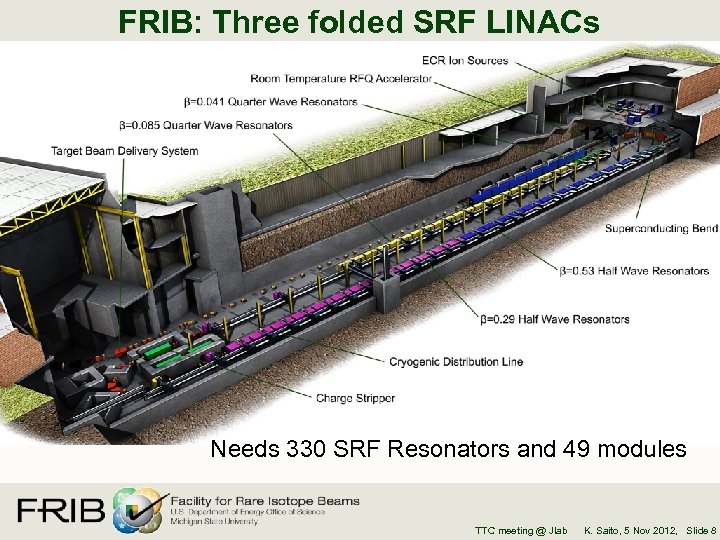
FRIB: Three folded SRF LINACs 12 Needs 330 SRF Resonators and 49 modules , Slide 8 FRIB ASD, 19 June 2012 TTC meeting @ Jlab K. Saito, 5 Nov 2012, Slide 8
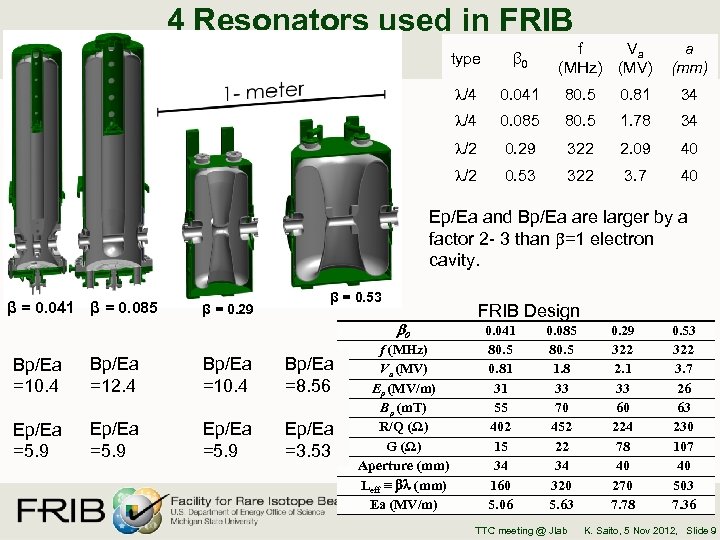
4 Resonators used in FRIB type β 0 f (MHz) Va (MV) a (mm) /4 0. 041 80. 5 0. 81 34 /4 0. 085 80. 5 1. 78 34 /2 0. 29 322 2. 09 40 /2 0. 53 322 3. 7 40 Ep/Ea and Bp/Ea are larger by a factor 2 - 3 than =1 electron cavity. β = 0. 041 β = 0. 085 β = 0. 29 β = 0. 53 0 Bp/Ea =10. 4 Bp/Ea =12. 4 Bp/Ea =10. 4 Bp/Ea =8. 56 Ep/Ea =5. 9 Ep/Ea =3. 53 f (MHz) Va (MV) Ep (MV/m) Bp (m. T) R/Q (Ω) G (Ω) Aperture (mm) Leff ≡ (mm) Ea (MV/m) FRIB Design 0. 041 80. 5 0. 81 31 55 402 15 34 160 5. 06 0. 085 80. 5 1. 8 33 70 452 22 34 320 5. 63 TTC meeting @ Jlab 0. 29 322 2. 1 33 60 224 78 40 270 7. 78 0. 53 322 3. 7 26 63 230 107 40 503 7. 36 K. Saito, 5 Nov 2012, Slide 9
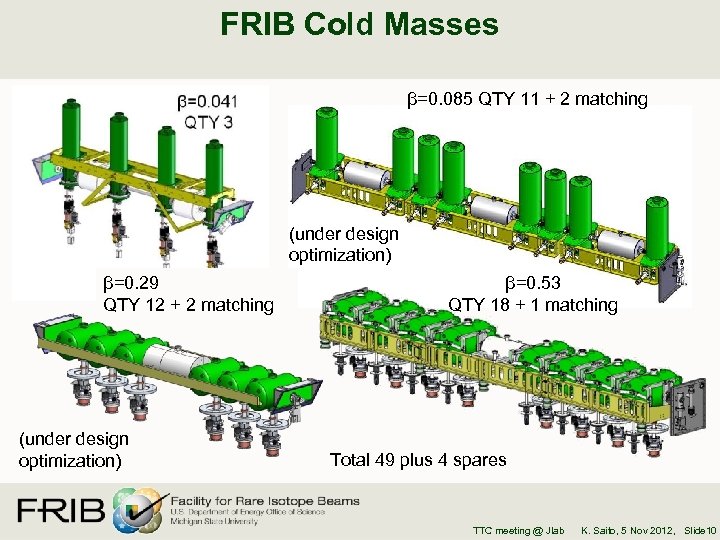
FRIB Cold Masses β=0. 085 QTY 11 + 2 matching (under design optimization) β=0. 29 QTY 12 + 2 matching (under design optimization) β=0. 53 QTY 18 + 1 matching Total 49 plus 4 spares TTC meeting @ Jlab , Slide 10 K. Saito, 5 Nov 2012, Slide 10
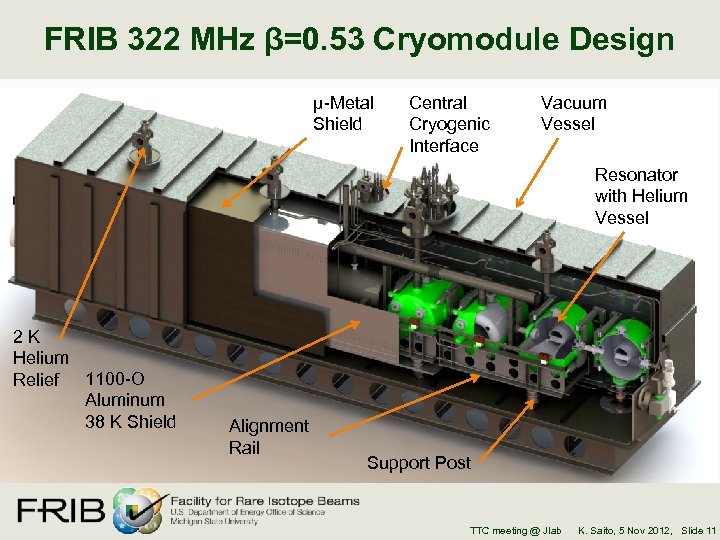
FRIB 322 MHz β=0. 53 Cryomodule Design μ-Metal Shield Central Cryogenic Interface Vacuum Vessel Resonator with Helium Vessel 2 K Helium Relief 1100 -O Aluminum 38 K Shield Alignment Rail Support Post TTC meeting @ Jlab K. Saito, 5 Nov 2012, Slide 11
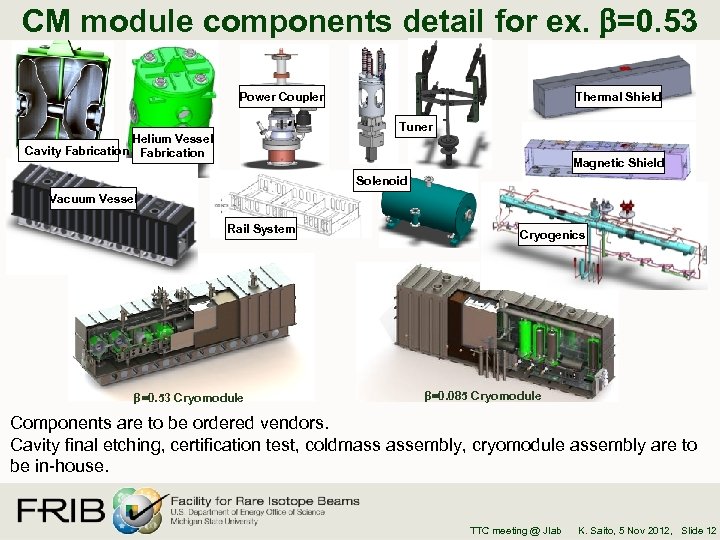
CM module components detail for ex. =0. 53 Power Coupler Thermal Shield Tuner Helium Vessel Cavity Fabrication Magnetic Shield Solenoid Vacuum Vessel Rail System β=0. 53 Cryomodule Cryogenics β=0. 085 Cryomodule Components are to be ordered vendors. Cavity final etching, certification test, coldmass assembly, cryomodule assembly are to be in-house. TTC meeting @ Jlab K. Saito, 5 Nov 2012, Slide 12
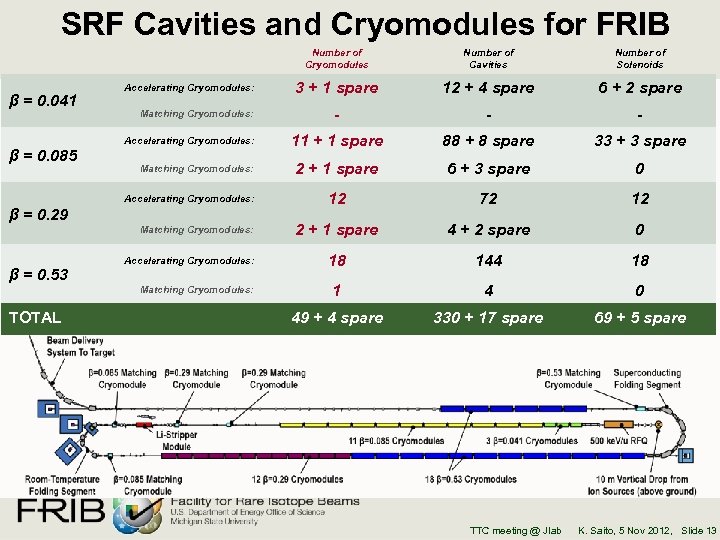
SRF Cavities and Cryomodules for FRIB Number of Cryomodules β = 0. 041 Accelerating Cryomodules: Matching Cryomodules: Accelerating Cryomodules: β = 0. 085 Matching Cryomodules: Accelerating Cryomodules: β = 0. 29 Matching Cryomodules: β = 0. 53 Accelerating Cryomodules: Matching Cryomodules: TOTAL Number of Cavities Number of Solenoids 3 + 1 spare 12 + 4 spare 6 + 2 spare - - - 11 + 1 spare 88 + 8 spare 33 + 3 spare 2 + 1 spare 6 + 3 spare 0 12 72 12 2 + 1 spare 4 + 2 spare 0 18 144 18 1 4 0 49 + 4 spare 330 + 17 spare 69 + 5 spare TTC meeting @ Jlab K. Saito, 5 Nov 2012, Slide 13
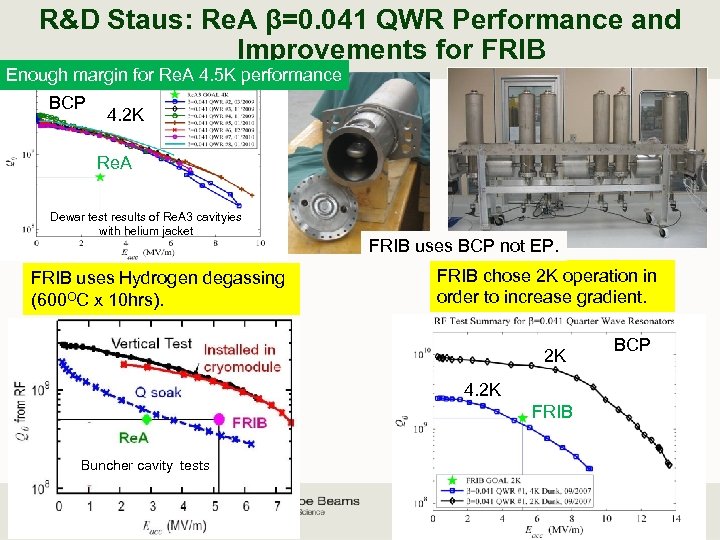
R&D Staus: Re. A β=0. 041 QWR Performance and Improvements for FRIB Enough margin for Re. A 4. 5 K performance BCP 4. 2 K Re. A Dewar test results of Re. A 3 cavityies with helium jacket FRIB uses Hydrogen degassing (600 OC x 10 hrs). FRIB uses BCP not EP. FRIB chose 2 K operation in order to increase gradient. 2 K BCP 4. 2 K FRIB Buncher cavity tests Cold mass assembly Best results (naked cavity dunk test) A. Facco, April 2012 Lehman Review - B 08, Slide 14
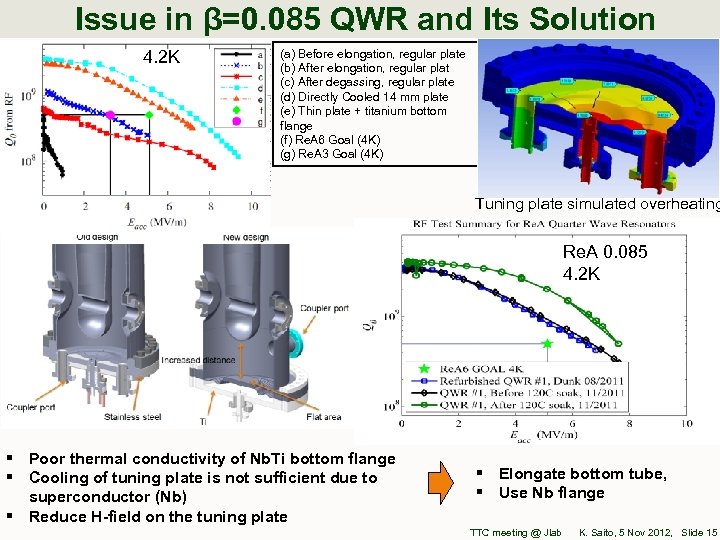
Issue in β=0. 085 QWR and Its Solution 4. 2 K (a) Before elongation, regular plate (b) After elongation, regular plat (c) After degassing, regular plate (d) Directly Cooled 14 mm plate (e) Thin plate + titanium bottom flange (f) Re. A 6 Goal (4 K) (g) Re. A 3 Goal (4 K) Tuning plate simulated overheating Re. A 0. 085 4. 2 K § Poor thermal conductivity of Nb. Ti bottom flange § Cooling of tuning plate is not sufficient due to superconductor (Nb) § Reduce H-field on the tuning plate § Elongate bottom tube, § Use Nb flange TTC meeting @ Jlab K. Saito, 5 Nov 2012, Slide 15
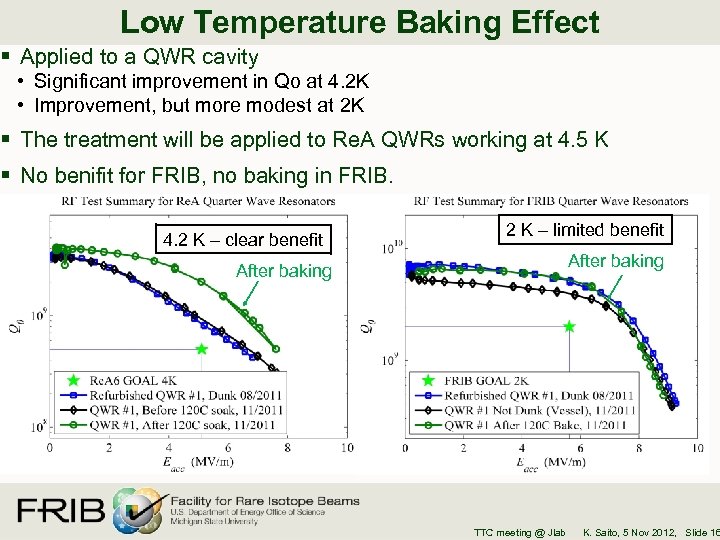
Low Temperature Baking Effect § Applied to a QWR cavity • Significant improvement in Qo at 4. 2 K • Improvement, but more modest at 2 K § The treatment will be applied to Re. A QWRs working at 4. 5 K § No benifit for FRIB, no baking in FRIB. 4. 2 K – clear benefit 2 K – limited benefit After baking TTC meeting @ Jlab K. Saito, 5 Nov 2012, Slide 16
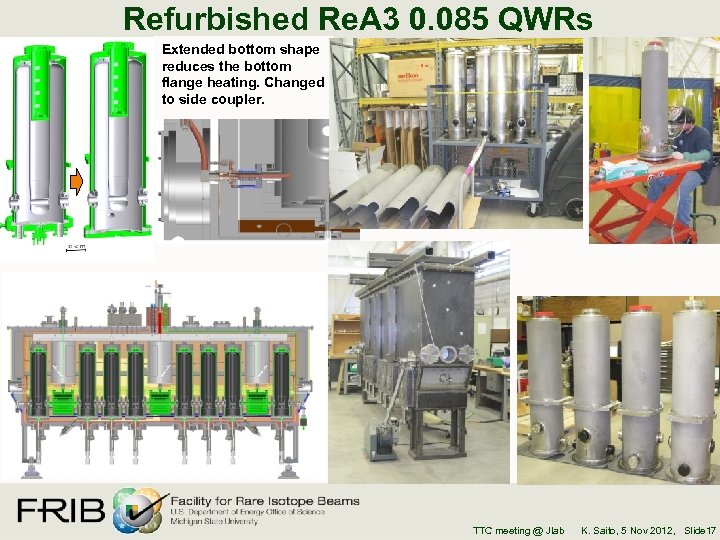
Refurbished Re. A 3 0. 085 QWRs Extended bottom shape reduces the bottom flange heating. Changed to side coupler. TTC meeting @ Jlab K. Saito, 5 Nov 2012, Slide 17
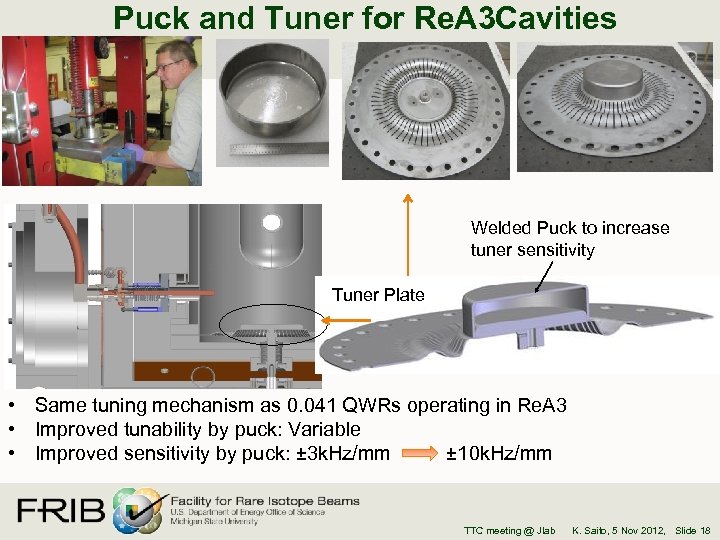
Puck and Tuner for Re. A 3 Cavities Welded Puck to increase tuner sensitivity Tuner Plate • Same tuning mechanism as 0. 041 QWRs operating in Re. A 3 • Improved tunability by puck: Variable • Improved sensitivity by puck: ± 3 k. Hz/mm ± 10 k. Hz/mm TTC meeting @ Jlab FRIB ASD, , Slide 1819 June 2012 K. Saito, 5 Nov 2012, Slide 18
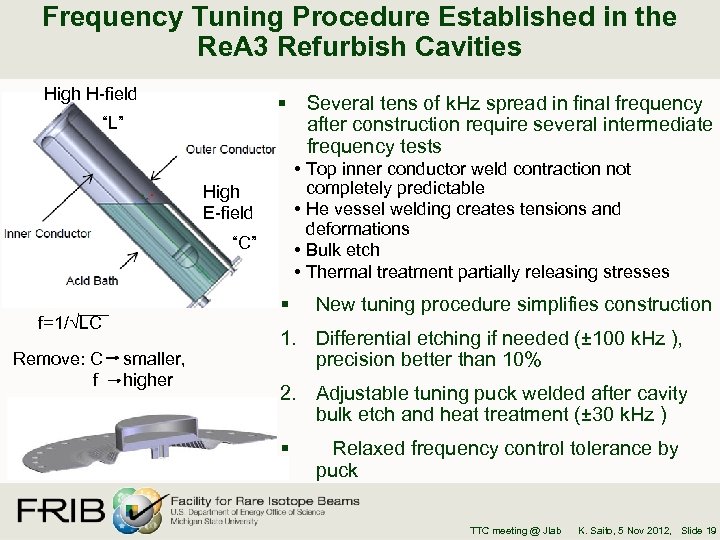
Frequency Tuning Procedure Established in the Re. A 3 Refurbish Cavities High H-field § Several tens of k. Hz spread in final frequency after construction require several intermediate frequency tests “L” • Top inner conductor weld contraction not completely predictable • He vessel welding creates tensions and deformations • Bulk etch • Thermal treatment partially releasing stresses High E-field “C” § f=1/√LC Remove: C f smaller, higher New tuning procedure simplifies construction 1. Differential etching if needed (± 100 k. Hz ), precision better than 10% 2. Adjustable tuning puck welded after cavity bulk etch and heat treatment (± 30 k. Hz ) § Relaxed frequency control tolerance by puck TTC meeting @ Jlab FRIB ASD, , Slide 1919 June 2012 K. Saito, 5 Nov 2012, Slide 19
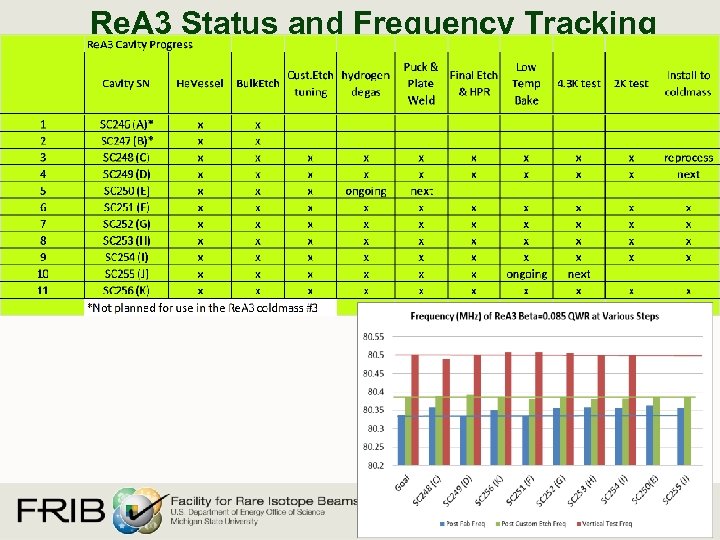
Re. A 3 Status and Frequency Tracking Revision 31 Oct 2012 L. Popielarski
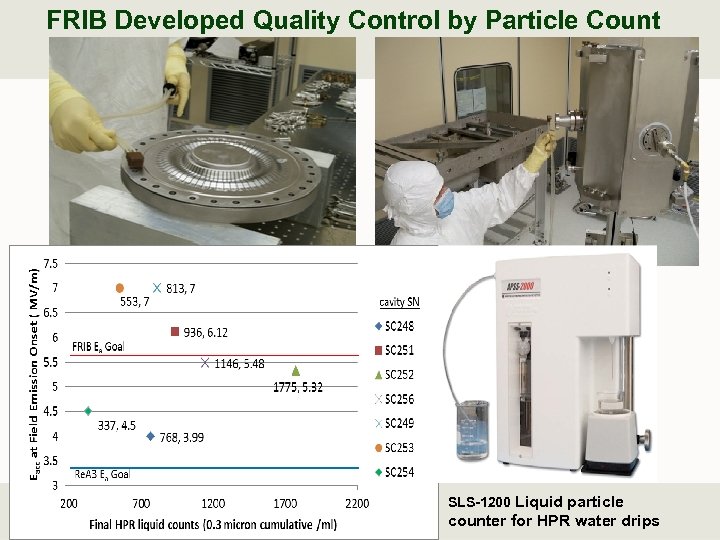
FRIB Developed Quality Control by Particle Count SLS-1200 Liquid particle counter for HPR water drips
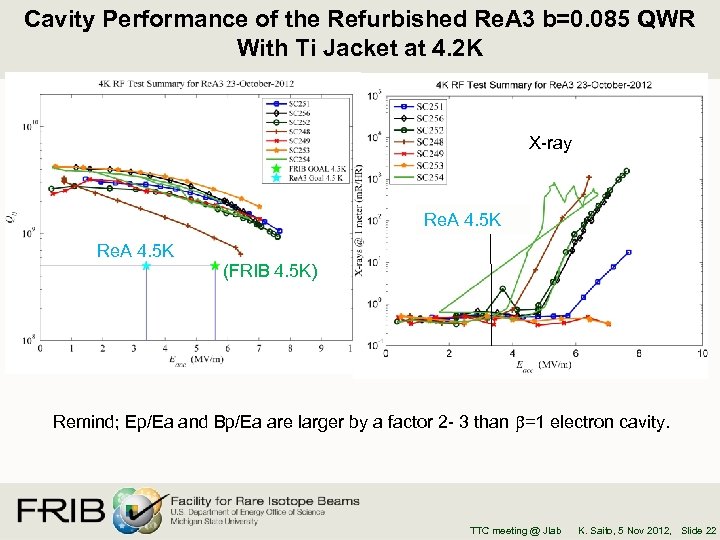
Cavity Performance of the Refurbished Re. A 3 b=0. 085 QWR With Ti Jacket at 4. 2 K X-ray Re. A 4. 5 K (FRIB 4. 5 K) Remind; Ep/Ea and Bp/Ea are larger by a factor 2 - 3 than =1 electron cavity. TTC meeting @ Jlab K. Saito, 5 Nov 2012, Slide 22
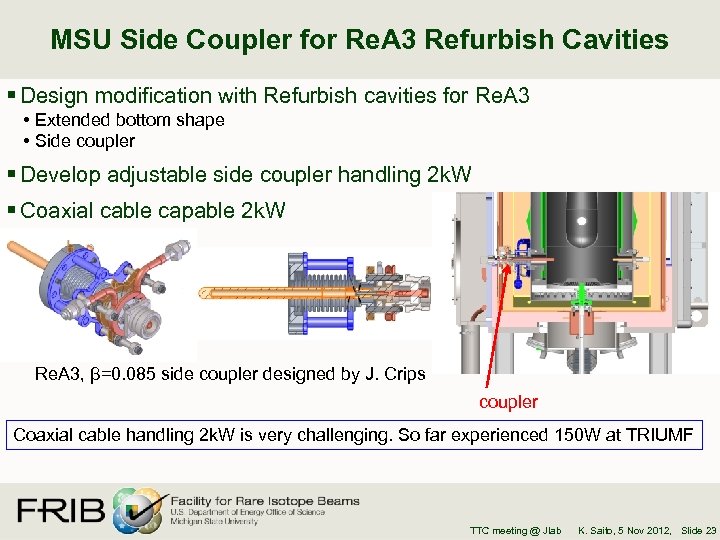
MSU Side Coupler for Re. A 3 Refurbish Cavities § Design modification with Refurbish cavities for Re. A 3 • Extended bottom shape • Side coupler § Develop adjustable side coupler handling 2 k. W § Coaxial cable capable 2 k. W Re. A 3, β=0. 085 side coupler designed by J. Crips coupler Coaxial cable handling 2 k. W is very challenging. So far experienced 150 W at TRIUMF TTC meeting @ Jlab FRIB ASD, , Slide 2319 June 2012 K. Saito, 5 Nov 2012, Slide 23
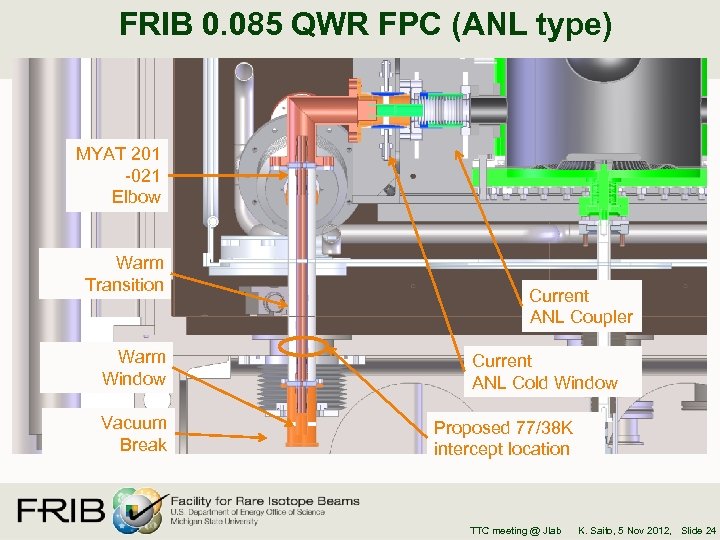
FRIB 0. 085 QWR FPC (ANL type) MYAT 201 -021 Elbow Warm Transition Warm Window Vacuum Break Current ANL Coupler Current ANL Cold Window Proposed 77/38 K intercept location TTC meeting @ Jlab FRIB ASD, , Slide 2419 June 2012 K. Saito, 5 Nov 2012, Slide 24
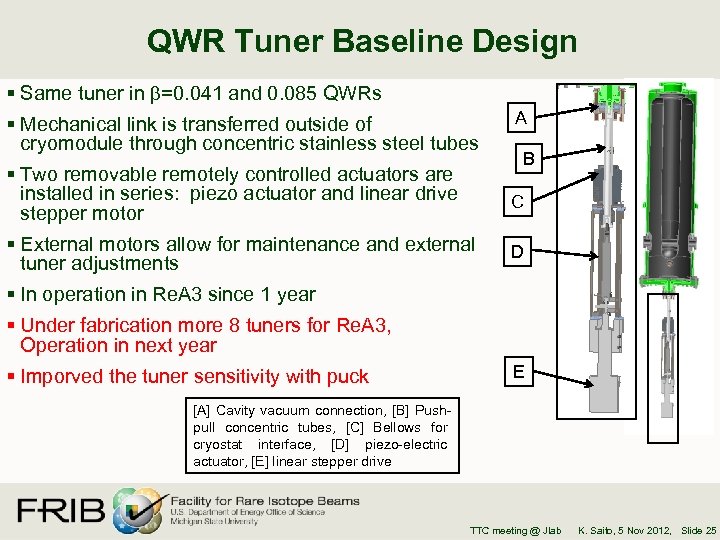
QWR Tuner Baseline Design § Same tuner in =0. 041 and 0. 085 QWRs § Mechanical link is transferred outside of cryomodule through concentric stainless steel tubes A B § Two removable remotely controlled actuators are installed in series: piezo actuator and linear drive stepper motor C § External motors allow for maintenance and external tuner adjustments D § In operation in Re. A 3 since 1 year § Under fabrication more 8 tuners for Re. A 3, Operation in next year § Imporved the tuner sensitivity with puck E [A] Cavity vacuum connection, [B] Pushpull concentric tubes, [C] Bellows for cryostat interface, [D] piezo-electric actuator, [E] linear stepper drive TTC meeting @ Jlab FRIB ASD, , Slide 2519 June 2012 K. Saito, 5 Nov 2012, Slide 25
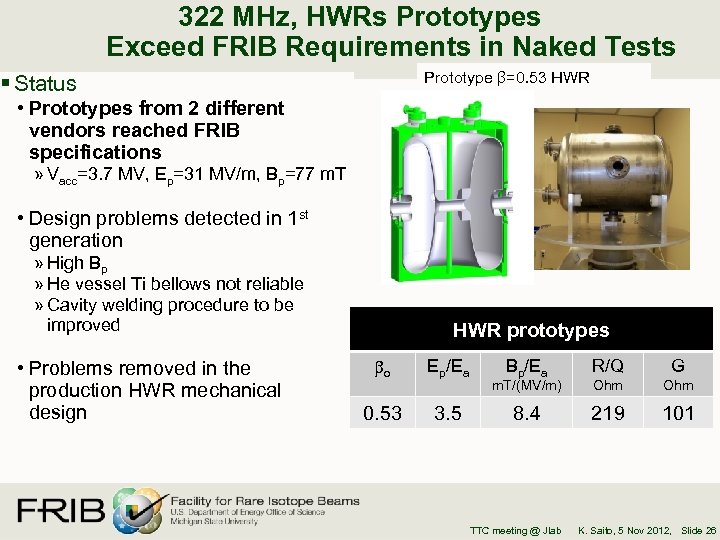
322 MHz, HWRs Prototypes Exceed FRIB Requirements in Naked Tests Prototype β=0. 53 HWR § Status • Prototypes from 2 different vendors reached FRIB specifications » Vacc=3. 7 MV, Ep=31 MV/m, Bp=77 m. T • Design problems detected in 1 st generation » High Bp » He vessel Ti bellows not reliable » Cavity welding procedure to be improved • Problems removed in the production HWR mechanical design HWR prototypes o Ep/Ea 0. 53 3. 5 Bp/Ea R/Q G m. T/(MV/m) Ohm 8. 4 219 101 TTC meeting @ Jlab K. Saito, 5 Nov 2012, Slide 26
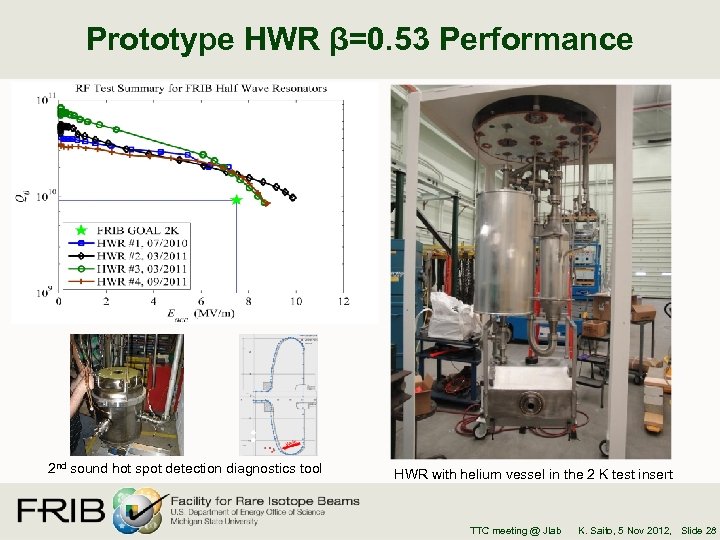
Prototype HWR β=0. 53 Performance 2 nd sound hot spot detection diagnostics tool HWR with helium vessel in the 2 K test insert TTC meeting @ Jlab K. Saito, 5 Nov 2012, Slide 28
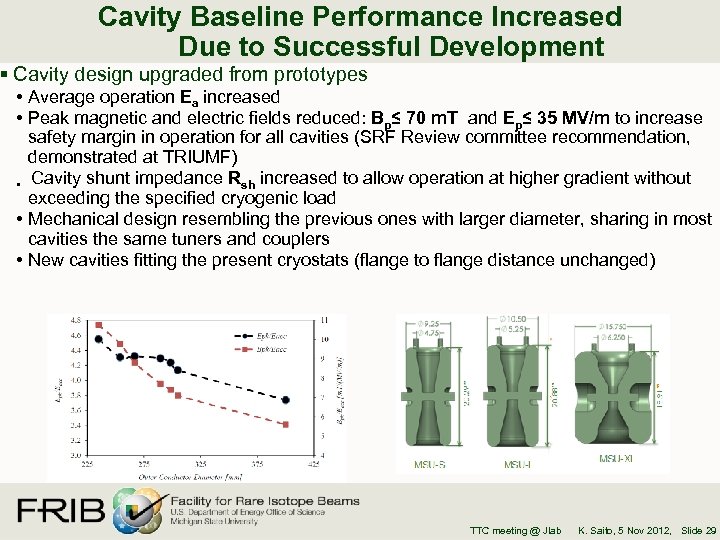
Cavity Baseline Performance Increased Due to Successful Development § Cavity design upgraded from prototypes • Average operation Ea increased • Peak magnetic and electric fields reduced: Bp≤ 70 m. T and Ep≤ 35 MV/m to increase safety margin in operation for all cavities (SRF Review committee recommendation, demonstrated at TRIUMF) • Cavity shunt impedance Rsh increased to allow operation at higher gradient without exceeding the specified cryogenic load • Mechanical design resembling the previous ones with larger diameter, sharing in most cavities the same tuners and couplers • New cavities fitting the present cryostats (flange to flange distance unchanged) TTC meeting @ Jlab K. Saito, 5 Nov 2012, Slide 29
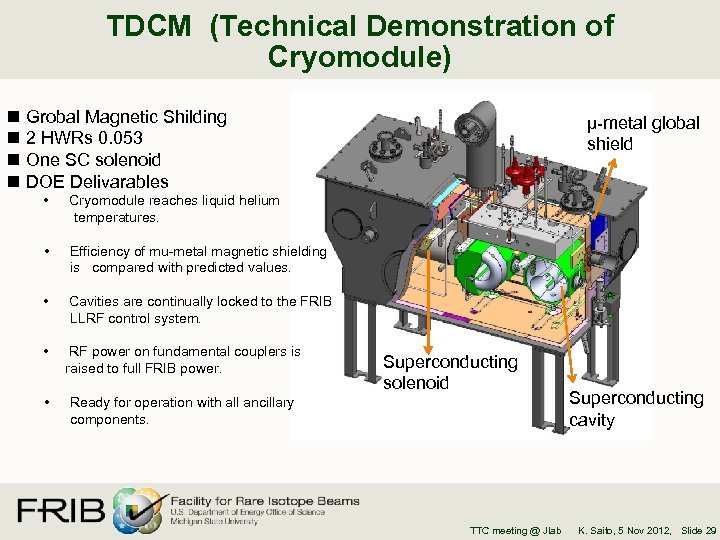
TDCM (Technical Demonstration of Cryomodule) n Grobal Magnetic Shilding n 2 HWRs 0. 053 n One SC solenoid n DOE Delivarables • Cryomodule reaches liquid helium temperatures. • Efficiency of mu-metal magnetic shielding is compared with predicted values. • Cavities are continually locked to the FRIB LLRF control system. • RF power on fundamental couplers is raised to full FRIB power. • µ-metal global shield Ready for operation with all ancillary components. Superconducting solenoid TTC meeting @ Jlab Superconducting cavity K. Saito, 5 Nov 2012, Slide 29
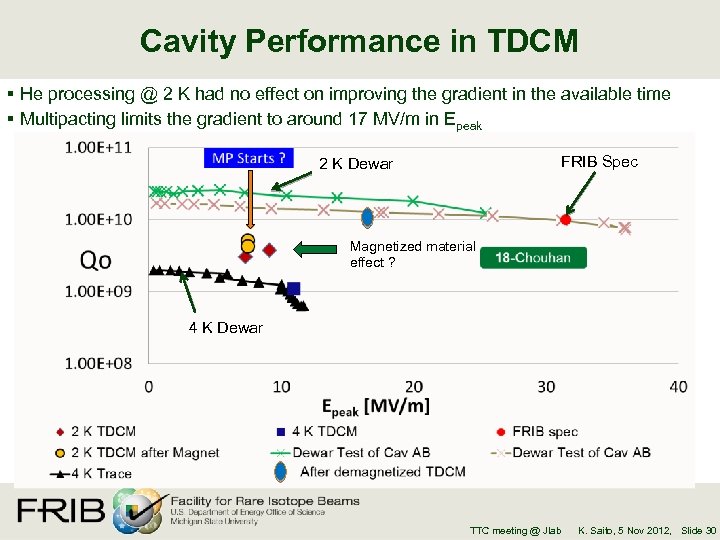
Cavity Performance in TDCM § He processing @ 2 K had no effect on improving the gradient in the available time § Multipacting limits the gradient to around 17 MV/m in Epeak FRIB Spec 2 K Dewar Magnetized material effect ? 4 K Dewar TTC meeting @ Jlab K. Saito, 5 Nov 2012, Slide 30
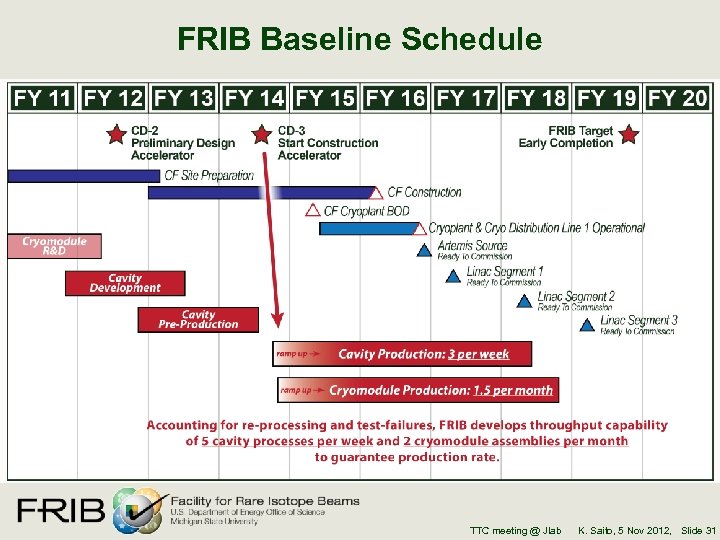
FRIB Baseline Schedule TTC meeting @ Jlab , Slide 31 K. Saito, 5 Nov 2012, Slide 31
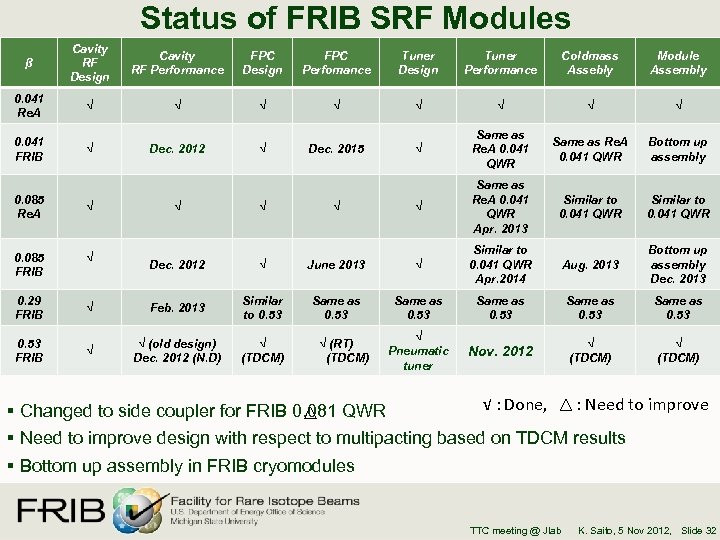
Status of FRIB SRF Modules β Cavity RF Design Cavity RF Performance FPC Design FPC Perfomance Tuner Design Tuner Performance Coldmass Assebly Module Assembly 0. 041 Re. A √ √ √ √ √ Same as Re. A 0. 041 QWR Bottom up assembly √ Same as Re. A 0. 041 QWR Apr. 2013 Similar to 0. 041 QWR Aug. 2013 Bottom up assembly Dec. 2013 0. 041 FRIB 0. 085 Re. A 0. 085 FRIB √ √ √ Dec. 2012 √ √ √ Dec. 2015 √ Dec. 2012 √ June 2013 √ Similar to 0. 041 QWR Apr. 2014 Same as 0. 53 √ Pneumatic tuner Nov. 2012 √ (TDCM) 0. 29 FRIB √ Feb. 2013 Similar to 0. 53 FRIB √ √ (old design) Dec. 2012 (N. D) √ (TDCM) √ (RT) (TDCM) √ : Done, : Need to improve § Changed to side coupler for FRIB 0. 081 QWR § Need to improve design with respect to multipacting based on TDCM results § Bottom up assembly in FRIB cryomodules , Slide 32 FRIB ASD, 19 June 2012 TTC meeting @ Jlab K. Saito, 5 Nov 2012, Slide 32
Скачать презентацию Status of FRIB design plans cavity and cryomodule
ad5407f646dcab34dfc4b1440faeec1b.ppt