


 Скачать презентацию Status of DAQ development for ILD-Si ECAL in
75c44e76508382d71a2284272d61813a.ppt
- Количество слайдов: 21
 Status of DAQ development for ILD-Si. ECAL in Kyushu (and more) Taikan Suehara (Kyushu University, Japan) Taikan Suehara, Si. ECAL meeting in Tokyo, 10 Sep. 2014 page 1
 Topics • Communication with Hamamatsu • Idea of test setup for mass production • DAQ – Overall plan – Connecting to EUDAQ Taikan Suehara, Si. ECAL meeting in Tokyo, 10 Sep. 2014 page 2
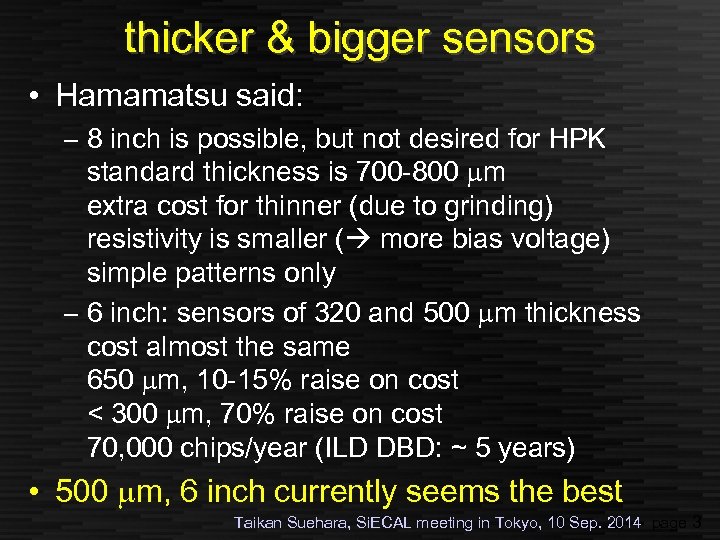 thicker & bigger sensors • Hamamatsu said: – 8 inch is possible, but not desired for HPK standard thickness is 700 -800 mm extra cost for thinner (due to grinding) resistivity is smaller ( more bias voltage) simple patterns only – 6 inch: sensors of 320 and 500 mm thickness cost almost the same 650 mm, 10 -15% raise on cost < 300 mm, 70% raise on cost 70, 000 chips/year (ILD DBD: ~ 5 years) • 500 mm, 6 inch currently seems the best Taikan Suehara, Si. ECAL meeting in Tokyo, 10 Sep. 2014 page 3
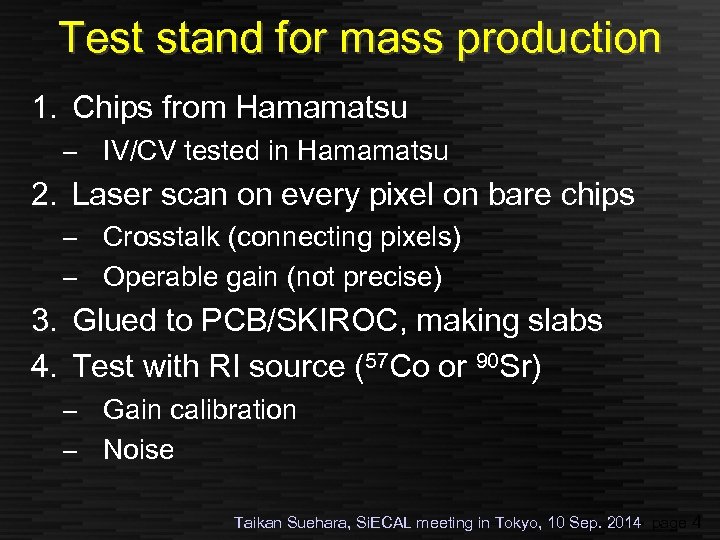 Test stand for mass production 1. Chips from Hamamatsu – IV/CV tested in Hamamatsu 2. Laser scan on every pixel on bare chips – Crosstalk (connecting pixels) – Operable gain (not precise) 3. Glued to PCB/SKIROC, making slabs 4. Test with RI source (57 Co or 90 Sr) – Gain calibration – Noise Taikan Suehara, Si. ECAL meeting in Tokyo, 10 Sep. 2014 page 4
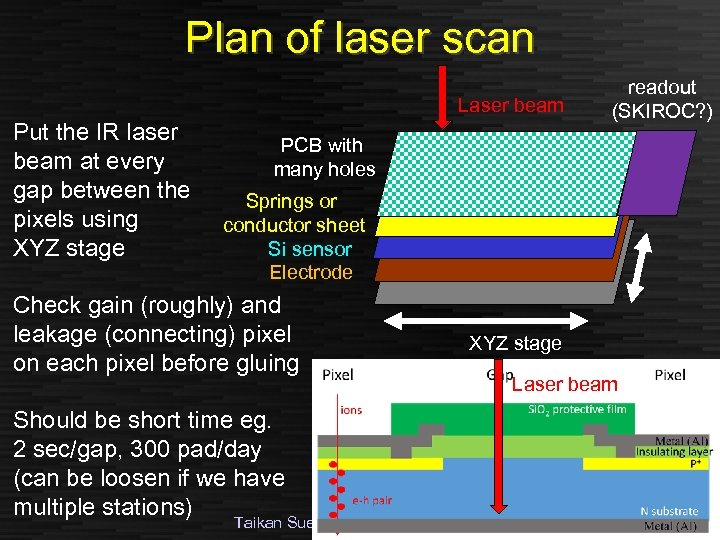 Plan of laser scan Put the IR laser beam at every gap between the pixels using XYZ stage Laser beam readout (SKIROC? ) PCB with many holes Springs or conductor sheet Si sensor Electrode Check gain (roughly) and leakage (connecting) pixel on each pixel before gluing Should be short time eg. 2 sec/gap, 300 pad/day (can be loosen if we have multiple stations) XYZ stage Laser beam Taikan Suehara, Si. ECAL meeting in Tokyo, 10 Sep. 2014 page 5
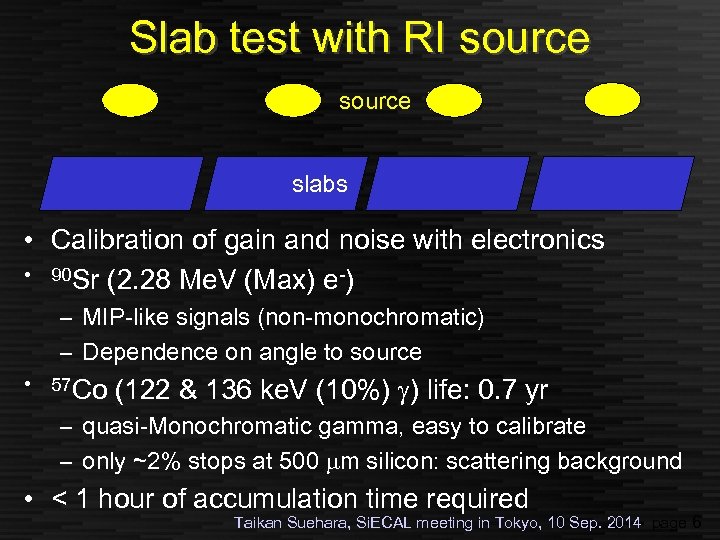 Slab test with RI source slabs • Calibration of gain and noise with electronics • 90 Sr (2. 28 Me. V (Max) e-) – MIP-like signals (non-monochromatic) – Dependence on angle to source • 57 Co (122 & 136 ke. V (10%) g) life: 0. 7 yr – quasi-Monochromatic gamma, easy to calibrate – only ~2% stops at 500 mm silicon: scattering background • < 1 hour of accumulation time required Taikan Suehara, Si. ECAL meeting in Tokyo, 10 Sep. 2014 page 6
 Plan to assemble a test station • 57 Co • • • will arrive in Oct. 90 Sr already available XYZ automated stage: order soon PCB with holes: should design DAQ: firstly CAMAC with non-full channel (eg. 16 channels) Plan to establish them within this fiscal year (~Mar. 2015) DAQ with SKIROC: next fiscal year Taikan Suehara, Si. ECAL meeting in Tokyo, 10 Sep. 2014 page 7
 DAQ Taikan Suehara, Si. ECAL meeting in Tokyo, 10 Sep. 2014 page 8
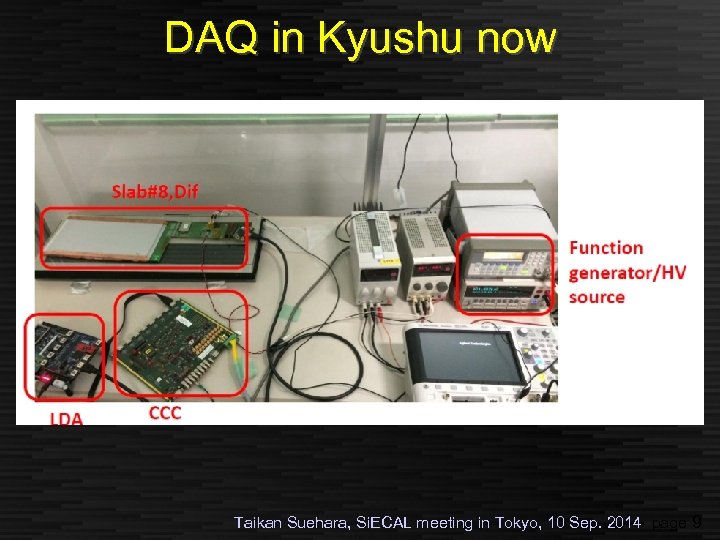 DAQ in Kyushu now Taikan Suehara, Si. ECAL meeting in Tokyo, 10 Sep. 2014 page 9
 DAQ development plans in Kyushu Ongoing 1. Online monitor (talk by H. Hirai) 2. Connection to external framework (EUDAQ or others) Planned after looking at new calicoes 1. Flexible logging system 2. C++ support module 3. Enforce analysis/debugging Taikan Suehara, Si. ECAL meeting in Tokyo, 10 Sep. 2014 page 10
 Topics about EUDAQ connection • Structure • Data format (LCIO) • Schedule/Plan Taikan Suehara, Si. ECAL meeting in Tokyo, 10 Sep. 2014 page 11
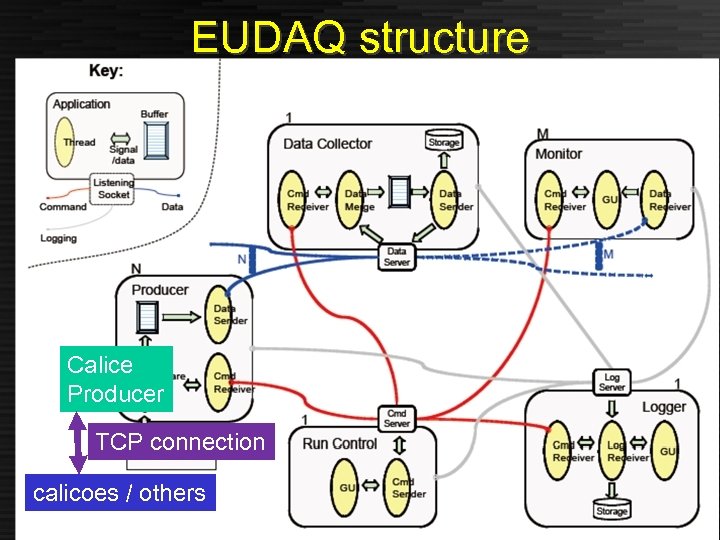 EUDAQ structure Calice Producer TCP connection calicoes / others Taikan Suehara, Si. ECAL meeting in Tokyo, 10 Sep. 2014 page 12
 Data format in LCIO 1. Store ‘hit’-like objects • • We have ‘Calorimeter. Hit’ class in LCIO Need threshold – not always suitable for lowlevel analysis (cross talk etc. ) 2. Store simple array of raw data planned • • • More flexibility; hit-like data can be created from the raw array Need more steps for high-level analysis No specific LCIO structure, use LCGeneric. Object with attachment class Taikan Suehara, Si. ECAL meeting in Tokyo, 10 Sep. 2014 page 13
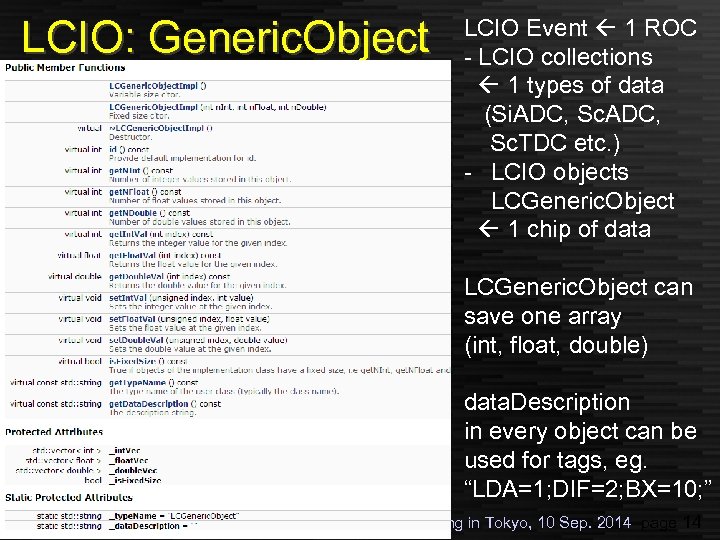 LCIO: Generic. Object LCIO Event 1 ROC - LCIO collections 1 types of data (Si. ADC, Sc. TDC etc. ) - LCIO objects LCGeneric. Object 1 chip of data LCGeneric. Object can save one array (int, float, double) data. Description in every object can be used for tags, eg. “LDA=1; DIF=2; BX=10; ” Taikan Suehara, Si. ECAL meeting in Tokyo, 10 Sep. 2014 page 14
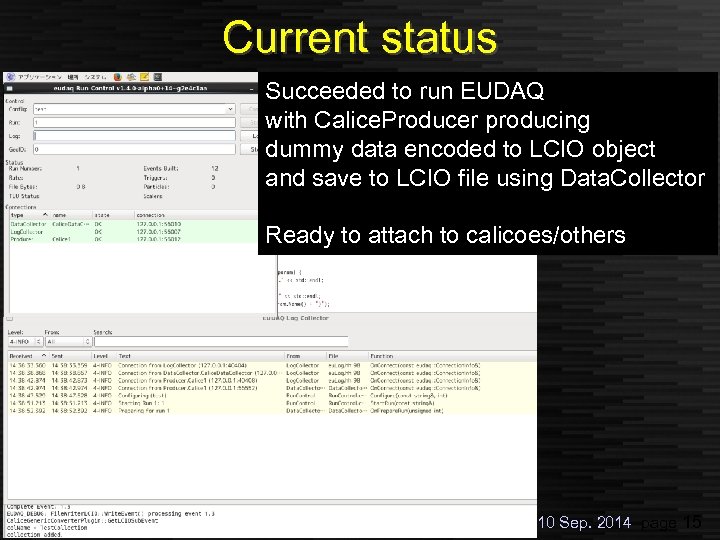 Current status Succeeded to run EUDAQ with Calice. Producer producing dummy data encoded to LCIO object and save to LCIO file using Data. Collector Ready to attach to calicoes/others Taikan Suehara, Si. ECAL meeting in Tokyo, 10 Sep. 2014 page 15
 Things to do EUDAQ part • Writing TCP adapter • Converter from raw to LCIO (if needed) calicoes part • Attachment of calicoes to output data to TCP • Integration and test • Testbeam at CERN: 26 Nov. – 8 Dec. Taikan Suehara, Si. ECAL meeting in Tokyo, 10 Sep. 2014 page 16
 Summary • We started to work on DAQ (Thanks to LLR and DESY for sending us setup) • Our first target is the testbeam Nov. -Dec. • Base software is updating: we’d like to adapt to it • We’ll also work on prototype of test facility Taikan Suehara, Si. ECAL meeting in Tokyo, 10 Sep. 2014 page 17
 Taikan Suehara, Si. ECAL meeting in Tokyo, 10 Sep. 2014 page 18
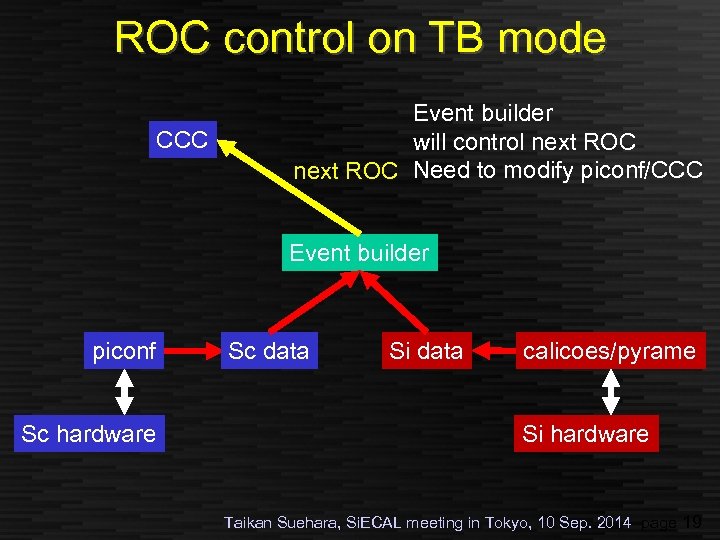 ROC control on TB mode CCC Event builder will control next ROC Need to modify piconf/CCC Event builder piconf Sc hardware Sc data Si data calicoes/pyrame Si hardware Taikan Suehara, Si. ECAL meeting in Tokyo, 10 Sep. 2014 page 19
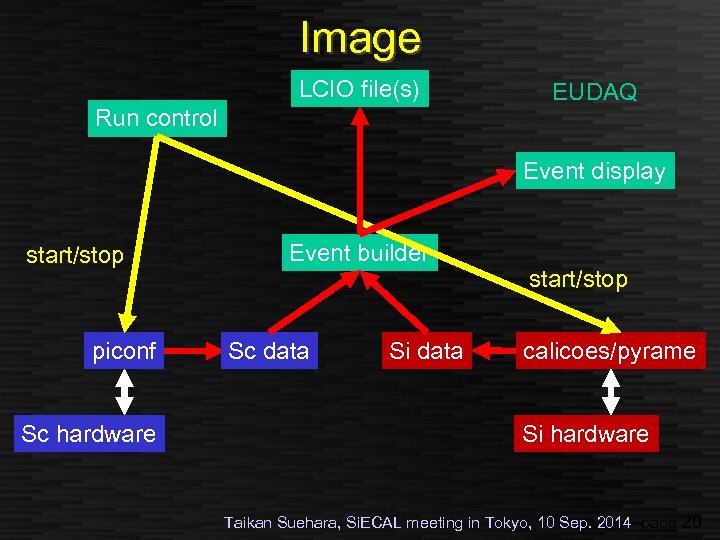 Image Run control LCIO file(s) EUDAQ Event display start/stop piconf Sc hardware Event builder Sc data Si data start/stop calicoes/pyrame Si hardware Taikan Suehara, Si. ECAL meeting in Tokyo, 10 Sep. 2014 page 20
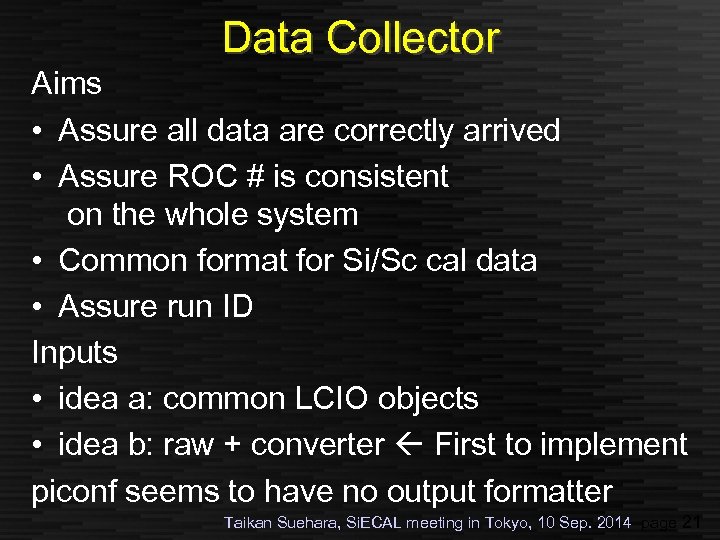 Data Collector Aims • Assure all data are correctly arrived • Assure ROC # is consistent on the whole system • Common format for Si/Sc cal data • Assure run ID Inputs • idea a: common LCIO objects • idea b: raw + converter First to implement piconf seems to have no output formatter Taikan Suehara, Si. ECAL meeting in Tokyo, 10 Sep. 2014 page 21