 Скачать презентацию Status of ADF System Design November 2002 D
4882646c344e828dbbe040df966aad90.ppt
- Количество слайдов: 64



Status of ADF System Design November 2002 D. Calvet DSM/DAPNIA/SEDI, CEA Saclay 91191 Gif-sur-Yvette Cedex
Content • Algorithm and Simulation • Analog Splitters • ADF board • ADF crate • Timing card • Test bench • Software • Summary calvet@hep. saclay. cea. fr 2 Saclay, 4 November 2002
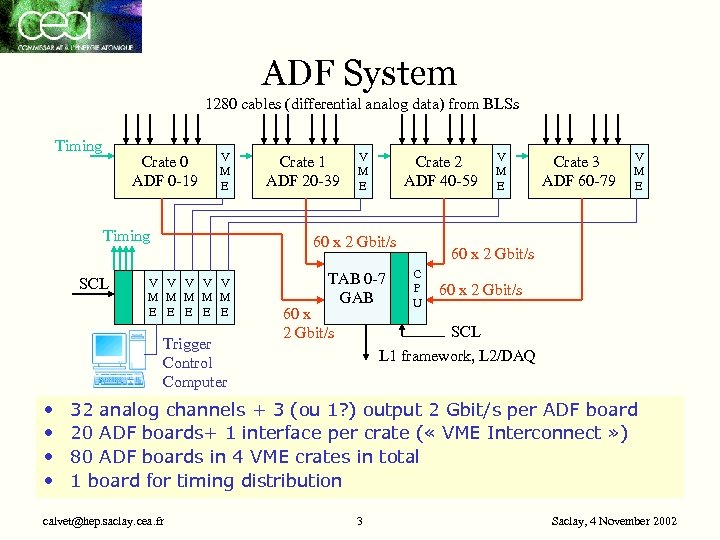
ADF System 1280 cables (differential analog data) from BLSs Timing Crate 0 ADF 0 -19 V M E Timing SCL V M E Crate 2 ADF 40 -59 60 x 2 Gbit/s V V V M M M E E E Trigger Control Computer • • Crate 1 ADF 20 -39 TAB 0 -7 GAB 60 x 2 Gbit/s V M E Crate 3 ADF 60 -79 V M E 60 x 2 Gbit/s C P U 60 x 2 Gbit/s SCL L 1 framework, L 2/DAQ 32 analog channels + 3 (ou 1? ) output 2 Gbit/s per ADF board 20 ADF boards+ 1 interface per crate ( « VME Interconnect » ) 80 ADF boards in 4 VME crates in total 1 board for timing distribution calvet@hep. saclay. cea. fr 3 Saclay, 4 November 2002
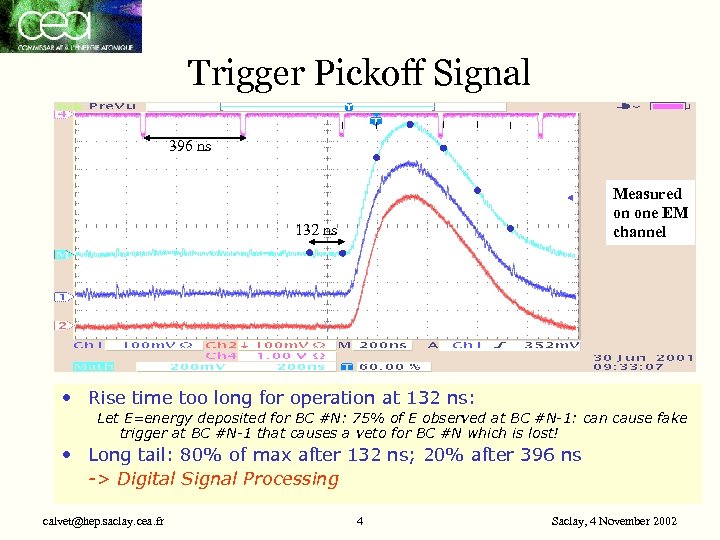
Trigger Pickoff Signal 396 ns Measured on one EM channel 132 ns • Rise time too long for operation at 132 ns: Let E=energy deposited for BC #N: 75% of E observed at BC #N-1: can cause fake trigger at BC #N-1 that causes a veto for BC #N which is lost! • Long tail: 80% of max after 132 ns; 20% after 396 ns -> Digital Signal Processing calvet@hep. saclay. cea. fr 4 Saclay, 4 November 2002
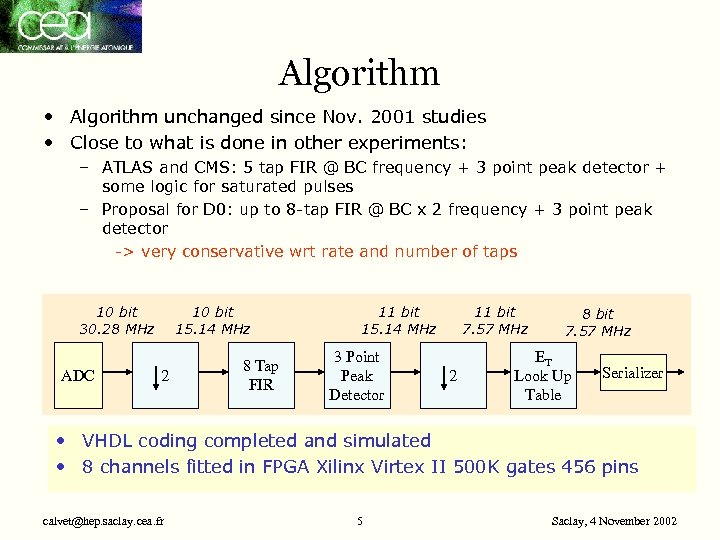
Algorithm • Algorithm unchanged since Nov. 2001 studies • Close to what is done in other experiments: – ATLAS and CMS: 5 tap FIR @ BC frequency + 3 point peak detector + some logic for saturated pulses – Proposal for D 0: up to 8 -tap FIR @ BC x 2 frequency + 3 point peak detector -> very conservative wrt rate and number of taps 10 bit 30. 28 MHz ADC 10 bit 15. 14 MHz 2 8 Tap FIR 11 bit 15. 14 MHz 3 Point Peak Detector 11 bit 7. 57 MHz 2 8 bit 7. 57 MHz ET Look Up Table Serializer • VHDL coding completed and simulated • 8 channels fitted in FPGA Xilinx Virtex II 500 K gates 456 pins calvet@hep. saclay. cea. fr 5 Saclay, 4 November 2002
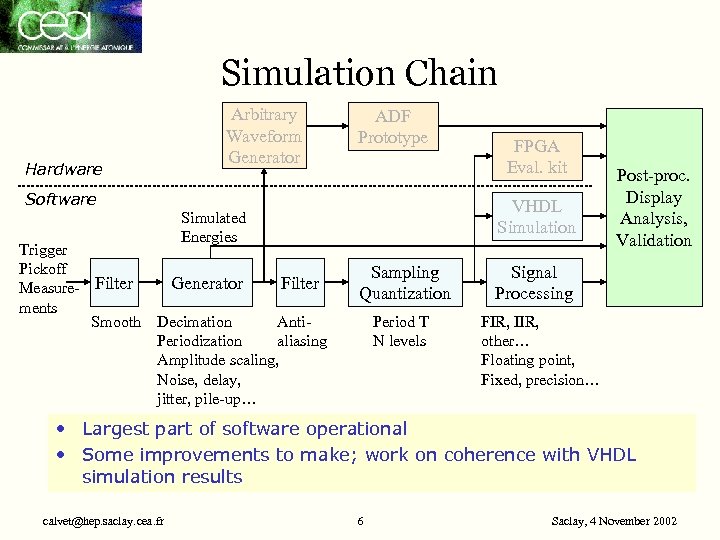
Simulation Chain Arbitrary Waveform Generator Hardware ADF Prototype Software Trigger Pickoff Measure- Filter ments Smooth VHDL Simulation Simulated Energies Generator FPGA Eval. kit Filter Sampling Quantization Decimation Anti. Periodization aliasing Amplitude scaling, Noise, delay, jitter, pile-up… Period T N levels Post-proc. Display Analysis, Validation Signal Processing FIR, IIR, other… Floating point, Fixed, precision… • Largest part of software operational • Some improvements to make; work on coherence with VHDL simulation results calvet@hep. saclay. cea. fr 6 Saclay, 4 November 2002
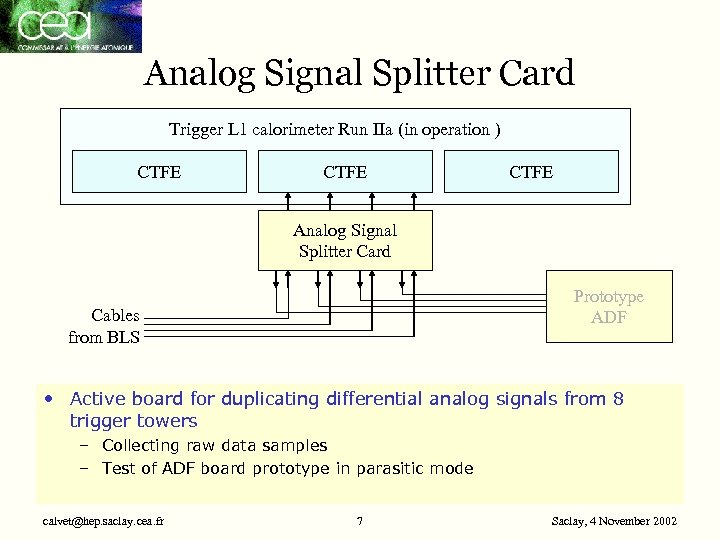
Analog Signal Splitter Card Trigger L 1 calorimeter Run IIa (in operation ) CTFE Analog Signal Splitter Card Prototype ADF Cables from BLS • Active board for duplicating differential analog signals from 8 trigger towers – Collecting raw data samples – Test of ADF board prototype in parasitic mode calvet@hep. saclay. cea. fr 7 Saclay, 4 November 2002
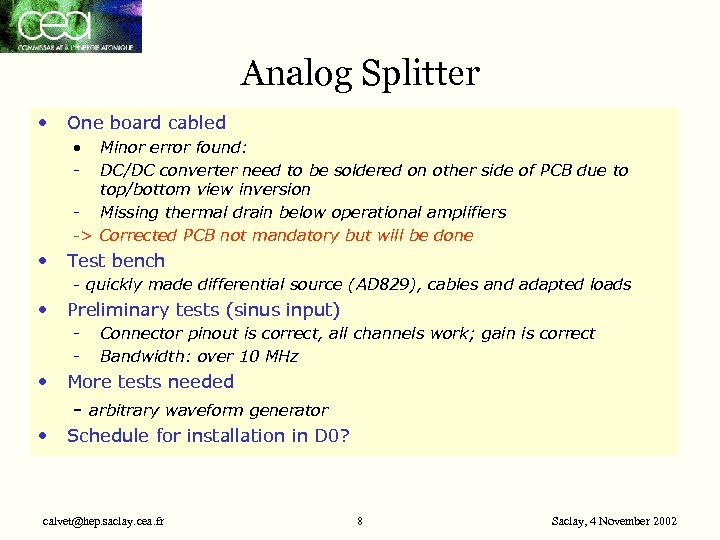
Analog Splitter • One board cabled • - Minor error found: DC/DC converter need to be soldered on other side of PCB due to top/bottom view inversion - Missing thermal drain below operational amplifiers -> Corrected PCB not mandatory but will be done • Test bench - quickly made differential source (AD 829), cables and adapted loads • Preliminary tests (sinus input) - • Connector pinout is correct, all channels work; gain is correct Bandwidth: over 10 MHz More tests needed - arbitrary waveform generator • Schedule for installation in D 0? calvet@hep. saclay. cea. fr 8 Saclay, 4 November 2002
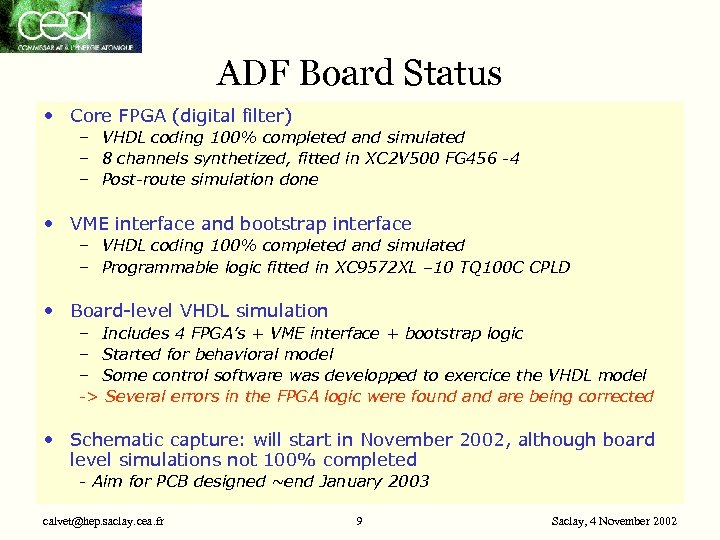
ADF Board Status • Core FPGA (digital filter) – VHDL coding 100% completed and simulated – 8 channels synthetized, fitted in XC 2 V 500 FG 456 -4 – Post-route simulation done • VME interface and bootstrap interface – VHDL coding 100% completed and simulated – Programmable logic fitted in XC 9572 XL – 10 TQ 100 C CPLD • Board-level VHDL simulation – Includes 4 FPGA’s + VME interface + bootstrap logic – Started for behavioral model – Some control software was developped to exercice the VHDL model -> Several errors in the FPGA logic were found are being corrected • Schematic capture: will start in November 2002, although board level simulations not 100% completed - Aim for PCB designed ~end January 2003 calvet@hep. saclay. cea. fr 9 Saclay, 4 November 2002
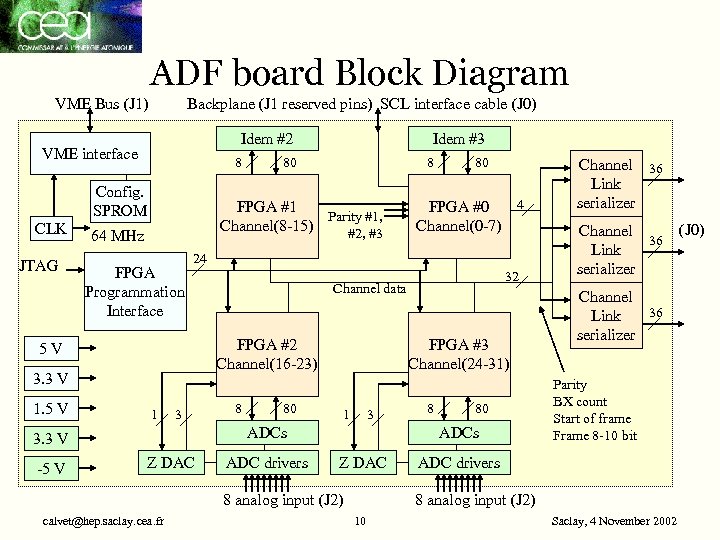
ADF board Block Diagram VME Bus (J 1) Backplane (J 1 reserved pins) SCL interface cable (J 0) Idem #2 VME interface CLK JTAG 8 Config. SPROM 64 MHz 8 FPGA Programmation Interface 3 Z DAC 32 8 80 FPGA #3 Channel(24 -31) 1 3 ADCs 3. 3 V ADC drivers 8 80 ADCs Z DAC 8 analog input (J 2) calvet@hep. saclay. cea. fr 4 FPGA #0 Channel(0 -7) Channel data FPGA #2 Channel(16 -23) 1 80 24 3. 3 V -5 V 80 FPGA #1 Parity #1, Channel(8 -15) #2, #3 5 V 1. 5 V Idem #3 Channel 36 Link serializer Parity BX count Start of frame Frame 8 -10 bit ADC drivers 8 analog input (J 2) 10 Saclay, 4 November 2002 (J 0)
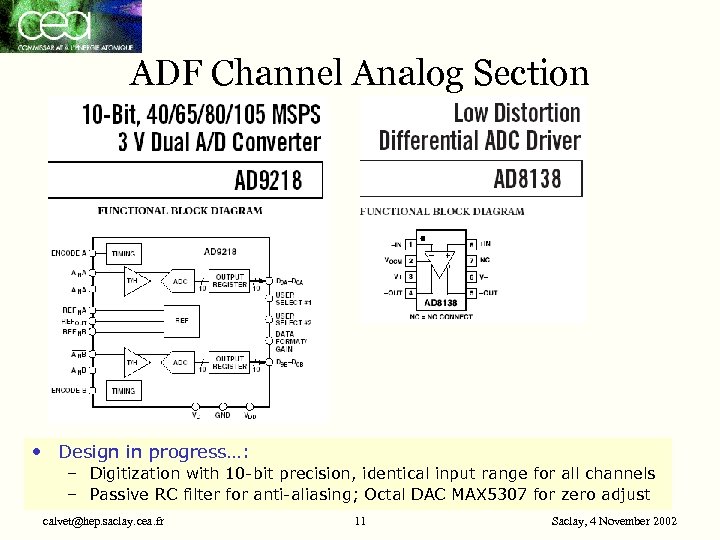
ADF Channel Analog Section • Design in progress…: – Digitization with 10 -bit precision, identical input range for all channels – Passive RC filter for anti-aliasing; Octal DAC MAX 5307 for zero adjust calvet@hep. saclay. cea. fr 11 Saclay, 4 November 2002
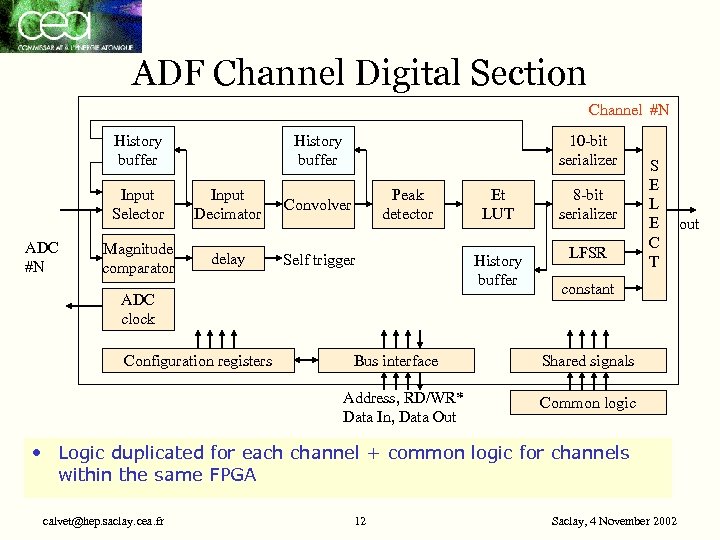
ADF Channel Digital Section Channel #N History buffer 10 -bit serializer Input Selector ADC #N Input Decimator Convolver Peak detector Magnitude comparator delay Self trigger ADC clock Configuration registers Bus interface Address, RD/WR* Data In, Data Out Et LUT History buffer 8 -bit serializer LFSR S E L E C T constant Shared signals Common logic • Logic duplicated for each channel + common logic for channels within the same FPGA calvet@hep. saclay. cea. fr 12 Saclay, 4 November 2002 out
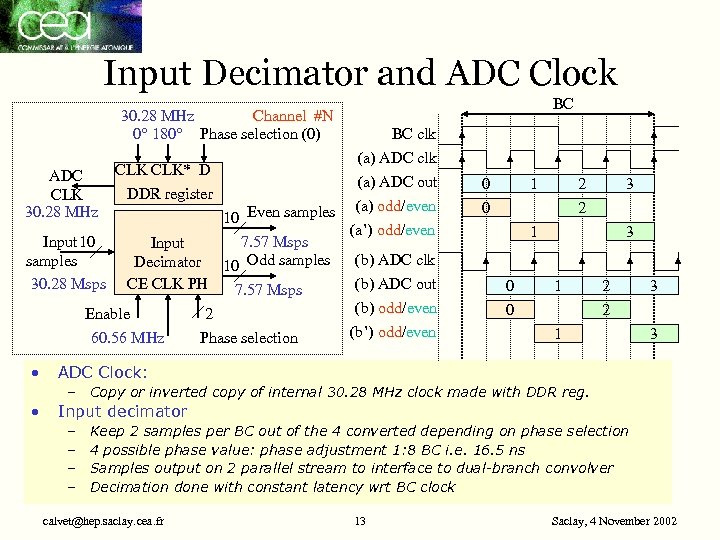
Input Decimator and ADC Clock BC 30. 28 MHz Channel #N 0° 180° Phase selection (0) BC clk (a) ADC clk ADC (a) ADC out CLK (a) odd/even 30. 28 MHz 10 Even samples (a’) odd/even Input 10 7. 57 Msps Input (b) ADC clk samples Decimator 10 Odd samples 30. 28 Msps CE CLK PH (b) ADC out 7. 57 Msps (b) odd/even Enable 2 (b’) odd/even 60. 56 MHz Phase selection CLK* D DDR register • 0 0 1 2 2 3 1 0 0 3 1 2 2 1 3 3 ADC Clock: – Copy or inverted copy of internal 30. 28 MHz clock made with DDR reg. • Input decimator – – Keep 2 samples per BC out of the 4 converted depending on phase selection 4 possible phase value: phase adjustment 1: 8 BC i. e. 16. 5 ns Samples output on 2 parallel stream to interface to dual-branch convolver Decimation done with constant latency wrt BC clock calvet@hep. saclay. cea. fr 13 Saclay, 4 November 2002
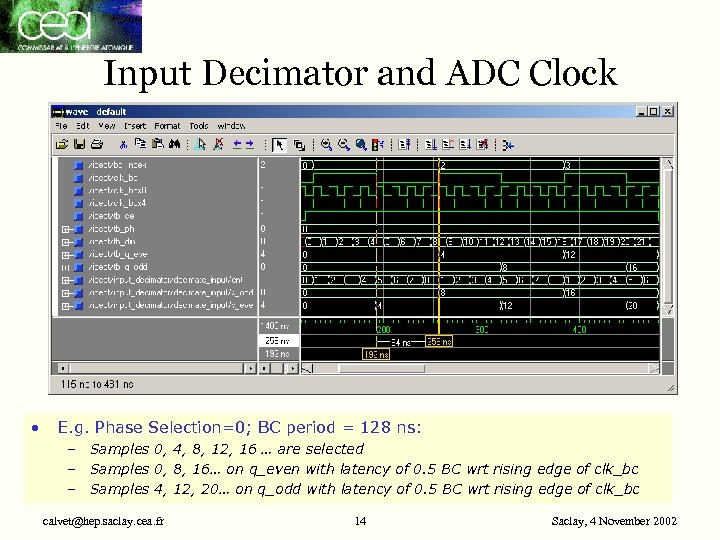
Input Decimator and ADC Clock • E. g. Phase Selection=0; BC period = 128 ns: – Samples 0, 4, 8, 12, 16 … are selected – Samples 0, 8, 16… on q_even with latency of 0. 5 BC wrt rising edge of clk_bc – Samples 4, 12, 20… on q_odd with latency of 0. 5 BC wrt rising edge of clk_bc calvet@hep. saclay. cea. fr 14 Saclay, 4 November 2002
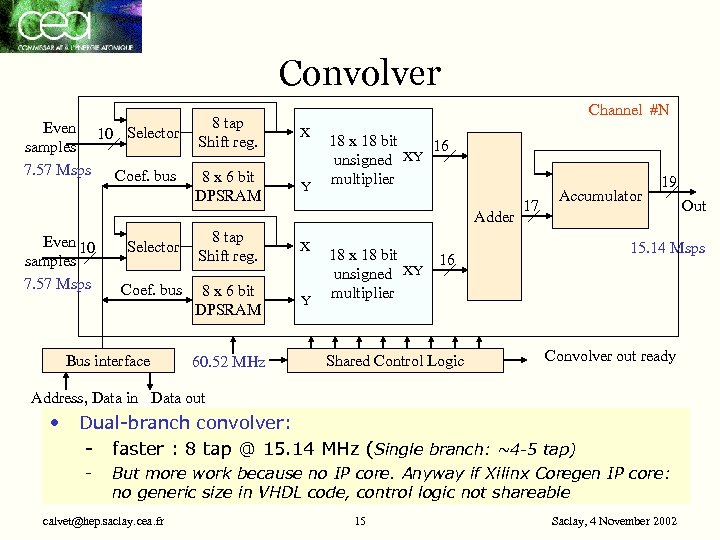
Convolver Even 10 Selector samples 7. 57 Msps Coef. bus Channel #N 8 tap Shift reg. X 8 x 6 bit DPSRAM Y 18 x 18 bit 16 XY unsigned multiplier Adder Even 10 samples 7. 57 Msps Selector Coef. bus Bus interface 8 tap Shift reg. X 8 x 6 bit DPSRAM Y 60. 52 MHz 17 Accumulator Convolver out ready Address, Data in Data out • Dual-branch convolver: - faster : 8 tap @ 15. 14 MHz (Single branch: ~4 -5 tap) - But more work because no IP core. Anyway if Xilinx Coregen IP core: no generic size in VHDL code, control logic not shareable calvet@hep. saclay. cea. fr 15 Out 15. 14 Msps 18 x 18 bit 16 unsigned XY multiplier Shared Control Logic 19 Saclay, 4 November 2002
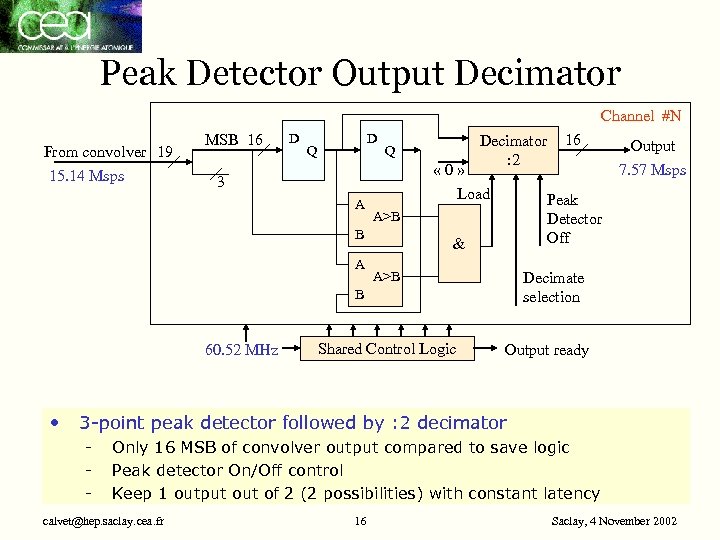
Peak Detector Output Decimator Channel #N From convolver 19 15. 14 Msps MSB 16 D D Q « 0 » Load 3 A & A>B • Shared Control Logic Output 7. 57 Msps Decimate selection B 60. 52 MHz 16 Peak Detector Off A>B B A Decimator : 2 Q Output ready 3 -point peak detector followed by : 2 decimator - Only 16 MSB of convolver output compared to save logic Peak detector On/Off control Keep 1 output of 2 (2 possibilities) with constant latency calvet@hep. saclay. cea. fr 16 Saclay, 4 November 2002
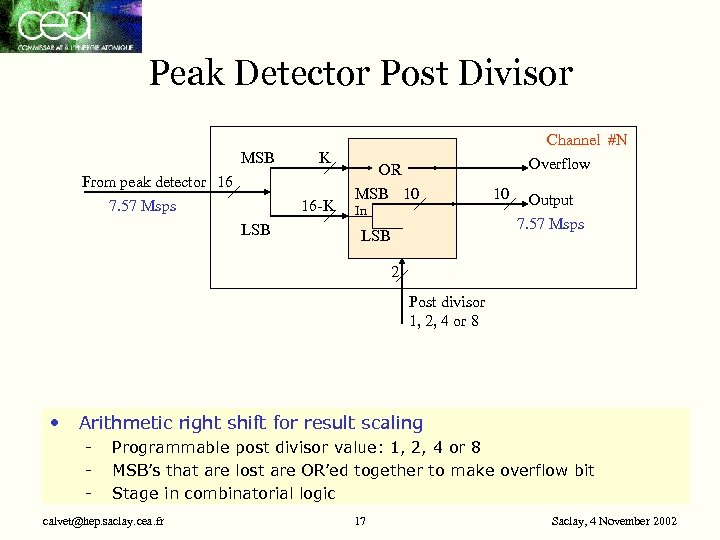
Peak Detector Post Divisor MSB From peak detector 16 7. 57 Msps K 16 -K LSB OR MSB 10 In LSB Channel #N Overflow 10 Output 7. 57 Msps 2 Post divisor 1, 2, 4 or 8 • Arithmetic right shift for result scaling - Programmable post divisor value: 1, 2, 4 or 8 MSB’s that are lost are OR’ed together to make overflow bit Stage in combinatorial logic calvet@hep. saclay. cea. fr 17 Saclay, 4 November 2002
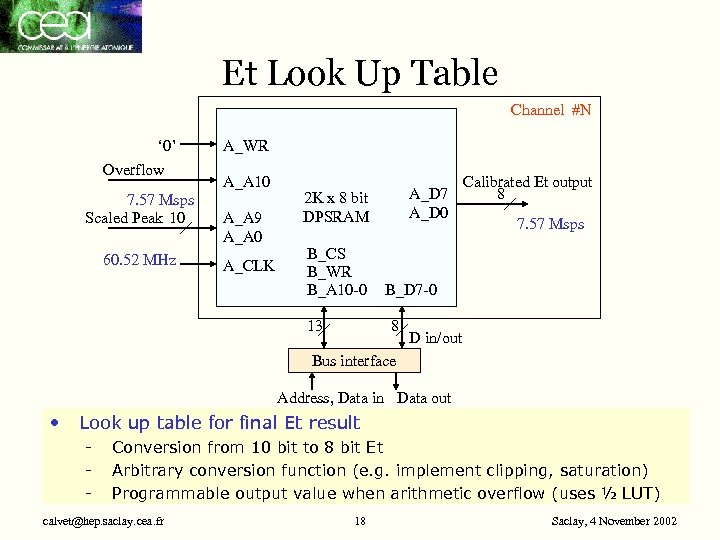
Et Look Up Table Channel #N ‘ 0’ Overflow 7. 57 Msps Scaled Peak 10 60. 52 MHz A_WR A_A 10 A_A 9 A_A 0 A_CLK A_D 7 A_D 0 2 K x 8 bit DPSRAM B_CS B_WR B_A 10 -0 13 Calibrated Et output 8 7. 57 Msps B_D 7 -0 8 D in/out Bus interface Address, Data in Data out • Look up table for final Et result - Conversion from 10 bit to 8 bit Et Arbitrary conversion function (e. g. implement clipping, saturation) Programmable output value when arithmetic overflow (uses ½ LUT) calvet@hep. saclay. cea. fr 18 Saclay, 4 November 2002
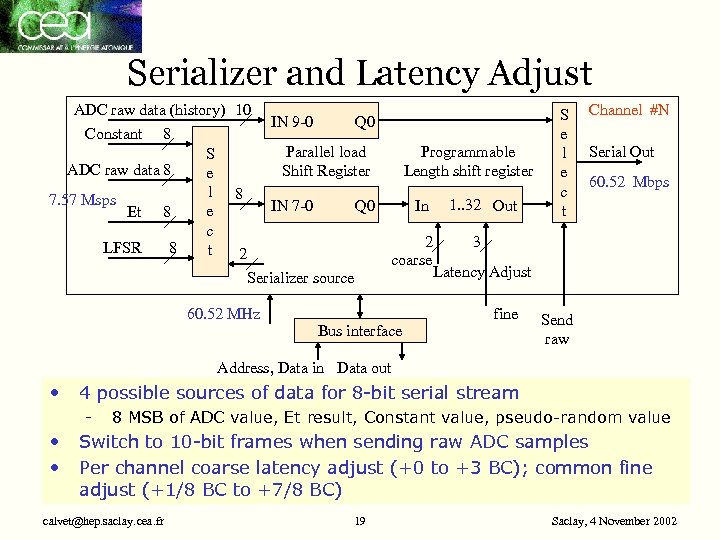
Serializer and Latency Adjust ADC raw data (history) 10 Constant 8 S ADC raw data 8 e l 8 7. 57 Msps e Et 8 c LFSR 8 t 2 IN 9 -0 Q 0 Parallel load Shift Register IN 7 -0 Programmable Length shift register Q 0 In 2 coarse Serializer source 60. 52 MHz Bus interface 1. . 32 Out S e l e c t Channel #N Serial Out 60. 52 Mbps 3 Latency Adjust fine Send raw Address, Data in Data out • 4 possible sources of data for 8 -bit serial stream - • • 8 MSB of ADC value, Et result, Constant value, pseudo-random value Switch to 10 -bit frames when sending raw ADC samples Per channel coarse latency adjust (+0 to +3 BC); common fine adjust (+1/8 BC to +7/8 BC) calvet@hep. saclay. cea. fr 19 Saclay, 4 November 2002
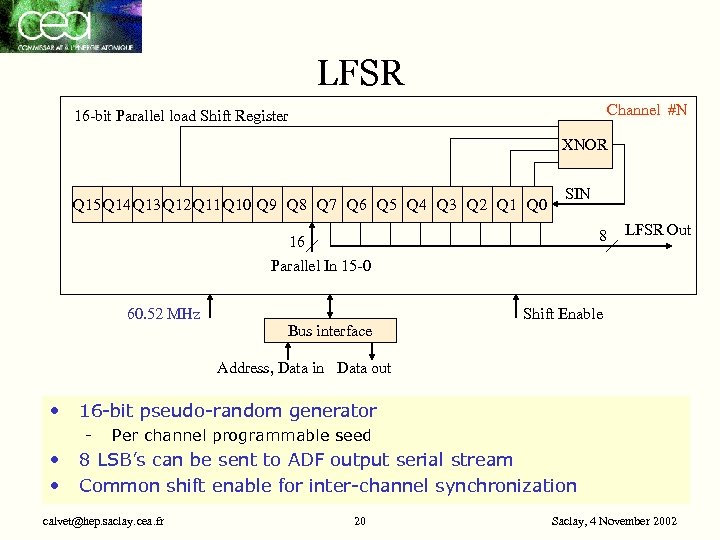
LFSR Channel #N 16 -bit Parallel load Shift Register XNOR Q 15 Q 14 Q 13 Q 12 Q 11 Q 10 Q 9 Q 8 Q 7 Q 6 Q 5 Q 4 Q 3 Q 2 Q 1 Q 0 SIN 8 16 Parallel In 15 -0 60. 52 MHz Bus interface LFSR Out Shift Enable Address, Data in Data out • 16 -bit pseudo-random generator - • • Per channel programmable seed 8 LSB’s can be sent to ADF output serial stream Common shift enable for inter-channel synchronization calvet@hep. saclay. cea. fr 20 Saclay, 4 November 2002
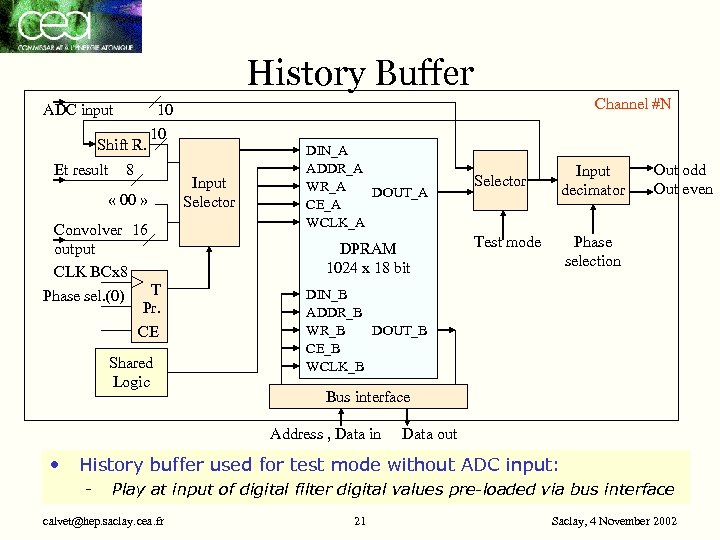
History Buffer ADC input Shift R. Et result Channel #N 10 10 8 « 00 » Convolver 16 output CLK BCx 8 T Phase sel. (0) Pr. CE Shared Logic Input Selector DIN_A ADDR_A WR_A DOUT_A CE_A WCLK_A DPRAM 1024 x 18 bit Test mode Out odd Out even Phase selection DIN_B ADDR_B WR_B DOUT_B CE_B WCLK_B Bus interface Address , Data in • Input decimator Selector Data out History buffer used for test mode without ADC input: - Play at input of digital filter digital values pre-loaded via bus interface calvet@hep. saclay. cea. fr 21 Saclay, 4 November 2002
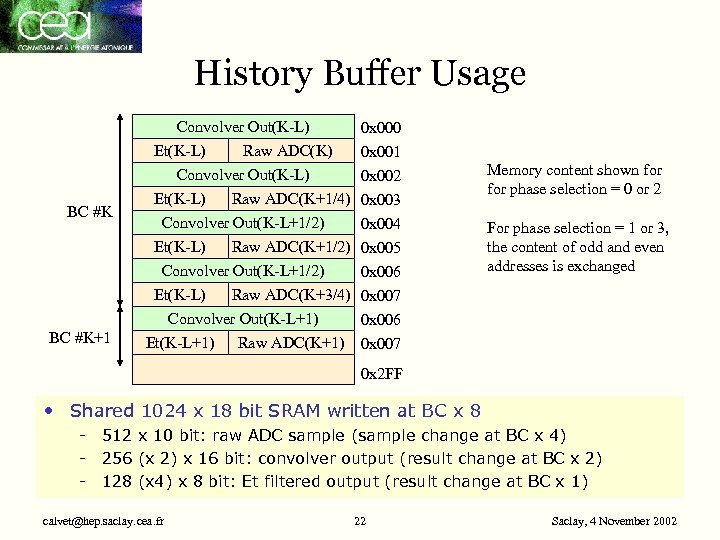
History Buffer Usage Convolver Out(K-L) BC #K+1 0 x 000 Et(K-L) Raw ADC(K) Convolver Out(K-L) Et(K-L) Raw ADC(K+1/4) Convolver Out(K-L+1/2) Et(K-L) Raw ADC(K+1/2) 0 x 001 0 x 002 0 x 003 0 x 004 0 x 005 Convolver Out(K-L+1/2) Et(K-L) Raw ADC(K+3/4) Convolver Out(K-L+1) Et(K-L+1) Raw ADC(K+1) 0 x 006 0 x 007 Memory content shown for phase selection = 0 or 2 For phase selection = 1 or 3, the content of odd and even addresses is exchanged 0 x 2 FF • Shared 1024 x 18 bit SRAM written at BC x 8 - 512 x 10 bit: raw ADC sample (sample change at BC x 4) - 256 (x 2) x 16 bit: convolver output (result change at BC x 2) - 128 (x 4) x 8 bit: Et filtered output (result change at BC x 1) calvet@hep. saclay. cea. fr 22 Saclay, 4 November 2002
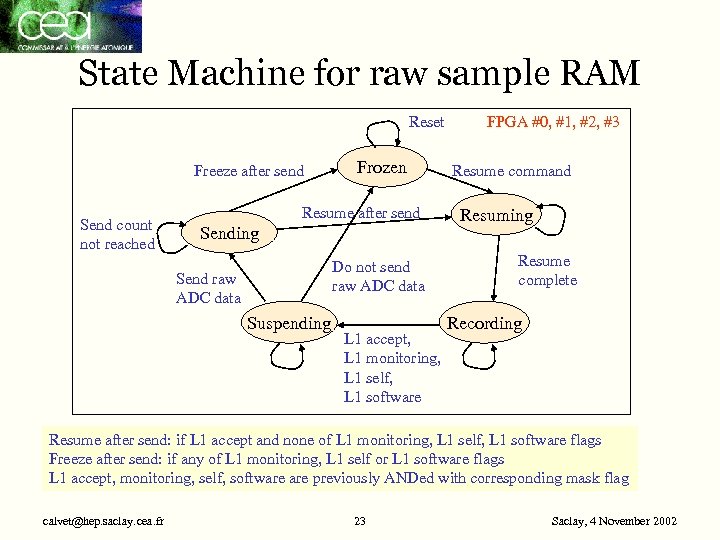
State Machine for raw sample RAM Reset Freeze after send Send count not reached Frozen Resume after send Sending Do not send raw ADC data Suspending L 1 accept, L 1 monitoring, L 1 self, L 1 software FPGA #0, #1, #2, #3 Resume command Resuming Resume complete Recording Resume after send: if L 1 accept and none of L 1 monitoring, L 1 self, L 1 software flags Freeze after send: if any of L 1 monitoring, L 1 self or L 1 software flags L 1 accept, monitoring, self, software previously ANDed with corresponding mask flag calvet@hep. saclay. cea. fr 23 Saclay, 4 November 2002
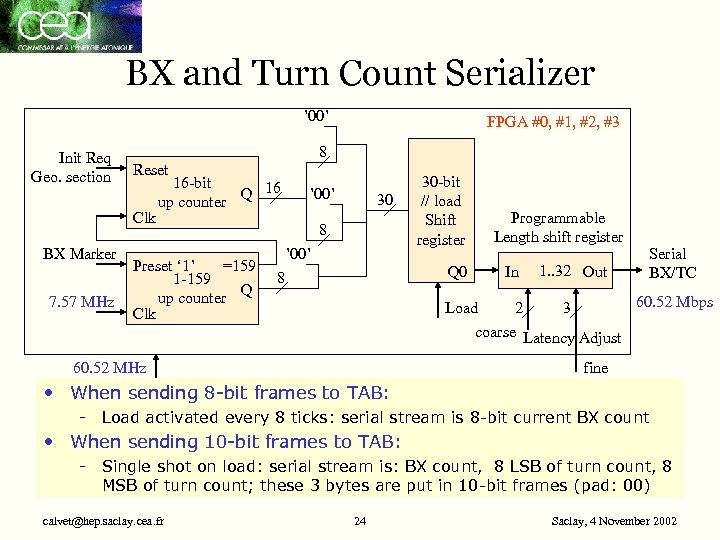
BX and Turn Count Serializer ’ 00’ Init Req Geo. section 8 Reset Clk BX Marker 7. 57 MHz FPGA #0, #1, #2, #3 16 -bit Q 16 up counter Preset ‘ 1’ =159 1 -159 Q up counter Clk ’ 00’ 30 8 ’ 00’ 30 -bit // load Shift register Q 0 8 Programmable Length shift register In 1. . 32 Out Serial BX/TC 60. 52 Mbps Load 2 3 coarse Latency Adjust 60. 52 MHz fine • When sending 8 -bit frames to TAB: - Load activated every 8 ticks: serial stream is 8 -bit current BX count • When sending 10 -bit frames to TAB: - Single shot on load: serial stream is: BX count, 8 LSB of turn count, 8 MSB of turn count; these 3 bytes are put in 10 -bit frames (pad: 00) calvet@hep. saclay. cea. fr 24 Saclay, 4 November 2002
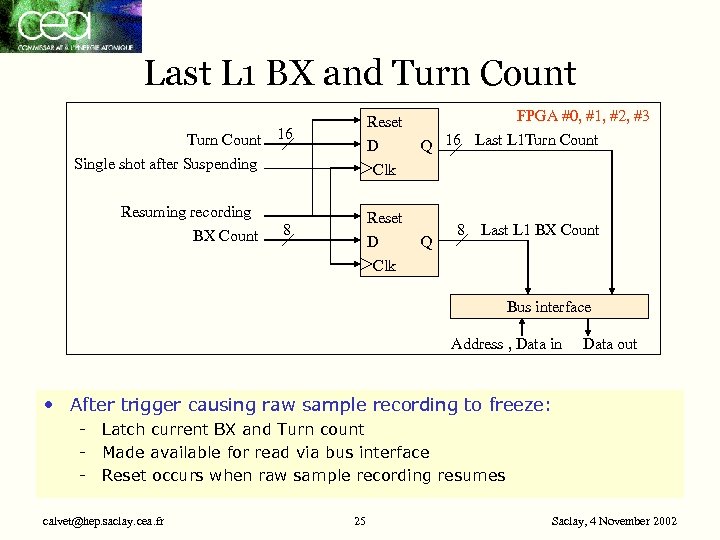
Last L 1 BX and Turn Count 16 Single shot after Suspending Resuming recording BX Count FPGA #0, #1, #2, #3 Reset D Clk 8 Q 16 Last L 1 Turn Count Q 8 Last L 1 BX Count Bus interface Address , Data in Data out • After trigger causing raw sample recording to freeze: - Latch current BX and Turn count - Made available for read via bus interface - Reset occurs when raw sample recording resumes calvet@hep. saclay. cea. fr 25 Saclay, 4 November 2002
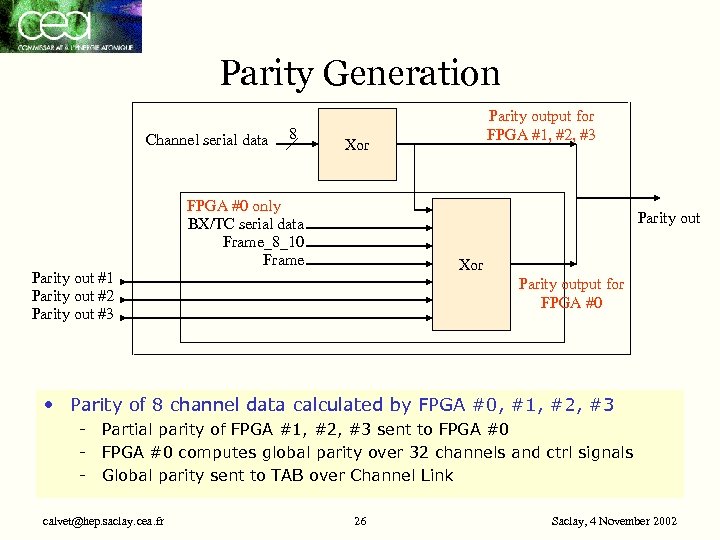
Parity Generation Channel serial data 8 Parity output for FPGA #1, #2, #3 Xor FPGA #0 only BX/TC serial data Frame_8_10 Frame Parity out Xor Parity out #1 Parity out #2 Parity out #3 Parity output for FPGA #0 • Parity of 8 channel data calculated by FPGA #0, #1, #2, #3 - Partial parity of FPGA #1, #2, #3 sent to FPGA #0 - FPGA #0 computes global parity over 32 channels and ctrl signals - Global parity sent to TAB over Channel Link calvet@hep. saclay. cea. fr 26 Saclay, 4 November 2002
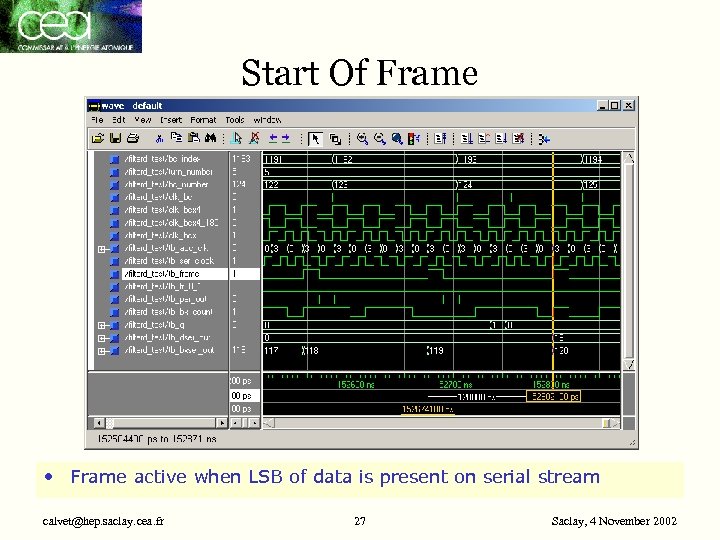
Start Of Frame • Frame active when LSB of data is present on serial stream calvet@hep. saclay. cea. fr 27 Saclay, 4 November 2002
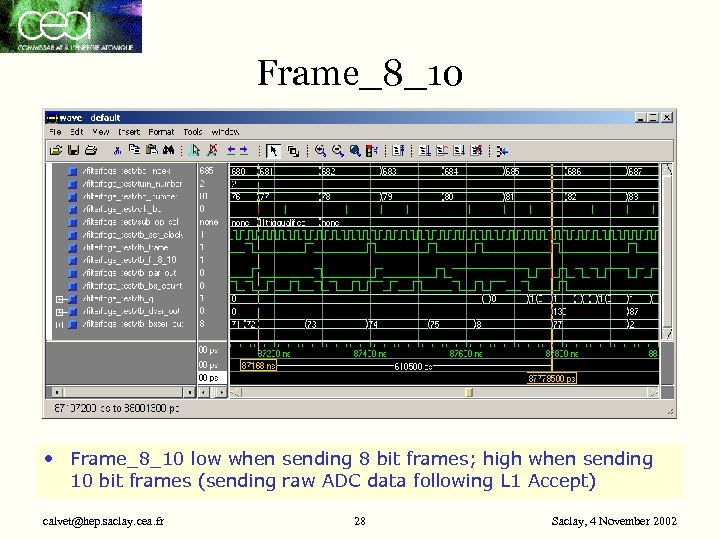
Frame_8_10 • Frame_8_10 low when sending 8 bit frames; high when sending 10 bit frames (sending raw ADC data following L 1 Accept) calvet@hep. saclay. cea. fr 28 Saclay, 4 November 2002
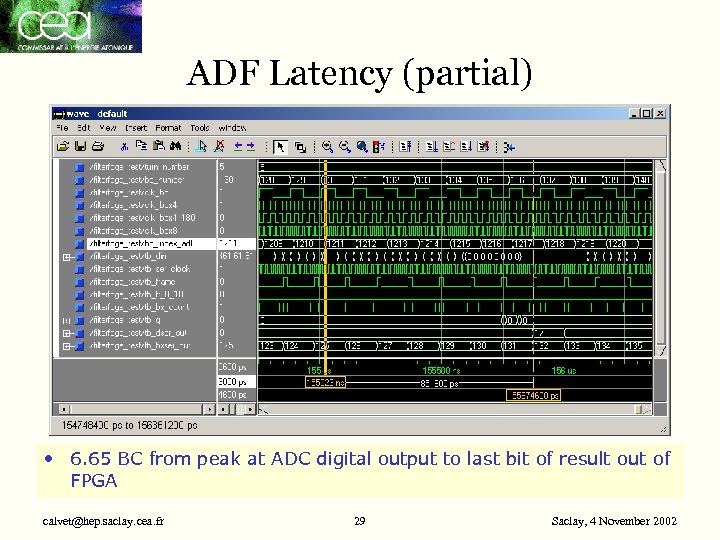
ADF Latency (partial) • 6. 65 BC from peak at ADC digital output to last bit of result out of FPGA calvet@hep. saclay. cea. fr 29 Saclay, 4 November 2002
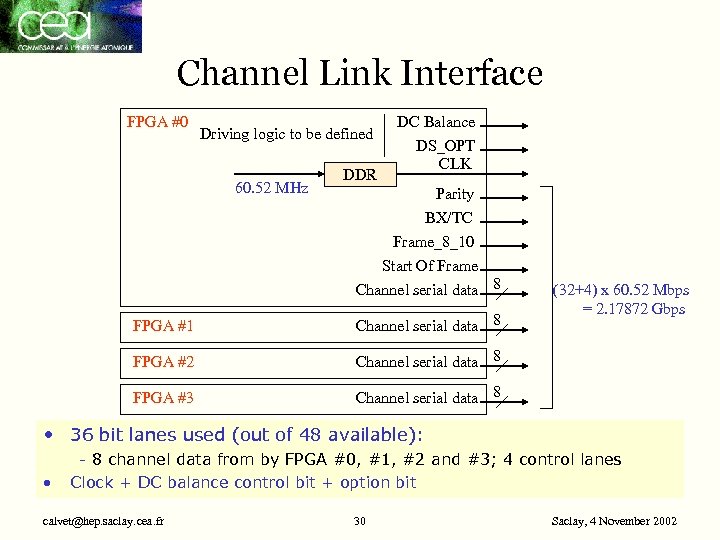
Channel Link Interface FPGA #0 Driving logic to be defined 60. 52 MHz DDR DC Balance DS_OPT CLK Parity BX/TC Frame_8_10 Start Of Frame Channel serial data 8 FPGA #1 Channel serial data 8 FPGA #2 Channel serial data 8 FPGA #3 (32+4) x 60. 52 Mbps = 2. 17872 Gbps Channel serial data 8 • 36 bit lanes used (out of 48 available): • - 8 channel data from by FPGA #0, #1, #2 and #3; 4 control lanes Clock + DC balance control bit + option bit calvet@hep. saclay. cea. fr 30 Saclay, 4 November 2002
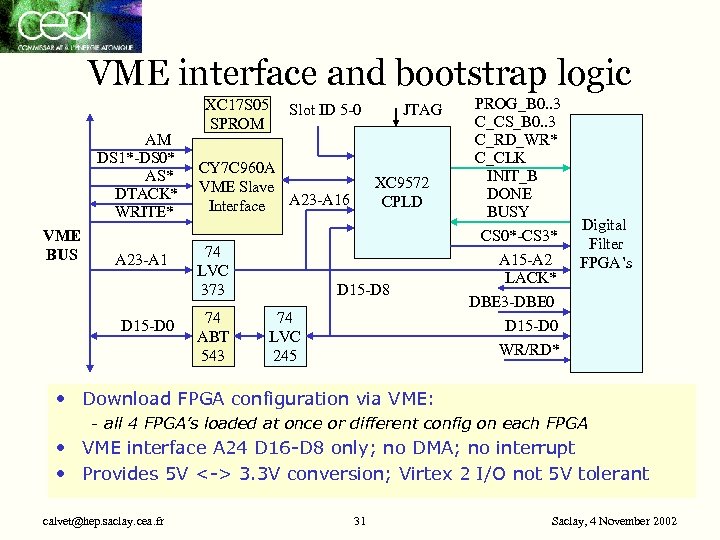
VME interface and bootstrap logic AM DS 1*-DS 0* AS* DTACK* WRITE* VME BUS A 23 -A 1 D 15 -D 0 XC 17 S 05 SPROM Slot ID 5 -0 CY 7 C 960 A VME Slave Interface A 23 -A 16 74 LVC 373 74 ABT 543 JTAG XC 9572 CPLD D 15 -D 8 74 LVC 245 PROG_B 0. . 3 C_CS_B 0. . 3 C_RD_WR* C_CLK INIT_B DONE BUSY CS 0*-CS 3* A 15 -A 2 LACK* DBE 3 -DBE 0 D 15 -D 0 WR/RD* Digital Filter FPGA’s • Download FPGA configuration via VME: - all 4 FPGA’s loaded at once or different config on each FPGA • VME interface A 24 D 16 -D 8 only; no DMA; no interrupt • Provides 5 V <-> 3. 3 V conversion; Virtex 2 I/O not 5 V tolerant calvet@hep. saclay. cea. fr 31 Saclay, 4 November 2002
Types of L 1 Trigger for ADF System • D 0 Framework L 1 Accept – Generated by D 0 framework; sent to all Geographic Sections via SCL – Fanout to ADF system by SCL Interface Fanout card (SCLIF) – Indicates that current BC is a L 1 accepted event • L 1 Accept with Monitoring – Generated asynchronously by TCC to indicate that monitoring data of Geo section should be kept for one of next D 0 framework L 1 Accept – Sent synchronously by D 0 L 1 framework to Geo section by L 1 Qualifier – If L 1 Framework accept and L 1 Qualifier for Monitoring asserted: the current L 1 is to be monitored; all history data kept for TCC readout – L 1 accept with monitoring flags are fanout to ADF system by SCL Interface Fanout Card calvet@hep. saclay. cea. fr 32 Saclay, 4 November 2002
Types of L 1 Trigger for ADF System • L 1 Software Accept – Generated asynchronously by TCC to indicate that one of the next L 1 crossing should be treated as D 0 Framework L 1 Accept by ADF system – Issued by one ADF card upon asynchronous write by TCC, – bounced-back synchronously to ADF system by SCLIF card • L 1 Self trigger Accept – Generated by each ADF channel when ADC input greater than programmable threshold – Wired-Ored for all channels on an ADF card – Wired-Ored for all ADF cards within each ADF crate and sent to SCLIF – OR-ed by SCLIF and sent back to all ADF cards synchronously calvet@hep. saclay. cea. fr 33 Saclay, 4 November 2002
Actions upon L 1 Trigger for ADF • D 0 Framework L 1 Accept – Send burst of raw ADC data to TAB (if feature enabled); no action if disabled -> TABs get raw ADC samples around BC that caused L 1 trigger in D 0 • L 1 Monitoring accept – Send burst of raw ADC data to TAB (if enabled) then freeze history buffer in all channels – Wait resume recording command to start saving data in history buffer -> TCC can read ADC raw samples and intermediate results for some BC’s that caused L 1 trigger in D 0 • L 1 Software accept – Same action as L 1 monitoring accept -> TCC can read ADC raw samples and intermediate results for random BC’s that did not cause a L 1 trigger in D 0 (used to check correct operation of ADF system) • L 1 Self trigger accept – Same action as L 1 monitoring accept -> TCC can record the shape of pickoff pulses on each channel to determine (offline) optimal digital processing parameter sets calvet@hep. saclay. cea. fr 34 Saclay, 4 November 2002
Limitations • History buffer common for sending raw ADC samples to TAB and for read-out via TCC – When recording is frozen (i. e. TCC read-out in progress), sub-sequent L 1 accept will not trigger sending of raw ADC samples to TAB -> Raw ADC samples for these L 1 accept are lost (but digital filter output continues to flow) - If no L 1 Monitoring or L 1 software accept are issued, raw sample recording is never frozen, raw samples for all L 1 accept can be sent to TAB • Links to send filtered data and raw ADC data to TAB are the same – While sending out raw ADC data to TABs, flow of filtered data is stopped -> can introduce dead-time for L 1 if sending time is larger than that of other sub-systems -> e. g. sending raw samples of 8 BC around L 1: 320 bit / channel sending time = 5. 28 us calvet@hep. saclay. cea. fr 35 Saclay, 4 November 2002
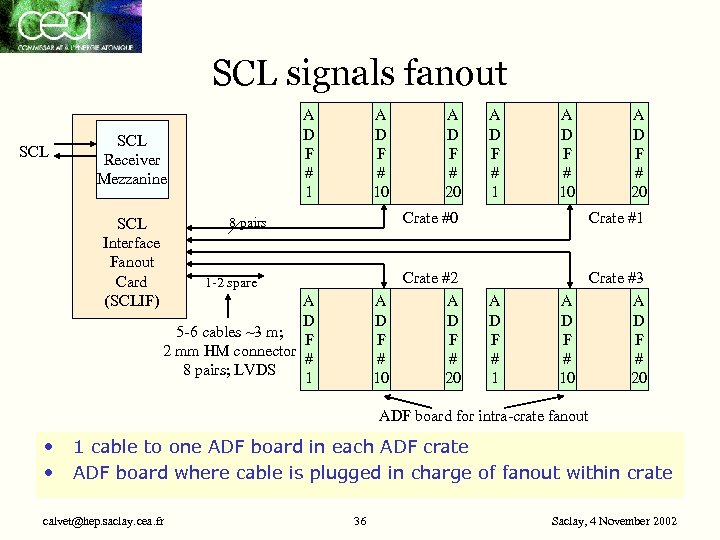
SCL signals fanout SCL A D F # 1 SCL Receiver Mezzanine SCL Interface Fanout Card (SCLIF) A D F # 10 A D F # 20 Crate #0 1 -2 spare A D 5 -6 cables ~3 m; F 2 mm HM connector # 8 pairs; LVDS 1 Crate #2 A A D D F F # # 10 20 8 pairs Crate #3 A A D D F F # # 10 20 A D F # 1 ADF board for intra-crate fanout • • 1 cable to one ADF board in each ADF crate ADF board where cable is plugged in charge of fanout within crate calvet@hep. saclay. cea. fr 36 Saclay, 4 November 2002
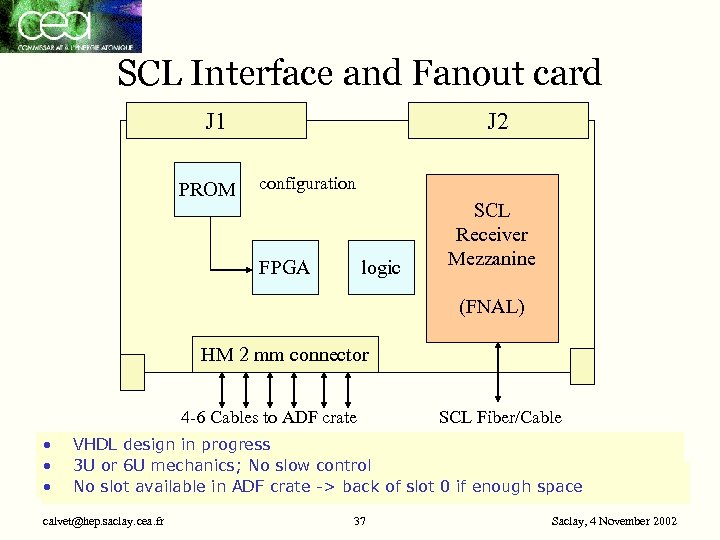
SCL Interface and Fanout card J 1 PROM J 2 configuration FPGA logic SCL Receiver Mezzanine (FNAL) HM 2 mm connector 4 -6 Cables to ADF crate SCL Fiber/Cable • VHDL design in progress • 3 U or 6 U mechanics; No slow control • Baseline: segmentation 0. 2 x 0. 2 • No slot available in ADF crate -> back of slot 0 if enough space calvet@hep. saclay. cea. fr 37 Saclay, 4 November 2002
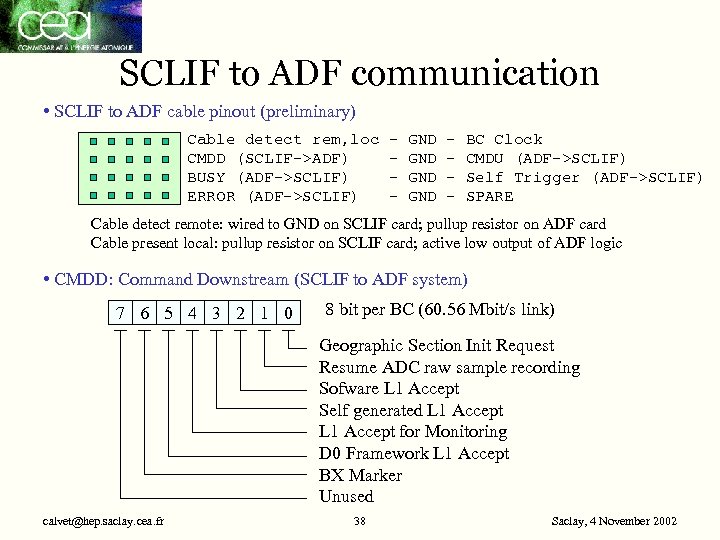
SCLIF to ADF communication • SCLIF to ADF cable pinout (preliminary) Cable detect rem, loc CMDD (SCLIF->ADF) BUSY (ADF->SCLIF) ERROR (ADF->SCLIF) - GND GND - BC Clock CMDU (ADF->SCLIF) Self Trigger (ADF->SCLIF) SPARE Cable detect remote: wired to GND on SCLIF card; pullup resistor on ADF card Cable present local: pullup resistor on SCLIF card; active low output of ADF logic • CMDD: Command Downstream (SCLIF to ADF system) 7 6 5 4 3 2 1 0 8 bit per BC (60. 56 Mbit/s link) Geographic Section Init Request Resume ADC raw sample recording Sofware L 1 Accept Self generated L 1 Accept for Monitoring D 0 Framework L 1 Accept BX Marker Unused calvet@hep. saclay. cea. fr 38 Saclay, 4 November 2002
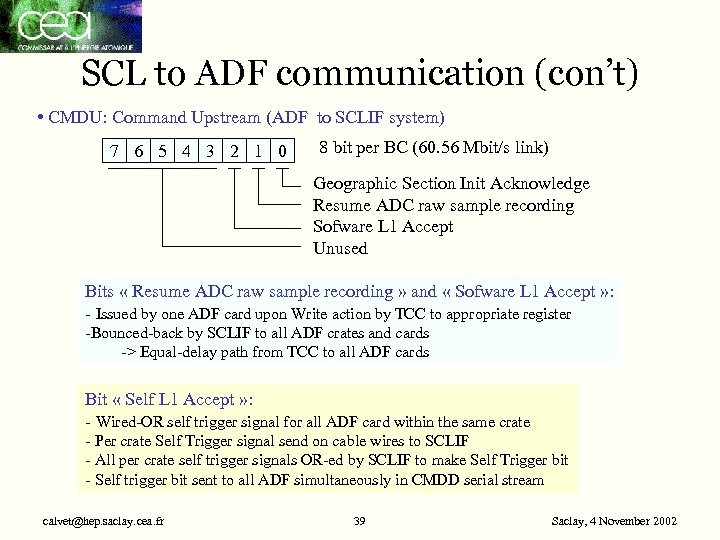
SCL to ADF communication (con’t) • CMDU: Command Upstream (ADF to SCLIF system) 7 6 5 4 3 2 1 0 8 bit per BC (60. 56 Mbit/s link) Geographic Section Init Acknowledge Resume ADC raw sample recording Sofware L 1 Accept Unused Bits « Resume ADC raw sample recording » and « Sofware L 1 Accept » : - Issued by one ADF card upon Write action by TCC to appropriate register -Bounced-back by SCLIF to all ADF crates and cards -> Equal-delay path from TCC to all ADF cards Bit « Self L 1 Accept » : - Wired-OR self trigger signal for all ADF card within the same crate - Per crate Self Trigger signal send on cable wires to SCLIF - All per crate self trigger signals OR-ed by SCLIF to make Self Trigger bit - Self trigger bit sent to all ADF simultaneously in CMDD serial stream calvet@hep. saclay. cea. fr 39 Saclay, 4 November 2002
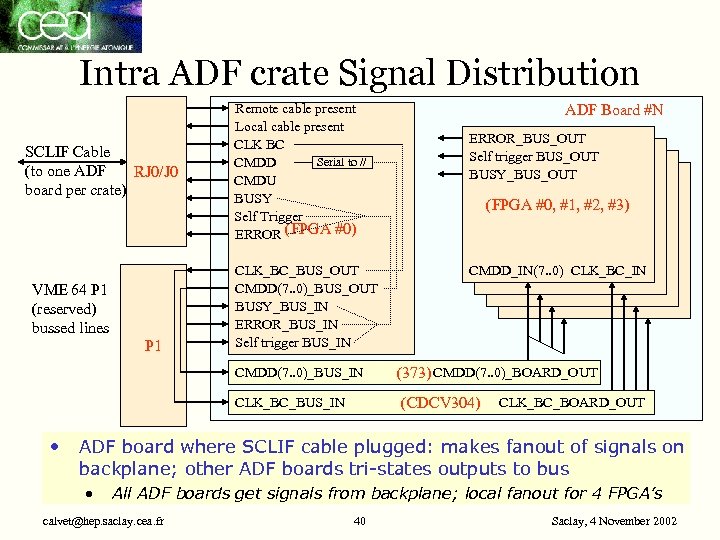
Intra ADF crate Signal Distribution SCLIF Cable (to one ADF RJ 0/J 0 board per crate) VME 64 P 1 (reserved) bussed lines P 1 Remote cable present Local cable present CLK BC Serial to // CMDD CMDU BUSY Self Trigger ERROR (FPGA #0) CLK_BC_BUS_OUT CMDD(7. . 0)_BUS_OUT BUSY_BUS_IN ERROR_BUS_IN Self trigger BUS_IN CMDD(7. . 0)_BUS_IN ERROR_BUS_OUT Self trigger BUS_OUT BUSY_BUS_OUT (FPGA #0, #1, #2, #3) CMDD_IN(7. . 0) CLK_BC_IN (373) CMDD(7. . 0)_BOARD_OUT (CDCV 304) CLK_BC_BUS_IN • ADF Board #N CLK_BC_BOARD_OUT ADF board where SCLIF cable plugged: makes fanout of signals on backplane; other ADF boards tri-states outputs to bus • All ADF boards get signals from backplane; local fanout for 4 FPGA’s calvet@hep. saclay. cea. fr 40 Saclay, 4 November 2002
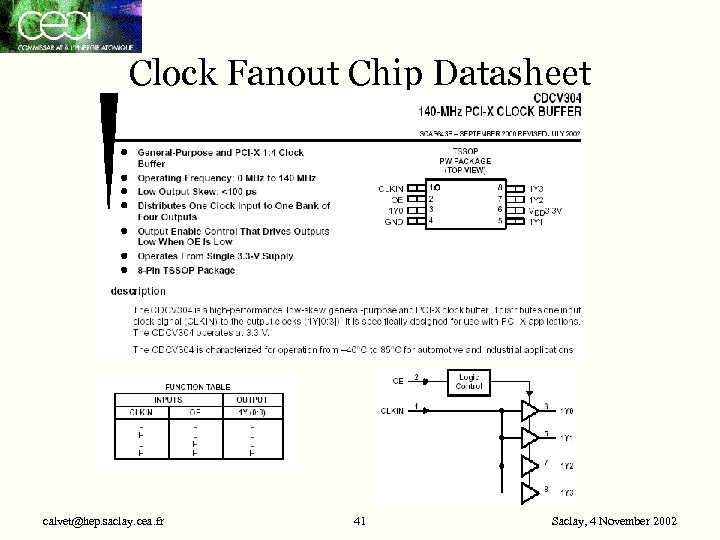
Clock Fanout Chip Datasheet calvet@hep. saclay. cea. fr 41 Saclay, 4 November 2002
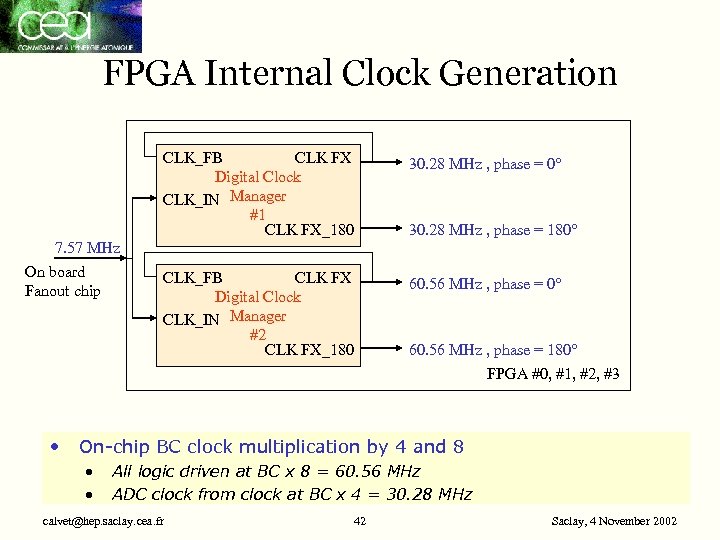
FPGA Internal Clock Generation CLK_FB CLK FX Digital Clock CLK_IN Manager #1 CLK FX_180 30. 28 MHz , phase = 0° CLK_FB CLK FX Digital Clock CLK_IN Manager #2 CLK FX_180 60. 56 MHz , phase = 0° 30. 28 MHz , phase = 180° 7. 57 MHz On board Fanout chip • 60. 56 MHz , phase = 180° FPGA #0, #1, #2, #3 On-chip BC clock multiplication by 4 and 8 • • All logic driven at BC x 8 = 60. 56 MHz ADC clock from clock at BC x 4 = 30. 28 MHz calvet@hep. saclay. cea. fr 42 Saclay, 4 November 2002
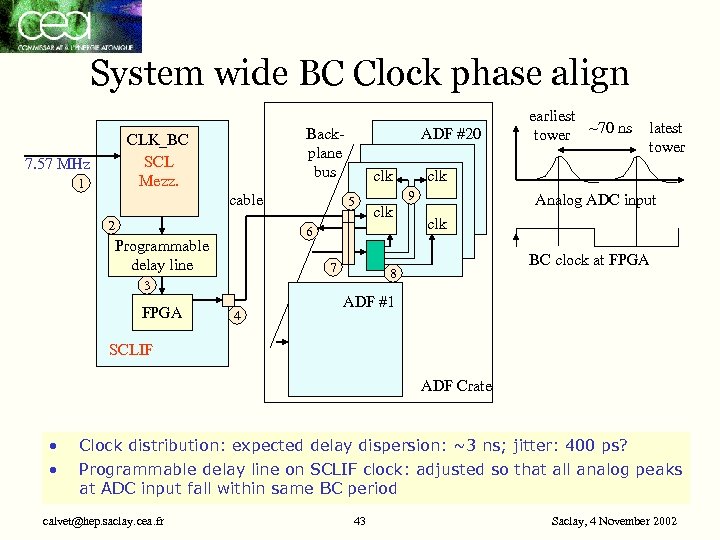
System wide BC Clock phase align Backplane bus CLK_BC SCL Mezz. 7. 57 MHz 1 cable 2 clk 5 clk 6 Programmable delay line 7 3 FPGA ADF #20 4 earliest tower ~70 ns latest tower clk 9 Analog ADC input clk BC clock at FPGA 8 ADF #1 SCLIF ADF Crate • • Clock distribution: expected delay dispersion: ~3 ns; jitter: 400 ps? Programmable delay line on SCLIF clock: adjusted so that all analog peaks at ADC input fall within same BC period calvet@hep. saclay. cea. fr 43 Saclay, 4 November 2002
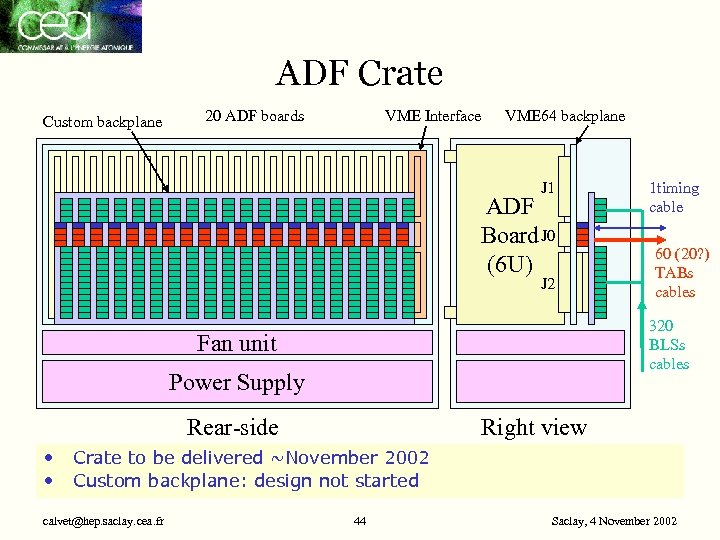
ADF Crate Custom backplane 20 ADF boards VME Interface VME 64 backplane J 1 ADF Board J 0 (6 U) J 2 60 (20? ) TABs cables 320 BLSs cables Fan unit Power Supply Rear-side • • 1 timing cable Right view Crate to be delivered ~November 2002 Custom backplane: design not started calvet@hep. saclay. cea. fr 44 Saclay, 4 November 2002
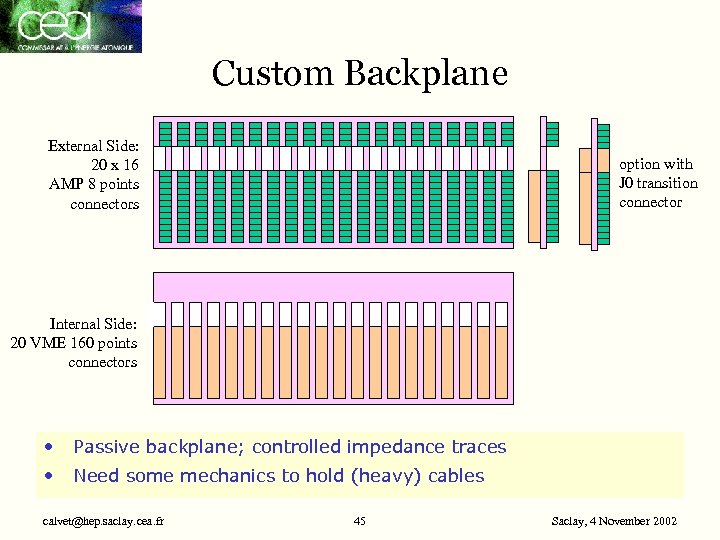
Custom Backplane External Side: 20 x 16 AMP 8 points connectors option with J 0 transition connector Internal Side: 20 VME 160 points connectors • Passive backplane; controlled impedance traces • Need some mechanics to hold (heavy) cables calvet@hep. saclay. cea. fr 45 Saclay, 4 November 2002
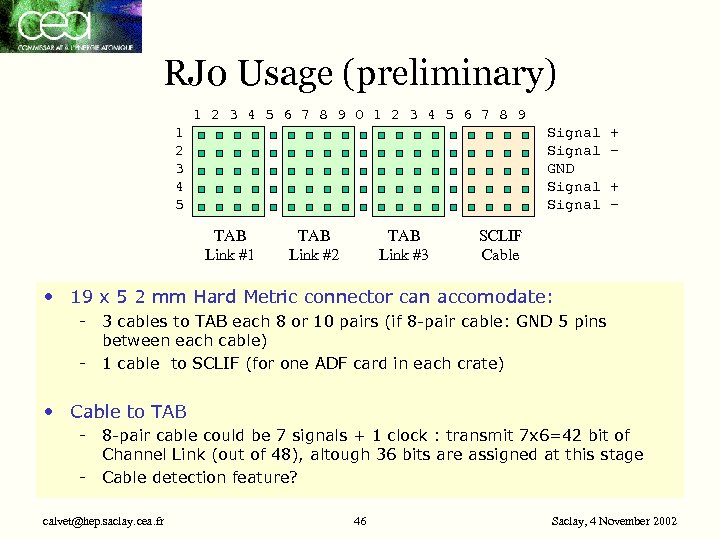
RJ 0 Usage (preliminary) 1 2 3 4 5 6 7 8 9 0 1 2 3 4 5 6 7 8 9 1 2 3 4 5 Signal GND Signal TAB Link #1 TAB Link #2 TAB Link #3 + + - SCLIF Cable • 19 x 5 2 mm Hard Metric connector can accomodate: - 3 cables to TAB each 8 or 10 pairs (if 8 -pair cable: GND 5 pins between each cable) - 1 cable to SCLIF (for one ADF card in each crate) • Cable to TAB - 8 -pair cable could be 7 signals + 1 clock : transmit 7 x 6=42 bit of Channel Link (out of 48), altough 36 bits are assigned at this stage - Cable detection feature? calvet@hep. saclay. cea. fr 46 Saclay, 4 November 2002
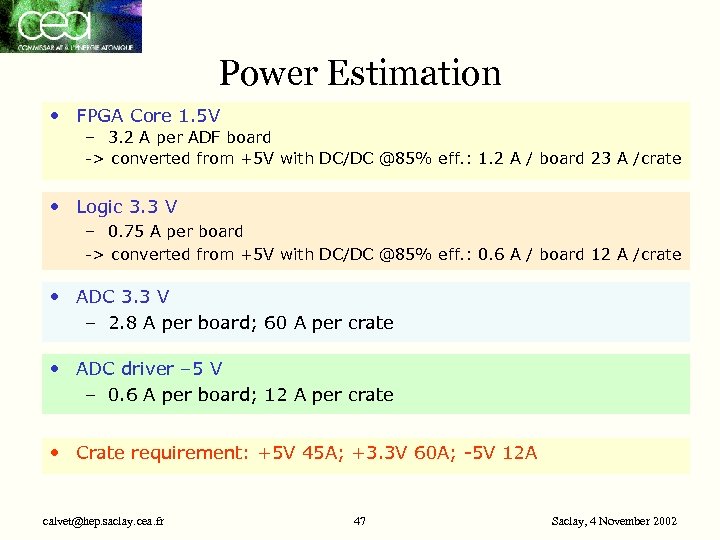
Power Estimation • FPGA Core 1. 5 V – 3. 2 A per ADF board -> converted from +5 V with DC/DC @85% eff. : 1. 2 A / board 23 A /crate • Logic 3. 3 V – 0. 75 A per board -> converted from +5 V with DC/DC @85% eff. : 0. 6 A / board 12 A /crate • ADC 3. 3 V – 2. 8 A per board; 60 A per crate • ADC driver – 5 V – 0. 6 A per board; 12 A per crate • Crate requirement: +5 V 45 A; +3. 3 V 60 A; -5 V 12 A calvet@hep. saclay. cea. fr 47 Saclay, 4 November 2002
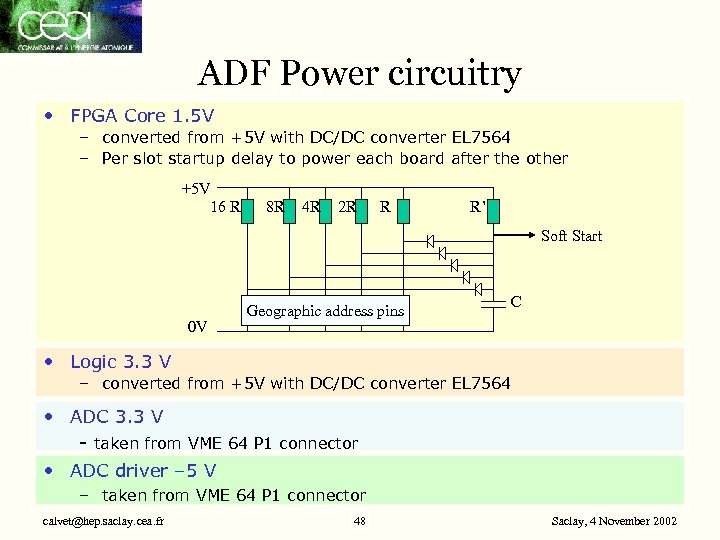
ADF Power circuitry • FPGA Core 1. 5 V – converted from +5 V with DC/DC converter EL 7564 – Per slot startup delay to power each board after the other +5 V 16 R 8 R 4 R 2 R R R’ Soft Start 0 V Geographic address pins C • Logic 3. 3 V – converted from +5 V with DC/DC converter EL 7564 • ADC 3. 3 V - taken from VME 64 P 1 connector • ADC driver – 5 V – taken from VME 64 P 1 connector calvet@hep. saclay. cea. fr 48 Saclay, 4 November 2002
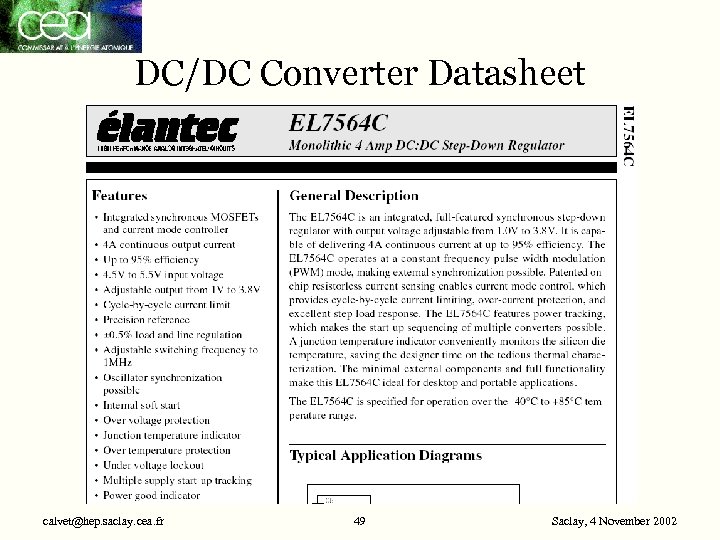
DC/DC Converter Datasheet calvet@hep. saclay. cea. fr 49 Saclay, 4 November 2002
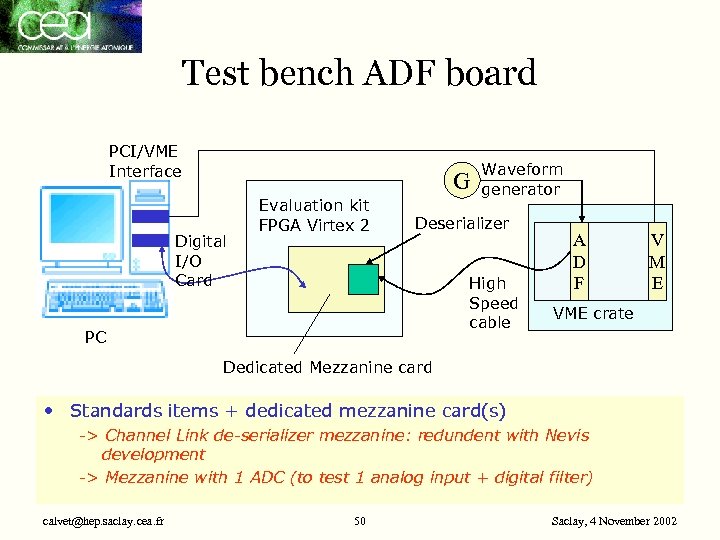
Test bench ADF board PCI/VME Interface G Digital I/O Card Evaluation kit FPGA Virtex 2 Waveform generator Deserializer High Speed cable PC A D F V M E VME crate Dedicated Mezzanine card • Standards items + dedicated mezzanine card(s) -> Channel Link de-serializer mezzanine: redundent with Nevis development -> Mezzanine with 1 ADC (to test 1 analog input + digital filter) calvet@hep. saclay. cea. fr 50 Saclay, 4 November 2002
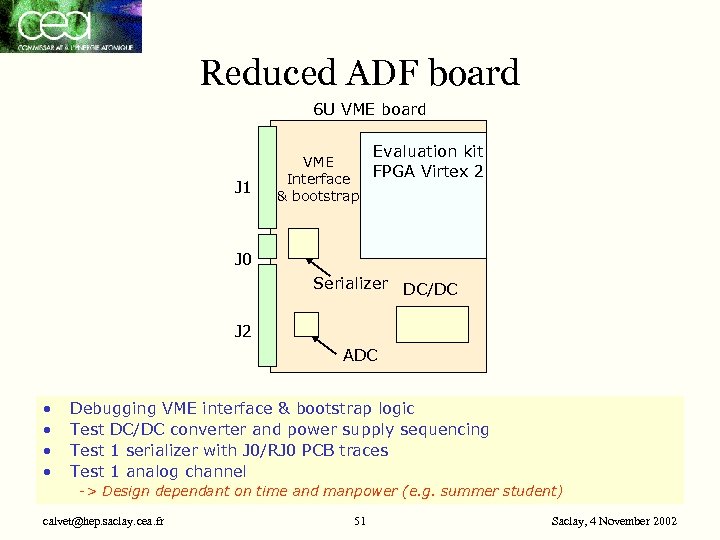
Reduced ADF board 6 U VME board Evaluation kit J 1 VME FPGA Virtex 2 Interface & bootstrap J 0 Serializer DC/DC J 2 ADC • • Debugging VME interface & bootstrap logic Test DC/DC converter and power supply sequencing Test 1 serializer with J 0/RJ 0 PCB traces Test 1 analog channel -> Design dependant on time and manpower (e. g. summer student) calvet@hep. saclay. cea. fr 51 Saclay, 4 November 2002
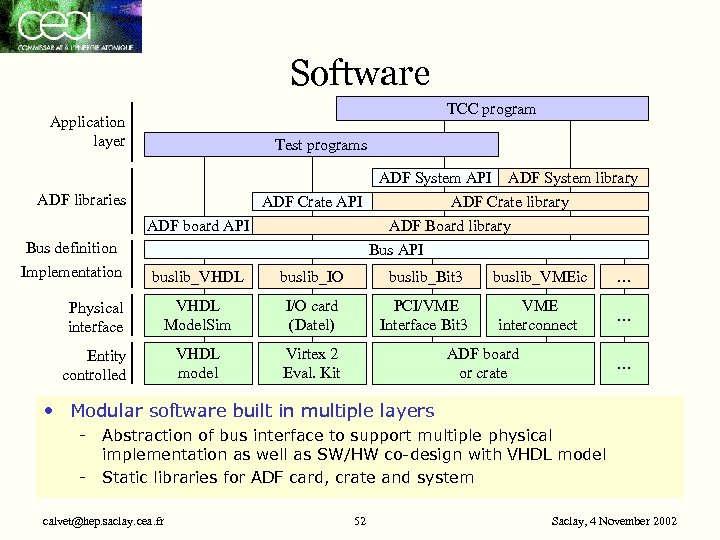
Software TCC program Application layer ADF libraries Bus definition Implementation Test programs ADF System API ADF System library ADF Crate API ADF Crate library ADF board API ADF Board library Bus API buslib_VHDL buslib_IO buslib_Bit 3 buslib_VMEic … Physical interface VHDL Model. Sim I/O card (Datel) PCI/VME Interface Bit 3 VME interconnect … Entity controlled VHDL model Virtex 2 Eval. Kit ADF board or crate … • Modular software built in multiple layers - Abstraction of bus interface to support multiple physical implementation as well as SW/HW co-design with VHDL model - Static libraries for ADF card, crate and system calvet@hep. saclay. cea. fr 52 Saclay, 4 November 2002
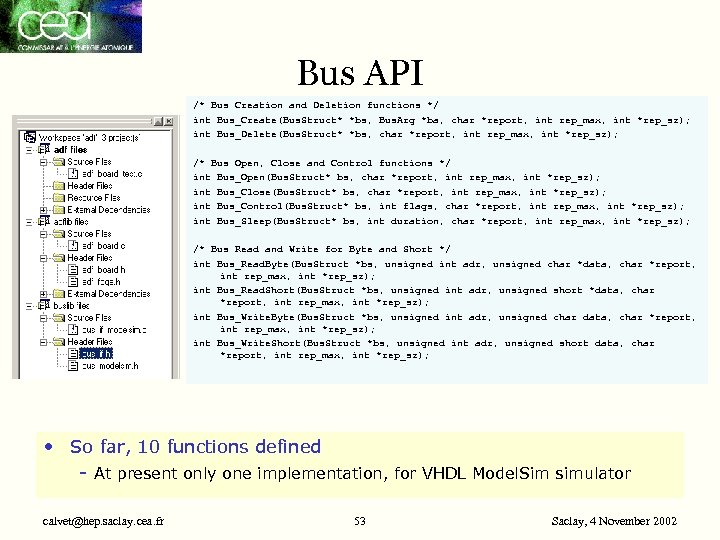
Bus API /* Bus Creation and Deletion functions */ int Bus_Create(Bus. Struct* *bs, Bus. Arg *ba, char *report, int rep_max, int *rep_sz); int Bus_Delete(Bus. Struct* *bs, char *report, int rep_max, int *rep_sz); /* Bus Open, Close and Control functions */ int Bus_Open(Bus. Struct* bs, char *report, int rep_max, int *rep_sz); int Bus_Close(Bus. Struct* bs, char *report, int rep_max, int *rep_sz); int Bus_Control(Bus. Struct* bs, int flags, char *report, int rep_max, int *rep_sz); int Bus_Sleep(Bus. Struct* bs, int duration, char *report, int rep_max, int *rep_sz); /* Bus Read and Write for Byte and Short */ int Bus_Read. Byte(Bus. Struct *bs, unsigned int adr, unsigned char *data, char *report, int rep_max, int *rep_sz); int Bus_Read. Short(Bus. Struct *bs, unsigned int adr, unsigned short *data, char *report, int rep_max, int *rep_sz); int Bus_Write. Byte(Bus. Struct *bs, unsigned int adr, unsigned char data, char *report, int rep_max, int *rep_sz); int Bus_Write. Short(Bus. Struct *bs, unsigned int adr, unsigned short data, char *report, int rep_max, int *rep_sz); • So far, 10 functions defined - At present only one implementation, for VHDL Model. Sim simulator calvet@hep. saclay. cea. fr 53 Saclay, 4 November 2002
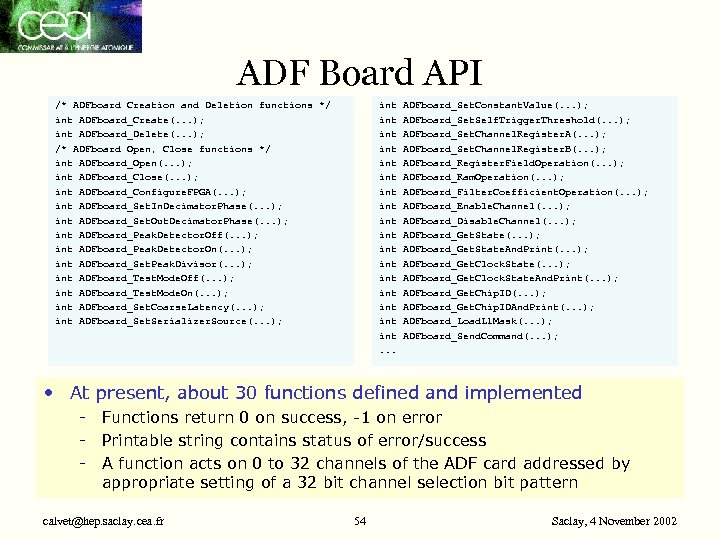
ADF Board API /* ADFboard Creation and Deletion functions */ int ADFboard_Create(. . . ); int ADFboard_Delete(. . . ); /* ADFboard Open, Close functions */ int ADFboard_Open(. . . ); int ADFboard_Close(. . . ); int ADFboard_Configure. FPGA(. . . ); int ADFboard_Set. In. Decimator. Phase(. . . ); int ADFboard_Set. Out. Decimator. Phase(. . . ); int ADFboard_Peak. Detector. Off(. . . ); int ADFboard_Peak. Detector. On(. . . ); int ADFboard_Set. Peak. Divisor(. . . ); int ADFboard_Test. Mode. Off(. . . ); int ADFboard_Test. Mode. On(. . . ); int ADFboard_Set. Coarse. Latency(. . . ); int ADFboard_Set. Serializer. Source(. . . ); int int int int int. . . ADFboard_Set. Constant. Value(. . . ); ADFboard_Set. Self. Trigger. Threshold(. . . ); ADFboard_Set. Channel. Register. A(. . . ); ADFboard_Set. Channel. Register. B(. . . ); ADFboard_Register. Field. Operation(. . . ); ADFboard_Ram. Operation(. . . ); ADFboard_Filter. Coefficient. Operation(. . . ); ADFboard_Enable. Channel(. . . ); ADFboard_Disable. Channel(. . . ); ADFboard_Get. State. And. Print(. . . ); ADFboard_Get. Clock. State. And. Print(. . . ); ADFboard_Get. Chip. IDAnd. Print(. . . ); ADFboard_Load. L 1 Mask(. . . ); ADFboard_Send. Command(. . . ); • At present, about 30 functions defined and implemented - Functions return 0 on success, -1 on error - Printable string contains status of error/success - A function acts on 0 to 32 channels of the ADF card addressed by appropriate setting of a 32 bit channel selection bit pattern calvet@hep. saclay. cea. fr 54 Saclay, 4 November 2002
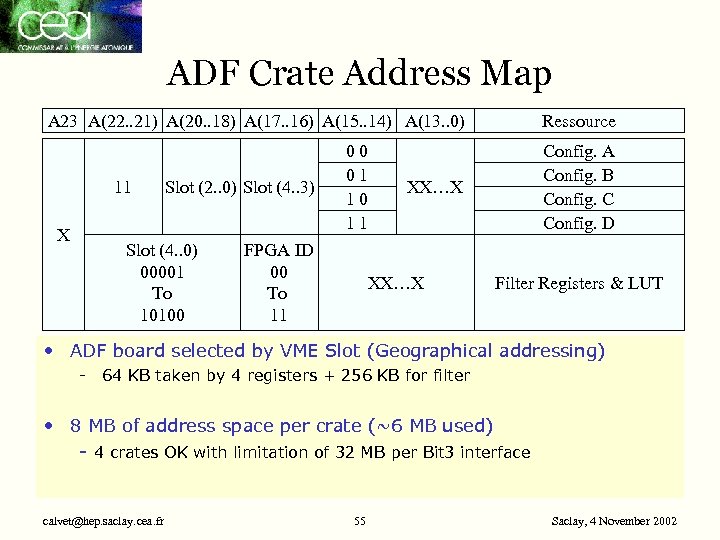
ADF Crate Address Map A 23 A(22. . 21) A(20. . 18) A(17. . 16) A(15. . 14) A(13. . 0) 11 X Slot (2. . 0) Slot (4. . 3) Slot (4. . 0) 00001 To 10100 0 1 1 FPGA ID 00 To 11 Ressource Config. A Config. B Config. C Config. D XX…X Filter Registers & LUT • ADF board selected by VME Slot (Geographical addressing) - 64 KB taken by 4 registers + 256 KB for filter • 8 MB of address space per crate (~6 MB used) - 4 crates OK with limitation of 32 MB per Bit 3 interface calvet@hep. saclay. cea. fr 55 Saclay, 4 November 2002
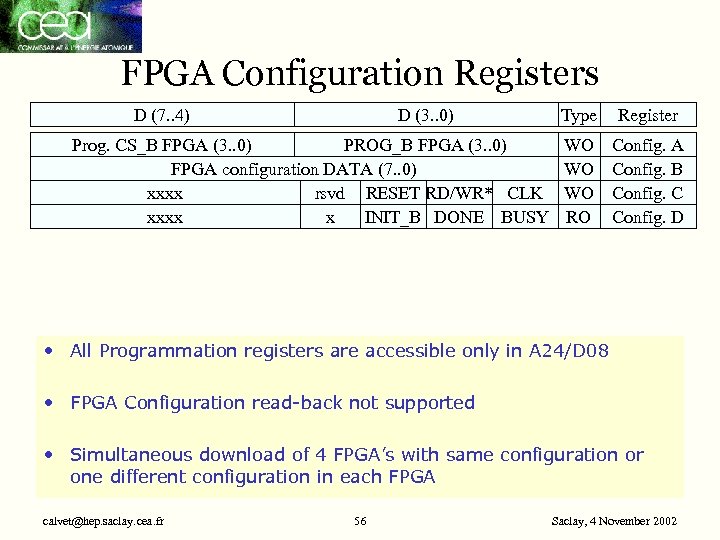
FPGA Configuration Registers D (7. . 4) D (3. . 0) Prog. CS_B FPGA (3. . 0) PROG_B FPGA (3. . 0) FPGA configuration DATA (7. . 0) xxxx rsvd RESET RD/WR* CLK xxxx x INIT_B DONE BUSY Type Register WO WO WO RO Config. A Config. B Config. C Config. D • All Programmation registers are accessible only in A 24/D 08 • FPGA Configuration read-back not supported • Simultaneous download of 4 FPGA’s with same configuration or one different configuration in each FPGA calvet@hep. saclay. cea. fr 56 Saclay, 4 November 2002
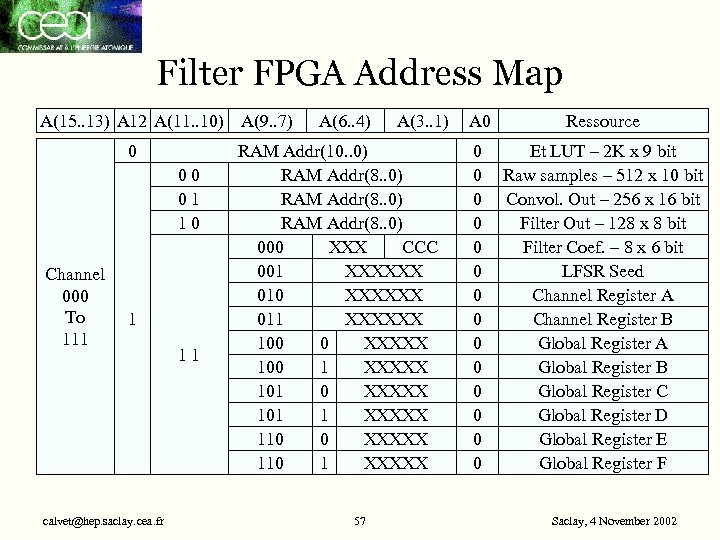
Filter FPGA Address Map A(15. . 13) A 12 A(11. . 10) A(9. . 7) 0 0 1 1 0 Channel 000 To 111 1 calvet@hep. saclay. cea. fr 1 1 A(6. . 4) A(3. . 1) RAM Addr(10. . 0) RAM Addr(8. . 0) 000 XXX CCC 001 XXXXXX 010 XXXXXX 011 XXXXXX 100 0 XXXXX 100 1 XXXXX 101 0 XXXXX 101 1 XXXXX 110 0 XXXXX 110 1 XXXXX 57 A 0 Ressource 0 0 0 0 Et LUT – 2 K x 9 bit Raw samples – 512 x 10 bit Convol. Out – 256 x 16 bit Filter Out – 128 x 8 bit Filter Coef. – 8 x 6 bit LFSR Seed Channel Register A Channel Register B Global Register A Global Register B Global Register C Global Register D Global Register E Global Register F Saclay, 4 November 2002
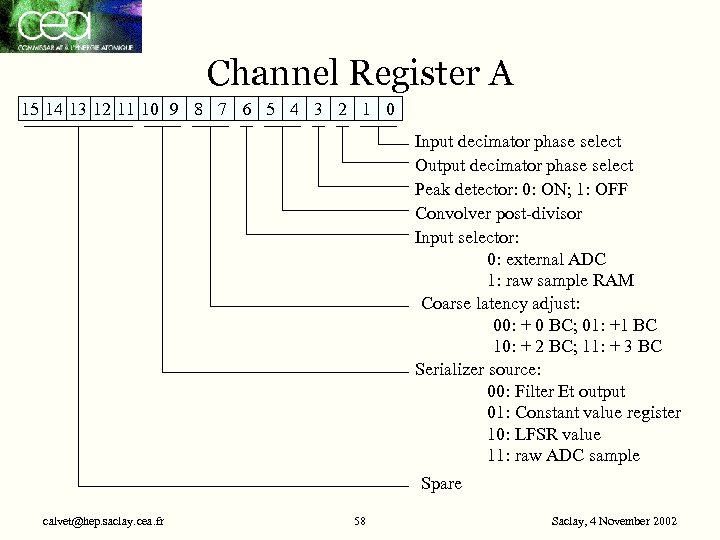
Channel Register A 15 14 13 12 11 10 9 8 7 6 5 4 3 2 1 0 Input decimator phase select Output decimator phase select Peak detector: 0: ON; 1: OFF Convolver post-divisor Input selector: 0: external ADC 1: raw sample RAM Coarse latency adjust: 00: + 0 BC; 01: +1 BC 10: + 2 BC; 11: + 3 BC Serializer source: 00: Filter Et output 01: Constant value register 10: LFSR value 11: raw ADC sample Spare calvet@hep. saclay. cea. fr 58 Saclay, 4 November 2002
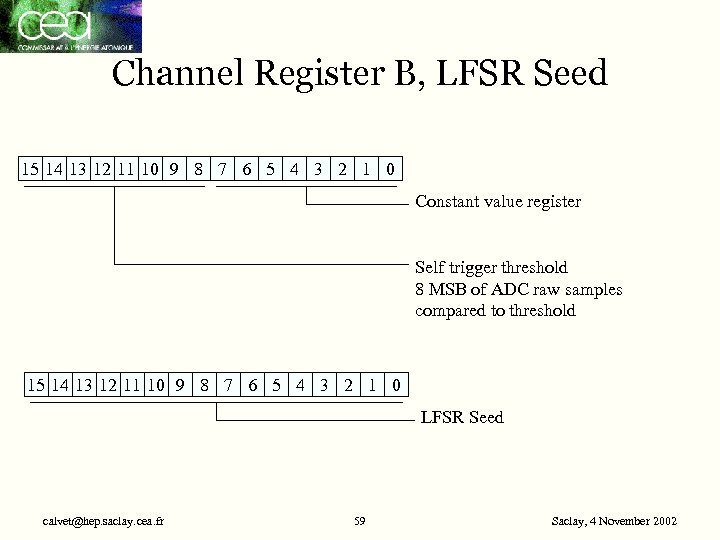
Channel Register B, LFSR Seed 15 14 13 12 11 10 9 8 7 6 5 4 3 2 1 0 Constant value register Self trigger threshold 8 MSB of ADC raw samples compared to threshold 15 14 13 12 11 10 9 8 7 6 5 4 3 2 1 0 LFSR Seed calvet@hep. saclay. cea. fr 59 Saclay, 4 November 2002
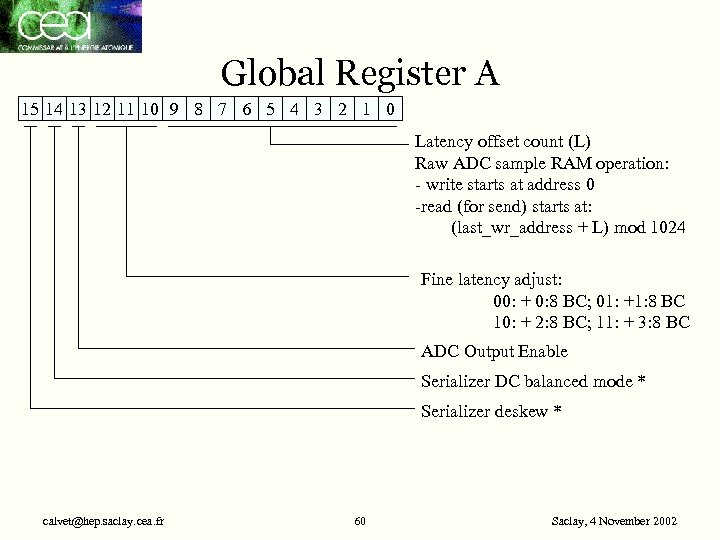
Global Register A 15 14 13 12 11 10 9 8 7 6 5 4 3 2 1 0 Latency offset count (L) Raw ADC sample RAM operation: - write starts at address 0 -read (for send) starts at: (last_wr_address + L) mod 1024 Fine latency adjust: 00: + 0: 8 BC; 01: +1: 8 BC 10: + 2: 8 BC; 11: + 3: 8 BC ADC Output Enable Serializer DC balanced mode * Serializer deskew * calvet@hep. saclay. cea. fr 60 Saclay, 4 November 2002
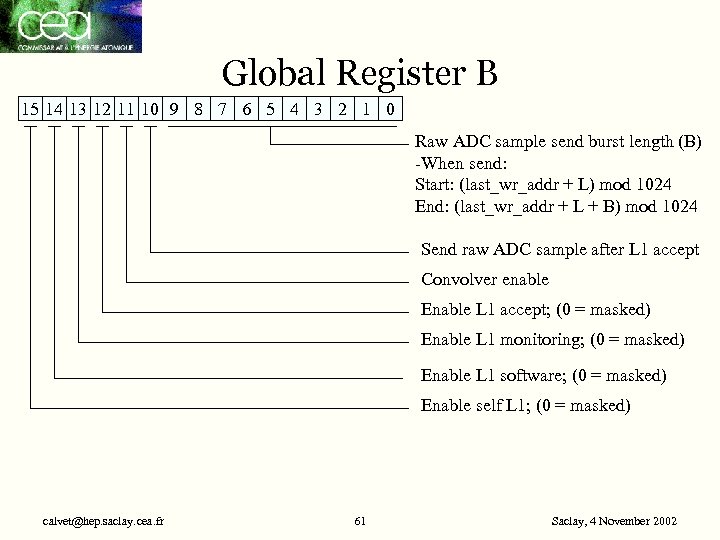
Global Register B 15 14 13 12 11 10 9 8 7 6 5 4 3 2 1 0 Raw ADC sample send burst length (B) -When send: Start: (last_wr_addr + L) mod 1024 End: (last_wr_addr + L + B) mod 1024 Send raw ADC sample after L 1 accept Convolver enable Enable L 1 accept; (0 = masked) Enable L 1 monitoring; (0 = masked) Enable L 1 software; (0 = masked) Enable self L 1; (0 = masked) calvet@hep. saclay. cea. fr 61 Saclay, 4 November 2002
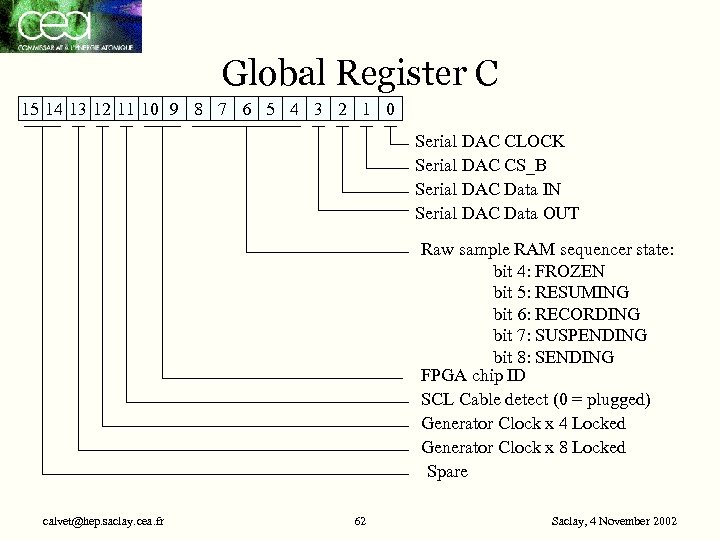
Global Register C 15 14 13 12 11 10 9 8 7 6 5 4 3 2 1 0 Serial DAC CLOCK Serial DAC CS_B Serial DAC Data IN Serial DAC Data OUT Raw sample RAM sequencer state: bit 4: FROZEN bit 5: RESUMING bit 6: RECORDING bit 7: SUSPENDING bit 8: SENDING FPGA chip ID SCL Cable detect (0 = plugged) Generator Clock x 4 Locked Generator Clock x 8 Locked Spare calvet@hep. saclay. cea. fr 62 Saclay, 4 November 2002
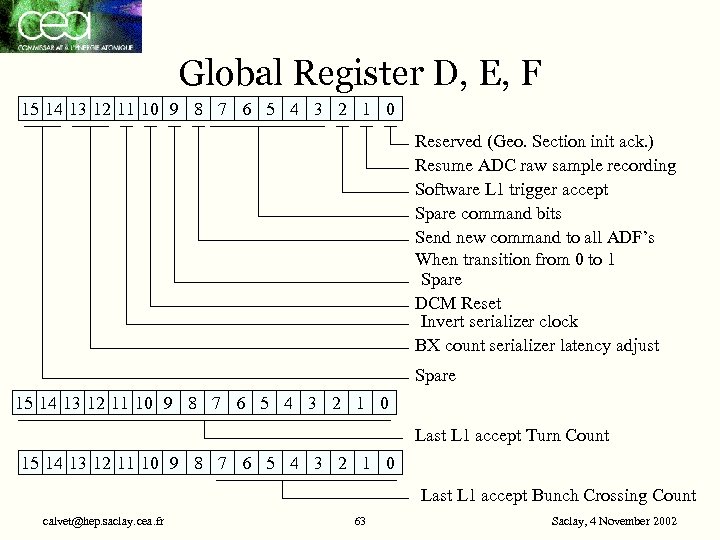
Global Register D, E, F 15 14 13 12 11 10 9 8 7 6 5 4 3 2 1 0 Reserved (Geo. Section init ack. ) Resume ADC raw sample recording Software L 1 trigger accept Spare command bits Send new command to all ADF’s When transition from 0 to 1 Spare DCM Reset Invert serializer clock BX count serializer latency adjust Spare 15 14 13 12 11 10 9 8 7 6 5 4 3 2 1 0 Last L 1 accept Turn Count 15 14 13 12 11 10 9 8 7 6 5 4 3 2 1 0 Last L 1 accept Bunch Crossing Count calvet@hep. saclay. cea. fr 63 Saclay, 4 November 2002
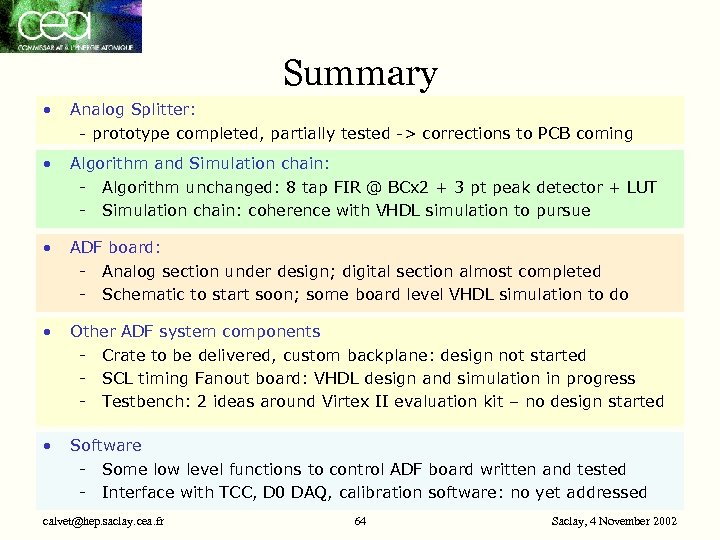
Summary • Analog Splitter: - prototype completed, partially tested -> corrections to PCB coming • Algorithm and Simulation chain: - Algorithm unchanged: 8 tap FIR @ BCx 2 + 3 pt peak detector + LUT - Simulation chain: coherence with VHDL simulation to pursue • ADF board: - Analog section under design; digital section almost completed - Schematic to start soon; some board level VHDL simulation to do • Other ADF system components - Crate to be delivered, custom backplane: design not started - SCL timing Fanout board: VHDL design and simulation in progress - Testbench: 2 ideas around Virtex II evaluation kit – no design started • Software - Some low level functions to control ADF board written and tested - Interface with TCC, D 0 DAQ, calibration software: no yet addressed calvet@hep. saclay. cea. fr 64 Saclay, 4 November 2002
Скачать презентацию Status of ADF System Design November 2002 D
4882646c344e828dbbe040df966aad90.ppt