


 Скачать презентацию Status and results from the OPERA experiment Tsutomu
efe6f96e32bd72d95cf808cc475a12e4.ppt
- Количество слайдов: 31
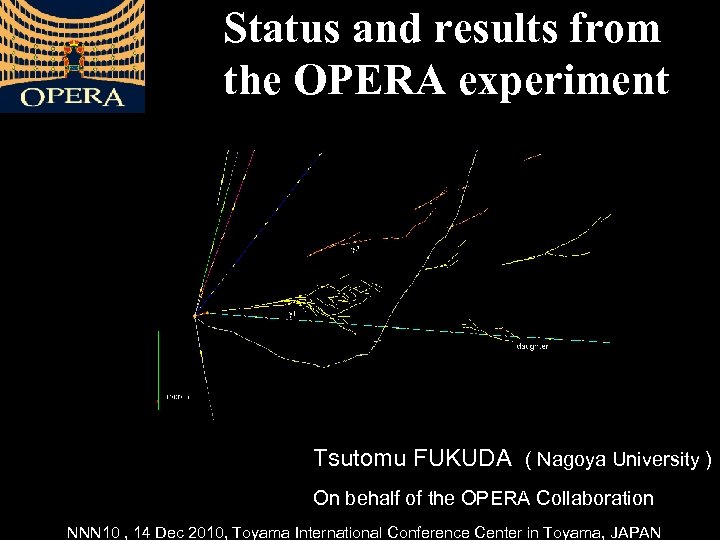 Status and results from the OPERA experiment Tsutomu FUKUDA ( Nagoya University ) On behalf of the OPERA Collaboration NNN 10 , 14 Dec 2010, Toyama International Conference Center in Toyama, JAPAN
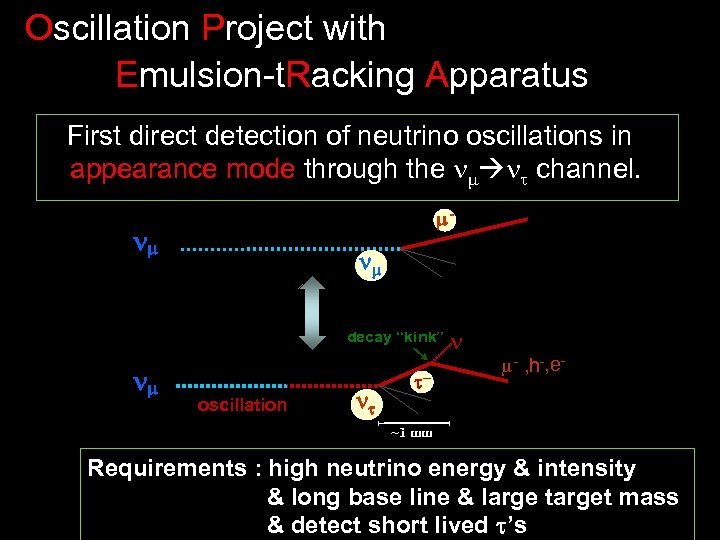 Oscillation Project with Emulsion-t. Racking Apparatus First direct detection of neutrino oscillations in appearance mode through the channel. - decay “kink” oscillation - - , h-, e- ~1 mm Requirements : high neutrino energy & intensity & long base line & large target mass & detect short lived ’s
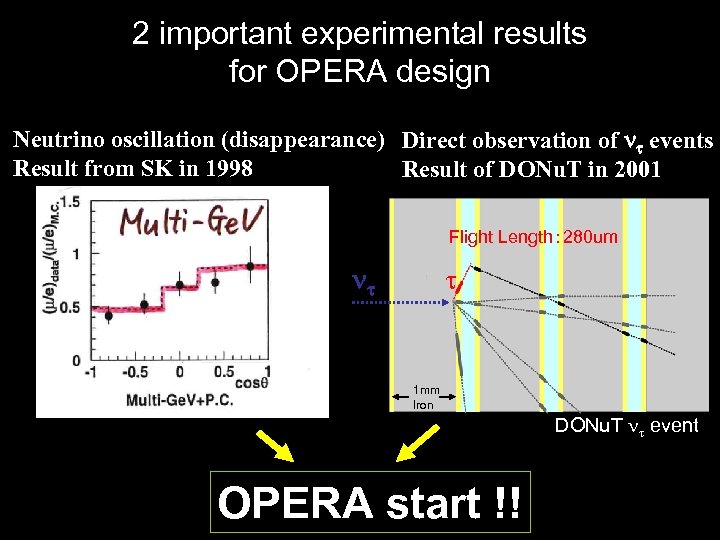 2 important experimental results for OPERA design Neutrino oscillation (disappearance) Direct observation of events Result from SK in 1998 Result of DONu. T in 2001 Flight Length: 280 um 1 mm Iron DONu. T event OPERA start !!
 The OPERA Collaboration 180 physicists, 33 institutions in 12 countries Belgium IIHE-ULB Brussels Croatia IRB Zagreb France LAPP Annecy IPNL Lyon IPHC Strasbourg Italy Bari Bologna LNF Frascati L’Aquila LNGS Naples Padova Rome Salerno Hamburg Münster Rostock Israel Korea Technion Haifa INR RAS Moscow NPI RAS Moscow ITEP Moscow SINP MSU Moscow JINR Dubna Switzerland Bern ETH Zurich Japan Aichi Toho Kobe Nagoya Utsunomiya Germany Russia Jinju Tunisia CNSTN Tunis Turkey METU Ankara
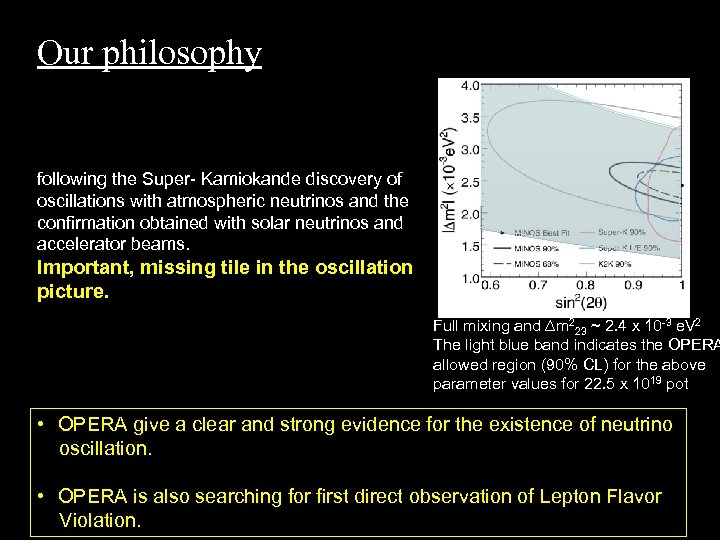 Our philosophy following the Super- Kamiokande discovery of oscillations with atmospheric neutrinos and the confirmation obtained with solar neutrinos and accelerator beams. Important, missing tile in the oscillation picture. Full mixing and ∆m 223 ~ 2. 4 x 10 -3 e. V 2 The light blue band indicates the OPERA allowed region (90% CL) for the above parameter values for 22. 5 x 10¹⁹ pot • OPERA give a clear and strong evidence for the existence of neutrino oscillation. • OPERA is also searching for first direct observation of Lepton Flavor Violation.
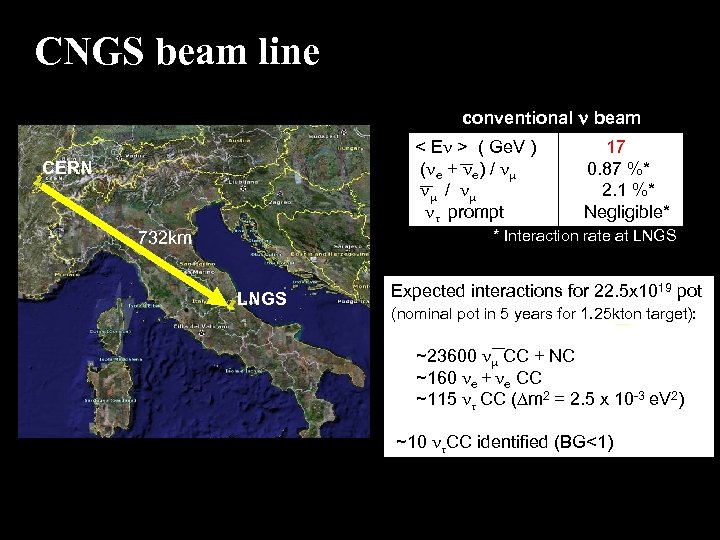 CNGS beam line conventional beam < E > ( Ge. V ) ( e + e) / / prompt CERN 17 0. 87 %* 2. 1 %* Negligible* * Interaction rate at LNGS 732 km LNGS Expected interactions for 22. 5 x 10¹⁹ pot (nominal pot in 5 years for 1. 25 kton target): ~23600 CC + NC ~160 e + e CC ~115 CC ( m 2 = 2. 5 x 10 -3 e. V 2) ~10 CC identified (BG<1)
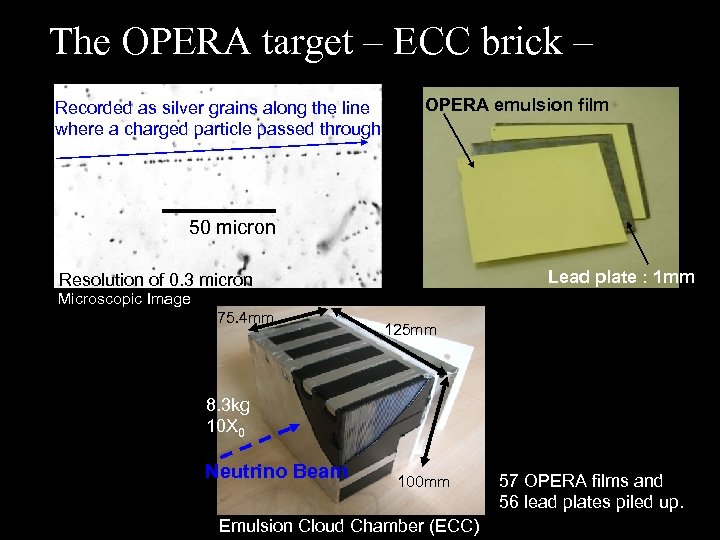 The OPERA target – ECC brick – Recorded as silver grains along the line where a charged particle passed through OPERA emulsion film 50 micron Lead plate : 1 mm Resolution of 0. 3 micron Microscopic Image 75. 4 mm 125 mm 8. 3 kg 10 X 0 Neutrino Beam 100 mm Emulsion Cloud Chamber (ECC) 57 OPERA films and 56 lead plates piled up.
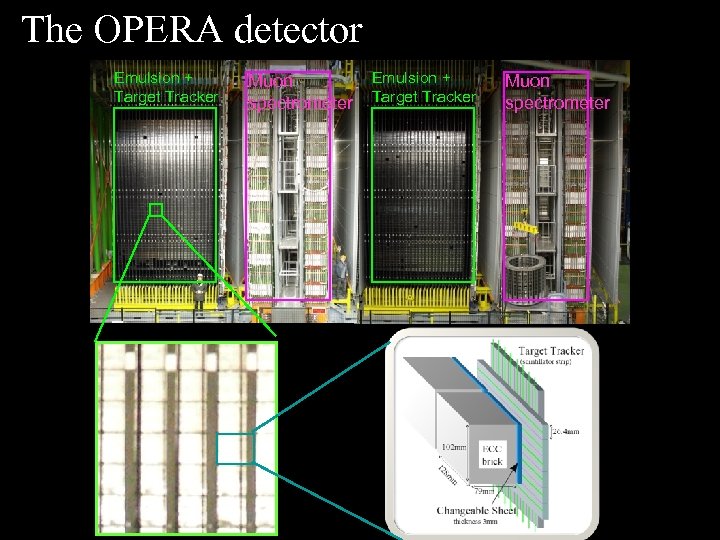 The OPERA detector Emulsion + Target Tracker Muon spectrometer OPERA emulsion film
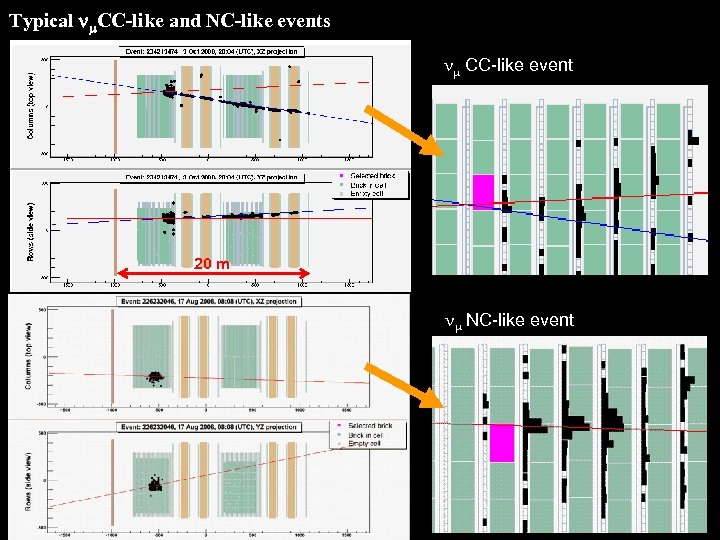 Typical CC-like and NC-like events CC-like event 20 m NC-like event
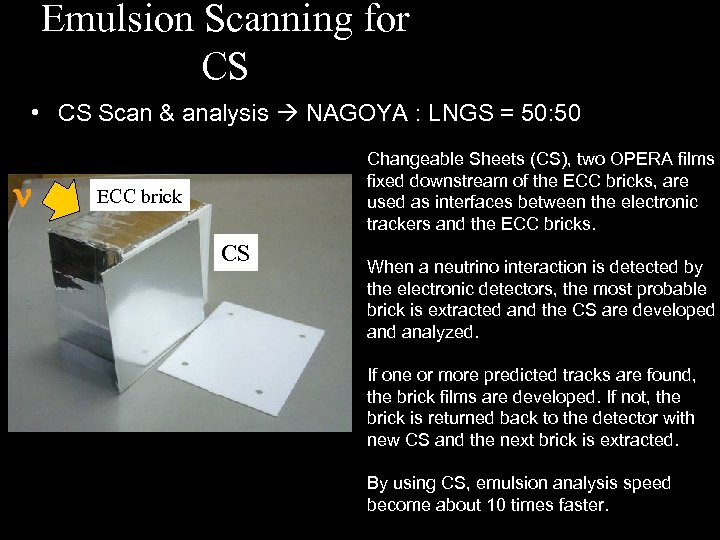 Emulsion Scanning for CS • CS Scan & analysis NAGOYA : LNGS = 50: 50 Changeable Sheets (CS), two OPERA films fixed downstream of the ECC bricks, are used as interfaces between the electronic trackers and the ECC bricks. ECC brick CS When a neutrino interaction is detected by the electronic detectors, the most probable brick is extracted and the CS are developed analyzed. If one or more predicted tracks are found, the brick films are developed. If not, the brick is returned back to the detector with new CS and the next brick is extracted. By using CS, emulsion analysis speed become about 10 times faster.
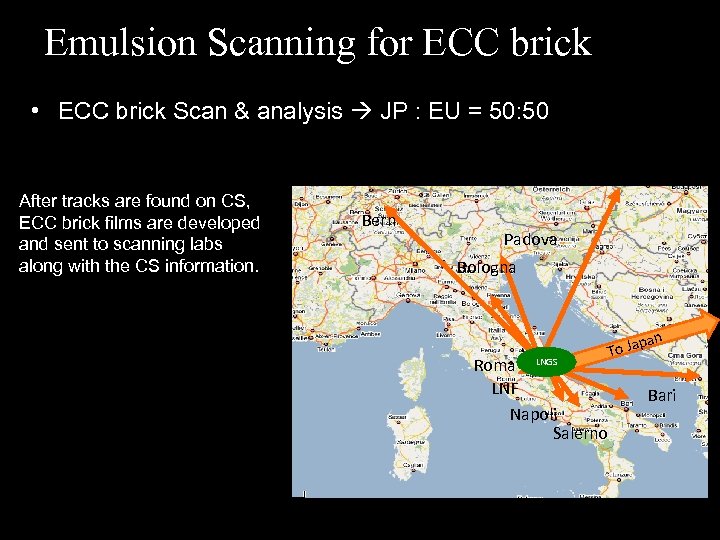 Emulsion Scanning for ECC brick • ECC brick Scan & analysis JP : EU = 50: 50 After tracks are found on CS, ECC brick films are developed and sent to scanning labs along with the CS information. Bern Padova Bologna an Roma LNGS LNF Napoli Salerno p To Ja Bari
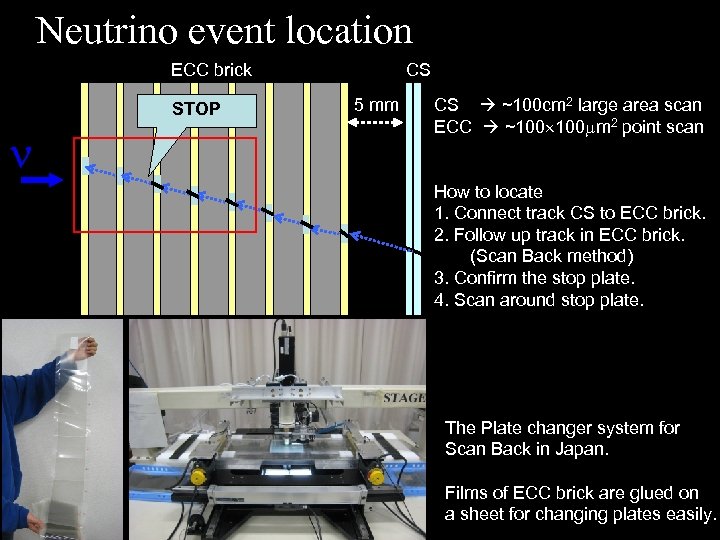 Neutrino event location CS ECC brick STOP 5 mm CS ~100 cm 2 large area scan ECC ~100 m 2 point scan How to locate 1. Connect track CS to ECC brick. 2. Follow up track in ECC brick. (Scan Back method) 3. Confirm the stop plate. 4. Scan around stop plate. The Plate changer system for Scan Back in Japan. Films of ECC brick are glued on a sheet for changing plates easily.
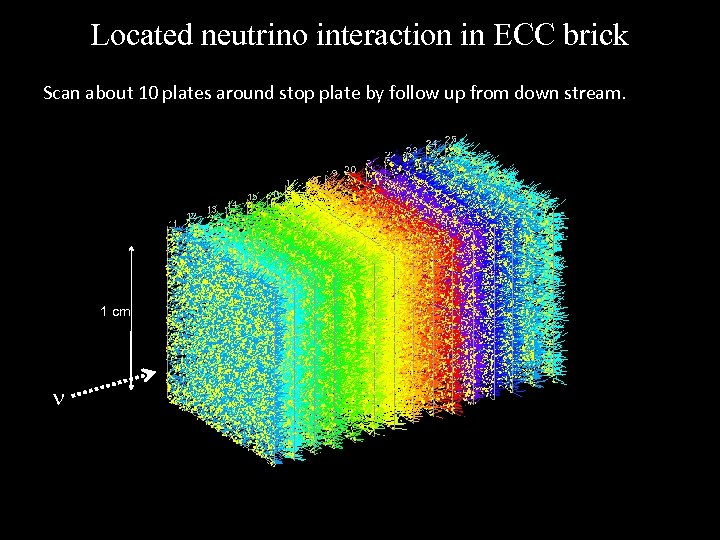 Located neutrino interaction in ECC brick Scan about 10 plates around stop plate by follow up from down stream. 1 cm
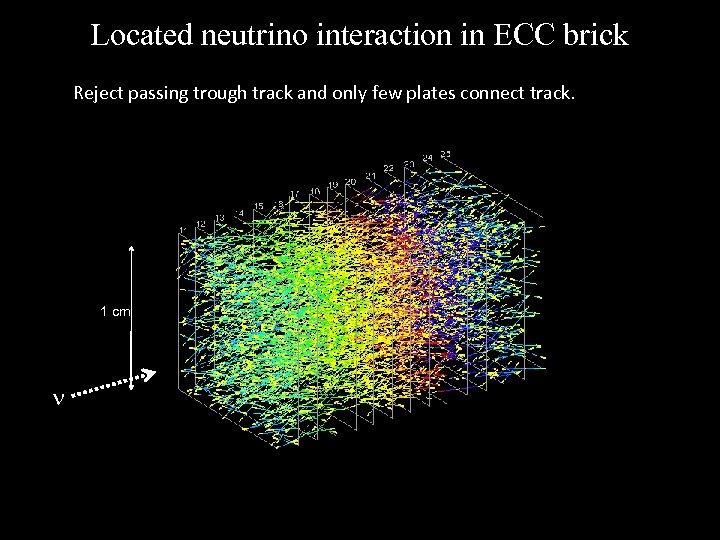 Located neutrino interaction in ECC brick Reject passing trough track and only few plates connect track. 1 cm
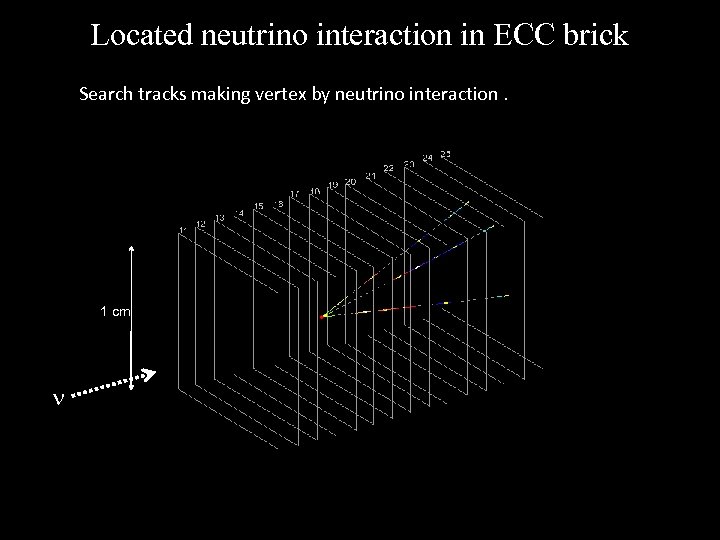 Located neutrino interaction in ECC brick Search tracks making vertex by neutrino interaction. 1 cm
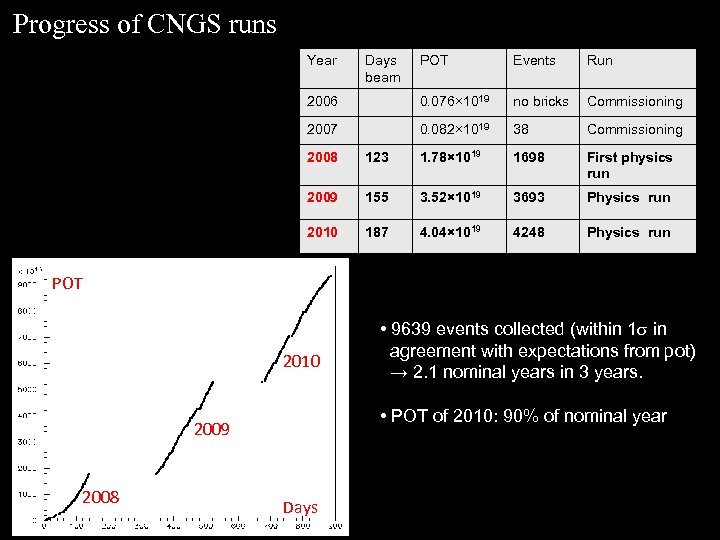 Progress of CNGS runs Year Days beam POT Events Run 2006 0. 076× 1019 no bricks Commissioning 2007 0. 082× 1019 38 Commissioning 2008 123 1. 78× 1019 1698 First physics run 2009 155 3. 52× 1019 3693 Physics run 2010 187 4. 04× 1019 4248 Physics run POT 2010 • POT of 2010: 90% of nominal year 2009 2008 • 9639 events collected (within 1 s in agreement with expectations from pot) → 2. 1 nominal years in 3 years. Days
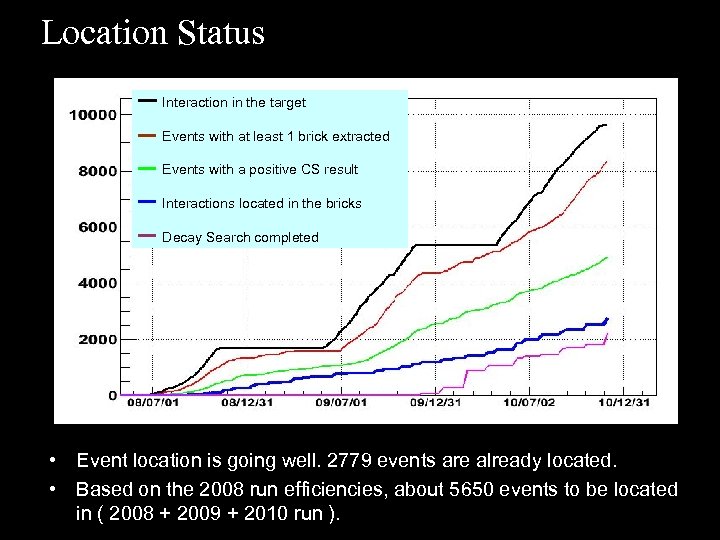 Location Status Interaction in the target Events with at least 1 brick extracted Events with a positive CS result Interactions located in the bricks Decay Search completed • Event location is going well. 2779 events are already located. • Based on the 2008 run efficiencies, about 5650 events to be located in ( 2008 + 2009 + 2010 run ).
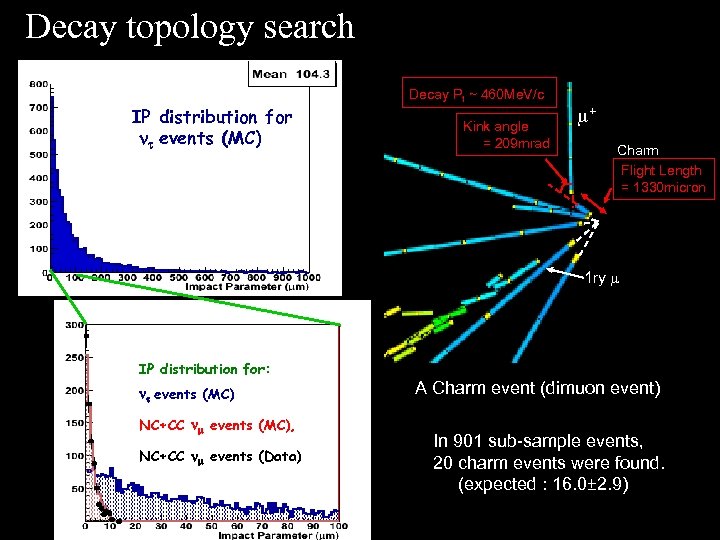 Decay topology search IP distribution for events (MC) Decay Pt ~ 460 Me. V/c Kink angle = 209 mrad + Charm Flight Length = 1330 micron 1 ry IP distribution for: events (MC) NC+CC events (MC), NC+CC events (Data) A Charm event (dimuon event) In 901 sub-sample events, 20 charm events were found. (expected : 16. 0± 2. 9)
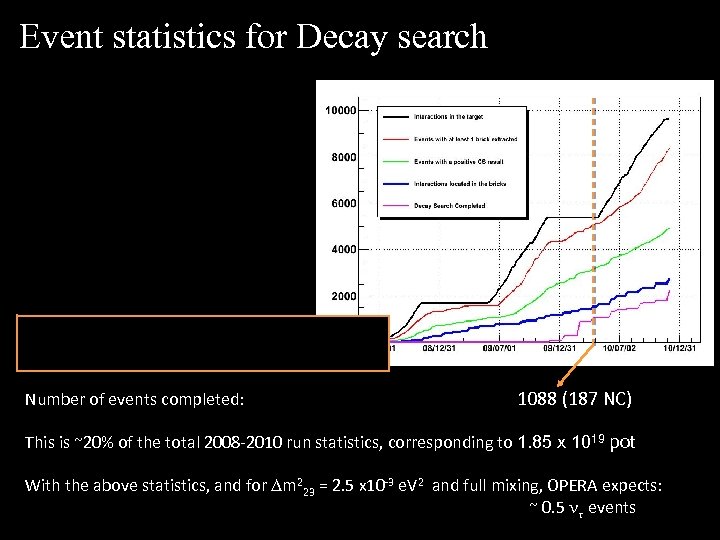 Event statistics for Decay search The analysis of a sub-sample of the data taken in the 2008 -2009 runs was completed. Number of events completed: 1088 (187 NC) This is ~20% of the total 2008 -2010 run statistics, corresponding to 1. 85 x 1019 pot With the above statistics, and for m 223 = 2. 5 x 10 -3 e. V 2 and full mixing, OPERA expects: ~ 0. 5 events
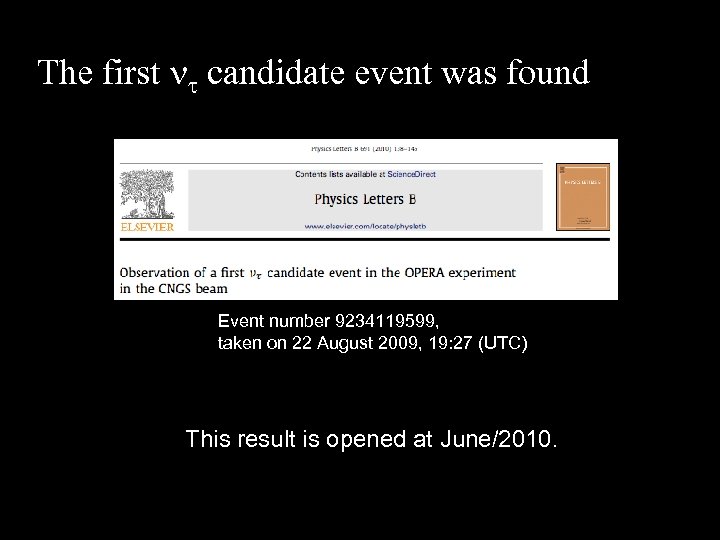 The first candidate event was found Event number 9234119599, taken on 22 August 2009, 19: 27 (UTC) This result is opened at June/2010.
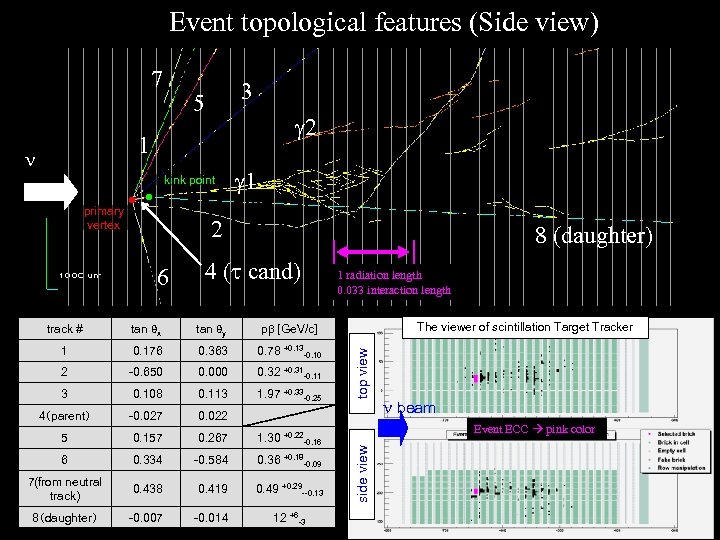 Event topological features (Side view) 7 3 5 2 1 kink point primary vertex 1 2 6 8 (daughter) 4 ( cand) tan y 1 0. 176 0. 363 0. 78 +0. 13 -0. 10 2 -0. 650 0. 000 0. 32 +0. 31 -0. 11 3 0. 108 0. 113 1. 97 +0. 33 -0. 25 4(parent) -0. 027 0. 022 5 0. 157 0. 267 1. 30 +0. 22 -0. 16 6 0. 334 -0. 584 0. 36 +0. 18 -0. 09 7(from neutral track) 0. 438 0. 419 0. 49 +0. 29 --0. 13 8(daughter) -0. 007 -0. 014 12 +6 -3 The viewer of scintillation Target Tracker p [Ge. V/c] top view tan x beam Event ECC pink color side view track # 1 radiation length 0. 033 interaction length
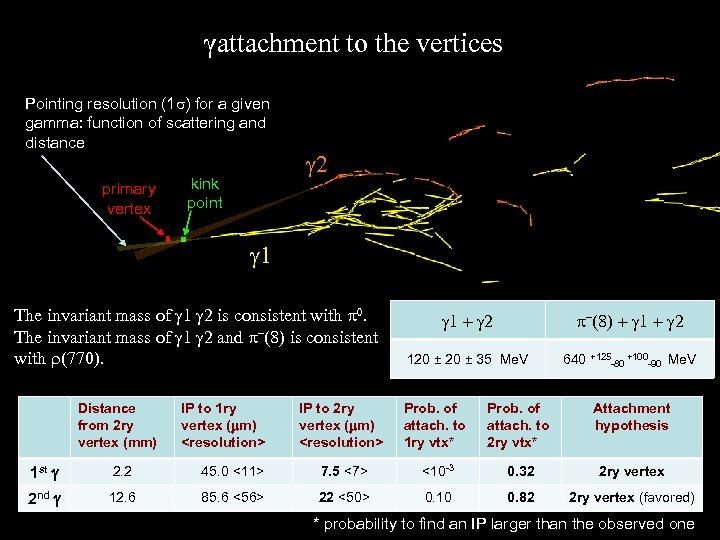 γattachment to the vertices Pointing resolution (1 s) for a given gamma: function of scattering and distance primary vertex kink point 2 1 The invariant mass of 1 2 is consistent with 0. The invariant mass of 1 2 and (8) is consistent with r(770). Distance from 2 ry vertex (mm) IP to 1 ry vertex ( m)
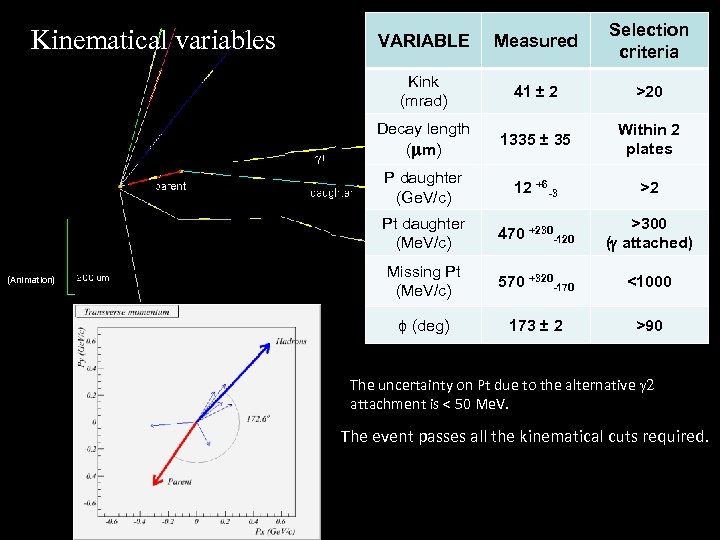 Selection criteria 41 ± 2 >20 Decay length ( m) 1335 ± 35 Within 2 plates P daughter (Ge. V/c) 12 +6 -3 >2 Pt daughter (Me. V/c) (Animation) Measured Kink (mrad) Kinematical variables VARIABLE 470 +230 -120 >300 (g attached) Missing Pt (Me. V/c) 570 +320 -170 <1000 ϕ (deg) 173 ± 2 >90 The uncertainty on Pt due to the alternative 2 attachment is < 50 Me. V. The event passes all the kinematical cuts required.
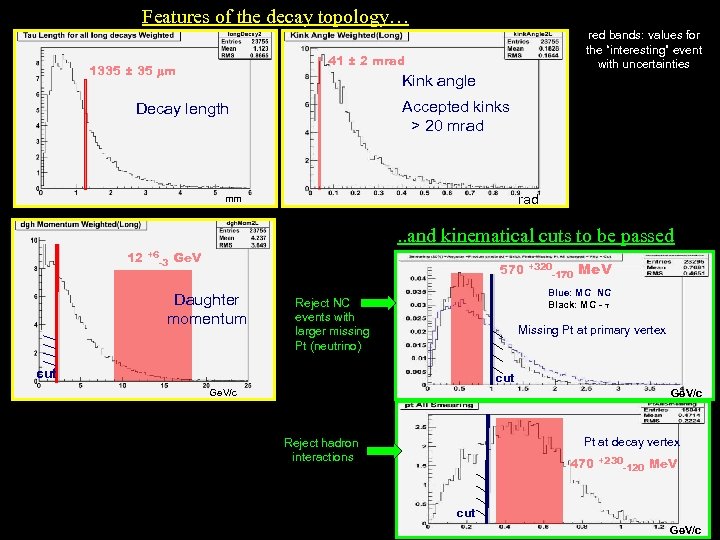 Features of the decay topology… red bands: values for the “interesting” event with uncertainties 41 ± 2 mrad 1335 ± 35 m Kink angle Accepted kinks > 20 mrad Decay length rad mm . . and kinematical cuts to be passed 12 +6 -3 Ge. V 570 Daughter momentum +320 -170 Me. V Blue: MC NC Black: MC - Reject NC events with larger missing Pt (neutrino) Missing Pt at at primary Missing Ptprimary vertex cut cut Ge. V/c Pt at decay vertex Reject hadron interactions 470 +230 -120 Me. V cut Ge. V/c
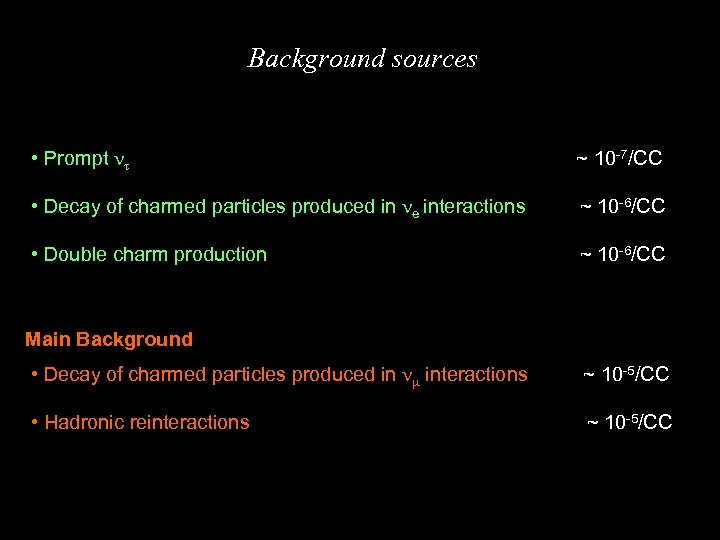 Background sources • Prompt ~ 10 -7/CC • Decay of charmed particles produced in e interactions ~ 10 -6/CC • Double charm production ~ 10 -6/CC Main Background • Decay of charmed particles produced in interactions • Hadronic reinteractions ~ 10 -5/CC ~ 10 -5/CC
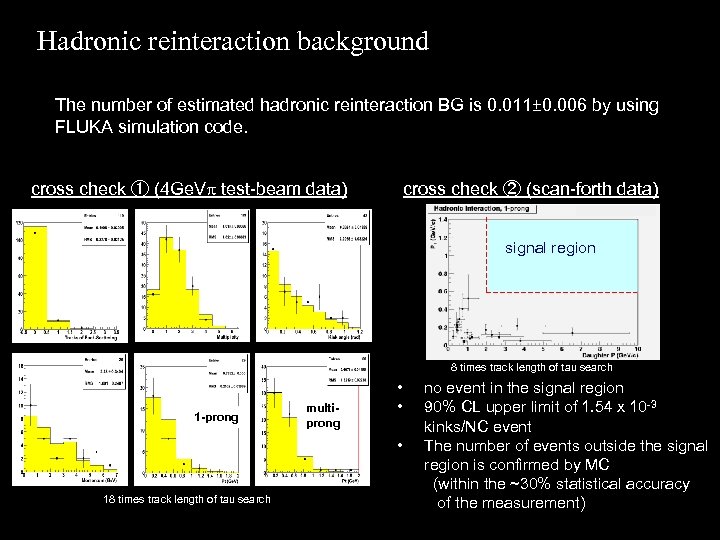 Hadronic reinteraction background The number of estimated hadronic reinteraction BG is 0. 011± 0. 006 by using FLUKA simulation code. cross check ① (4 Ge. V test-beam data) cross check ② (scan-forth data) signal region 8 times track length of tau search 1 -prong multiprong • • • 18 times track length of tau search no event in the signal region 90% CL upper limit of 1. 54 x 10 -3 kinks/NC event The number of events outside the signal region is confirmed by MC (within the ~30% statistical accuracy of the measurement)
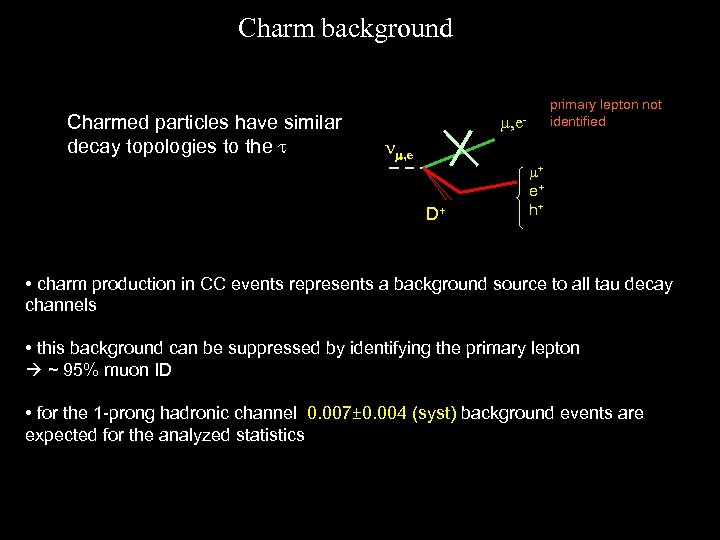 Charm background Charmed particles have similar decay topologies to the primary lepton not identified , e- , e D+ + e+ h+ • charm production in CC events represents a background source to all tau decay channels • this background can be suppressed by identifying the primary lepton ~ 95% muon ID • for the 1 -prong hadronic channel 0. 007± 0. 004 (syst) background events are expected for the analyzed statistics
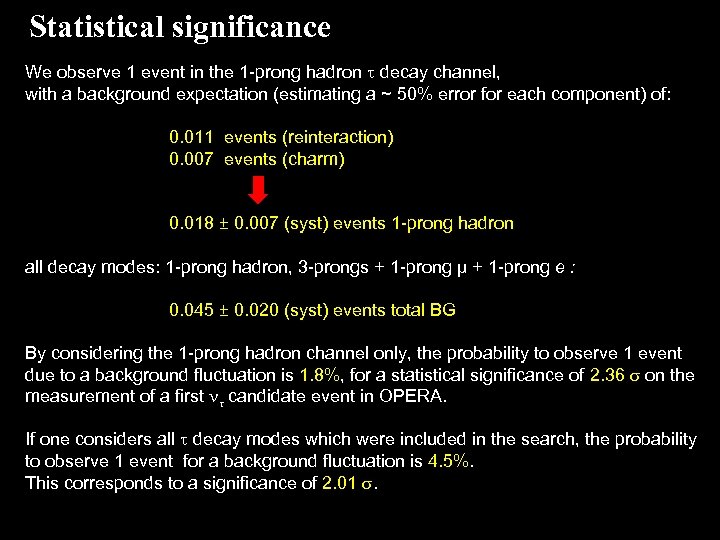 Statistical significance We observe 1 event in the 1 -prong hadron decay channel, with a background expectation (estimating a ~ 50% error for each component) of: 0. 011 events (reinteraction) 0. 007 events (charm) 0. 018 ± 0. 007 (syst) events 1 -prong hadron all decay modes: 1 -prong hadron, 3 -prongs + 1 -prong μ + 1 -prong e : 0. 045 ± 0. 020 (syst) events total BG By considering the 1 -prong hadron channel only, the probability to observe 1 event due to a background fluctuation is 1. 8%, for a statistical significance of 2. 36 s on the measurement of a first candidate event in OPERA. If one considers all decay modes which were included in the search, the probability to observe 1 event for a background fluctuation is 4. 5%. This corresponds to a significance of 2. 01 s.
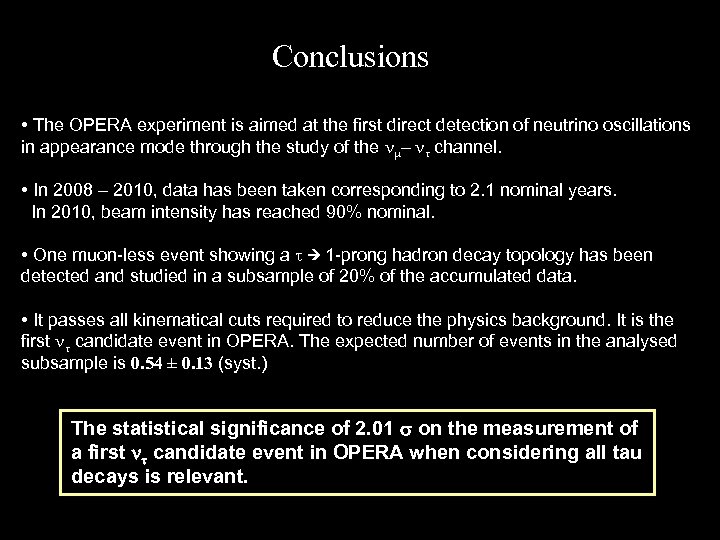 Conclusions • The OPERA experiment is aimed at the first direct detection of neutrino oscillations in appearance mode through the study of the channel. • In 2008 – 2010, data has been taken corresponding to 2. 1 nominal years. In 2010, beam intensity has reached 90% nominal. • One muon-less event showing a 1 -prong hadron decay topology has been detected and studied in a subsample of 20% of the accumulated data. • It passes all kinematical cuts required to reduce the physics background. It is the first candidate event in OPERA. The expected number of events in the analysed subsample is 0. 54 ± 0. 13 (syst. ) The statistical significance of 2. 01 s on the measurement of a first candidate event in OPERA when considering all tau decays is relevant.
 Outlook • In 2011, 6 extra weeks of beam in dedicated mode have been attributed corresponding to 1. 2 nominal years. If 2012 (or 2013) is like 2011: Data on ~ 19. 7× 10¹⁹ POT or ~ 87% of Proposal beam intensity collected • Analysis of 2008/2009 events will be closed in Feb/2011 and new results on oscillations will be released in spring 2011.
 Thank you for your attention ! Tsutomu FUKUDA ( Nagoya University ) NNN 10 , 14 Dec 2010, Toyama International Conference Center in Toyama, JAPAN