


 Скачать презентацию Status and issues in Potato Production STATUS
5326e47709debb93406b7fc2c5241c74.ppt
- Количество слайдов: 25
 Status and issues in Potato Production
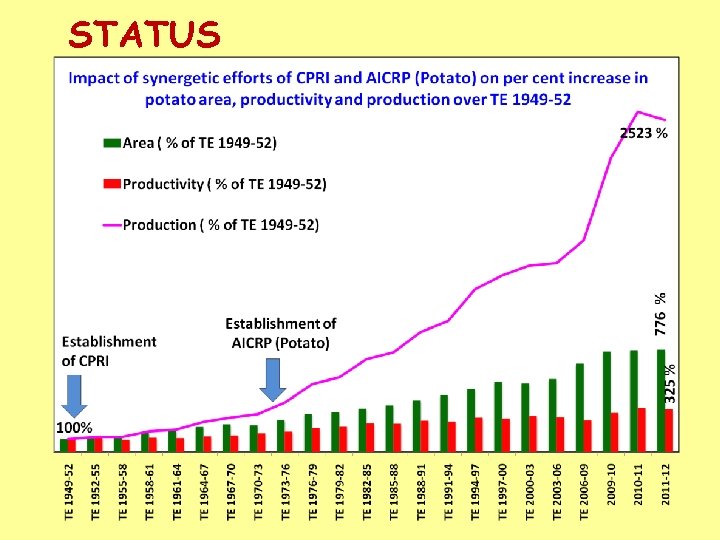 STATUS
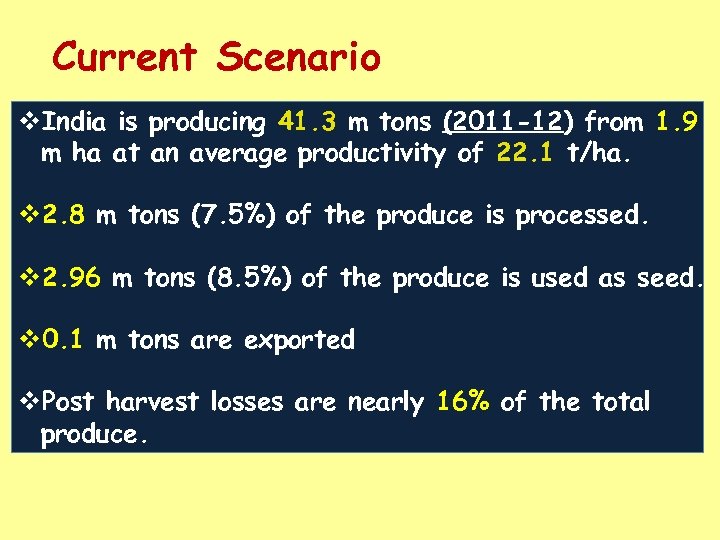 Current Scenario v. India is producing 41. 3 m tons (2011 -12) from 1. 9 m ha at an average productivity of 22. 1 t/ha. v 2. 8 m tons (7. 5%) of the produce is processed. v 2. 96 m tons (8. 5%) of the produce is used as seed. v 0. 1 m tons are exported v. Post harvest losses are nearly 16% of the total produce.
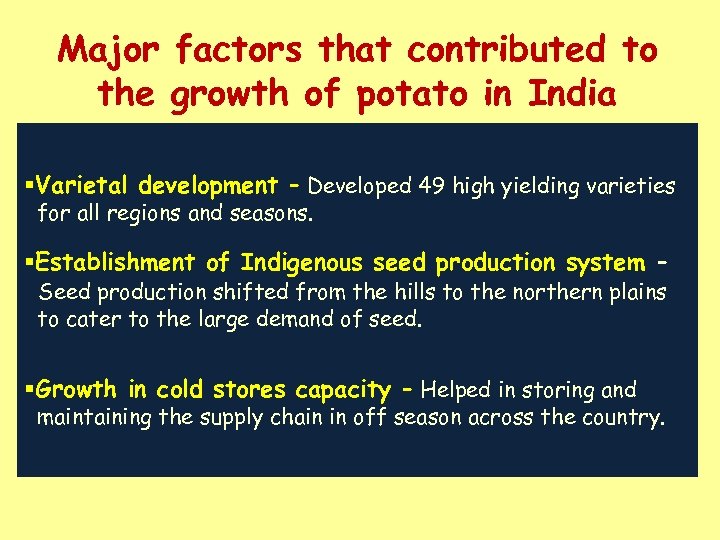 Major factors that contributed to the growth of potato in India §Varietal development – Developed 49 high yielding varieties for all regions and seasons. §Establishment of Indigenous seed production system – Seed production shifted from the hills to the northern plains to cater to the large demand of seed. §Growth in cold stores capacity – Helped in storing and maintaining the supply chain in off season across the country.
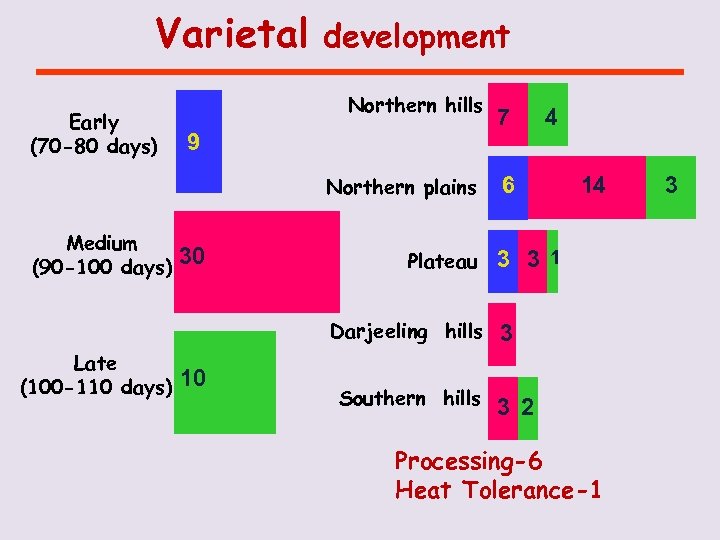 Varietal Early (70 -80 days) development Northern hills 9 Northern plains Medium (90 -100 days) 30 7 4 6 14 Plateau 3 3 1 Darjeeling hills 3 Late (100 -110 days) 10 Southern hills 3 2 Processing-6 Heat Tolerance-1 3
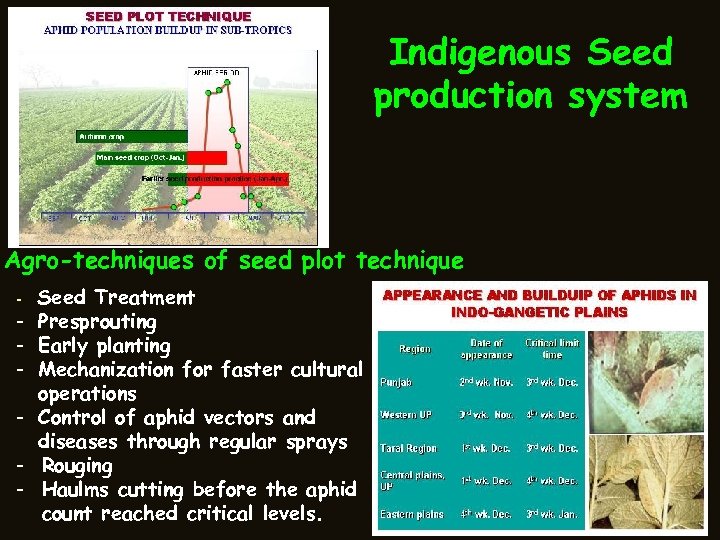 Indigenous Seed production system Agro-techniques of seed plot technique - Seed Treatment - Presprouting - Early planting - Mechanization for faster cultural operations - Control of aphid vectors and diseases through regular sprays - Rouging - Haulms cutting before the aphid count reached critical levels.
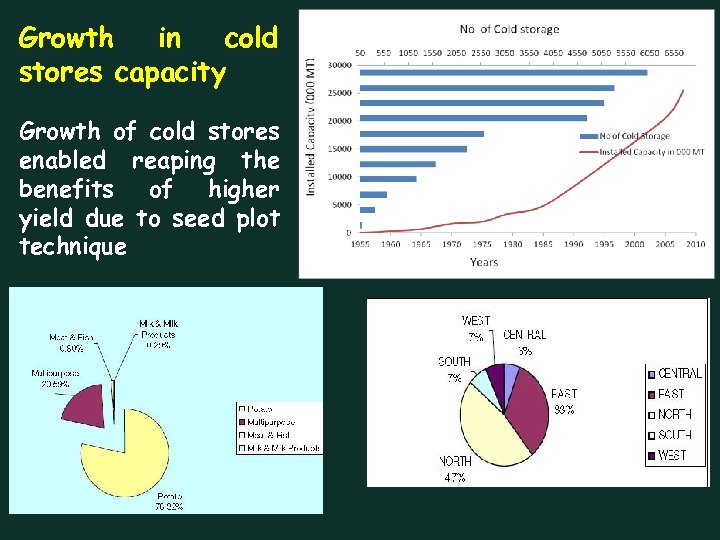 Growth in cold stores capacity Growth of cold stores enabled reaping the benefits of higher yield due to seed plot technique
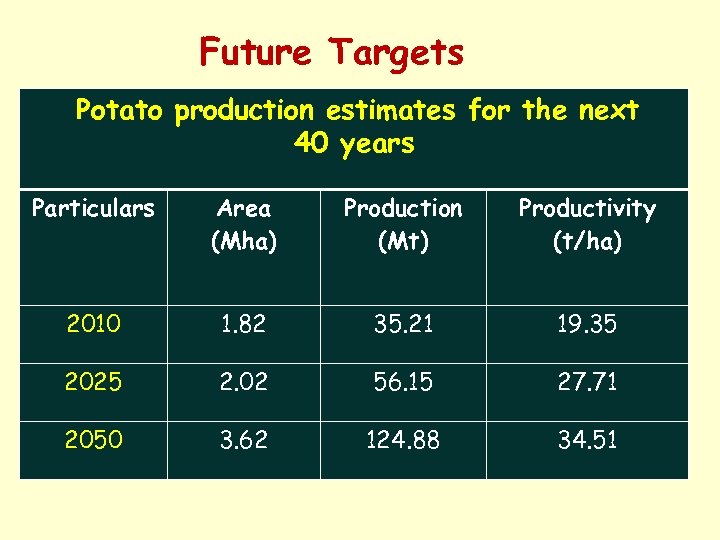 Future Targets Potato production estimates for the next 40 years Particulars Area (Mha) Production (Mt) Productivity (t/ha) 2010 1. 82 35. 21 19. 35 2025 2. 02 56. 15 27. 71 2050 3. 62 124. 88 34. 51
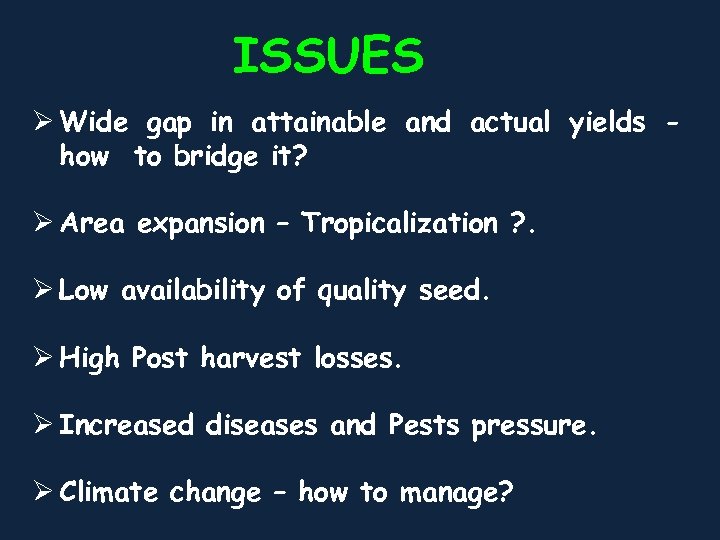 ISSUES Ø Wide gap in attainable and actual yields how to bridge it? Ø Area expansion – Tropicalization ? . Ø Low availability of quality seed. Ø High Post harvest losses. Ø Increased diseases and Pests pressure. Ø Climate change – how to manage?
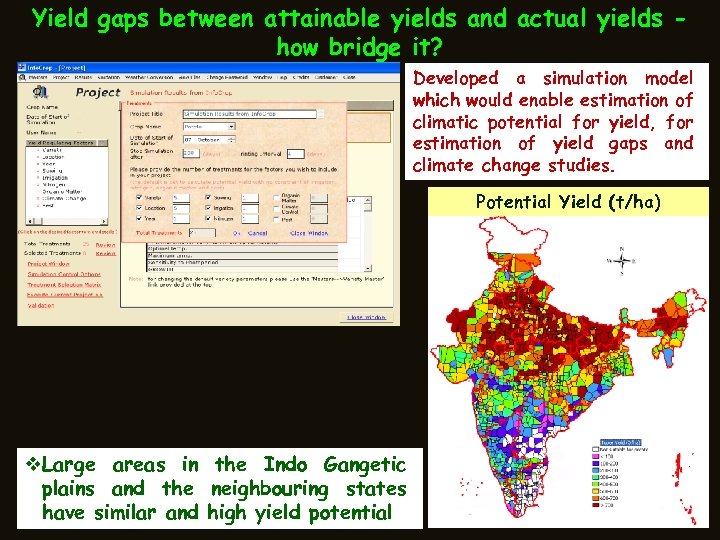 Yield gaps between attainable yields and actual yields how bridge it? Developed a simulation model which would enable estimation of climatic potential for yield, for estimation of yield gaps and climate change studies. Potential Yield (t/ha) v. Large areas in the Indo Gangetic plains and the neighbouring states have similar and high yield potential
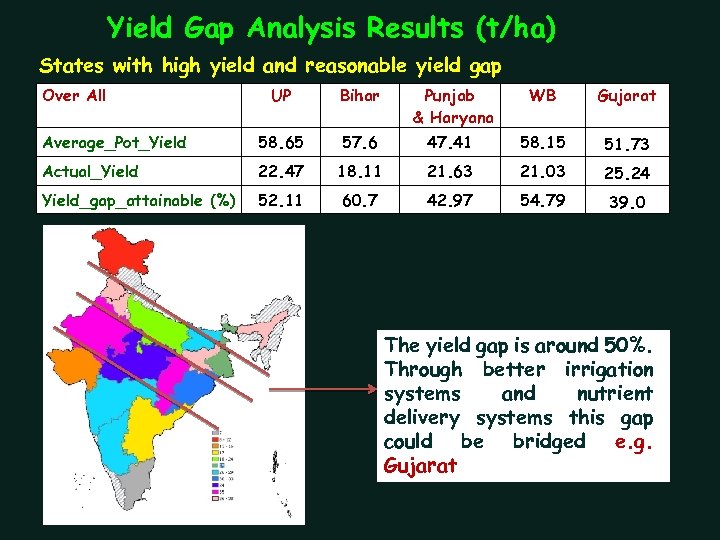 Yield Gap Analysis Results (t/ha) States with high yield and reasonable yield gap Over All UP Bihar Punjab & Haryana WB Gujarat Average_Pot_Yield 58. 65 57. 6 47. 41 58. 15 51. 73 Actual_Yield 22. 47 18. 11 21. 63 21. 03 25. 24 Yield_gap_attainable (%) 52. 11 60. 7 42. 97 54. 79 39. 0 The yield gap is around 50%. Through better irrigation systems and nutrient delivery systems this gap could be bridged e. g. Gujarat
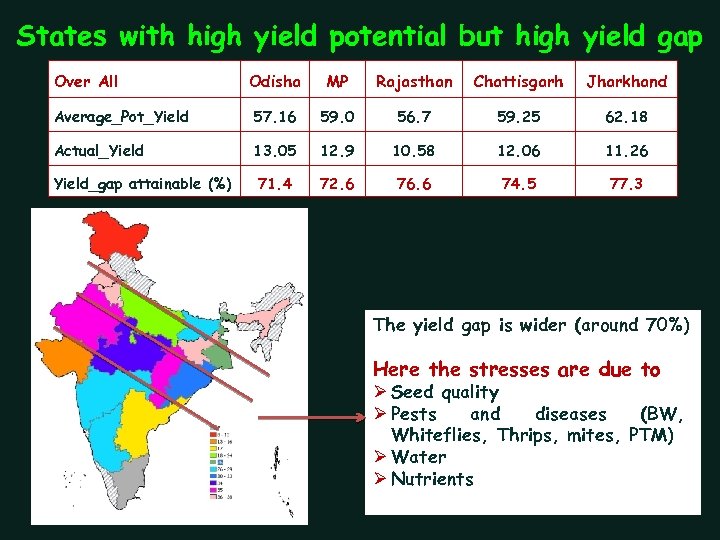 States with high yield potential but high yield gap Over All Odisha MP Rajasthan Chattisgarh Jharkhand Average_Pot_Yield 57. 16 59. 0 56. 7 59. 25 62. 18 Actual_Yield 13. 05 12. 9 10. 58 12. 06 11. 26 71. 4 72. 6 76. 6 74. 5 77. 3 Yield_gap attainable (%) The yield gap is wider (around 70%) Here the stresses are due to Ø Seed quality Ø Pests and diseases (BW, Whiteflies, Thrips, mites, PTM) Ø Water Ø Nutrients
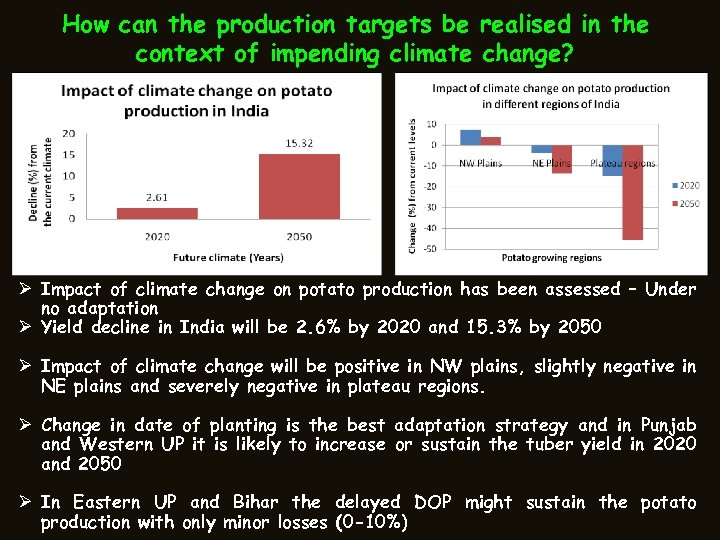 How can the production targets be realised in the context of impending climate change? Ø Impact of climate change on potato production has been assessed – Under no adaptation Ø Yield decline in India will be 2. 6% by 2020 and 15. 3% by 2050 Ø Impact of climate change will be positive in NW plains, slightly negative in NE plains and severely negative in plateau regions. Ø Change in date of planting is the best adaptation strategy and in Punjab and Western UP it is likely to increase or sustain the tuber yield in 2020 and 2050 Ø In Eastern UP and Bihar the delayed DOP might sustain the potato production with only minor losses (0 -10%)
 Future Varietal Requirements Ø Short duration varieties which can fit in cereal based cropping system Ø Heat tolerant varieties to enable spatial diversification of potato to non traditional areas and to minimize the impact of climate change Ø Varieties with multiple disease resistance (WB, LB, Viruses) Ø Processing varieties to meet the growing demand of the consumers - Short duration High resistant starch content Cold induced sweetening resistant Specialty potatoes
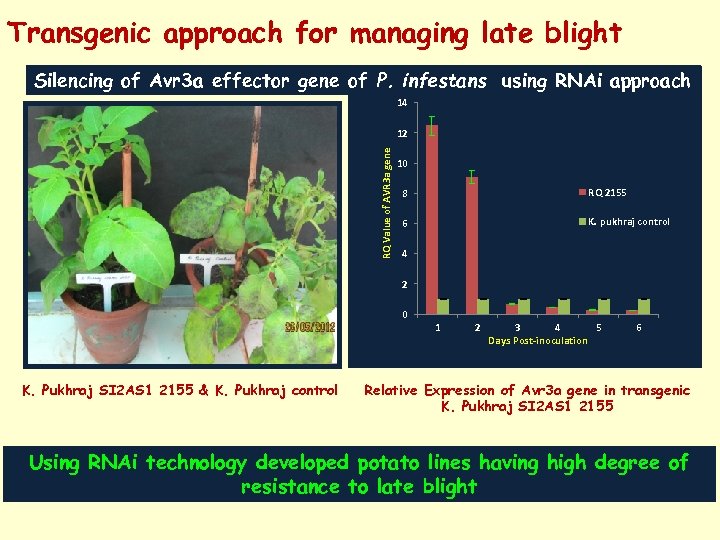 Transgenic approach for managing late blight Silencing of Avr 3 a effector gene of P. infestans using RNAi approach 14 RQ Value of AVR 3 a gene 12 10 8 RQ 2155 6 K. pukhraj control 4 2 0 1 K. Pukhraj SI 2 AS 1 2155 & K. Pukhraj control 2 3 4 5 Days Post-inoculation 6 Relative Expression of Avr 3 a gene in transgenic K. Pukhraj SI 2 AS 1 2155 Using RNAi technology developed potato lines having high degree of resistance to late blight
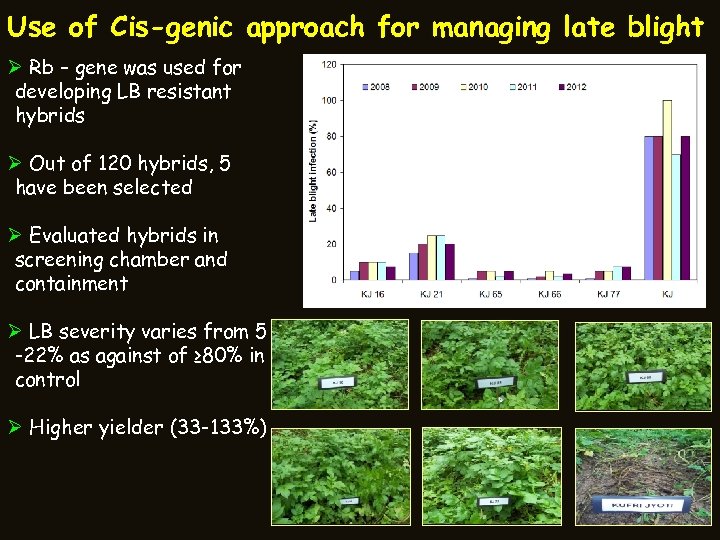 Use of Cis-genic approach for managing late blight Ø Rb – gene was used for developing LB resistant hybrids Ø Out of 120 hybrids, 5 have been selected Ø Evaluated hybrids in screening chamber and containment Ø LB severity varies from 5 -22% as against of ≥ 80% in control Ø Higher yielder (33 -133%)
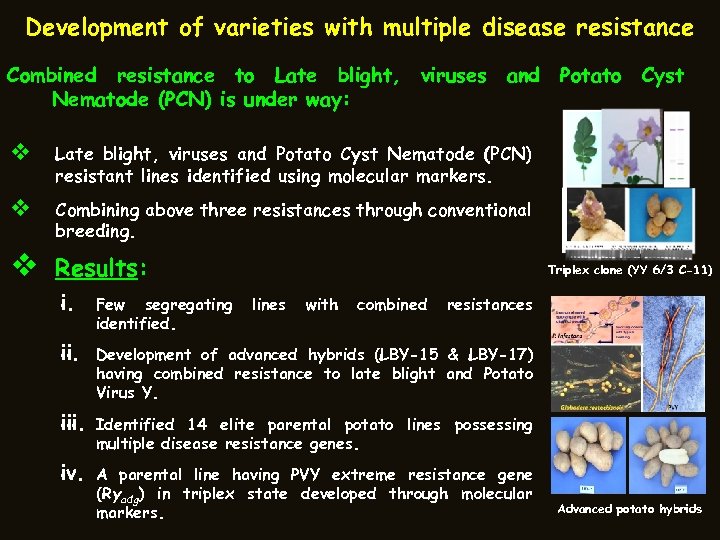 Development of varieties with multiple disease resistance Combined resistance to Late blight, Nematode (PCN) is under way: viruses and v Combining above three resistances through conventional breeding. v Results: Cyst Late blight, viruses and Potato Cyst Nematode (PCN) resistant lines identified using molecular markers. v Potato Triplex clone (YY 6/3 C-11) i. Few segregating identified. ii. Development of advanced hybrids (LBY-15 & LBY-17) having combined resistance to late blight and Potato Virus Y. iii. Identified 14 elite parental potato lines possessing multiple disease resistance genes. iv. A parental line having PVY extreme resistance gene (Ryadg) in triplex state developed through molecular markers. lines with combined resistances Advanced potato hybrids
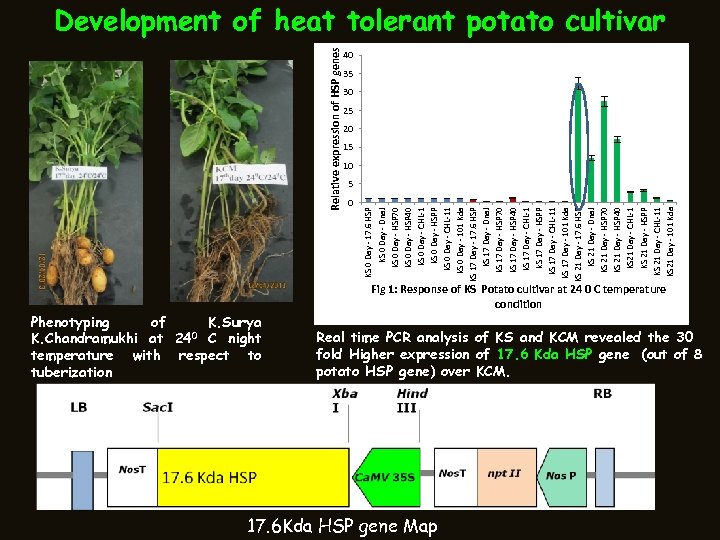 Relative expression of HSP genes Phenotyping of K. Surya 0 C night K. Chandramukhi at 24 temperature with respect to tuberization 0 Fig 1: Response of KS Potato cultivar at 24 0 C temperature condition KS 0 Day - 17. 6 HSP KS 0 Day - Dna. J k. S 0 Day - HSP 70 k. S 0 Day - HSP 40 k. S 0 Day - CHL-1 k. S 0 Day - HSPP k. S 0 Day - CHL-11 k. S 0 Day - 101 Kda KS 17 Day - 17. 6 HSP KS 17 Day - Dna. J k. S 17 Day - HSP 70 k. S 17 Day - HSP 40 k. S 17 Day - CHL-1 k. S 17 Day - HSPP k. S 17 Day - CHL-11 k. S 17 Day - 101 Kda KS 21 Day - 17. 6 HSP KS 21 Day - Dna. J KS 21 Day - HSP 70 KS 21 Day - HSP 40 KS 21 Day - CHL-1 KS 21 Day - HSPP KS 21 Day - CHL-11 KS 21 Day - 101 Kda Development of heat tolerant potato cultivar 40 35 30 25 20 15 10 5 Real time PCR analysis of KS and KCM revealed the 30 fold Higher expression of 17. 6 Kda HSP gene (out of 8 potato HSP gene) over KCM. 17. 6 Kda HSP gene Map
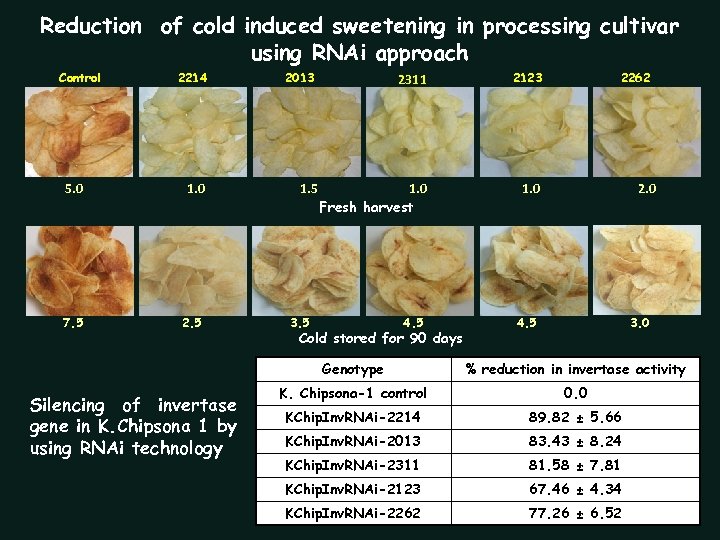 Reduction of cold induced sweetening in processing cultivar using RNAi approach Control 2214 5. 0 1. 0 7. 5 2013 1. 5 2311 2123 1. 0 Fresh harvest 1. 0 3. 5 4. 5 Cold stored for 90 days 2262 2. 0 4. 5 3. 0 Genotype Silencing of invertase gene in K. Chipsona 1 by using RNAi technology % reduction in invertase activity K. Chipsona-1 control 0. 0 KChip. Inv. RNAi-2214 89. 82 ± 5. 66 KChip. Inv. RNAi-2013 83. 43 ± 8. 24 KChip. Inv. RNAi-2311 81. 58 ± 7. 81 KChip. Inv. RNAi-2123 67. 46 ± 4. 34 KChip. Inv. RNAi-2262 77. 26 ± 6. 52
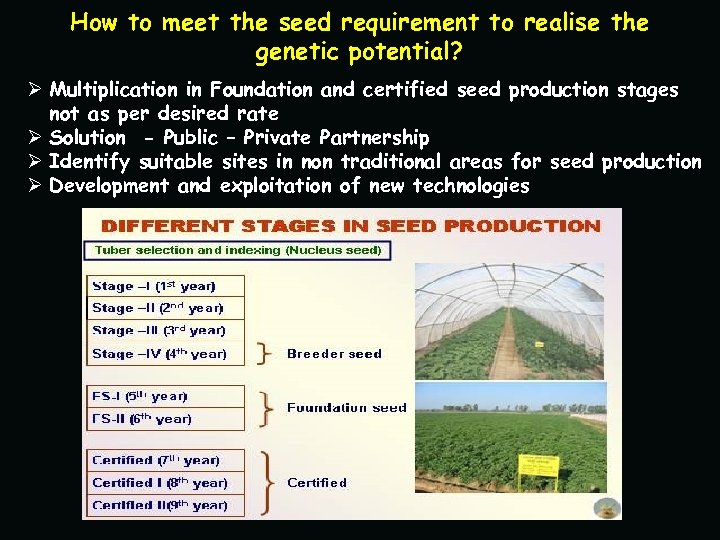 How to meet the seed requirement to realise the genetic potential? Ø Multiplication in Foundation and certified seed production stages not as per desired rate Ø Solution - Public – Private Partnership Ø Identify suitable sites in non traditional areas for seed production Ø Development and exploitation of new technologies
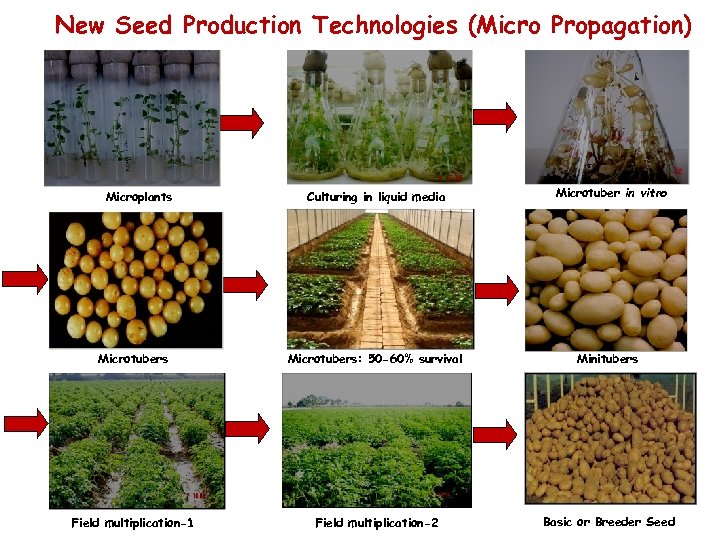 New Seed Production Technologies (Micro Propagation) Microplants Culturing in liquid media Microtuber in vitro Microtubers: 50 -60% survival Minitubers Field multiplication-1 Field multiplication-2 Basic or Breeder Seed
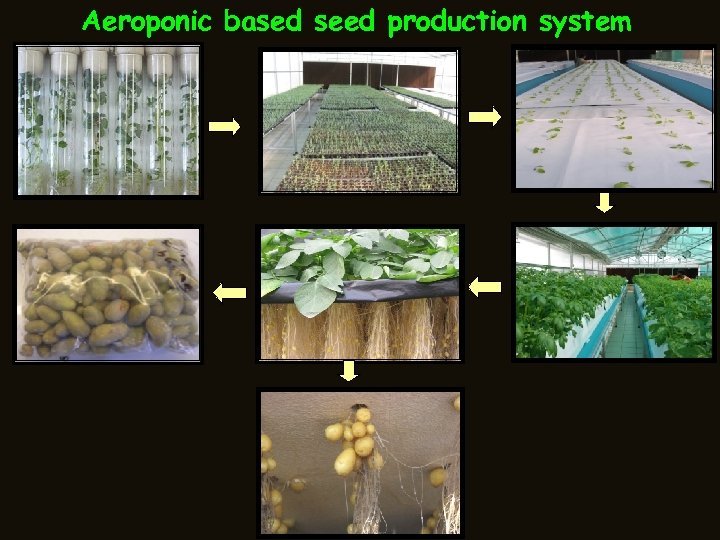 Aeroponic based seed production system
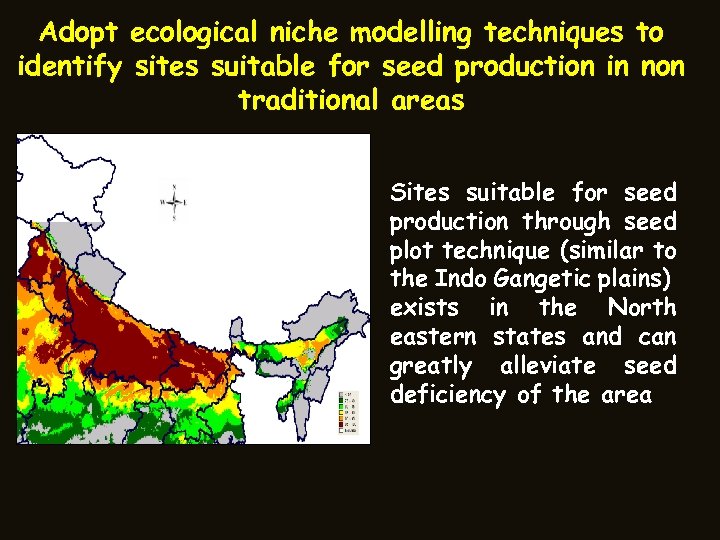 Adopt ecological niche modelling techniques to identify sites suitable for seed production in non traditional areas Sites suitable for seed production through seed plot technique (similar to the Indo Gangetic plains) exists in the North eastern states and can greatly alleviate seed deficiency of the area
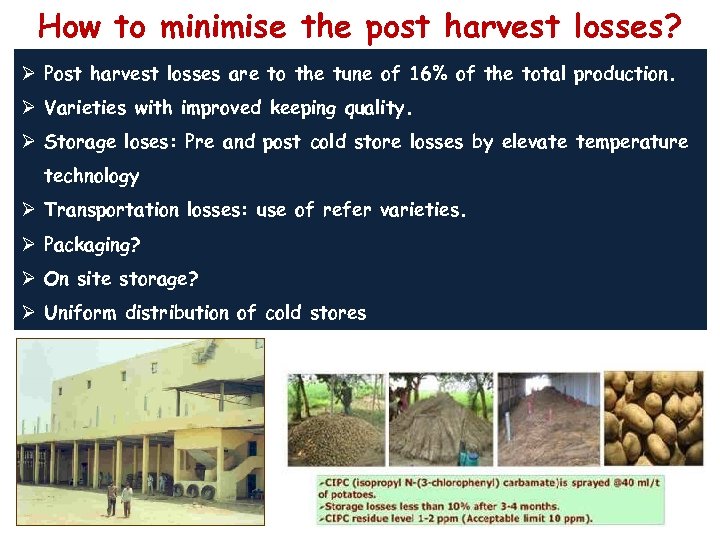 How to minimise the post harvest losses? Ø Post harvest losses are to the tune of 16% of the total production. Ø Varieties with improved keeping quality. Ø Storage loses: Pre and post cold store losses by elevate temperature technology Ø Transportation losses: use of refer varieties. Ø Packaging? Ø On site storage? Ø Uniform distribution of cold stores
 Thank You