 Скачать презентацию Status and development of the Large Angle Beamstrahlung
1424c26c8473d7abe435bcaa1de334ce.ppt
- Количество слайдов: 40




Status and development of the Large Angle Beamstrahlung Monitor for Super. KEKB Giovanni Bonvicini 1
Collaboration: Hawaii (G. Varner) KEK (J. Flanagan, Y. Funakoshi, K. Kanazawa, N. Ohuchi) Luther College (T. Pedlar) PNNL ( D. Asner et al. ) Wayne State Univ. (G. Bonvicini, H. Farhat, R. Gillard) Outline: • Experimental method • CESR device and results • Super. KEKB design • Possibilities for Super. KEKB 2

What is beamstrahlung • The radiation of the particles of one beam due to the bending force of the EM field of the other beam • Used to monitor the beam-beam interaction already at SLC (in the gamma ray part of the spectrum), it produced fundamental information about the beam conditions. • Produced at Super. KEKB, 1. 3 k. W for LER and 5. 4 k. W for the HER at nominal conditions • Many similarities with SR but • Also some substantial differences due to very short “magnet” (L= z/2√ 2=2 mm). Short magnets produce a much broader angular distribution 3
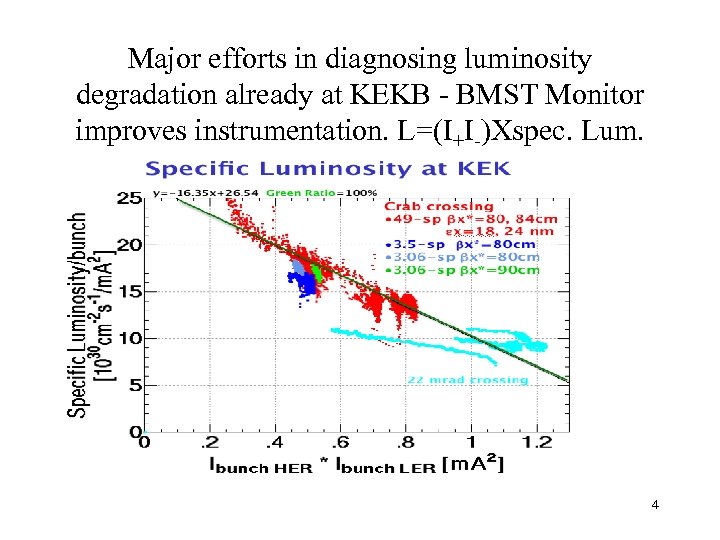
Major efforts in diagnosing luminosity degradation already at KEKB - BMST Monitor improves instrumentation. L=(I+I-)Xspec. Lum. 4
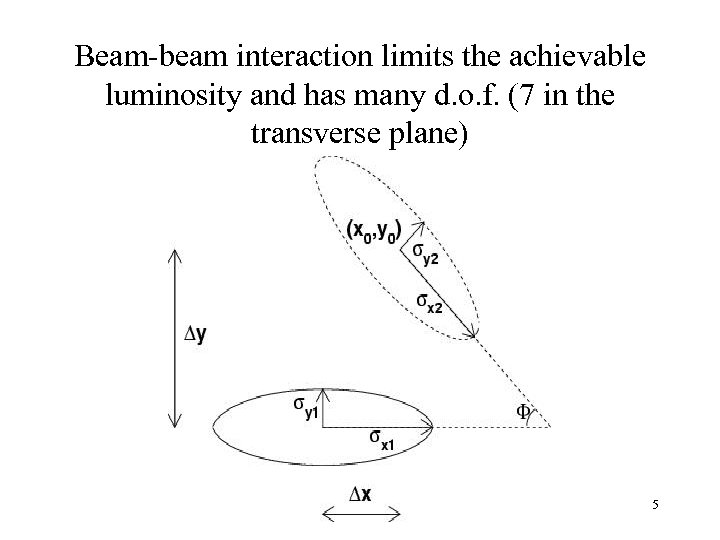
Beam-beam interaction limits the achievable luminosity and has many d. o. f. (7 in the transverse plane) 5
Methods to measure the Beam Interaction • A very difficult experimental problem few measurements, many degrees of freedom • Gamma ray part of the Beamstrahlung spectrum used with great success at SLC • Beam-beam scanning and scattering also very successful at SLC (two quantities) • Frequency locked vertical oscillation successful at CESR (one quantity) • Other methods indirect 6
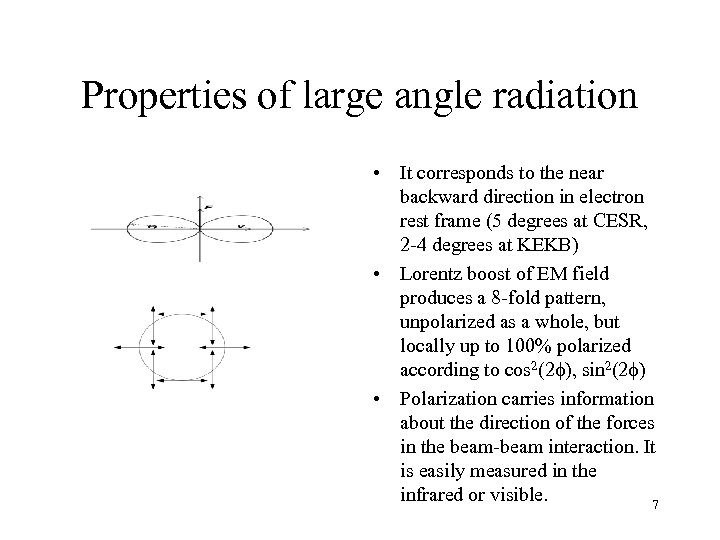
Properties of large angle radiation • It corresponds to the near backward direction in electron rest frame (5 degrees at CESR, 2 -4 degrees at KEKB) • Lorentz boost of EM field produces a 8 -fold pattern, unpolarized as a whole, but locally up to 100% polarized according to cos 2(2 ), sin 2(2 ) • Polarization carries information about the direction of the forces in the beam-beam interaction. It is easily measured in the infrared or visible. 7
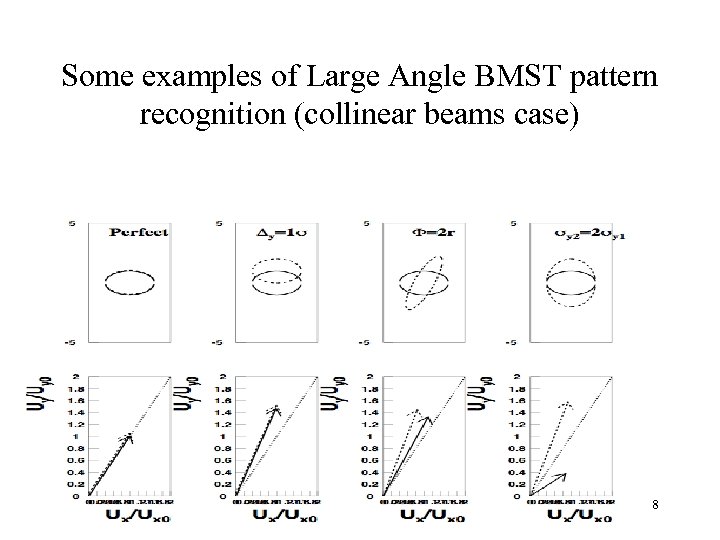
Some examples of Large Angle BMST pattern recognition (collinear beams case) 8
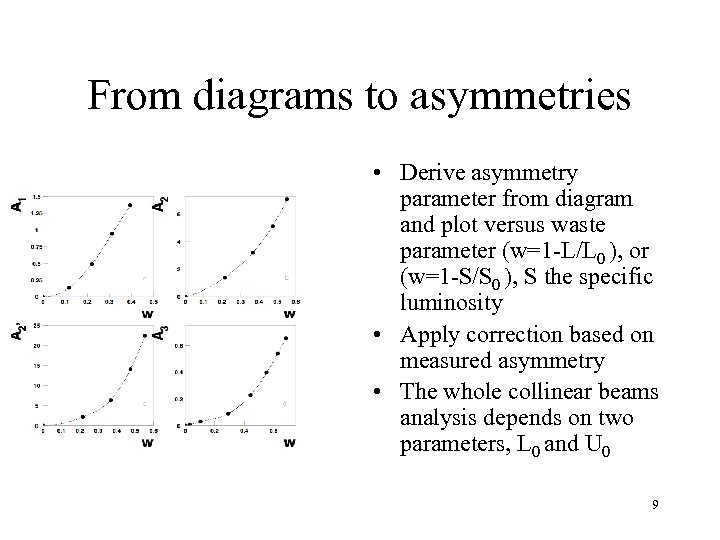
From diagrams to asymmetries • Derive asymmetry parameter from diagram and plot versus waste parameter (w=1 -L/L 0 ), or (w=1 -S/S 0 ), S the specific luminosity • Apply correction based on measured asymmetry • The whole collinear beams analysis depends on two parameters, L 0 and U 0 9
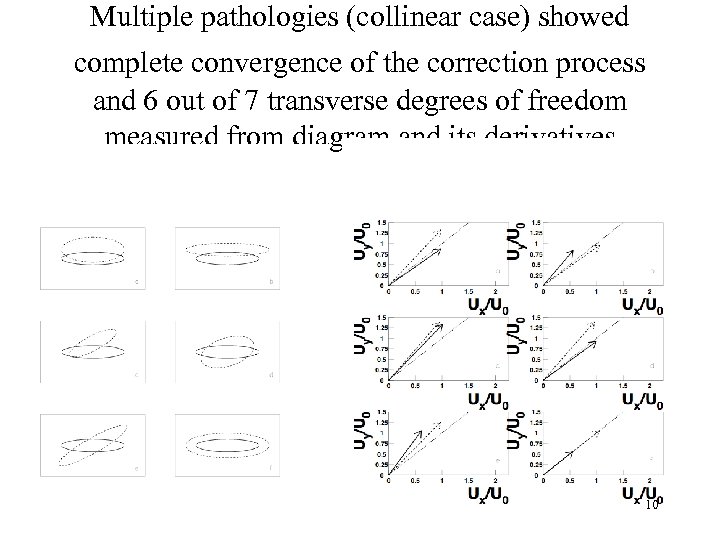
Multiple pathologies (collinear case) showed complete convergence of the correction process and 6 out of 7 transverse degrees of freedom measured from diagram and its derivatives 10
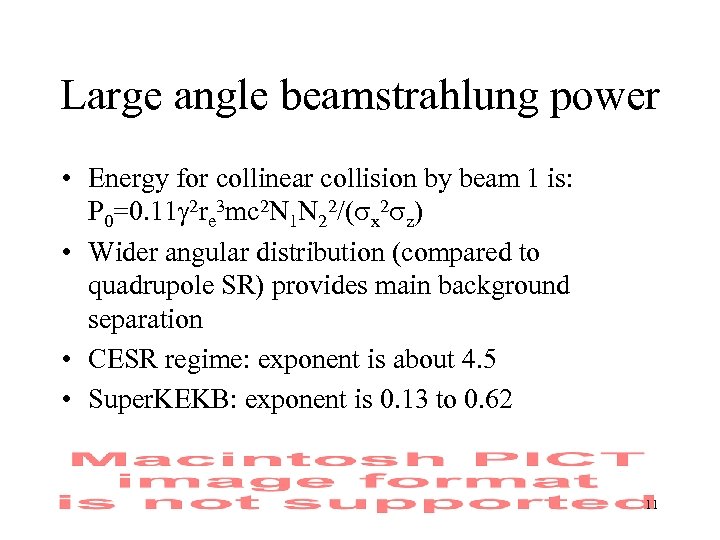
Large angle beamstrahlung power • Energy for collinear collision by beam 1 is: P 0=0. 11 2 re 3 mc 2 N 1 N 22/( x 2 z) • Wider angular distribution (compared to quadrupole SR) provides main background separation • CESR regime: exponent is about 4. 5 • Super. KEKB: exponent is 0. 13 to 0. 62 11
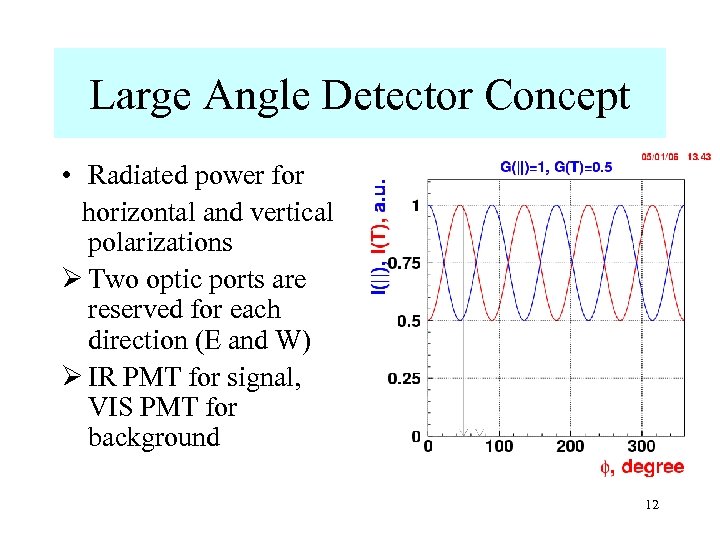
Large Angle Detector Concept • Radiated power for horizontal and vertical polarizations Ø Two optic ports are reserved for each direction (E and W) Ø IR PMT for signal, VIS PMT for background 12
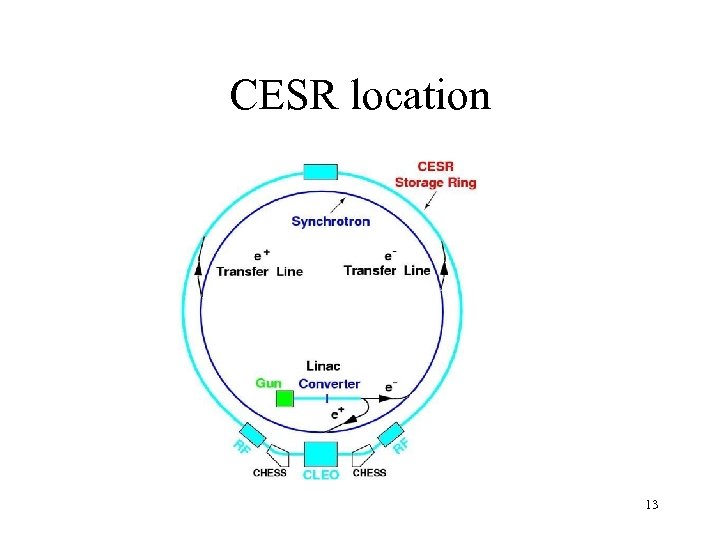
CESR location 13
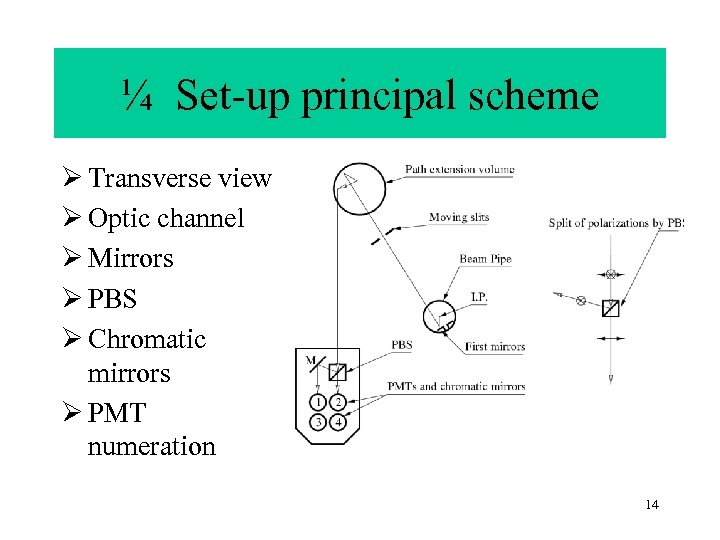
¼ Set-up principal scheme Ø Transverse view Ø Optic channel Ø Mirrors Ø PBS Ø Chromatic mirrors Ø PMT numeration 14
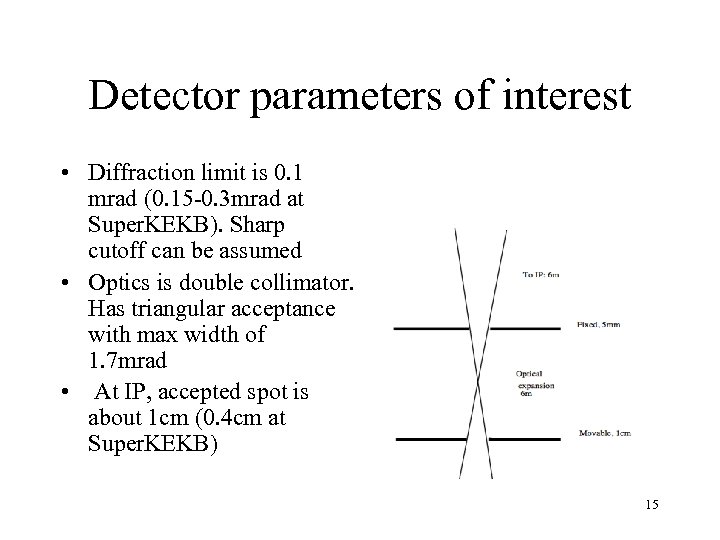
Detector parameters of interest • Diffraction limit is 0. 1 mrad (0. 15 -0. 3 mrad at Super. KEKB). Sharp cutoff can be assumed • Optics is double collimator. Has triangular acceptance with max width of 1. 7 mrad • At IP, accepted spot is about 1 cm (0. 4 cm at Super. KEKB) 15
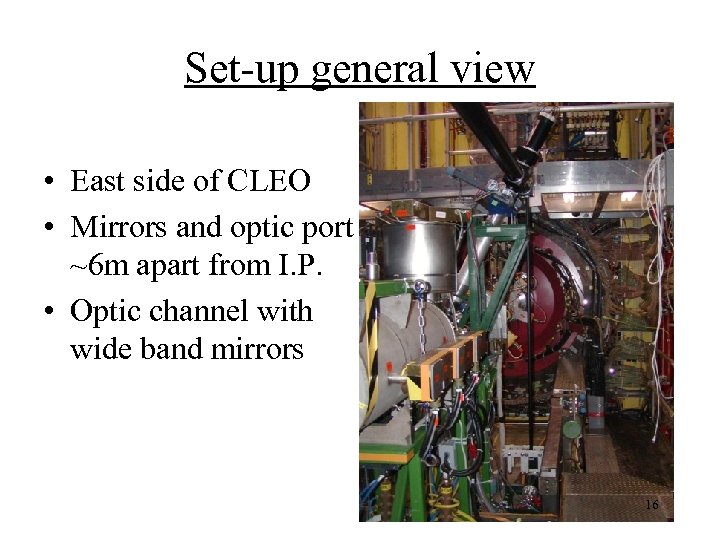
Set-up general view • East side of CLEO • Mirrors and optic port ~6 m apart from I. P. • Optic channel with wide band mirrors 16
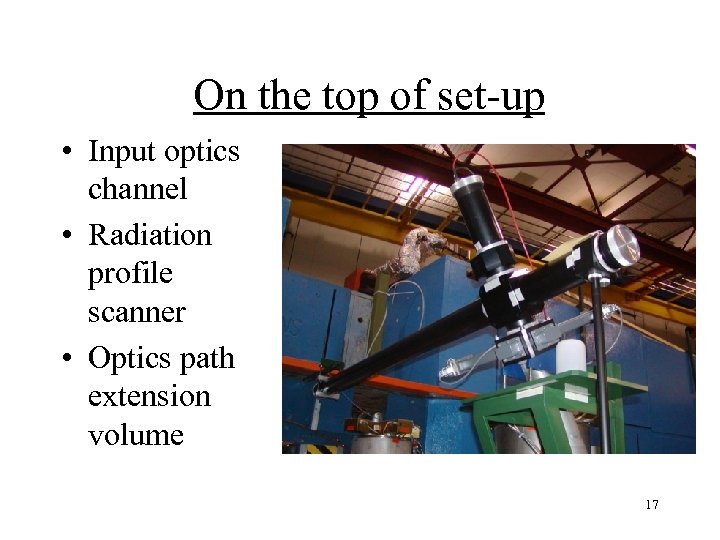
On the top of set-up • Input optics channel • Radiation profile scanner • Optics path extension volume 17
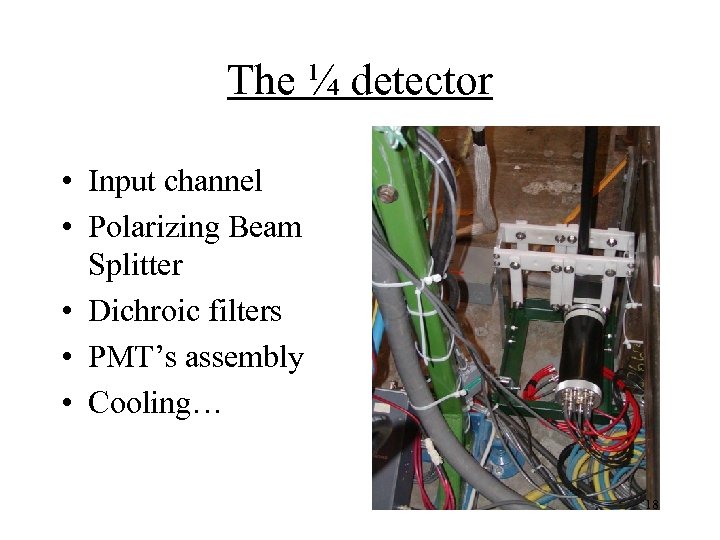
The ¼ detector • Input channel • Polarizing Beam Splitter • Dichroic filters • PMT’s assembly • Cooling… 18
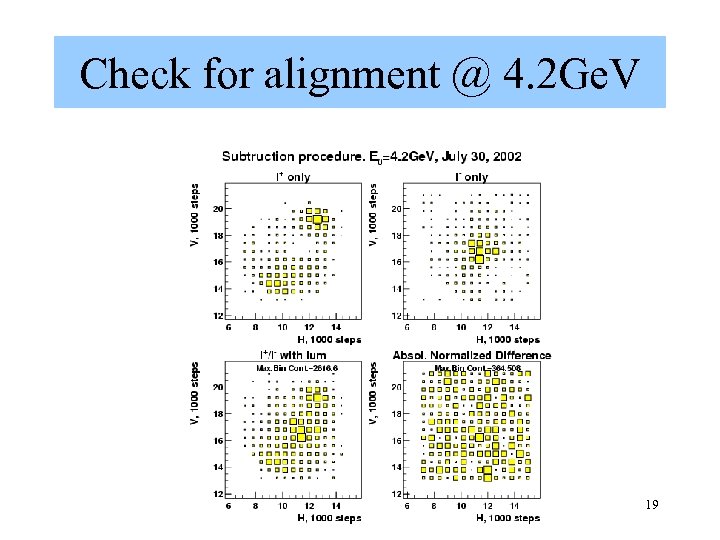
Check for alignment @ 4. 2 Ge. V 19
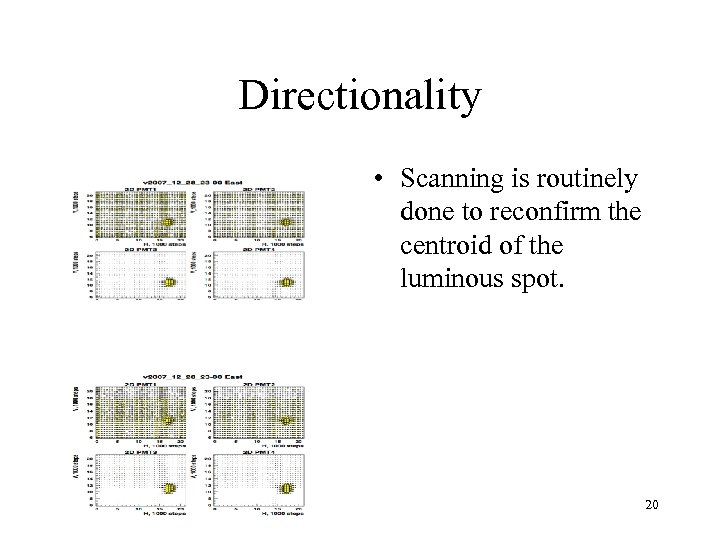
Directionality • Scanning is routinely done to reconfirm the centroid of the luminous spot. 20
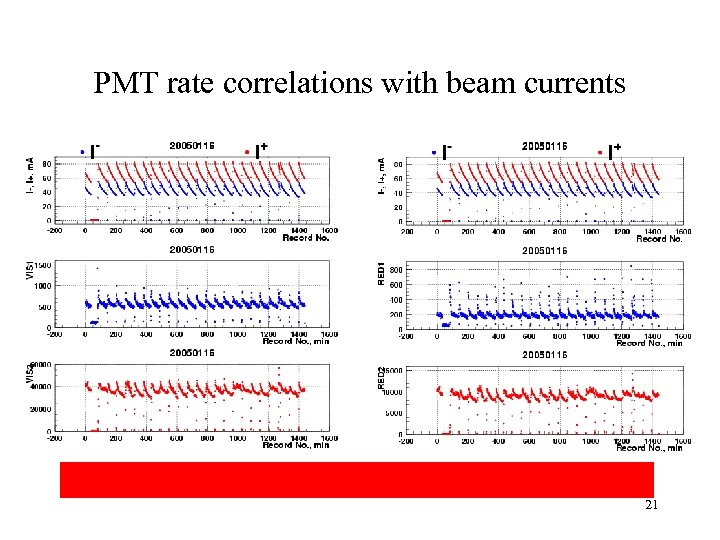
PMT rate correlations with beam currents 21
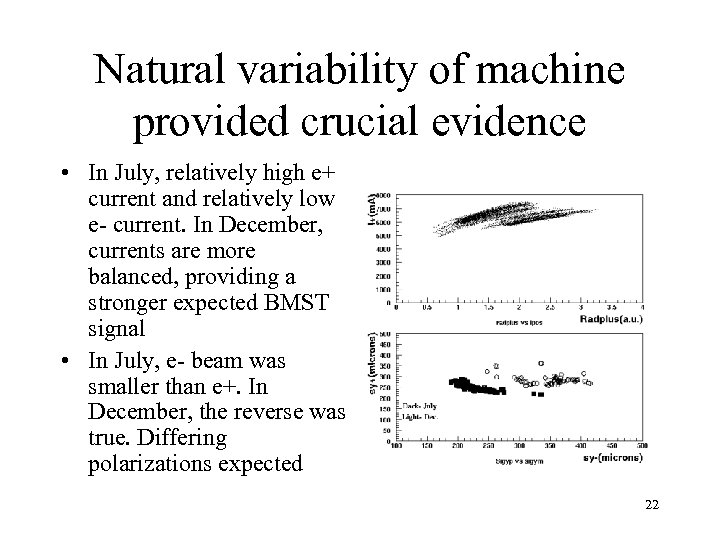
Natural variability of machine provided crucial evidence • In July, relatively high e+ current and relatively low e- current. In December, currents are more balanced, providing a stronger expected BMST signal • In July, e- beam was smaller than e+. In December, the reverse was true. Differing polarizations expected 22
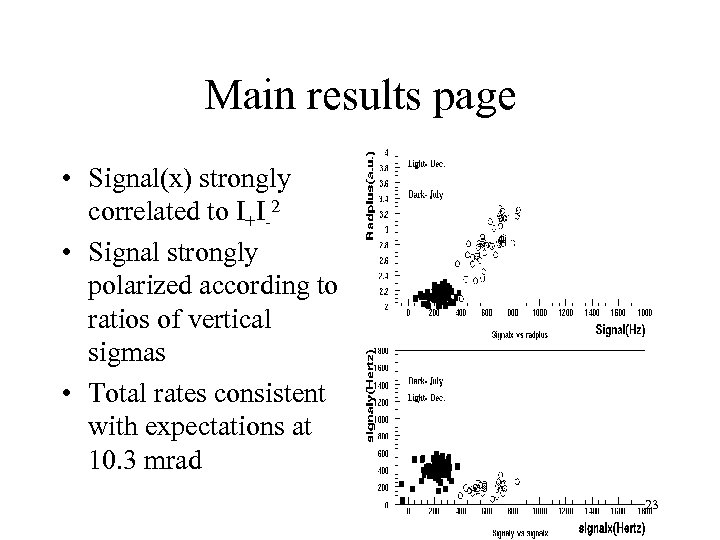
Main results page • Signal(x) strongly correlated to I+I-2 • Signal strongly polarized according to ratios of vertical sigmas • Total rates consistent with expectations at 10. 3 mrad 23
Backgrounds • At CESR, S/B~0. 02 -0. 7 • Signal per collision will increase by 2 -400, 000 at Super. KEKB (at equal angles), while backgrounds will remain approximately the same or decrease • Backgrounds are dominated by the beam tails. At CESR, beams were off center in the quadrupoles, and that further increased backgrounds 24
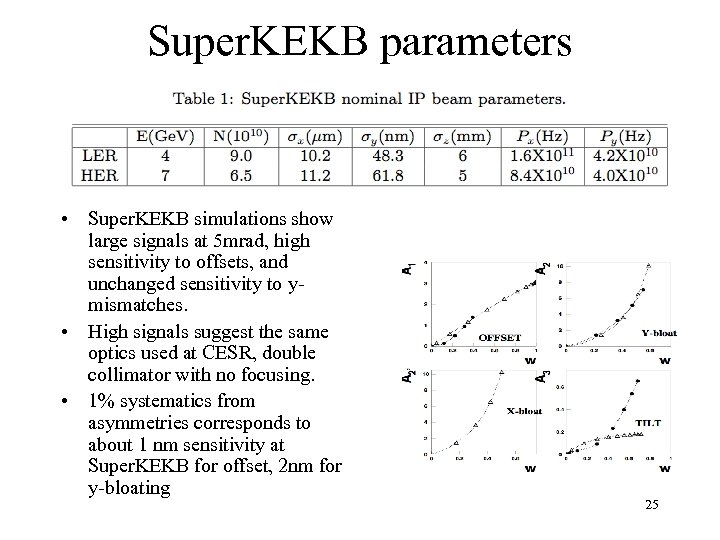
Super. KEKB parameters • Super. KEKB simulations show large signals at 5 mrad, high sensitivity to offsets, and unchanged sensitivity to ymismatches. • High signals suggest the same optics used at CESR, double collimator with no focusing. • 1% systematics from asymmetries corresponds to about 1 nm sensitivity at Super. KEKB for offset, 2 nm for y-bloating 25
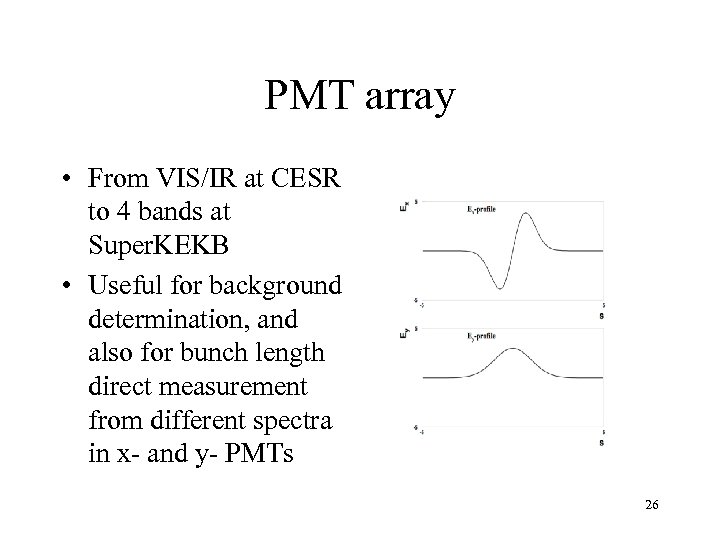
PMT array • From VIS/IR at CESR to 4 bands at Super. KEKB • Useful for background determination, and also for bunch length direct measurement from different spectra in x- and y- PMTs 26
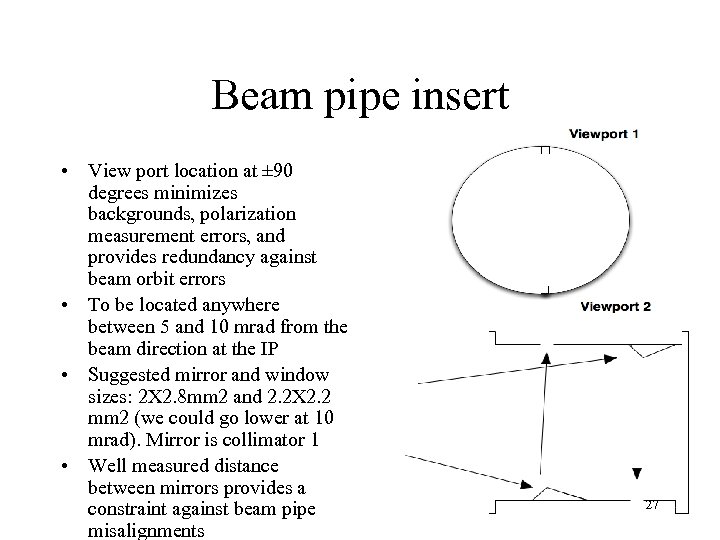
Beam pipe insert • View port location at ± 90 degrees minimizes backgrounds, polarization measurement errors, and provides redundancy against beam orbit errors • To be located anywhere between 5 and 10 mrad from the beam direction at the IP • Suggested mirror and window sizes: 2 X 2. 8 mm 2 and 2. 2 X 2. 2 mm 2 (we could go lower at 10 mrad). Mirror is collimator 1 • Well measured distance between mirrors provides a constraint against beam pipe misalignments 27
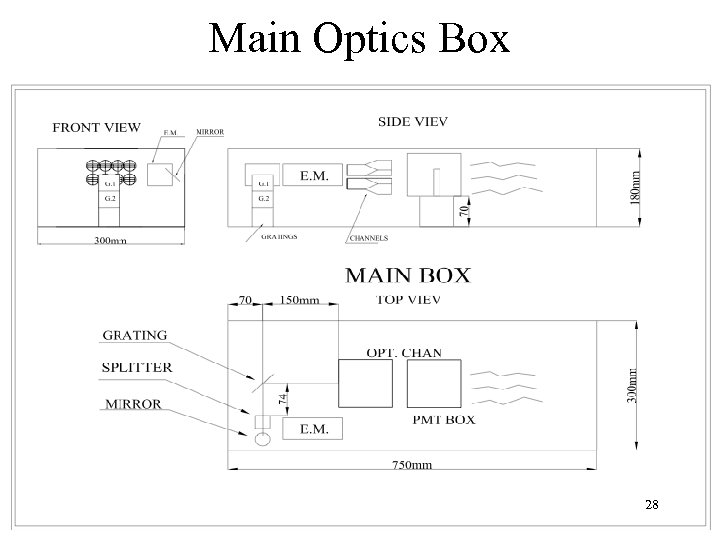
Main Optics Box 28
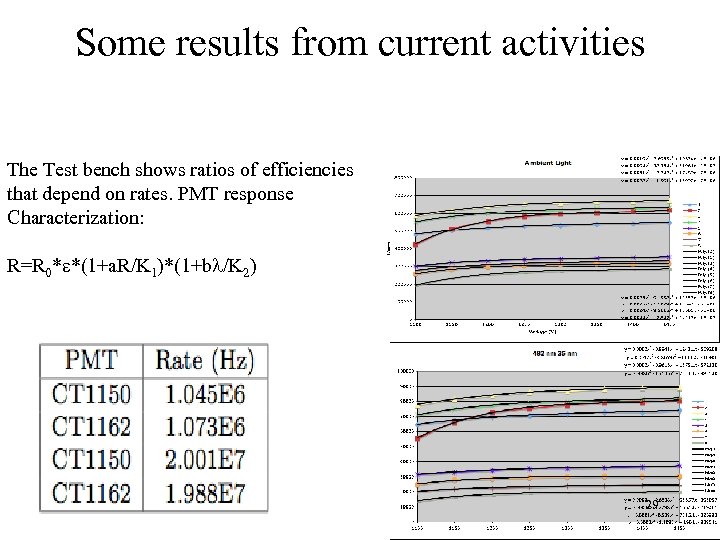
Some results from current activities The Test bench shows ratios of efficiencies that depend on rates. PMT response Characterization: R=R 0* *(1+a. R/K 1)*(1+b /K 2) 29
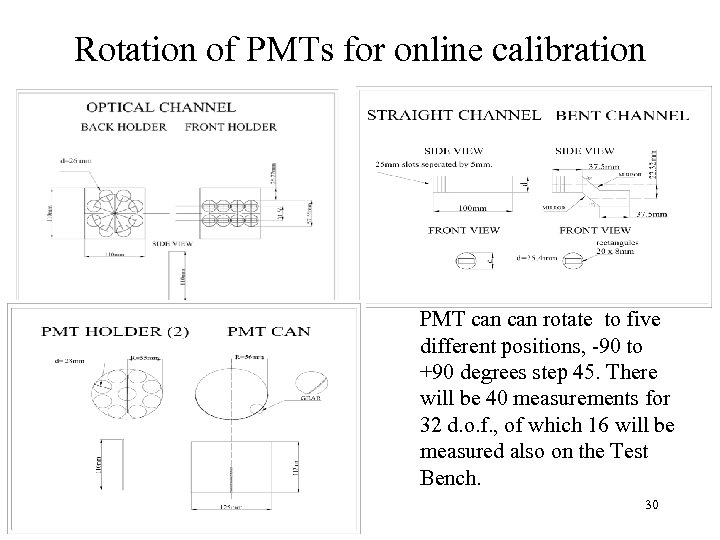
Rotation of PMTs for online calibration PMT can rotate to five different positions, -90 to +90 degrees step 45. There will be 40 measurements for 32 d. o. f. , of which 16 will be measured also on the Test Bench. 30
Beam Dump: direct measurement of background • When one beam is lost, the other beam goes from the colliding beam envelope to the single beam envelope over several damping times (50 msec or so) • Triggering on such an event, or storing and retrieving data, would measure backgrounds directly. 31
Design Summary • Double, opposite mirrors minimize backgrounds and eliminate beam position systematics • Different possible locations of primary mirrors are dealt with by observing at different wavelengths • Small PMT and optics systematics are controlled by Test Bench measurements and online calibration • Box can be made as small as 25 X 40 cm 3, and it can go anywhere from (0 -3) meters from Pipe 32
Data analysis system • Where algorithms are tried offline before they go in EPICS • One server (non-EPICS) with 50 TB of disk space (at 1 k. Hz sampling, 2. 5 years of data) • Substantial analysis platform by T. Pedlar (ROOTbased), including periodometer, advanced fitting and other statistical software, global data analysis • Event record of order 100 variables including all beam monitors (LABM, Interferometers, BPM, Luminosity Monitors, Ground Motion sensors) 33

Electronics • Front end electronics from G. Varner, Hawaii • Some work needed about data packaging and algorithms to extract needed information from EPICS. PNNL, Luther College interested in this part 34
Some examples of potentially interesting special data taking • • Bunch-to-bunch effects Measurement of beam tails at IP during fill Ground motion effects on IP Beam Spot frequency-locked measurements at IP (1 nm IP variations) ALL THESE ARE PASSIVE MEASUREMENTS EXCEPT FREQUENCY-LOCKED 35
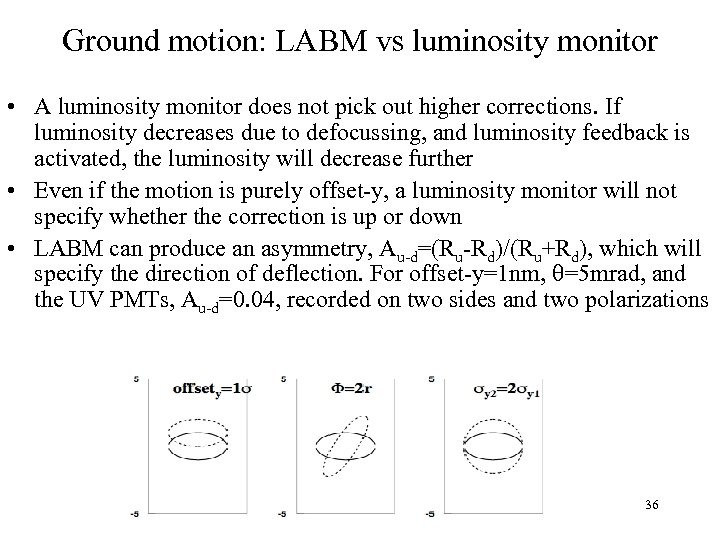
Ground motion: LABM vs luminosity monitor • A luminosity monitor does not pick out higher corrections. If luminosity decreases due to defocussing, and luminosity feedback is activated, the luminosity will decrease further • Even if the motion is purely offset-y, a luminosity monitor will not specify whether the correction is up or down • LABM can produce an asymmetry, Au-d=(Ru-Rd)/(Ru+Rd), which will specify the direction of deflection. For offset-y=1 nm, =5 mrad, and the UV PMTs, Au-d=0. 04, recorded on two sides and two polarizations 36
Conclusions • This project is about making the study of the beam -beam interaction data-driven • The tools are a direct, precise monitor of the beam -beam interaction, global, ILC-type monitor analysis, and a flexible DAQ system • We hope that Super. KEKB scientists will use and be helped by the information this device can produce 37
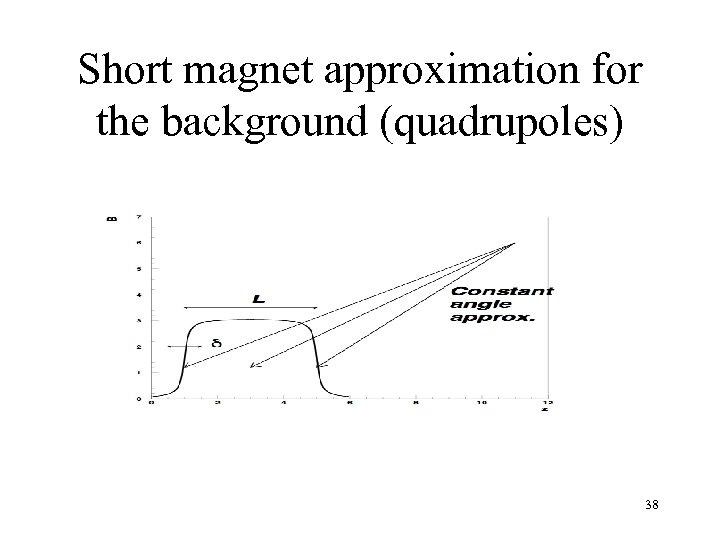
Short magnet approximation for the background (quadrupoles) 38

If the angle can be considered large and constant… • Assuming (atan(z/ )+atan((L-z)/ ) as the field profile, one gets (u= s, c=cos, sin( )) 39
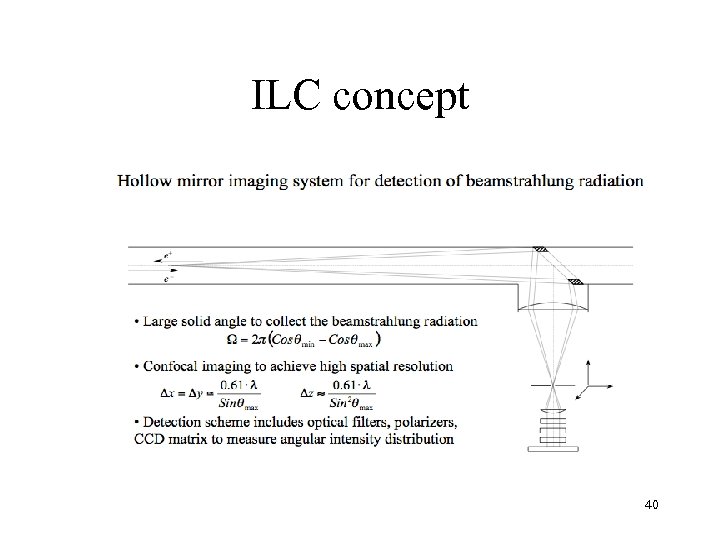
ILC concept 40
Скачать презентацию Status and development of the Large Angle Beamstrahlung
1424c26c8473d7abe435bcaa1de334ce.ppt