


 Скачать презентацию Statistics software for the LHC Wouter Verkerke NIKHEF
7addb5089d8564f3d5f05a428e9fb2aa.ppt
- Количество слайдов: 81
 Statistics software for the LHC Wouter Verkerke (NIKHEF) Wouter Verkerke, NIKHEF
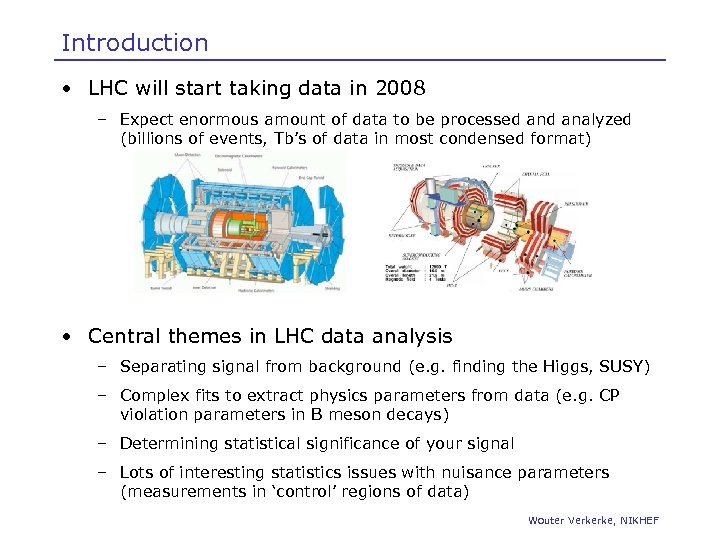 Introduction • LHC will start taking data in 2008 – Expect enormous amount of data to be processed analyzed (billions of events, Tb’s of data in most condensed format) • Central themes in LHC data analysis – Separating signal from background (e. g. finding the Higgs, SUSY) – Complex fits to extract physics parameters from data (e. g. CP violation parameters in B meson decays) – Determining statistical significance of your signal – Lots of interesting statistics issues with nuisance parameters (measurements in ‘control’ regions of data) Wouter Verkerke, NIKHEF
 Introduction • Statistics tools for LHC analyses – Potentially a very broad subject! – Need to make some choices here (apologies to software unmentioned) • Will focus on following areas, breakdown roughly following practical steps taken in LHC data analysis – Working environment (R/ROOT) – Separating signal and background – Fitting, minimization and error analysis – Practical aspects of defining complex data models – Tools to calculate limits, confidence intervals etc. . Wouter Verkerke, NIKHEF
 Working Environment Wouter Verkerke, NIKHEF
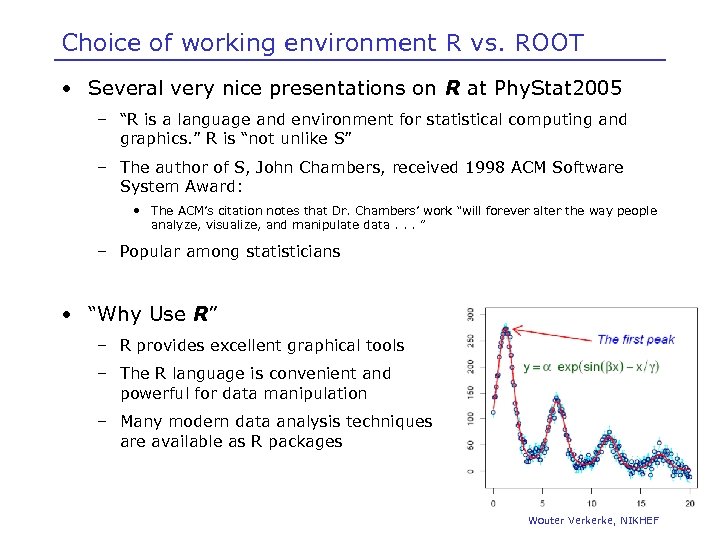 Choice of working environment R vs. ROOT • Several very nice presentations on R at Phy. Stat 2005 – “R is a language and environment for statistical computing and graphics. ” R is “not unlike S” – The author of S, John Chambers, received 1998 ACM Software System Award: • The ACM’s citation notes that Dr. Chambers’ work “will forever alter the way people analyze, visualize, and manipulate data. . . ” – Popular among statisticians • “Why Use R” – R provides excellent graphical tools – The R language is convenient and powerful for data manipulation – Many modern data analysis techniques are available as R packages Wouter Verkerke, NIKHEF
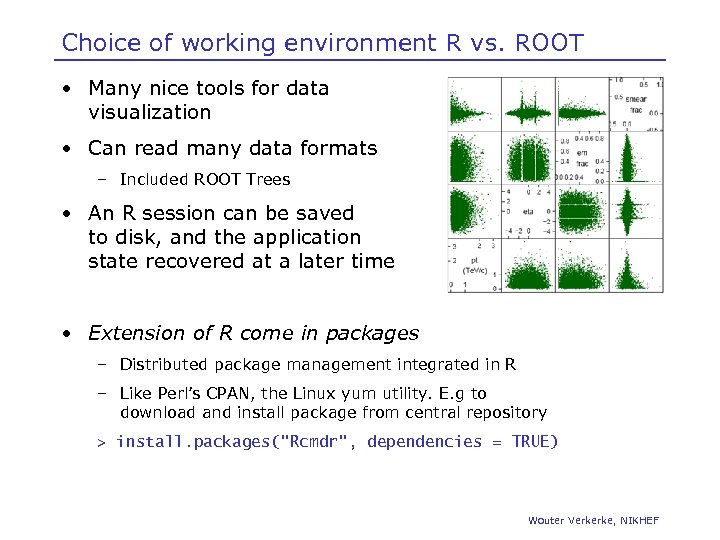 Choice of working environment R vs. ROOT • Many nice tools for data visualization • Can read many data formats – Included ROOT Trees • An R session can be saved to disk, and the application state recovered at a later time • Extension of R come in packages – Distributed package management integrated in R – Like Perl’s CPAN, the Linux yum utility. E. g to download and install package from central repository > install. packages("Rcmdr", dependencies = TRUE) Wouter Verkerke, NIKHEF
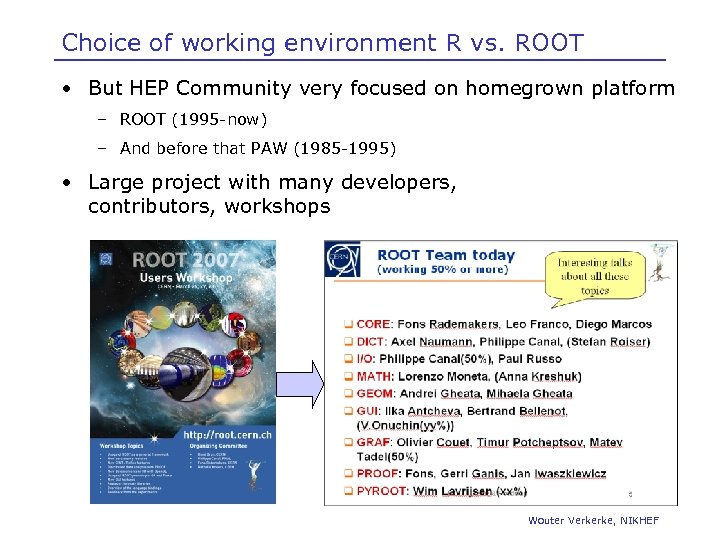 Choice of working environment R vs. ROOT • But HEP Community very focused on homegrown platform – ROOT (1995 -now) – And before that PAW (1985 -1995) • Large project with many developers, contributors, workshops Wouter Verkerke, NIKHEF
 Choice of working environment R vs. ROOT • ROOT has become de facto HEP standard analysis environment – Available and actively used for analyses in running experiments (Tevatron, B factories etc. . ) – ROOT is integrated LHC experimental software releases – Data format of LHC experiments is (indirectly) based on ROOT Several experiments have/are working on summary data format directly usable in ROOT – Ability to handle very large amounts of data • ROOT brings together a lot of the ingredients needed for (statistical) data analysis – C++ command line, publication quality graphics – Many standard mathematics, physics classes: Vectors, Matrices, Lorentz Vectors Physics constants… • Line between ‘ROOT’ and ‘external’ software not very sharp – Lot of software developed elsewhere, distributed with ROOT (TMVA, Roo. Fit) – Or thin interface layer provided to be able to work with external library (GSL, FFTW) – Still not quite as nice & automated as ‘R’ package concept Wouter Verkerke, NIKHEF
 (Statistical) software repositories • ROOT functions as moderated repository for statistical & data analysis tools – Examples TMVA, Roo. Fit, TLimit, TFraction. Fitter • Several HEP repository initiatives, some contain statistical software – Phy. Stat. org (Stat. Pattern. Recognition, TMVA, Lep. Stats 4 LHC) – Hep. Forge (mostly physics MC generators), – Free. Hep • Excellent summary of non-HEP statistical repositories on Jim Linnemans statistical resources web page – From Phystat 2005 – http: //www. pa. msu. edu/people/linnemann/stat_resources. html Wouter Verkerke, NIKHEF
 Core ROOT software specifically related to statistical analysis • Lots of statistics related software in MATH works package provided by ROOT team (L. Moneta) – See also presentation by Lorenzo in this session • Main responsibilities for this work package: – Basic mathematical functions – Numerical algorithms – Random numbers – Linear algebra – Physics and geometry vectors (3 D and 4 D) – Fitting and minimization – Histograms (math and statistical part) – Statistics (confidence levels, multivariate analysis) Wouter Verkerke, NIKHEF
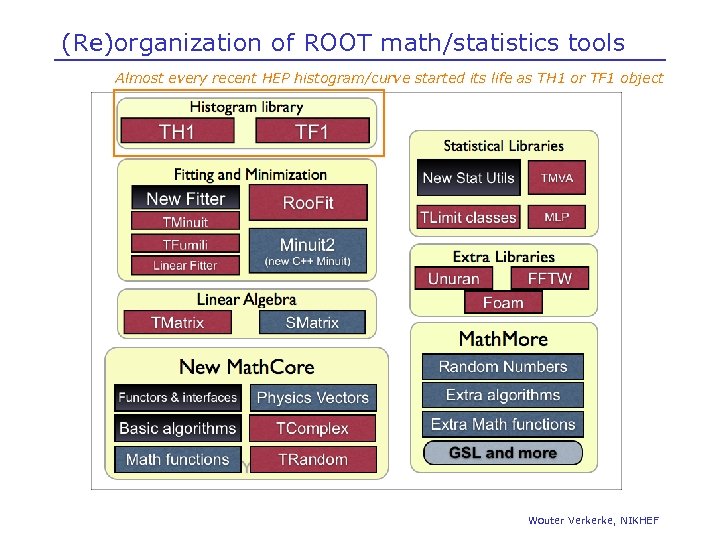 (Re)organization of ROOT math/statistics tools Almost every recent HEP histogram/curve started its life as TH 1 or TF 1 object Wouter Verkerke, NIKHEF
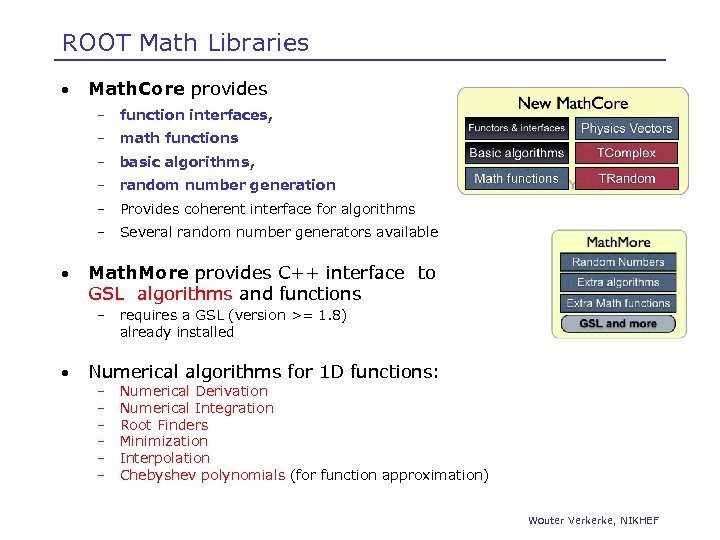 ROOT Math Libraries • Math. Core provides – – math functions – basic algorithms, – random number generation – Provides coherent interface for algorithms – • function interfaces, Several random number generators available Math. More provides C++ interface to GSL algorithms and functions – • requires a GSL (version >= 1. 8) already installed Numerical algorithms for 1 D functions: – – – Numerical Derivation Numerical Integration Root Finders Minimization Interpolation Chebyshev polynomials (for function approximation) Wouter Verkerke, NIKHEF
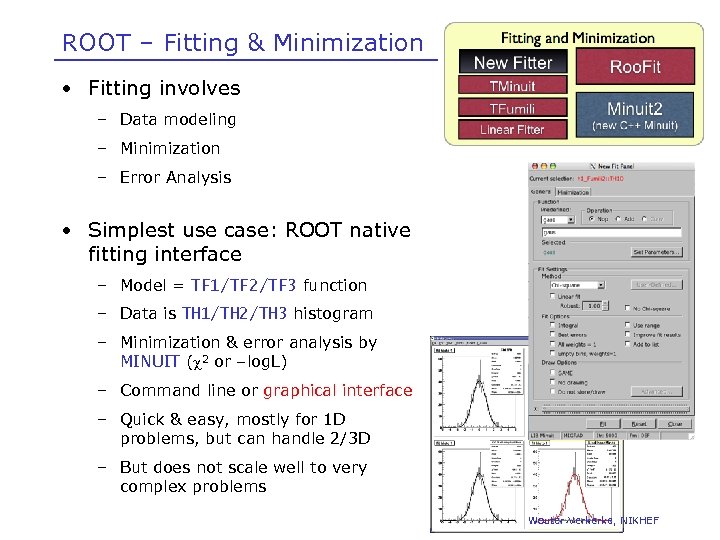 ROOT – Fitting & Minimization • Fitting involves – Data modeling – Minimization – Error Analysis • Simplest use case: ROOT native fitting interface – Model = TF 1/TF 2/TF 3 function – Data is TH 1/TH 2/TH 3 histogram – Minimization & error analysis by MINUIT ( 2 or –log. L) – Command line or graphical interface – Quick & easy, mostly for 1 D problems, but can handle 2/3 D – But does not scale well to very complex problems Wouter Verkerke, NIKHEF
 ROOT – Choices for Minimization & Error analysis • Industry Standard for minimization and error analysis for nearly 40 years: MINUIT – From the manual “It is especially suited to handle difficult problems, including those which may require guidance in order to find the correct solution. ” – Multi-decade track record Started in CERNLIB, then interfaced in PAW, now in ROOT – MINUIT provides two options for analysis: HESSE (2 nd derivative) and MINOS (hill climbing) – Ported to C++ by authors in 2002, extensively tested again • A number of alternatives available – TFumili, faster convergence for certain type of problems – TLinear. Fitter analytical solution for linear problems – TFraction. Fitter , TBinomial. Efficiency. Fitter for fitting of MC templates, efficiencies from ratios (F. Filthaut) Wouter Verkerke, NIKHEF
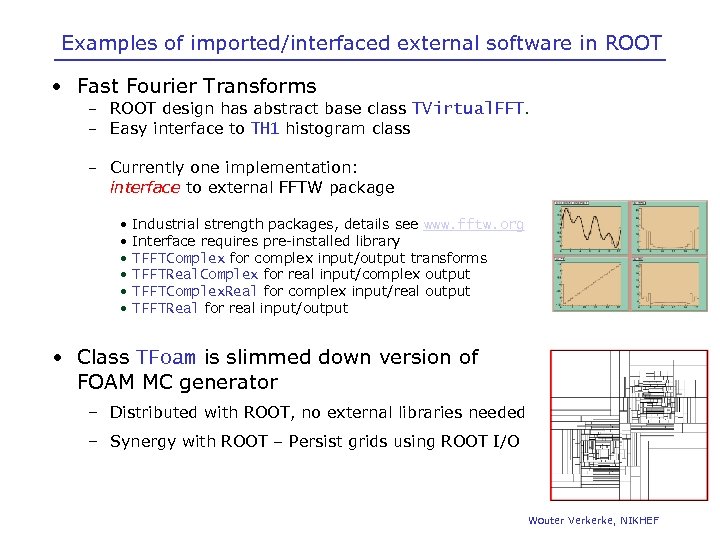 Examples of imported/interfaced external software in ROOT • Fast Fourier Transforms – ROOT design has abstract base class TVirtual. FFT. – Easy interface to TH 1 histogram class – Currently one implementation: interface to external FFTW package • • • Industrial strength packages, details see www. fftw. org Interface requires pre-installed library TFFTComplex for complex input/output transforms TFFTReal. Complex for real input/complex output TFFTComplex. Real for complex input/real output TFFTReal for real input/output • Class TFoam is slimmed down version of FOAM MC generator – Distributed with ROOT, no external libraries needed – Synergy with ROOT – Persist grids using ROOT I/O Wouter Verkerke, NIKHEF
 Signal and Background Tools for Multivariate Analysis Wouter Verkerke, NIKHEF
 HEP tradition & multivariate analysis • HEP traditionally quite conservative – Cut based analysis or simple NN applications most common past • Simple NN tools integrated in PAW/ROOT since long time – PAW: MLPfit (Multi. Layer Percetron. J. Schwindling) – ROOT: TMultilayer. Perceptron (inspired on MLPFIT) – Also standalone tools used (JETNET etc. . ) • Use of other (newer) MVA taking off in recent years • Easy access other/newer MVA techniques crucial to acceptance & good uses of these techniques in HEP – E. g overheard over coffee at CERN after seminar on an analysis using Boosted Decision Trees “Of course you can find a signal anywhere with a BDT! I’ll believe it when a cut based analysis see the same signal” – Clear need for tools to understand & compare MVA techniques Wouter Verkerke, NIKHEF
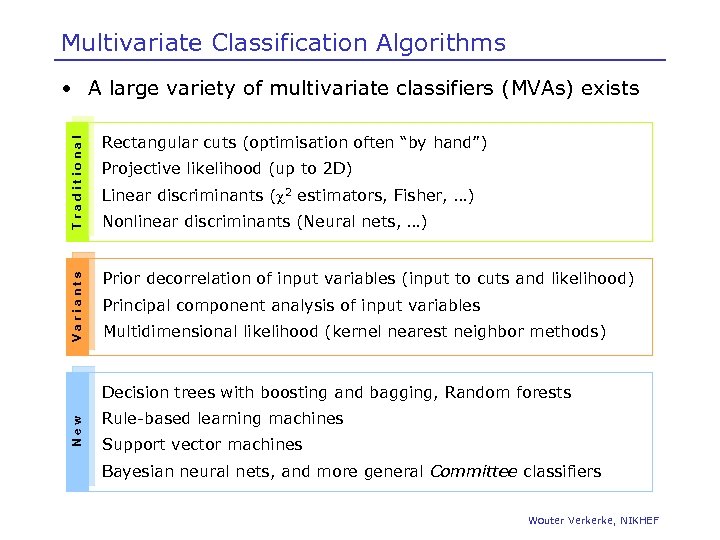 Multivariate Classification Algorithms Traditional Rectangular cuts (optimisation often “by hand”) Variants • A large variety of multivariate classifiers (MVAs) exists Prior decorrelation of input variables (input to cuts and likelihood) Projective likelihood (up to 2 D) Linear discriminants ( 2 estimators, Fisher, …) Nonlinear discriminants (Neural nets, …) Principal component analysis of input variables Multidimensional likelihood (kernel nearest neighbor methods) New Decision trees with boosting and bagging, Random forests Rule-based learning machines Support vector machines Bayesian neural nets, and more general Committee classifiers Wouter Verkerke, NIKHEF
 Software for Multivariate analysis • Case for use of Multivariate analysis in HEP is clear – Additional discrimination power – Especially if information is contained in correlations (which are difficult to exploit with a cut-based analysis) – New techniques more robust when many variable are added that not carry a lot of discriminating information • Active development of HEP MVA training & evaluation & validation tools since 2005 – TMVA – Toolkit for Multi. Variate Analysis (see talk by F. Tegelfeld) – Stat. Pattern. Recognition (see talk by I. Narksy) • Both developed in C++ on Source. Forge – Implement large variety of MVA techniques – Provide training & validation tools – Work with ROOT native data • The average HEP physicist can now get started with e. g. a Boosted Decision Tree in <1 day of work Wouter Verkerke, NIKHEF
 Introduction to TMVA & Stat. Pattern. Recognition • TMVA ― Toolkit for multivariate data analysis – Distributed with ROOT / read & write ROOT native data format – Framework for parallel training, testing, evaluation and application of MV classifiers – Each classifier provides a ranking of the input variables – The input variables can be de-correlated or projected upon their principal components – Training results and full configuration are written to weight files and applied by a Reader • Stat. Pattern. Recognition – Standalone tool with ROOT I/O capability – Production tool, rather than Interactive Analysis tools – Ability to process large datasets in many dimensions – Reasonable CPU and memory consumption, scalability – Use in production code developed by a HEP collaboration Wouter Verkerke, NIKHEF
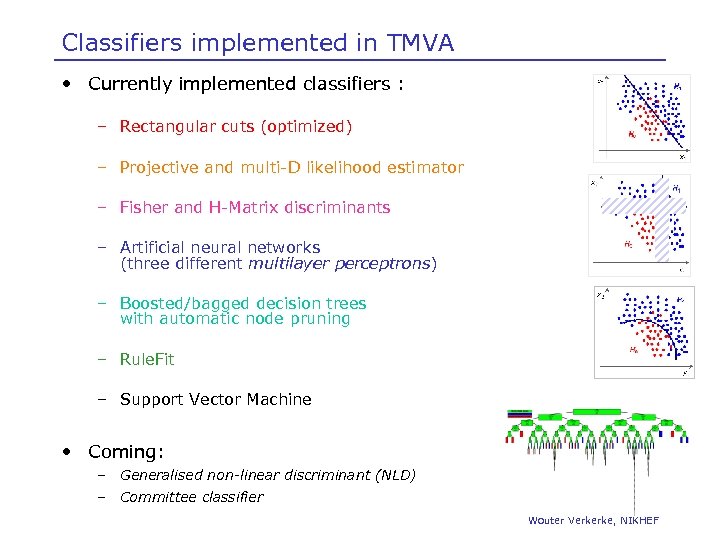 Classifiers implemented in TMVA • Currently implemented classifiers : – Rectangular cuts (optimized) – Projective and multi-D likelihood estimator – Fisher and H-Matrix discriminants – Artificial neural networks (three different multilayer perceptrons) – Boosted/bagged decision trees with automatic node pruning – Rule. Fit – Support Vector Machine • Coming: – Generalised non-linear discriminant (NLD) – Committee classifier Wouter Verkerke, NIKHEF
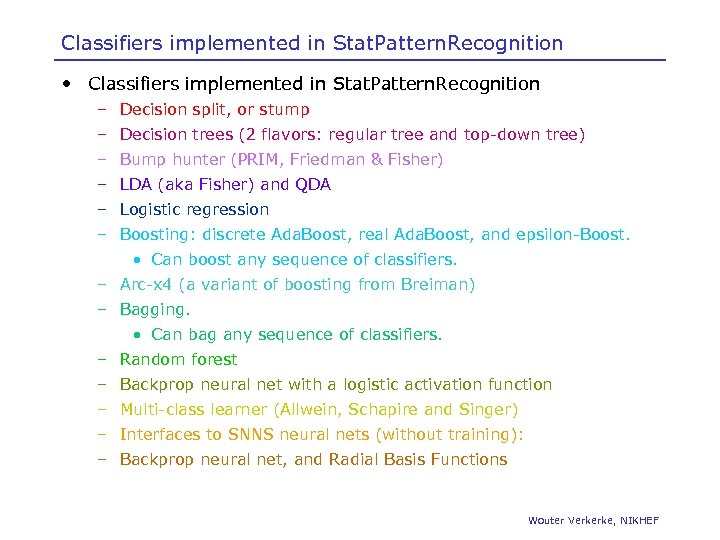 Classifiers implemented in Stat. Pattern. Recognition • Classifiers implemented in Stat. Pattern. Recognition – Decision split, or stump – Decision trees (2 flavors: regular tree and top-down tree) – Bump hunter (PRIM, Friedman & Fisher) – LDA (aka Fisher) and QDA – Logistic regression – Boosting: discrete Ada. Boost, real Ada. Boost, and epsilon-Boost. • Can boost any sequence of classifiers. – Arc-x 4 (a variant of boosting from Breiman) – Bagging. • Can bag any sequence of classifiers. – Random forest – Backprop neural net with a logistic activation function – Multi-class learner (Allwein, Schapire and Singer) – Interfaces to SNNS neural nets (without training): – Backprop neural net, and Radial Basis Functions Wouter Verkerke, NIKHEF
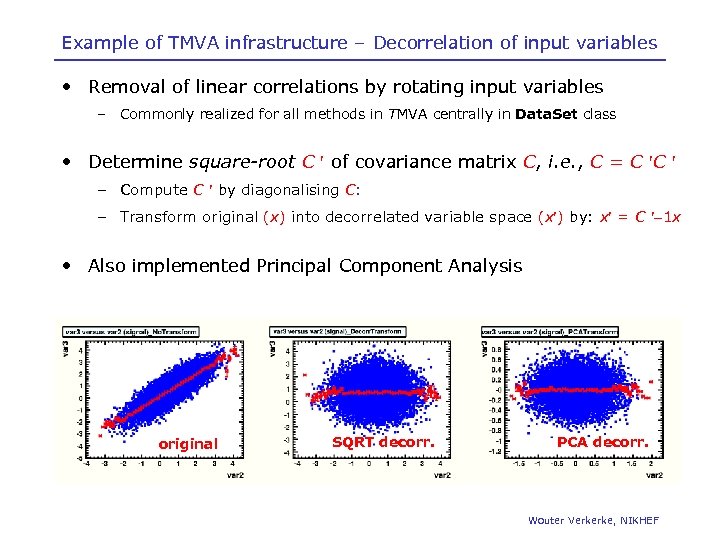 Example of TMVA infrastructure – Decorrelation of input variables • Removal of linear correlations by rotating input variables – Commonly realized for all methods in TMVA centrally in Data. Set class • Determine square-root C of covariance matrix C, i. e. , C = C C – Compute C by diagonalising C: – Transform original (x) into decorrelated variable space (x ) by: x = C 1 x • Also implemented Principal Component Analysis original SQRT decorr. PCA decorr. Wouter Verkerke, NIKHEF
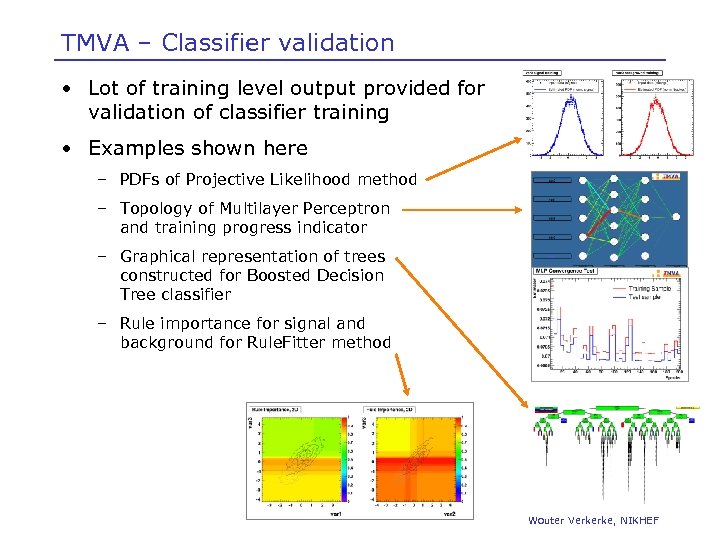 TMVA – Classifier validation • Lot of training level output provided for validation of classifier training • Examples shown here – PDFs of Projective Likelihood method – Topology of Multilayer Perceptron and training progress indicator – Graphical representation of trees constructed for Boosted Decision Tree classifier – Rule importance for signal and background for Rule. Fitter method Wouter Verkerke, NIKHEF
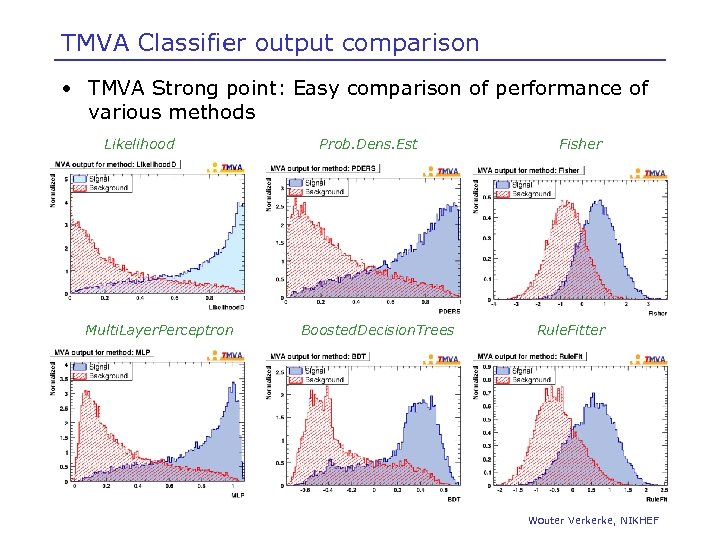 TMVA Classifier output comparison • TMVA Strong point: Easy comparison of performance of various methods Likelihood Multi. Layer. Perceptron Prob. Dens. Est Boosted. Decision. Trees Fisher Rule. Fitter Wouter Verkerke, NIKHEF
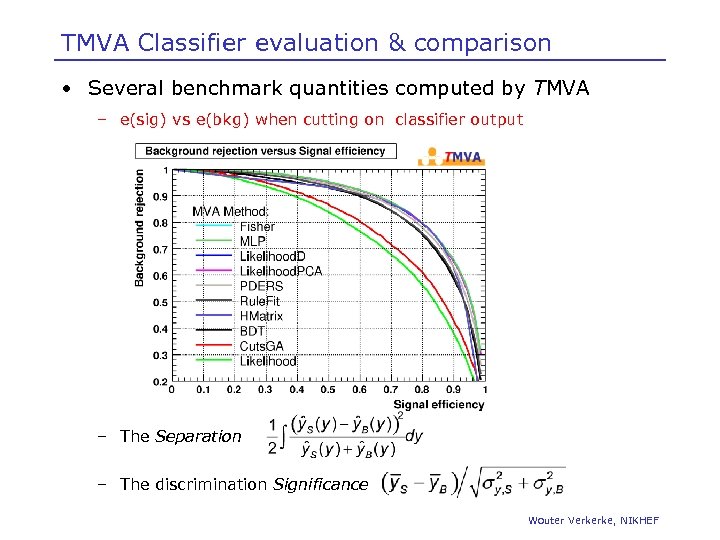 TMVA Classifier evaluation & comparison • Several benchmark quantities computed by TMVA – e(sig) vs e(bkg) when cutting on classifier output – The Separation – The discrimination Significance Wouter Verkerke, NIKHEF
 TMVA Classifier evaluation & comparison • Overtraining detection – Compare performance between training and test sample to detect overtraining • Classifiers provide specific ranking of input variables • Correlation matrix and classification “overlap” : – if two classifiers have similar performance, but significant nonoverlapping classifications combine them! Wouter Verkerke, NIKHEF
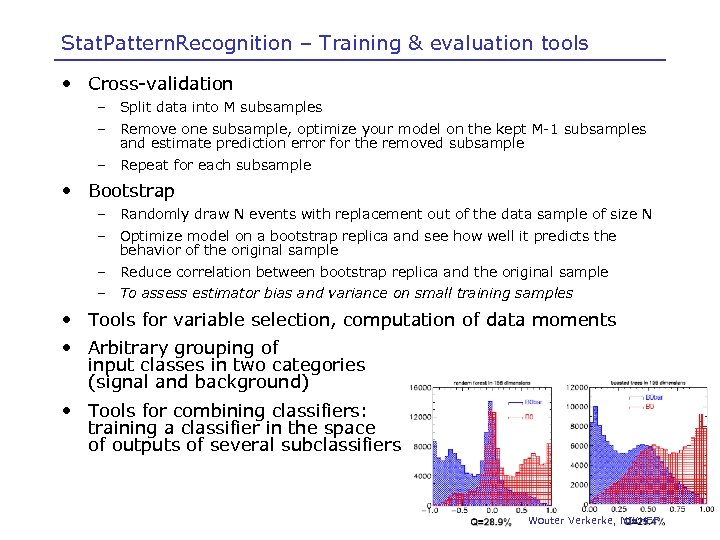 Stat. Pattern. Recognition – Training & evaluation tools • Cross-validation – Split data into M subsamples – Remove one subsample, optimize your model on the kept M-1 subsamples and estimate prediction error for the removed subsample – Repeat for each subsample • Bootstrap – Randomly draw N events with replacement out of the data sample of size N – Optimize model on a bootstrap replica and see how well it predicts the behavior of the original sample – Reduce correlation between bootstrap replica and the original sample – To assess estimator bias and variance on small training samples • Tools for variable selection, computation of data moments • Arbitrary grouping of input classes in two categories (signal and background) • Tools for combining classifiers: training a classifier in the space of outputs of several subclassifiers Wouter Verkerke, NIKHEF
 Stat. Pattern. Recognition Distribution & Use • Distribution – Introduced in early 2005 at Ba. Bar and committed to Ba. Bar CVS. – In September 2006 SPR was posted at Sourceforge: https: //sourceforge. net/projects/statpatrec – Two versions • Standalone with ASCII I/O; no external dependencies • With Root I/O (ROOT dependency) • Use – Currently used by several HEP collaborations (Ba. Bar, D 0, MINOS, SNO, searches for supernovae), being promoted within CMS. – There are users outside HEP as well. Downloaded off Sourceforge ~310 times (as of mid April 2007). – O(10) analyses and O(20) people using the package in Ba. Bar alone, mostly in rare leptonic and particle ID groups. Wouter Verkerke, NIKHEF
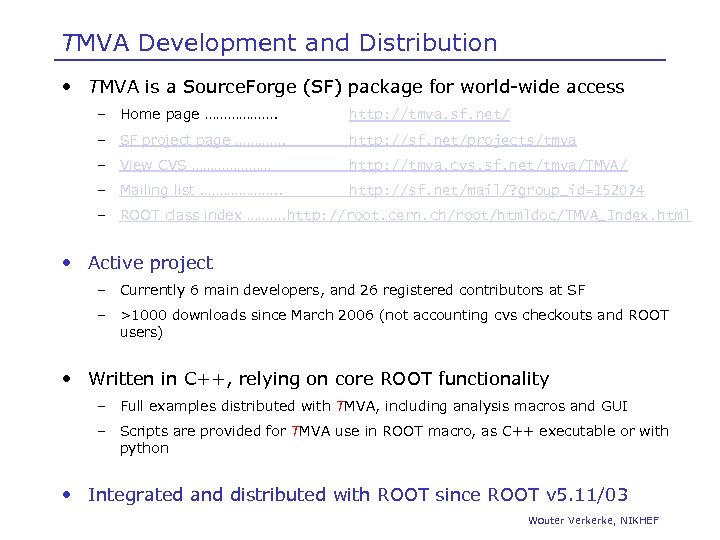 TMVA Development and Distribution • TMVA is a Source. Forge (SF) package for world-wide access – Home page ………………. http: //tmva. sf. net/ – SF project page …………. http: //sf. net/projects/tmva – View CVS ………………… http: //tmva. cvs. sf. net/tmva/TMVA/ – Mailing list. ………………. . http: //sf. net/mail/? group_id=152074 – ROOT class index ………. http: //root. cern. ch/root/htmldoc/TMVA_Index. html • Active project – Currently 6 main developers, and 26 registered contributors at SF – >1000 downloads since March 2006 (not accounting cvs checkouts and ROOT users) • Written in C++, relying on core ROOT functionality – Full examples distributed with TMVA, including analysis macros and GUI – Scripts are provided for TMVA use in ROOT macro, as C++ executable or with python • Integrated and distributed with ROOT since ROOT v 5. 11/03 Wouter Verkerke, NIKHEF
 Constructing models to describe your data Wouter Verkerke, NIKHEF
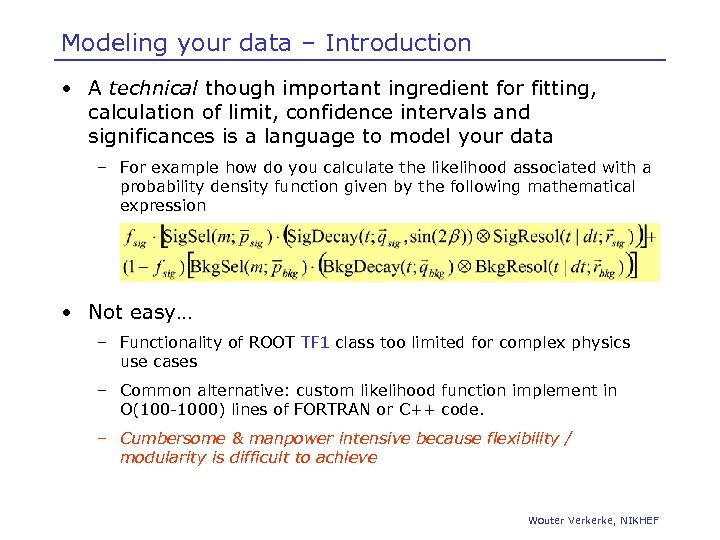 Modeling your data – Introduction • A technical though important ingredient for fitting, calculation of limit, confidence intervals and significances is a language to model your data – For example how do you calculate the likelihood associated with a probability density function given by the following mathematical expression • Not easy… – Functionality of ROOT TF 1 class too limited for complex physics use cases – Common alternative: custom likelihood function implement in O(100 -1000) lines of FORTRAN or C++ code. – Cumbersome & manpower intensive because flexibility / modularity is difficult to achieve Wouter Verkerke, NIKHEF
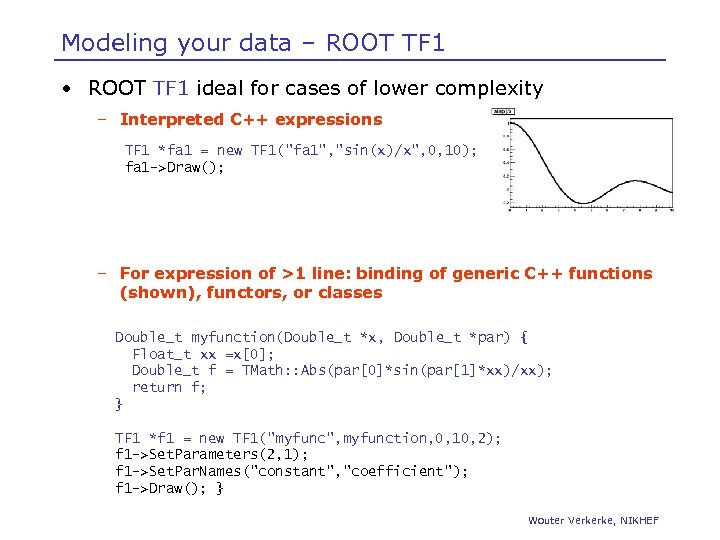 Modeling your data – ROOT TF 1 • ROOT TF 1 ideal for cases of lower complexity – Interpreted C++ expressions TF 1 *fa 1 = new TF 1("fa 1", "sin(x)/x", 0, 10); fa 1 ->Draw(); – For expression of >1 line: binding of generic C++ functions (shown), functors, or classes Double_t myfunction(Double_t *x, Double_t *par) { Float_t xx =x[0]; Double_t f = TMath: : Abs(par[0]*sin(par[1]*xx)/xx); return f; } TF 1 *f 1 = new TF 1("myfunc", myfunction, 0, 10, 2); f 1 ->Set. Parameters(2, 1); f 1 ->Set. Par. Names("constant", "coefficient"); f 1 ->Draw(); } Wouter Verkerke, NIKHEF
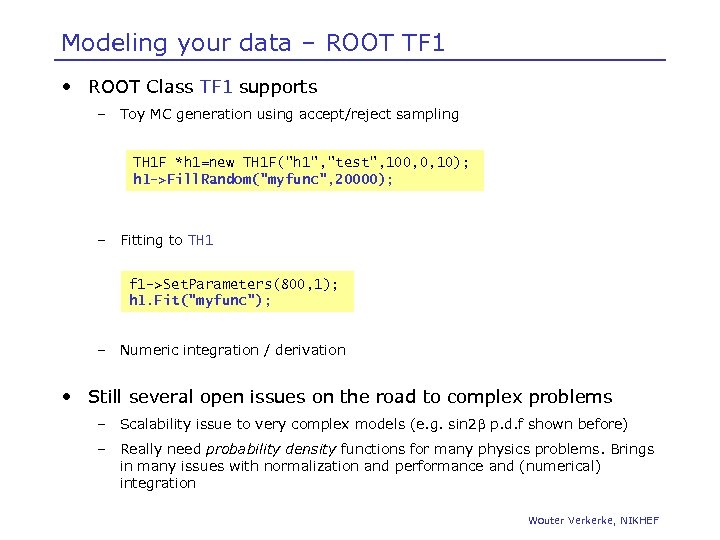 Modeling your data – ROOT TF 1 • ROOT Class TF 1 supports – Toy MC generation using accept/reject sampling TH 1 F *h 1=new TH 1 F("h 1", "test", 100, 0, 10); h 1 ->Fill. Random("myfunc", 20000); – Fitting to TH 1 f 1 ->Set. Parameters(800, 1); h 1. Fit("myfunc"); – Numeric integration / derivation • Still several open issues on the road to complex problems – Scalability issue to very complex models (e. g. sin 2 b p. d. f shown before) – Really need probability density functions for many physics problems. Brings in many issues with normalization and performance and (numerical) integration Wouter Verkerke, NIKHEF
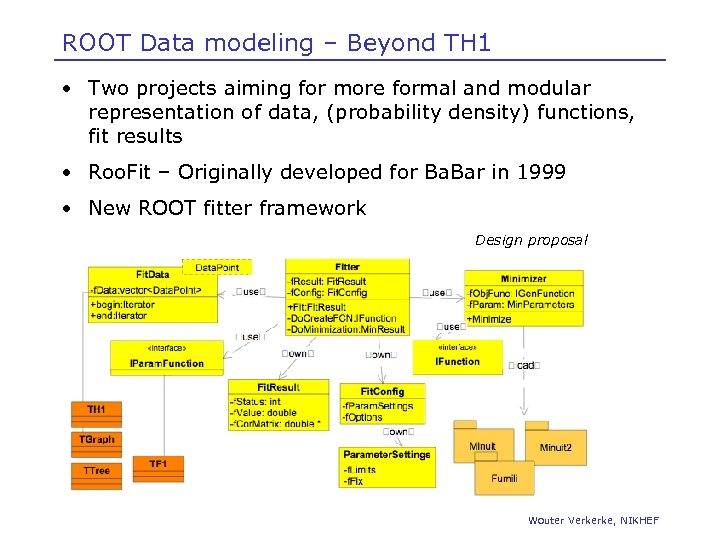 ROOT Data modeling – Beyond TH 1 • Two projects aiming for more formal and modular representation of data, (probability density) functions, fit results • Roo. Fit – Originally developed for Ba. Bar in 1999 • New ROOT fitter framework Design proposal Wouter Verkerke, NIKHEF
 Roo. Fit – Development history • Initial approach complex unbinned ML fits in Ba. Bar: write it from scratch (in FORTRAN!) – Does its designated job quite well, but took a long time to develop – Possible because sin(2 b) effort supported by O(50) people. – Optimization of ML calculations hand-coded error prone and not easy to maintain – Difficult to transfer knowledge/code from one analysis to another. • A better solution: A modeling language in C++ that integrates seamlessly into ROOT – Recycle code and knowledge • Development of Roo. Fit package – Started 7 years ago in Ba. Bar CVS repository – Very successful in Ba. Bar virtually everybody uses it – Now in standard ROOT distribution Wouter Verkerke, NIKHEF
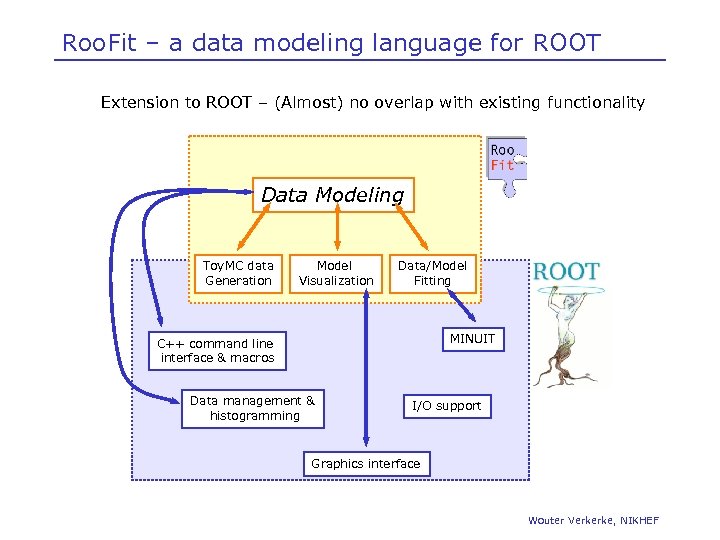 Roo. Fit – a data modeling language for ROOT Extension to ROOT – (Almost) no overlap with existing functionality Data Modeling Toy. MC data Generation Model Visualization Data/Model Fitting MINUIT C++ command line interface & macros Data management & histogramming I/O support Graphics interface Wouter Verkerke, NIKHEF
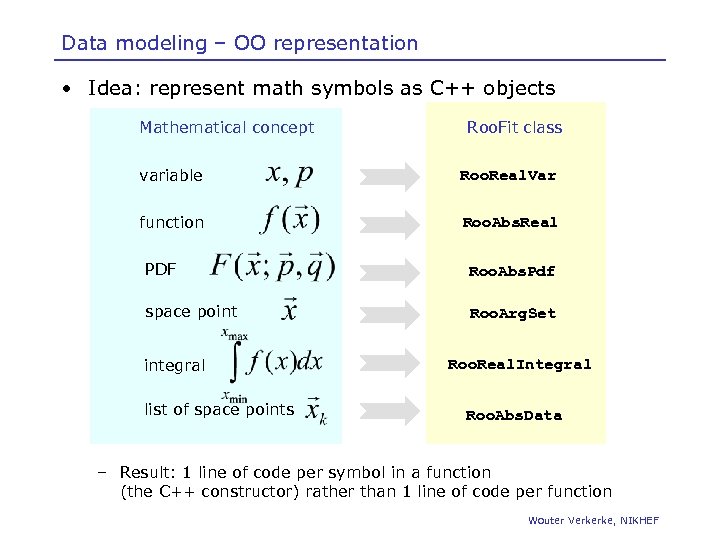 Data modeling – OO representation • Idea: represent math symbols as C++ objects Mathematical concept Roo. Fit class variable Roo. Real. Var function Roo. Abs. Real PDF Roo. Abs. Pdf space point Roo. Arg. Set integral list of space points Roo. Real. Integral Roo. Abs. Data – Result: 1 line of code per symbol in a function (the C++ constructor) rather than 1 line of code per function Wouter Verkerke, NIKHEF
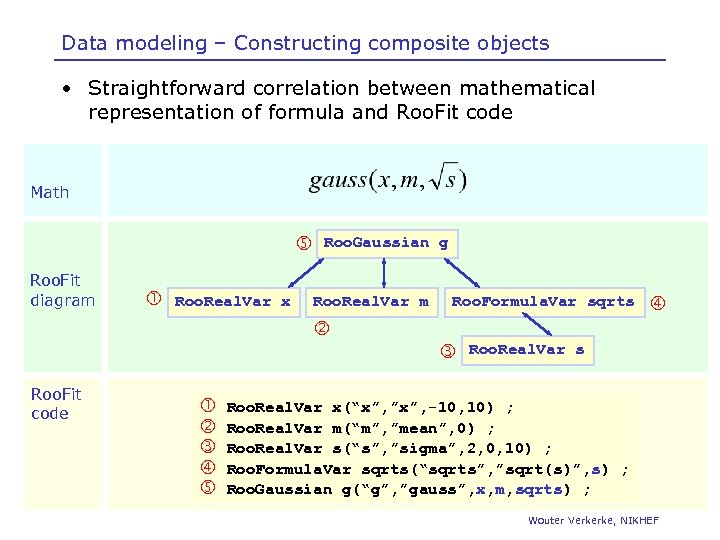 Data modeling – Constructing composite objects • Straightforward correlation between mathematical representation of formula and Roo. Fit code Math Roo. Fit diagram Roo. Real. Var x Roo. Gaussian g Roo. Real. Var m Roo. Formula. Var sqrts Roo. Fit code Roo. Real. Var s Roo. Real. Var x(“x”, ”x”, -10, 10) ; Roo. Real. Var m(“m”, ”mean”, 0) ; Roo. Real. Var s(“s”, ”sigma”, 2, 0, 10) ; Roo. Formula. Var sqrts(“sqrts”, ”sqrt(s)”, s) ; Roo. Gaussian g(“g”, ”gauss”, x, m, sqrts) ; Wouter Verkerke, NIKHEF
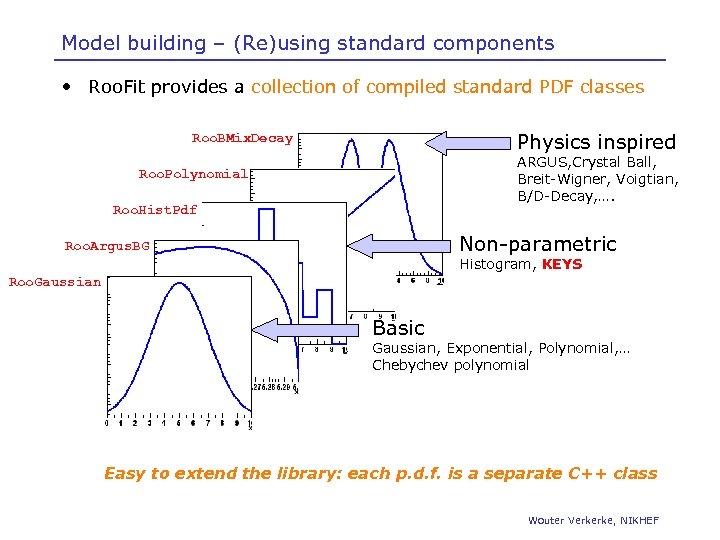 Model building – (Re)using standard components • Roo. Fit provides a collection of compiled standard PDF classes Physics inspired Roo. BMix. Decay ARGUS, Crystal Ball, Breit-Wigner, Voigtian, B/D-Decay, …. Roo. Polynomial Roo. Hist. Pdf Non-parametric Roo. Argus. BG Histogram, KEYS Roo. Gaussian Basic Gaussian, Exponential, Polynomial, … Chebychev polynomial Easy to extend the library: each p. d. f. is a separate C++ class Wouter Verkerke, NIKHEF
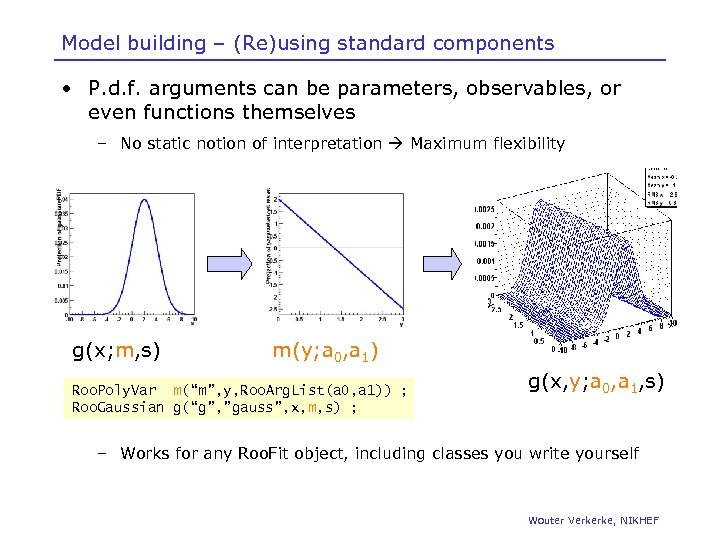 Model building – (Re)using standard components • P. d. f. arguments can be parameters, observables, or even functions themselves – No static notion of interpretation Maximum flexibility g(x; m, s) m(y; a 0, a 1) Roo. Poly. Var m(“m”, y, Roo. Arg. List(a 0, a 1)) ; Roo. Gaussian g(“g”, ”gauss”, x, m, s) ; g(x, y; a 0, a 1, s) – Works for any Roo. Fit object, including classes you write yourself Wouter Verkerke, NIKHEF
 Handling of p. d. f normalization • Normalization of (component) p. d. f. s to unity is often a good part of the work of writing a p. d. f. • Roo. Fit handles most normalization issues transparently to the user – P. d. f can advertise (multiple) analytical expressions for integrals – When no analytical expression is provided, Roo. Fit will automatically perform numeric integration to obtain normalization – More complicated that it seems: even if gauss(x, m, s) can be integrated analytically over x, gauss(f(x), m, s) cannot. Such use cases are automatically recognized. – Multi-dimensional integrals can be combination of numeric and p. d. f-provided analytical partial integrals • Variety of numeric integration techniques is interfaced – Adaptive trapezoid, Gauss-Kronrod, VEGAS MC… – User can override configuration globally or per p. d. f. as necessary Wouter Verkerke, NIKHEF
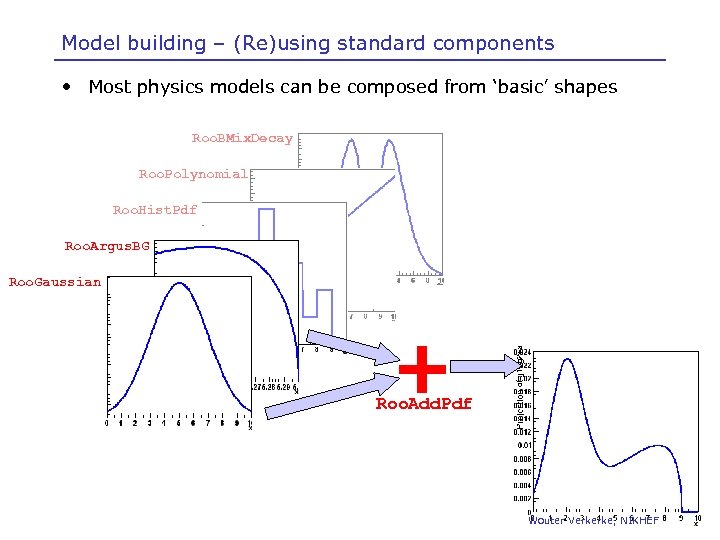 Model building – (Re)using standard components • Most physics models can be composed from ‘basic’ shapes Roo. BMix. Decay Roo. Polynomial Roo. Hist. Pdf Roo. Argus. BG Roo. Gaussian + Roo. Add. Pdf Wouter Verkerke, NIKHEF
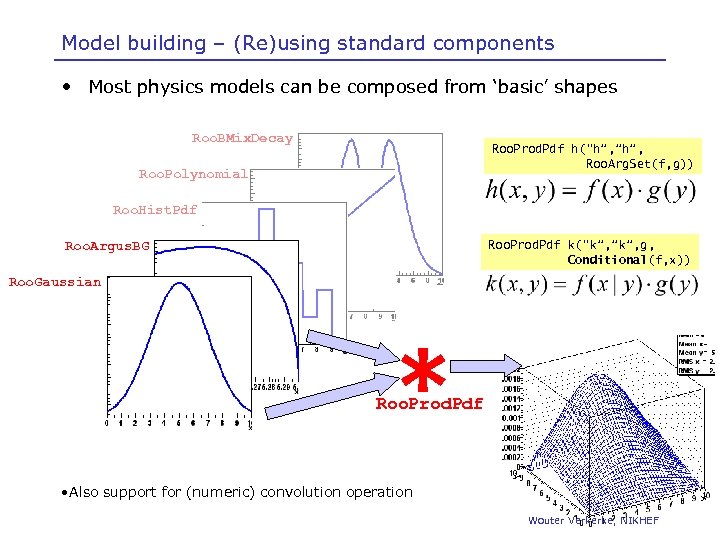 Model building – (Re)using standard components • Most physics models can be composed from ‘basic’ shapes Roo. BMix. Decay Roo. Prod. Pdf h(“h”, ”h”, Roo. Arg. Set(f, g)) Roo. Polynomial Roo. Hist. Pdf Roo. Prod. Pdf k(“k”, ”k”, g, Conditional(f, x)) Roo. Argus. BG Roo. Gaussian * Roo. Prod. Pdf • Also support for (numeric) convolution operation Wouter Verkerke, NIKHEF
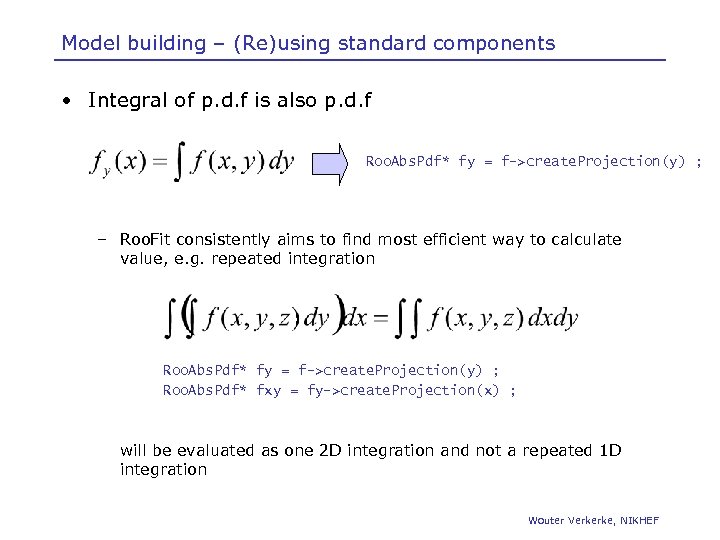 Model building – (Re)using standard components • Integral of p. d. f is also p. d. f Roo. Abs. Pdf* fy = f->create. Projection(y) ; – Roo. Fit consistently aims to find most efficient way to calculate value, e. g. repeated integration Roo. Abs. Pdf* fy = f->create. Projection(y) ; Roo. Abs. Pdf* fxy = fy->create. Projection(x) ; will be evaluated as one 2 D integration and not a repeated 1 D integration Wouter Verkerke, NIKHEF
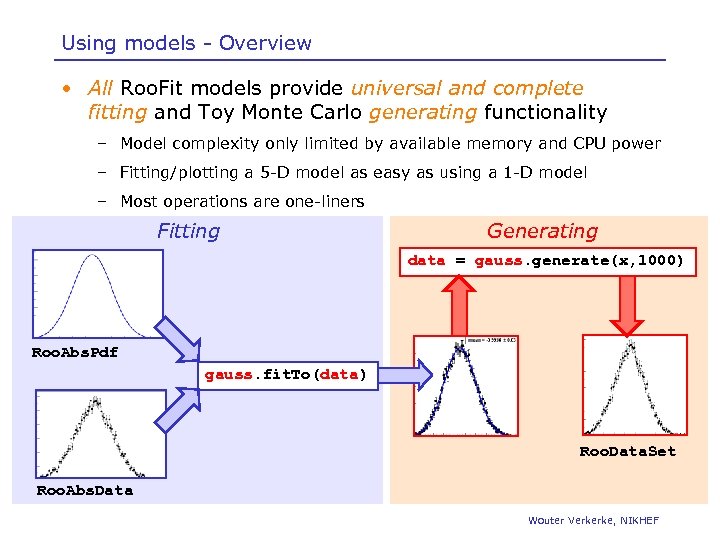 Using models - Overview • All Roo. Fit models provide universal and complete fitting and Toy Monte Carlo generating functionality – Model complexity only limited by available memory and CPU power – Fitting/plotting a 5 -D model as easy as using a 1 -D model – Most operations are one-liners Fitting Generating data = gauss. generate(x, 1000) Roo. Abs. Pdf gauss. fit. To(data) Roo. Data. Set Roo. Abs. Data Wouter Verkerke, NIKHEF
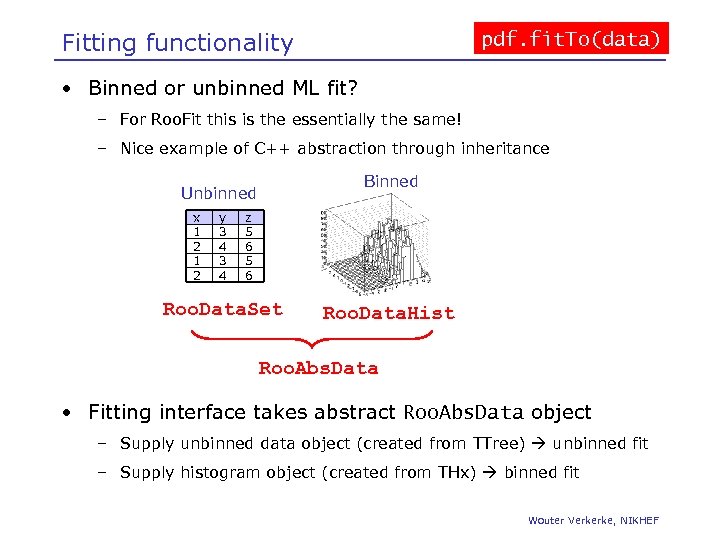 Fitting functionality pdf. fit. To(data) • Binned or unbinned ML fit? – For Roo. Fit this is the essentially the same! – Nice example of C++ abstraction through inheritance Binned Unbinned x 1 2 y 3 4 z 5 6 Roo. Data. Set Roo. Data. Hist Roo. Abs. Data • Fitting interface takes abstract Roo. Abs. Data object – Supply unbinned data object (created from TTree) unbinned fit – Supply histogram object (created from THx) binned fit Wouter Verkerke, NIKHEF
 Automated vs. hand-coded optimization of p. d. f. • Automatic pre-fit PDF optimization – Prior to each fit, the PDF is analyzed for possible optimizations – Optimization algorithms: • Detection and precalculation of constant terms in any PDF expression • Function caching and lazy evaluation • Factorization of multi-dimensional problems where ever possible – Optimizations are always tailored to the specific use in each fit. – Possible because OO structure of p. d. f. allows automated analysis of structure • No need for users to hard-code optimizations – Keeps your code understandable, maintainable and flexible without sacrificing performance – Optimization concepts implemented by Roo. Fit are applied consistently and completely to all PDFs – Speedup of factor 3 -10 reported in realistic complex fits • Fit parallelization on multi-CPU hosts – Option for automatic parallelization of fit function on multi-CPU hosts (no explicit or implicit support from user PDFs needed) Wouter Verkerke, NIKHEF
 MC Event generation pdf. generate(vars, nevt) • Sample “toy Monte Carlo” samples from any PDF – Accept/reject sampling method used by default • MC generation method automatically optimized – PDF can advertise internal generator if more efficient methods exists (e. g. Gaussian) – Each generator request will use the most efficient accept-reject / internal generator combination available – Operator PDFs (sum, product, …) distribute generation over components whenever possible – Generation order for products with conditional PDFs is sorted out automatically – Possible because OO structure of p. d. f. allows automated analysis of structure • Can also specify template data as input to generator pdf. generate(vars, data) Wouter Verkerke, NIKHEF
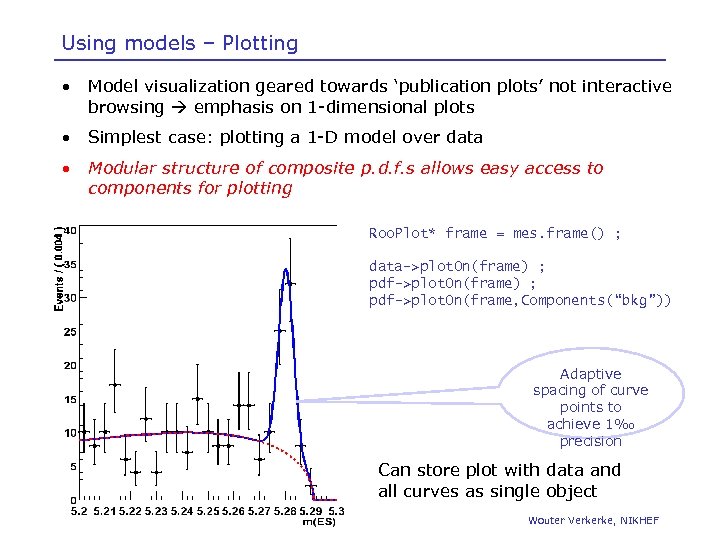 Using models – Plotting • Model visualization geared towards ‘publication plots’ not interactive browsing emphasis on 1 -dimensional plots • Simplest case: plotting a 1 -D model over data • Modular structure of composite p. d. f. s allows easy access to components for plotting Roo. Plot* frame = mes. frame() ; data->plot. On(frame) ; pdf->plot. On(frame, Components(“bkg”)) Adaptive spacing of curve points to achieve 1‰ precision Can store plot with data and all curves as single object Wouter Verkerke, NIKHEF
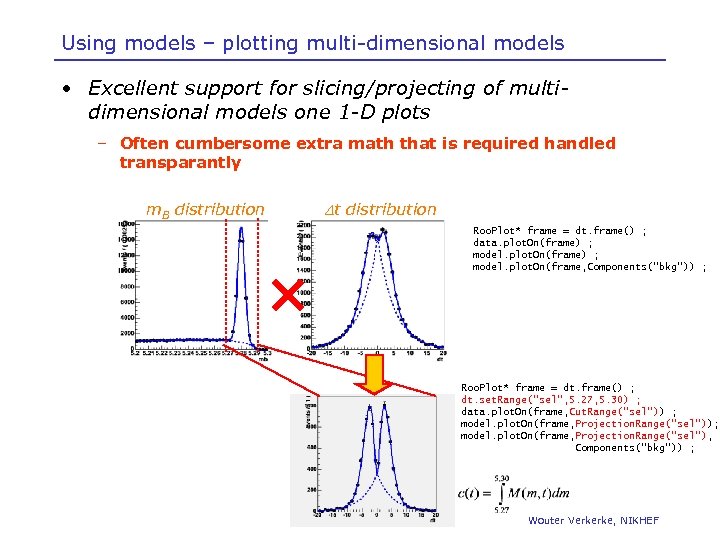 Using models – plotting multi-dimensional models • Excellent support for slicing/projecting of multidimensional models one 1 -D plots – Often cumbersome extra math that is required handled transparantly Dt distribution m. B distribution Roo. Plot* frame = dt. frame() ; data. plot. On(frame) ; model. plot. On(frame, Components(“bkg”)) ; Roo. Plot* frame = dt. frame() ; dt. set. Range(“sel”, 5. 27, 5. 30) ; data. plot. On(frame, Cut. Range(“sel”)) ; model. plot. On(frame, Projection. Range(“sel”)); model. plot. On(frame, Projection. Range(“sel”), Components(“bkg”)) ; Wouter Verkerke, NIKHEF
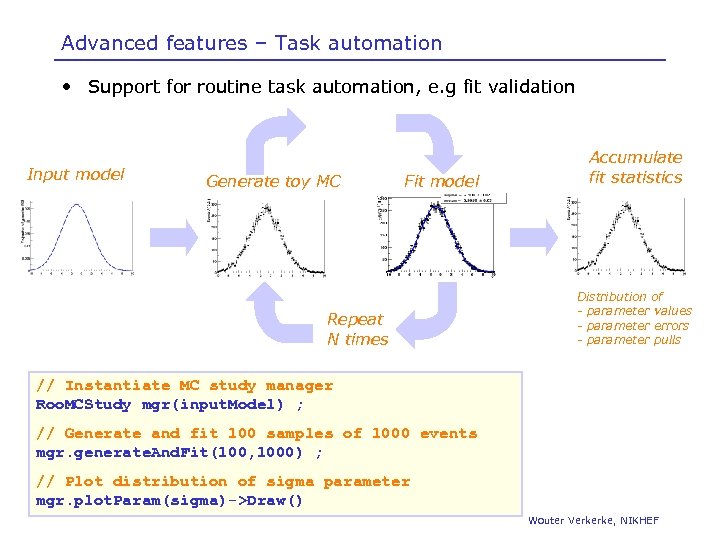 Advanced features – Task automation • Support for routine task automation, e. g fit validation Input model Generate toy MC Fit model Repeat N times Accumulate fit statistics Distribution of - parameter values - parameter errors - parameter pulls // Instantiate MC study manager Roo. MCStudy mgr(input. Model) ; // Generate and fit 100 samples of 1000 events mgr. generate. And. Fit(100, 1000) ; // Plot distribution of sigma parameter mgr. plot. Param(sigma)->Draw() Wouter Verkerke, NIKHEF
 Roo. Fit – Plans for 2007 • Migrate code to ROOT CVS repository – Source code now maintained in ROOT CVS repository as of June 2007 (used to send tarballs) Easier to make small changes • Improve Math. More/Roo. Fit interoperability – E. g replace private implementations of GSL numeric integration classes and by interfaces to Math. More versions – Generic templated Roo. Abs. Real/Roo. Abs. Pdf adapter function for Math. More functions and p. d. f. s • Update and complete Users Manual Wouter Verkerke, NIKHEF
 Tools for significance, limits, p-values goodness-of-fit Wouter Verkerke, NIKHEF
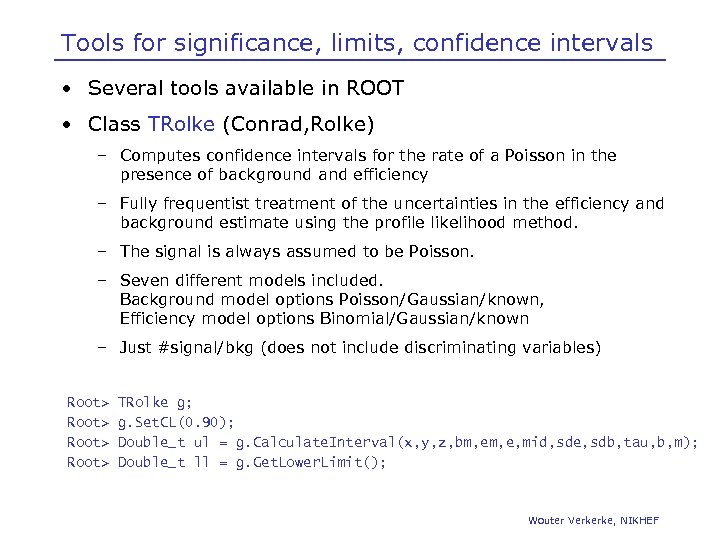 Tools for significance, limits, confidence intervals • Several tools available in ROOT • Class TRolke (Conrad, Rolke) – Computes confidence intervals for the rate of a Poisson in the presence of background and efficiency – Fully frequentist treatment of the uncertainties in the efficiency and background estimate using the profile likelihood method. – The signal is always assumed to be Poisson. – Seven different models included. Background model options Poisson/Gaussian/known, Efficiency model options Binomial/Gaussian/known – Just #signal/bkg (does not include discriminating variables) Root> TRolke g; g. Set. CL(0. 90); Double_t ul = g. Calculate. Interval(x, y, z, bm, e, mid, sde, sdb, tau, b, m); Double_t ll = g. Get. Lower. Limit(); Wouter Verkerke, NIKHEF
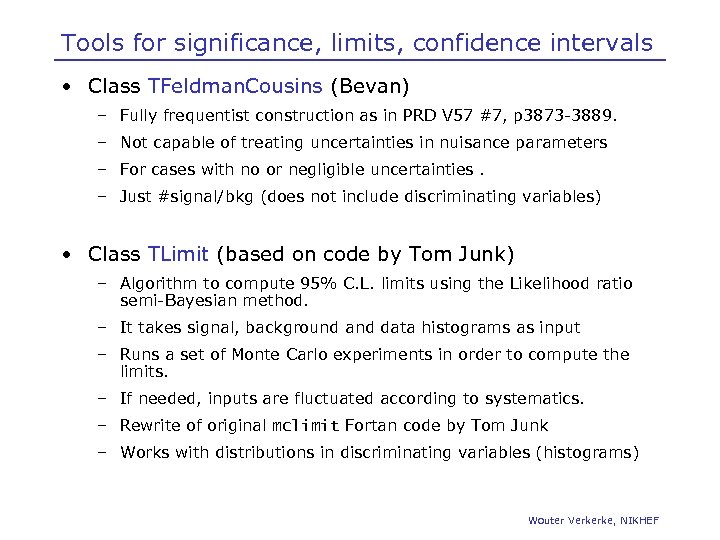 Tools for significance, limits, confidence intervals • Class TFeldman. Cousins (Bevan) – Fully frequentist construction as in PRD V 57 #7, p 3873 -3889. – Not capable of treating uncertainties in nuisance parameters – For cases with no or negligible uncertainties. – Just #signal/bkg (does not include discriminating variables) • Class TLimit (based on code by Tom Junk) – Algorithm to compute 95% C. L. limits using the Likelihood ratio semi-Bayesian method. – It takes signal, background and data histograms as input – Runs a set of Monte Carlo experiments in order to compute the limits. – If needed, inputs are fluctuated according to systematics. – Rewrite of original mclimit Fortan code by Tom Junk – Works with distributions in discriminating variables (histograms) Wouter Verkerke, NIKHEF
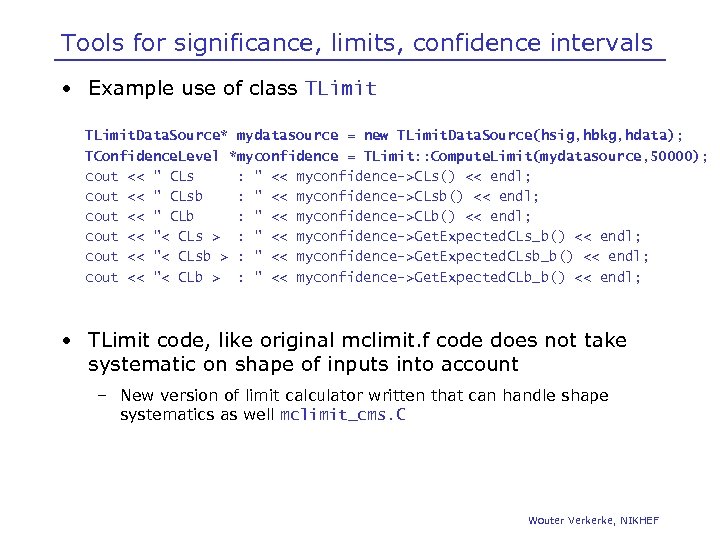 Tools for significance, limits, confidence intervals • Example use of class TLimit. Data. Source* mydatasource = new TLimit. Data. Source(hsig, hbkg, hdata); TConfidence. Level *myconfidence = TLimit: : Compute. Limit(mydatasource, 50000); cout << " CLs : " << myconfidence->CLs() << endl; cout << " CLsb : " << myconfidence->CLsb() << endl; cout << " CLb : " << myconfidence->CLb() << endl; cout << "< CLs > : " << myconfidence->Get. Expected. CLs_b() << endl; cout << "< CLsb > : " << myconfidence->Get. Expected. CLsb_b() << endl; cout << "< CLb > : " << myconfidence->Get. Expected. CLb_b() << endl; • TLimit code, like original mclimit. f code does not take systematic on shape of inputs into account – New version of limit calculator written that can handle shape systematics as well mclimit_cms. C Wouter Verkerke, NIKHEF
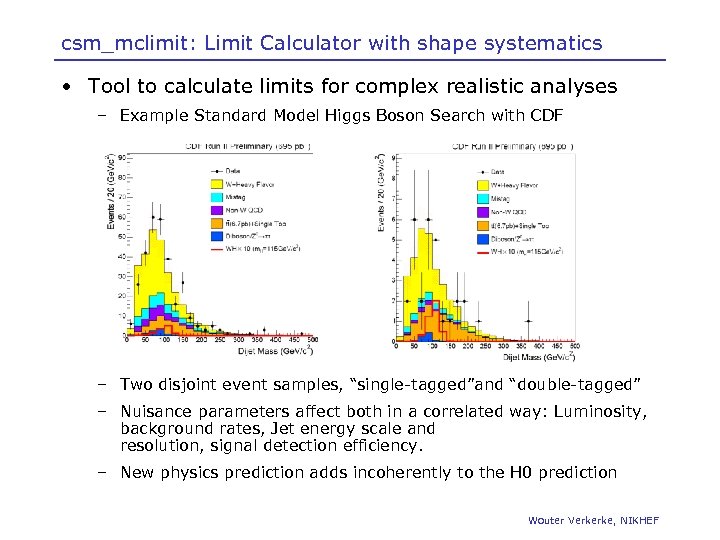 csm_mclimit: Limit Calculator with shape systematics • Tool to calculate limits for complex realistic analyses – Example Standard Model Higgs Boson Search with CDF – Two disjoint event samples, “single-tagged”and “double-tagged” – Nuisance parameters affect both in a correlated way: Luminosity, background rates, Jet energy scale and resolution, signal detection efficiency. – New physics prediction adds incoherently to the H 0 prediction Wouter Verkerke, NIKHEF
 csm_mclimit: Limit Calculator with shape systematics • Problems addressed and what it does – Input data are binned in one or more histograms (1 D or 2 D). – Can have multiple signal and multiple background sources. – Model predictions are sums of template histograms from different sources. – Each source of signal and background can have rate and shape uncertainties from multiple sources of systematic uncertainty. • Systematic uncertainties are listed by name, and uncertainties with the same name are 100% correlated and uncertainties with different names are 0% correlated. – Shape uncertainties are handled by template morphing or by simple linear interpolation within each bin. • (Linear interpolation of histograms. Alexander L. Read (Oslo U. ). 1999. NIM. A 425: 357 -360, 1999. ) – Uncertain parameters can be fit for, in the data and for each pseudo-experiment. – Finite MC statistical errors in each bin are included in the fits and the pseudo-experiments. Wouter Verkerke, NIKHEF
 Limit Calculator with shape systematics • Output – Given the data and model predictions p-values are computed to possibly discover or exclude. – CLs and CLs-based cross-section limits can be computed – Bayesian limits using a flat prior in cross section can be computed. • Software and documentation provided at – http: //www. hep. uiuc. edu/home/trj/cdfstats/mclimit_csm 1/ index. html – “Interface is rather cumbersome due to the large number of possible systematic errors which need to be included” • Tom is interested in further interfacing in ROOT / Roo. Fit Wouter Verkerke, NIKHEF
 Lep. Stats 4 LHC – LEP-style Frequentist limit calculations • Series of tools for frequentist limit calculations (K. Cranmer) – Implement LEP-style calculation of significances (in C++) – Uses FFTW package for convolution calculations – Interface is series of command line utilities – Code & manual available for download at phystat. org • Poisson. Sig – Calculate the significance of a number counting analysis. • Poisson. Sig_syst – Calculate the significance of a number counting analysis including systematic error on the background expectation. • Likelihood – Calculate the combined significance of several search channels or to calculate the significance of a search channel with a discriminating variable. • Likelihood_syst – Calculate the combined significance of several search channels including systematic errors associated with each channel. Wouter Verkerke, NIKHEF
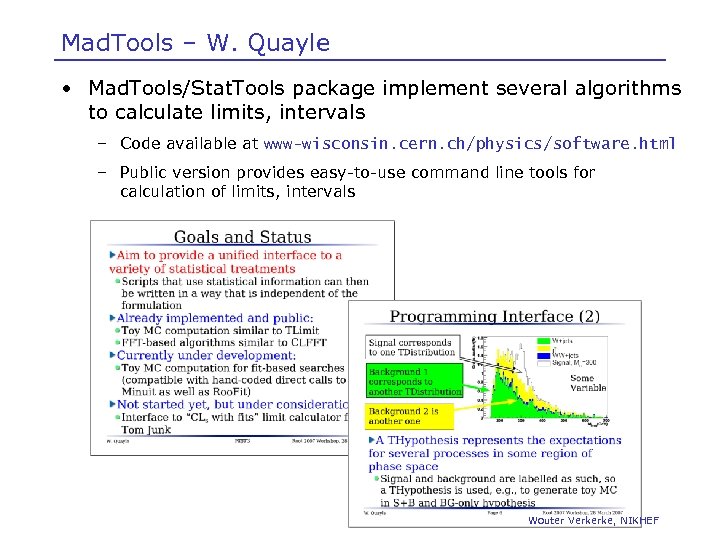 Mad. Tools – W. Quayle • Mad. Tools/Stat. Tools package implement several algorithms to calculate limits, intervals – Code available at www-wisconsin. cern. ch/physics/software. html – Public version provides easy-to-use command line tools for calculation of limits, intervals Wouter Verkerke, NIKHEF
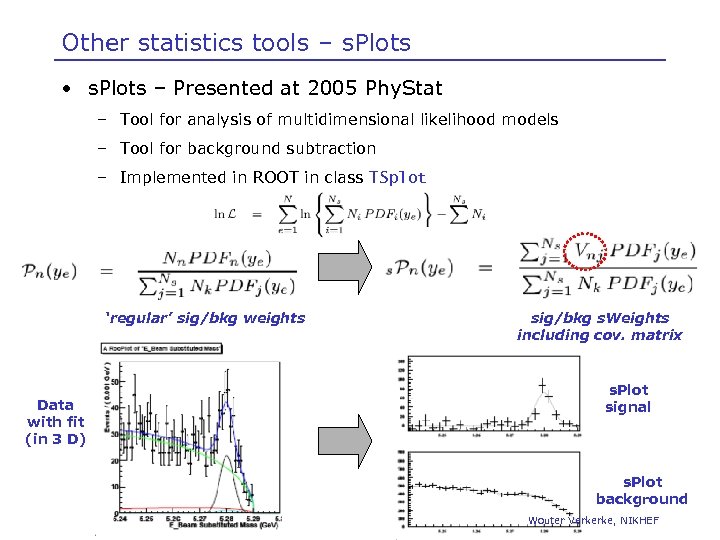 Other statistics tools – s. Plots • s. Plots – Presented at 2005 Phy. Stat – Tool for analysis of multidimensional likelihood models – Tool for background subtraction – Implemented in ROOT in class TSplot ‘regular’ sig/bkg weights Data with fit (in 3 D) sig/bkg s. Weights including cov. matrix s. Plot signal s. Plot background Wouter Verkerke, NIKHEF
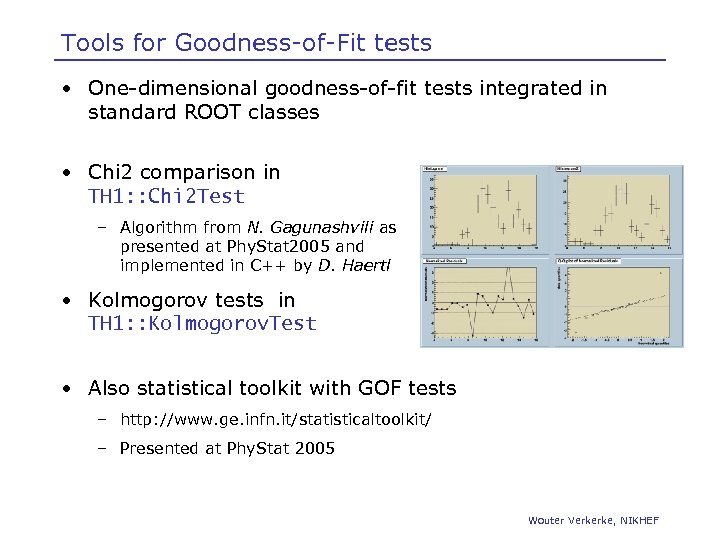 Tools for Goodness-of-Fit tests • One-dimensional goodness-of-fit tests integrated in standard ROOT classes • Chi 2 comparison in TH 1: : Chi 2 Test – Algorithm from N. Gagunashvili as presented at Phy. Stat 2005 and implemented in C++ by D. Haertl • Kolmogorov tests in TH 1: : Kolmogorov. Test • Also statistical toolkit with GOF tests – http: //www. ge. infn. it/statisticaltoolkit/ – Presented at Phy. Stat 2005 Wouter Verkerke, NIKHEF
 A Common Framework for statistical tools? • Both LEP and Tevatron experiments have created tools that combine multiple channels and include systematic uncertainties, but – The tools generally implement a specific technique, – Combinations require significant manual intervention • Would like a more versatile, generic solution • In addition to providing tools for simple calculations, the framework should be able to combine the results of multiple measurements, – Be able to incorporate systematic uncertainty, – Facilitate the technical aspects of sharing code Wouter Verkerke, NIKHEF
 A common framework for statistical tools • What techniques should such a framework implement? • There are few major classes of statistical techniques: – Likelihood: All inference from likelihood curves – Bayesian: Use prior on parameter to compute P(theory|data) – Frequentist: Restricted to statements of P(data|theory) • Even within one of these classes, there are several ways to approach the same problem. • The framework should support each of these types of techniques, and provide common abstractions Wouter Verkerke, NIKHEF
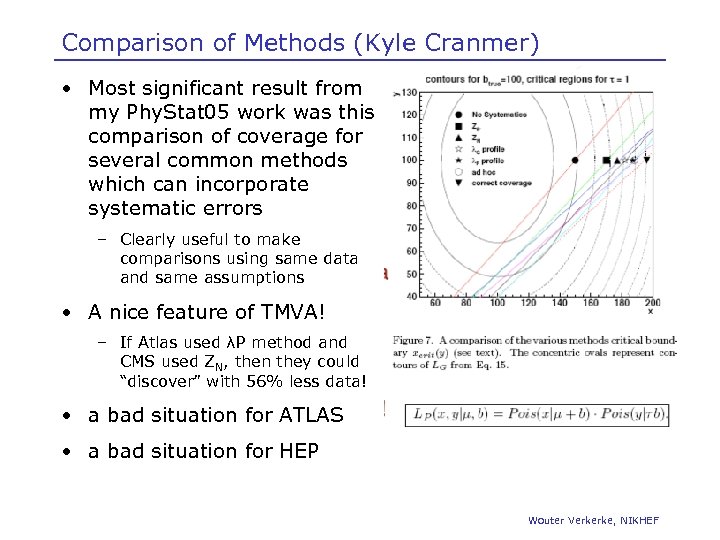 Comparison of Methods (Kyle Cranmer) • Most significant result from my Phy. Stat 05 work was this comparison of coverage for several common methods which can incorporate systematic errors – Clearly useful to make comparisons using same data and same assumptions • A nice feature of TMVA! – If Atlas used λP method and CMS used ZN, then they could “discover” with 56% less data! • a bad situation for ATLAS • a bad situation for HEP Wouter Verkerke, NIKHEF
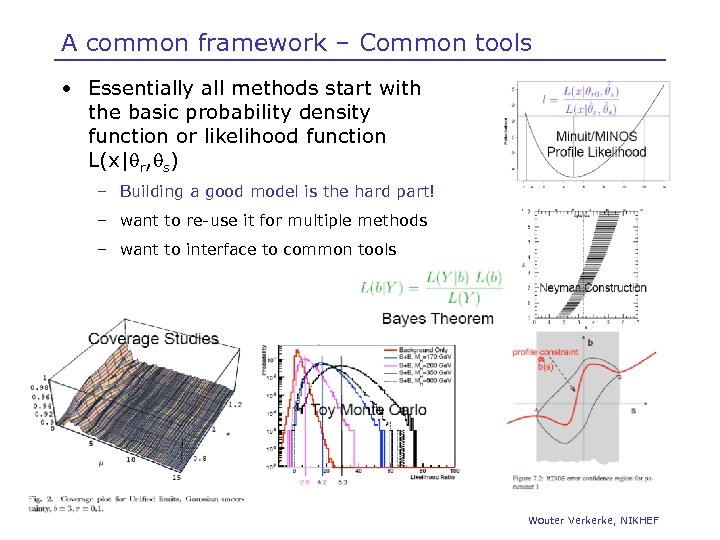 A common framework – Common tools • Essentially all methods start with the basic probability density function or likelihood function L(x|qr, qs) – Building a good model is the hard part! – want to re-use it for multiple methods – want to interface to common tools Wouter Verkerke, NIKHEF
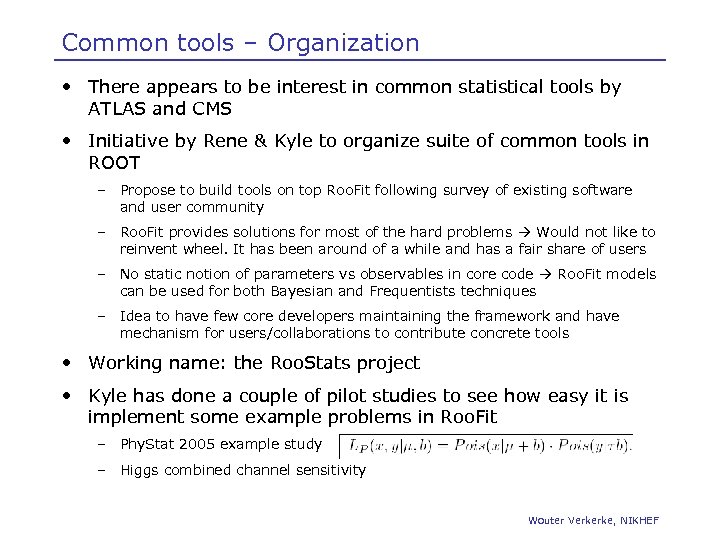 Common tools – Organization • There appears to be interest in common statistical tools by ATLAS and CMS • Initiative by Rene & Kyle to organize suite of common tools in ROOT – Propose to build tools on top Roo. Fit following survey of existing software and user community – Roo. Fit provides solutions for most of the hard problems Would not like to reinvent wheel. It has been around of a while and has a fair share of users – No static notion of parameters vs observables in core code Roo. Fit models can be used for both Bayesian and Frequentists techniques – Idea to have few core developers maintaining the framework and have mechanism for users/collaborations to contribute concrete tools • Working name: the Roo. Stats project • Kyle has done a couple of pilot studies to see how easy it is implement some example problems in Roo. Fit – Phy. Stat 2005 example study – Higgs combined channel sensitivity Wouter Verkerke, NIKHEF
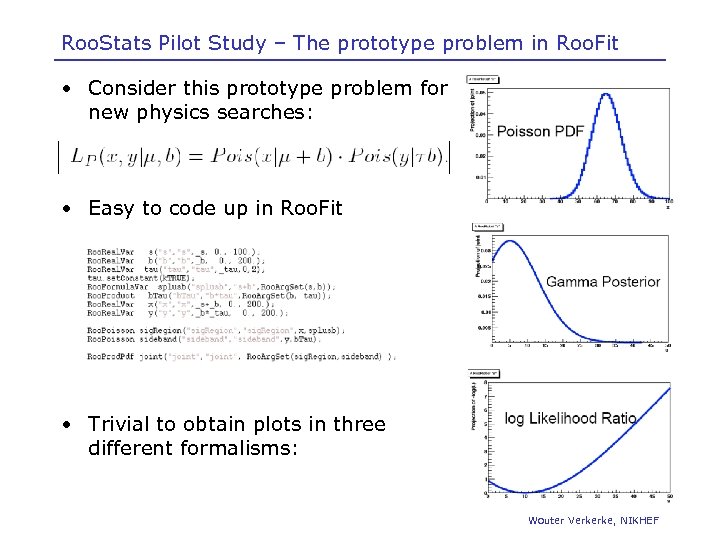 Roo. Stats Pilot Study – The prototype problem in Roo. Fit • Consider this prototype problem for new physics searches: • Easy to code up in Roo. Fit • Trivial to obtain plots in three different formalisms: Wouter Verkerke, NIKHEF
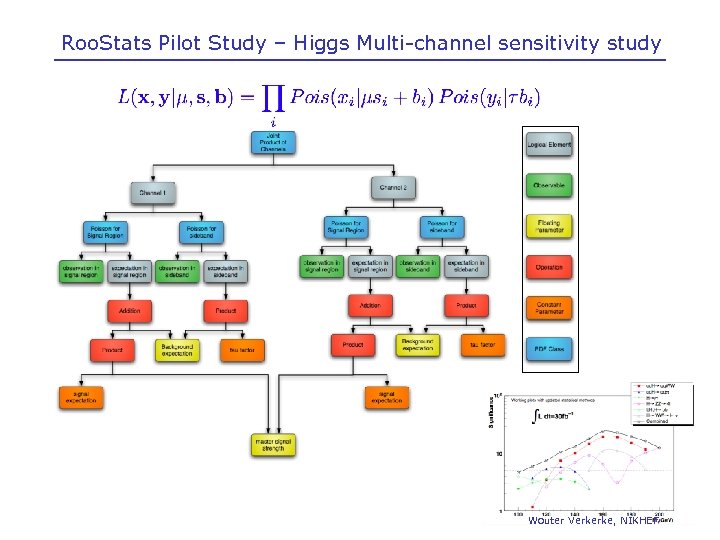 Roo. Stats Pilot Study – Higgs Multi-channel sensitivity study Wouter Verkerke, NIKHEF
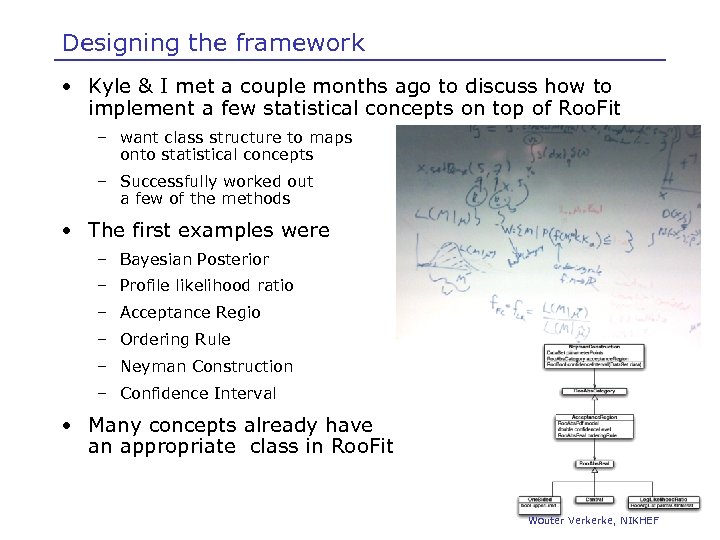 Designing the framework • Kyle & I met a couple months ago to discuss how to implement a few statistical concepts on top of Roo. Fit – want class structure to maps onto statistical concepts – Successfully worked out a few of the methods • The first examples were – Bayesian Posterior – Profile likelihood ratio – Acceptance Regio – Ordering Rule – Neyman Construction – Confidence Interval • Many concepts already have an appropriate class in Roo. Fit Wouter Verkerke, NIKHEF
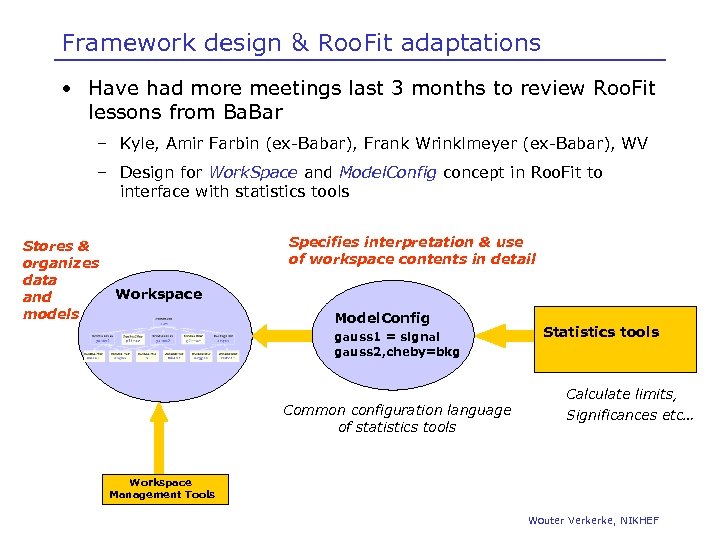 Framework design & Roo. Fit adaptations • Have had more meetings last 3 months to review Roo. Fit lessons from Ba. Bar – Kyle, Amir Farbin (ex-Babar), Frank Wrinklmeyer (ex-Babar), WV – Design for Work. Space and Model. Config concept in Roo. Fit to interface with statistics tools Stores & organizes data and models Specifies interpretation & use of workspace contents in detail Workspace Model. Config gauss 1 = signal gauss 2, cheby=bkg Common configuration language of statistics tools Statistics tools Calculate limits, Significances etc… Workspace Management Tools Wouter Verkerke, NIKHEF
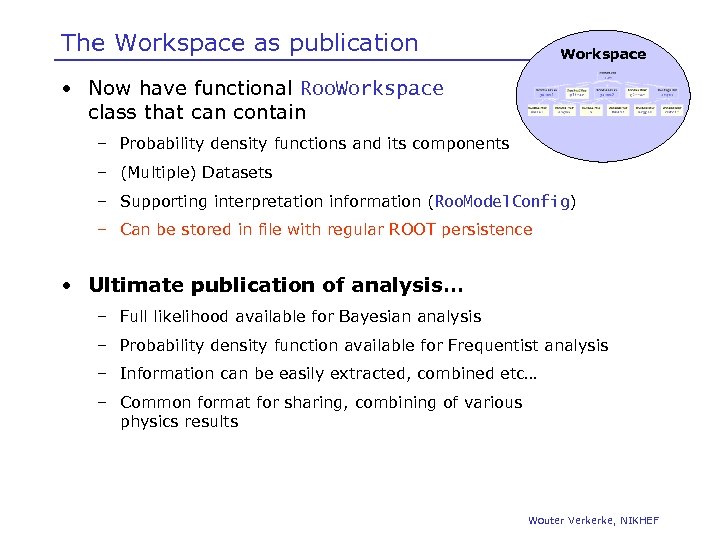 The Workspace as publication Workspace • Now have functional Roo. Workspace class that can contain – Probability density functions and its components – (Multiple) Datasets – Supporting interpretation information (Roo. Model. Config) – Can be stored in file with regular ROOT persistence • Ultimate publication of analysis… – Full likelihood available for Bayesian analysis – Probability density function available for Frequentist analysis – Information can be easily extracted, combined etc… – Common format for sharing, combining of various physics results Wouter Verkerke, NIKHEF
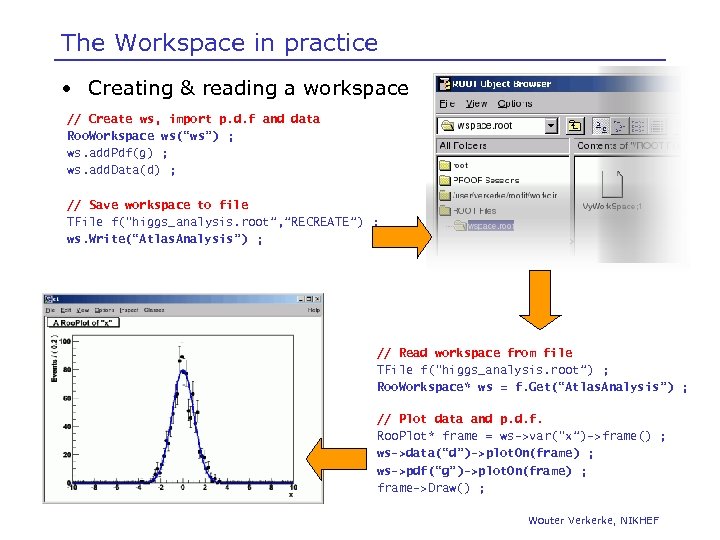 The Workspace in practice • Creating & reading a workspace // Create ws, import p. d. f and data Roo. Workspace ws(“ws”) ; ws. add. Pdf(g) ; ws. add. Data(d) ; // Save workspace to file TFile f(“higgs_analysis. root”, ”RECREATE”) ; ws. Write(“Atlas. Analysis”) ; // Read workspace from file TFile f(“higgs_analysis. root”) ; Roo. Workspace* ws = f. Get(“Atlas. Analysis”) ; // Plot data and p. d. f. Roo. Plot* frame = ws->var(“x”)->frame() ; ws->data(“d”)->plot. On(frame) ; ws->pdf(“g”)->plot. On(frame) ; frame->Draw() ; Wouter Verkerke, NIKHEF
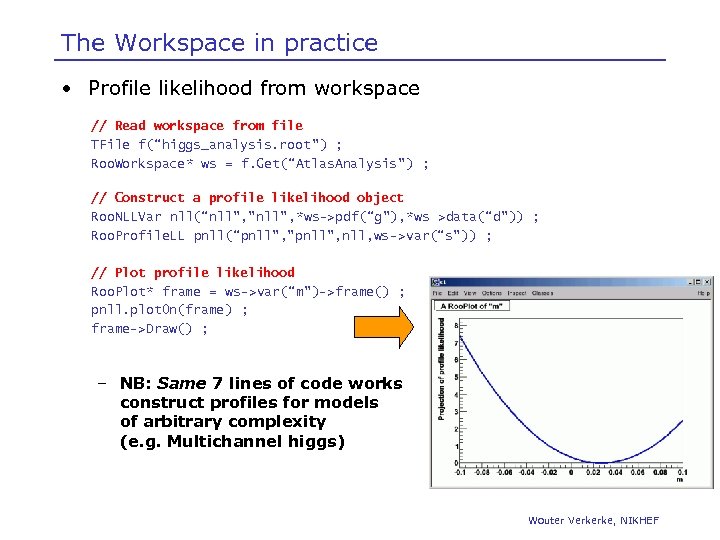 The Workspace in practice • Profile likelihood from workspace // Read workspace from file TFile f(“higgs_analysis. root”) ; Roo. Workspace* ws = f. Get(“Atlas. Analysis”) ; // Construct a profile likelihood object Roo. NLLVar nll(“nll”, ”nll”, *ws->pdf(“g”), *ws >data(“d”)) ; Roo. Profile. LL pnll(“pnll”, ”pnll”, nll, ws->var(“s”)) ; // Plot profile likelihood Roo. Plot* frame = ws->var(“m”)->frame() ; pnll. plot. On(frame) ; frame->Draw() ; – NB: Same 7 lines of code works construct profiles for models of arbitrary complexity (e. g. Multichannel higgs) Wouter Verkerke, NIKHEF
 Roo. Stats Framework – Status & plans • Initial Roo. Workspace class with persistence feature now ready, will available in next ROOT release • Now working on design of Roo. Model. Config layer – Store details on specific use of model for a given problem, i. e. what is signal background etc… – Intended to solve ‘cumbersome interface problem’ of tools that require many input parameters (as in Tom Junks csm_mclimit. C) – Common language of various statistics tools • Next step: add higher level tools to framework that calculate limits, confidence intervals from information in workspaces Roo. Stats: : Baysian. Interval, Roo. Stats: : Neyman. Construction Wouter Verkerke, NIKHEF
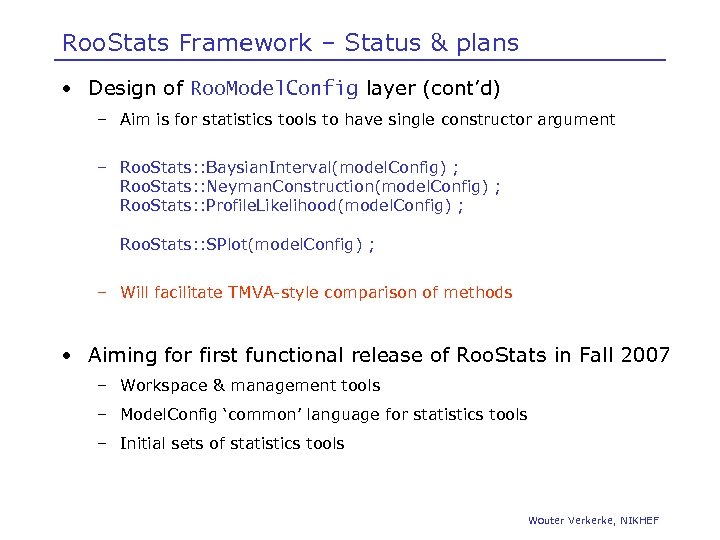 Roo. Stats Framework – Status & plans • Design of Roo. Model. Config layer (cont’d) – Aim is for statistics tools to have single constructor argument – Roo. Stats: : Baysian. Interval(model. Config) ; Roo. Stats: : Neyman. Construction(model. Config) ; Roo. Stats: : Profile. Likelihood(model. Config) ; Roo. Stats: : SPlot(model. Config) ; – Will facilitate TMVA-style comparison of methods • Aiming for first functional release of Roo. Stats in Fall 2007 – Workspace & management tools – Model. Config ‘common’ language for statistics tools – Initial sets of statistics tools Wouter Verkerke, NIKHEF
 Summary Wouter Verkerke, NIKHEF
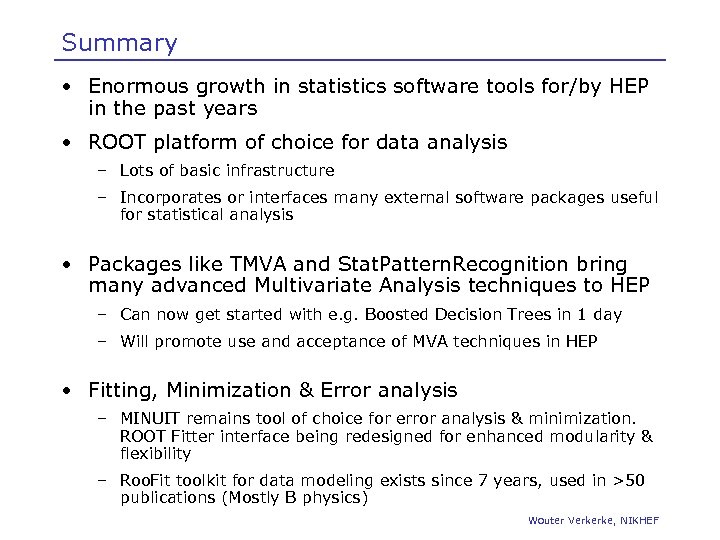 Summary • Enormous growth in statistics software tools for/by HEP in the past years • ROOT platform of choice for data analysis – Lots of basic infrastructure – Incorporates or interfaces many external software packages useful for statistical analysis • Packages like TMVA and Stat. Pattern. Recognition bring many advanced Multivariate Analysis techniques to HEP – Can now get started with e. g. Boosted Decision Trees in 1 day – Will promote use and acceptance of MVA techniques in HEP • Fitting, Minimization & Error analysis – MINUIT remains tool of choice for error analysis & minimization. ROOT Fitter interface being redesigned for enhanced modularity & flexibility – Roo. Fit toolkit for data modeling exists since 7 years, used in >50 publications (Mostly B physics) Wouter Verkerke, NIKHEF
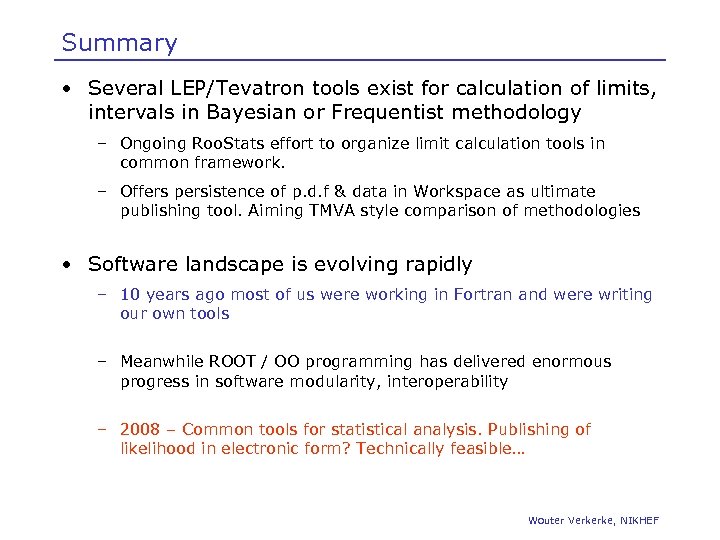 Summary • Several LEP/Tevatron tools exist for calculation of limits, intervals in Bayesian or Frequentist methodology – Ongoing Roo. Stats effort to organize limit calculation tools in common framework. – Offers persistence of p. d. f & data in Workspace as ultimate publishing tool. Aiming TMVA style comparison of methodologies • Software landscape is evolving rapidly – 10 years ago most of us were working in Fortran and were writing our own tools – Meanwhile ROOT / OO programming has delivered enormous progress in software modularity, interoperability – 2008 – Common tools for statistical analysis. Publishing of likelihood in electronic form? Technically feasible… Wouter Verkerke, NIKHEF