


 Скачать презентацию Statistics New Zealand Classification Management System Andrew Hancock
ffbda06f21abeac48e0f8c3f3999507f.ppt
- Количество слайдов: 13
 Statistics New Zealand Classification Management System Andrew Hancock Statistics New Zealand Prepared for 2013 Meeting of the UN Expert Group on International Statistical Classifications
 Contents Overview History/Background of existing CARS System Reasons for Change Vision CMS Overview 2013 UN Expert Group Meeting
 Overview Statistics New Zealand currently undergoing 10 year programme of change (Statistics 2020) Programme will: • mitigate legacy computer systems • transform the way statistics are delivered • bring about efficiencies to systems Provides opportunity to rethink the way classifications are developed, maintained and disseminated 2013 UN Expert Group Meeting
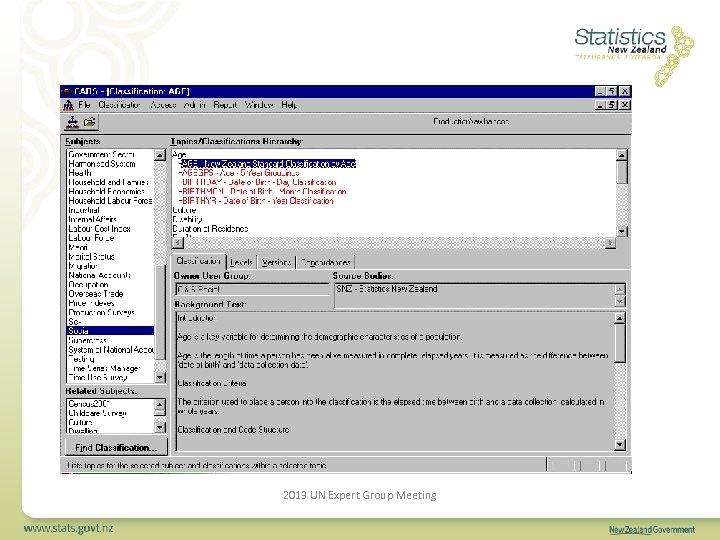
 History/Background of CARS Classification and Related Standards (CARS) created in 1996 Is a respository of all classifications, concordances and coding indexes used in Statistics NZ Currently holds 4625 classifications, 5627 versions and 2218 concordances Provides common ways to update, access and use standard classifications data 2013 UN Expert Group Meeting
 2013 UN Expert Group Meeting
 Reasons for change The rationale for moving to a new classification management system is due to: • The need to mitigate a legacy system • The need to move from a classification repository system to a full classification management system • The need to reduce proliferation of like classifications and versions • A desire to introduce a new approach to the management, storage and dissemination of classification related attributes and entities. 2013 UN Expert Group Meeting
 Vision Move to a concepts based system Allow greater relationships between attributes Automated authorisation and dissemination processes Greater search and discovery Enable greater reuse and reduce duplication ie store once and use in multiple locations. 2013 UN Expert Group Meeting
 CMS Overview Proposed CMS model relates to other standards and models eg ISO/IEC 11179, Neuchatel, DDI, SDMX Being designed primarily to support classification management within a single organisation but planned for wider use across Official Statistical System Joint venture between Statistics New Zealand Metadata Technology North America (MTNA) 2013 UN Expert Group Meeting
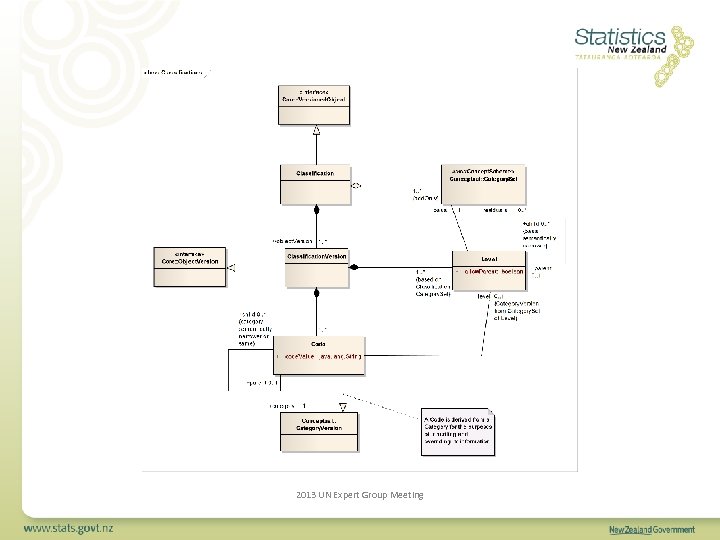
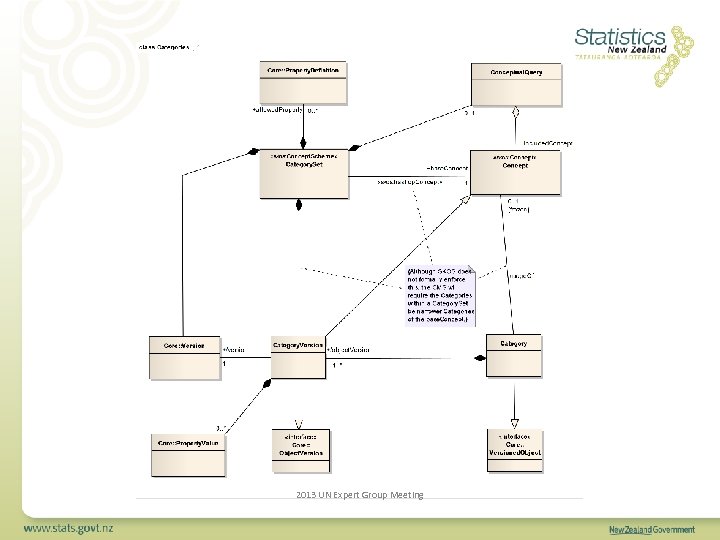
 CMS Components Core – This portion of the model focuses on identification, versioning, and describing contexts within which classifications are used. Classification – This package gives a general model for classifications in their generic sense, and then gives more specific extensions formal statistical classifications and derived classifications. Coding – This package describes the relationships needed for integration with the SNZ coding system, and hold constructs such as synonyms, and synonym sets. Conceptual – This is the place where the concepts and their uses are modelled, along with the model for categories (that is, units of meaning). Concordances – This package describes all the relationships which can exist in concordances. 2013 UN Expert Group Meeting
 2013 UN Expert Group Meeting
 2013 UN Expert Group Meeting
 Conclusions A new classification management system, and not merely a repository The model is designed to be flexible and extensible Builds on many of the best features of other models and standards Associates concepts and other types of relationships between classifications 2013 UN Expert Group Meeting
 Statistics New Zealand Classification Management System Andrew Hancock Statistics New Zealand Prepared for 2013 Meeting of the UN Expert Group on International Statistical Classifications