 Скачать презентацию Statistics Netherlands internal training programme international contribution
796d35e00219b49b2147dd13fc3f6922.ppt
- Количество слайдов: 11



Statistics Netherlands’ internal training programme & international contribution to training and development Carina FRANSEN International Relations
Introduction - ambition: high quality knowledge institution - increasing complexity of processes and methodologies -changing needs in society, now and in the future - upgrading the knowledge and skills - a continuous process of learning, training and development : life-time employability - three main target groups for statistical training - Integrated management
Statistical education programme available to own staff 1. Personal development 2. Statistical Tree for upgrading statistical knowledge 3. Process M. . Tools Course 4. ESTP courses 5. Management Development programme for potential and current managers
Personal development WFBB-cycle: 1. a personal workplan 2. performance interview 3. assessing and evaluating competencies 4. assigning a score (in a scale from a to d) Possible small financial bonus. Career counseling, personal development plan Contract professional education bureaus Further steps
Statistical Tree -Developed in-house by division of Q & M -Support the whole structure, both now and in the future - Obligatory for new staff members or promotion - Systematically integrated course programme and learning track Starter course Basic courses: 18 statistical modules, 3 changing relevant topics Advanced courses
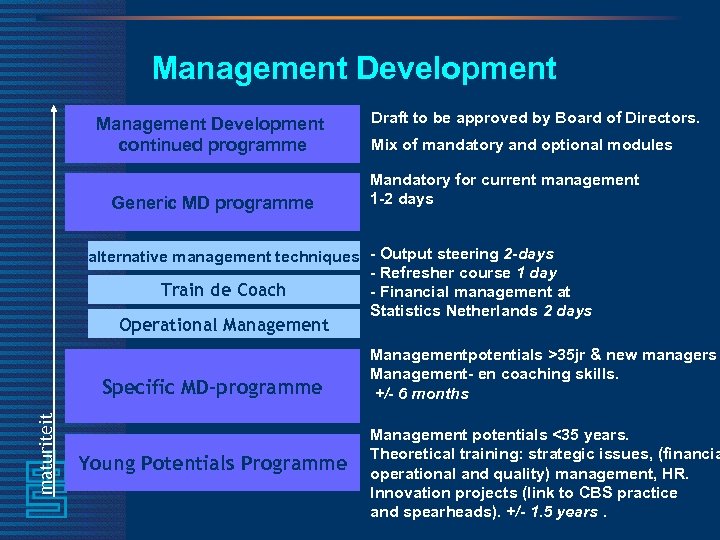
Management Development continued programme Dia’s Marja CPO Generic MD programme Draft to be approved by Board of Directors. Mix of mandatory and optional modules Mandatory for current management 1 -2 days alternative management techniques - Output steering 2 -days - Refresher course 1 day Train de Coach - Financial management at Statistics Netherlands 2 days Operational Management maturiteit Specific MD-programme Young Potentials Programme Managementpotentials >35 jr & new managers Management- en coaching skills. +/- 6 months Management potentials <35 years. Theoretical training: strategic issues, (financia operational and quality) management, HR. Innovation projects (link to CBS practice and spearheads). +/- 1. 5 years.
Statistics Netherlands’ international contribution to training and development Although the Netherlands is a relatively small country, it tries to invest in the global future and to contribute to international education Three instruments: 1. Bilateral exchange of experiences, good practices and knowledge 2. Contributing to the European Statistical Training Programme and Task Force 3. Participation in technical assistance programmes
Exchange of experience & knowledge Efficient and effective way of learning from each other Valuable at all levels - High level: regular basis (historical bilateral relations) or at invitation follow up at operational level by small directors conference or workshop - Expert level: study visits 2 features Statistics Netherlands Young statisticians club One week training programme on NA
Contribution to ESTP programme Strong support for aim and subjects of ESTP Active participation in all aspects. As - Member of task force ESTP / ESS LDF - organiser of courses (NA, SDC, Non response, administrative registers, metadata) - supplier of trainers - motivating and enabling own staff to attend the courses - contract party in the current consortium pro’s and con’s; future: more permanent organisational structure
Technical Assistance very practical and useful form of training re aim Advantages for beneficiary and provider TA policy of Statistics Netherlands - centralised approach (steering Internat. Rel. ) - scope: thematic and geografic restrictions, sustainability, available capacity For instance: USST 2, MBP Phare
Work in Progress ***** Thanks for your attention! Question?
Скачать презентацию Statistics Netherlands internal training programme international contribution
796d35e00219b49b2147dd13fc3f6922.ppt