


 Скачать презентацию Statistics for Health Research What size of trial
fa62a241280e474d02779d8b16d2d51b.ppt
- Количество слайдов: 51
 Statistics for Health Research What size of trial do I need? Peter T. Donnan Professor of Epidemiology and Biostatistics Co-Director of TCTU
 Tayside Clinical Trials Unit • TCTU fully registered with UKCRC Trials units • Added randomisation service
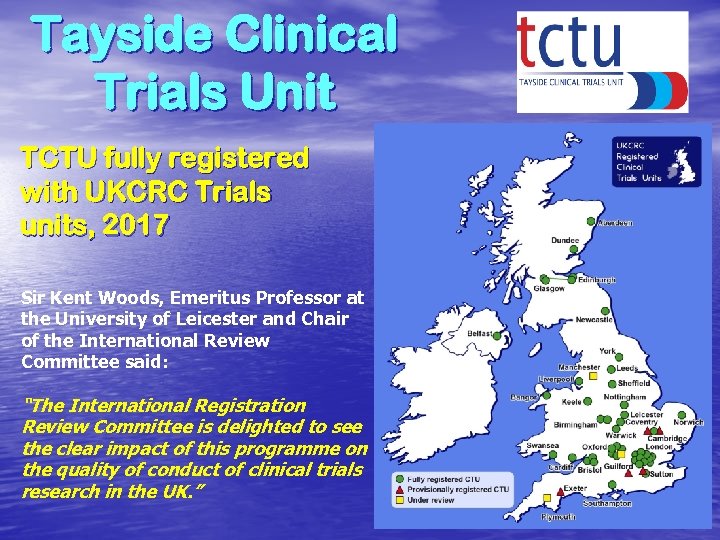 Tayside Clinical Trials Unit TCTU fully registered with UKCRC Trials units, 2017 Sir Kent Woods, Emeritus Professor at the University of Leicester and Chair of the International Review Committee said: “The International Registration Review Committee is delighted to see the clear impact of this programme on the quality of conduct of clinical trials research in the UK. ”
 Outline of Talk • Basis of sample size • Effect size • Significance level or (Type I error - α) • Type II error (β) • Power (1 – type II error)
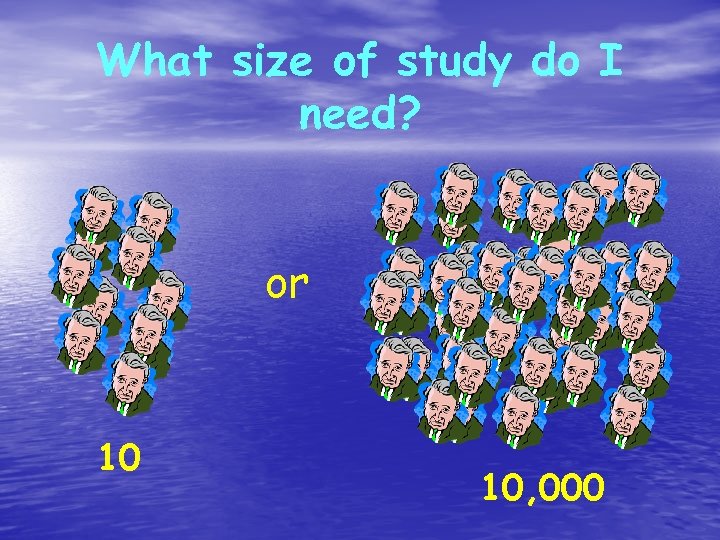 What size of study do I need? or 10 10, 000
 Answer • As large as possible! • Data is information, so the more data the sounder the conclusions • In real world, data limited by resources: access to patients, money, time, etc. .
 What size of study do I need? Expand the question: What size of study do I need to answer the question posed, given the size of my practice / clinic, or no. of samples, given the amount of resources (time and money) I have to collect the information?
 What is the question? • Efficacy: new drugs (CTIMP), weight loss programme (non. CTIMP • Equivalence (not very common) • Non-inferiority (e. g. me-too drug with less side effects)
 Why bother? 1. You will not get your study past ethics! 2. You will not get your proposal past a statistical review by funders! 3. It will be difficult to publish your results!
 Why bother? • Is the study feasible? • Is likely sample size enough to show meaningful differences with statistical significance? • Does number planned enough power or need number? give larger
 OBJECTIVES • Understand issues involved in estimating sample size • Sample size is dependent on design and type of analysis • Parameters needed for sample size estimation
 OBJECTIVES • Understand what is necessary to carry out some simple sample size calculations • Carry out these calculations with software • Note SPSS does have a sample size calculator but
 What is the measure of outcome? • Difference in Change in : • Depression Scores, physiological measures (BP, Chol), QOL, hospitalisations, mortality, etc…. • Choose PRIMARY OUTCOME • A number of secondary but not too many!
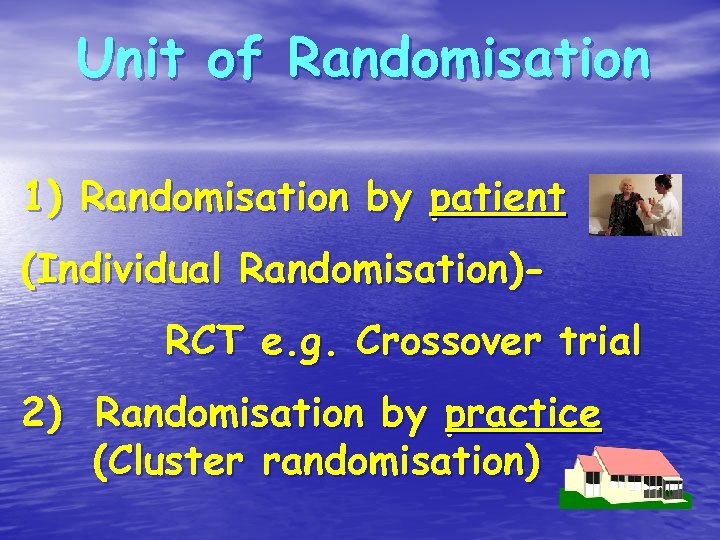 Unit of Randomisation 1) Randomisation by patient (Individual Randomisation)RCT e. g. Crossover trial 2) Randomisation by practice (Cluster randomisation)
 RANDOMISED TRIAL CONTROLLED (RCT) Gold standard method to assess Efficacy of treatment
 RANDOMISED CONTROLLED TRIAL (RCT) Random allocation to intervention or control so likely balance of all factors affecting outcome Hence any difference in outcome ‘caused’ by the intervention
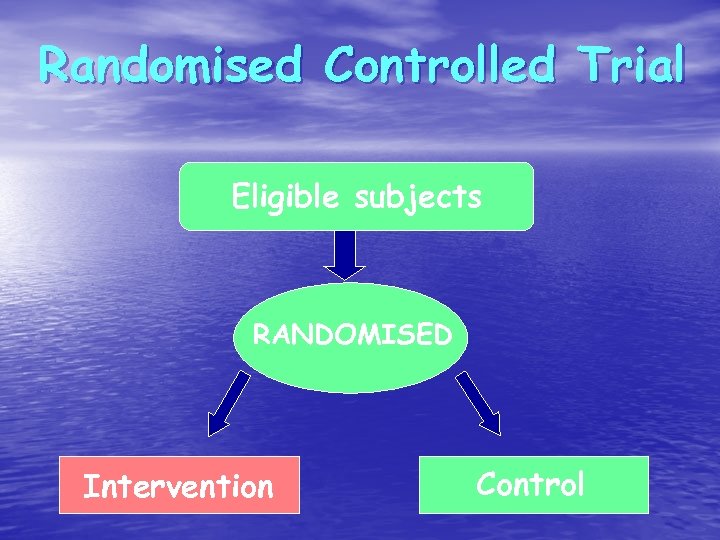 Randomised Controlled Trial Eligible subjects RANDOMISED Intervention Control
 INTERVENTION: To improve patient care and/or efficiency of care delivery • new drug/therapy • patient education • Health professional education • organisational change
 Example Evaluate cost-effectiveness of new statin RCT of new statin vs. old Randomise eligible individuals to either receive new statin or old statin
 Eligible subjects Evaluate cost-effectiveness of new statin on: Men ? Aged over 50? Cardiovascular disease? Previous MI? Requires precise INCLUSION and EXCLUSION criteria in protocol
 WHAT IS THE OUTCOME? • Improvement in patients’ health • Reduction in CV hospitalisations • More explicitly a greater reduction in mean lipid levels in those receiving the new statin compared with the old statin • Reduction in costs
 Decide on Effect size? (Minimum Clinically Important Difference) Sounds a bit chicken and egg! Likely size of effect: What is the minimum effect size you will accept as being clinically or scientifically meaningful?
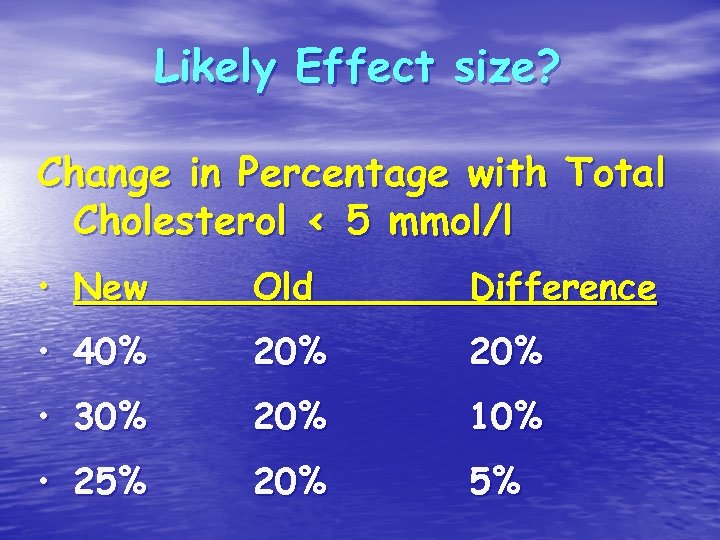 Likely Effect size? Change in Percentage with Total Cholesterol < 5 mmol/l • New Old Difference • 40% 20% • 30% 20% 10% • 25% 20% 5%
 Variability of effect? Variability of size of effect: Obtained from previous published studies and/or Obtained from pilot work prior to main study
 Variability of effect? For a comparison of two proportions the variability of size of effect is dependent on: 1) the size of the study and 2) the size of the proportions or percentages
 How many subjects? • 1) Likely size of effect • 2) Variability of effect • 3) Statistical significance level • 4) Power • 5) 1 or 2 -sided tests
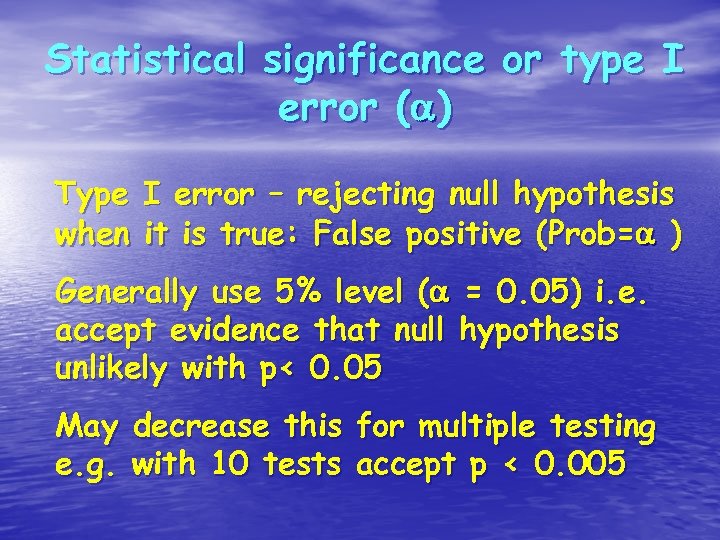 Statistical significance or type I error ( ) Type when I error – rejecting null hypothesis it is true: False positive (Prob= ) Generally use 5% level ( = 0. 05) i. e. accept evidence that null hypothesis unlikely with p< 0. 05 May decrease this for multiple testing e. g. with 10 tests accept p < 0. 005
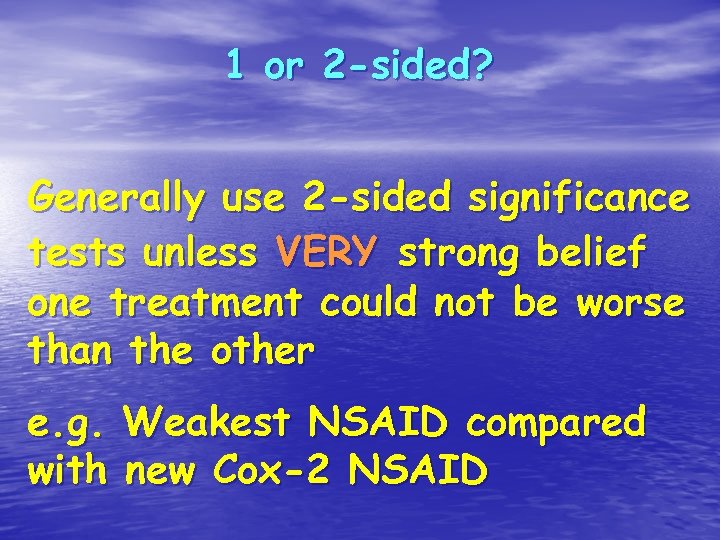 1 or 2 -sided? Generally use 2 -sided significance tests unless VERY strong belief one treatment could not be worse than the other e. g. with Weakest NSAID compared new Cox-2 NSAID
 How many subjects? • 1) Likely size of effect • 2) Variability of effect • 3) Statistical significance level • 4) Power • 5) 1 or 2 -sided tests
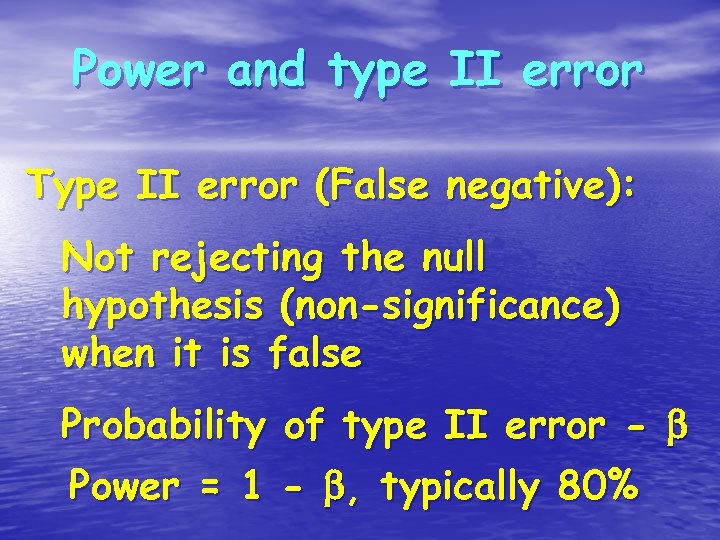 Power and type II error Type II error (False negative): Not rejecting the null hypothesis (non-significance) when it is false Probability of type II error - Power = 1 - , typically 80%
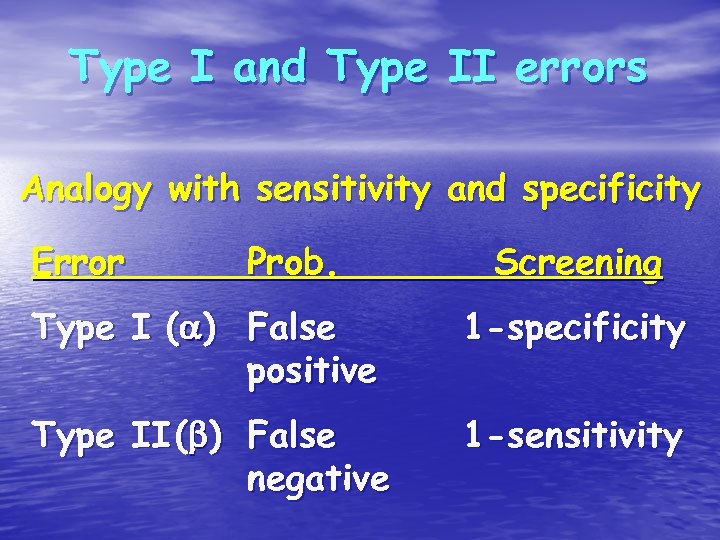 Type I and Type II errors Analogy with sensitivity and specificity Error Prob. Screening Type I ( ) False positive 1 -specificity Type II ( ) False negative 1 -sensitivity
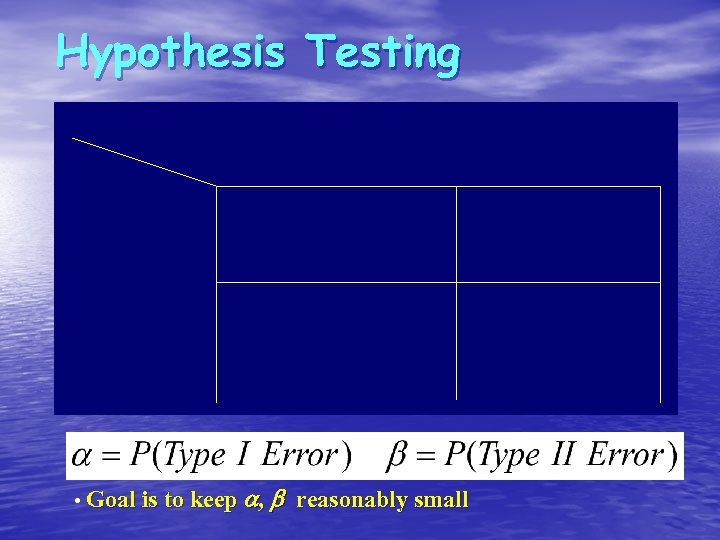 Hypothesis Testing • Goal is to keep a, b reasonably small
 Power Acceptable power 70% - 99% If go sample size for 90% or is not a problem 95% power; If sample size could be problematic go for lower power but still sufficient e. g. 80%
 Power In some studies finite limit on the possible size of the study then question is rephrased: What likely effect size will I be able to detect given a fixed sample size?
 How many subjects? • 1) Likely size of effect • 2) Variability of effect • 3) Statistical significance level • 4) Power • 5) 1 or 2 -sided tests
 Sample size for difference in two proportions Number needed for comparison depends on statistical test used For comparison of two proportions or percentages use Chi-Squared ( 2) test
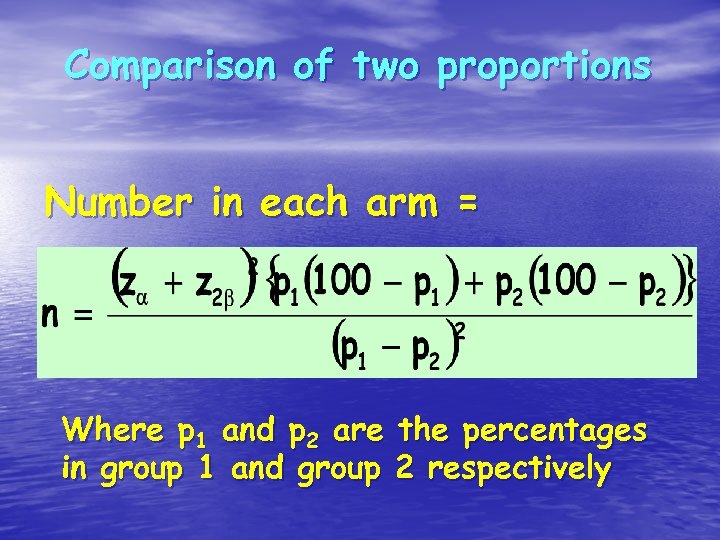 Comparison of two proportions Number in each arm = Where p 1 and p 2 are the percentages in group 1 and group 2 respectively
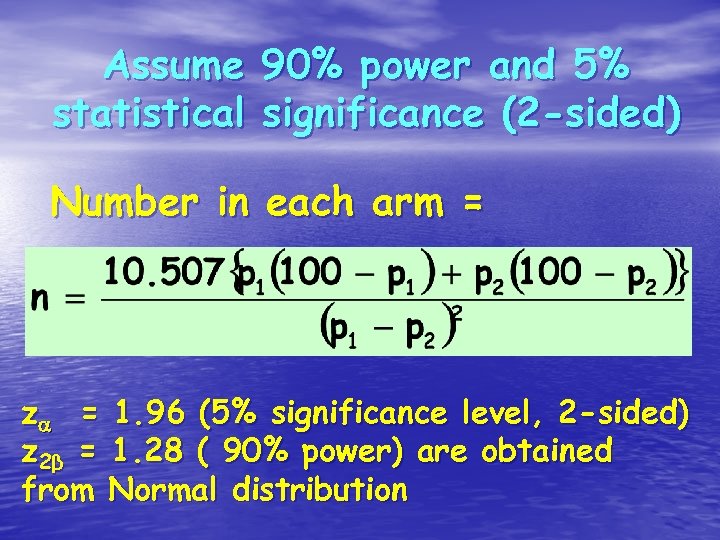 Assume 90% power and 5% statistical significance (2 -sided) Number in each arm = z = 1. 96 (5% significance level, 2 -sided) z 2β = 1. 28 ( 90% power) are obtained from Normal distribution
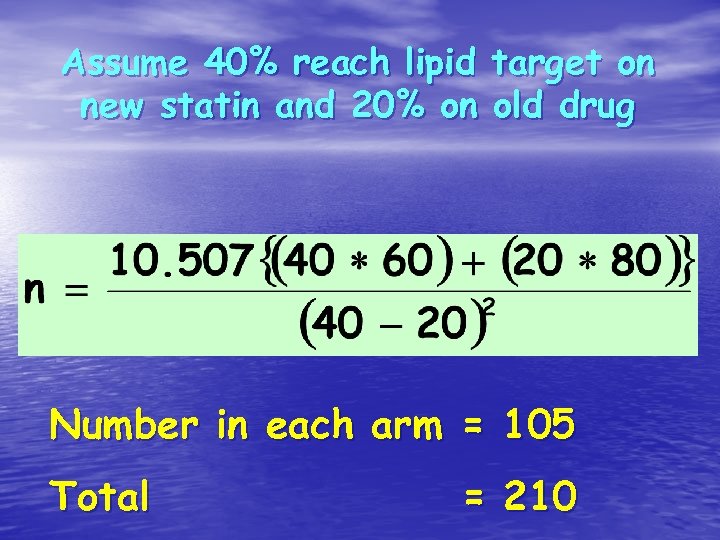 Assume 40% reach lipid target on new statin and 20% on old drug Number in each arm = 105 Total = 210
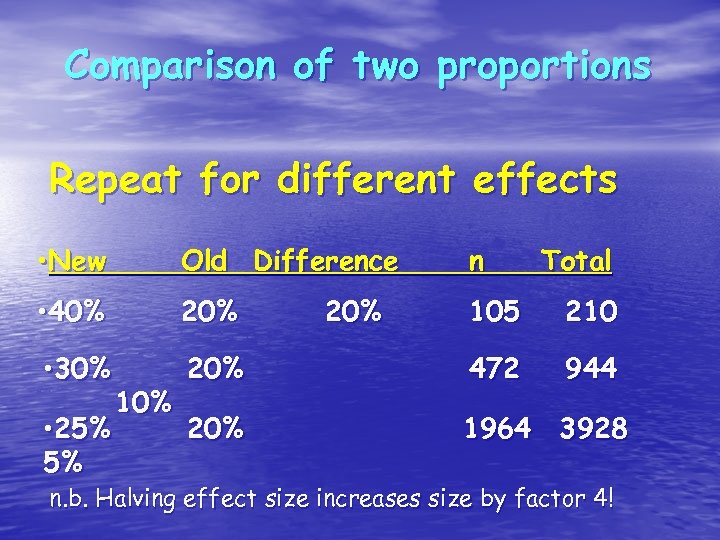 Comparison of two proportions Repeat for different effects • New Old Difference n • 40% 20% 105 210 • 30% 20% 472 944 20% 1964 3928 • 25% 5% 10% 20% Total n. b. Halving effect size increases size by factor 4!
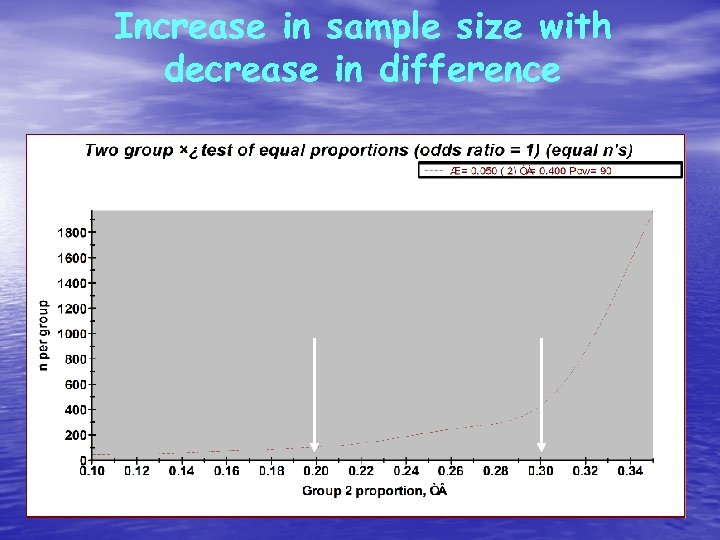 Increase in sample size with decrease in difference
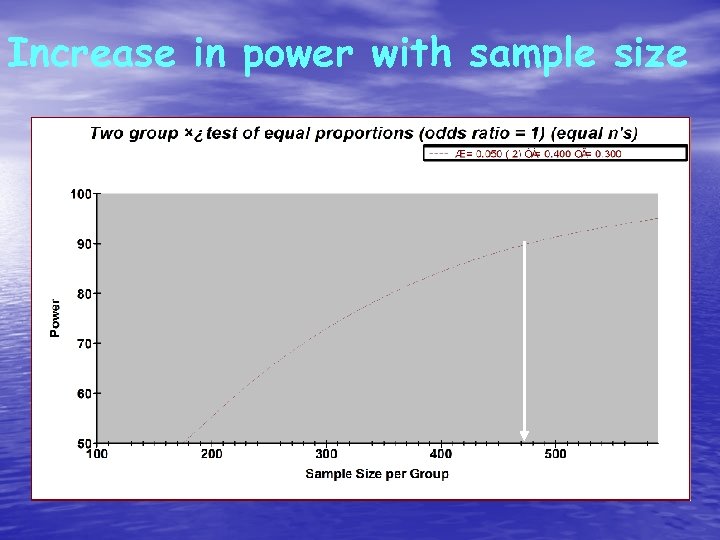 Increase in power with sample size
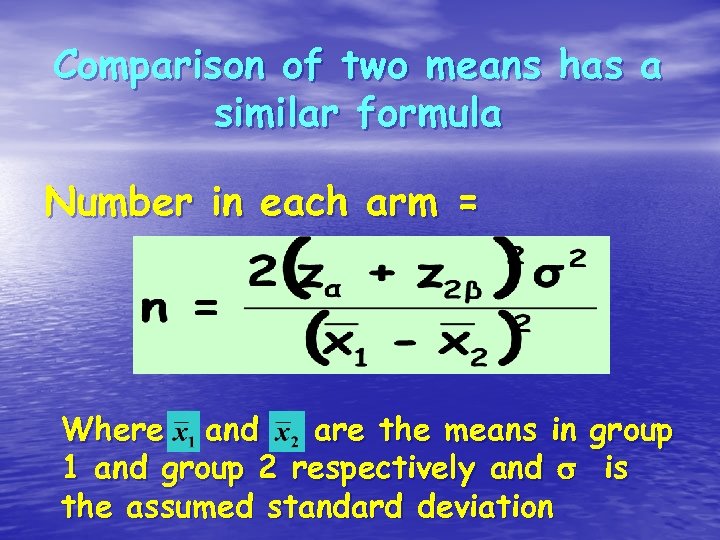 Comparison of two means has a similar formula Number in each arm = Where and are the means in group 1 and group 2 respectively and is the assumed standard deviation
 Allowing for loss to follow-up / non-compliance The number estimated for statistical purposes may need to be inflated if likely that a proportion will be lost to follow-up For example if you know approx. 20% will drop-out inflate sample size by 1/(1 -0. 2) = 1. 25
 Software and other sample size estimation The formula depends on the nature of the outcome and likely statistical test Numerous texts with sample size tables and formula Software – n. Query Advisor® IBM SPSS Sample. Power ~1600$ G Power – free www. stat. ubc. ca/~rollin/stats/ssize - free
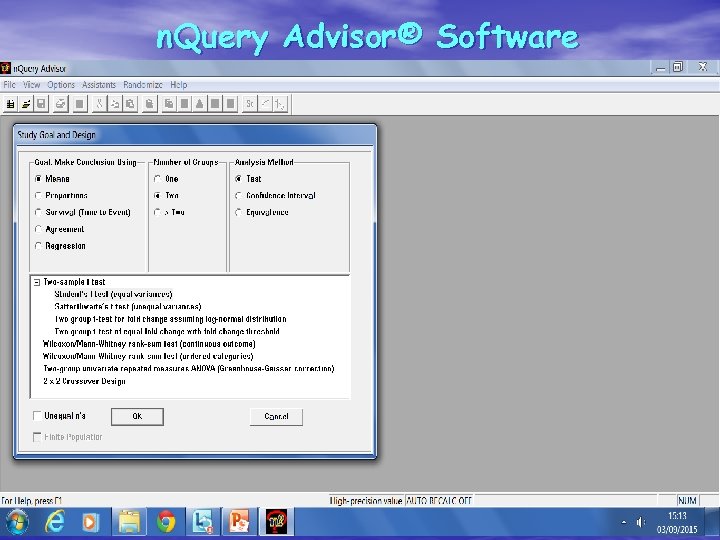 n. Query Advisor® Software
 SUMMARY In planning consider: design, type of intervention, outcomes, sample size, power, and ethics together at the design stage
 SUMMARY Sample size follows from type of analysis which follows from design Invaluable information is gained from pilot work and also more likely to be funded (CSO, MRC, NIHR, etc. )
 SUMMARY Pilot also gives information on recruitment rate You may size due need to inflate sample to: Loss of follow-up/ drop-out Low compliance
 Remember the checklist • 1) Likely size of effect • 2) Variability of effect • 3) Statistical significance level • 4) Power • 5) 1 or 2 -sided tests
 SUMMARY Remember in Scientific Research: Size Matters