


 Скачать презентацию Statistical Trend and Change Point Analysis of Vegetation
34fd8072545f2ded68539683f1c981eb.ppt
- Количество слайдов: 28
 Statistical Trend and Change Point Analysis of Vegetation Cover and Phenology Dong-Yun Kim, Nicolle Goble, Jennifer Olson and Matthew Williams Dept. of Statistics, Virginia Tech and Dept. of Telecommunications, Michigan State University. Joint Statistical Meeting, Washington, D. C. August 2009 Supported by NSF grants BCS-0308420 and BCS-0709671
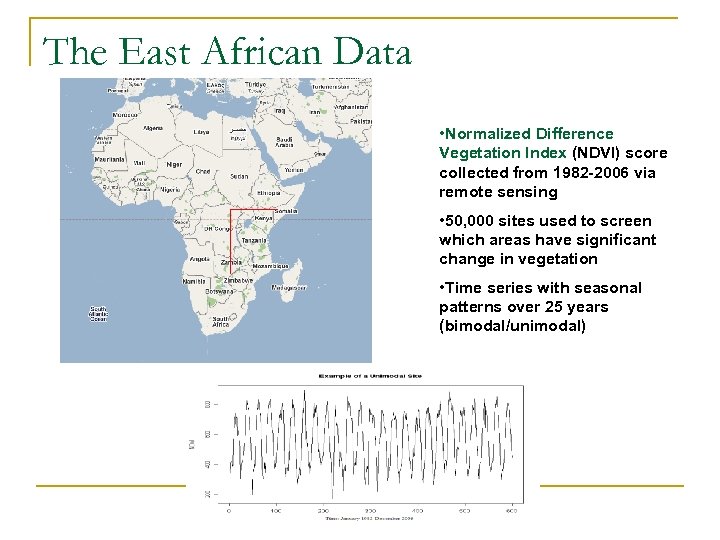 The East African Data • Normalized Difference Vegetation Index (NDVI) score collected from 1982 -2006 via remote sensing • 50, 000 sites used to screen which areas have significant change in vegetation • Time series with seasonal patterns over 25 years (bimodal/unimodal)
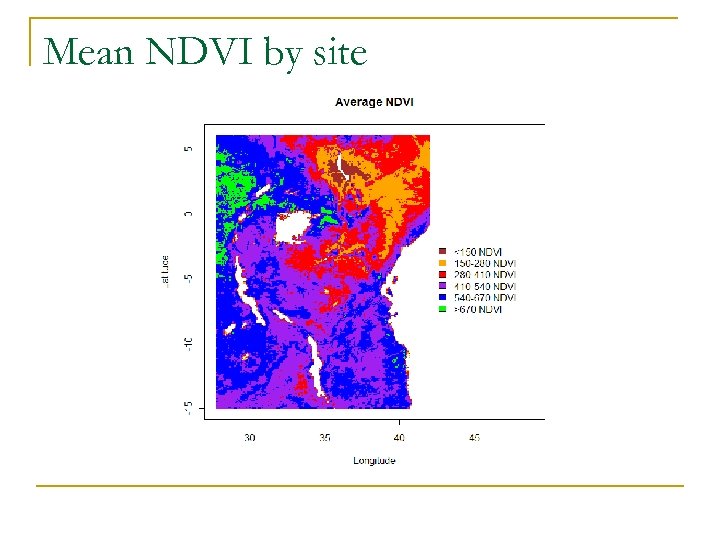 Mean NDVI by site
 Change Point Methods n n Isotonic Regression (2001) Horvath (1993) Jaruskova (1998) Brillinger (1989)
 Isotonic Regression n Isotonic regression (2001) allows for short term dependency in the observations. This test is shown to be more powerful than Horvath and Jaruskova in detecting change points because it does not specify any form of change. Thus, it can detect abrupt, linear, trend, or any other form of change to the mean of the data.
 Horvath n n n The Horvath (1993) method is used to check whether the parameters of independent normal random variables have changed abruptly at an unknown point. The estimate for the change point is the largest value of the test statistic maximized over all possible change points. Horvath’s method will detect abrupt changes in the mean or variance of the data.
 Jaruskova n n The Jaruskova (1998) method differs from Horvath in that it tests for linear trends present in the mean of the independent observations. The estimate of the change point is the location of the beginning of the linear trend.
 Brillinger n Brillinger’s (1989) method is useful in testing for monotonic trend change in the mean, yet allowing for the presence of auto-correlated data. This method assumes that the change happened at time zero, so it will often detect changed data that Jaruskova and Horvath could not.
 These methods were used as a screening process. n n The multiple testing of change point methods allowed us to categorize the types of change on the yearly data per site. After screening of changing areas, further modeling and detailed research can be pursued. Testing was done at the 5% Type I error rate. Code was done in R, by Matt Williams
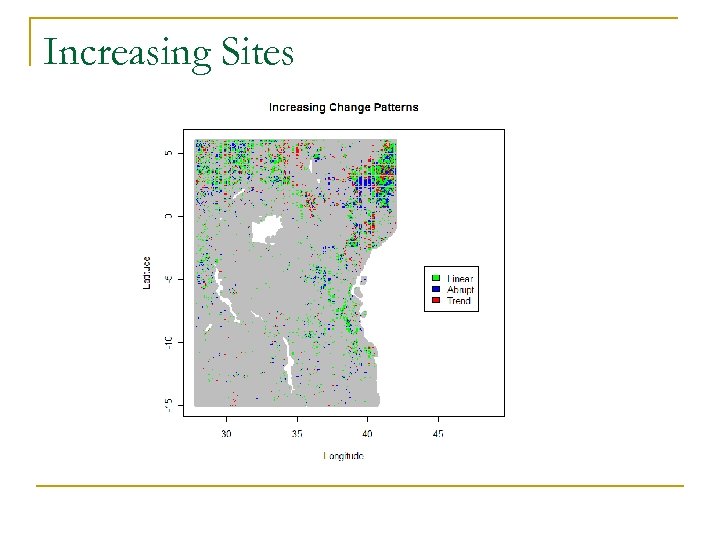
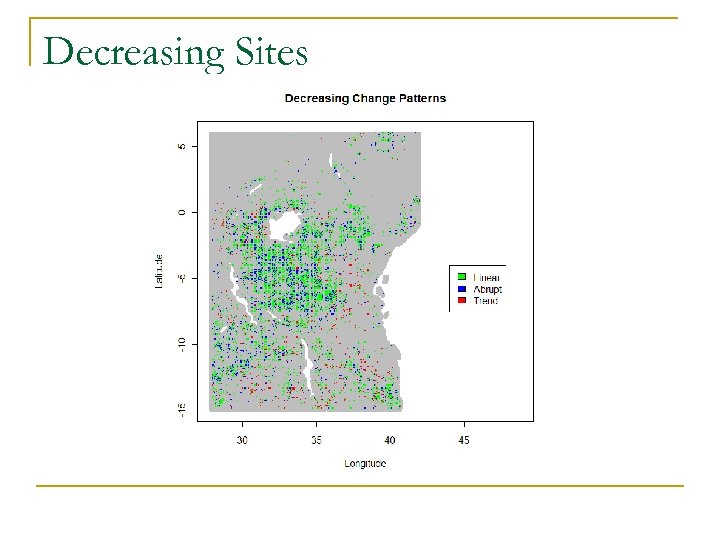
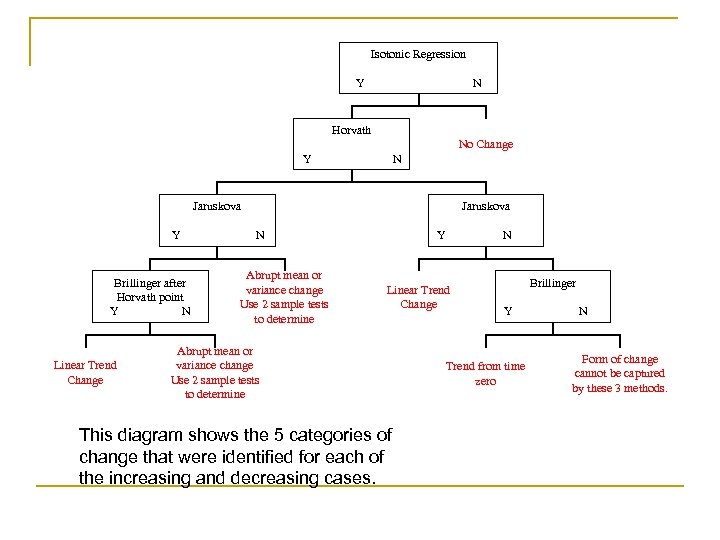 Isotonic Regression Y N Horvath No Change Y N Jaruskova Y Brillinger after Horvath point Y N Linear Trend Change Jaruskova N Abrupt mean or variance change Use 2 sample tests to determine Y N Linear Trend Change Abrupt mean or variance change Use 2 sample tests to determine This diagram shows the 5 categories of change that were identified for each of the increasing and decreasing cases. Brillinger Y Trend from time zero N Form of change cannot be captured by these 3 methods.
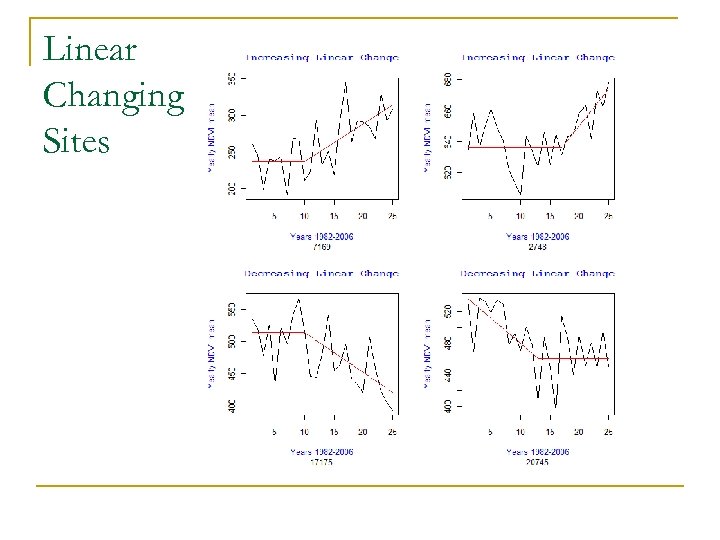 Linear Changing Sites
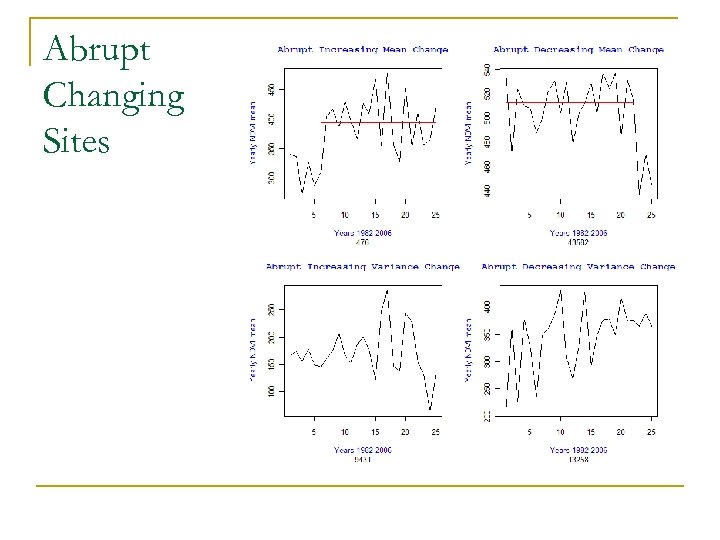 Abrupt Changing Sites
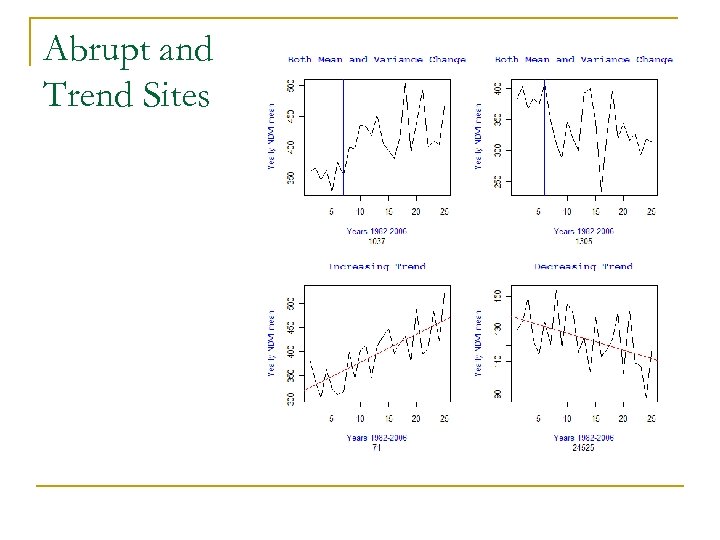 Abrupt and Trend Sites
 Increasing Sites
 High priority conservation zone designated by the Congo Basin Forest Partnership starting in 2000
 Kenya’s coastline: increased precipitation due to elevated SST
 Decreasing Sites
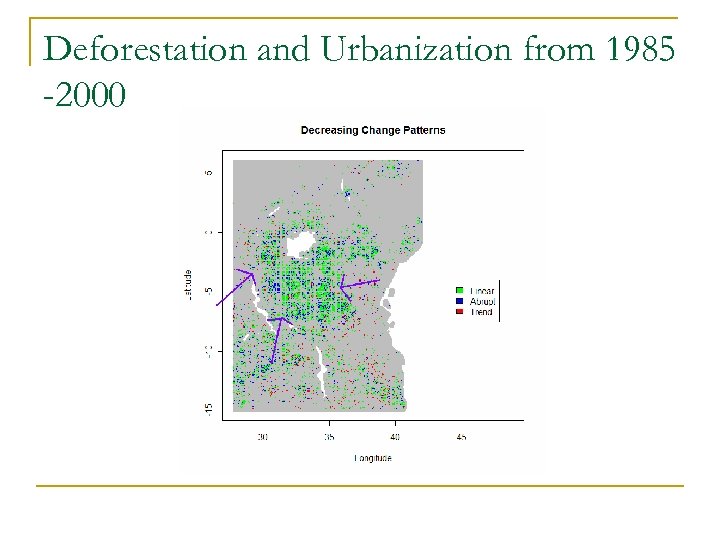 Deforestation and Urbanization from 1985 -2000
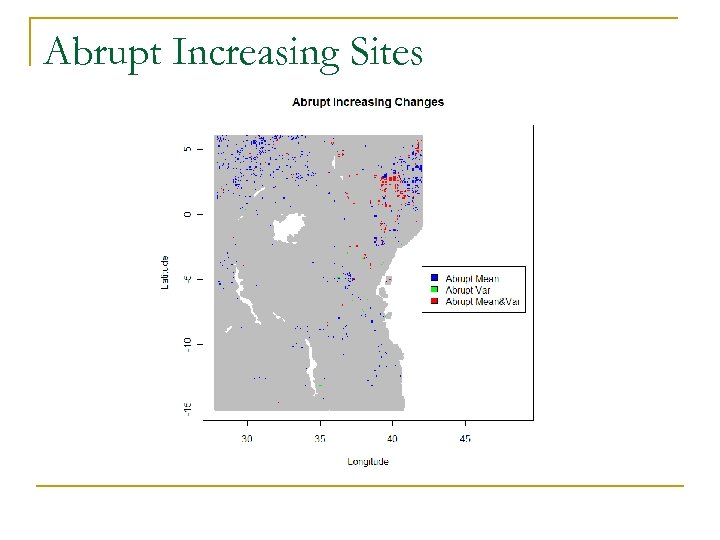 Abrupt Increasing Sites
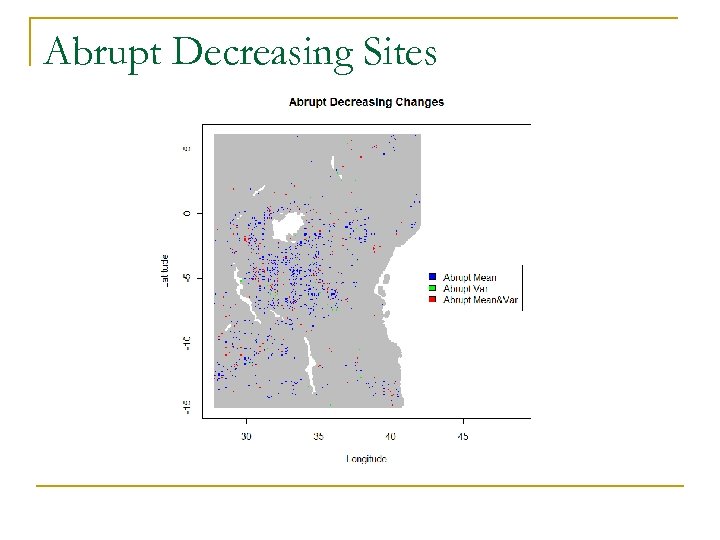 Abrupt Decreasing Sites
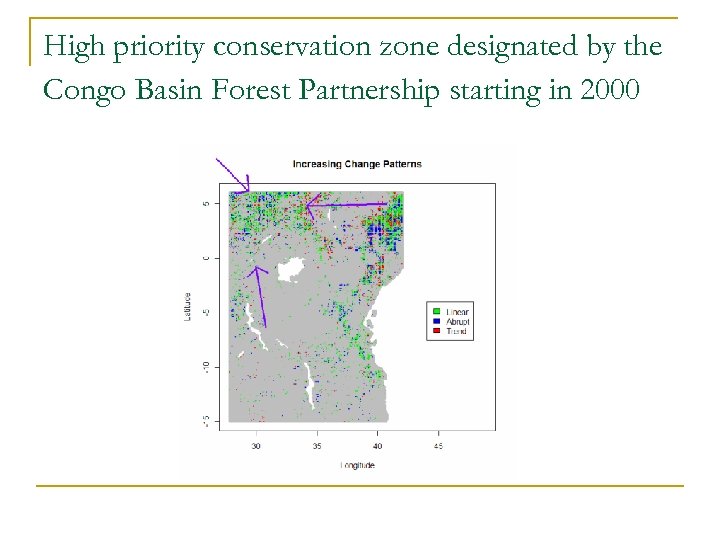
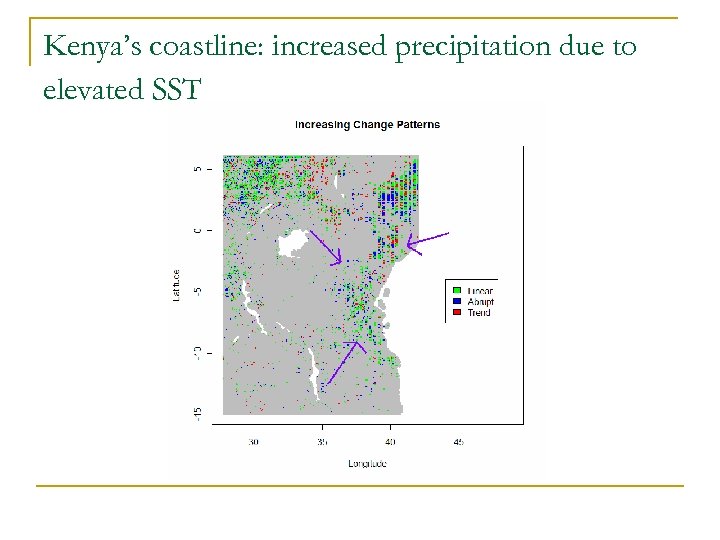
 Northern and Southern Hemisphere n n n With a few areas of exception, we can generally infer that above the equator vegetation is increasing while below is decreasing. The equator serving as a rough separation line is interesting because we also know that Northern and Southern hemispheres have opposite seasonal patterns. The Northern hemisphere has green vegetation and a growing season in the summer months (April. September) and the Southern hemisphere has a growing season in the winter months (October. February).
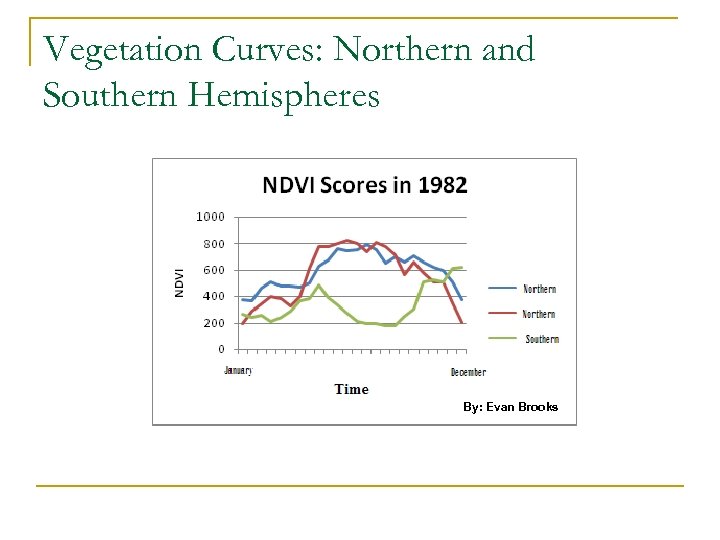 Vegetation Curves: Northern and Southern Hemispheres By: Evan Brooks
 How is the vegetation curve changing? n n A detection of increasing yearly NDVI scores could be due to the entire vegetation curve being shifted upwards over time, meaning each year has higher NDVI scores over all months, but the shape of the curve generally stays the same. On the other hand, an increasing yearly NDVI score could be because the growing season itself is changing, or the curve is changing. For increasing sites, this would mean that green vegetation is starting earlier and staying longer, creating a wider “bell” shape to the curve.
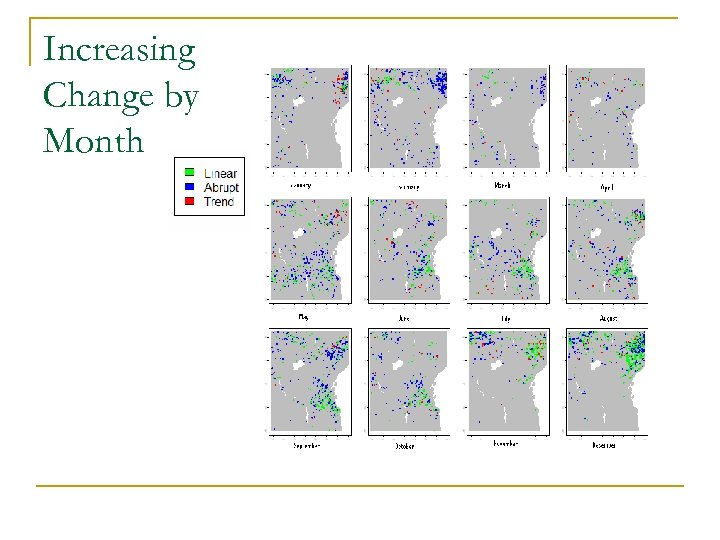 Increasing Change by Month
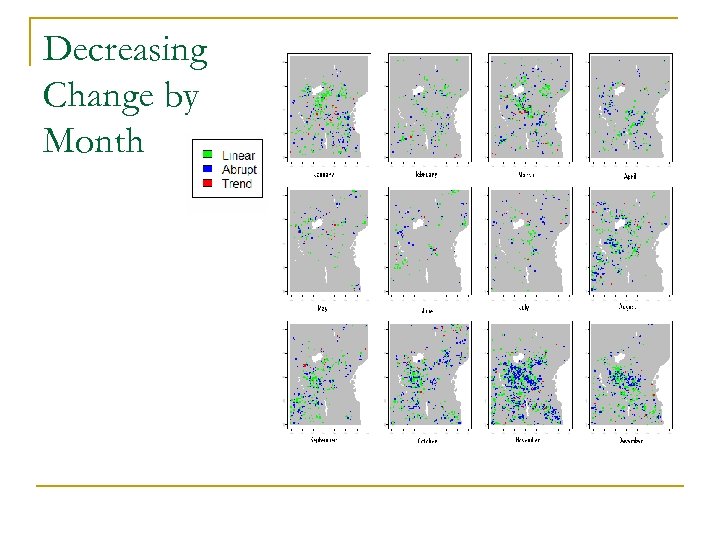 Decreasing Change by Month
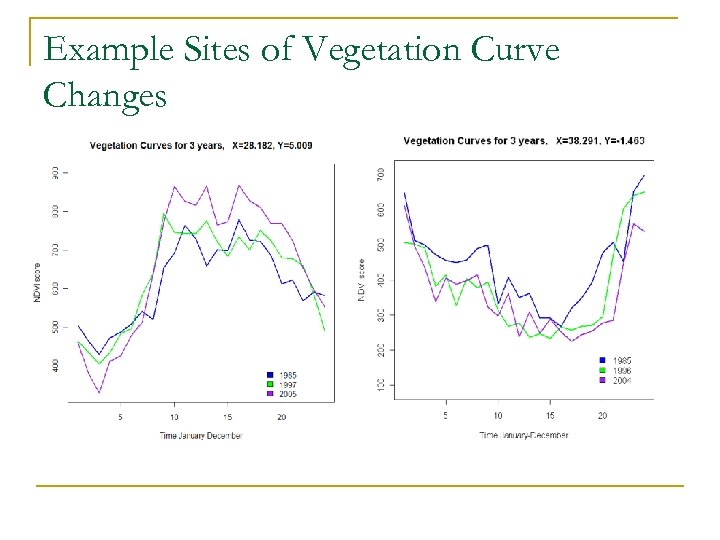 Example Sites of Vegetation Curve Changes
 Conclusion n Recall goal: identify areas in East Africa with changes to green vegetation with NDVI and screen likely forms of change. Found that Northern hemisphere vegetation is increasing while Southern hemisphere it is decreasing. Looked at monthly data in more detail to see how the vegetation curve is shifted.
 Literature Sites n n n n Brillinger, D. R. (1989). “Trend analysis: binary-valued and point cases” Stochastic Hydrology and Hydraulics. 207 -213. Chen, Jin; Jönsson, Per; Tamura, Masayuki (2003). “A simple method for reconstructing a highquality NDVI time-series data set based on the Savitzky–Golay filter. ” Foody, G. M. “Geographical weighting as a further refinement to regression modeling: an example focused on the NDVI-rainfall relationship. ” Elsevier Science Inc. Hayes, D. J. ; Sader, S. A. (2001). “Comparison of change-detection techniques for monitoring tropical forest clearing and vegetation regrowth in a time series. ” PE&RS - Photogrammetric Engineering and Remote Sensing. Vol. 67, no. 9, pp. 1067 -1075. Horváth, L. (1993). “The maximum likelihood method for testing changes in the parameters of normal observations”. Ann. Statist. 21, 671 -680. Jarušková, D. (1998). “Testing appearance of linear trend”. J. Stat. Plan. Inf. 70, 263 -276. Pettorelli, Nathalie; Olav Vik, Jon; Mysterud, Atle. (2006) “Using the satellite-derived NDVI to assess ecological responses to environmental change. ” Trends in Ecology & Evolution, Volume 21, Issue 1, January 2006, Page 11 Wu, W. B. ; Woodroofe, M. ; & Mentz, G. (2001). "Isotonic regression: Another look at the changepoint problem". Biometrika 88 (3) 793– 804.