


 Скачать презентацию Statistical mechanics of money income and wealth foundations
ed39f7857538aa1d55cb72d0ac90b3f3.ppt
- Количество слайдов: 14
 Statistical mechanics of money, income and wealth: foundations and applications Victor M. Yakovenko Adrian A. Dragulescu and A. Christian Silva Department of Physics, University of Maryland, College Park, USA http: //www 2. physics. umd. edu/~yakovenk/econophysics. html Publications • European Physical Journal B 17, 723 (2000), cond-mat/0001432 • European Physical Journal B 20, 585 (2001), cond-mat/0008305 • Physica A 299, 213 (2001), cond-mat/0103544 • Modeling of Complex Systems: Seventh Granada Lectures, AIP Conference Proceedings 661, 180 (2003), cond-mat/0211175 • Europhysics Letters 69, 304 (2005), cond-mat/0406385 Victor Yakovenko Statistical mechanics of money, income and wealth
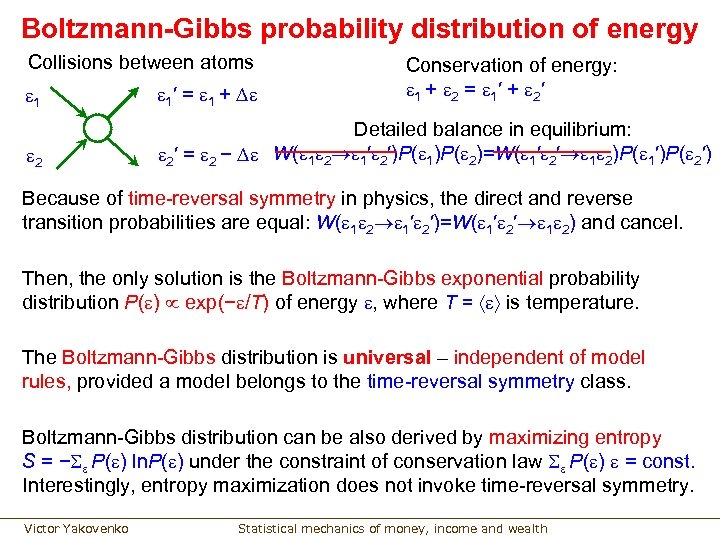 Boltzmann-Gibbs probability distribution of energy Collisions between atoms Conservation of energy: 1 + 2 = 1 ′ + 2 ′ 1 1′ = 1 + 2 Detailed balance in equilibrium: 2′ = 2 − W( 1 2 1′ 2′)P( 1)P( 2)=W( 1′ 2′ 1 2)P( 1′)P( 2′) Because of time-reversal symmetry in physics, the direct and reverse transition probabilities are equal: W( 1 2 1′ 2′)=W( 1′ 2′ 1 2) and cancel. Then, the only solution is the Boltzmann-Gibbs exponential probability distribution P( ) exp(− /T) of energy , where T = is temperature. The Boltzmann-Gibbs distribution is universal – independent of model rules, provided a model belongs to the time-reversal symmetry class. Boltzmann-Gibbs distribution can be also derived by maximizing entropy S = − P( ) ln. P( ) under the constraint of conservation law P( ) = const. Interestingly, entropy maximization does not invoke time-reversal symmetry. Victor Yakovenko Statistical mechanics of money, income and wealth
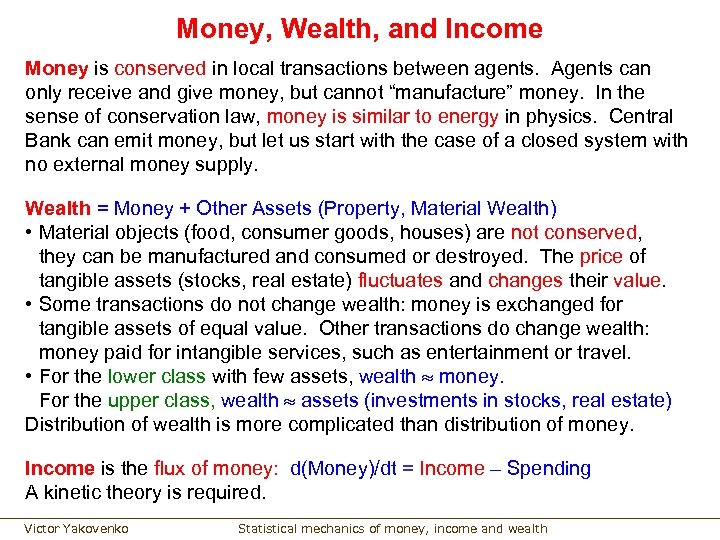 Money, Wealth, and Income Money is conserved in local transactions between agents. Agents can only receive and give money, but cannot “manufacture” money. In the sense of conservation law, money is similar to energy in physics. Central Bank can emit money, but let us start with the case of a closed system with no external money supply. Wealth = Money + Other Assets (Property, Material Wealth) • Material objects (food, consumer goods, houses) are not conserved, they can be manufactured and consumed or destroyed. The price of tangible assets (stocks, real estate) fluctuates and changes their value. • Some transactions do not change wealth: money is exchanged for tangible assets of equal value. Other transactions do change wealth: money paid for intangible services, such as entertainment or travel. • For the lower class with few assets, wealth money. For the upper class, wealth assets (investments in stocks, real estate) Distribution of wealth is more complicated than distribution of money. Income is the flux of money: d(Money)/dt = Income – Spending A kinetic theory is required. Victor Yakovenko Statistical mechanics of money, income and wealth
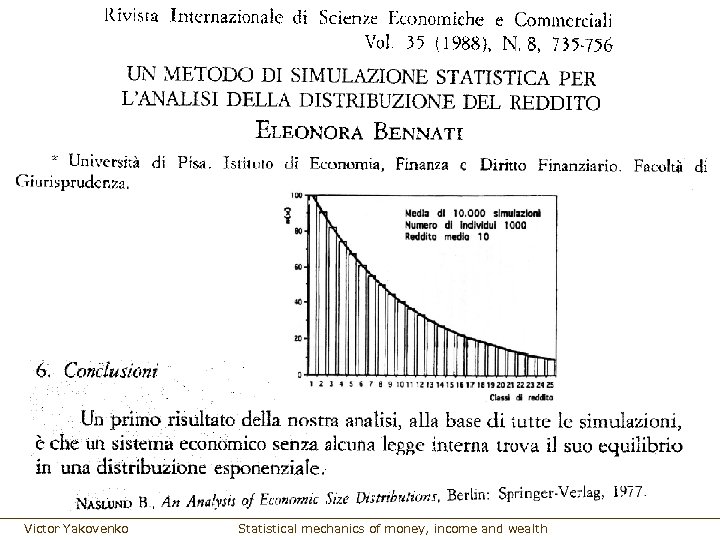
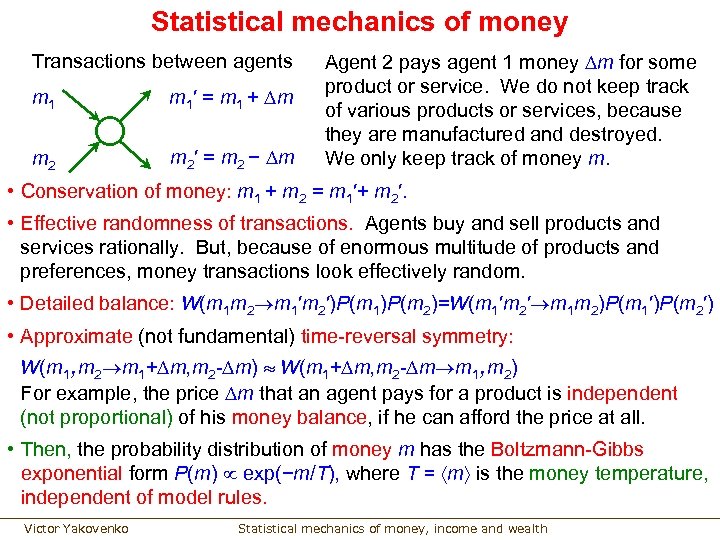 Statistical mechanics of money Transactions between agents m 1′ = m 1 + m m 2′ = m 2 − m Agent 2 pays agent 1 money m for some product or service. We do not keep track of various products or services, because they are manufactured and destroyed. We only keep track of money m. • Conservation of money: m 1 + m 2 = m 1′+ m 2′. • Effective randomness of transactions. Agents buy and sell products and services rationally. But, because of enormous multitude of products and preferences, money transactions look effectively random. • Detailed balance: W(m 1 m 2 m 1′m 2′)P(m 1)P(m 2)=W(m 1′m 2′ m 1 m 2)P(m 1′)P(m 2′) • Approximate (not fundamental) time-reversal symmetry: W(m 1, m 2 m 1+ m, m 2 - m) W(m 1+ m, m 2 - m m 1, m 2) For example, the price m that an agent pays for a product is independent (not proportional) of his money balance, if he can afford the price at all. • Then, the probability distribution of money m has the Boltzmann-Gibbs exponential form P(m) exp(−m/T), where T = m is the money temperature, independent of model rules. Victor Yakovenko Statistical mechanics of money, income and wealth
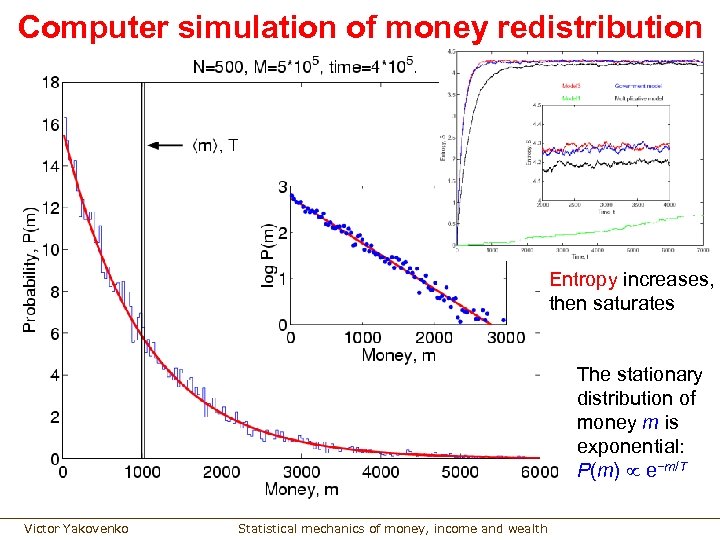 Computer simulation of money redistribution Entropy increases, then saturates The stationary distribution of money m is exponential: P(m) e−m/T Victor Yakovenko Statistical mechanics of money, income and wealth
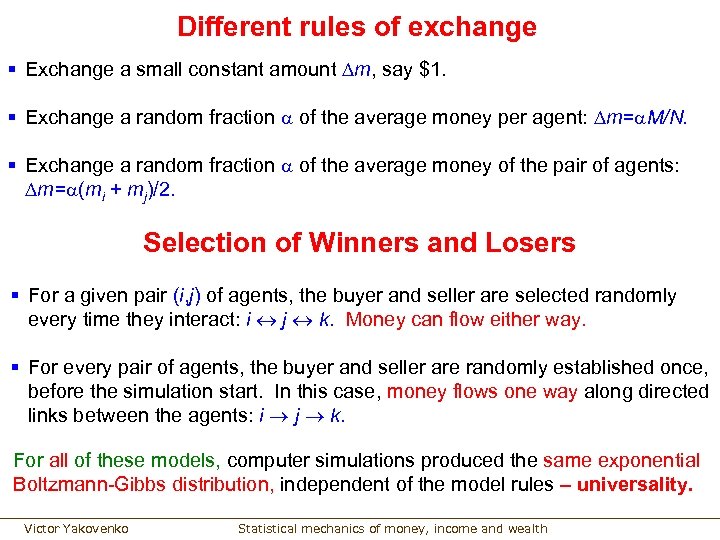 Different rules of exchange § Exchange a small constant amount m, say $1. § Exchange a random fraction of the average money per agent: m= M/N. § Exchange a random fraction of the average money of the pair of agents: m= (mi + mj)/2. Selection of Winners and Losers § For a given pair (i, j) of agents, the buyer and seller are selected randomly every time they interact: i j k. Money can flow either way. § For every pair of agents, the buyer and seller are randomly established once, before the simulation start. In this case, money flows one way along directed links between the agents: i j k. For all of these models, computer simulations produced the same exponential Boltzmann-Gibbs distribution, independent of the model rules – universality. Victor Yakovenko Statistical mechanics of money, income and wealth
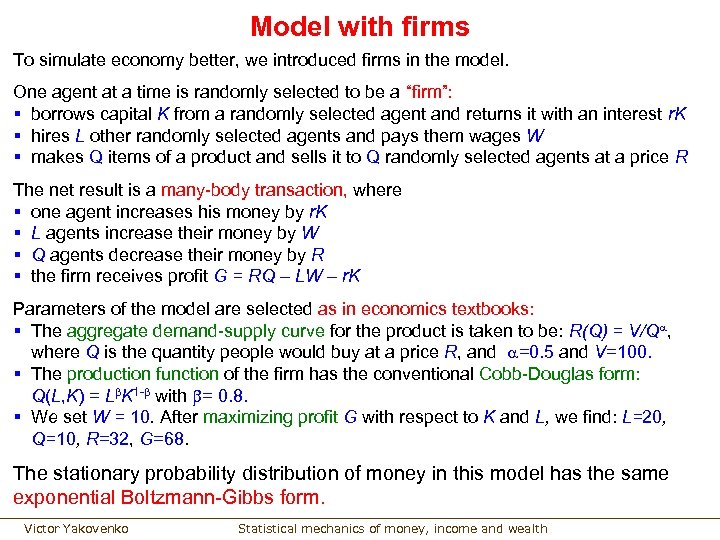 Model with firms To simulate economy better, we introduced firms in the model. One agent at a time is randomly selected to be a “firm”: § borrows capital K from a randomly selected agent and returns it with an interest r. K § hires L other randomly selected agents and pays them wages W § makes Q items of a product and sells it to Q randomly selected agents at a price R The net result is a many-body transaction, where § one agent increases his money by r. K § L agents increase their money by W § Q agents decrease their money by R § the firm receives profit G = RQ – LW – r. K Parameters of the model are selected as in economics textbooks: § The aggregate demand-supply curve for the product is taken to be: R(Q) = V/Q , where Q is the quantity people would buy at a price R, and =0. 5 and V=100. § The production function of the firm has the conventional Cobb-Douglas form: Q(L, K) = L K 1 - with = 0. 8. § We set W = 10. After maximizing profit G with respect to K and L, we find: L=20, Q=10, R=32, G=68. The stationary probability distribution of money in this model has the same exponential Boltzmann-Gibbs form. Victor Yakovenko Statistical mechanics of money, income and wealth
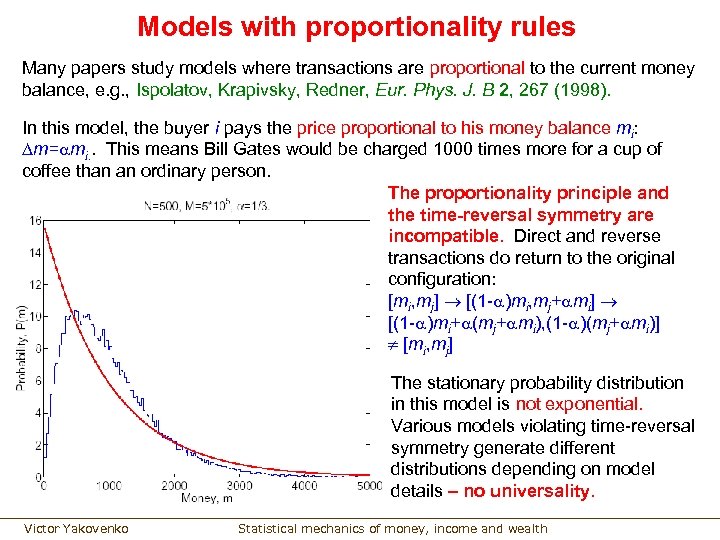 Models with proportionality rules Many papers study models where transactions are proportional to the current money balance, e. g. , Ispolatov, Krapivsky, Redner, Eur. Phys. J. B 2, 267 (1998). In this model, the buyer i pays the price proportional to his money balance mi: m= mi. . This means Bill Gates would be charged 1000 times more for a cup of coffee than an ordinary person. The proportionality principle and the time-reversal symmetry are incompatible. Direct and reverse transactions do return to the original configuration: [mi, mj] [(1 - )mi, mj+ mi] [(1 - )mi+ (mj+ mi), (1 - )(mj+ mi)] [mi, mj] The stationary probability distribution in this model is not exponential. Various models violating time-reversal symmetry generate different distributions depending on model details – no universality. Victor Yakovenko Statistical mechanics of money, income and wealth
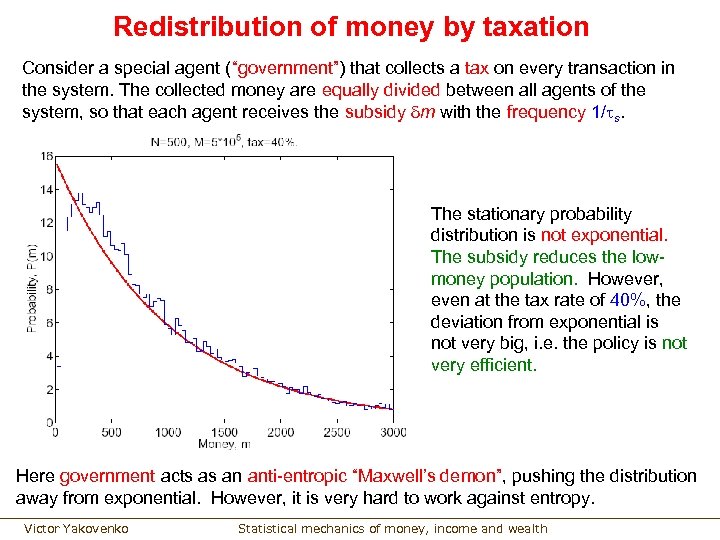 Redistribution of money by taxation Consider a special agent (“government”) that collects a tax on every transaction in the system. The collected money are equally divided between all agents of the system, so that each agent receives the subsidy m with the frequency 1/ s. The stationary probability distribution is not exponential. The subsidy reduces the lowmoney population. However, even at the tax rate of 40%, the deviation from exponential is not very big, i. e. the policy is not very efficient. Here government acts as an anti-entropic “Maxwell’s demon”, pushing the distribution away from exponential. However, it is very hard to work against entropy. Victor Yakovenko Statistical mechanics of money, income and wealth
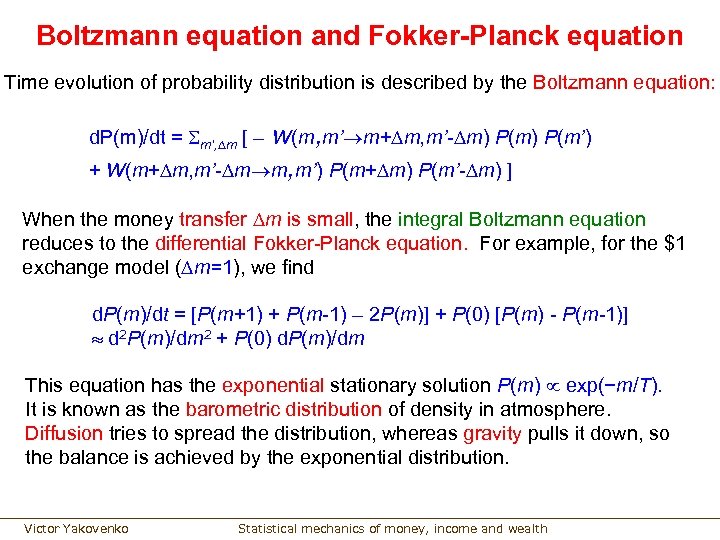 Boltzmann equation and Fokker-Planck equation Time evolution of probability distribution is described by the Boltzmann equation: d. P(m)/dt = m’, m [ – W(m, m’ m+ m, m’- m) P(m’) + W(m+ m, m’- m m, m’) P(m+ m) P(m’- m) ] When the money transfer m is small, the integral Boltzmann equation reduces to the differential Fokker-Planck equation. For example, for the $1 exchange model ( m=1), we find d. P(m)/dt = [P(m+1) + P(m-1) – 2 P(m)] + P(0) [P(m) - P(m-1)] d 2 P(m)/dm 2 + P(0) d. P(m)/dm This equation has the exponential stationary solution P(m) exp(−m/T). It is known as the barometric distribution of density in atmosphere. Diffusion tries to spread the distribution, whereas gravity pulls it down, so the balance is achieved by the exponential distribution. Victor Yakovenko Statistical mechanics of money, income and wealth
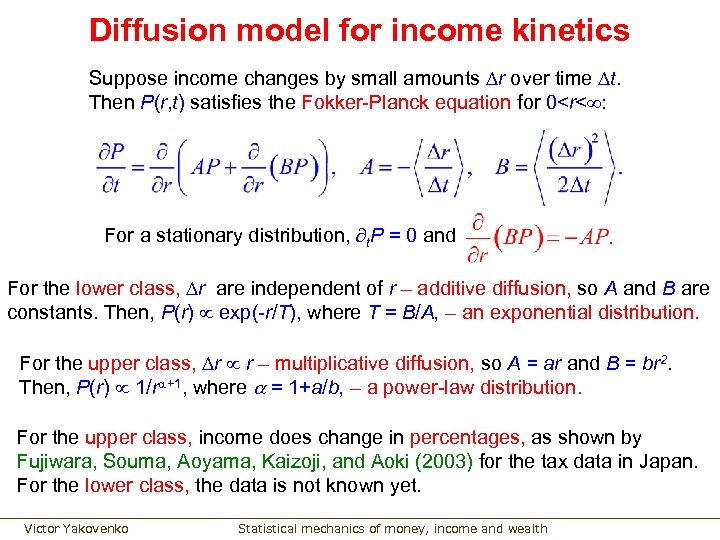 Diffusion model for income kinetics Suppose income changes by small amounts r over time t. Then P(r, t) satisfies the Fokker-Planck equation for 0
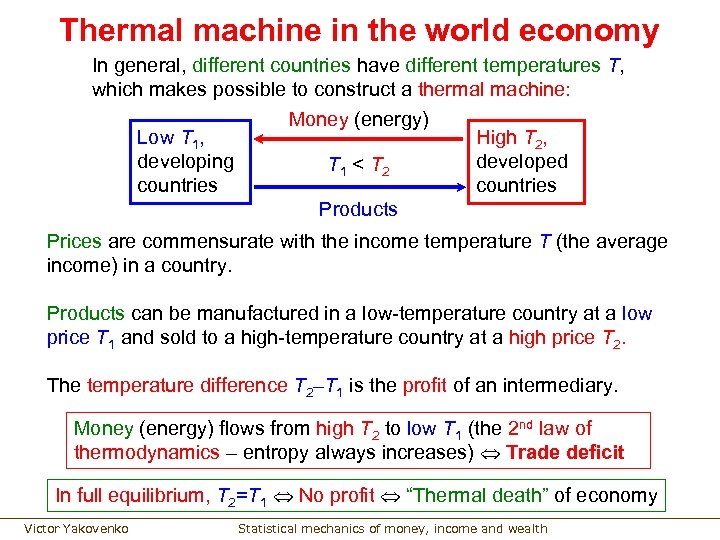 Thermal machine in the world economy In general, different countries have different temperatures T, which makes possible to construct a thermal machine: Money (energy) Low T 1, High T 2, developing developed T 1 < T 2 countries Products Prices are commensurate with the income temperature T (the average income) in a country. Products can be manufactured in a low-temperature country at a low price T 1 and sold to a high-temperature country at a high price T 2. The temperature difference T 2–T 1 is the profit of an intermediary. Money (energy) flows from high T 2 to low T 1 (the 2 nd law of thermodynamics – entropy always increases) Trade deficit In full equilibrium, T 2=T 1 No profit “Thermal death” of economy Victor Yakovenko Statistical mechanics of money, income and wealth
 Conclusions § The analogy in conservation laws between energy in physics and money in economics results in the universal exponential (“thermal”) Boltzmann. Gibbs probability distribution of money P(m) exp(-m/T) in models with the time-reversal symmetry, independent of model details. § If the time-reversal symmetry is violated, then the distribution is nonexponential and non-universal, depending on model details. The timereversal symmetry is typically violated by the proportionality principle. § Often the time-reversal symmetry is more realistic than the proportionality symmetry. Time reversal does not mean reverse transactions between the same agents, but reversal in the money space. § The Fokker-Planck equation with the additive and multiplicative diffusion processes can describe the observed two-class distribution of income. § Difference of income and money temperatures between different countries can be exploited to make profit in international trade and leads to a systematic trade deficit for the higher-temperature countries. Victor Yakovenko Statistical mechanics of money, income and wealth
 Victor Yakovenko Statistical mechanics of money, income and wealth