


 Скачать презентацию Statistical Machine Translation Slides from Ray Mooney
24e573a3e529a237700c0cda443e2e91.ppt
- Количество слайдов: 121
 Statistical Machine Translation Slides from Ray Mooney
 Intuition Surprising: intuition comes from the impossibility of translation! l Consider Hebrew “adonai roi” (“the Lord is my shepherd”) l § for a culture without sheep or shepherds! § something fluent and understandable, but not faithful: • “The Lord will look after me” § Something faithful, but not fluent and natural • “The Lord is for me like somebody who looks after animals with cotton-like hair”
 What makes a good translation Translators often talk about two factors we want to maximize: l Faithfulness or fidelity l § How close is the meaning of the translation to the meaning of the original § Even better: does the translation cause the reader to draw the same inferences as the original would have l Fluency or naturalness § How natural the translation is, just considering its fluency in the target language
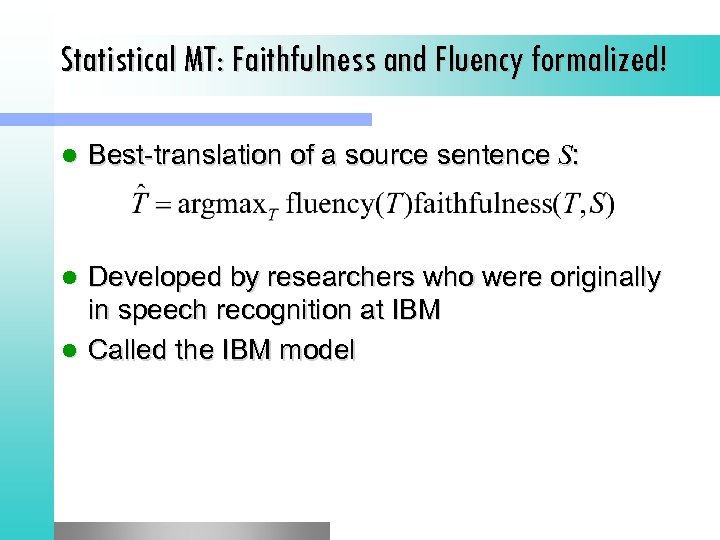 Statistical MT: Faithfulness and Fluency formalized! l Best-translation of a source sentence S: Developed by researchers who were originally in speech recognition at IBM l Called the IBM model l
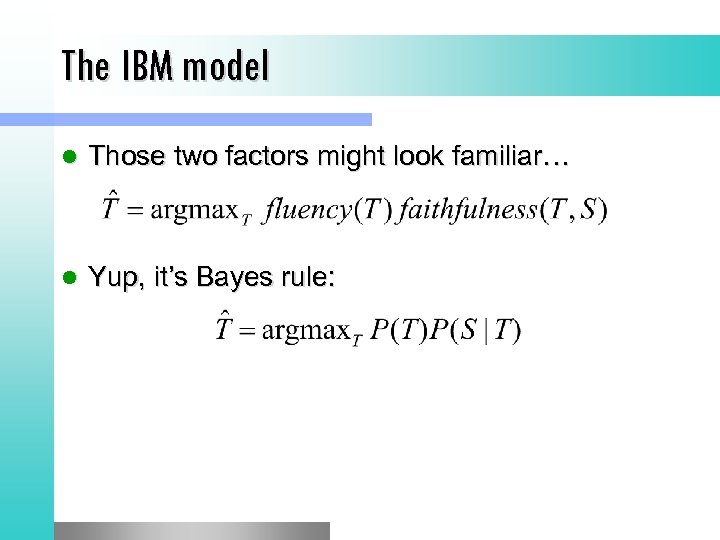 The IBM model l Those two factors might look familiar… l Yup, it’s Bayes rule:
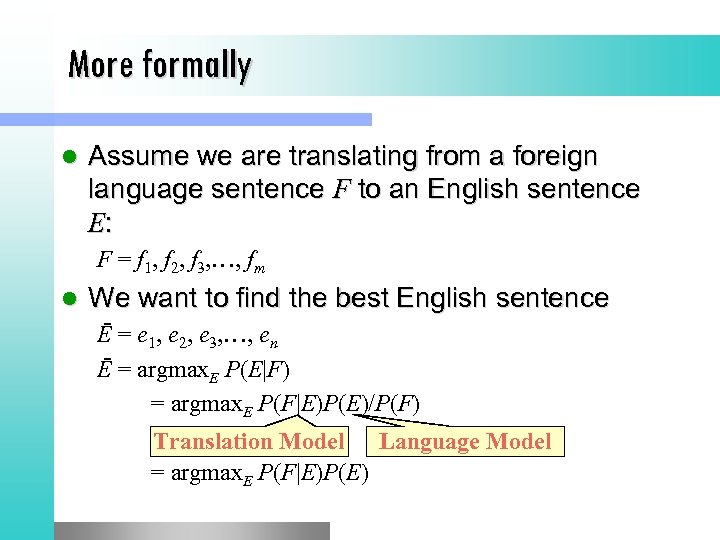 More formally l Assume we are translating from a foreign language sentence F to an English sentence E: F = f 1, f 2, f 3, …, fm l We want to find the best English sentence Ē = e 1, e 2, e 3, …, en Ē = argmax. E P(E|F) = argmax. E P(F|E)P(E)/P(F) Translation Model Language Model = argmax. E P(F|E)P(E)
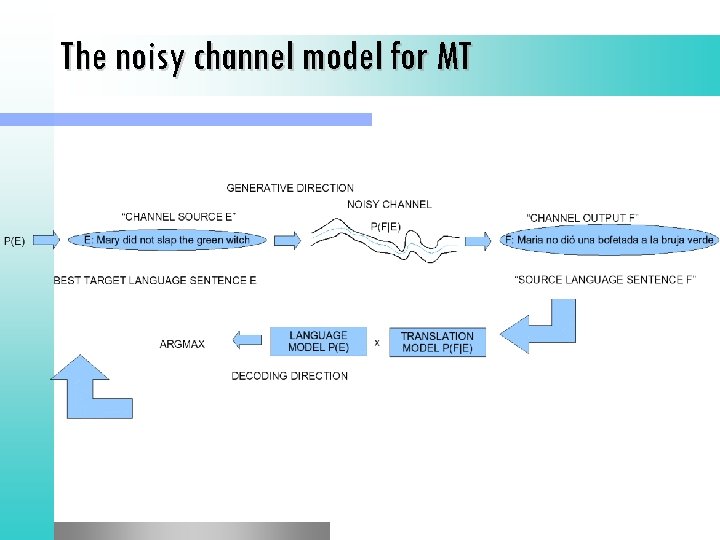 The noisy channel model for MT
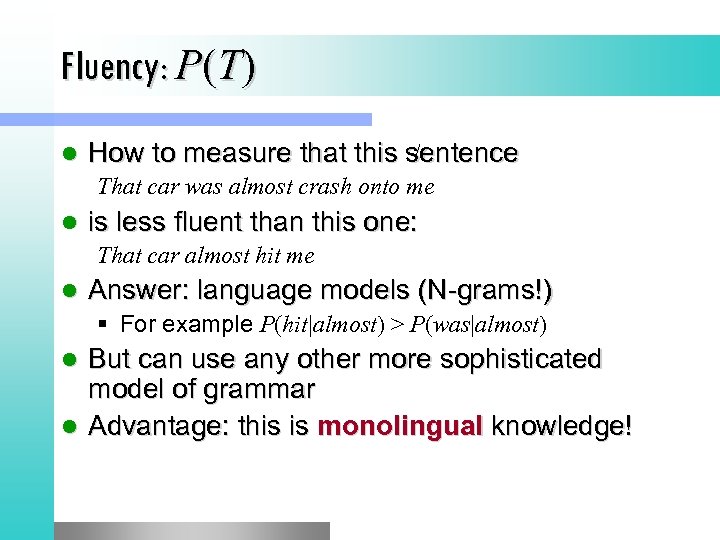 Fluency: P(T) l How to measure that this sentence That car was almost crash onto me l is less fluent than this one: That car almost hit me l Answer: language models (N-grams!) § For example P(hit|almost) > P(was|almost) But can use any other more sophisticated model of grammar l Advantage: this is monolingual knowledge! l
![Faithfulness: P(S|T) l l French: ça me plait [that me pleases] English: § that](https://present5.com/presentation/24e573a3e529a237700c0cda443e2e91/image-9.jpg "Faithfulness: P(S|T) l l French: ça me plait [that me pleases] English: § that") Faithfulness: P(S|T) l l French: ça me plait [that me pleases] English: § that pleases me - most fluent § I like it § I’ll take that one l l How to quantify this? Intuition: degree to which words in one sentence are plausible translations of words in other sentence § Product of probabilities that each word in target sentence would generate each word in source sentence.
Faithfulness: P(S|T) l l French: ça me plait [that me pleases] English: § that pleases me - most fluent § I like it § I’ll take that one l l How to quantify this? Intuition: degree to which words in one sentence are plausible translations of words in other sentence § Product of probabilities that each word in target sentence would generate each word in source sentence.
 Faithfulness P(S|T) Need to know, for every target language word, probability of it mapping to every source language word. l How do we learn these probabilities? l Parallel texts! l § Lots of times we have two texts that are translations of each other § If we knew which word in Source text mapped to each word in Target text, we could just count!
 Faithfulness P(S|T) l Sentence alignment: § Figuring out which source language sentence maps to which target language sentence l Word alignment § Figuring out which source language word maps to which target language word
 Big Point about Faithfulness and Fluency Job of the faithfulness model P(S|T) is just to model “bag of words”; which words come from say English to Italian l P(S|T) doesn’t have to worry about internal facts about Italian word order: that’s the job of P (T ) l P(T) can do bag generation: put the following words in order (from Kevin Knight) l § have programming a seen never I language better § actual the hashing is since not collision-free usually the is less perfectly the of somewhat capacity table
 P(T) and bag generation: the answer l “Usually the actual capacity of the table is somewhat less, since the hashing is not prefectly collision-free” l How about: § loves Mary John
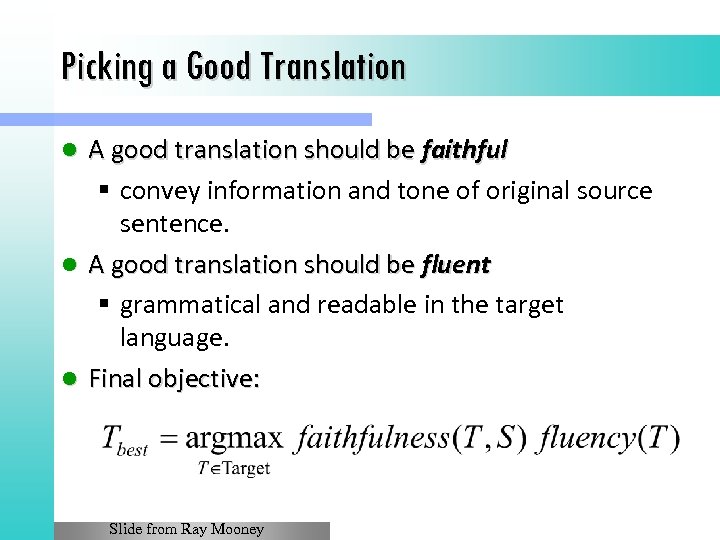 Picking a Good Translation A good translation should be faithful § convey information and tone of original source sentence. l A good translation should be fluent § grammatical and readable in the target language. l Final objective: l Slide from Ray Mooney
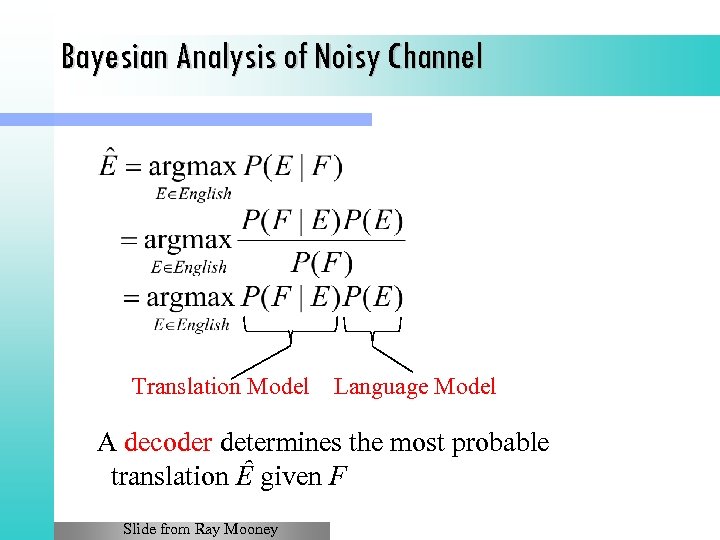 Bayesian Analysis of Noisy Channel Translation Model Language Model A decoder determines the most probable translation Ȇ given F Slide from Ray Mooney
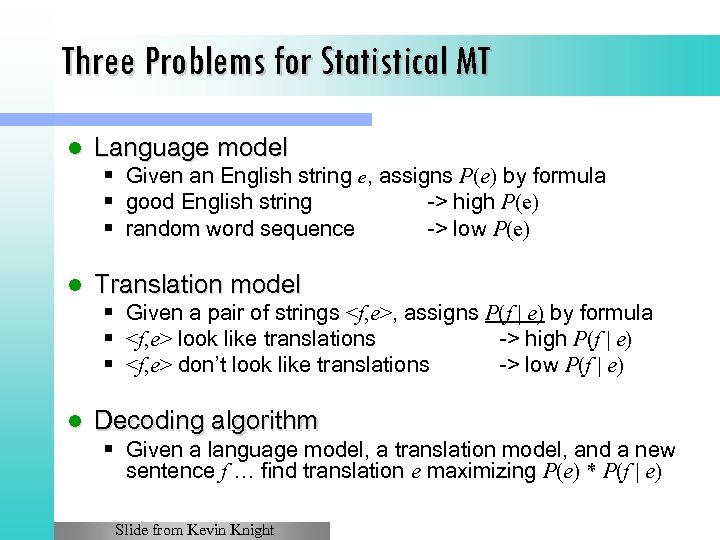 Three Problems for Statistical MT l Language model § Given an English string e, assigns P(e) by formula § good English string -> high P(e) § random word sequence -> low P(e) l Translation model § Given a pair of strings
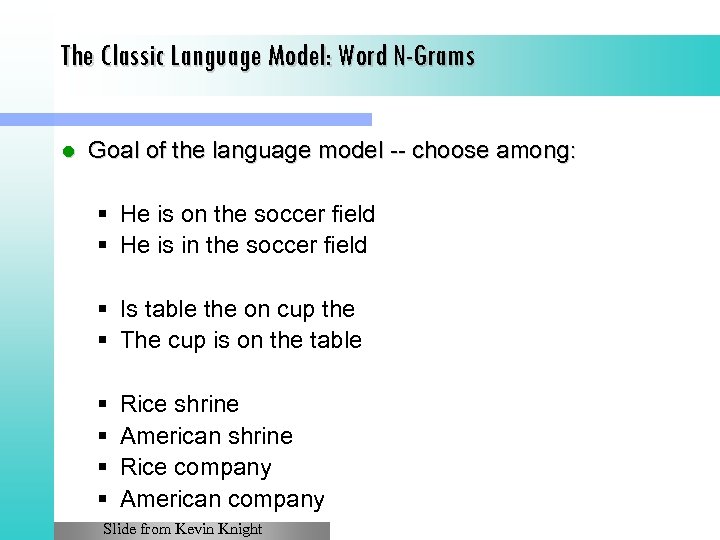 The Classic Language Model: Word N-Grams l Goal of the language model -- choose among: § He is on the soccer field § He is in the soccer field § Is table the on cup the § The cup is on the table § § Rice shrine American shrine Rice company American company Slide from Kevin Knight
 Language Model Use a standard n-gram language model for P(E). l Can be trained on a large, unsupervised mono-lingual corpus for the target language E. l Could use a more sophisticated PCFG language model to capture long-distance dependencies. l Terabytes of web data have been used to build a large 5 -gram model of English. l Slide from Ray Mooney
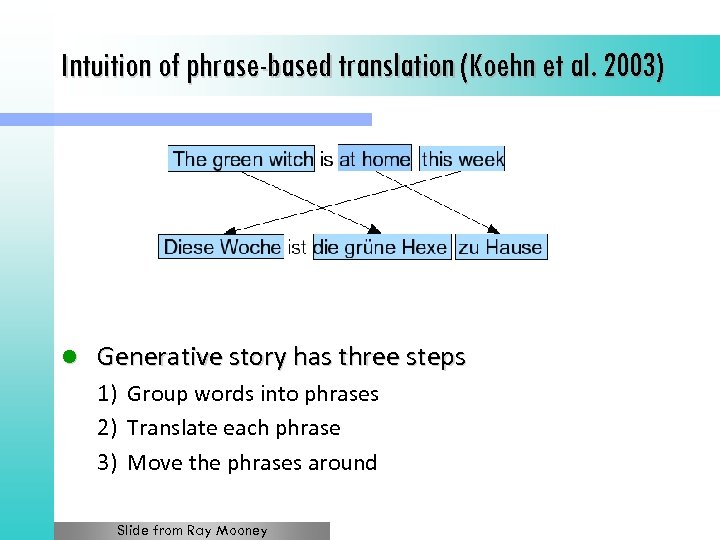 Intuition of phrase-based translation (Koehn et al. 2003) l Generative story has three steps 1) Group words into phrases 2) Translate each phrase 3) Move the phrases around Slide from Ray Mooney
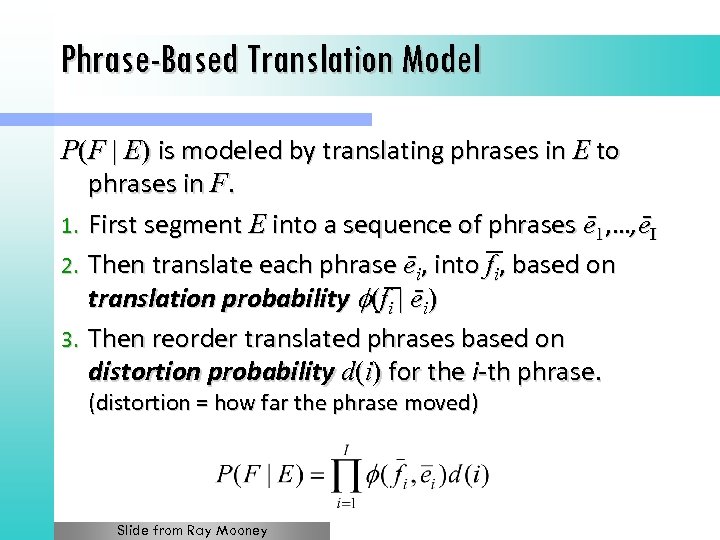 Phrase-Based Translation Model P(F | E) is modeled by translating phrases in E to phrases in F. 1. First segment E into a sequence of phrases ē 1, …, ēI 2. Then translate each phrase ēi, into fi, based on translation probability (fi | ēi) 3. Then reorder translated phrases based on distortion probability d(i) for the i-th phrase. (distortion = how far the phrase moved) Slide from Ray Mooney
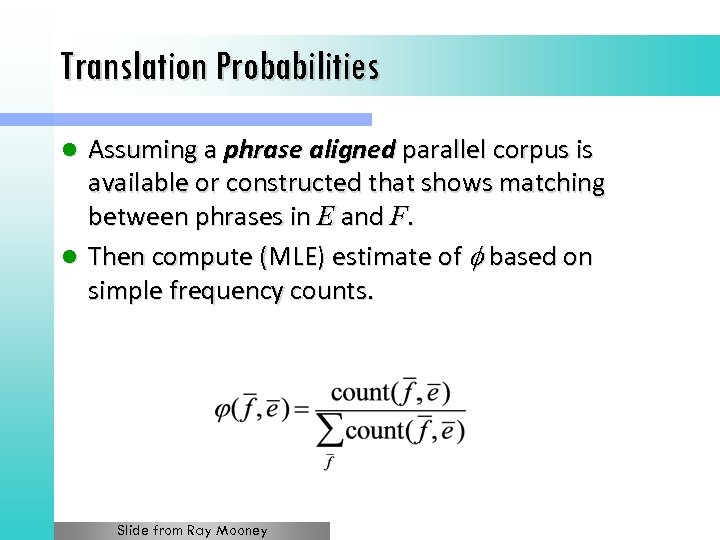 Translation Probabilities Assuming a phrase aligned parallel corpus is available or constructed that shows matching between phrases in E and F. l Then compute (MLE) estimate of based on simple frequency counts. l Slide from Ray Mooney
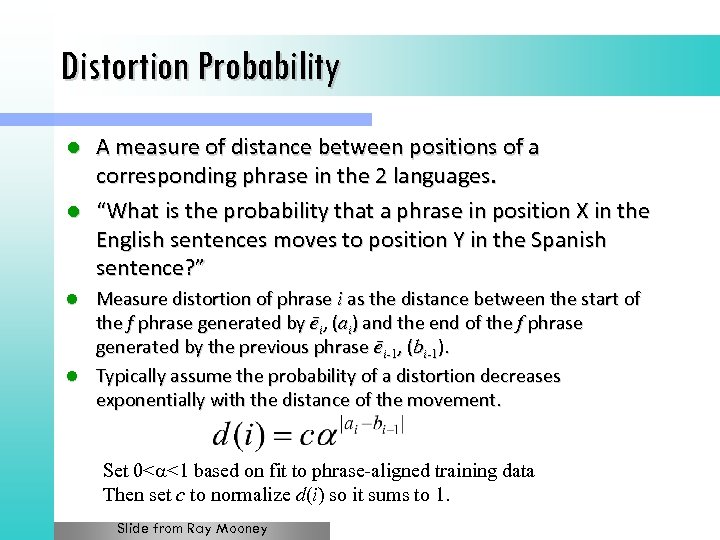 Distortion Probability A measure of distance between positions of a corresponding phrase in the 2 languages. l “What is the probability that a phrase in position X in the English sentences moves to position Y in the Spanish sentence? ” l Measure distortion of phrase i as the distance between the start of the f phrase generated by ēi, (ai) and the end of the f phrase generated by the previous phrase ēi-1, (bi-1). l Typically assume the probability of a distortion decreases exponentially with the distance of the movement. l Set 0< <1 based on fit to phrase-aligned training data Then set c to normalize d(i) so it sums to 1. Slide from Ray Mooney
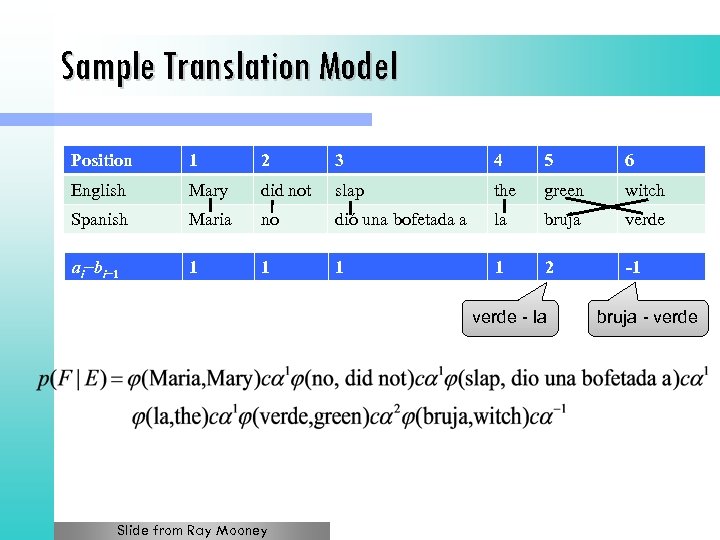 Sample Translation Model Position 1 2 3 4 5 6 English Mary did not slap the green witch Spanish Maria no dió una bofetada a la bruja verde ai−bi− 1 1 1 2 -1 verde - la Slide from Ray Mooney bruja - verde
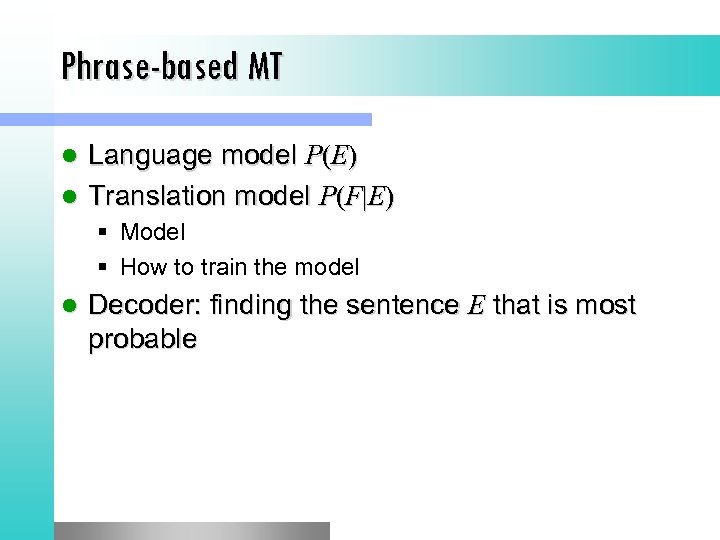 Phrase-based MT Language model P(E) l Translation model P(F|E) l § Model § How to train the model l Decoder: finding the sentence E that is most probable
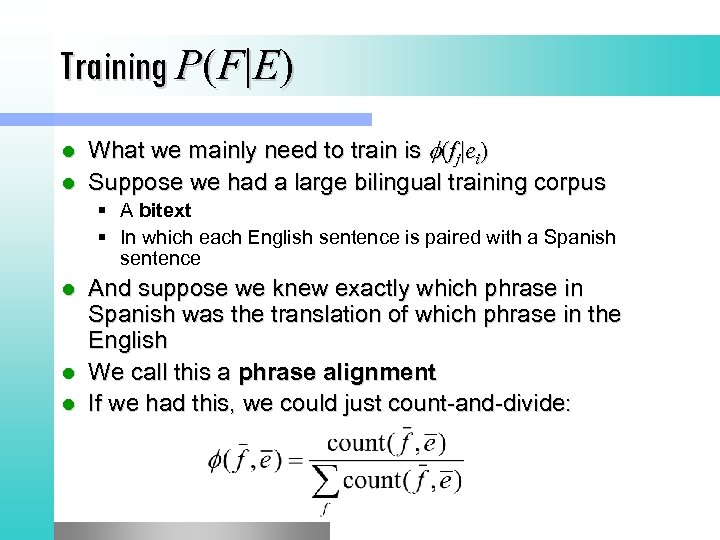 Training P(F|E) What we mainly need to train is (fj|ei) l Suppose we had a large bilingual training corpus l § A bitext § In which each English sentence is paired with a Spanish sentence l l l And suppose we knew exactly which phrase in Spanish was the translation of which phrase in the English We call this a phrase alignment If we had this, we could just count-and-divide:
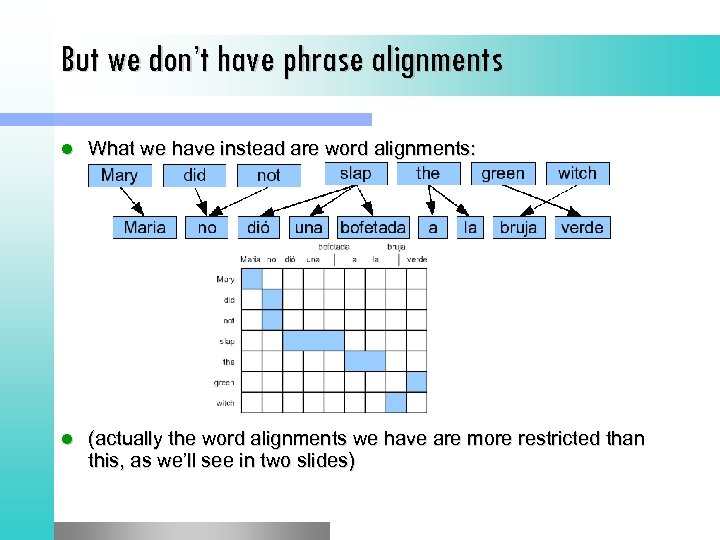 But we don’t have phrase alignments l What we have instead are word alignments: l (actually the word alignments we have are more restricted than this, as we’ll see in two slides)
 Getting phrase alignments l To get phrase alignments: 1) We first get word alignments 2) Then we “symmetrize” the word alignments into phrase alignments
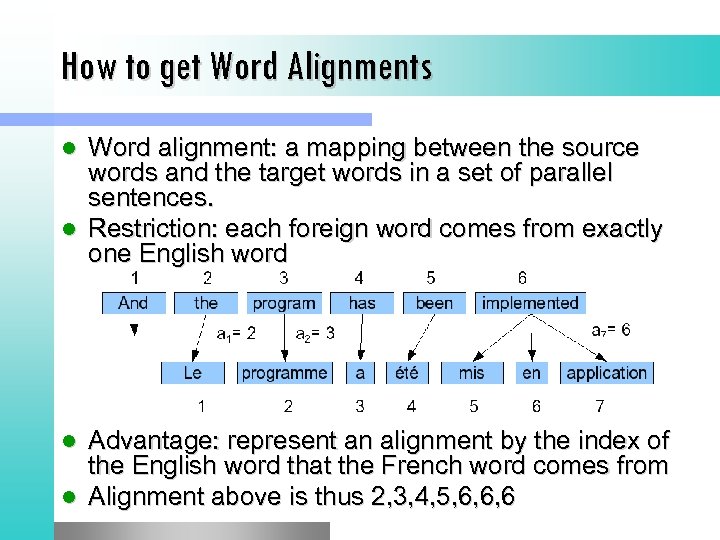 How to get Word Alignments Word alignment: a mapping between the source words and the target words in a set of parallel sentences. l Restriction: each foreign word comes from exactly one English word l Advantage: represent an alignment by the index of the English word that the French word comes from l Alignment above is thus 2, 3, 4, 5, 6, 6, 6 l
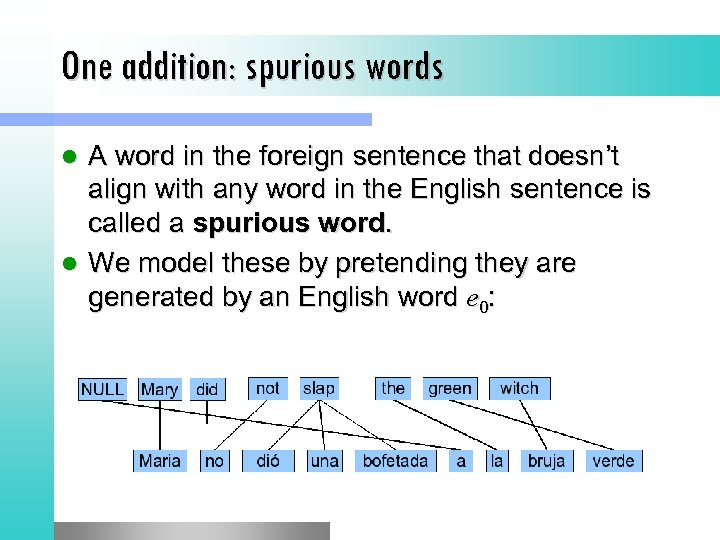 One addition: spurious words A word in the foreign sentence that doesn’t align with any word in the English sentence is called a spurious word. l We model these by pretending they are generated by an English word e 0: l
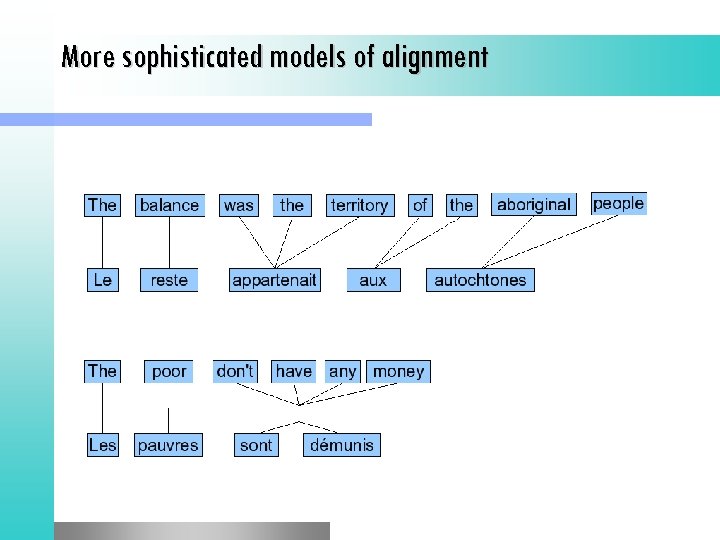 More sophisticated models of alignment
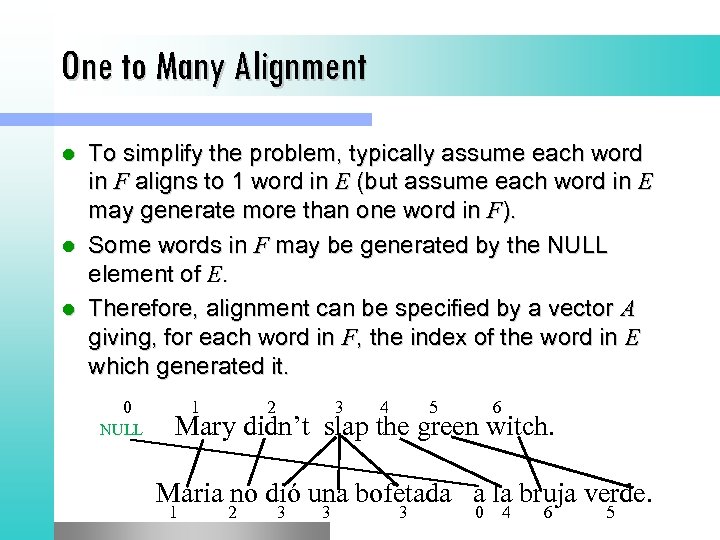 One to Many Alignment To simplify the problem, typically assume each word in F aligns to 1 word in E (but assume each word in E may generate more than one word in F). l Some words in F may be generated by the NULL element of E. l Therefore, alignment can be specified by a vector A giving, for each word in F, the index of the word in E which generated it. l 0 NULL 1 2 3 4 5 6 Mary didn’t slap the green witch. Maria no dió una bofetada a la bruja verde. 1 2 3 3 3 0 4 6 5
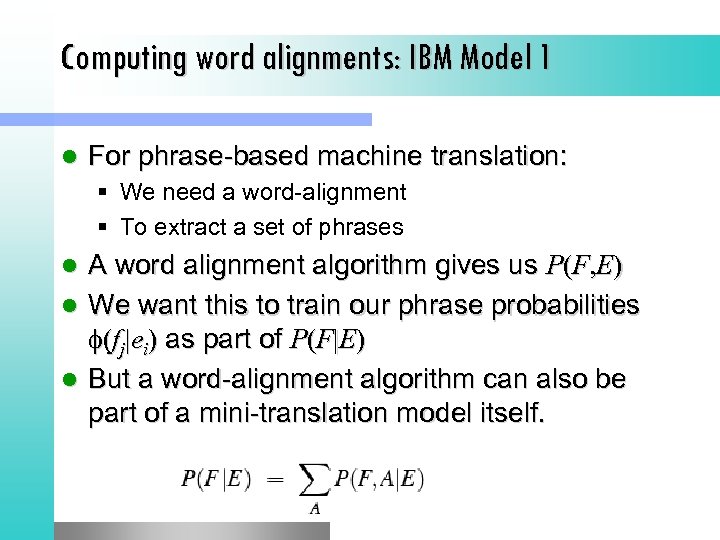 Computing word alignments: IBM Model 1 l For phrase-based machine translation: § We need a word-alignment § To extract a set of phrases A word alignment algorithm gives us P(F, E) l We want this to train our phrase probabilities (fj|ei) as part of P(F|E) l But a word-alignment algorithm can also be part of a mini-translation model itself. l
 IBM Model 1 First model proposed in seminal paper by Brown et al. in 1993 as part of CANDIDE, the first complete SMT system. l Assumes following simple generative model of producing F from E=e 1, e 2, …e. I l § Choose length, J, of F sentence: F=f 1, f 2, …f. J § Choose a 1 to many alignment A=a 1, a 2, …a. J § For each position in F, generate a word fj from the aligned word in E: eaj Slide from Ray Mooney
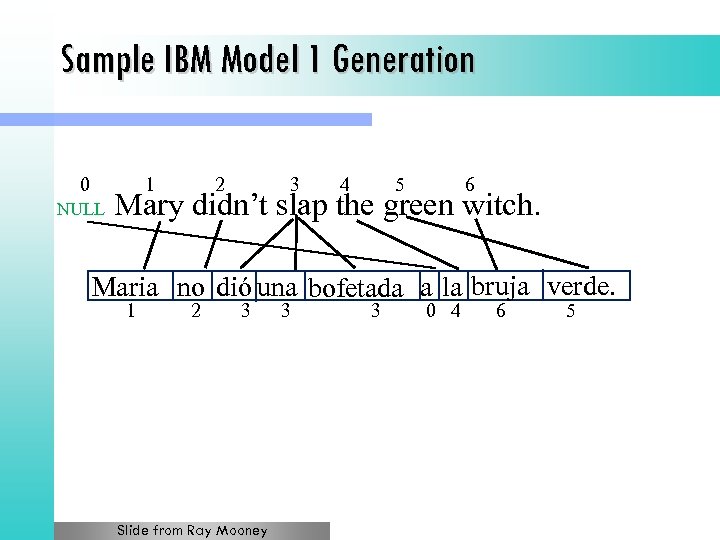 Sample IBM Model 1 Generation 0 1 NULL 2 3 4 5 6 Mary didn’t slap the green witch. Maria no dió una bofetada a la bruja verde. 1 2 3 Slide from Ray Mooney 3 3 0 4 6 5
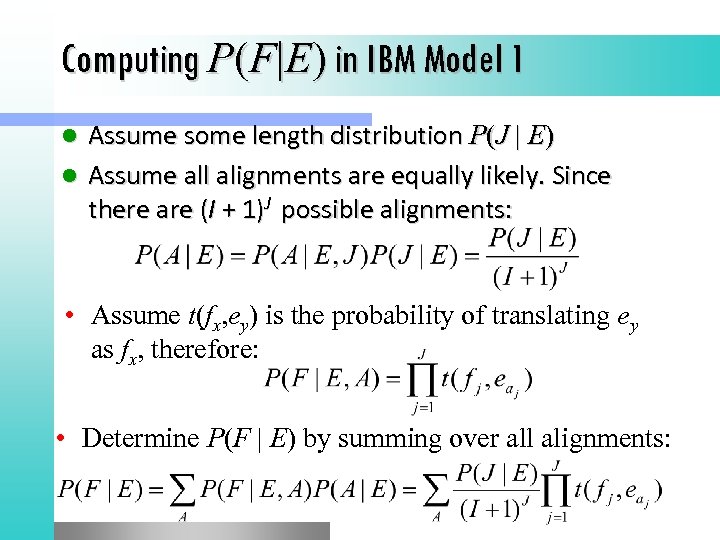 Computing P(F|E) in IBM Model 1 Assume some length distribution P(J | E) l Assume all alignments are equally likely. Since there are (I + 1)J possible alignments: l • Assume t(fx, ey) is the probability of translating ey as fx, therefore: • Determine P(F | E) by summing over all alignments:
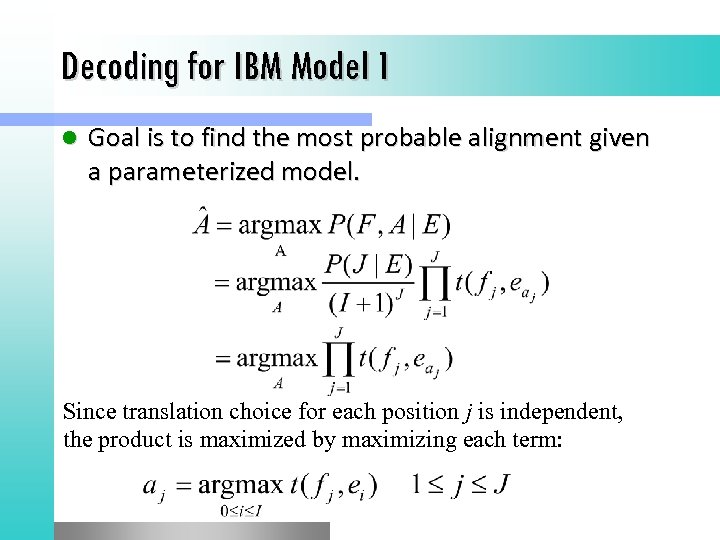 Decoding for IBM Model 1 l Goal is to find the most probable alignment given a parameterized model. Since translation choice for each position j is independent, the product is maximized by maximizing each term:
 HMM-Based Word Alignment l IBM Model 1 assumes all alignments are equally likely and does not take into account locality: § If two words appear together in one language, then their translations are likely to appear together in the result in the other language. l An alternative model of word alignment based on an HMM model does account for locality by making longer jumps in switching from translating one word to another less likely. Slide from Ray Mooney
 HMM Model Assumes the hidden state is the specific word occurrence ei in E currently being translated (i. e. there are I states, one for each word in E). l Assumes the observations from these hidden states are the possible translations fj of ei. l Generation of F from E then consists of moving to the initial E word to be translated, generating a translation, moving to the next word to be translated, and so on. l Slide from Ray Mooney
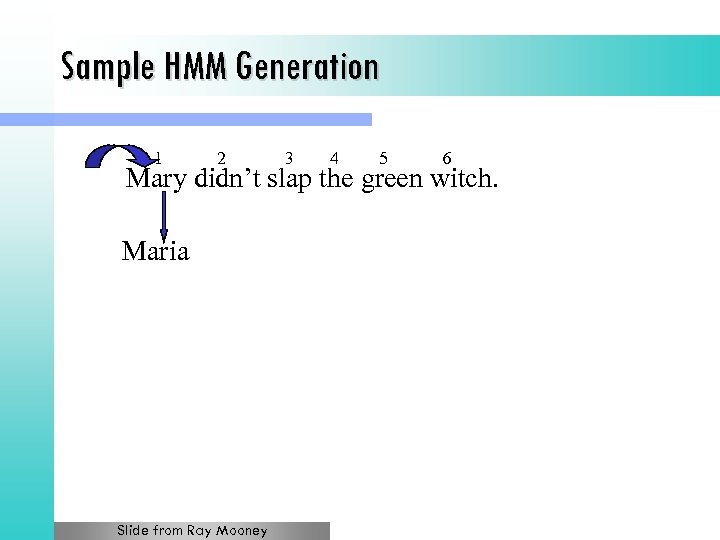 Sample HMM Generation 1 2 3 4 5 6 Mary didn’t slap the green witch. Maria Slide from Ray Mooney
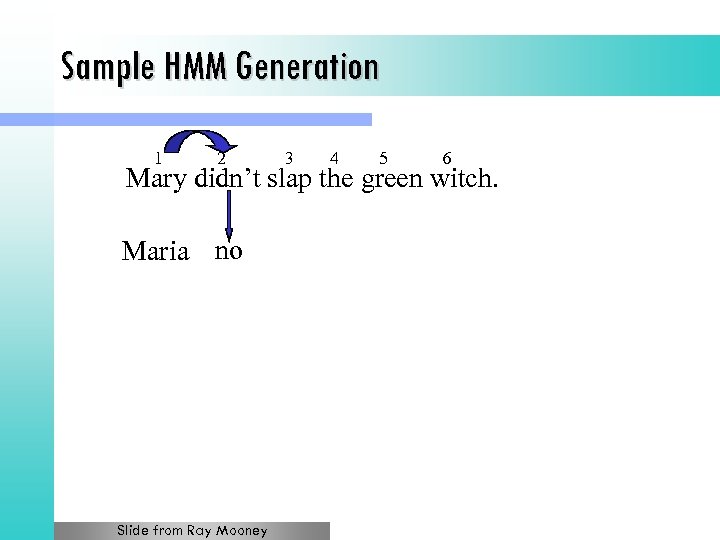 Sample HMM Generation 1 2 3 4 5 6 Mary didn’t slap the green witch. Maria no Slide from Ray Mooney
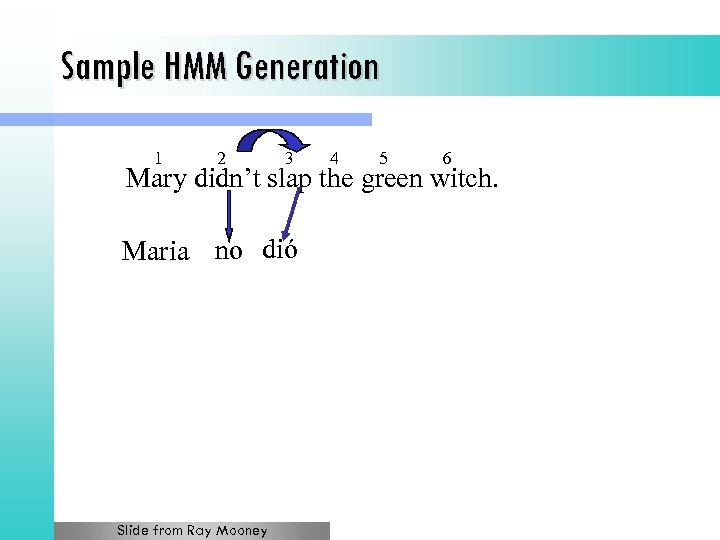 Sample HMM Generation 1 2 3 4 5 6 Mary didn’t slap the green witch. Maria no dió Slide from Ray Mooney
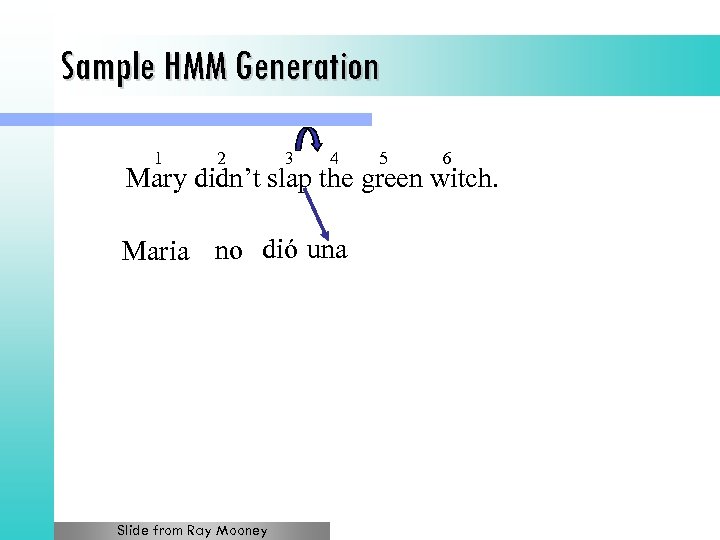 Sample HMM Generation 1 2 3 4 5 6 Mary didn’t slap the green witch. Maria no dió una Slide from Ray Mooney
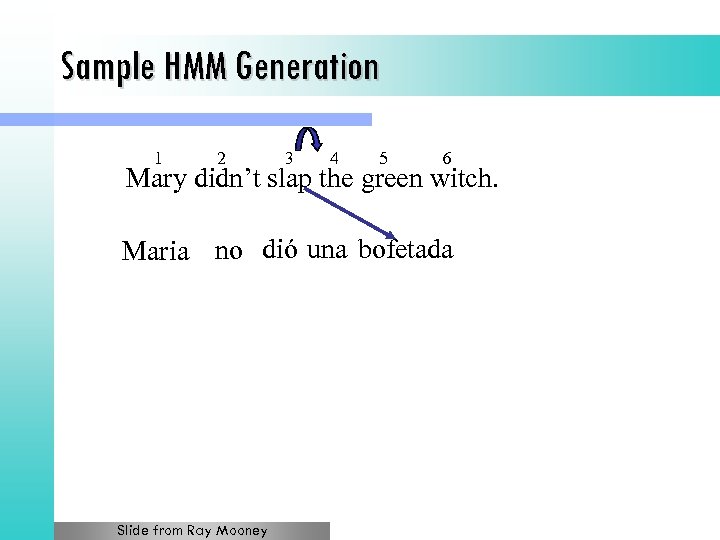 Sample HMM Generation 1 2 3 4 5 6 Mary didn’t slap the green witch. Maria no dió una bofetada Slide from Ray Mooney
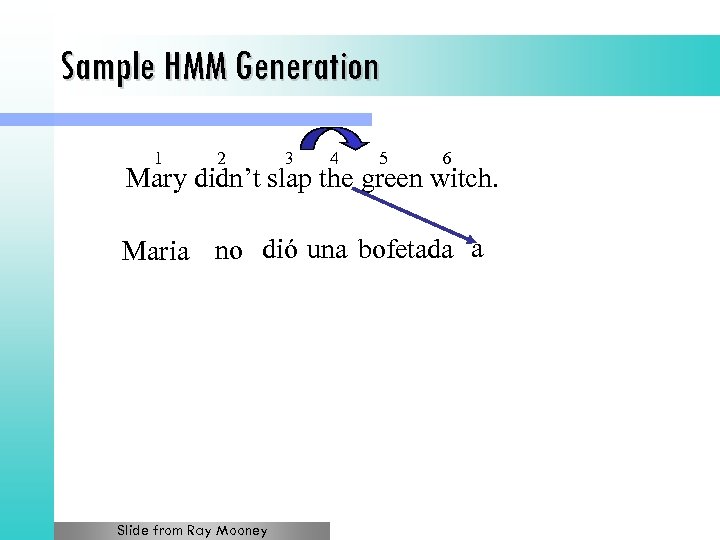 Sample HMM Generation 1 2 3 4 5 6 Mary didn’t slap the green witch. Maria no dió una bofetada a Slide from Ray Mooney
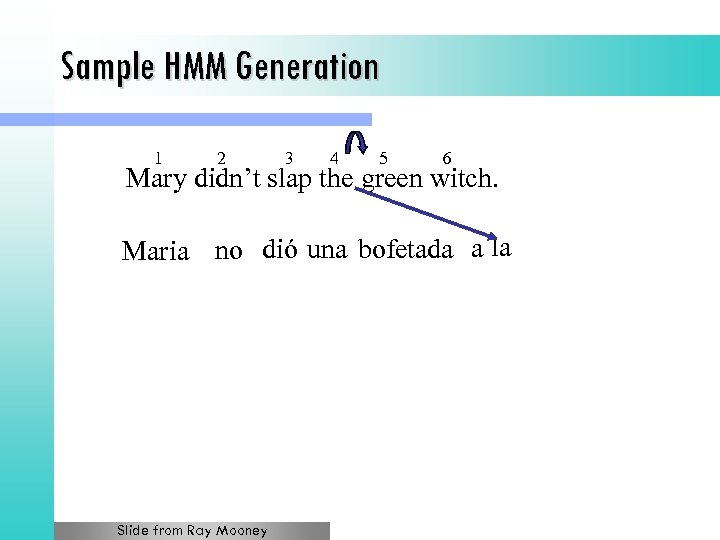 Sample HMM Generation 1 2 3 4 5 6 Mary didn’t slap the green witch. Maria no dió una bofetada a la Slide from Ray Mooney
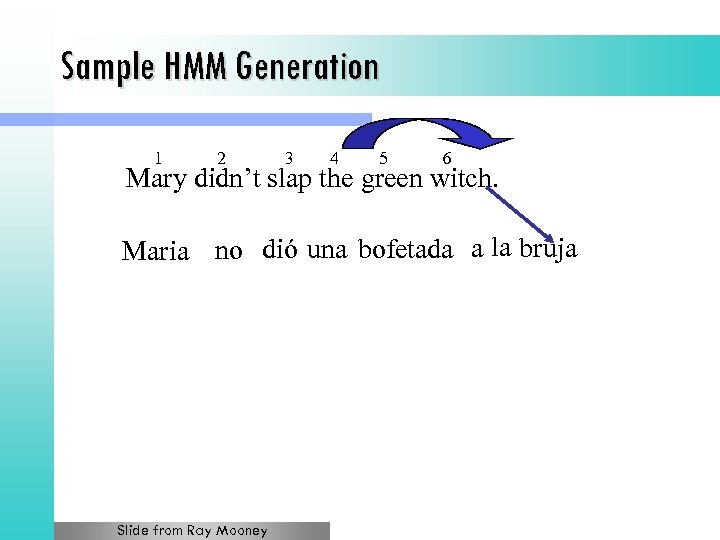 Sample HMM Generation 1 2 3 4 5 6 Mary didn’t slap the green witch. Maria no dió una bofetada a la bruja Slide from Ray Mooney
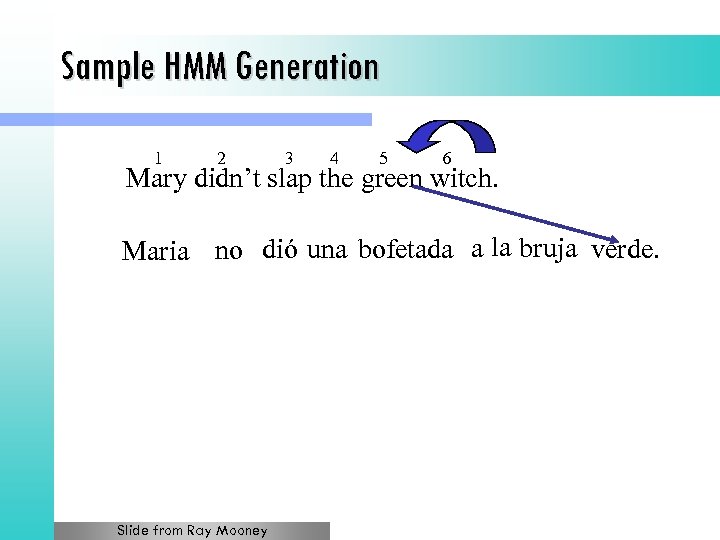 Sample HMM Generation 1 2 3 4 5 6 Mary didn’t slap the green witch. Maria no dió una bofetada a la bruja verde. Slide from Ray Mooney
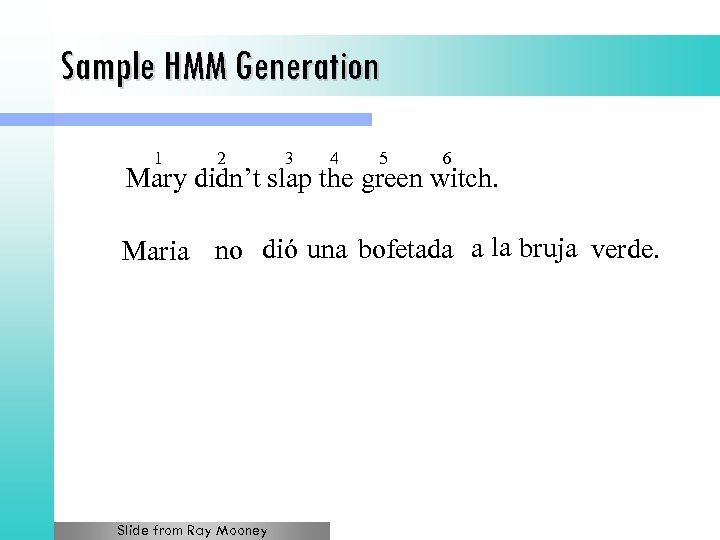 Sample HMM Generation 1 2 3 4 5 6 Mary didn’t slap the green witch. Maria no dió una bofetada a la bruja verde. Slide from Ray Mooney
 HMM Parameters Transition and observation parameters of states for HMMs for all possible source sentences are “tied” to reduce the number of free parameters that have to be estimated. l Observation probabilities: bj(fi)=P(fi | ej) the same for all states representing an occurrence of the same English word. l State transition probabilities: aij = s(j i) the same for all transitions that involve the same jump width (and direction). l Slide from Ray Mooney
 Computing P(F|E) in the HMM Model l Given the observation and state-transition probabilities, P(F | E) (observation likelihood) can be computed using the standard forward algorithm for HMMs. Slide from Ray Mooney
 Decoding for the HMM Model l Use the standard Viterbi algorithm to efficiently compute the most likely alignment (i. e. most likely state sequence). Slide from Ray Mooney
 Training alignment probabilities l Step 1: get a parallel corpus § Hansards • Canadian parliamentary proceedings, in French and English • Hong Kong Hansards: English and Chinese § Europarl Step 2: sentence alignment l Step 3: use EM (Expectation Maximization) to train word alignments l
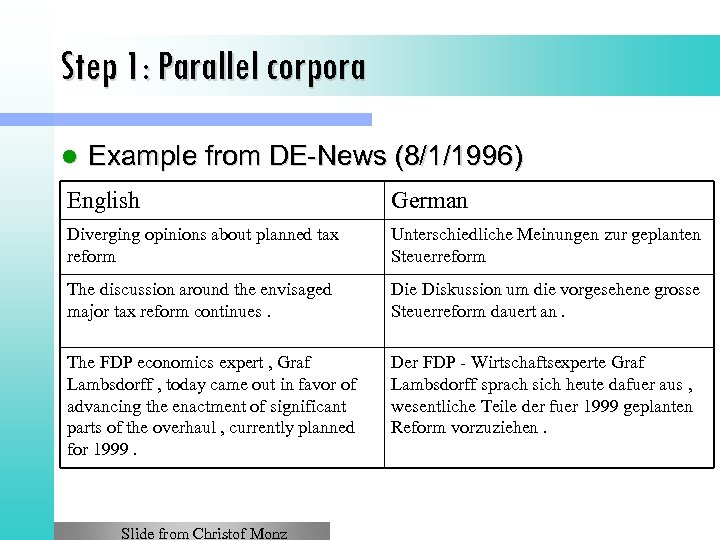 Step 1: Parallel corpora l Example from DE-News (8/1/1996) English German Diverging opinions about planned tax reform Unterschiedliche Meinungen zur geplanten Steuerreform The discussion around the envisaged major tax reform continues. Die Diskussion um die vorgesehene grosse Steuerreform dauert an. The FDP economics expert , Graf Lambsdorff , today came out in favor of advancing the enactment of significant parts of the overhaul , currently planned for 1999. Der FDP - Wirtschaftsexperte Graf Lambsdorff sprach sich heute dafuer aus , wesentliche Teile der fuer 1999 geplanten Reform vorzuziehen. Slide from Christof Monz
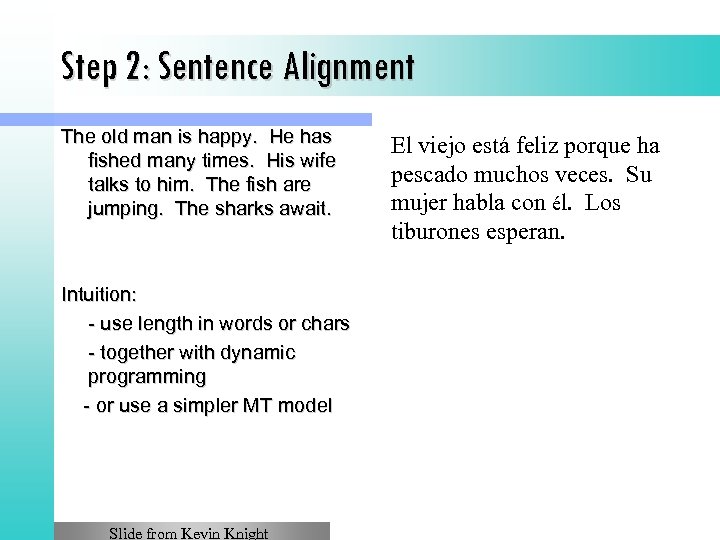 Step 2: Sentence Alignment The old man is happy. He has fished many times. His wife talks to him. The fish are jumping. The sharks await. Intuition: - use length in words or chars - together with dynamic programming - or use a simpler MT model Slide from Kevin Knight El viejo está feliz porque ha pescado muchos veces. Su mujer habla con él. Los tiburones esperan.
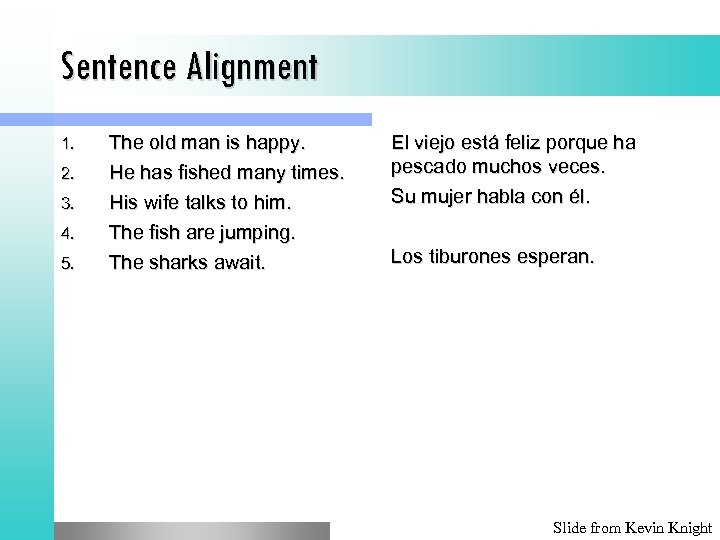 Sentence Alignment 1. 2. 3. 4. 5. The old man is happy. He has fished many times. His wife talks to him. The fish are jumping. The sharks await. El viejo está feliz porque ha pescado muchos veces. Su mujer habla con él. Los tiburones esperan. Slide from Kevin Knight
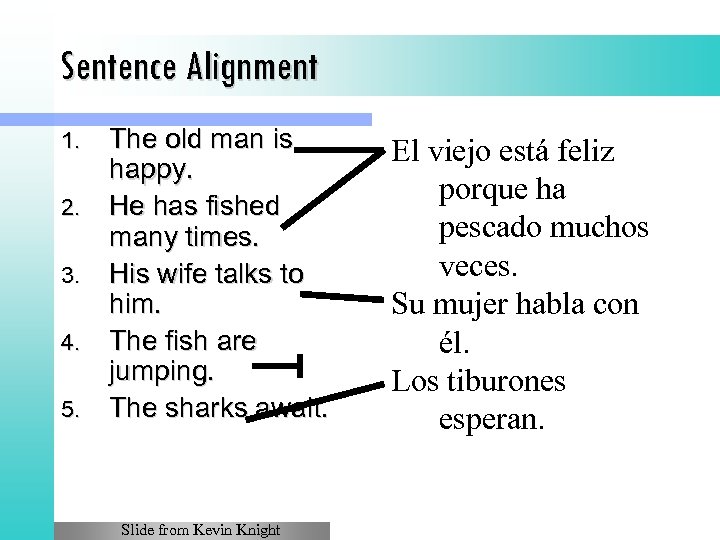 Sentence Alignment 1. 2. 3. 4. 5. The old man is happy. He has fished many times. His wife talks to him. The fish are jumping. The sharks await. Slide from Kevin Knight El viejo está feliz porque ha pescado muchos veces. Su mujer habla con él. Los tiburones esperan.
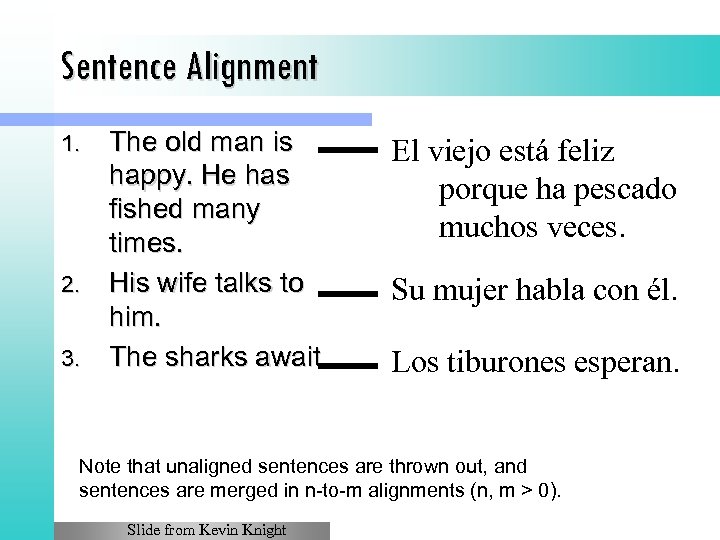 Sentence Alignment The old man is happy. He has fished many times. 2. His wife talks to him. 3. The sharks await. 1. El viejo está feliz porque ha pescado muchos veces. Su mujer habla con él. Los tiburones esperan. Note that unaligned sentences are thrown out, and sentences are merged in n-to-m alignments (n, m > 0). Slide from Kevin Knight
 Step 3: word alignments We can bootstrap alignments from a sentence-aligned bilingual corpus l using the Expectation-Maximization (EM) algorithm l
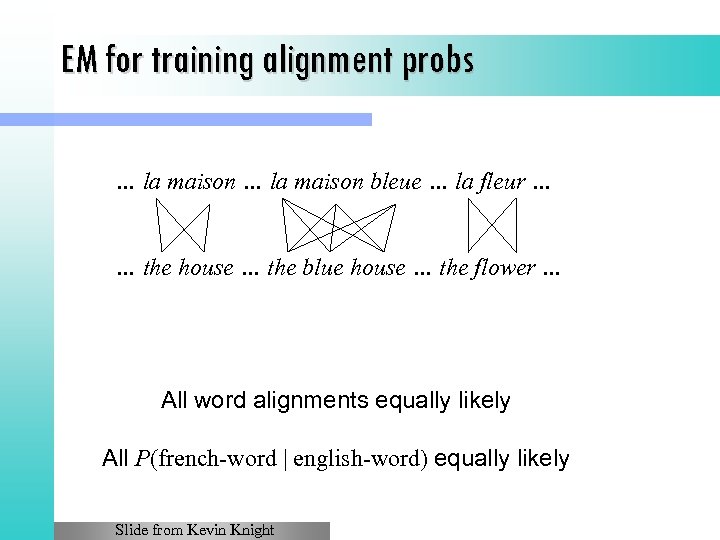 EM for training alignment probs … la maison bleue … la fleur … … the house … the blue house … the flower … All word alignments equally likely All P(french-word | english-word) equally likely Slide from Kevin Knight
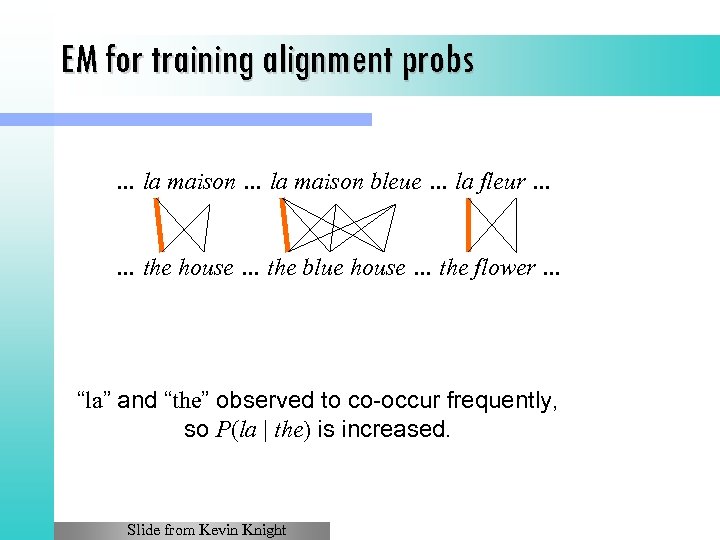 EM for training alignment probs … la maison bleue … la fleur … … the house … the blue house … the flower … “la” and “the” observed to co-occur frequently, so P(la | the) is increased. Slide from Kevin Knight
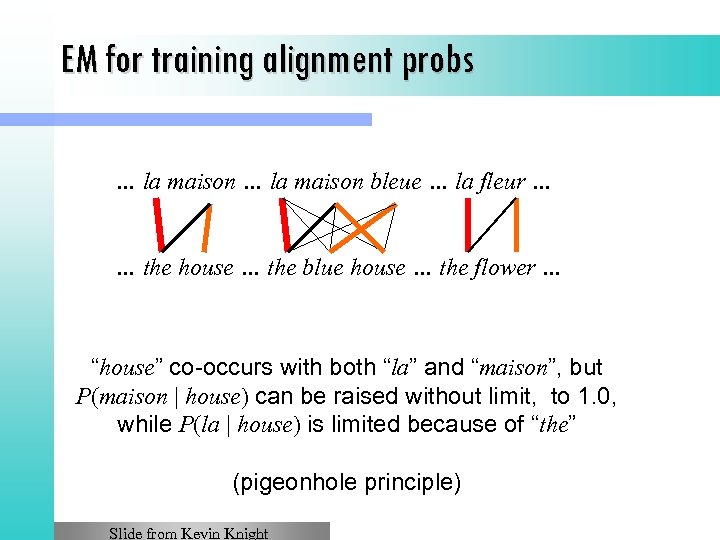 EM for training alignment probs … la maison bleue … la fleur … … the house … the blue house … the flower … “house” co-occurs with both “la” and “maison”, but P(maison | house) can be raised without limit, to 1. 0, while P(la | house) is limited because of “the” (pigeonhole principle) Slide from Kevin Knight
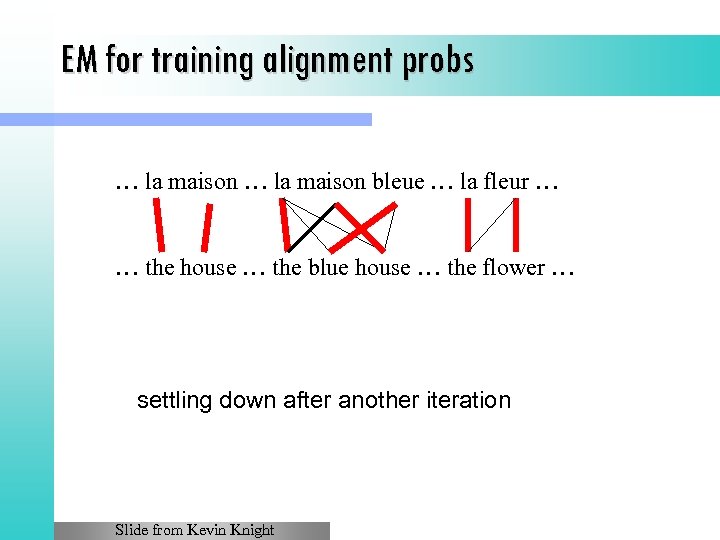 EM for training alignment probs … la maison bleue … la fleur … … the house … the blue house … the flower … settling down after another iteration Slide from Kevin Knight
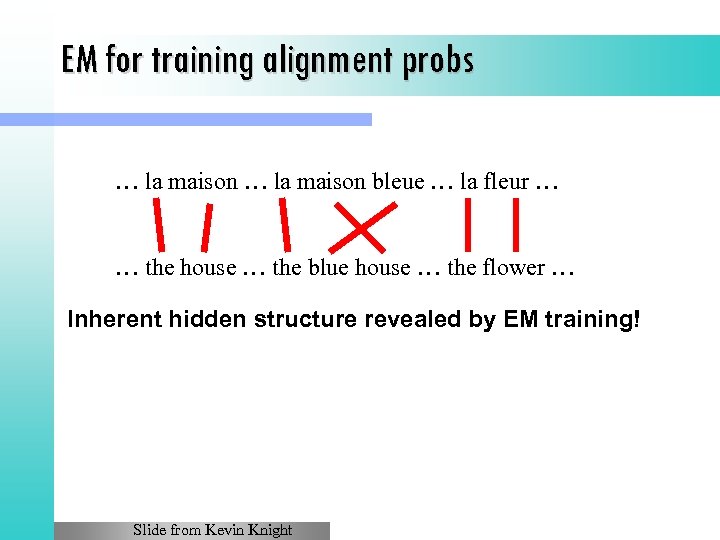 EM for training alignment probs … la maison bleue … la fleur … … the house … the blue house … the flower … Inherent hidden structure revealed by EM training! Slide from Kevin Knight
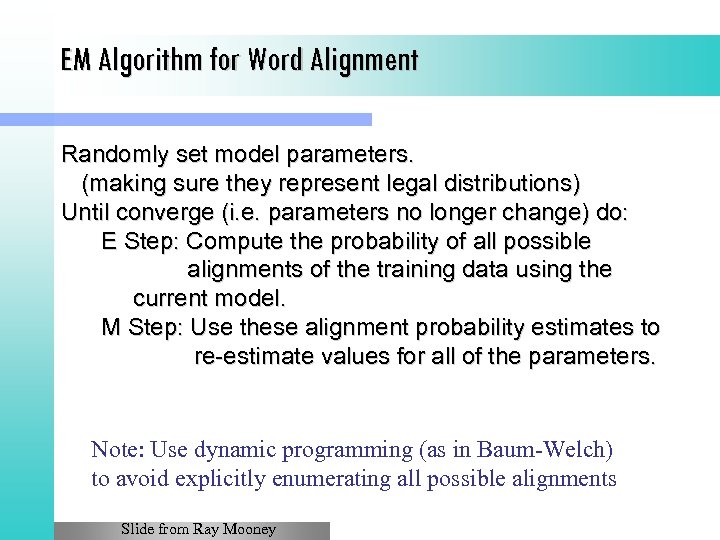 EM Algorithm for Word Alignment Randomly set model parameters. (making sure they represent legal distributions) Until converge (i. e. parameters no longer change) do: E Step: Compute the probability of all possible alignments of the training data using the current model. M Step: Use these alignment probability estimates to re-estimate values for all of the parameters. Note: Use dynamic programming (as in Baum-Welch) to avoid explicitly enumerating all possible alignments Slide from Ray Mooney
 IBM Model 1 and EM
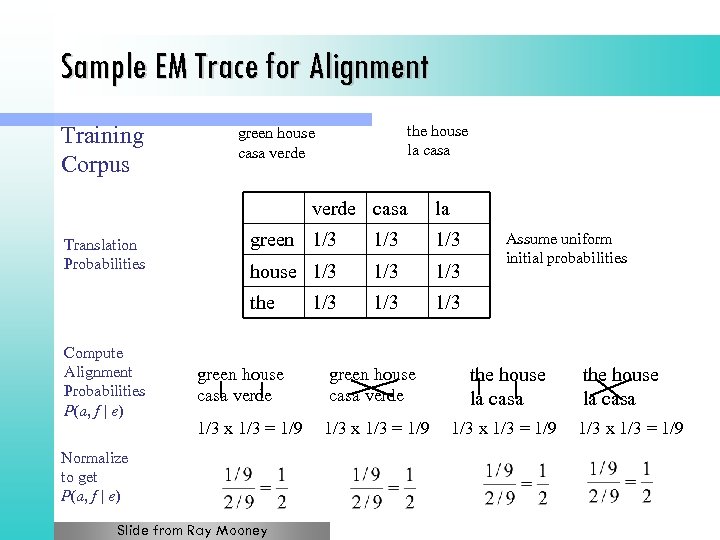 Sample EM Trace for Alignment Training Corpus the house la casa green house casa verde casa la Compute Alignment Probabilities P(a, f | e) green 1/3 1/3 house 1/3 1/3 the Translation Probabilities 1/3 1/3 Assume uniform initial probabilities green house casa verde the house la casa 1/3 x 1/3 = 1/9 Normalize to get P(a, f | e) Slide from Ray Mooney the house la casa 1/3 x 1/3 = 1/9
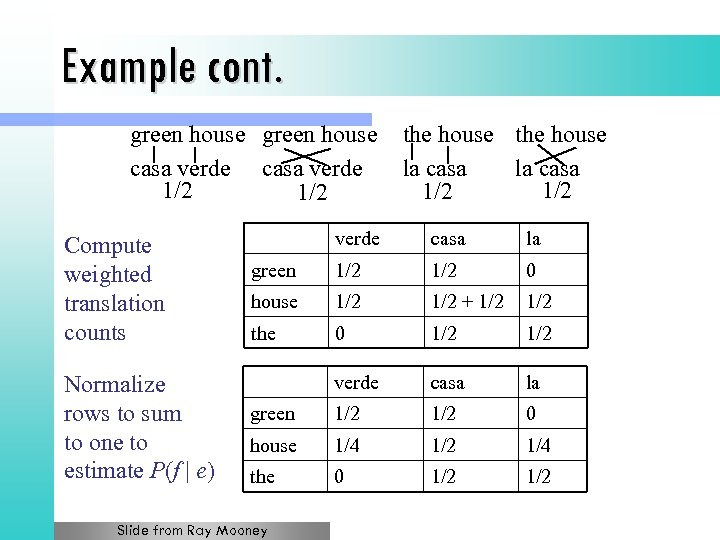 Example cont. green house casa verde 1/2 Compute weighted translation counts Normalize rows to sum to one to estimate P(f | e) the house la casa 1/2 verde casa la green 1/2 0 house 1/2 + 1/2 the 0 1/2 verde casa la green 1/2 0 house 1/4 1/2 1/4 the 0 1/2 Slide from Ray Mooney
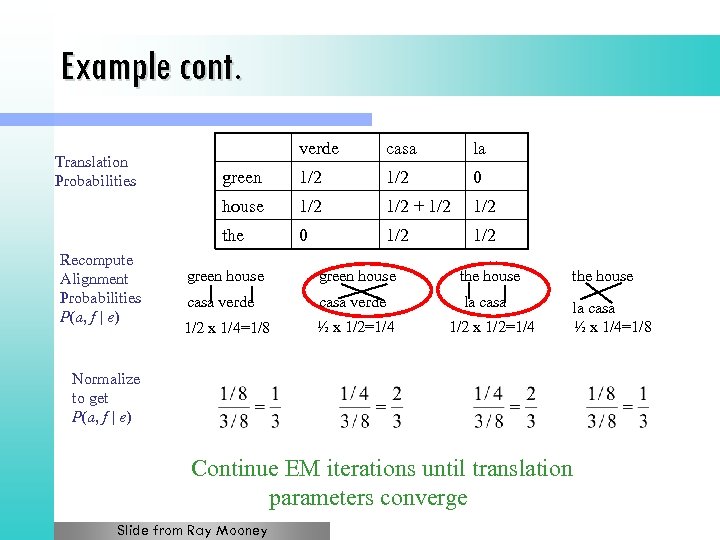 Example cont. casa la green 1/2 0 1/2 + 1/2 the Recompute Alignment Probabilities P(a, f | e) verde house Translation Probabilities 0 1/2 green house the house casa verde la casa 1/2 x 1/4=1/8 ½ x 1/2=1/4 la casa ½ x 1/4=1/8 1/2 x 1/2=1/4 Normalize to get P(a, f | e) Continue EM iterations until translation parameters converge Slide from Ray Mooney
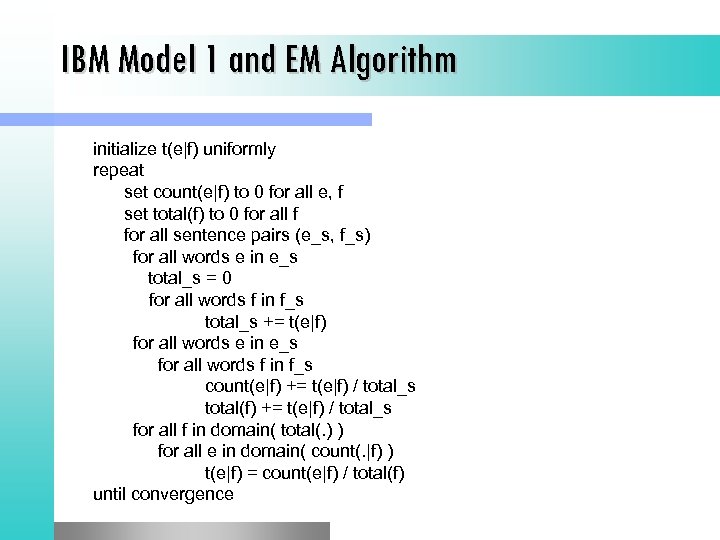 IBM Model 1 and EM Algorithm initialize t(e|f) uniformly repeat set count(e|f) to 0 for all e, f set total(f) to 0 for all f for all sentence pairs (e_s, f_s) for all words e in e_s total_s = 0 for all words f in f_s total_s += t(e|f) for all words e in e_s for all words f in f_s count(e|f) += t(e|f) / total_s total(f) += t(e|f) / total_s for all f in domain( total(. ) ) for all e in domain( count(. |f) ) t(e|f) = count(e|f) / total(f) until convergence
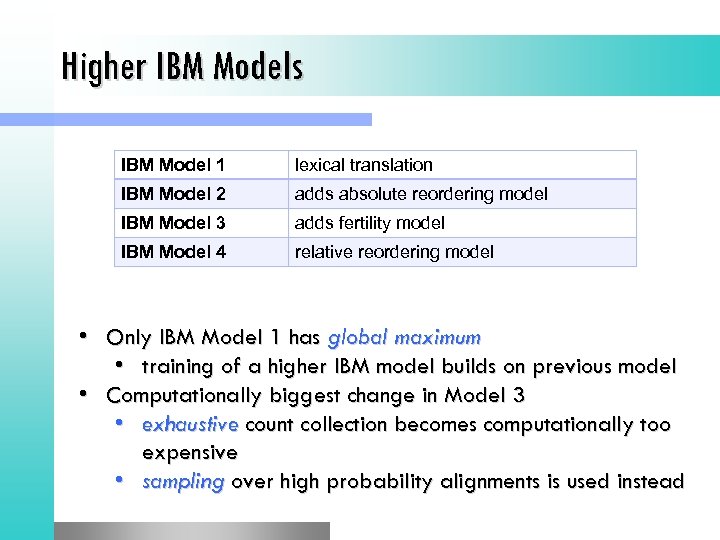 Higher IBM Models IBM Model 1 lexical translation IBM Model 2 adds absolute reordering model IBM Model 3 adds fertility model IBM Model 4 relative reordering model • Only IBM Model 1 has global maximum • training of a higher IBM model builds on previous model • Computationally biggest change in Model 3 • exhaustive count collection becomes computationally too expensive • sampling over high probability alignments is used instead
 Phrase Alignment
 Phrase Alignments from Word Alignments l l Alignment algorithms produce one to many word translations We know that words do not map one-to-one in translations Better to map ‘phrases’, i. e. sequences of words, to phrases and probabilistically reorder them in translation Combine E→F and F →E word alignments to produce a phrase alignment
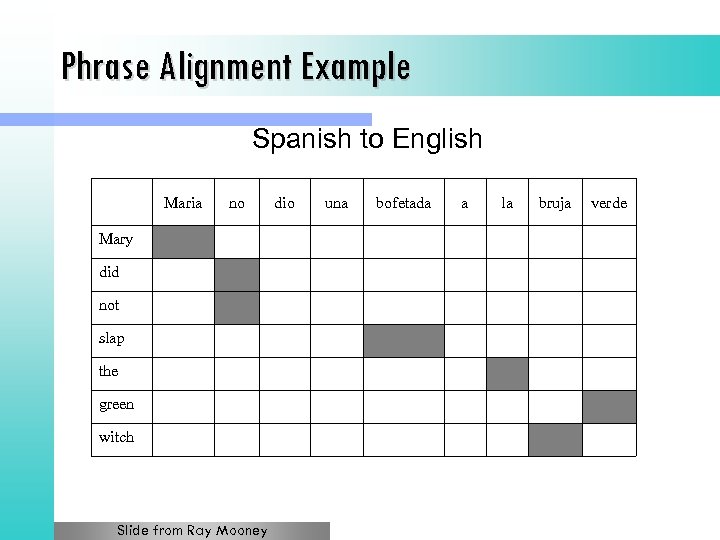 Phrase Alignment Example Spanish to English Maria no Mary did not slap the green witch Slide from Ray Mooney dio una bofetada a la bruja verde
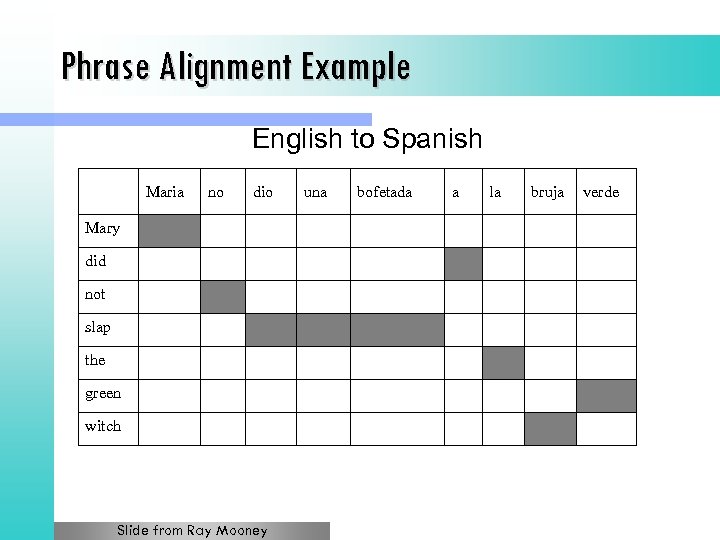 Phrase Alignment Example English to Spanish Maria no dio Mary did not slap the green witch Slide from Ray Mooney una bofetada a la bruja verde
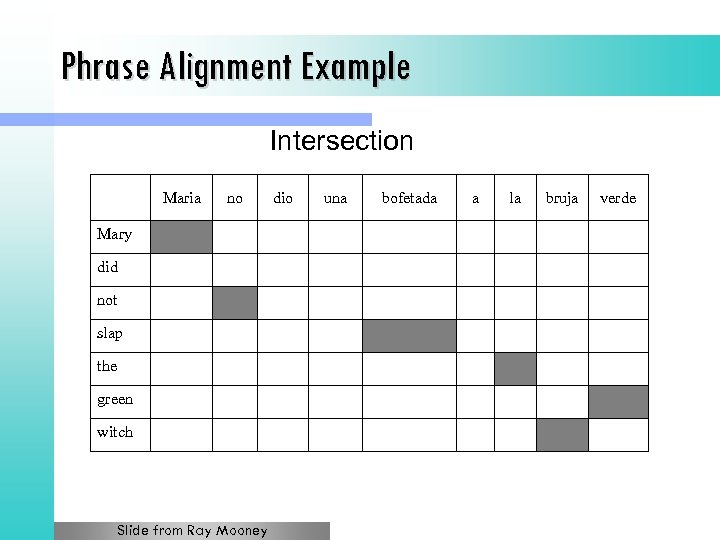 Phrase Alignment Example Intersection Maria no Mary did not slap the green witch Slide from Ray Mooney dio una bofetada a la bruja verde
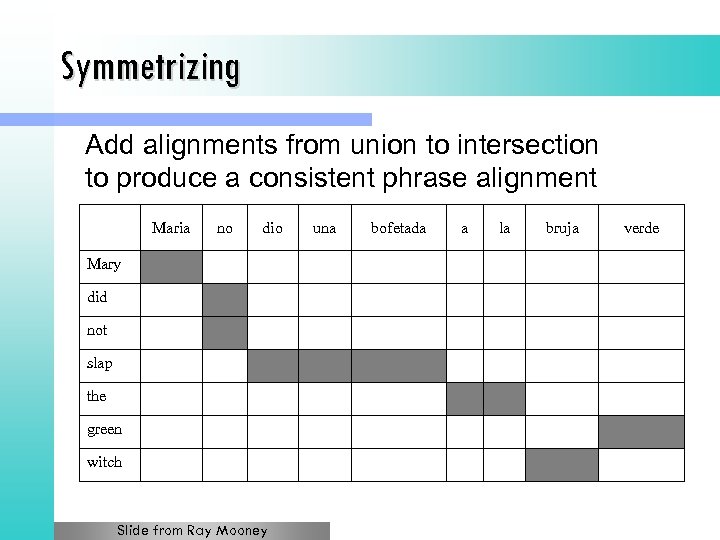 Symmetrizing Add alignments from union to intersection to produce a consistent phrase alignment Maria no dio Mary did not slap the green witch Slide from Ray Mooney una bofetada a la bruja verde
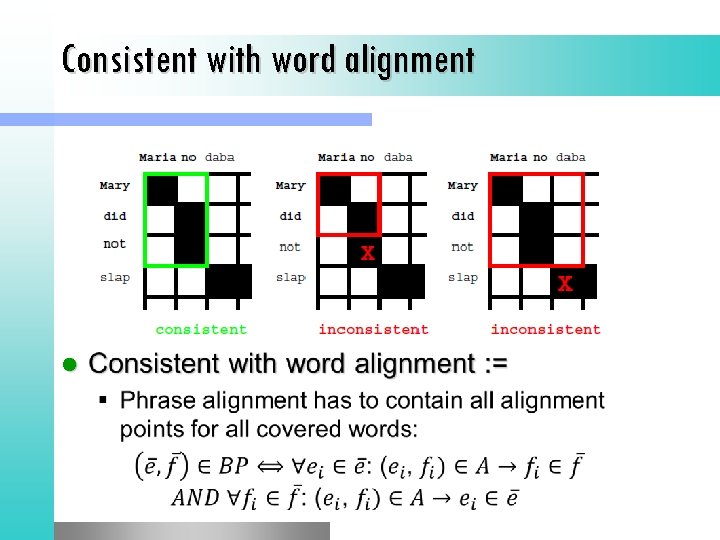 Consistent with word alignment l
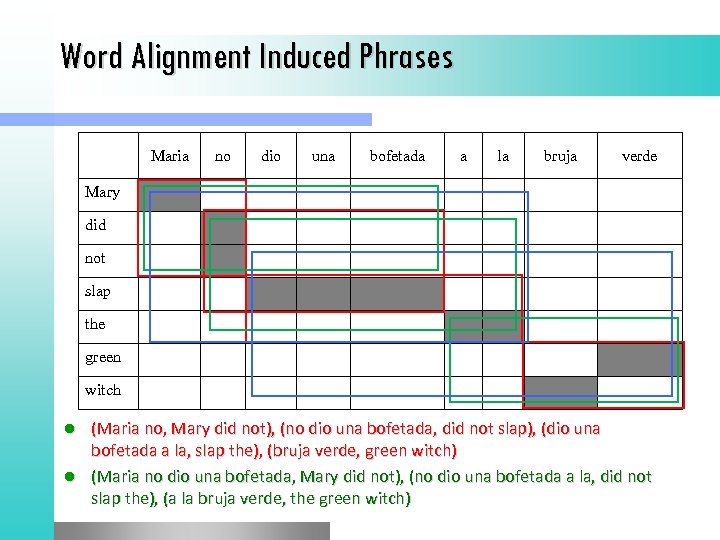 Word Alignment Induced Phrases Maria no dio una bofetada a la bruja verde Mary did not slap the green witch (Maria no, Mary did not), (no dio una bofetada, did not slap), (dio una bofetada a la, slap the), (bruja verde, green witch) l (Maria no dio una bofetada, Mary did not), (no dio una bofetada a la, did not slap the), (a la bruja verde, the green witch) l
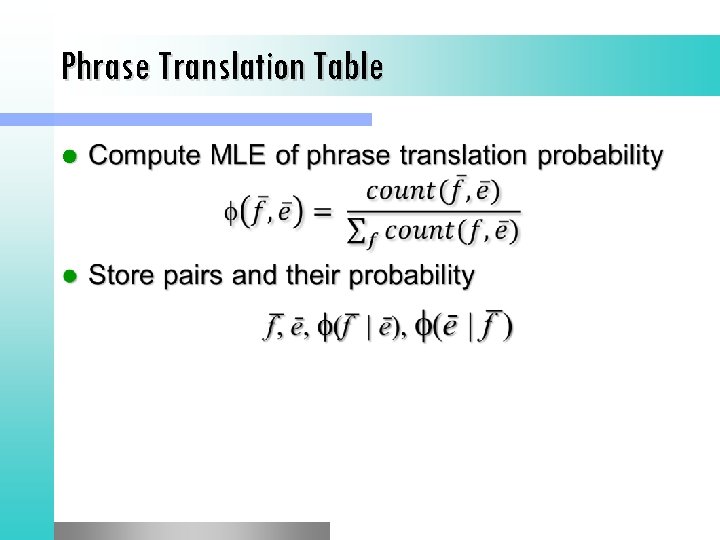 Phrase Translation Table l
 Decoding
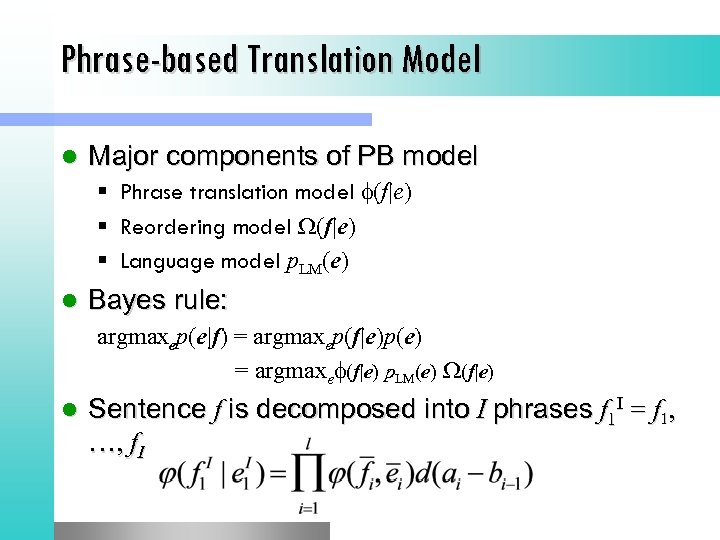 Phrase-based Translation Model l Major components of PB model § Phrase translation model (f|e) § Reordering model W(f|e) § Language model p. LM(e) l Bayes rule: argmaxep(e|f) = argmaxep(f|e)p(e) = argmaxe (f|e) p. LM(e) W(f|e) l Sentence f is decomposed into I phrases f 1 I = f 1, …, f. I
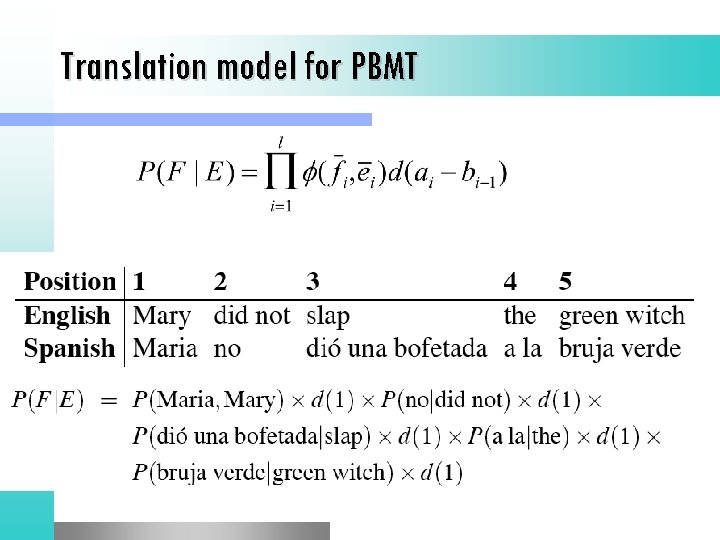 Translation model for PBMT l Let’s look at a simple example with no distortion
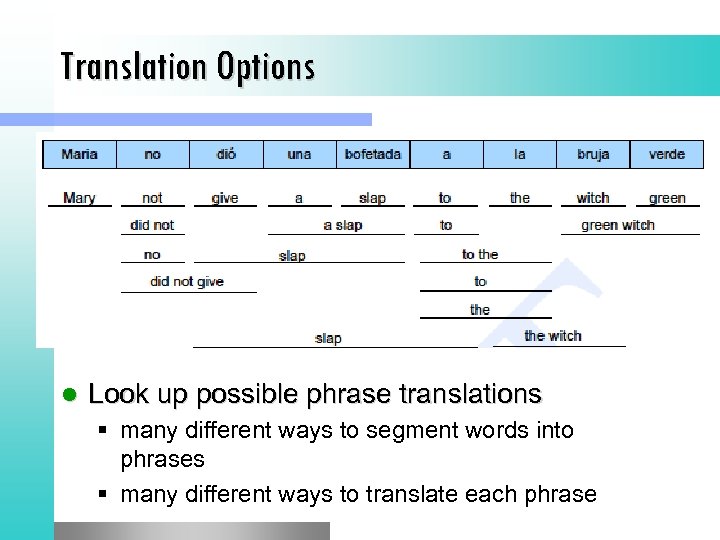 Translation Options l Look up possible phrase translations § many different ways to segment words into phrases § many different ways to translate each phrase
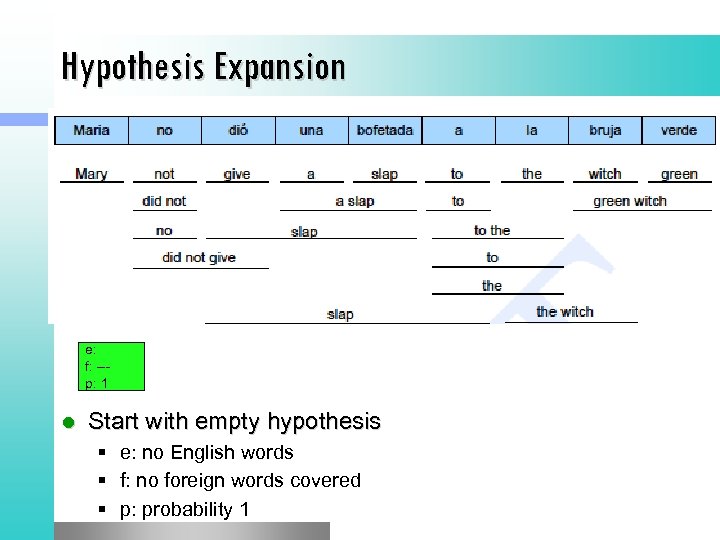 Hypothesis Expansion e: f: --p: 1 l Start with empty hypothesis § e: no English words § f: no foreign words covered § p: probability 1
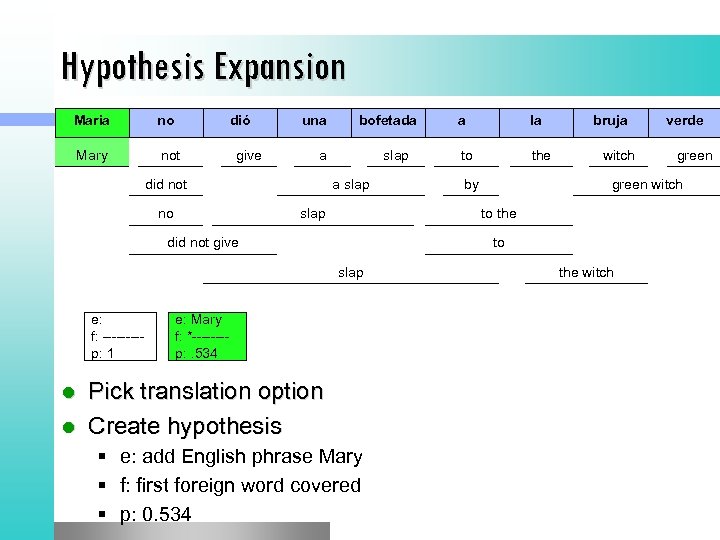 Hypothesis Expansion Maria no dió Mary not give una a did not no bofetada slap la to the by bruja witch to slap e: Mary f: *-------p: . 534 Pick translation option l Create hypothesis l § e: add English phrase Mary § f: first foreign word covered § p: 0. 534 verde green witch to the did not give e: f: ----p: 1 a the witch
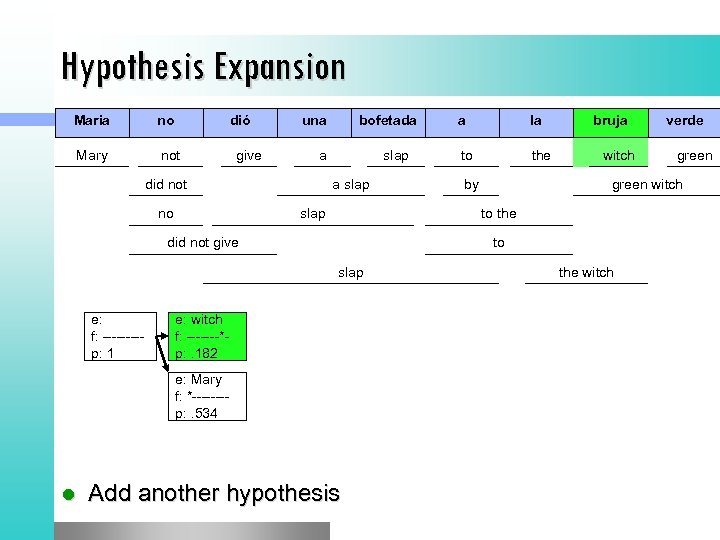 Hypothesis Expansion Maria no dió Mary not give una a did not no bofetada slap to the by bruja witch e: witch f: -------*p: . 182 e: Mary f: *-------p: . 534 Add another hypothesis verde green witch to slap l la to the did not give e: f: ----p: 1 a the witch
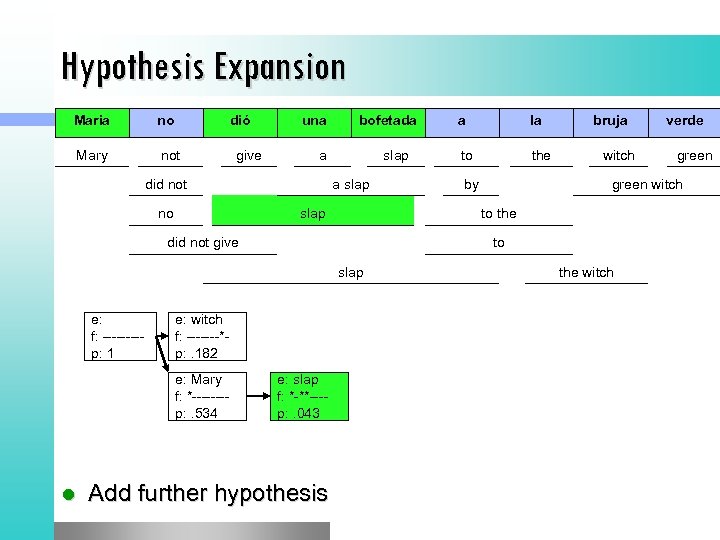 Hypothesis Expansion Maria no dió Mary not give una a did not no bofetada slap l to the by bruja witch e: witch f: -------*p: . 182 e: slap f: *-**---p: . 043 Add further hypothesis verde green witch to slap e: Mary f: *-------p: . 534 la to the did not give e: f: ----p: 1 a the witch
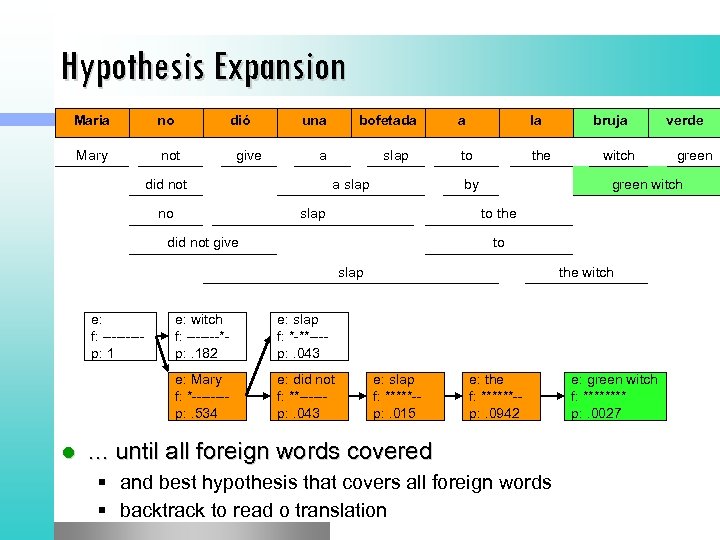 Hypothesis Expansion Maria no dió Mary not give una a did not no bofetada slap a la to the by slap to e: witch f: -------*p: . 182 e: did not f: **-----p: . 043 the witch e: slap f: *-**---p: . 043 e: Mary f: *-------p: . 534 e: slap f: *****-p: . 015 verde green witch slap l witch to the did not give e: f: ----p: 1 bruja e: the f: ******-p: . 0942 . . . until all foreign words covered § and best hypothesis that covers all foreign words § backtrack to read o translation e: green witch f: **** p: . 0027
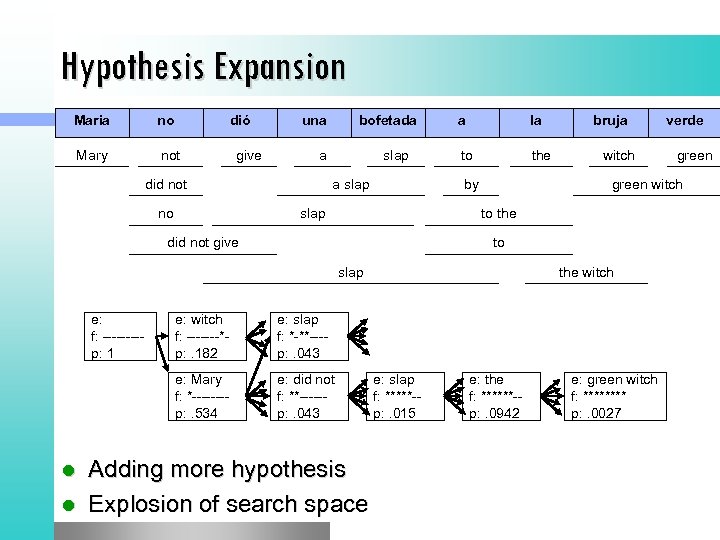 Hypothesis Expansion Maria no dió Mary not give una a did not no bofetada slap a la to the by slap to e: witch f: -------*p: . 182 e: did not f: **-----p: . 043 the witch e: slap f: *-**---p: . 043 e: Mary f: *-------p: . 534 Adding more hypothesis l Explosion of search space e: slap f: *****-p: . 015 verde green witch slap l witch to the did not give e: f: ----p: 1 bruja e: the f: ******-p: . 0942 e: green witch f: **** p: . 0027
 Explosion of search space Number of hypotheses is exponential with respect to sentence length l Decoding is NP-complete [Knight, 1999] l Need to reduce search space l § risk free: hypothesis recombination § risky: histogram/threshold pruning
 Pruning l Hypothesis recombination is not sufficient § Heuristically discard weak hypotheses early l Organize Hypothesis in stacks, e. g. by § same foreign words covered § same number of English words produced l Compare hypotheses in stacks, discard bad ones § histogram pruning: keep top n hypotheses in each stack (e. g. , n=100) § threshold pruning: keep hypotheses that are at most times the cost of best hypothesis in stack (e. g. , = 0. 001)
 Evaluation
 Evaluating MT Human subjective evaluation is the best but is time-consuming and expensive. l Automated evaluation comparing the output to multiple human reference translations is cheaper and correlates with human judgements. l Slide from Ray Mooney
 Human Evaluation of MT l Ask humans to estimate MT output on several dimensions. § Fluency: Is the result grammatical, understandable, and readable in the target language. § Fidelity: Does the result correctly convey the information in the original source language. • Adequacy: Human judgment on a fixed scale. – Bilingual judges given source and target language. – Monolingual judges given reference translation and MT result. • Informativeness: Monolingual judges must answer questions about the source sentence given only the MT translation (task -based evaluation). Slide from Ray Mooney
 Computer-Aided Translation Evaluation l Edit cost: Measure the number of changes that a human translator must make to correct the MT output. § Number of words changed § Amount of time taken to edit § Number of keystrokes needed to edit Slide from Ray Mooney
 Automatic Evaluation of MT Collect one or more human reference translations of the source. l Compare MT output to these reference translations. l Score result based on similarity to the reference translations. l § § BLEU NIST TER METEOR Slide from Ray Mooney
 BLEU Determine number of n-grams of various sizes that the MT output shares with the reference translations. l Compute a modified precision measure of the ngrams in MT result. l Slide from Ray Mooney
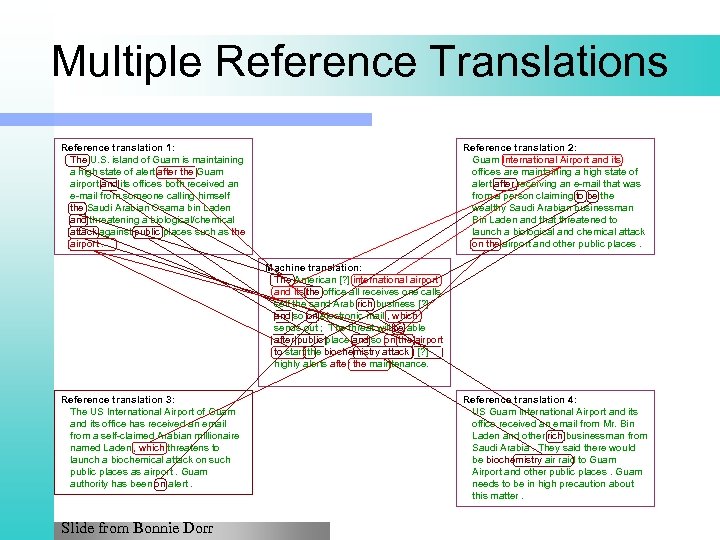 Multiple Reference Translations Reference translation 1: The U. S. island of Guam is maintaining a high state of alert after the Guam airport and its offices both received an e-mail from someone calling himself the Saudi Arabian Osama bin Laden and threatening a biological/chemical attack against public places such as the airport. Reference translation 2: Guam International Airport and its offices are maintaining a high state of alert after receiving an e-mail that was from a person claiming to be the wealthy Saudi Arabian businessman Bin Laden and that threatened to launch a biological and chemical attack on the airport and other public places. Machine translation: The American [? ] international airport and its the office all receives one calls self the sand Arab rich business [? ] and so on electronic mail , which sends out ; The threat will be able after public place and so on the airport to start the biochemistry attack , [? ] highly alerts after the maintenance. Reference translation 3: The US International Airport of Guam and its office has received an email from a self-claimed Arabian millionaire named Laden , which threatens to launch a biochemical attack on such public places as airport. Guam authority has been on alert. Slide from Bonnie Dorr Reference translation 4: US Guam International Airport and its office received an email from Mr. Bin Laden and other rich businessman from Saudi Arabia. They said there would be biochemistry air raid to Guam Airport and other public places. Guam needs to be in high precaution about this matter.
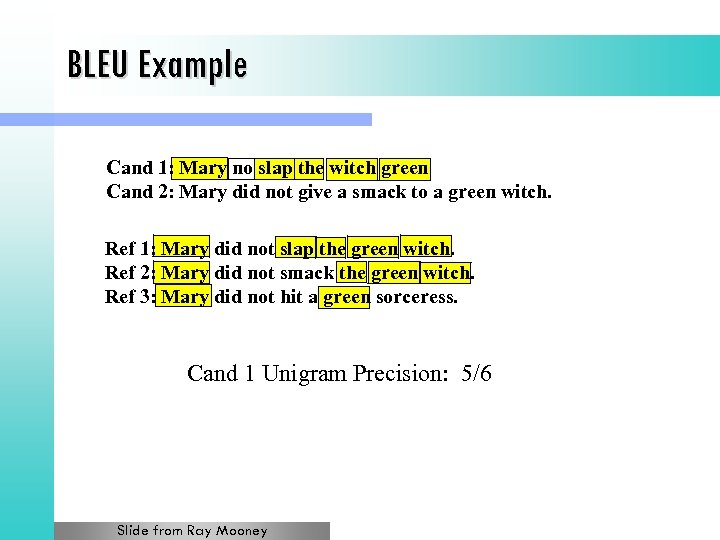 BLEU Example Cand 1: Mary no slap the witch green Cand 2: Mary did not give a smack to a green witch. Ref 1: Mary did not slap the green witch. Ref 2: Mary did not smack the green witch. Ref 3: Mary did not hit a green sorceress. Cand 1 Unigram Precision: 5/6 Slide from Ray Mooney
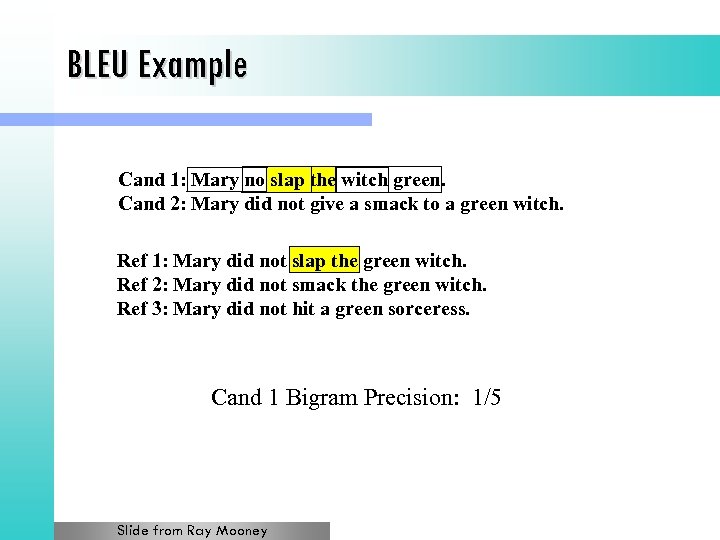 BLEU Example Cand 1: Mary no slap the witch green. Cand 2: Mary did not give a smack to a green witch. Ref 1: Mary did not slap the green witch. Ref 2: Mary did not smack the green witch. Ref 3: Mary did not hit a green sorceress. Cand 1 Bigram Precision: 1/5 Slide from Ray Mooney
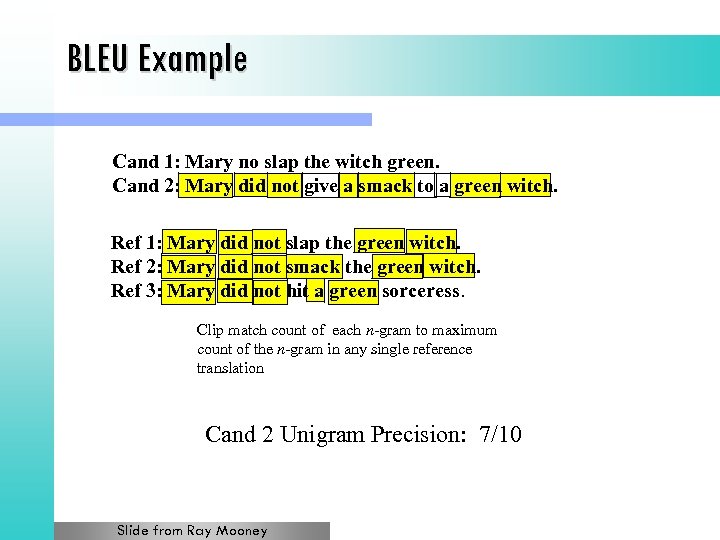 BLEU Example Cand 1: Mary no slap the witch green. Cand 2: Mary did not give a smack to a green witch. Ref 1: Mary did not slap the green witch. Ref 2: Mary did not smack the green witch. Ref 3: Mary did not hit a green sorceress. Clip match count of each n-gram to maximum count of the n-gram in any single reference translation Cand 2 Unigram Precision: 7/10 Slide from Ray Mooney
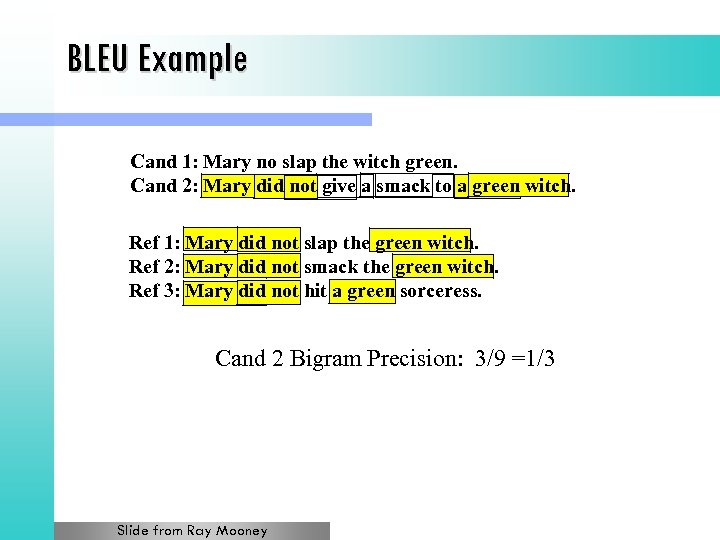 BLEU Example Cand 1: Mary no slap the witch green. Cand 2: Mary did not give a smack to a green witch. Ref 1: Mary did not slap the green witch. Ref 2: Mary did not smack the green witch. Ref 3: Mary did not hit a green sorceress. Cand 2 Bigram Precision: 3/9 =1/3 Slide from Ray Mooney
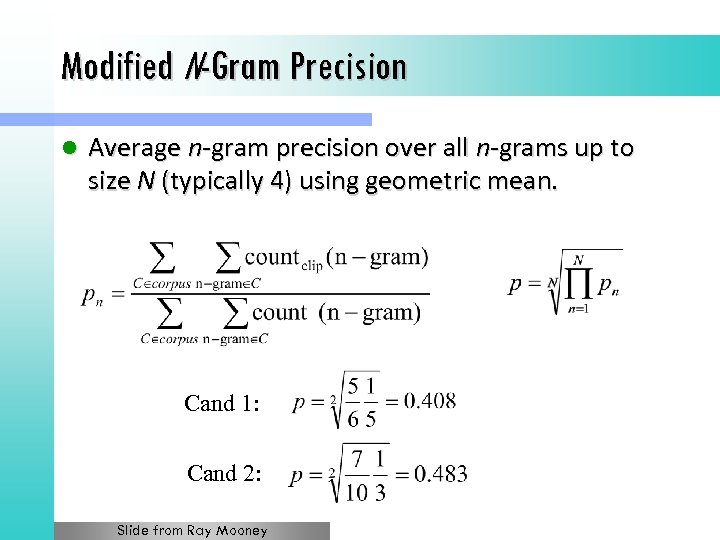 Modified N-Gram Precision l Average n-gram precision over all n-grams up to size N (typically 4) using geometric mean. Cand 1: Cand 2: Slide from Ray Mooney
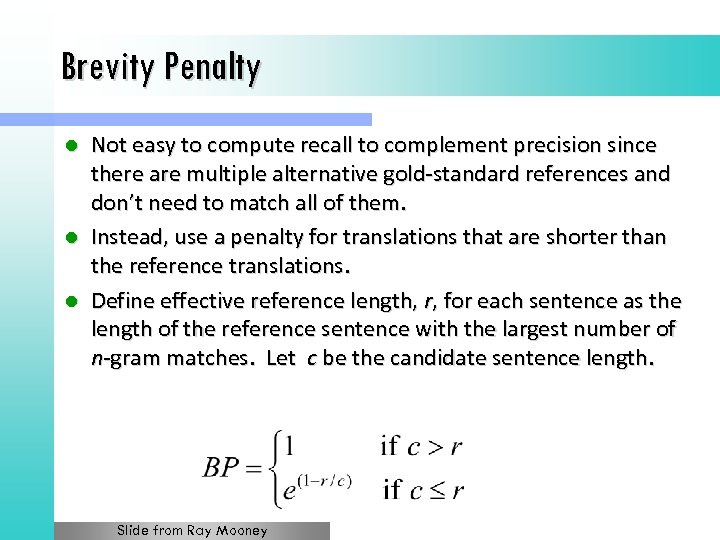 Brevity Penalty Not easy to compute recall to complement precision since there are multiple alternative gold-standard references and don’t need to match all of them. l Instead, use a penalty for translations that are shorter than the reference translations. l Define effective reference length, r, for each sentence as the length of the reference sentence with the largest number of n-gram matches. Let c be the candidate sentence length. l Slide from Ray Mooney
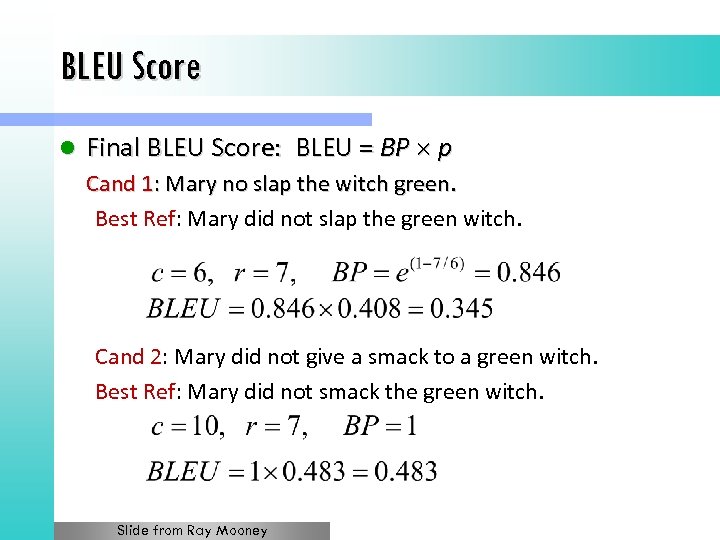 BLEU Score l Final BLEU Score: BLEU = BP p Cand 1: Mary no slap the witch green. Best Ref: Mary did not slap the green witch. Cand 2: Mary did not give a smack to a green witch. Best Ref: Mary did not smack the green witch. Slide from Ray Mooney
 BLEU Score Issues BLEU has been shown to correlate with human evaluation when comparing outputs from different SMT systems. l However, it does not correlate with human judgments when comparing SMT systems with manually developed MT (Systran) or MT with human translations. l Other MT evaluation metrics have been proposed that claim to overcome some of the limitations of BLEU. l Slide from Ray Mooney
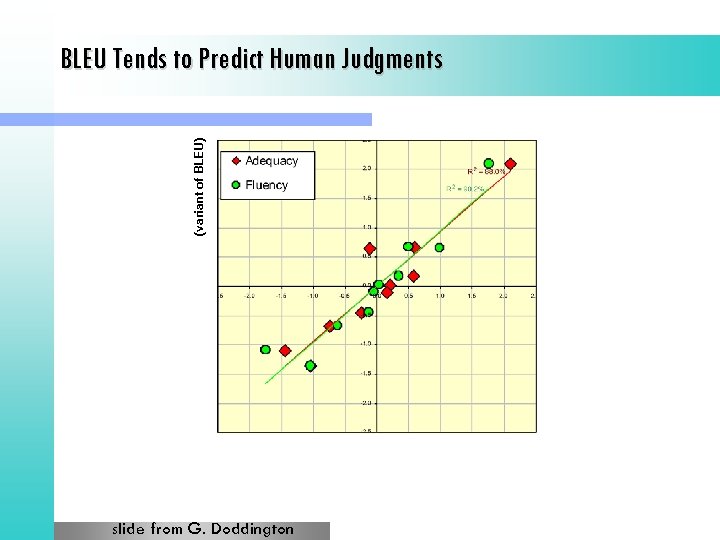 (variant of BLEU) BLEU Tends to Predict Human Judgments slide from G. Doddington
 Syntax-Based Statistical Machine Translation Recent SMT methods have adopted a syntactic transfer approach. l Improved results demonstrated for translating between more distant language pairs, e. g. Chinese/English. l Slide from Ray Mooney
 Synchronous Grammar Multiple parse trees in a single derivation. l Used by (Chiang, 2005; Galley et al. , 2006). l Describes the hierarchical structures of a sentence and its translation, and also the correspondence between their sub-parts. l Slide from Ray Mooney
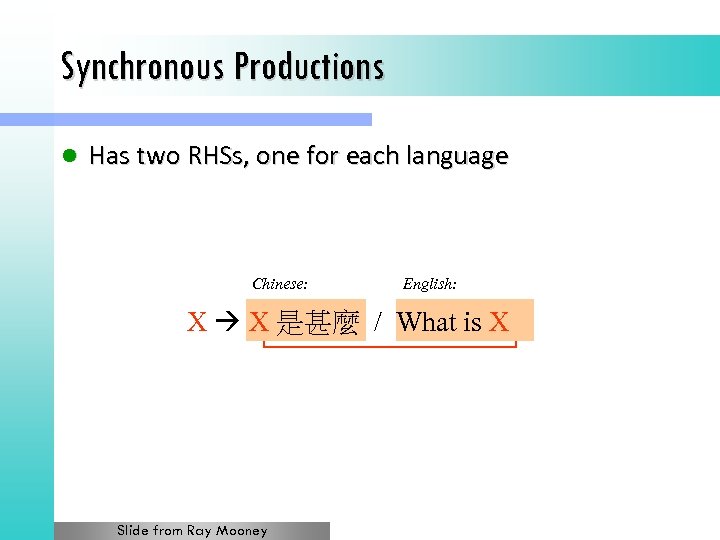 Synchronous Productions l Has two RHSs, one for each language Chinese: English: X X 是甚麼 / What is X Slide from Ray Mooney
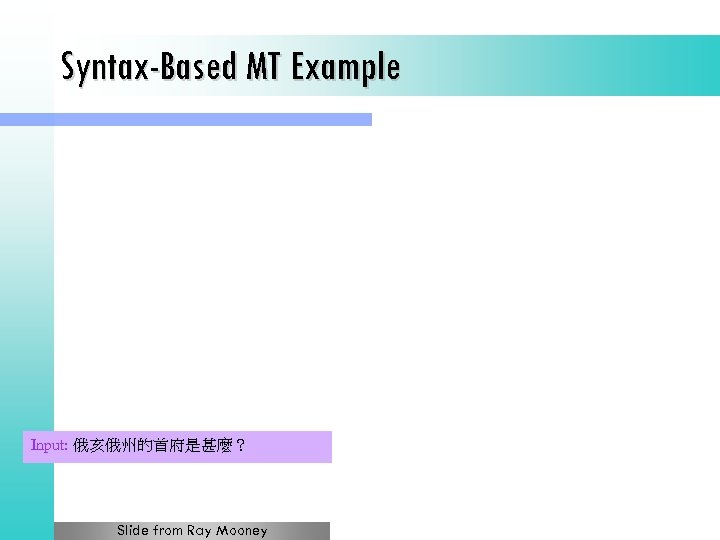 Syntax-Based MT Example Input: 俄亥俄州的首府是甚麼? Slide from Ray Mooney
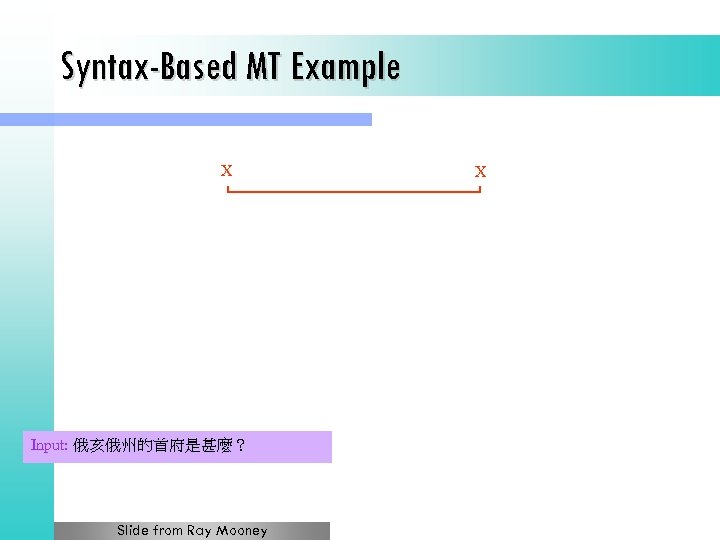 Syntax-Based MT Example X Input: 俄亥俄州的首府是甚麼? Slide from Ray Mooney X
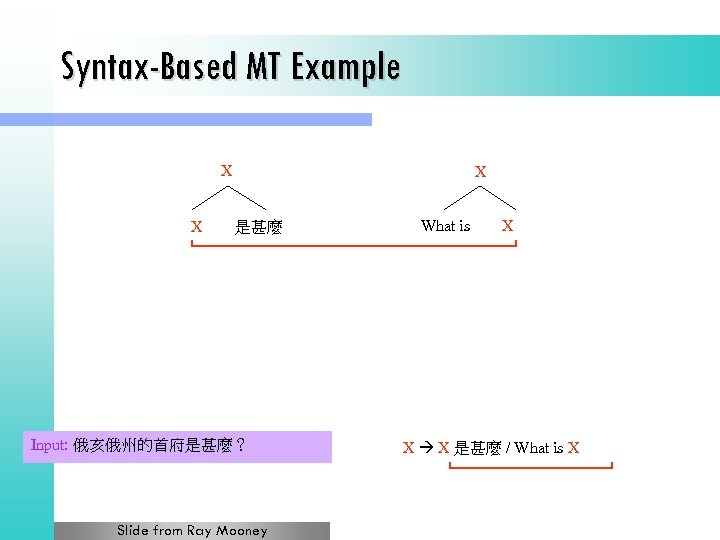 Syntax-Based MT Example X X X 是甚麼 Input: 俄亥俄州的首府是甚麼? Slide from Ray Mooney What is X X X 是甚麼 / What is X
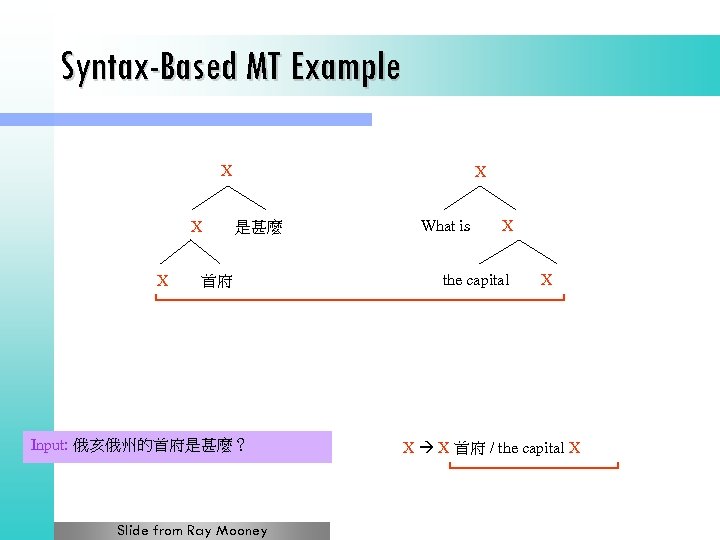 Syntax-Based MT Example X X 是甚麼 首府 Input: 俄亥俄州的首府是甚麼? Slide from Ray Mooney What is X the capital X X X 首府 / the capital X
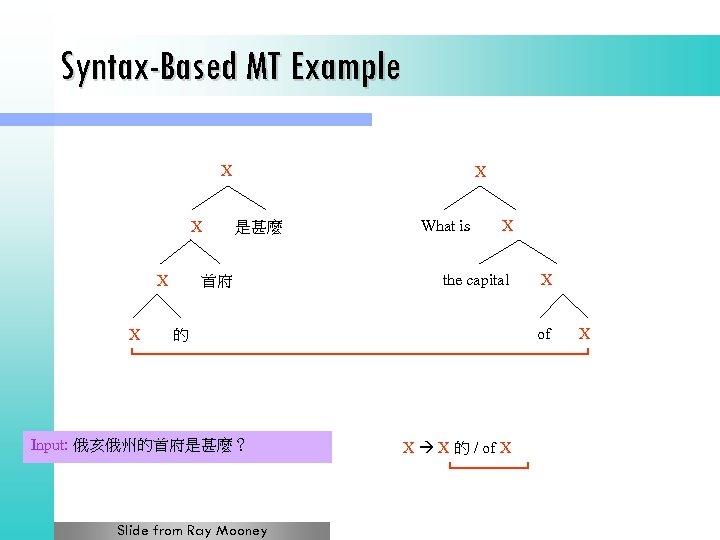 Syntax-Based MT Example X X X 是甚麼 首府 What is X the capital of 的 Input: 俄亥俄州的首府是甚麼? Slide from Ray Mooney X X X 的 / of X X
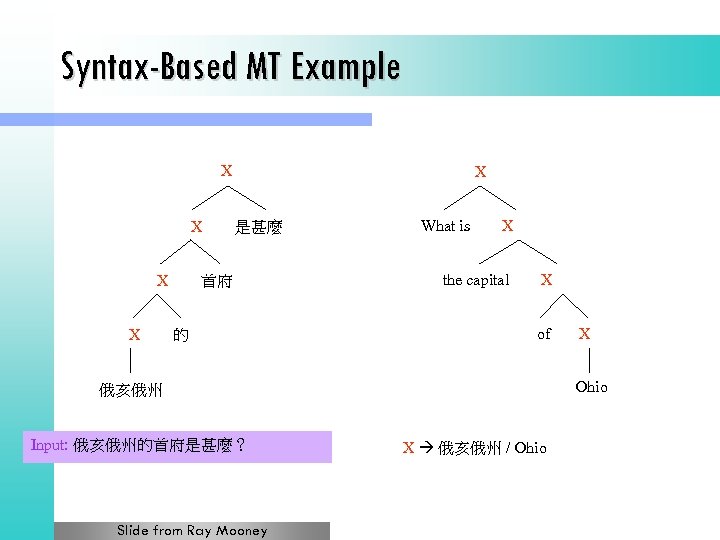 Syntax-Based MT Example X X X 是甚麼 首府 的 What is X the capital X of Ohio 俄亥俄州 Input: 俄亥俄州的首府是甚麼? Slide from Ray Mooney X X 俄亥俄州 / Ohio
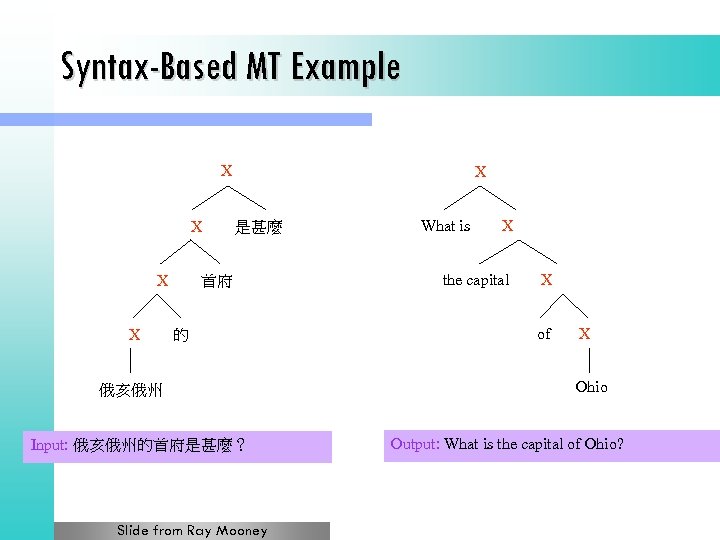 Syntax-Based MT Example X X X 是甚麼 首府 的 俄亥俄州 Input: 俄亥俄州的首府是甚麼? Slide from Ray Mooney What is X the capital X of X Ohio Output: What is the capital of Ohio?
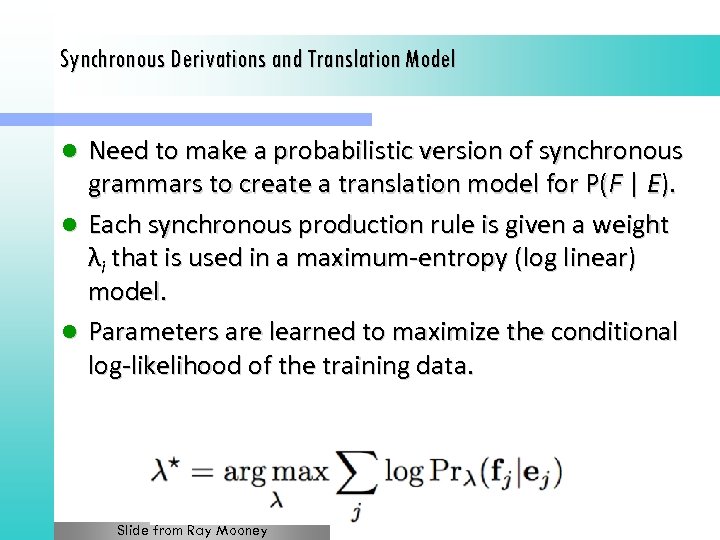 Synchronous Derivations and Translation Model Need to make a probabilistic version of synchronous grammars to create a translation model for P(F | E). l Each synchronous production rule is given a weight λi that is used in a maximum-entropy (log linear) model. l Parameters are learned to maximize the conditional log-likelihood of the training data. l Slide from Ray Mooney
 MERT
MERT
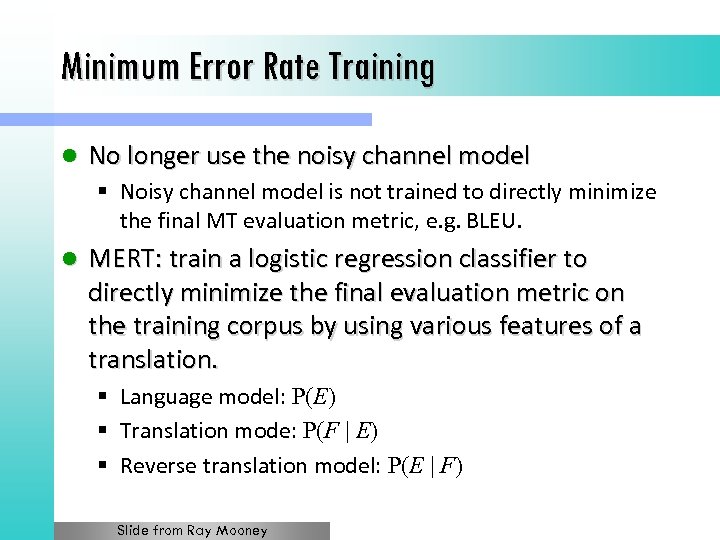 Minimum Error Rate Training l No longer use the noisy channel model § Noisy channel model is not trained to directly minimize the final MT evaluation metric, e. g. BLEU. l MERT: train a logistic regression classifier to directly minimize the final evaluation metric on the training corpus by using various features of a translation. § Language model: P(E) § Translation mode: P(F | E) § Reverse translation model: P(E | F) Slide from Ray Mooney
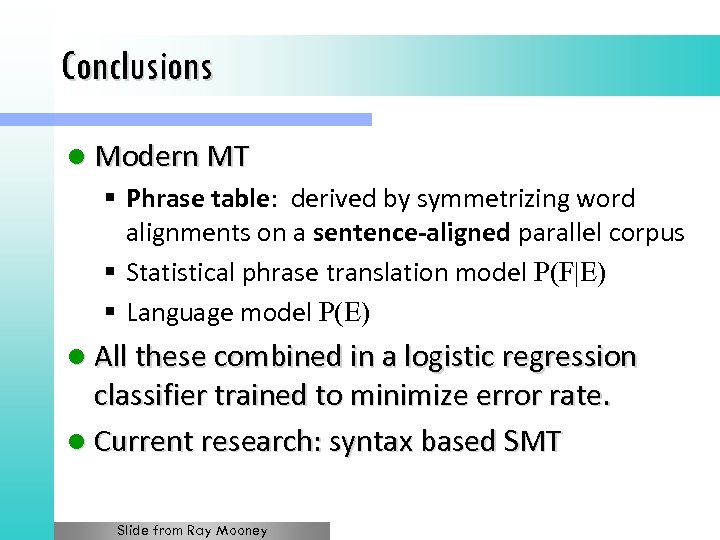 Conclusions l Modern MT § Phrase table: derived by symmetrizing word alignments on a sentence-aligned parallel corpus § Statistical phrase translation model P(F|E) § Language model P(E) l All these combined in a logistic regression classifier trained to minimize error rate. l Current research: syntax based SMT Slide from Ray Mooney