


 Скачать презентацию Statewide Special Education Directors Meeting June 28 2012
47ecb175ed5fe1e7f37cd71d9198a06c.ppt
- Количество слайдов: 67
 Statewide Special Education Directors Meeting June 28, 2012 Trecina Green, Associate Superintendent Instructional Enhancement
 Common Core State Standards Update 2
 What is the CCSS Initiative? • An initiative of the National Governors Association (NGA) and the Council of Chief State School Officers (CCSSO) • A significant and historic opportunity for states collectively to develop and adopt a core set of academic standards in Mathematics and English/Language Arts 3
 The Common Core State Standards Initiative • Beginning in the spring of 2009, Governors and state commissioners of education from 48 states, 2 territories and the District of Columbia committed to developing a common core of rigorous state K-12 standards. • In June 2010, the final Common Core State Standards (CCSS) were released by NGA and CCSSO. • To date, 46 states and the District of Columbia have adopted the Standards (MS adopted the CCSS in August, 2010). • Most states intend to fully implement the new standards by the 2014 -15 school year. 4
 What are the Common Core State Standards (CCSS)? • Fewer, clearer, and higher • Aligned with college and work expectations • Rigorous content requiring higher-order thinking and application of knowledge • Internationally benchmarked • Evidence- and/or research-based 5
 Why is this initiative important? • • • Provides consistency across states Allows for equal access Prepares students to compete globally Allows for more focused professional development Allows for the development of a common assessment Provides the opportunity to compare and evaluate policies that affect student achievement across states 6
 Key Advances in the Common Core ELA/Literacy Standards Reading • Balance of literature and informational texts • Focus on text complexity and what students read Writing • Emphasis on argument and informative/explanatory writing • Writing about sources (evidence) Speaking and Listening • Inclusion of formal and informal talk Language • Stress on academic and domain-specific vocabulary Address reading and writing across the curriculum • Responsibility of teachers in those subjects • Complement rather than replace content standards in those subjects 7
 Key Advances in the Common Core Math Standards Focus and coherence • Focus on key topics at each grade level • Coherent progressions across grade levels Depth over breadth • Allows more time for mastery Balance of concepts and skills • Content standards require both conceptual understanding and procedural fluency Mathematical practices • Foster reasoning, modeling, and sense-making in mathematics 8
 Shift from “What’s Taught” to “What Students Need to Be Able to Do” To succeed in 21 st century college and careers, students need to be able to: 1. Solve problems 5. Reflect on / improve performance 2. Manage oneself 6. Communicate 3. Adapt to change 7. Work in teams 4. Analyze/conceptualize 8. Create / innovate / critique 9. Engage in learning throughout life 9
 Instructional Delivery System At a minimum, to successfully implement Common Core State Standards and Assessments, TEACHERS must: 1. Know how to plan intentionally for rigorous and deep learning experiences. 2. Know how to design and utilize formative assessment that ensures retention and the ability to apply learning. 3. Be able to create a learning environment that fosters deep thinking, engagement of students, integration of subject areas, and problembased learning experiences. 4. Be able to analyze and use a variety of data to drive instructional practice. 5. Embrace continuous professional learning. 10
 What is not included in the CCSS? • How teachers should teach • All that can or should be taught • Intervention strategies to support students • The full range of support appropriate for English Language Learners and for students with special needs • Textbooks to help with implementation 11
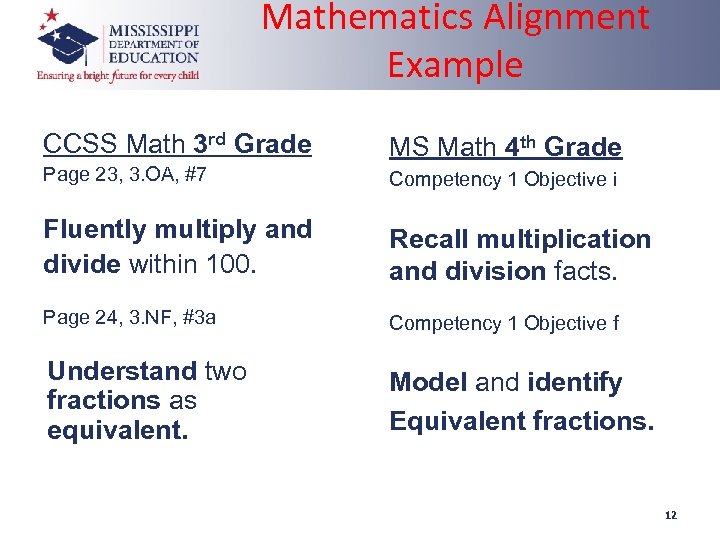 Mathematics Alignment Example CCSS Math 3 rd Grade MS Math 4 th Grade Page 23, 3. OA, #7 Competency 1 Objective i Fluently multiply and divide within 100. Recall multiplication and division facts. Page 24, 3. NF, #3 a Competency 1 Objective f Understand two fractions as equivalent. Model and identify Equivalent fractions. 12
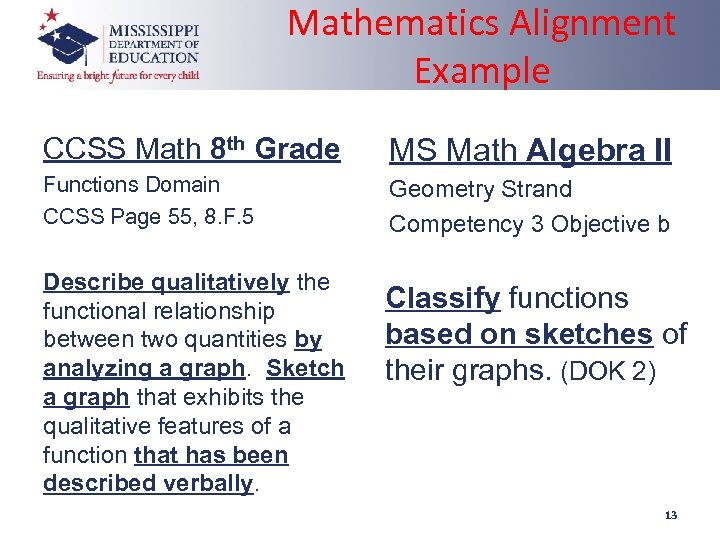 Mathematics Alignment Example CCSS Math 8 th Grade MS Math Algebra II Functions Domain CCSS Page 55, 8. F. 5 Geometry Strand Competency 3 Objective b Describe qualitatively the functional relationship between two quantities by analyzing a graph. Sketch a graph that exhibits the qualitative features of a function that has been described verbally. Classify functions based on sketches of their graphs. (DOK 2) 13
 Alignment of CCSS for Math and MS Math Framework • Overall alignment is not good • Many specifics in the CCSS are addressed in the MS Math Framework but at a lower grade level(s) • Several of the MS Math Framework objectives are not mentioned in the Common Core • CCSS for Math are more rigorous than the MS Math Framework 14
 ELA Alignment Example CCSS ELA 3 rd Grade Page 14, RI, #1 Ask and answer questions to demonstrate understanding of a text, explicitly using the text as the basis for the answers. MS ELA 3 rd Grade Competency 2 Objective 2 d Analyze texts in order to identify, understand, infer, or synthesize information. -answer and generate questions -identify cause and effect as stated in text 15
 ELA Alignment Example CCSS ELA grade 7 Integration of Knowledge and Ideas CCSS Page 39, 7. RI. 9 Analyze how two or more authors writing about the same topic shape their presentations of key information by emphasizing different evidence or advancing different interpretations of facts. MS ELA grade 7 Competency 2 Objective b, #6 The student will analyze text to infer, justify, draw conclusions, synthesize, or evaluate information. (DOK 3) 6) Synthesize information stated in one or more texts with prior knowledge and experience to draw valid conclusions with supporting evidence including text-based evidence. 16
 Alignment of CCSS English Language Arts (ELA) and MS ELA • Overall alignment is good • Few specifics in the Common Core are not addressed in the MS ELA Framework or not addressed at the same grade level • Many of the MS ELA Framework objectives and subobjectives are not mentioned in the Common Core • Rigor is comparable 17
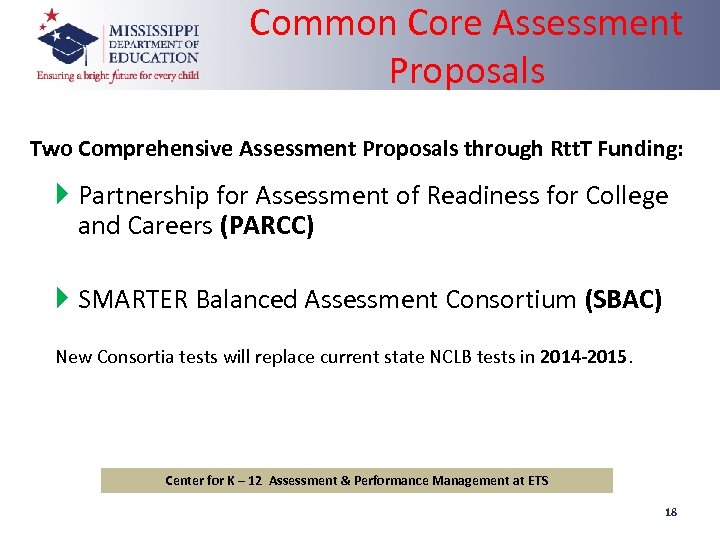 Common Core Assessment Proposals Two Comprehensive Assessment Proposals through Rtt. T Funding: Partnership for Assessment of Readiness for College and Careers (PARCC) SMARTER Balanced Assessment Consortium (SBAC) New Consortia tests will replace current state NCLB tests in 2014 -2015. Center for K – 12 Assessment & Performance Management at ETS 18
 Partnership for the Assessment of Readiness for College and Careers (PARCC) • Mississippi is a governing state in the PARCC consortium; as such, Mississippi will be on the governing board that makes decisions about the assessment design and development. • The assessment design was revised in June 2011. 19
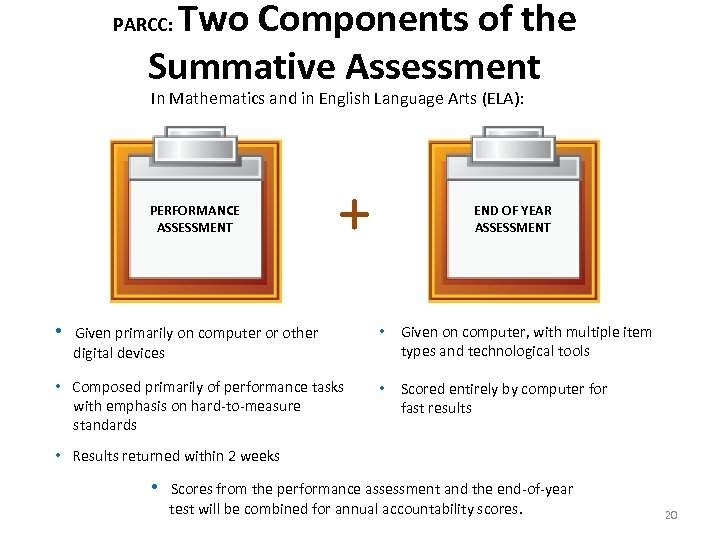 Two Components of the Summative Assessment PARCC: In Mathematics and in English Language Arts (ELA): PERFORMANCE ASSESSMENT • + Given primarily on computer or other digital devices • Composed primarily of performance tasks with emphasis on hard-to-measure standards END OF YEAR ASSESSMENT • Given on computer, with multiple item types and technological tools • Scored entirely by computer for fast results • Results returned within 2 weeks • Scores from the performance assessment and the end-of-year test will be combined for annual accountability scores. 20
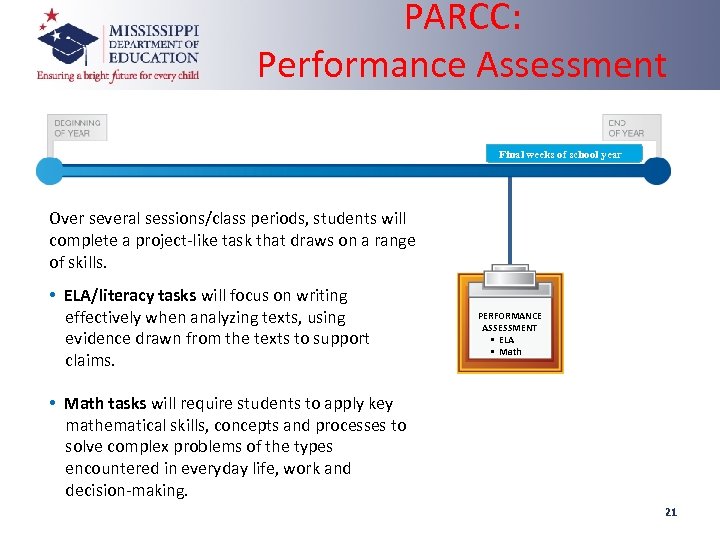 PARCC: Performance Assessment Final weeks of school year Over several sessions/class periods, students will complete a project-like task that draws on a range of skills. • ELA/literacy tasks will focus on writing effectively when analyzing texts, using evidence drawn from the texts to support claims. PERFORMANCE ASSESSMENT • ELA • Math tasks will require students to apply key mathematical skills, concepts and processes to solve complex problems of the types encountered in everyday life, work and decision-making. 21
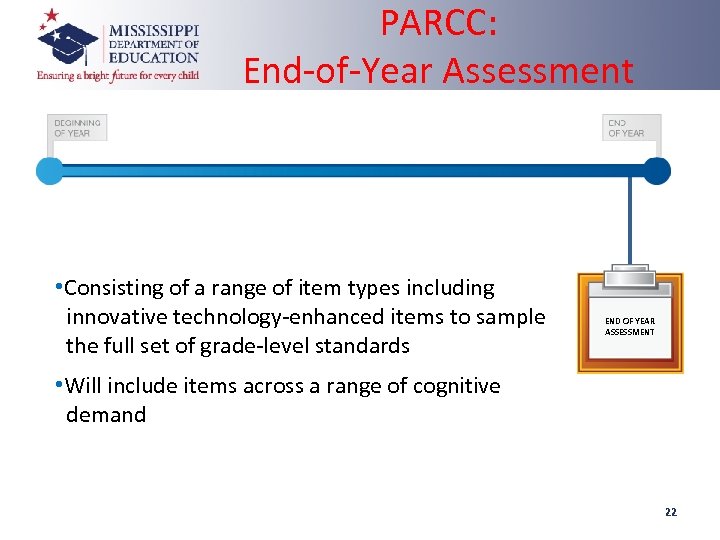 PARCC: End-of-Year Assessment • Consisting of a range of item types including innovative technology-enhanced items to sample the full set of grade-level standards END OF YEAR ASSESSMENT • Will include items across a range of cognitive demand 22
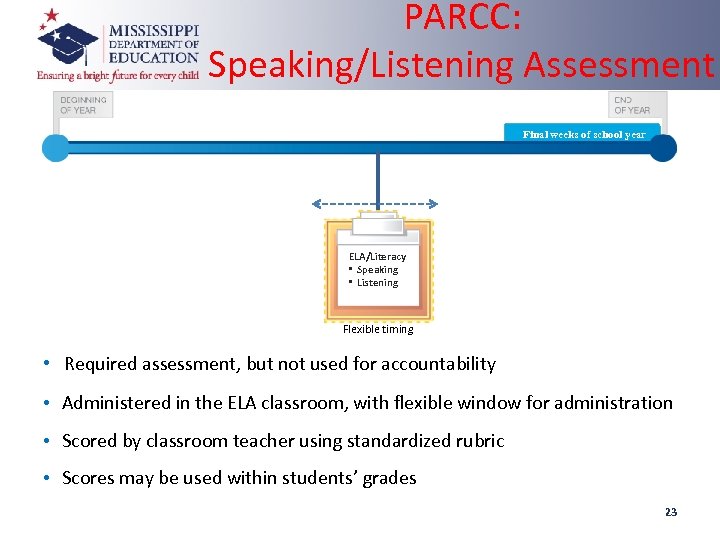 PARCC: Speaking/Listening Assessment Final weeks of school year ELA/Literacy • Speaking • Listening Flexible timing • Required assessment, but not used for accountability • Administered in the ELA classroom, with flexible window for administration • Scored by classroom teacher using standardized rubric • Scores may be used within students’ grades 23
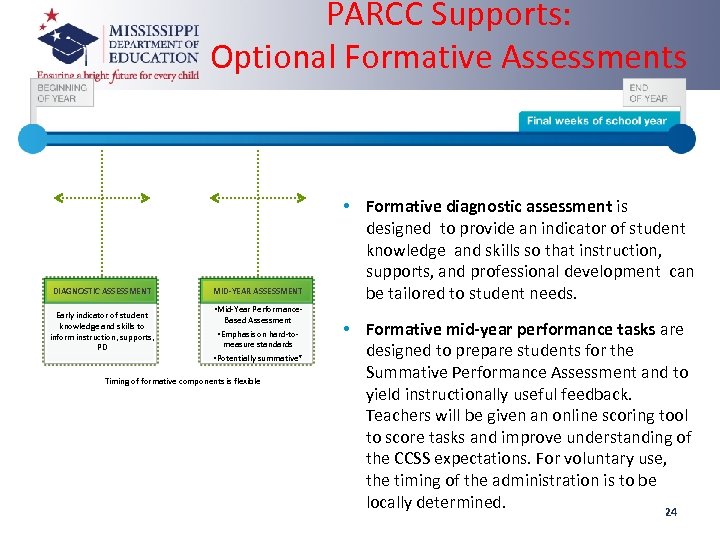 PARCC Supports: Optional Formative Assessments DIAGNOSTIC ASSESSMENT Early indicator of student knowledge and skills to inform instruction, supports, PD MID-YEAR ASSESSMENT • Mid-Year Performance. Based Assessment • Emphasis on hard-tomeasure standards • Potentially summative* Timing of formative components is flexible • Formative diagnostic assessment is designed to provide an indicator of student knowledge and skills so that instruction, supports, and professional development can be tailored to student needs. • Formative mid-year performance tasks are designed to prepare students for the Summative Performance Assessment and to yield instructionally useful feedback. Teachers will be given an online scoring tool to score tasks and improve understanding of the CCSS expectations. For voluntary use, the timing of the administration is to be locally determined. 24
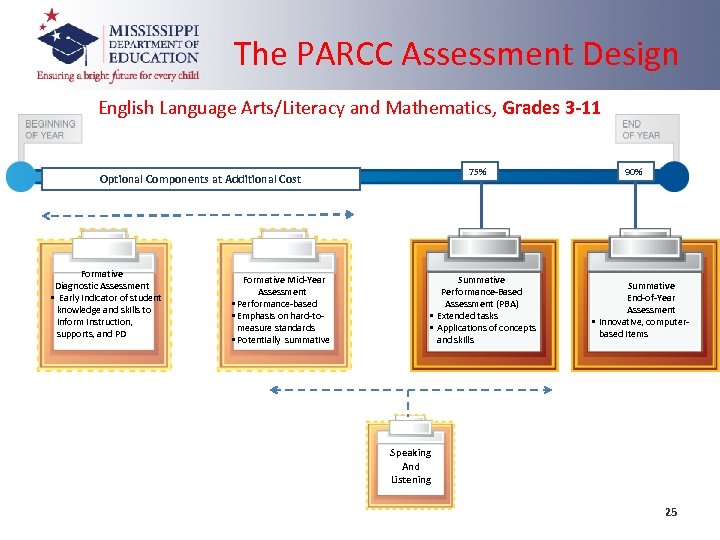 The PARCC Assessment Design English Language Arts/Literacy and Mathematics, Grades 3 -11 75% Optional Components at Additional Cost Formative Diagnostic Assessment • Early indicator of student knowledge and skills to inform instruction, supports, and PD Formative Mid-Year Assessment • Performance-based • Emphasis on hard-tomeasure standards • Potentially summative Summative Performance-Based Assessment (PBA) • Extended tasks • Applications of concepts and skills 90% Summative End-of-Year Assessment • Innovative, computerbased items Speaking And Listening 25
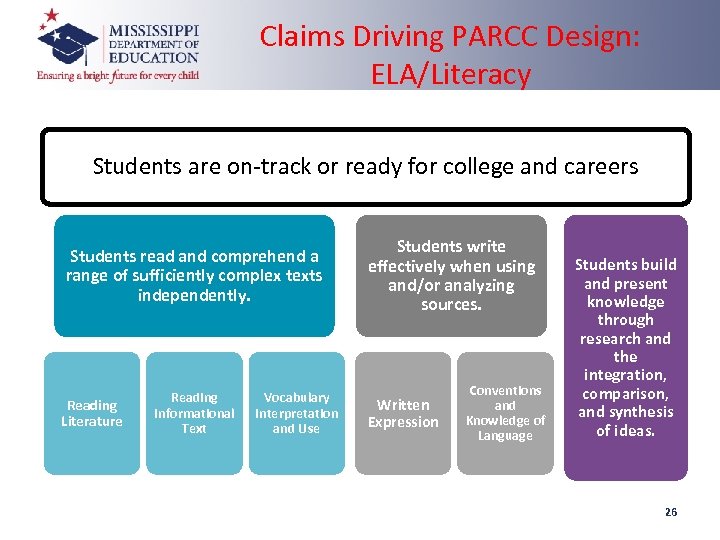 Claims Driving PARCC Design: ELA/Literacy Students are on-track or ready for college and careers Students read and comprehend a range of sufficiently complex texts independently. Reading Literature Reading Informational Text Vocabulary Interpretation and Use Students write effectively when using and/or analyzing sources. Written Expression Conventions and Knowledge of Language Students build and present knowledge through research and the integration, comparison, and synthesis of ideas. 26
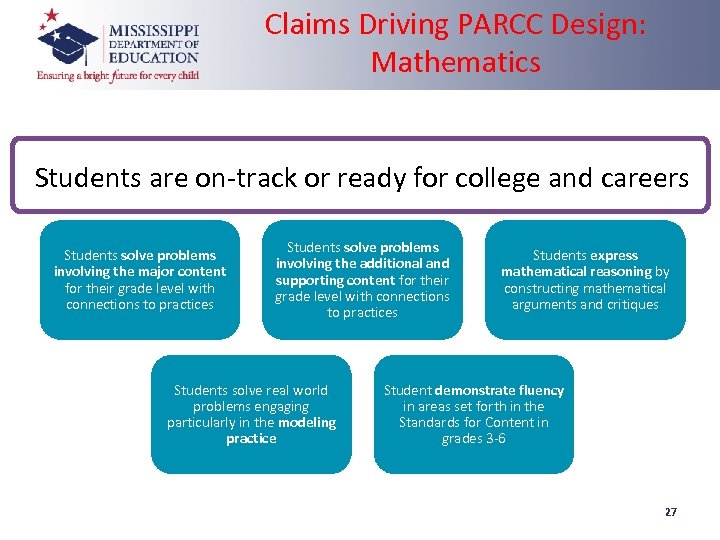 Claims Driving PARCC Design: Mathematics Students are on-track or ready for college and careers Students solve problems involving the major content for their grade level with connections to practices Students solve problems involving the additional and supporting content for their grade level with connections to practices Students solve real world problems engaging particularly in the modeling practice Students express mathematical reasoning by constructing mathematical arguments and critiques Student demonstrate fluency in areas set forth in the Standards for Content in grades 3 -6 27
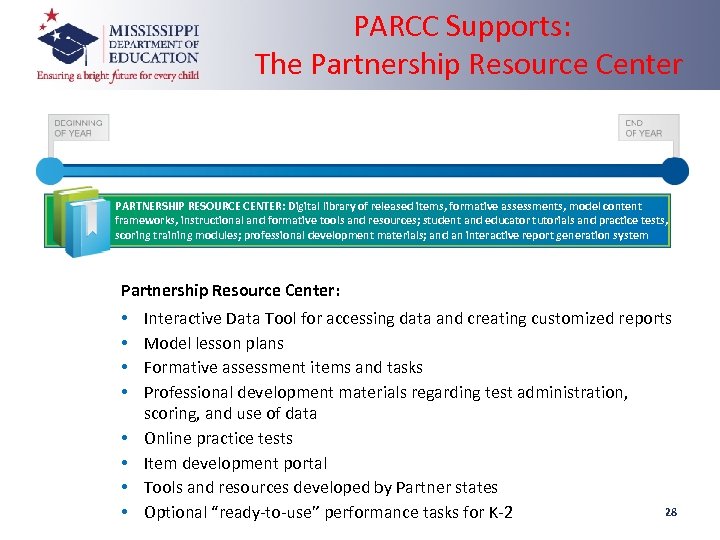 PARCC Supports: The Partnership Resource Center PARTNERSHIP RESOURCE CENTER: Digital library of released items, formative assessments, model content frameworks, instructional and formative tools and resources; student and educator tutorials and practice tests, scoring training modules; professional development materials; and an interactive report generation system Partnership Resource Center: • • Interactive Data Tool for accessing data and creating customized reports Model lesson plans Formative assessment items and tasks Professional development materials regarding test administration, scoring, and use of data Online practice tests Item development portal Tools and resources developed by Partner states 28 Optional “ready-to-use” performance tasks for K-2
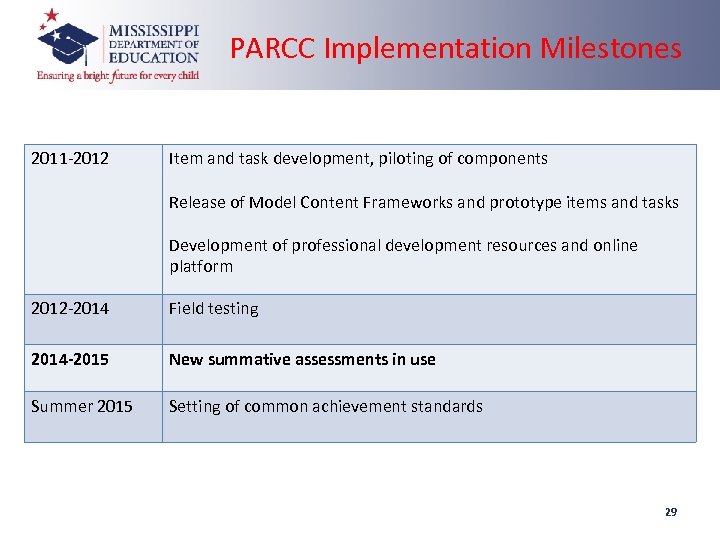 PARCC Implementation Milestones 2011 -2012 Item and task development, piloting of components Release of Model Content Frameworks and prototype items and tasks Development of professional development resources and online platform 2012 -2014 Field testing 2014 -2015 New summative assessments in use Summer 2015 Setting of common achievement standards 29
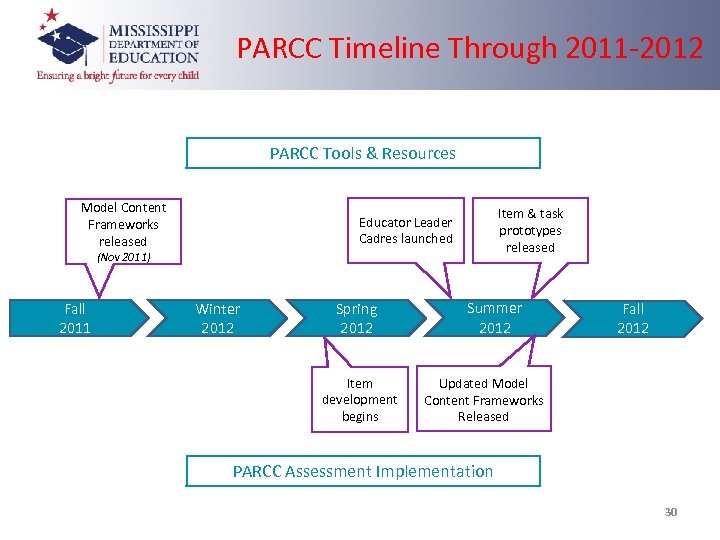 PARCC Timeline Through 2011 -2012 PARCC Tools & Resources Model Content Frameworks released Item & task prototypes released Educator Leader Cadres launched (Nov 2011) Fall 2011 Winter 2012 Spring 2012 Item development begins Summer 2012 Fall 2012 Updated Model Content Frameworks Released PARCC Assessment Implementation 30
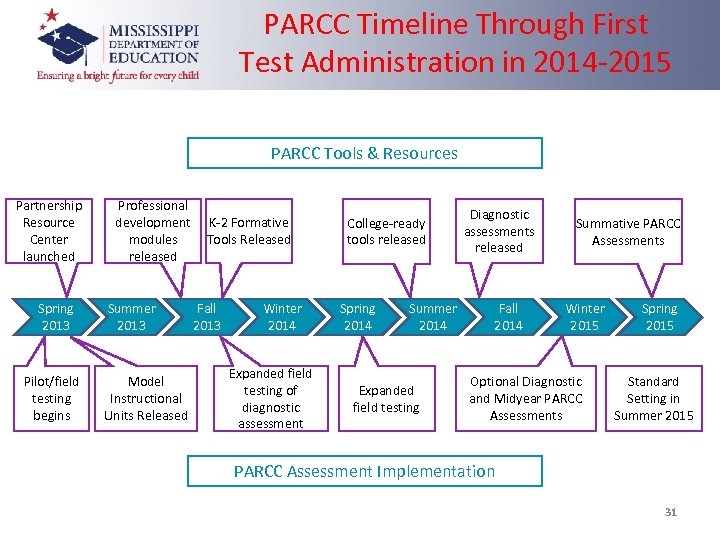 PARCC Timeline Through First Test Administration in 2014 -2015 PARCC Tools & Resources Partnership Resource Center launched Spring 2013 Pilot/field testing begins Professional development modules released Summer 2013 Model Instructional Units Released K-2 Formative Tools Released Fall 2013 Winter 2014 Expanded field testing of diagnostic assessment College-ready tools released Spring 2014 Summer 2014 Expanded field testing Diagnostic assessments released Fall 2014 Summative PARCC Assessments Winter 2015 Optional Diagnostic and Midyear PARCC Assessments Spring 2015 Standard Setting in Summer 2015 PARCC Assessment Implementation 31
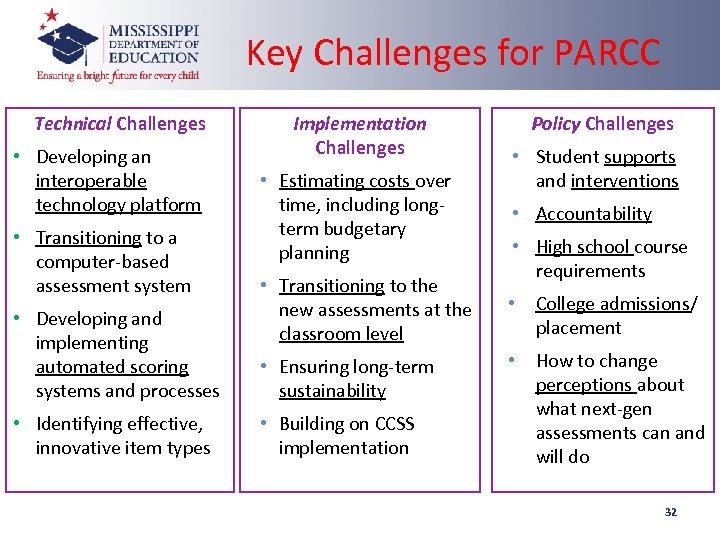 Key Challenges for PARCC Technical Challenges • Developing an interoperable technology platform • Transitioning to a computer-based assessment system • Developing and implementing automated scoring systems and processes • Identifying effective, innovative item types Implementation Challenges • Estimating costs over time, including longterm budgetary planning • Transitioning to the new assessments at the classroom level • Ensuring long-term sustainability • Building on CCSS implementation Policy Challenges • Student supports and interventions • Accountability • High school course requirements • College admissions/ placement • How to change perceptions about what next-gen assessments can and will do 32
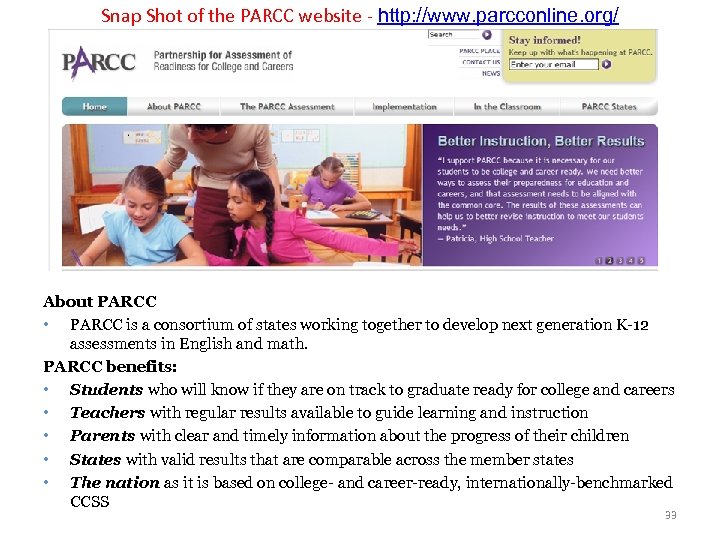 Snap Shot of the PARCC website - http: //www. parcconline. org/ About PARCC • PARCC is a consortium of states working together to develop next generation K-12 assessments in English and math. PARCC benefits: • Students who will know if they are on track to graduate ready for college and careers • Teachers with regular results available to guide learning and instruction • Parents with clear and timely information about the progress of their children • States with valid results that are comparable across the member states • The nation as it is based on college- and career-ready, internationally-benchmarked CCSS 33
 Dynamic Learning Maps Alternate Assessment Consortium Center for Educational Testing and Evaluation University of Kansas
 Dynamic Learning Maps • With the transition to Common Core State Standards (CCSS) and PARCC assessments, our students with Significant Cognitive Disabilities (SCD) who currently participate in the MAAECF will transition to the use of Common Core Essential Elements (CCEE) and Dynamic Learning Maps (DLM) assessments. • Mississippi is a governing state in the Dynamic Learning Maps Consortia. • More information regarding Dynamic Learning Maps can be found at www. dynamiclearningmaps. org. 35
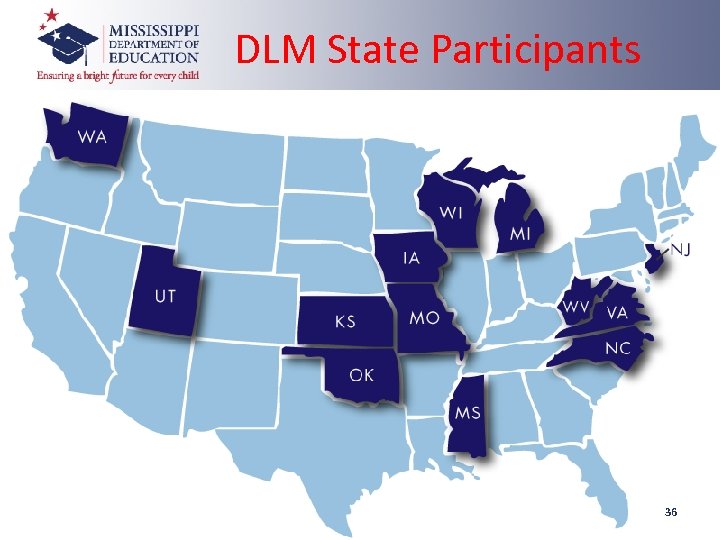 DLM State Participants 36
 DLM Delivery Team • University of Kansas – Center for Educational Testing and Evaluation – Beach Center on Disability – Center for Research Methods and Data Analysis – Center for Research on Learning – Faculty in several departments • The ARC • The Center for Literacy and Disability Studies at the University of North Carolina at Chapel Hill • Edvantia 37
 DLM Key Features • Common Core Essential Elements (CCEE) and achievement level descriptors (ALD) • Learning maps • Dynamic assessment • Inclusion of instructionally-relevant tasks • Instructionally-embedded and stand-alone versions • Advanced feedback and reporting systems (including growth modeling) 38
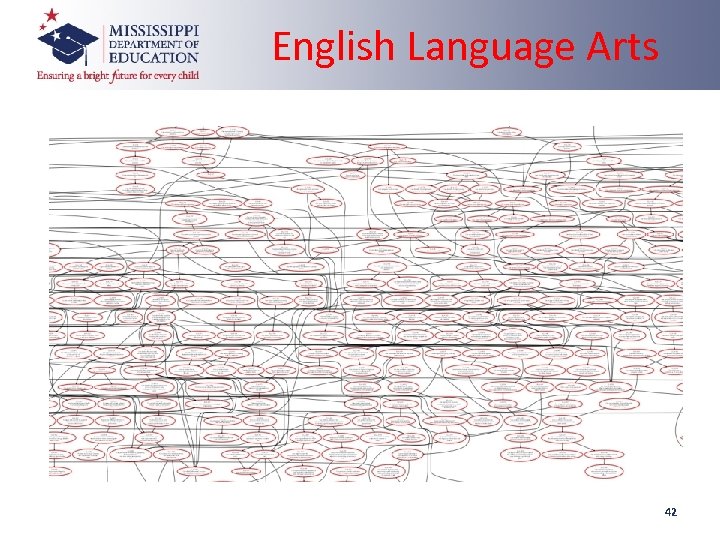
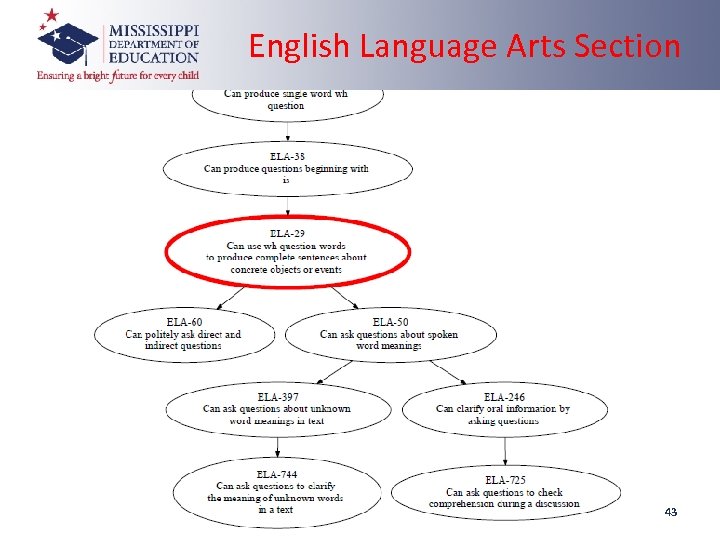
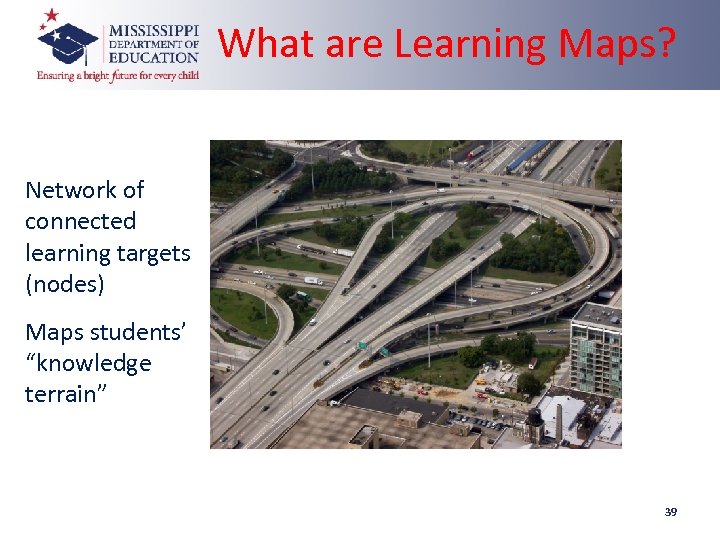 What are Learning Maps? Network of connected learning targets (nodes) Maps students’ “knowledge terrain” 39
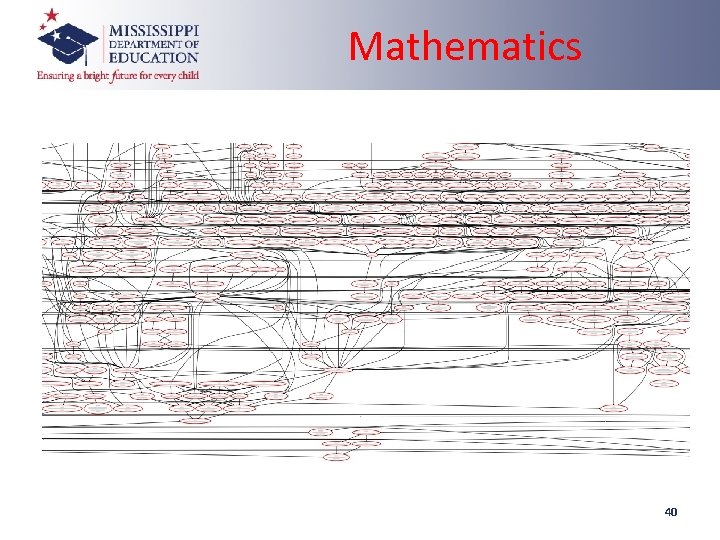 Mathematics 40
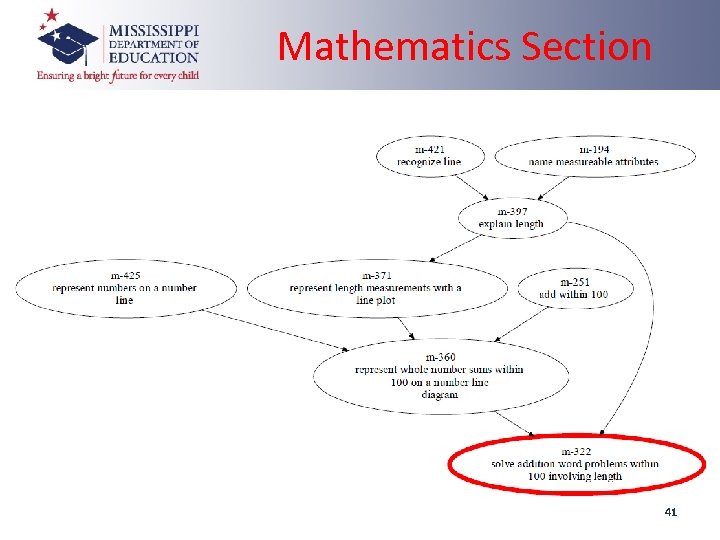 Mathematics Section 41
 English Language Arts 42
 English Language Arts Section 43
 DLM Key Features • Technology platform • Universal design • Evidence-centered design including cognitive labs • Structured scaffolding • Development of over 11, 900 tasks/items • Professional development 44
 DLM Common Core Essential Elements Definition: The Common Core Essential Elements (CCEE) are specific statements of the content and skills that are linked to the Common Core State Standards (CCSS) grade-level-specific expectations for students with significant cognitive disabilities. 45
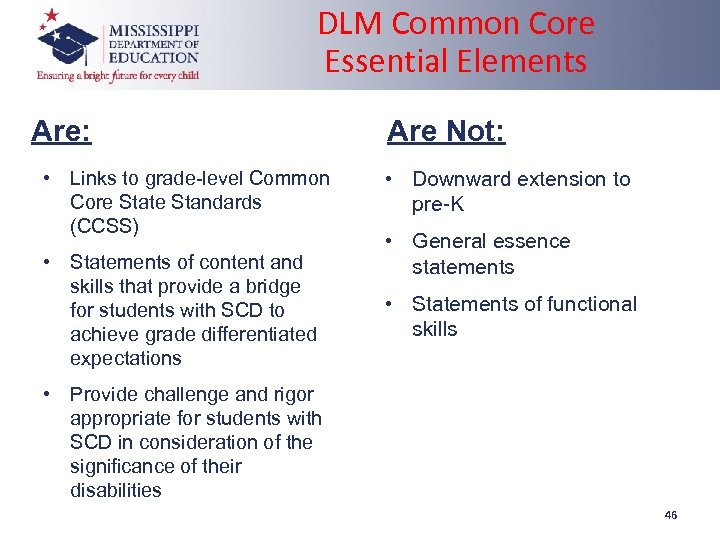 DLM Common Core Essential Elements Are: • Links to grade-level Common Core State Standards (CCSS) • Statements of content and skills that provide a bridge for students with SCD to achieve grade differentiated expectations Are Not: • Downward extension to pre-K • General essence statements • Statements of functional skills • Provide challenge and rigor appropriate for students with SCD in consideration of the significance of their disabilities 46
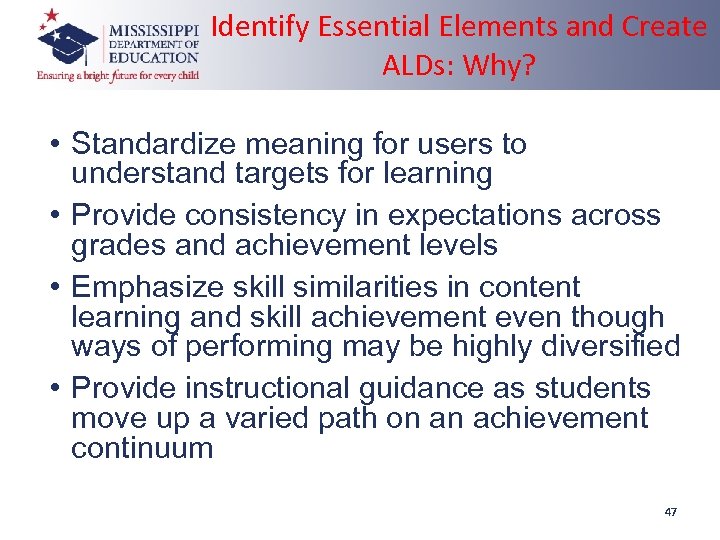 Identify Essential Elements and Create ALDs: Why? • Standardize meaning for users to understand targets for learning • Provide consistency in expectations across grades and achievement levels • Emphasize skill similarities in content learning and skill achievement even though ways of performing may be highly diversified • Provide instructional guidance as students move up a varied path on an achievement continuum 47
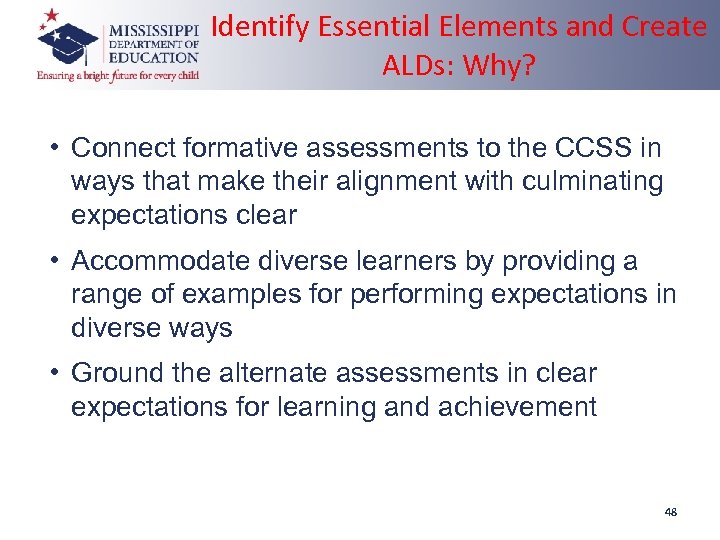 Identify Essential Elements and Create ALDs: Why? • Connect formative assessments to the CCSS in ways that make their alignment with culminating expectations clear • Accommodate diverse learners by providing a range of examples for performing expectations in diverse ways • Ground the alternate assessments in clear expectations for learning and achievement 48
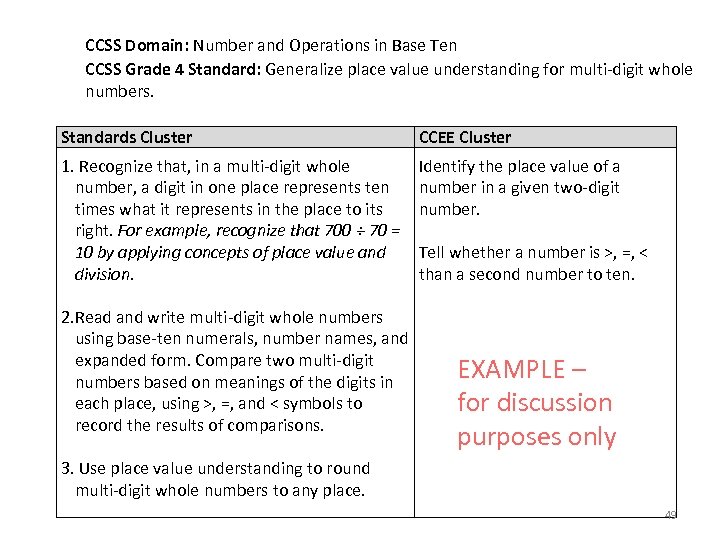 CCSS Domain: Number and Operations in Base Ten CCSS Grade 4 Standard: Generalize place value understanding for multi-digit whole numbers. Standards Cluster CCEE Cluster 1. Recognize that, in a multi-digit whole number, a digit in one place represents ten times what it represents in the place to its right. For example, recognize that 700 ÷ 70 = 10 by applying concepts of place value and division. Identify the place value of a number in a given two-digit number. 2. Read and write multi-digit whole numbers using base-ten numerals, number names, and expanded form. Compare two multi-digit numbers based on meanings of the digits in each place, using >, =, and < symbols to record the results of comparisons. Tell whether a number is >, =, < than a second number to ten. EXAMPLE – for discussion purposes only 3. Use place value understanding to round multi-digit whole numbers to any place. 49
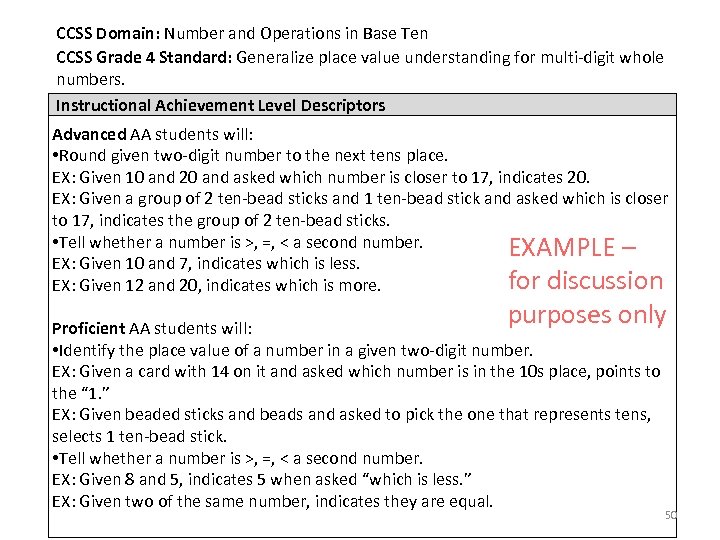 CCSS Domain: Number and Operations in Base Ten CCSS Grade 4 Standard: Generalize place value understanding for multi-digit whole numbers. Instructional Achievement Level Descriptors Advanced AA students will: • Round given two-digit number to the next tens place. EX: Given 10 and 20 and asked which number is closer to 17, indicates 20. EX: Given a group of 2 ten-bead sticks and 1 ten-bead stick and asked which is closer to 17, indicates the group of 2 ten-bead sticks. • Tell whether a number is >, =, < a second number. EXAMPLE – EX: Given 10 and 7, indicates which is less. for discussion EX: Given 12 and 20, indicates which is more. purposes only Proficient AA students will: • Identify the place value of a number in a given two-digit number. EX: Given a card with 14 on it and asked which number is in the 10 s place, points to the “ 1. ” EX: Given beaded sticks and beads and asked to pick the one that represents tens, selects 1 ten-bead stick. • Tell whether a number is >, =, < a second number. EX: Given 8 and 5, indicates 5 when asked “which is less. ” EX: Given two of the same number, indicates they are equal. 50
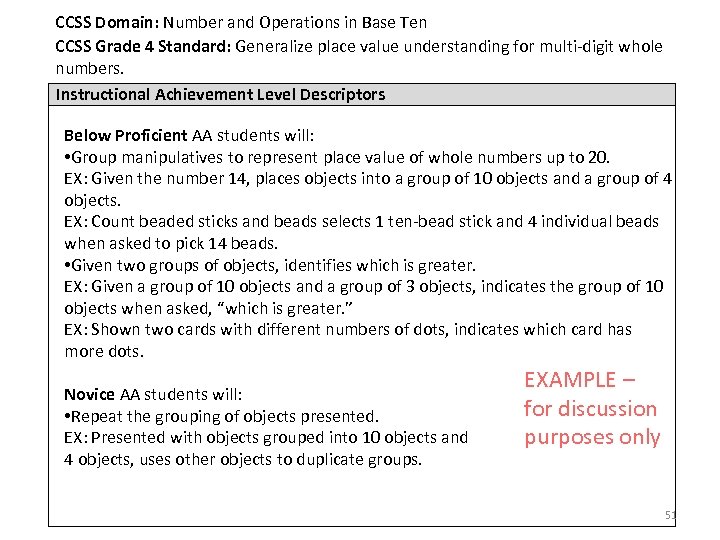 CCSS Domain: Number and Operations in Base Ten CCSS Grade 4 Standard: Generalize place value understanding for multi-digit whole numbers. Instructional Achievement Level Descriptors Below Proficient AA students will: • Group manipulatives to represent place value of whole numbers up to 20. EX: Given the number 14, places objects into a group of 10 objects and a group of 4 objects. EX: Count beaded sticks and beads selects 1 ten-bead stick and 4 individual beads when asked to pick 14 beads. • Given two groups of objects, identifies which is greater. EX: Given a group of 10 objects and a group of 3 objects, indicates the group of 10 objects when asked, “which is greater. ” EX: Shown two cards with different numbers of dots, indicates which card has more dots. Novice AA students will: • Repeat the grouping of objects presented. EX: Presented with objects grouped into 10 objects and 4 objects, uses other objects to duplicate groups. EXAMPLE – for discussion purposes only 51
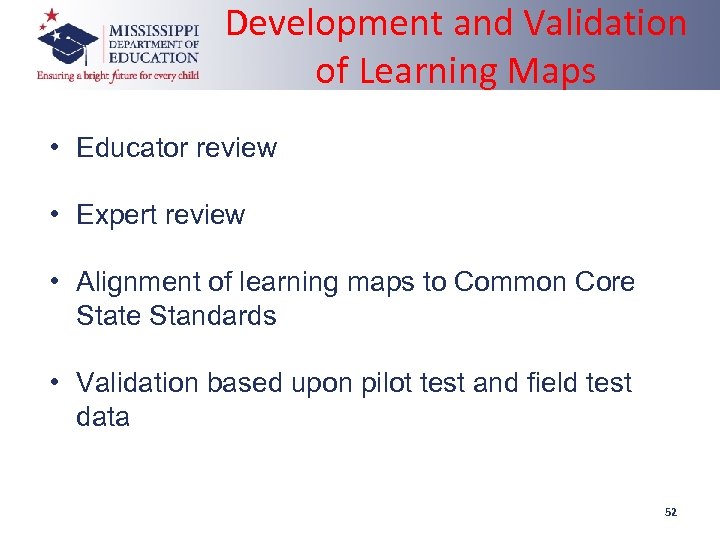 Development and Validation of Learning Maps • Educator review • Expert review • Alignment of learning maps to Common Core State Standards • Validation based upon pilot test and field test data 52
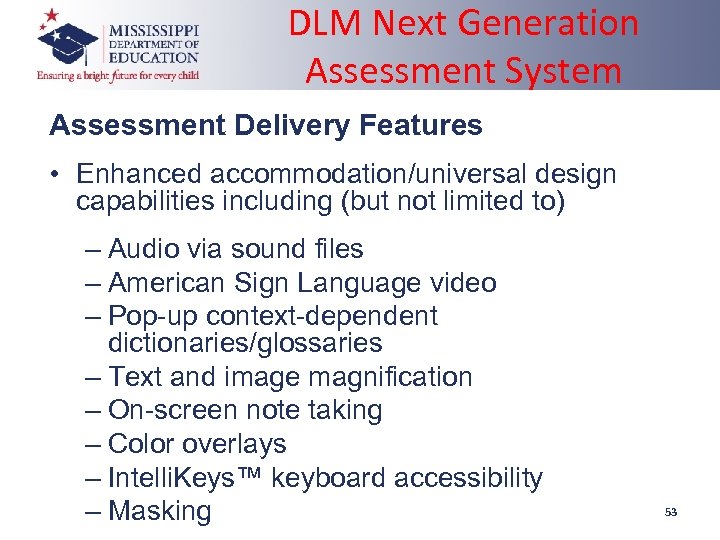 DLM Next Generation Assessment System Assessment Delivery Features • Enhanced accommodation/universal design capabilities including (but not limited to) – Audio via sound files – American Sign Language video – Pop-up context-dependent dictionaries/glossaries – Text and image magnification – On-screen note taking – Color overlays – Intelli. Keys™ keyboard accessibility – Masking 53
 DLM Instructionally-Relevant Item Types • Determine item types that model good instructional practices – Brainstorming groups with master educators – Review by special education, assessment, and technology experts 54
 Efforts in MS • Textbook Adoption • Implementation timeline • Training for teachers, administrators, and higher education faculty • Early learning standards for Pre-K programs (MS Early Childhood Standards) 55
 Efforts in MS Textbook adoption 2011 -2012 Reading/Literature 2012 -2013 Mathematics K-8 and Social Studies 2013 -2014 Mathematics 9 -12 and English/Language Arts 56
 Suggested Implementation Timeline • 2011 - 2012 Grades K-2 • 2012 - 2013 Grades 3 -8 • 2013 - 2014 Grades 9 -12 • 2014 - 2015 Live Assessments It may help to think of implementation as a multi-year process of weaving the Common Core State Standards into the fabric of classroom instruction until the CCSS have replaced the MS Curriculum Frameworks. 57
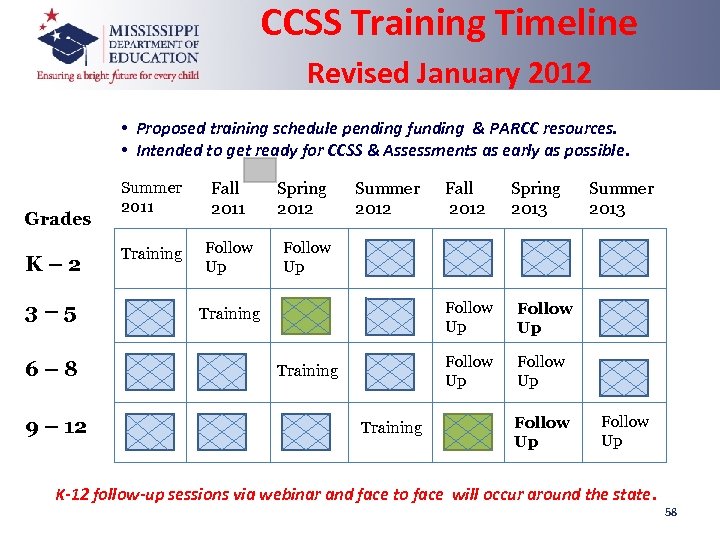 CCSS Training Timeline Revised January 2012 • Proposed training schedule pending funding & PARCC resources. • Intended to get ready for CCSS & Assessments as early as possible. Grades K– 2 3– 5 6– 8 9 – 12 Summer 2011 Fall 2011 Training Follow Up Spring 2012 Summer 2012 Fall 2012 Spring 2013 Summer 2013 Follow Up Training Follow Up K-12 follow-up sessions via webinar and face to face will occur around the state. 58
 CCSS Training • K-2 Training-of-the-Trainer (TOT) sessions were offered in three locations during June - July 2011. • Grades 3 -5 TOT sessions were offered in three locations during October November 2011. • Grades 6 -8 TOT sessions were offered in three locations during January February 2012. • Grades 9 -12 TOT sessions will be offered in the summer of 2012 following the same basic pattern with improvements learned along the way. • All grade levels will be trained by the summer of 2012. • Follow-up activities for all grades will be conducted via webinar and face to face. • Training sessions for higher education faculty are being conducted. 59
 Early Learning Standards (ELS) • Early learning standards (ELS) for programs serving 3 - and 4 -yearold children have been developed that are aligned to the CCSS for Kindergarten in ELA and Math. • The ELS were approved by the State Board of Education on January 20, 2012. • Early learning standards for other areas (scientific investigation, social emotional development, and physical development) will be revised during the 2012 -2013 school year. • The Kindergarten Guidelines will be revised during the 2011 -2012 school year. • Training on the ELS is being conducted during Summer 2012. 60
 Educator Leader Cadre • Develop a network of K-16 educators that can help lead implementation of PARCC and the CCSS • Lay the groundwork for sharing best practices and quality resources • Strengthen their content expertise and become leaders in their state 61
 Other Committees Additional Steering Committees of practitioners have been formed to assist in implementing the CCSS. • • Math 9 -12 ELA 9 -12 SATP Transition PARCC Item Review 62
 Importance of School Leadership School leaders should: 1. Be proactive to remain informed about CCSS and PARCC. 2. Be able to succinctly discuss key points about CCSS. 3. Communicate with key individuals at the local level. 4. Engage parents in discussion about CCSS. 5. Focus on engaging instruction aligned to CCSS, as the assessments are a changing dynamic. 6. Build staff/student capacity, as students must be able to think, process, write, argue, and defend their views. 7. Share issues and concerns with the MDE. 63
 64
64
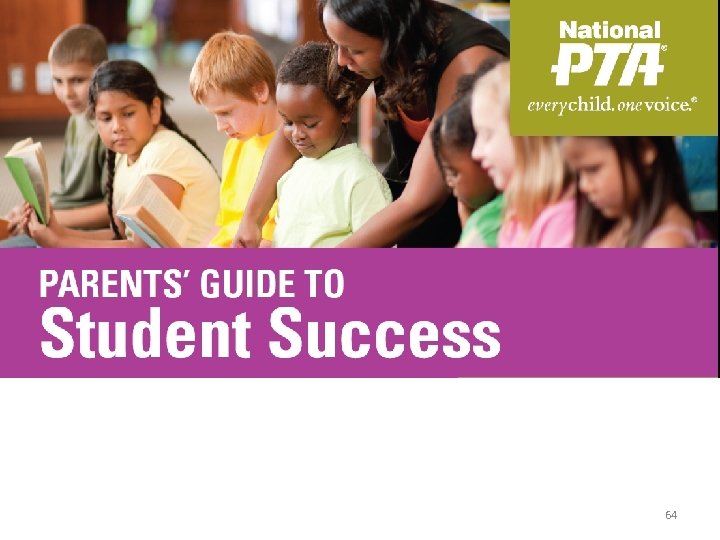
 National Parent Teacher Association (PTA®) created guides for grades K-8 and two guides for grades 9 -12 (one for English/Language Arts and one for Mathematics) based on the Common Core State Standards (CCSS). Each Guide includes: • Key items that children should be learning in English /Language Arts and mathematics in each grade once the CCSS are fully implemented. • Activities that parents can do at home to support their children’s learning. • Methods for helping parents build stronger relationships with their child’s teacher. • Tips for planning for college and career (high school only). 65
 Resources Common Core Website www. corestandards. org PTA Website www. pta. org MDE Website – Hot Topics www. mde. k 12. ms. us PARCC Website www. parcconline. org 66
 Contact Information Office of Curriculum and Instruction 601. 359. 2586 commoncore@mde. k 12. ms. us Nathan Oakley – Director of Curriculum noakley@mde. k 12. ms. us Marla Davis - Mathematics mdavis@mde. k 12. ms. us Chauncey Spears – Social Studies, AP/Gifted crspears@mde. k 12. ms. us Vincent Segalini – English/Language Arts vsegalini@mde. k 12. ms. us 67