


 Скачать презентацию Stategies for Dedollarization Financial Sector Development and Inflation
2d1df735ed8e08c5834c7c8f64b3f2e3.ppt
- Количество слайдов: 27
 Stategies for Dedollarization: Financial Sector Development and Inflation Targeting Jorge Desormeaux Central Bank of Chile Prepared for the International Conference: “Dollarization: Consequences and Policy Options” organized by the Central Bank of the Republic of Turkey December 14 -15, 2006, Istanbul 1 CENTRAL BANK OF CHILE
 Outline Roots of Financial Dollarization (FD) II. Empirical Evidence on Correlations between FD and Aggregate Variables III. Dedollarization I: Strengthening the Financial Sector IV. Dedollarization II: Adopting Full-fledged Inflation Targeting (IT) V. Final Remarks I. 2 CENTRAL BANK OF CHILE
 Roots of Financial Dollarization 3 CENTRAL BANK OF CHILE
 Roots of Financial Dollarization § There are two alternative explanations for financial dollarization (FD): 1. FD is the result of a market equilibrium in which agents choose an optimal currency composition (Ize and Levy Yeyati 2006). 2. FD may reflect policy or market failures (Levy Yeyati 2006) 4 CENTRAL BANK OF CHILE
 Roots of Financial Dollarization § FD is widespread in economies where: § Monetary policy is weak and lacks credibility § Monetary authority exhibits “fear of floating” § There is exchange-rate policy asymmetry and a tendency to currency overvaluation: § § 5 Local currency is not allowed to appreciate in good times but is expected to depreciate in bad times An unhedged private sector expects a government bailout in case of large devaluations. CENTRAL BANK OF CHILE
 Empirical Evidence on FD 6 CENTRAL BANK OF CHILE
 Empirical Evidence on FD § There is empirical evidence on correlations between aggregate variables and FD - but note: § Most correlations do not imply causality § Many correlations are driven by third factors § Many correlations do not have immediate policy implications 7 CENTRAL BANK OF CHILE
 Empirical Evidence on FD § FD is positively correlated with: § The quality of institutions (Levy Yeyati 2006) § Exchange rate pass-through (Reinhart et al. 8 2003) § Fear of floating (Reinhart et al. 2003) § Output volatility (Levy Yeyati 2006) § Inflation (Levy Yeyati 2006) § Vulnerability to crises and capital flight (Levy Yeyati 2006) § Bias towards currency depreciation (Rennhack and Nozaki 2006) § FD is not correlated with financial deepening (Rennhack and Nozaki 2006) CENTRAL BANK OF CHILE
 Dedollarization I: Strengthening the Financial Sector 9 CENTRAL BANK OF CHILE
 Dedollarization I: Strengthening the Financial Sector § § But the latter are not sufficient conditions if other binding market failures are present. § 10 Sound monetary policy and strong institutions are necessary conditions for a successful dedollarization. To overcome market failures that lead to FD, financial sector development should be strengthened by adopting three sets of measures: CENTRAL BANK OF CHILE
 Dedollarization I: Strengthening the Financial Sector 1. Promoting the use of domestic currency or domestic currency-based substitutes and hedging markets (Levy Yeyati 2006). § Experiences of Chile and Israel are examples of successful adoption of inflation-indexed financial instruments to reduce (or elude) FD. 11 CENTRAL BANK OF CHILE
 Dedollarization I: Strengthening the Financial Sector § In Chile monetary, exchange rate and public debt policies supported indexation (and thus avoided dollarization) of financial markets. § Issuance of indexed public debt, indexation of the tax code and accounting rules, mandatory wage indexation § Indexation of the nominal exchange rate between 1984 and 1988 § But financial indexation generated costs: fragmented financial markets, low financial integration, high inflation persistence. 12 CENTRAL BANK OF CHILE
 Dedollarization I: Strengthening the Financial Sector 2. Establishing financial regulation and safety nets that: § focus on currency exposure of local firms (dollar debtors with non-dollar revenues). • Chile’s 2000 financial regulation of domestic banks, required them to provision against their clients’ exposure to currency risk. § move away from currency-blind deposit insurance schemes. • lender of last resort role of central banks applies to domestic currency 13 CENTRAL BANK OF CHILE
 Dedollarization I: Strengthening the Financial Sector 3. There is little agreement if measures geared at limiting dollarization directly can reduce FD § limits on dollar deposits, taxes on dollar intermediation, forced conversion from foreign to domestic-currency financial instruments (Argentina) § These policies can hurt more than benefit economies with high levels of FD since these economies are prone to capital flight (Cowan 2006) § Excessive domestic financial-sector regulation 14 may lead to offshore dollarization, in which resident financial institutions and CENTRAL BANK OF CHILE intermediaries provide off-shore banking
 Dedollarization II: Adopting Full -fledged Inflation Targeting (IT) 15 CENTRAL BANK OF CHILE
 Dedollarization II: Adopting Full -fledged Inflation Targeting (IT) § In addition to financial sector measures, successful dedollarization requires a suitable monetary and exchange-rate regime: 1. IT contributes to monetary policy credibility and creates environment of low and stable inflation: IT countries are successful in hitting inflation targets one of the most successful has been Chile (Mishkin and Schmidt-Hebbel 2007) § IT strengthens central bank credibility and anchors inflation expectations (Gurkaynak et al. 2007) § Efficiency in coping with shocks increases with adoption of IT, particularly after a stationary inflation target has been achieved. Example, in Chile monetary policy efficiency has increased significantly after adoption of full -fledged IT § 16 CENTRAL BANK OF CHILE
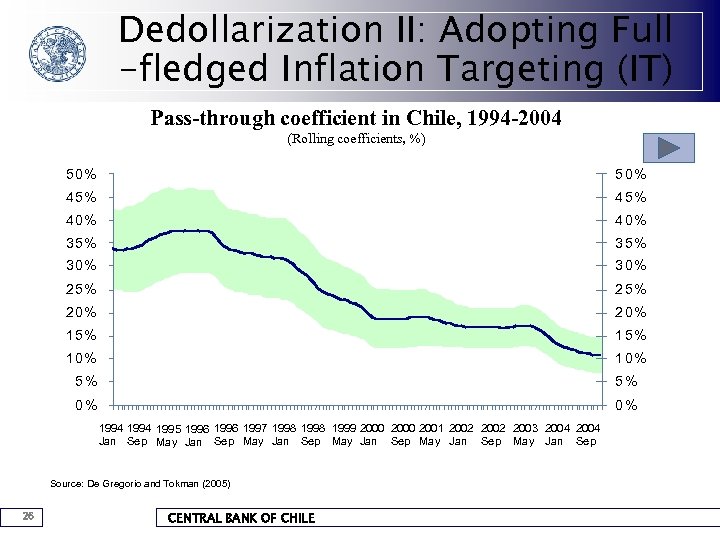
 Dedollarization II: Adopting Full -fledged Inflation Targeting (IT) 2. A floating exchange rate regime overcomes fear of floating and mitigates dollarization bias (Schmidt-Hebbel 2006) Countries are abandoning intermediate exchange rate regimes in favor of more flexible regimes or hard pegs as a superior response to the trade-off between independent monetary policy and exchange rate stability (Bubula and Ötker-Robe 2002) § Under IT, a free float reduces interest rate and reserve volatility, while exchange rate volatility rises, monetary policy becomes more independent of exchange rate shocks, and exchange rate passthrough declines, e. g. Chile (Schmidt-Hebbel 2006) § Inflation in IT countries responds less to oil price and exchange CHILE shocks (Mishkin and Schmidtrate CENTRAL BANK OF Hebbel 2007) § 17
 Dedollarization II: Adopting Full -fledged Inflation Targeting (IT) § A uniquely successful case is Peru, a country with initially high dollarization that has adopted IT with a floating exchange rate, with success reflected by: § § § 18 attaining low and stable inflation levels lowering inflation volatility relative to exchange -rate volatility reducing FD at a speed not observed in other countries with high levels of FD, like Bolivia or Uruguay. CENTRAL BANK OF CHILE
 Final Remarks 19 CENTRAL BANK OF CHILE
 Final Remarks § Adoption of a full-fledged IT regime with a floating exchange rate system helps countries to reduce the extent of FD. § Dedollarization, however, also requires policies aimed at supporting financial sector development. § Chile and Peru are good examples on how to avoid or reduce FD using the two latter complementary strategies. 20 CENTRAL BANK OF CHILE
 Stategies for Dedollarization: Financial Sector Development and Inflation Targeting Jorge Desormeaux Central Bank of Chile Prepared for the International Conference: “Dollarization: Consequences and Policy Options” organized by the Central Bank of the Republic of Turkey December 14 -15, 2006, Istanbul 21 CENTRAL BANK OF CHILE
 Dollarization – and how to get out of it through IT and beyond Jorge Desormeaux Central Bank of Chile Prepared for the International Conference: “Dollarization: Consequences and Policy Options” organized by the Central Bank of the Republic of Turkey December 14 -15, 2006, Istanbul 22 CENTRAL BANK OF CHILE
 References § Armas, A. Aize and E. Levy Yeyati (2006) Financial Dollarization: The Policy Agenda, Palgrave Mc. Millan. § Bubula, A. and Otker-Robe (2002) “Testing the Unstable Middle and Two Corners Hypothesis, ” IMF Working Paper 02/155. § § § Gurkaynak, R. , A. Levin and E. Swanson (2007), “Inflation Targeting and the Anchoring of Inflation Expectations in the Western Hemisphere, ” in F. S. Mishkin and K. Schmidt-Hebbel (ed. ): Monetary Policy under Inflation Targeting. Santiago, Chile: Central Bank of Chile. Herrera, L. O. and R. Valdés (2004) "Dedollarization, Indexation and Nominalization: The Chilean Experience, " The Journal of Policy Reform, vol. 8 pp. 281 -312 Mishkin, F. and K. Schmidt-Hebbel (2005), “Does Inflation Targeting Make a Difference? ”, in F. S. Mishkin and K. Schmidt-Hebbel (ed. ): Monetary Policy under Inflation Targeting. Santiago, Chile: Central Bank of Chile. § Reinhart, C. , K. Rogoff and M. Savastano (2003), “Addicted to dollars, ” NBER Working Paper No. 10015. § Rennhack, R. and M. Nozaki (2006), “Financial Dollarization in Latin America, ” in A. Armas, A. Aize and E. Levy Yeyati (eds. ) Financial Dollarization: The Policy Agenda, Palgrave Mc. Millan. § § 23 Schmidt-Hebbel, K. (2006), “Comments on Chapters 5 and 6, ” in A. Armas, A. Aize and E. Levy Yeyati (eds. ) Financial Dollarization: The Policy Agenda, Palgrave Mc. Millan. Yeyati Levy, E. (2006) “Financial Dollarization, ” Economic Policy, January pp. 61 -118. CENTRAL BANK OF CHILE
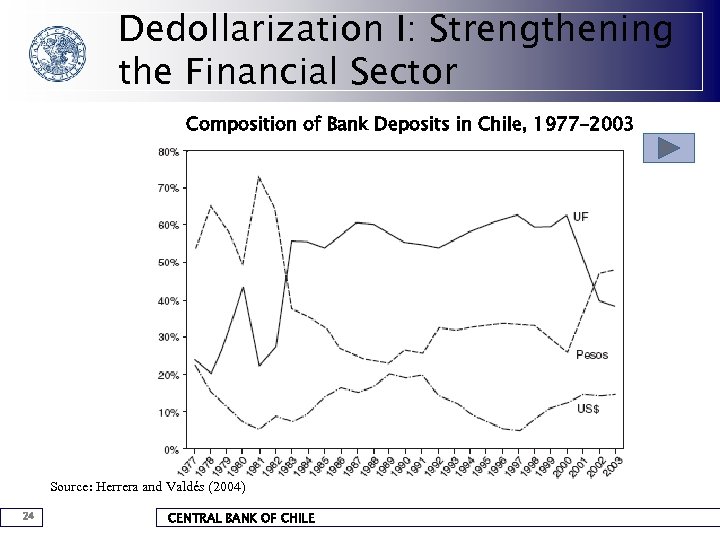 Dedollarization I: Strengthening the Financial Sector Composition of Bank Deposits in Chile, 1977 -2003 Source: Herrera and Valdés (2004) 24 CENTRAL BANK OF CHILE
 Dedollarization II: Adopting Full -fledged Inflation Targeting (IT) Changes in monetary policy efficiency in IT countries and in Chile IT countries before and after de adoption of IT Source: Mishkin and Schmidt-Hebbel (2007) 25 CENTRAL BANK OF CHILE Chile before and after 1999
 Dedollarization II: Adopting Full -fledged Inflation Targeting (IT) Pass-through coefficient in Chile, 1994 -2004 (Rolling coefficients, %) 50% 45% 40% 35% 30% 25% 20% 15% 10% 5% 5% 0% 0% 1994 1995 1996 1997 1998 1999 2000 2001 2002 2003 2004 Jan Sep May Jan Sep May Jan Sep Source: De Gregorio and Tokman (2005) 26 CENTRAL BANK OF CHILE
 Dedollarization II: Adopting Full -fledged Inflation Targeting (IT) Targeting Financial Dollarization and Inflation in Peru, 19932003 Source: BCRP. Note: Financial dollarization is the share of banking system broad money in US$ dollars. 27 CENTRAL BANK OF CHILE