 Скачать презентацию STATE REGULATION OF ECONOMY Anticyclic regulation by Bolatova
anticyclic regulation.ppt
- Количество слайдов: 14



STATE REGULATION OF ECONOMY Anticyclic regulation by: Bolatova B

ANTICYCLIC REGULATION - One of the government's economic policy, aimed to mitigate the economic cycles. Based on the use of stabilizers (Income Tax Financials. those corporate tax benefits, unemployment subsidies to maintain prices in the northhouseholds. products, etc. ).
There are different views on the causes of cyclical fluctuations, but despite considerable variation of views and different emphases in the development of anticyclical policies in general there are two areas of regulation: neo-Keynesianism and neo-conservatism, which developed in the basis of the classical school.
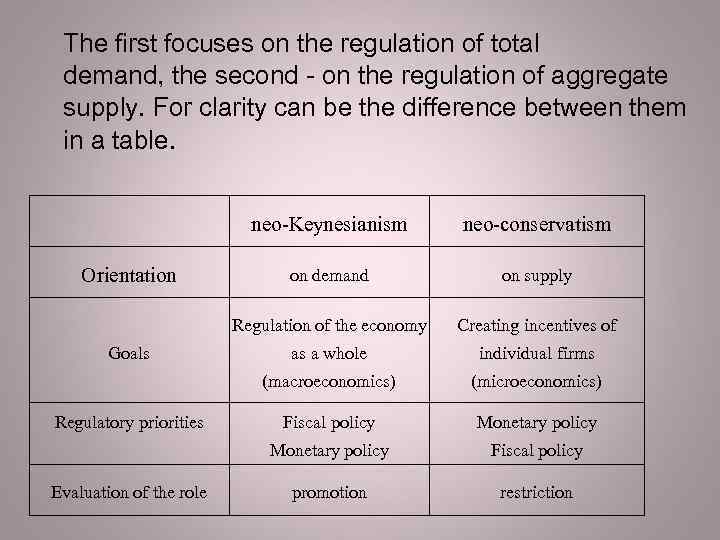
The first focuses on the regulation of total demand, the second - on the regulation of aggregate supply. For clarity can be the difference between them in a table. neo-Keynesianism Evaluation of the role Creating incentives of as a whole individual firms (microeconomics) Fiscal policy Monetary policy Regulatory priorities on supply (macroeconomics) Goals on demand Regulation of the economy Orientation neo-conservatism Fiscal policy promotion restriction
ANTICYCLIC REGULATION Depending on the initial settings and targets supporters of a directions differently solve problems smoothing cyclical fluctuations, operate different instruments at the disposal of the state, which can be used for this purpose

NEO-KEYNESIANISM Proponents of Keynesian recipes and more attention paid fiscal policy (mainly due to the increase or reduced government spending) and taxes policy (manipulation tax rates, depending on the state of the economy).
There is also variation problem of the participation of the state in the ongoing processes-policy regulating the economy in general and in the smoothing of cyclical fluctuations. Despite these seemingly major differences, there is general understanding these concepts to the fact that, first, the state is able to smooth out cyclical fluctuations, and, secondly, the State shall implement in order to achieve and maintain economic stability.
NEO-CONSERVATISM Supporters neoconservative prescription pay much attention to the problem money and credit. This is mainly a question of the money supply and its regulation.
There is a common understanding of what should be a whole line of conduct the state, aimed at overcoming the cyclical fluctuations. In the decay phase of all the activities of the state should be directed to stimulating business activity. In the area of tax policy, this means rate cuts, tax breaks on new investment a policy of accelerated depreciation.

WHILE KEYNESIANS A BIG HOPE FOR THE GROWTH OF PUBLIC SPENDING THAT CONSIDERED AS A STIMULANT ACCUMULATION. TAX MEASURES MORE SUPPLEMENT THE BUDGET, AND TOGETHER THEY LEAD TO THE STIMULATION OF AGGREGATE DEMAND, AND IN THE END AND PRODUCTION.
WHAT HAPPENS IN THE OPPOSITE CASE, IT UST A RISE IN THE ECONOMIC CONJUNCTURE? State in order to prevent overheating and related ill effects in the economic life of a policy deterrence, including opposing activities in fiscal and monetary policy.
Fiscal policy of this period is characterized by increased tax rates, reduced public expenditure constraints in of the depreciation policy. It is on fiscal policy oriented theorists Keynesian methods of regulation. fiscal measures lead to a smoothing of purchasing power, and hence demand, leading eventually to some economic decline.

Conclusion In general, the policy to be carried out in order to state smoothing of cyclical fluctuations, we can say that in a recession State policy of enhancing all business processes, and during the "overheating" of the economy tends to restrain economic activity.
 Скачать презентацию STATE REGULATION OF ECONOMY Anticyclic regulation by Bolatova
anticyclic regulation.ppt