


 Скачать презентацию State of Wisconsin Procurement Analysis Project Desired Future
d4c0ff4d4e4009ec3863145dc7f2583f.ppt
- Количество слайдов: 112
 State of Wisconsin Procurement Analysis Project Desired Future Situation & Detailed Recommendations January 2001 Advanced Data Concepts, LLC
 CONTENTS q INTRODUCTION q RECOMMENDATIONS – GAP ANALYSIS – IMPERATIVES – SYSTEM OPTIONS q ORGANIZATIONAL & POLITICAL CONSIDERATIONS q IMPLEMENTATION GAME PLAN q BEST PRACTICES PROCESS MAPS q APPENDICES – GLOSSARY – CASE STUDIES – E-PROCUREMENT VENDOR LISTING – SUPPORTING CHARTS – Data Warehouse Project - Development & Implementation © 2000 Advanced Data Concepts, LLC State of Wisconsin 2
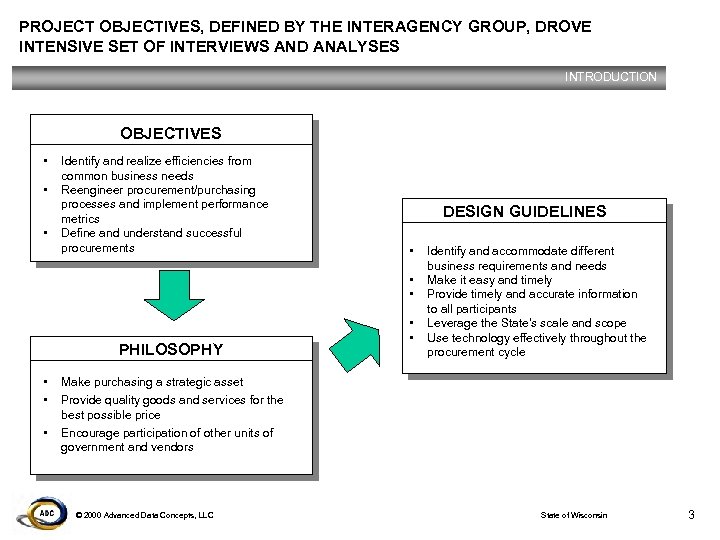 PROJECT OBJECTIVES, DEFINED BY THE INTERAGENCY GROUP, DROVE INTENSIVE SET OF INTERVIEWS AND ANALYSES INTRODUCTION OBJECTIVES • • • Identify and realize efficiencies from common business needs Reengineer procurement/purchasing processes and implement performance metrics Define and understand successful procurements DESIGN GUIDELINES • • • PHILOSOPHY • • • Identify and accommodate different business requirements and needs Make it easy and timely Provide timely and accurate information to all participants Leverage the State’s scale and scope Use technology effectively throughout the procurement cycle Make purchasing a strategic asset Provide quality goods and services for the best possible price Encourage participation of other units of government and vendors © 2000 Advanced Data Concepts, LLC State of Wisconsin 3
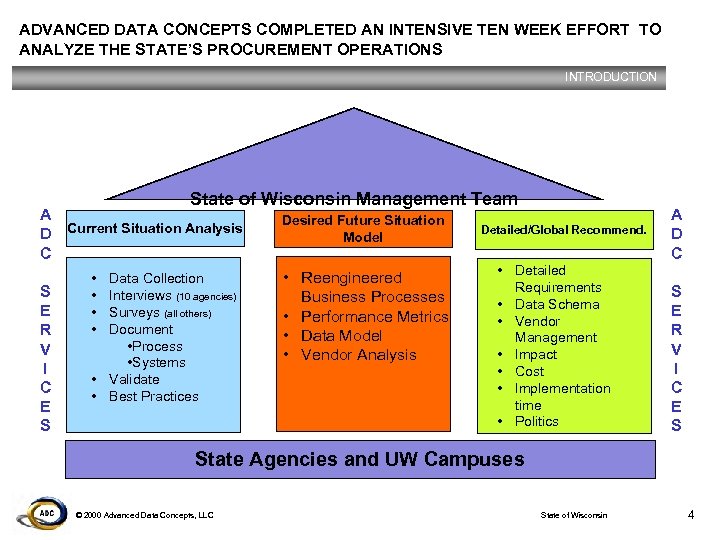 ADVANCED DATA CONCEPTS COMPLETED AN INTENSIVE TEN WEEK EFFORT TO ANALYZE THE STATE’S PROCUREMENT OPERATIONS INTRODUCTION State of Wisconsin Management Team A D Current Situation Analysis C S E R V I C E S • • Data Collection Interviews (10 agencies) Surveys (all others) Document • Process • Systems • Validate • Best Practices Desired Future Situation Model • Reengineered Business Processes • Performance Metrics • Data Model • Vendor Analysis Detailed/Global Recommend. • Detailed Requirements • Data Schema • Vendor Management • Impact • Cost • Implementation time • Politics A D C S E R V I C E S State Agencies and UW Campuses © 2000 Advanced Data Concepts, LLC State of Wisconsin 4
 RECOMMENDATIONS TO FACILITATE WISCONSIN MOVING FROM ITS CURRENT STATE TO A DESIRED FUTURE STATE HAVE BEEN DEVELOPED INTRODUCTION In November 2000, ADC provided SBOP with a picture of the current procurement situation in the State of Wisconsin q This document now answers the questions: – What is the Desired Future State? – How do we get there? q © 2000 Advanced Data Concepts, LLC State of Wisconsin 5
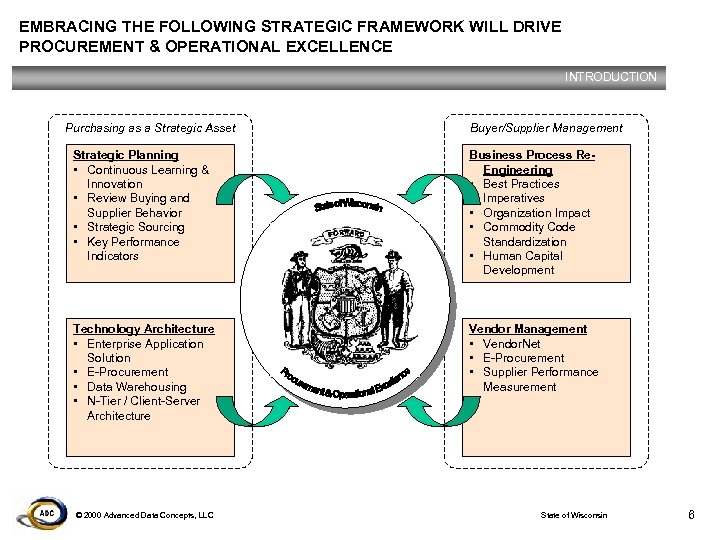 EMBRACING THE FOLLOWING STRATEGIC FRAMEWORK WILL DRIVE PROCUREMENT & OPERATIONAL EXCELLENCE INTRODUCTION Purchasing as a Strategic Asset Buyer/Supplier Management Strategic Planning • Continuous Learning & Innovation • Review Buying and Supplier Behavior • Strategic Sourcing • Key Performance Indicators Business Process Re. Engineering • Best Practices • Imperatives • Organization Impact • Commodity Code Standardization • Human Capital Development Technology Architecture • Enterprise Application Solution • E-Procurement • Data Warehousing • N-Tier / Client-Server Architecture Vendor Management • Vendor. Net • E-Procurement • Supplier Performance Measurement © 2000 Advanced Data Concepts, LLC State of Wisconsin 6
 THIS PROJECT RESULTED IN SEVERAL MAJOR RECOMMENDATIONS INTRODUCTION q THE FOLLOWING IMPERATIVES MUST BE ADDRESSED TO REALIZE IMPROVEMENT OPPORTUNITIES IN THE PROCUREMENT CYCLE. – Leverage Large Volume Purchases - achieve maximum vendor discount – Expand Use of Cross-Functional Teams - develop sourcing strategies for high volume and complex purchases – Approval Process - decrease approvals to one per transaction (requisition and purchase order) – Commodity Coding - standardize on UN/SPSC naming convention – Purchasing Card Reporting and Management - report on P-Card purchases by commodity and dollar amount – Purchasing as a Strategic Asset – establish purchasing as an integral part of the strategic planning process © 2000 Advanced Data Concepts, LLC State of Wisconsin 7
 THIS PROJECT RESULTED IN SEVERAL MAJOR RECOMMENDATIONS INTRODUCTION q KEY IMPERATIVES CONTINUED … – Expand Training Program - provide a continuous improvement program for SBOP and agency procurement staff – Standardization and Consolidation - institute a standardization program to achieve cost savings – Vendor. Net Official State Bidders List - eliminate all bidders list but Vendor. Net – Vendor Data Rationalization - WISMART the only vendor table for State – Key Performance Indicators - for Staff, Vendors and Customer Satisfaction – Develop Data Warehouse - for the analysis of statewide purchasing activity and spend data © 2000 Advanced Data Concepts, LLC State of Wisconsin 8
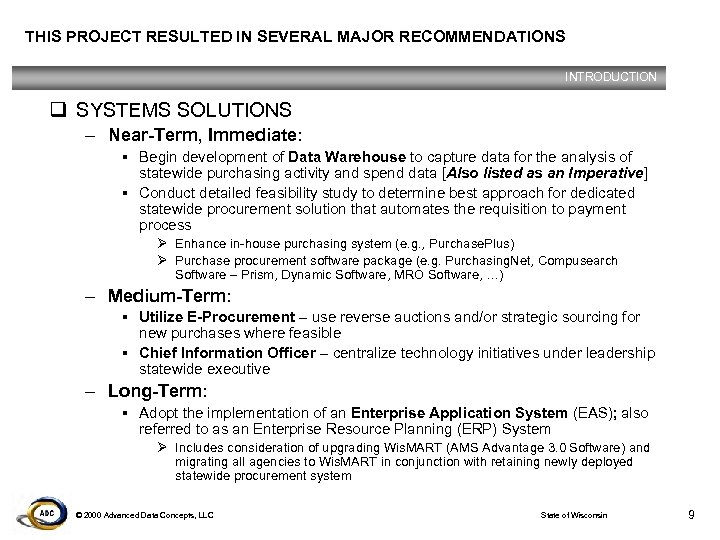 THIS PROJECT RESULTED IN SEVERAL MAJOR RECOMMENDATIONS INTRODUCTION q SYSTEMS SOLUTIONS – Near-Term, Immediate: § Begin development of Data Warehouse to capture data for the analysis of statewide purchasing activity and spend data [Also listed as an Imperative] § Conduct detailed feasibility study to determine best approach for dedicated statewide procurement solution that automates the requisition to payment process Ø Enhance in-house purchasing system (e. g. , Purchase. Plus) Ø Purchase procurement software package (e. g. Purchasing. Net, Compusearch Software – Prism, Dynamic Software, MRO Software, …) – Medium-Term: § Utilize E-Procurement – use reverse auctions and/or strategic sourcing for new purchases where feasible § Chief Information Officer – centralize technology initiatives under leadership statewide executive – Long-Term: § Adopt the implementation of an Enterprise Application System (EAS); also referred to as an Enterprise Resource Planning (ERP) System Ø Includes consideration of upgrading Wis. MART (AMS Advantage 3. 0 Software) and migrating all agencies to Wis. MART in conjunction with retaining newly deployed statewide procurement system © 2000 Advanced Data Concepts, LLC State of Wisconsin 9
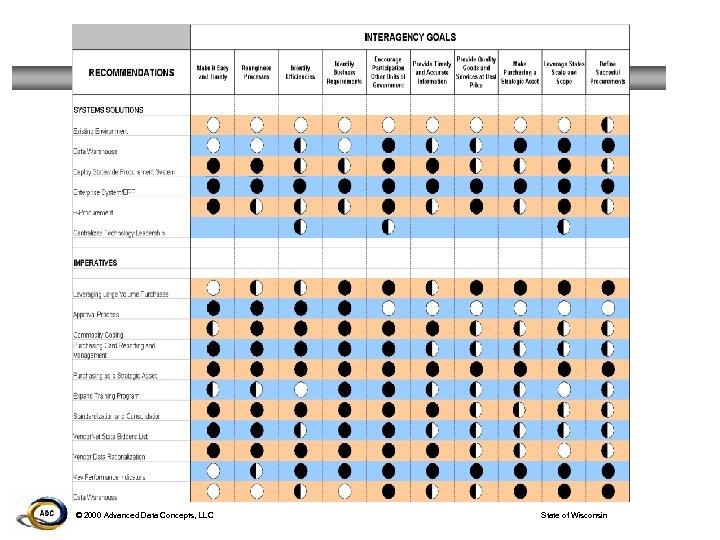
 WE HAVE TRIED TO ENSURE THAT RECOMMENDATIONS ARE CONSISTENT WITH THE INTERAGENCY GOALS INTRODUCTION q Please reference exhibit on the following page. © 2000 Advanced Data Concepts, LLC State of Wisconsin 10
 © 2000 Advanced Data Concepts, LLC State of Wisconsin
 RECOMMENDATIONS GAP ANALYSIS © 2000 Advanced Data Concepts, LLC State of Wisconsin
 GAP ANALYSIS q ADC created 85 process maps that outline the current situation in ten agencies, including the University of Wisconsin q Gap analysis charts, on the following pages, identify changes required to migrate current processes to best practices © 2000 Advanced Data Concepts, LLC State of Wisconsin 13
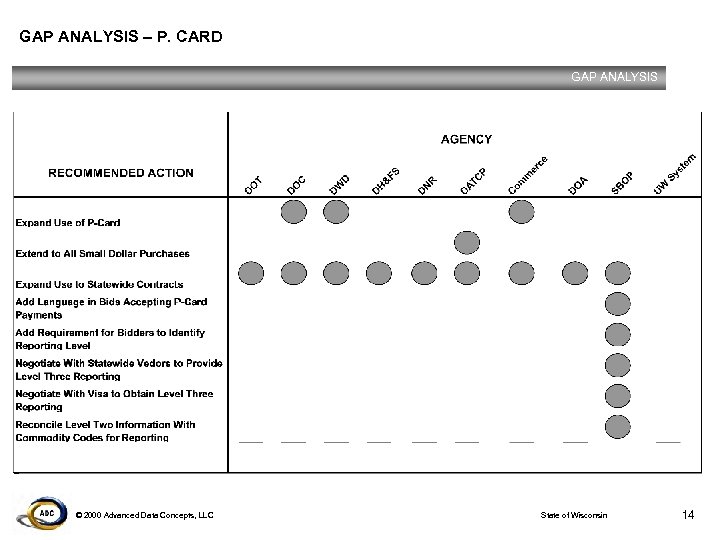 GAP ANALYSIS – P. CARD GAP ANALYSIS © 2000 Advanced Data Concepts, LLC State of Wisconsin 14
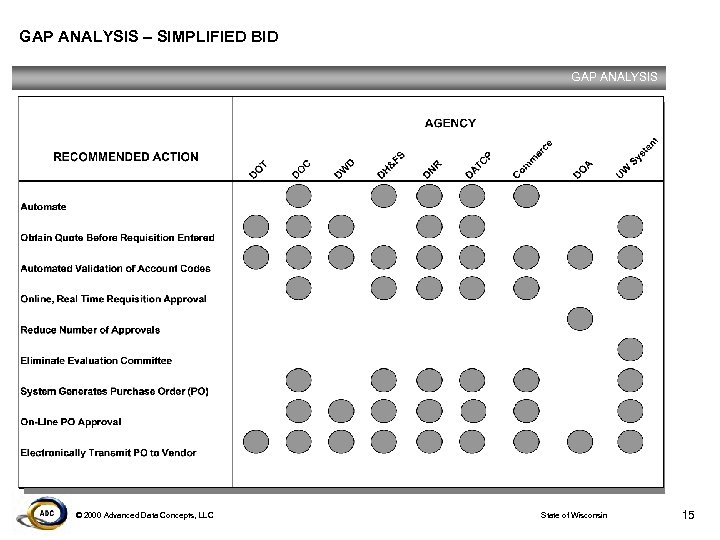 GAP ANALYSIS – SIMPLIFIED BID GAP ANALYSIS © 2000 Advanced Data Concepts, LLC State of Wisconsin 15
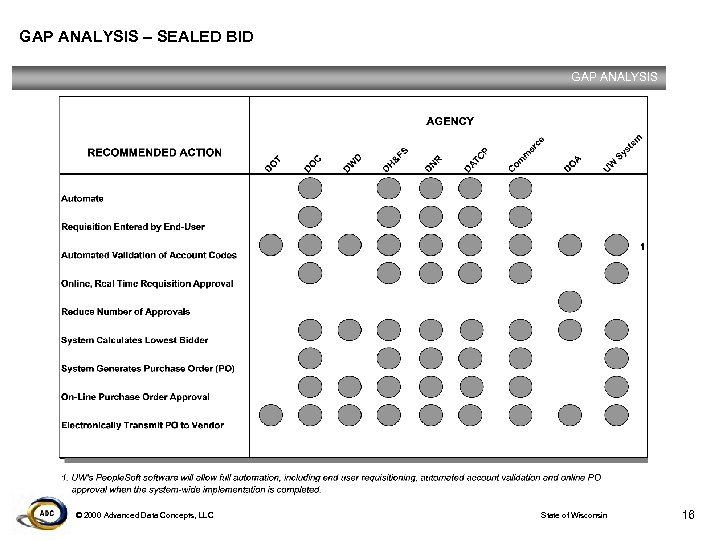 GAP ANALYSIS – SEALED BID GAP ANALYSIS © 2000 Advanced Data Concepts, LLC State of Wisconsin 16
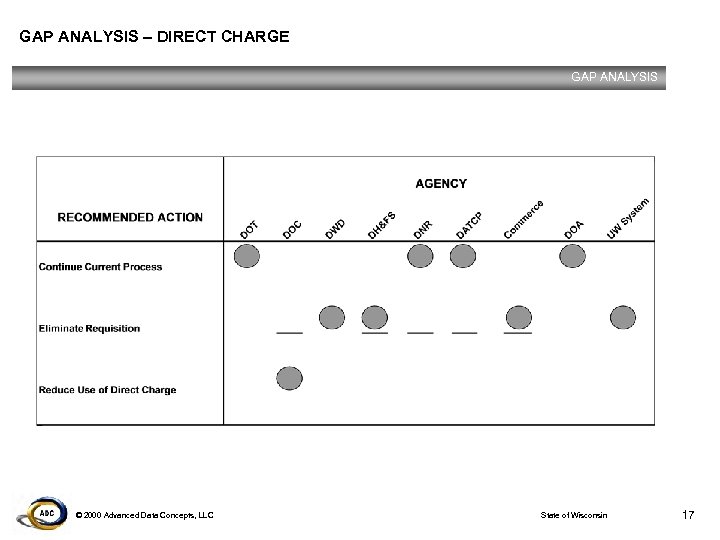 GAP ANALYSIS – DIRECT CHARGE GAP ANALYSIS © 2000 Advanced Data Concepts, LLC State of Wisconsin 17
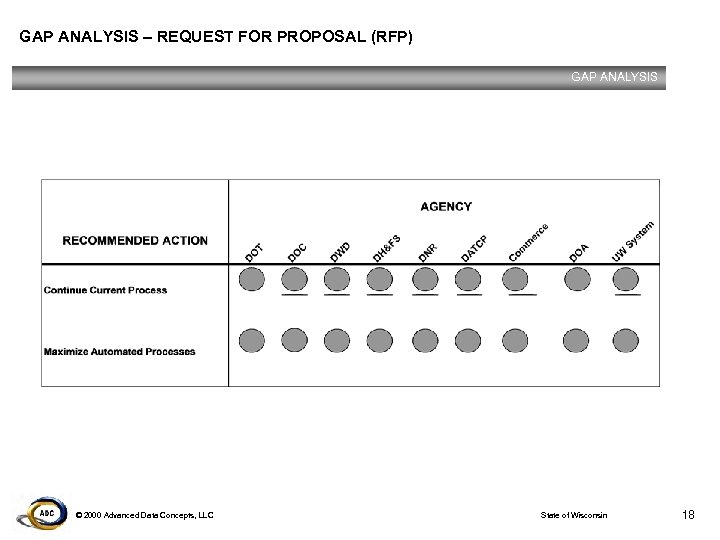 GAP ANALYSIS – REQUEST FOR PROPOSAL (RFP) GAP ANALYSIS © 2000 Advanced Data Concepts, LLC State of Wisconsin 18
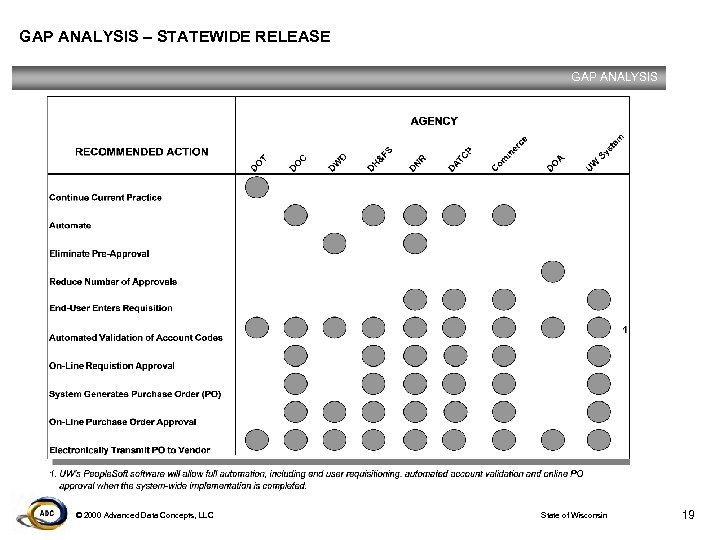 GAP ANALYSIS – STATEWIDE RELEASE GAP ANALYSIS © 2000 Advanced Data Concepts, LLC State of Wisconsin 19
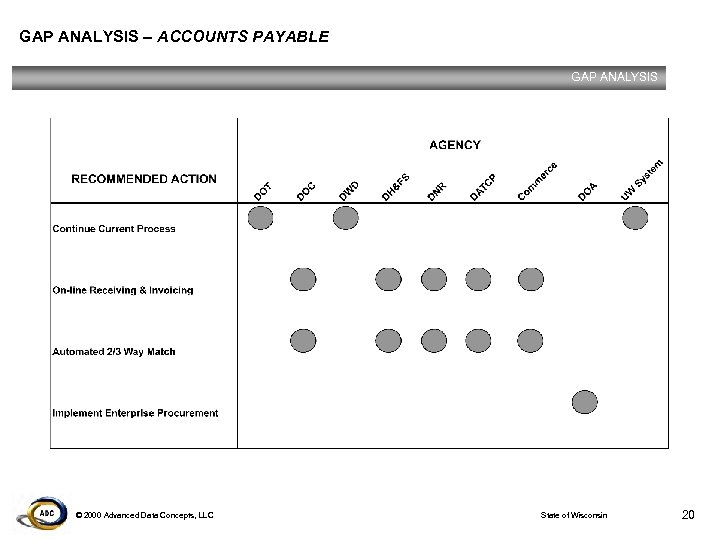 GAP ANALYSIS – ACCOUNTS PAYABLE GAP ANALYSIS © 2000 Advanced Data Concepts, LLC State of Wisconsin 20
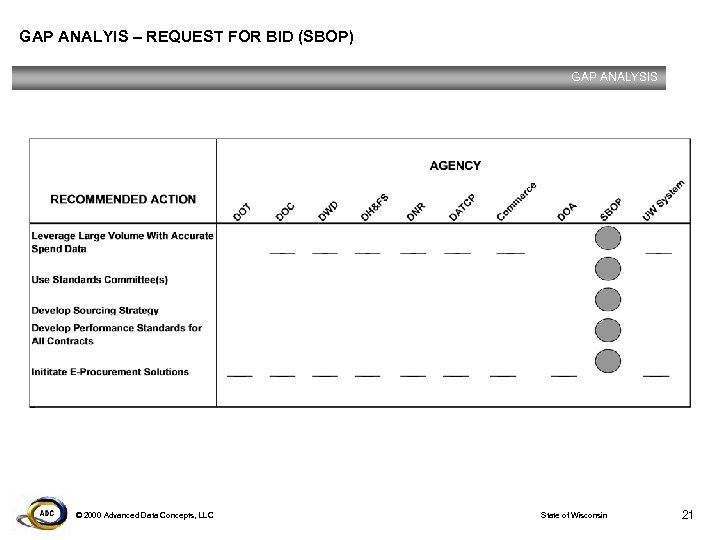 GAP ANALYIS – REQUEST FOR BID (SBOP) GAP ANALYSIS © 2000 Advanced Data Concepts, LLC State of Wisconsin 21
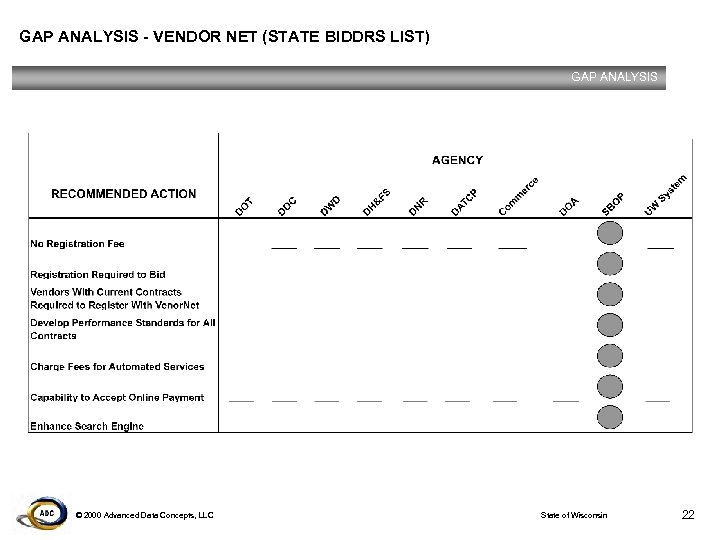 GAP ANALYSIS - VENDOR NET (STATE BIDDRS LIST) GAP ANALYSIS © 2000 Advanced Data Concepts, LLC State of Wisconsin 22
 RECOMMENDATIONS IMPERATIVES © 2000 Advanced Data Concepts, LLC State of Wisconsin
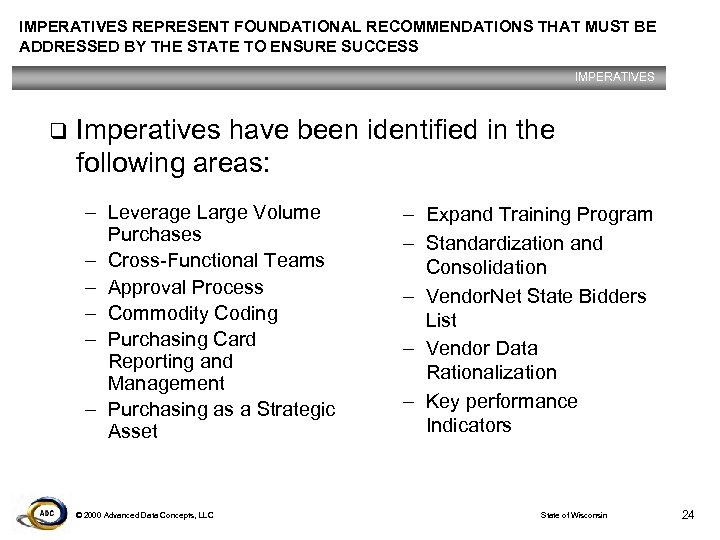 IMPERATIVES REPRESENT FOUNDATIONAL RECOMMENDATIONS THAT MUST BE ADDRESSED BY THE STATE TO ENSURE SUCCESS IMPERATIVES q Imperatives have been identified in the following areas: – Leverage Large Volume Purchases – Cross-Functional Teams – Approval Process – Commodity Coding – Purchasing Card Reporting and Management – Purchasing as a Strategic Asset © 2000 Advanced Data Concepts, LLC – Expand Training Program – Standardization and Consolidation – Vendor. Net State Bidders List – Vendor Data Rationalization – Key performance Indicators State of Wisconsin 24
 LEVERAGING LARGE VOLUME PURCHASES IMPERATIVES Desired Future State q Leverage large volume purchases to achieve maximum vendor discount Business Case for Action q q q © 2000 Advanced Data Concepts, LLC Currently not all agencies consistently utilize statewide contracts therefore lessening volumes – Usage on statewide office supply contract $4 to $5 million – UW utilizes different office supply contract; year to date expenditures approximately $5 million – DWD did not utilize statewide office supply vendor for a three year period. Combination of this volume would result in the state leveraging lower costs from the office supply vendor and insuring states customer service requirements would be met State has no official purchasing classification system and spend data cannot be aggregated for evaluation State of Wisconsin 25
 LEVERAGING LARGE VOLUME PURCHASES … IMPERATIVES Recommendation(s) q q q SBOP must identify and manage classification system that would allow the aggregation of purchasing spend data by commodity Aggregated commodity spend data must be used to identify the largest volume commodities Items within the largest volume commodities must be standardized so that number of items is reduced while item volume is increased SBOP must obtain data from municipalities and school districts that utilize their contract. This information must be included in quantity and spend estimates provided to vendors in solicitation Solicitations methods must require vendor to offer maximum cost saving and customer services © 2000 Advanced Data Concepts, LLC Approach q q A standard commodity code must be adopted Baseline spend data must be gathered on all commodities purchased statewide Standards committees must be formed to consolidate items in commodities with multiple items purchased in large quantities As new leveraging opportunities are uncovered, SBOP must determine the procurement method that will result in the highest savings. For example: – Strategic Sourcing solicitations – Reverse auctions – Discounts based on quantity thresholds – Rebates based on quantity thresholds – Discounts in return for contract extensions State of Wisconsin 26
 USING STANDARDS COMMITTEES/ CROSS-FUNCTIONAL TEAMS Desired Future State q Standards Committees are used to leverage large volume purchases and to develop a sourcing strategy Business Case for Action q q © 2000 Advanced Data Concepts, LLC According to Purchasing Online, a supply chain magazine, the use of crossfunctional teams is the best of the best practices in supply management In his book, Balanced Sourcing, Timothy Laseter indicates that using multifunctional teams is a winning sourcing strategy Wisconsin currently uses standard committees to develop RFB/RFPs Standards committees are not used consistently by agencies or SBOP staff members State of Wisconsin 27
 USING STANDARDS COMMITTEES/ CROSS-FUNCTIONAL TEAMS Recommendation(s) q q q SBOP should increase the use standards committees to develop RFB/RFPs SBOP should use cross-functional teams to develop sourcing strategies on all highvolume state-wide commodities. The strategy may include: – Standardization – E-commerce opportunities – Strategic vendor partnering opportunities – Volume discount sourcing These teams should set client goals and objectives and be held responsible for the success and/or failure of the initiative. © 2000 Advanced Data Concepts, LLC Approach q q Identify staff in agencies to participate in cross-functional teams To ensure team success, they will need – Organizational resource availability – Supplier participation and involvement – High level of internal and external decision-making authority – Effective team leadership – Performance evaluation and rewards State of Wisconsin 28
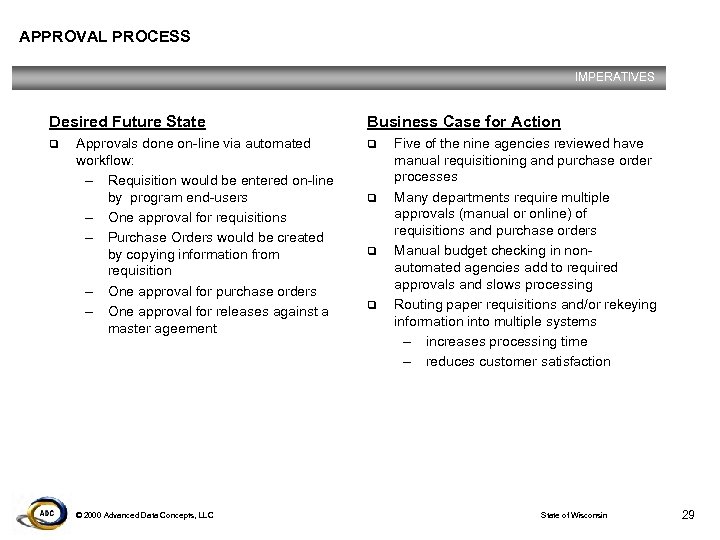 APPROVAL PROCESS IMPERATIVES Desired Future State q Approvals done on-line via automated workflow: – Requisition would be entered on-line by program end-users – One approval for requisitions – Purchase Orders would be created by copying information from requisition – One approval for purchase orders – One approval for releases against a master ageement © 2000 Advanced Data Concepts, LLC Business Case for Action q q Five of the nine agencies reviewed have manual requisitioning and purchase order processes Many departments require multiple approvals (manual or online) of requisitions and purchase orders Manual budget checking in nonautomated agencies add to required approvals and slows processing Routing paper requisitions and/or rekeying information into multiple systems – increases processing time – reduces customer satisfaction State of Wisconsin 29
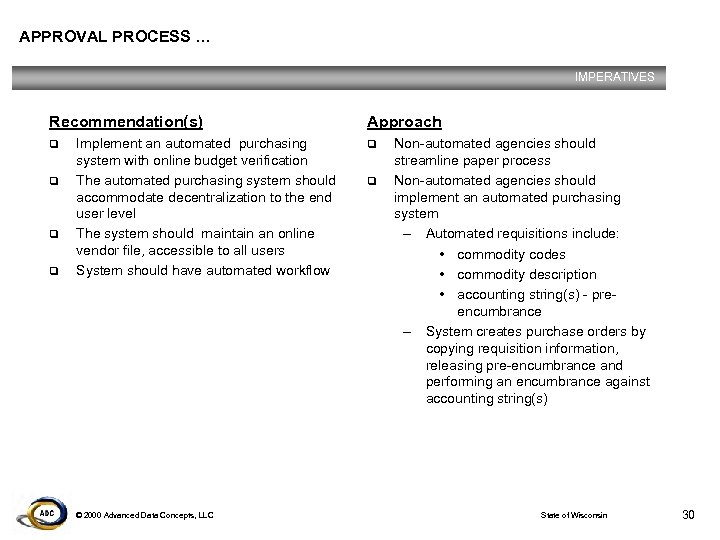 APPROVAL PROCESS … IMPERATIVES Recommendation(s) q q Implement an automated purchasing system with online budget verification The automated purchasing system should accommodate decentralization to the end user level The system should maintain an online vendor file, accessible to all users System should have automated workflow © 2000 Advanced Data Concepts, LLC Approach q q Non-automated agencies should streamline paper process Non-automated agencies should implement an automated purchasing system – Automated requisitions include: • commodity codes • commodity description • accounting string(s) - preencumbrance – System creates purchase orders by copying requisition information, releasing pre-encumbrance and performing an encumbrance against accounting string(s) State of Wisconsin 30
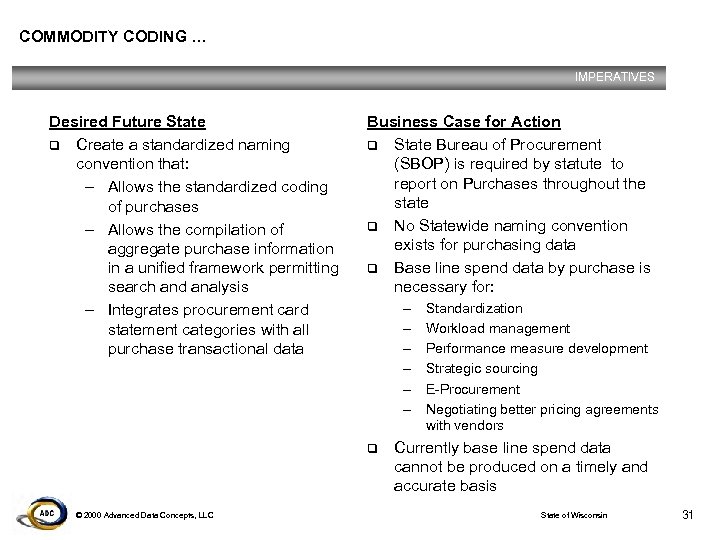 COMMODITY CODING … IMPERATIVES Desired Future State q Create a standardized naming convention that: – Allows the standardized coding of purchases – Allows the compilation of aggregate purchase information in a unified framework permitting search and analysis – Integrates procurement card statement categories with all purchase transactional data Business Case for Action q State Bureau of Procurement (SBOP) is required by statute to report on Purchases throughout the state q No Statewide naming convention exists for purchasing data q Base line spend data by purchase is necessary for: – – – q © 2000 Advanced Data Concepts, LLC Standardization Workload management Performance measure development Strategic sourcing E-Procurement Negotiating better pricing agreements with vendors Currently base line spend data cannot be produced on a timely and accurate basis State of Wisconsin 31
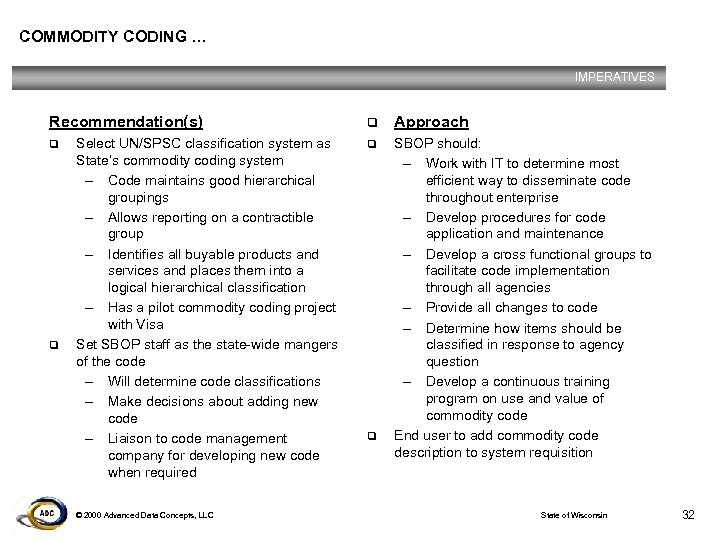 COMMODITY CODING … IMPERATIVES Recommendation(s) q q Select UN/SPSC classification system as State’s commodity coding system – Code maintains good hierarchical groupings – Allows reporting on a contractible group – Identifies all buyable products and services and places them into a logical hierarchical classification – Has a pilot commodity coding project with Visa Set SBOP staff as the state-wide mangers of the code – Will determine code classifications – Make decisions about adding new code – Liaison to code management company for developing new code when required © 2000 Advanced Data Concepts, LLC q Approach q SBOP should: – Work with IT to determine most efficient way to disseminate code throughout enterprise – Develop procedures for code application and maintenance – Develop a cross functional groups to facilitate code implementation through all agencies – Provide all changes to code – Determine how items should be classified in response to agency question – Develop a continuous training program on use and value of commodity code End user to add commodity code description to system requisition q State of Wisconsin 32
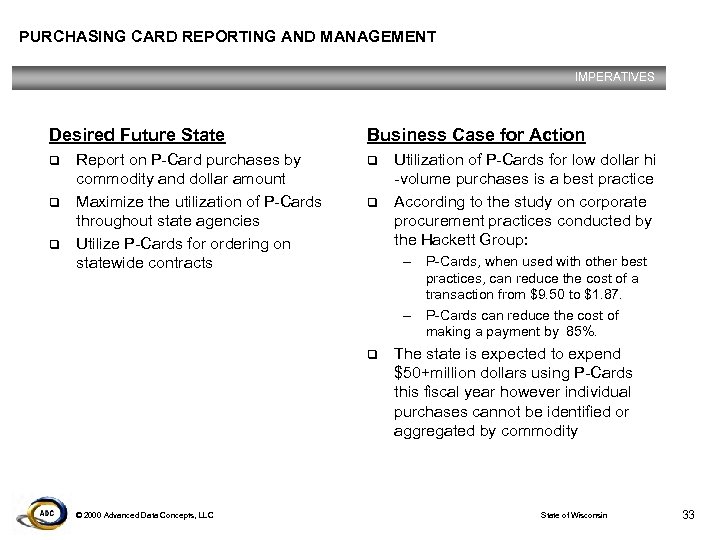 PURCHASING CARD REPORTING AND MANAGEMENT IMPERATIVES Desired Future State q q q Report on P-Card purchases by commodity and dollar amount Maximize the utilization of P-Cards throughout state agencies Utilize P-Cards for ordering on statewide contracts Business Case for Action q q – P-Cards, when used with other best practices, can reduce the cost of a transaction from $9. 50 to $1. 87. – P-Cards can reduce the cost of making a payment by 85%. q © 2000 Advanced Data Concepts, LLC Utilization of P-Cards for low dollar hi -volume purchases is a best practice According to the study on corporate procurement practices conducted by the Hackett Group: The state is expected to expend $50+million dollars using P-Cards this fiscal year however individual purchases cannot be identified or aggregated by commodity State of Wisconsin 33
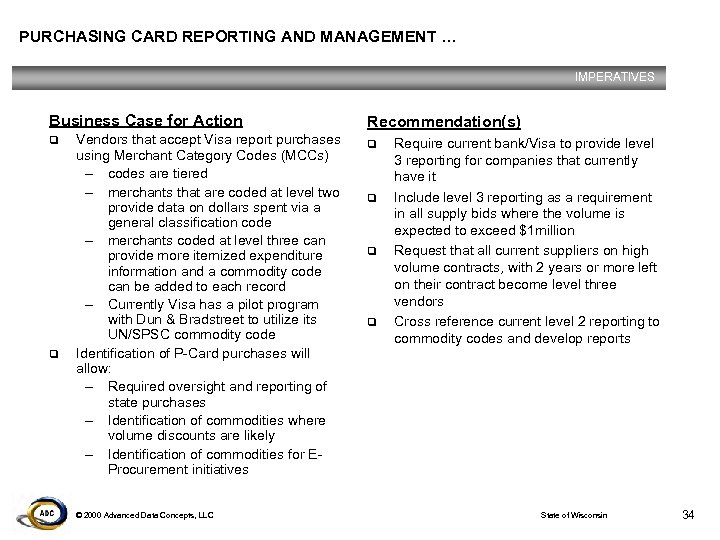 PURCHASING CARD REPORTING AND MANAGEMENT … IMPERATIVES Business Case for Action q q Vendors that accept Visa report purchases using Merchant Category Codes (MCCs) – codes are tiered – merchants that are coded at level two provide data on dollars spent via a general classification code – merchants coded at level three can provide more itemized expenditure information and a commodity code can be added to each record – Currently Visa has a pilot program with Dun & Bradstreet to utilize its UN/SPSC commodity code Identification of P-Card purchases will allow: – Required oversight and reporting of state purchases – Identification of commodities where volume discounts are likely – Identification of commodities for EProcurement initiatives © 2000 Advanced Data Concepts, LLC Recommendation(s) q q Require current bank/Visa to provide level 3 reporting for companies that currently have it Include level 3 reporting as a requirement in all supply bids where the volume is expected to exceed $1 million Request that all current suppliers on high volume contracts, with 2 years or more left on their contract become level three vendors Cross reference current level 2 reporting to commodity codes and develop reports State of Wisconsin 34
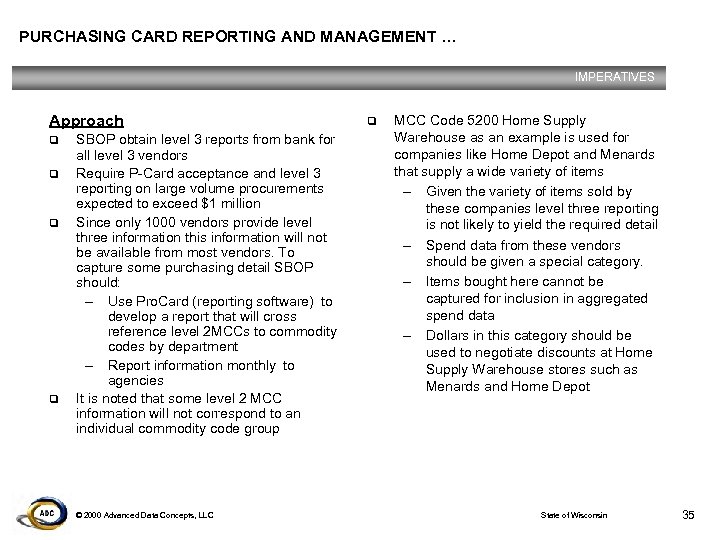 PURCHASING CARD REPORTING AND MANAGEMENT … IMPERATIVES Approach q q SBOP obtain level 3 reports from bank for all level 3 vendors Require P-Card acceptance and level 3 reporting on large volume procurements expected to exceed $1 million Since only 1000 vendors provide level three information this information will not be available from most vendors. To capture some purchasing detail SBOP should: – Use Pro. Card (reporting software) to develop a report that will cross reference level 2 MCCs to commodity codes by department – Report information monthly to agencies It is noted that some level 2 MCC information will not correspond to an individual commodity code group © 2000 Advanced Data Concepts, LLC q MCC Code 5200 Home Supply Warehouse as an example is used for companies like Home Depot and Menards that supply a wide variety of items – Given the variety of items sold by these companies level three reporting is not likely to yield the required detail – Spend data from these vendors should be given a special category. – Items bought here cannot be captured for inclusion in aggregated spend data – Dollars in this category should be used to negotiate discounts at Home Supply Warehouse stores such as Menards and Home Depot State of Wisconsin 35
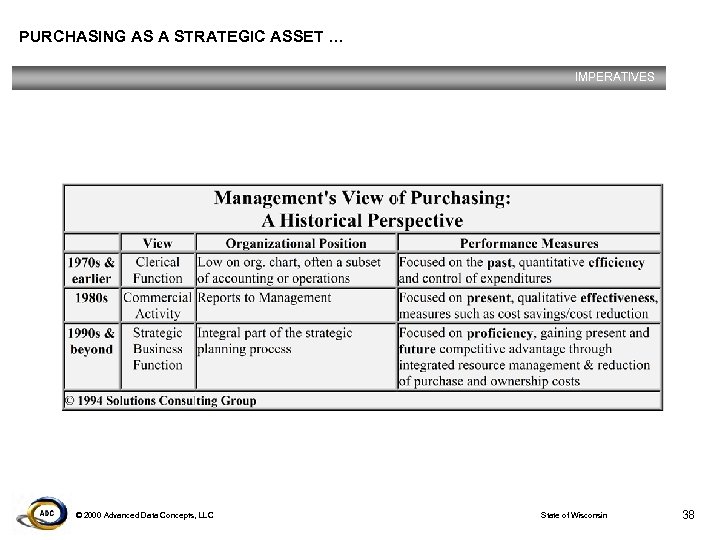
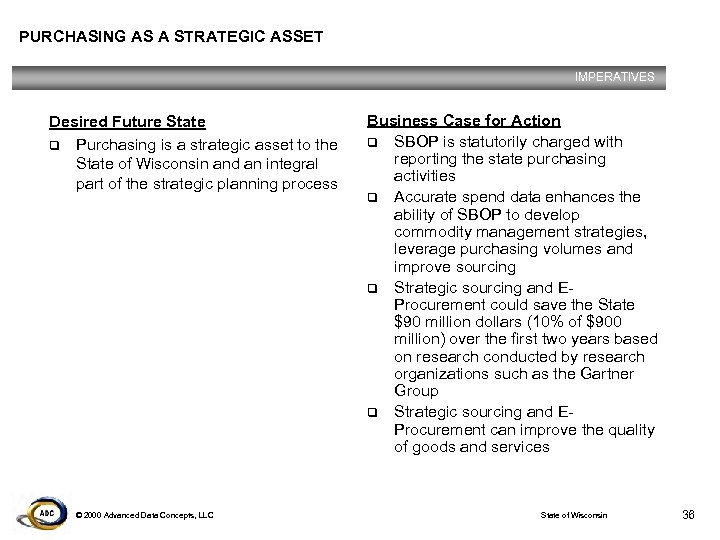 PURCHASING AS A STRATEGIC ASSET IMPERATIVES Desired Future State q Purchasing is a strategic asset to the State of Wisconsin and an integral part of the strategic planning process © 2000 Advanced Data Concepts, LLC Business Case for Action q SBOP is statutorily charged with reporting the state purchasing activities q Accurate spend data enhances the ability of SBOP to develop commodity management strategies, leverage purchasing volumes and improve sourcing q Strategic sourcing and EProcurement could save the State $90 million dollars (10% of $900 million) over the first two years based on research conducted by research organizations such as the Gartner Group q Strategic sourcing and EProcurement can improve the quality of goods and services State of Wisconsin 36
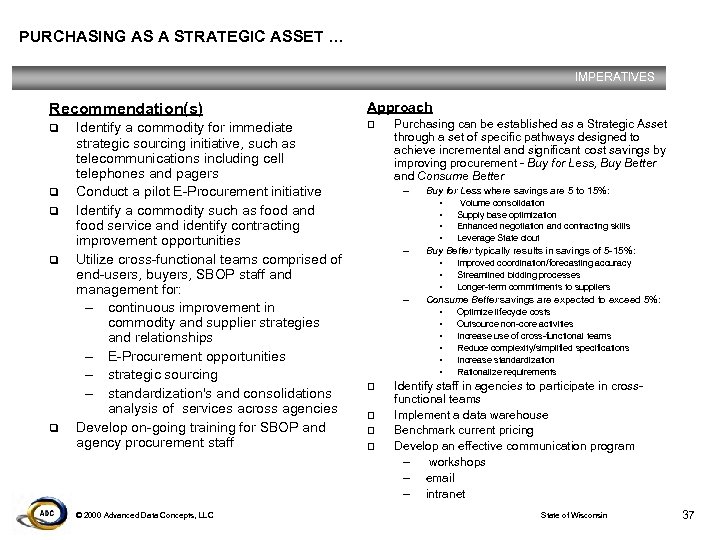 PURCHASING AS A STRATEGIC ASSET … IMPERATIVES Recommendation(s) q q q Identify a commodity for immediate strategic sourcing initiative, such as telecommunications including cell telephones and pagers Conduct a pilot E-Procurement initiative Identify a commodity such as food and food service and identify contracting improvement opportunities Utilize cross-functional teams comprised of end-users, buyers, SBOP staff and management for: – continuous improvement in commodity and supplier strategies and relationships – E-Procurement opportunities – strategic sourcing – standardization's and consolidations analysis of services across agencies Develop on-going training for SBOP and agency procurement staff © 2000 Advanced Data Concepts, LLC Approach q Purchasing can be established as a Strategic Asset through a set of specific pathways designed to achieve incremental and significant cost savings by improving procurement - Buy for Less, Buy Better and Consume Better – Buy for Less where savings are 5 to 15%: • • – Buy Better typically results in savings of 5 -15%: • • • – q q q Improved coordination/forecasting accuracy Streamlined bidding processes Longer-term commitments to suppliers Consume Better savings are expected to exceed 5%: • • • q Volume consolidation Supply base optimization Enhanced negotiation and contracting skills Leverage State clout Optimize lifecycle costs Outsource non-core activities Increase use of cross-functional teams Reduce complexity/simplified specifications Increase standardization Rationalize requirements Identify staff in agencies to participate in crossfunctional teams Implement a data warehouse Benchmark current pricing Develop an effective communication program – workshops – email – intranet State of Wisconsin 37
 PURCHASING AS A STRATEGIC ASSET … IMPERATIVES © 2000 Advanced Data Concepts, LLC State of Wisconsin 38
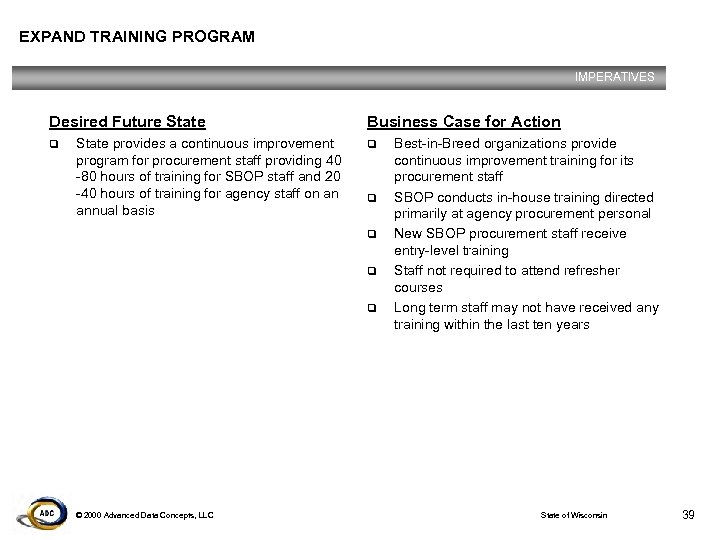 EXPAND TRAINING PROGRAM IMPERATIVES Desired Future State q State provides a continuous improvement program for procurement staff providing 40 -80 hours of training for SBOP staff and 20 -40 hours of training for agency staff on an annual basis Business Case for Action q q q © 2000 Advanced Data Concepts, LLC Best-in-Breed organizations provide continuous improvement training for its procurement staff SBOP conducts in-house training directed primarily at agency procurement personal New SBOP procurement staff receive entry-level training Staff not required to attend refresher courses Long term staff may not have received any training within the last ten years State of Wisconsin 39
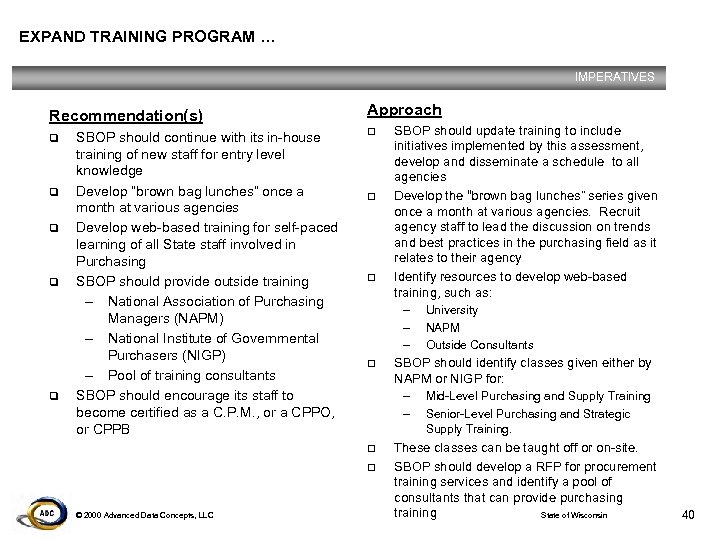 EXPAND TRAINING PROGRAM … IMPERATIVES Recommendation(s) q q q SBOP should continue with its in-house training of new staff for entry level knowledge Develop “brown bag lunches” once a month at various agencies Develop web-based training for self-paced learning of all State staff involved in Purchasing SBOP should provide outside training – National Association of Purchasing Managers (NAPM) – National Institute of Governmental Purchasers (NIGP) – Pool of training consultants SBOP should encourage its staff to become certified as a C. P. M. , or a CPPO, or CPPB Approach q q Supply Training. q q © 2000 Advanced Data Concepts, LLC SBOP should update training to include initiatives implemented by this assessment, develop and disseminate a schedule to all agencies Develop the “brown bag lunches” series given once a month at various agencies. Recruit agency staff to lead the discussion on trends and best practices in the purchasing field as it relates to their agency Identify resources to develop web-based training, such as: – University – NAPM – Outside Consultants SBOP should identify classes given either by NAPM or NIGP for: – Mid-Level Purchasing and Supply Training – Senior-Level Purchasing and Strategic These classes can be taught off or on-site. SBOP should develop a RFP for procurement training services and identify a pool of consultants that can provide purchasing training State of Wisconsin 40
 STANDARDIZATION AND CONSOLIDATION IMPERATIVES Desired Future State q Institute a standardization program (tool to Business Case for Action q achieve cost savings) q q q © 2000 Advanced Data Concepts, LLC Neither state nor agencies limit the type of items purchased to increase the volume of a selected item or commodity Examples of state contracts providing too much variety: – copier contract 15 types of copiers , 6 to 8 brands per type – printer contracts 25 types of printers, 4 to 12 brands per type – hand & electric tool contract offers access to all items on eight vendor catalogs Standards committees have no cost savings goals and are encouraged to develop requirements for many of items rather than consolidation to as few different types as possible Agencies provide no guidelines for staff regarding types of supplies which they are allowed to purchase therefore staff may use several varieties of the same item. State of Wisconsin 41
 STANDARDIZATION AND CONSOLIDATION … IMPERATIVES Recommendation(s) q q q Set cost saving goals for specific commodities Develop multi-agency standards committee with goals of reducing number of items in commodity Rebid expiring contracts within targeted commodities using reduced items listing and include requirements for analyzing cost savings. Approach q q q © 2000 Advanced Data Concepts, LLC SBOP should work with agencies to develop statewide, internal support for cost reduction/cost savings programs. SBOP should obtain baseline spend data on statewide purchases – Until this data can be obtained from internal reporting vendors should be asked to provide usage – Evaluate commodities to determine where standardization is warranted – Develop cross function, multi-agency team to work on standardizing designated statewide contracts Agencies should also develop agency wide teams to target standardization and consolidation opportunities within the agency State of Wisconsin 42
 VENDORNET STATE BIDDERS LIST IMPERATIVES Desired Future State q Vendor. Net the only State Bidders List Business Case for Action q q q © 2000 Advanced Data Concepts, LLC PRO C 35 has established Vendor. Net as the State’s bidders list Vendor. Net is a real-time, interactive, bid posting Internet application Vendor. Net is a precursor of EProcurement initiatives Currently, Vendor. Net has a base of 1, 600+ vendors Many of the State agencies continue to maintain their own bidder lists It is a common practice for agencies to send copies of bids and RFPs to non. Vendor. Net vendors State of Wisconsin 43
 VENDORNET STATE BIDDERS LIST … IMPERATIVES Recommendation(s) q q q q q Allow all vendors to register on-line with Vendor. Net Registration required for bid to be responsive All vendors that have a current contract must be on Vendor. Net Do not charge vendors to register with Vendor. Net Charge fee for automated services, such as receiving bid notification electronically or downloading bid documents Fee structure is based on: – number of commodity classes – in-state vs. out-of-state vendor Change legal notice requirement from newspaper advertisement to electronic notification Enhance Vendor. Net ability to accept online payment Enhance Vendor. Net to calculate bid tabulation Enhance search engine capabilities © 2000 Advanced Data Concepts, LLC Approach q q Change Wis. Stats. 16. 004; 16. 701>Wis. Adm. Code Chapter Adm 9 to indicate that vendors must register with Vendor. Net to bid with the State and/or receive contracts. Vendors must pay a fee to be notified automatically of all agency requests for bids/proposals over $25, 000. SBOP should work with agencies to ensure all current agency vendors are on Vendor. Net SBOP should develop a two-year strategic plan to ready all its vendors for EProcurement – At the end of 2 -years, change Wis. Stats. 16. 75 to identify legal notice as electronic notification SBOP should implement enhancements to Vendor. Net application/environment to include: – on-line payment – calculate bid tabulation – increased search engine capabilities State of Wisconsin 44
 VENDOR DATA RATIONALIZATION … IMPERATIVES Desired Future State q q WISMART the only vendor table for State Vendor List cleansed and rationalized within WISMART. Business Case For Action q q Multiple Vendor lists, files and databases across the State inhibits the State’s ability to effectively manage Vendors and monitor their performance. No coding standards for Vendor Information (e. g. , identification, address standardization, multiple locations, etc. ) Approach Recommendation(s) q Standardize Vendor Information. © 2000 Advanced Data Concepts, LLC q q Define rules and standards for Vendor identification and coding. Combine, cleanse, and rationalize multiple Vendor lists in use across State of Wisconsin 45
 KEY PERFORMANCE INDICATORS - VENDORS IMPERATIVES Desired Future State q q q RFPs and contracts resulting from RFPs should contain clear vendor performance standards SBOP should monitor vendor performance on statewide contracts Central purchasing staff within agencies should monitor performance on agency initiated contracts © 2000 Advanced Data Concepts, LLC Business Case for Action q q q Failure of vendors to meet performance criteria means – agency is paying for a quality level that will not be achieved – terms and conditions which are key to cost savings may not be honored Customer (end-user) satisfaction will be low Performance criteria that is not quantifiable or unclear leads to differences in the expectations of the vendor and the end user and results in disputes State of Wisconsin 46
 KEY PERFORMANCE INDICATORS – VENDORS … IMPERATIVES Recommendation(s) q q All RFPs and contracts resulting from them should contain measurable performance standards Performance standards at a minimum should identify: – the specific service (s) that must be performed – expected outcomes or deliverables – provide quantifiable test methods by which outcomes or deliverables will be judged – quality measures that must be met – time frame of delivery requirements – any performance/cost reduction relationships – minimum vendor capabilities Approach q q Contract value and complexity should dictate the contract monitoring frequency for SBOP and agency staff On Statewide contracts SBOP should work in tandem with lead agencies to identify vendor performance standards At contract start up, purchasing staff and vendor should review performance requirements included in contract Procurement staff should be assigned specific contract administration duties that include: – determining vendor compliance with contract terms and conditions – determining the level of customer satisfaction with vendor services – working with Accounts Payable to insure that invoices reflect contract terms and conditions © 2000 Advanced Data Concepts, LLC State of Wisconsin 47
 KEY PERFORMANCE INDICATORS - STAFF IMPERATIVES Desired Future State q q SBOP and Agency purchasing staff will have clear goals and objectives for performance Goals, objectives and performance standards will reflect purchasing as a strategic asset Staff goals and objectives will be tied to the overall goals and objectives of their department Staff will be given performance standards that identify a satisfactory level of performance that are specific and measurable © 2000 Advanced Data Concepts, LLC Business Case for Action q q Currently criteria for doing a good job is defined by evaluating transaction data (how many bids or RFPs handled, timely renewal of expiring contracts, attendance, on time arrival, etc. ) To achieve an overall goal of purchasing as a strategic asset, goals, objectives and performance standards must be based on activities that add value to the procurement process – Samples of typical performance appraisal questions for transactional purchasing and performance indicators of purchasing as a strategic asset are listed on the next slide State of Wisconsin 48
 KEY PERFORMANCE INDICATORS – STAFF … IMPERATIVES Recommendation(s) q q SBOP and agencies should identify goals and objectives that enhance the purchasing performance as a strategic asset ( goals related to cost savings require accurate baseline spend data) Staff should be apprised of organizational goals and objectives and (in tandem with supervisors) set goals for performance that support agency goals. Specific and measurable performance standards should be gleaned from goals and objectives that clearly identify satisfactory performance Incentives should be developed that will reward successful completion of employee goals and objectives © 2000 Advanced Data Concepts, LLC Approach q q q SBOP Management and Human Resources department must identify incentives (over and above standard increases) that can be offered to employees that successfully complete goals and objectives. SBOP and agency management must develop a strategic plan for department procurement that identifies departmental goals and objectives Supervisors, in tandem with employees, must set goals and objectives that support agency goals. Supervisors must develop employee performance standards and measures. Goals and objectives must support purchasing as a strategic asset as opposed to a transactional activity. State of Wisconsin 49
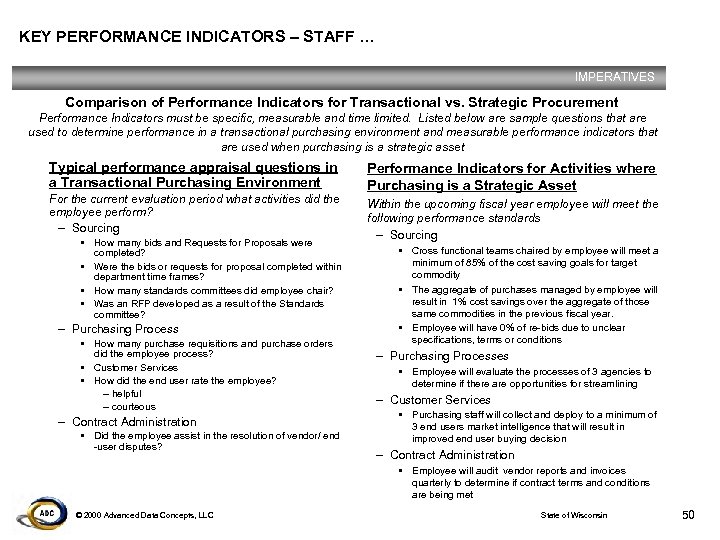 KEY PERFORMANCE INDICATORS – STAFF … IMPERATIVES Comparison of Performance Indicators for Transactional vs. Strategic Procurement Performance Indicators must be specific, measurable and time limited. Listed below are sample questions that are used to determine performance in a transactional purchasing environment and measurable performance indicators that are used when purchasing is a strategic asset Typical performance appraisal questions in a Transactional Purchasing Environment For the current evaluation period what activities did the employee perform? – Sourcing • How many bids and Requests for Proposals were completed? • Were the bids or requests for proposal completed within department time frames? • How many standards committees did employee chair? • Was an RFP developed as a result of the Standards committee? – Purchasing Process • How many purchase requisitions and purchase orders did the employee process? • Customer Services • How did the end user rate the employee? – helpful – courteous – Contract Administration • Did the employee assist in the resolution of vendor/ end -user disputes? Performance Indicators for Activities where Purchasing is a Strategic Asset Within the upcoming fiscal year employee will meet the following performance standards – Sourcing • Cross functional teams chaired by employee will meet a minimum of 85% of the cost saving goals for target commodity • The aggregate of purchases managed by employee will result in 1% cost savings over the aggregate of those same commodities in the previous fiscal year. • Employee will have 0% of re-bids due to unclear specifications, terms or conditions – Purchasing Processes • Employee will evaluate the processes of 3 agencies to determine if there are opportunities for streamlining – Customer Services • Purchasing staff will collect and deploy to a minimum of 3 end users market intelligence that will result in improved end user buying decision – Contract Administration • Employee will audit vendor reports and invoices quarterly to determine if contract terms and conditions are being met © 2000 Advanced Data Concepts, LLC State of Wisconsin 50
 KEY PERFORMANCE INDICATORS - CUSTOMER SATISFACTION IMPERATIVES Desired Future State q SBOP mission statement incorporates its customer service initiatives Business Case for Action q q © 2000 Advanced Data Concepts, LLC SBOP currently receives customer feedback from interagency meetings and surveys to agency purchasing staff and vendors monthly meetings of Purchasing personnel – too large for meaningful customer feedback and dialogue – does not include agency end users Current surveys are information gathering tools not specifically targeted to determine customer satisfaction SBOP is considering charging agencies for value added services – internal customer’s perceptions of SBOP’s service overall service and value will have a great impact on their acceptance of this funding philosophy State of Wisconsin 51
 KEY PERFORMANCE INDICATORS - CUSTOMER SATISFACTION … IMPERATIVES Recommendation(s) q q SBOP should develop a mission statement that includes its customer service goals. Mission statement should be incorporated into policies and procedures SBOP should conduct easy to answer “pulse” surveys, assessments of specific purchasing initiatives, for both vendor and internal customers Implement Customer Advisory Boards much like users groups that exist in the software industry. They provide feed back on both SBOP and agency practices. Utilize feedback from surveys and Customer Advisory Boards to develop performance standards for SBOP staff © 2000 Advanced Data Concepts, LLC Approach q q Develop mission statement and internal communication plan for incorporating customer service principles of mission statement into SBOP culture. Determine areas requiring feed back and develop survey schedule and topic. Staff should be assigned to this initiative. Purchasing advisory teams, comprised of like size agency end-users, procurement staff and vendors should be developed to provide SBOP feedback on its polices, procedures and services. Incorporate customer service performance standards as evaluation criteria in employee performance appraisals State of Wisconsin 52
 RECOMMENDATIONS SYSTEM SOLUTIONS © 2000 Advanced Data Concepts, LLC State of Wisconsin
 MIGRATE FROM MANUAL FRAGMENTED SYSTEMS TO AUTOMATED INTERGRATED SOLUTIONS SYSTEM SOLUTIONS q Current Situation – Highly manual; many hand-offs – High “touch”; labor intensive – Significant non-valueadded activities – Multiple systems; heterogeneous environment © 2000 Advanced Data Concepts, LLC q Desired Future Situation – Fully automated, endto-end – Low “touch”; exception-based processing – Integrated workflow – Leverage N-Tier Systems Architecture State of Wisconsin 54
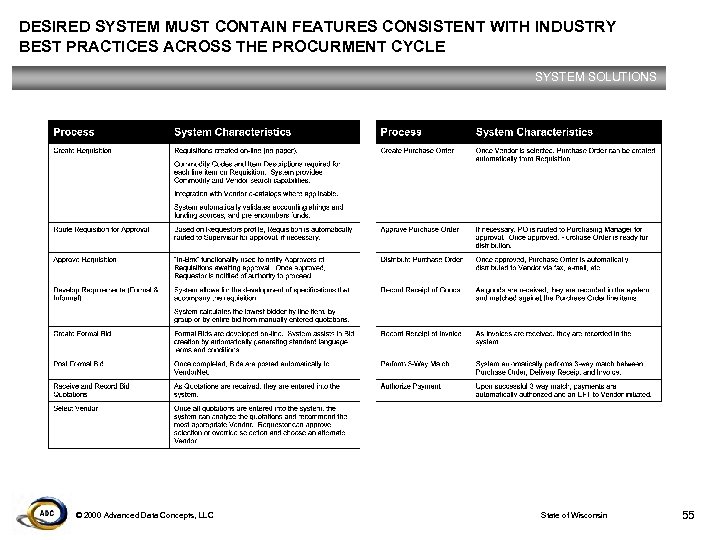 DESIRED SYSTEM MUST CONTAIN FEATURES CONSISTENT WITH INDUSTRY BEST PRACTICES ACROSS THE PROCURMENT CYCLE SYSTEM SOLUTIONS © 2000 Advanced Data Concepts, LLC State of Wisconsin 55
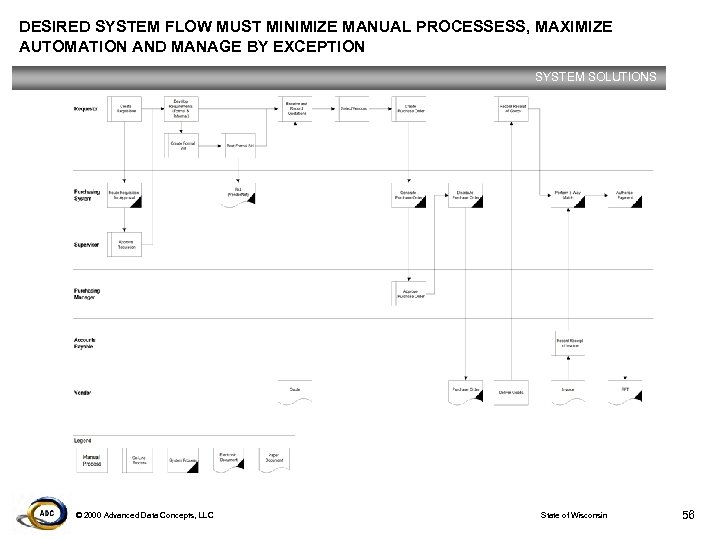 DESIRED SYSTEM FLOW MUST MINIMIZE MANUAL PROCESSESS, MAXIMIZE AUTOMATION AND MANAGE BY EXCEPTION SYSTEM SOLUTIONS © 2000 Advanced Data Concepts, LLC State of Wisconsin 56
 MAJOR SYSTEM RECOMMENDATIONS SYSTEM SOLUTIONS q SYSTEMS SOLUTIONS – Near-Term, Immediate: § Begin development of Data Warehouse to capture data for the analysis of statewide purchasing activity and spend data [Also listed as an Imperative] § Conduct detailed feasibility study to determine best approach for dedicated statewide procurement solution that automates the requisition to payment process Ø Enhance in-house purchasing system (e. g. , Purchase. Plus) Ø Purchase procurement software package (e. g. Purchasing. Net, Compusearch Software – Prism, Dynamic Software, MRO Software, …) – Medium-Term: § Utilize E-Procurement – use reverse auctions and/or strategic sourcing for new purchases where feasible § Chief Information Officer – centralize technology initiatives under leadership statewide executive – Long-Term: § Adopt the implementation of an Enterprise Application System (EAS); also referred to as an Enterprise Resource Planning (ERP) System Ø Includes consideration of upgrading Wis. MART (AMS Advantage 3. 0 Software) and migrating all agencies to Wis. MART in conjunction with retaining newly deployed statewide procurement system © 2000 Advanced Data Concepts, LLC State of Wisconsin 57
 SEVERAL SYSTEM SOLUTION OPTIONS EXIST SYSTEM SOLUTIONS © 2000 Advanced Data Concepts, LLC State of Wisconsin 58
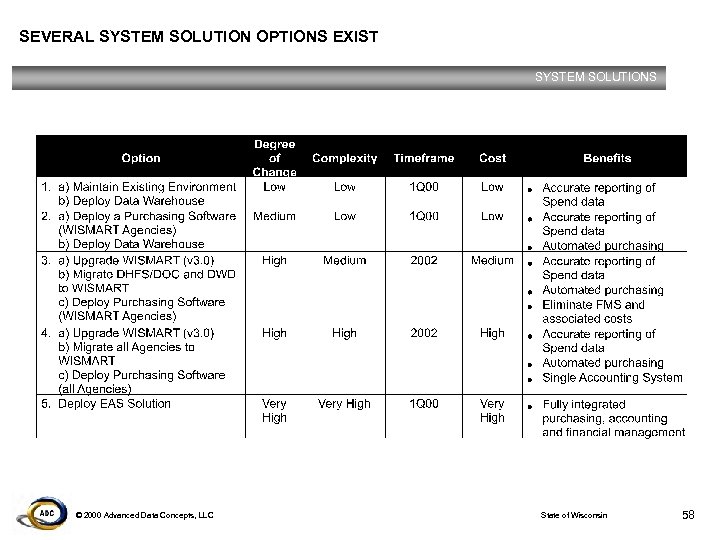
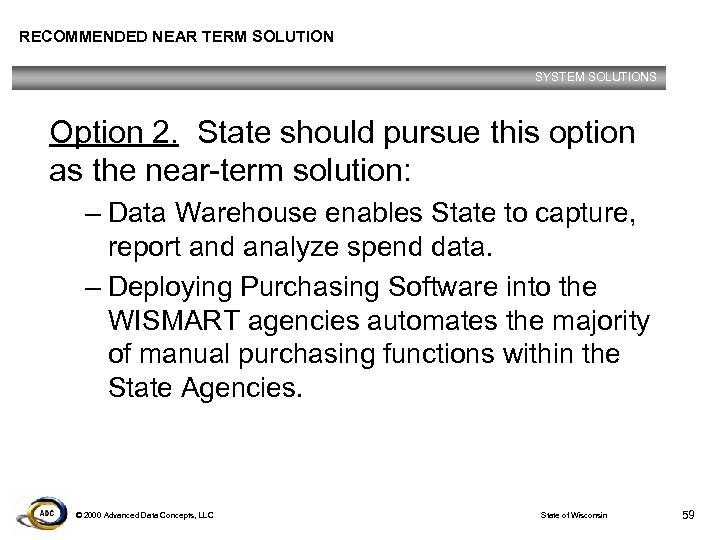 RECOMMENDED NEAR TERM SOLUTION SYSTEM SOLUTIONS Option 2. State should pursue this option as the near-term solution: – Data Warehouse enables State to capture, report and analyze spend data. – Deploying Purchasing Software into the WISMART agencies automates the majority of manual purchasing functions within the State Agencies. © 2000 Advanced Data Concepts, LLC State of Wisconsin 59
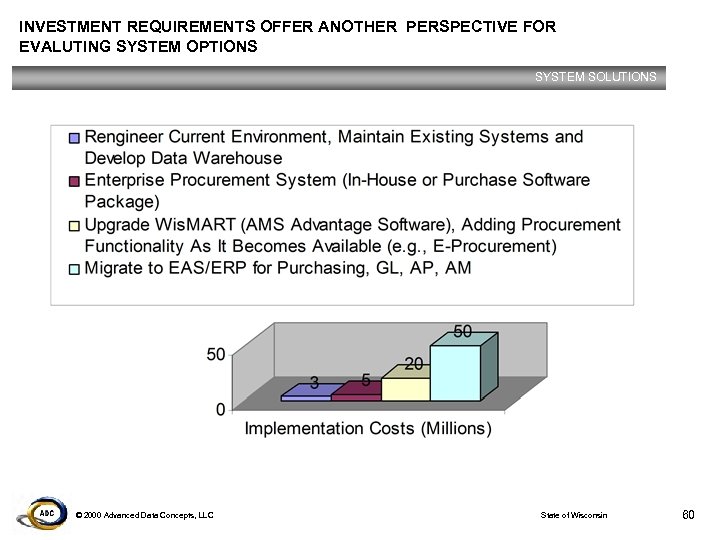 INVESTMENT REQUIREMENTS OFFER ANOTHER PERSPECTIVE FOR EVALUTING SYSTEM OPTIONS SYSTEM SOLUTIONS © 2000 Advanced Data Concepts, LLC State of Wisconsin 60
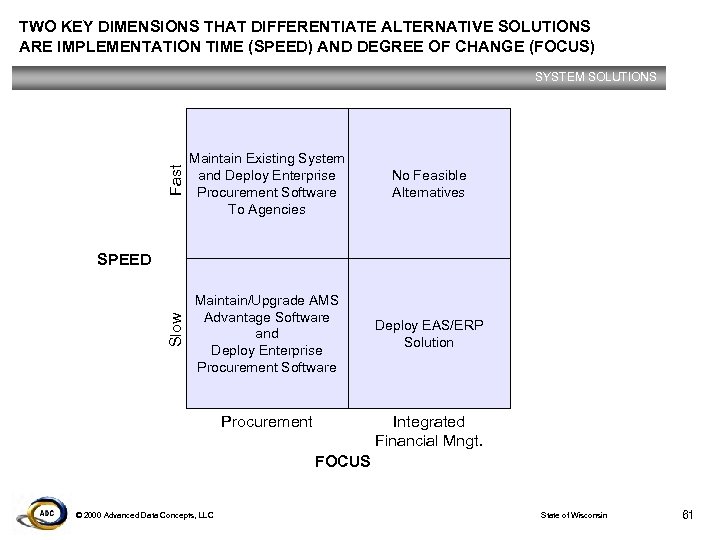 TWO KEY DIMENSIONS THAT DIFFERENTIATE ALTERNATIVE SOLUTIONS ARE IMPLEMENTATION TIME (SPEED) AND DEGREE OF CHANGE (FOCUS) Fast Maintain Existing System and Deploy Enterprise Procurement Software To Agencies No Feasible Alternatives Slow SYSTEM SOLUTIONS Maintain/Upgrade AMS Advantage Software and Deploy Enterprise Procurement Software Deploy EAS/ERP Solution SPEED Procurement Integrated Financial Mngt. FOCUS © 2000 Advanced Data Concepts, LLC State of Wisconsin 61
 DEPLOYING A DATA WAREHOUSE IS AN IMPERATIVE FOR A COMPREHENSIVE ANALYIS OF STATEWIDE PURCHASING ACTIVITY SYSTEM SOLUTIONS q What’s a Data Warehouse? – An information source containing data from multiple, heterogeneous, independent and possibly nonsynchronous systems, which is stored to optimize retrieval and reporting of data across the enterprise. – Typically subject-oriented allowing users access to operational data to track and respond to business trends and facilitate forecasting and planning efforts. © 2000 Advanced Data Concepts, LLC State of Wisconsin 62
 HOW DO DATA WAREHOUSES DIFFER FROM OPERATIONAL SYSTEMS? SYSTEM SOLUTIONS q Typically operational and transaction processing systems store data in its most atomic (non-redundant) format to alleviate performance issues and ease database maintenance. – Data stored in such a state is referred to as Normalized. q Normalized data can be difficult to extract and analyze when large amounts of data are required across a broad range of information types. – This difficultly is compounded when multiple systems and/or databases need to be accessed. – Large data extracts also degrade performance, which is not advisable in online, operational environments. q Data Warehousing addresses theses issues by focusing on structuring information into specific subject areas of interest (e. g. , Purchasing). – Data is the restructured into relevant Facts (e. g. , Spend Data) and Measures (e. g. , Total Spend Amount) that can be accessed by various Dimensions (e. g. , Agency, Time [Month/Year], Vendor, Commodity, etc. ) for analysis. © 2000 Advanced Data Concepts, LLC State of Wisconsin 63
 DATA WAREHOUSE ARCHITECTURE SYSTEM SOLUTIONS q q q Each “interfaced” agency would be responsible for generating an extract for the Data Warehouse. Remaining agencies purchasing activity would be captured via an extract from Purchase Software / WISMART. A “DW Load” process would then consolidate, cleanse and load the combined purchasing data to the Data Warehouse. Various Data Marts could then be generated to support the required reporting and analytical needs. Desktop and Browser-based query, reporting and OLAP tools (e. g. , Business Objects) would provide access to the Data Marts. © 2000 Advanced Data Concepts, LLC State of Wisconsin 64
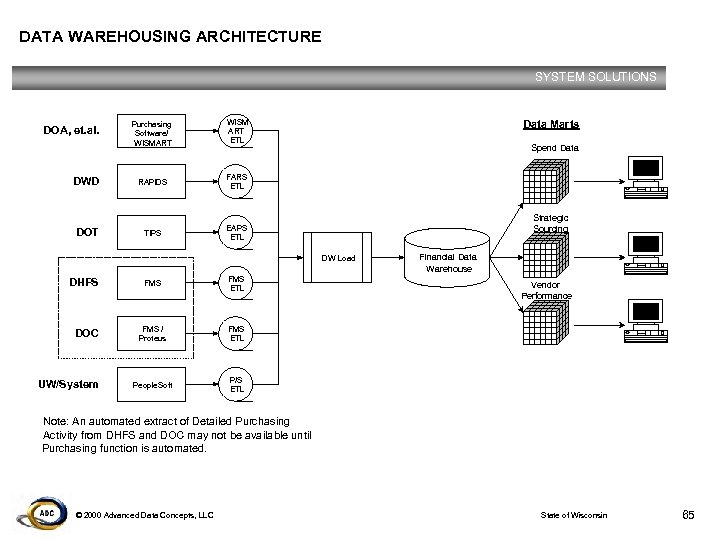 DATA WAREHOUSING ARCHITECTURE SYSTEM SOLUTIONS Purchasing Software/ WISMART WISM ART ETL DWD RAPIDS FARS ETL DOT TIPS EAPS ETL DOA, et. al. Data Marts Spend Data Strategic Sourcing DW Load DHFS DOC UW/System FMS ETL FMS / Proteus FMS ETL People. Soft Financial Data Warehouse P/S ETL Vendor Performance Note: An automated extract of Detailed Purchasing Activity from DHFS and DOC may not be available until Purchasing function is automated. © 2000 Advanced Data Concepts, LLC State of Wisconsin 65
 AN ENTERPRISE APPLICATION SYSTEM IS THE LONG-TERM RECOMMENDED SOLUTION SYSTEM SOLUTIONS Enterprise Application System (EAS) is: “An integrated technology bundle (some combination of software, hardware, and services) designed to integrate multiple facets of a business through the interchange of information from various vertical business process areas and related databases. These solutions effectively enable agencies to retrieve and disseminate mission critical data from throughout their organizations, providing managers with real-time operating information. ” Source: “Enterprise Application Solutions in the Public Sector”, Dataquest Perspective, VMPS-WW-DP-9903, Garter Group, April 1999. © 2000 Advanced Data Concepts, LLC State of Wisconsin 66
 BASED ON DISCUSSIONS WITH GARTNER GROUP … SYSTEM SOLUTIONS q One-third of State Governments have or are moving towards EAS solutions – Within 2 years, remaining States will enter RFP process for EAS solutions q Governor Councils mandating EAS solutions – Most will pursue single-vendor solutions – Fluidity in E-Commerce market space will likely drive “best-ofbreed” solutions q q 70% of existing State legacy environments are American Management Systems sites Public Sector EAS providers: – Leaders: Oracle, People. Soft, SAP – Others: JD Edwards, Lawson, Baan © 2000 Advanced Data Concepts, LLC State of Wisconsin 67
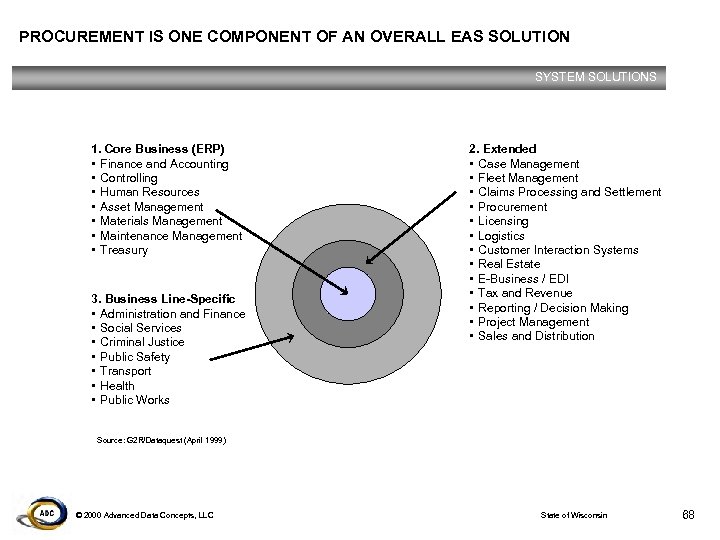 PROCUREMENT IS ONE COMPONENT OF AN OVERALL EAS SOLUTION SYSTEM SOLUTIONS 1. Core Business (ERP) • Finance and Accounting • Controlling • Human Resources • Asset Management • Materials Management • Maintenance Management • Treasury 3. Business Line-Specific • Administration and Finance • Social Services • Criminal Justice • Public Safety • Transport • Health • Public Works 2. Extended • Case Management • Fleet Management • Claims Processing and Settlement • Procurement • Licensing • Logistics • Customer Interaction Systems • Real Estate • E-Business / EDI • Tax and Revenue • Reporting / Decision Making • Project Management • Sales and Distribution Source: G 2 R/Dataquest (April 1999) © 2000 Advanced Data Concepts, LLC State of Wisconsin 68
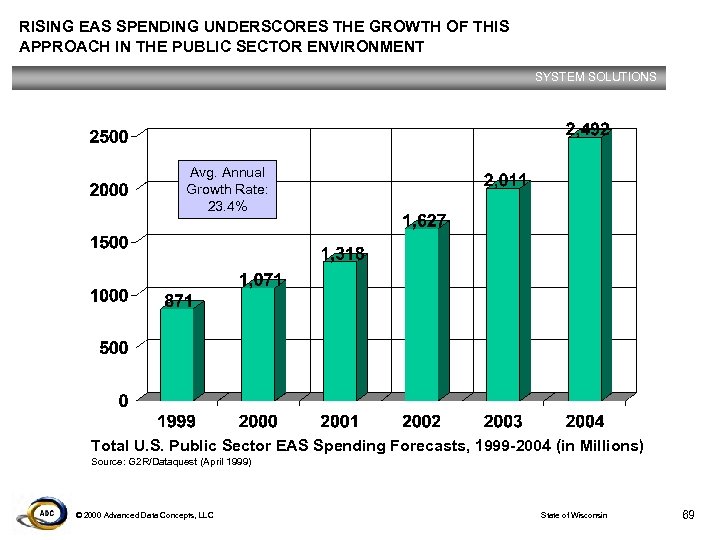 RISING EAS SPENDING UNDERSCORES THE GROWTH OF THIS APPROACH IN THE PUBLIC SECTOR ENVIRONMENT SYSTEM SOLUTIONS Avg. Annual Growth Rate: 23. 4% Total U. S. Public Sector EAS Spending Forecasts, 1999 -2004 (in Millions) Source: G 2 R/Dataquest (April 1999) © 2000 Advanced Data Concepts, LLC State of Wisconsin 69
 AN EAS/ERP IS THE RIGHT LONG-TERM SOLUTION AND MUST EXTEND BENEFITS BEYOND PROCUREMENT TO JUSTIFY BUSINESS CASE FOR INVESTMENT q q q Pursuant to Executive Order No. 408 and specifically Section 14. 019 of the Wisconsin Statutes, the Secretary of the Department of Administration is to create an internet-based “service center” giving citizens access to core state government services which includes portals, e-procurement, e-records and e-signatures. Electronic Government requires a well designed front-end web portal, tight integration with back-office administrative systems (finance, purchasing, human resources, etc. ), and reengineered business processes to successfully manage the new business model. Enterprise Application Systems or ERP serve as the most comprehensive foundation for the successful implementation of electronic government initiatives. Such systems not only provide the technical capability to make this happen, but also force the necessary degree of organizational change required. © 2000 Advanced Data Concepts, LLC State of Wisconsin 70
 AN EAS/ERP IS THE RIGHT LONG-TERM SOLUTION AND MUST EXTEND BENEFITS BEYOND PROCUREMENT TO JUSTIFY BUSINESS CASE FOR INVESTMENT q Software consolidation – State will minimize costs associated with maintaining a large number of disparate systems (e. g. , over 12 different financial and purchasing systems currently in use) q q q Real Time update Better management through seamless integration with finance, human resources, payroll, manufacturing (Badger Industries), and other functions. Examples include: – Cut financial period closing times – Capability to properly link cross-functional business process and adapt to organizational changes Leverage EAS/ERP built-in “best business practices”, research and development, best-of-breed pre-configured solutions (e. g. , Eprocurement, Citizen Relationship Management) and industry groups © 2000 Advanced Data Concepts, LLC State of Wisconsin 71
 THE STATE CAN REALIZE THE FOLLOWING BENEFITS FROM AN INTEGRATED E-PROCUREMENT & PURCHASING SOLUTION SYSTEM SOLUTIONS q q q q Reduce transactions to lower procurement costs Faster cycle times Reduced maverick or unauthorized buying Increased control over the supply chain Improved integration of the procurement function with back-office systems Proactive management of key procurement data Higher quality purchasing decisions Elevation of procurement to a position of strategic importance © 2000 Advanced Data Concepts, LLC State of Wisconsin 72
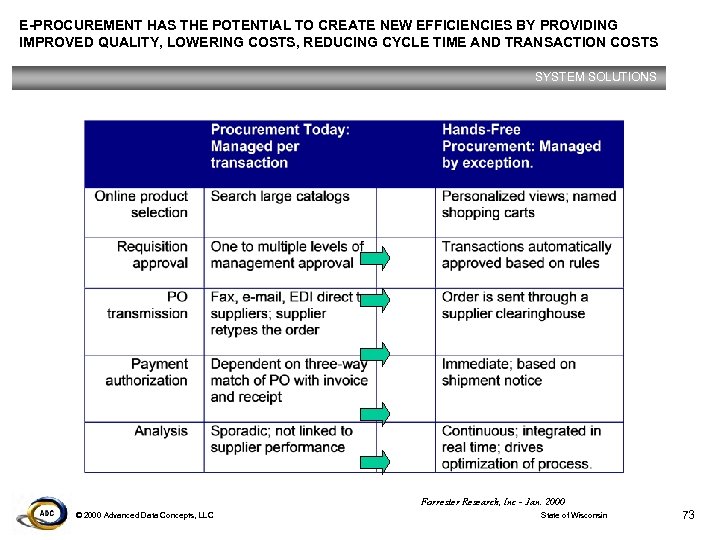 E-PROCUREMENT HAS THE POTENTIAL TO CREATE NEW EFFICIENCIES BY PROVIDING IMPROVED QUALITY, LOWERING COSTS, REDUCING CYCLE TIME AND TRANSACTION COSTS SYSTEM SOLUTIONS Forrester Research, Inc - Jan. 2000 © 2000 Advanced Data Concepts, LLC State of Wisconsin 73
 CENTRALIZED MANAGEMENT ENHANCES OPPORTUNITIES FOR SUCCESS IN STATEWIDE ENTERPRISE TECHNOLOGY INITIATIVES SYSTEM SOLUTIONS q q q Gartner Group indicates majority of States currently have or are in process of recruiting a Chief Information Officer. Given Wisconsin’s push toward E-Government and EProcurement, a Statewide CIO will be crucial to achieving the State’s vision. IT Organization and System changes necessary to support the vision require CIO-level authority to direct and coordinate their implementation. © 2000 Advanced Data Concepts, LLC State of Wisconsin 74
 ORGANIZATIONAL & POLITICAL CONSIDERATIONS © 2000 Advanced Data Concepts, LLC State of Wisconsin
 BUY-IN MUST BE DEVELOPED EARLY AND REAFFIRMED OFTEN; UNDERSTANDING AND MANAGING CHANGE IS CRITICAL TO ORGANIZATIONAL SUCCESS ORGANIZATIONAL & POLITICAL CONSIDERATIONS q q q Major organizational change for State of Wisconsin implies significant potential disruption to existing ways of doing business Willingness to accept change cannot be assumed A success implementation must have sponsorship at the highest levels of the organization Middle management and staff must also internalize and buy into the vision The buy-in process must start before the project begins – Agency staff must be deeply involved in implementing the new business imperatives and systems solution – An effective communications process is a necessary vehicle to obtain staff input and share information © 2000 Advanced Data Concepts, LLC State of Wisconsin 76
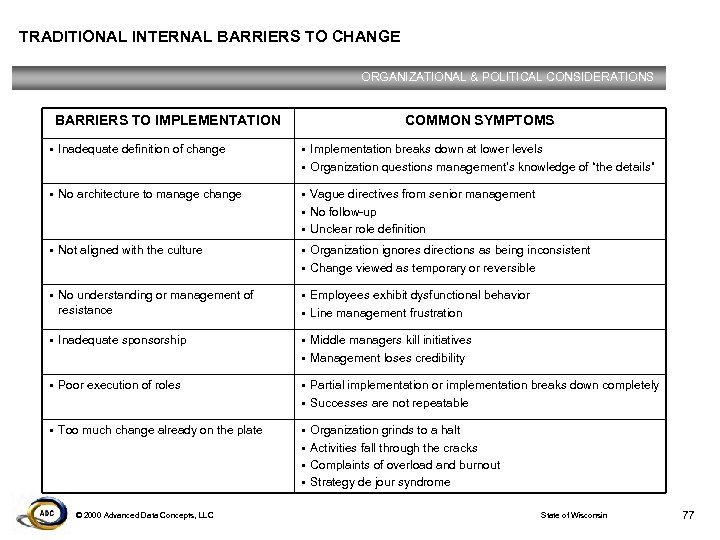 TRADITIONAL INTERNAL BARRIERS TO CHANGE ORGANIZATIONAL & POLITICAL CONSIDERATIONS BARRIERS TO IMPLEMENTATION § Inadequate definition of change COMMON SYMPTOMS § § § No architecture to manage change § § Not aligned with the culture § § No understanding or management of resistance § Inadequate sponsorship § § Poor execution of roles § § § Too much change already on the plate § § © 2000 Advanced Data Concepts, LLC Implementation breaks down at lower levels Organization questions management’s knowledge of “the details” Vague directives from senior management No follow-up Unclear role definition Organization ignores directions as being inconsistent Change viewed as temporary or reversible Employees exhibit dysfunctional behavior Line management frustration Middle managers kill initiatives Management loses credibility Partial implementation or implementation breaks down completely Successes are not repeatable Organization grinds to a halt Activities fall through the cracks Complaints of overload and burnout Strategy de jour syndrome State of Wisconsin 77
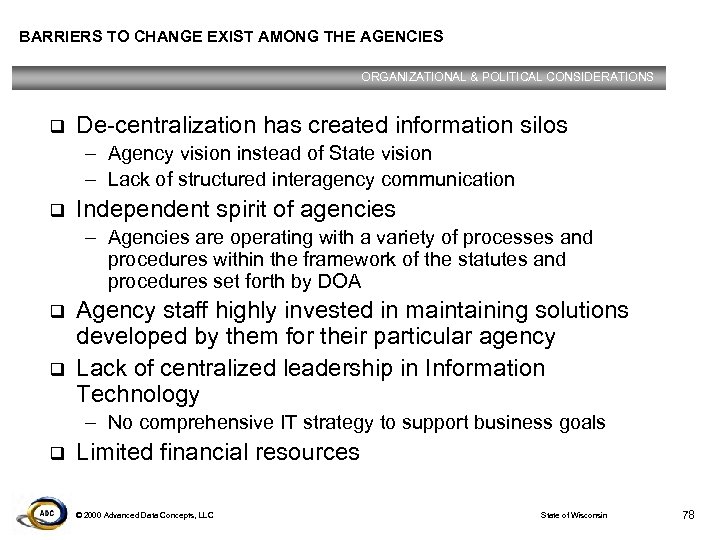 BARRIERS TO CHANGE EXIST AMONG THE AGENCIES ORGANIZATIONAL & POLITICAL CONSIDERATIONS q De-centralization has created information silos – Agency vision instead of State vision – Lack of structured interagency communication q Independent spirit of agencies – Agencies are operating with a variety of processes and procedures within the framework of the statutes and procedures set forth by DOA q q Agency staff highly invested in maintaining solutions developed by them for their particular agency Lack of centralized leadership in Information Technology – No comprehensive IT strategy to support business goals q Limited financial resources © 2000 Advanced Data Concepts, LLC State of Wisconsin 78
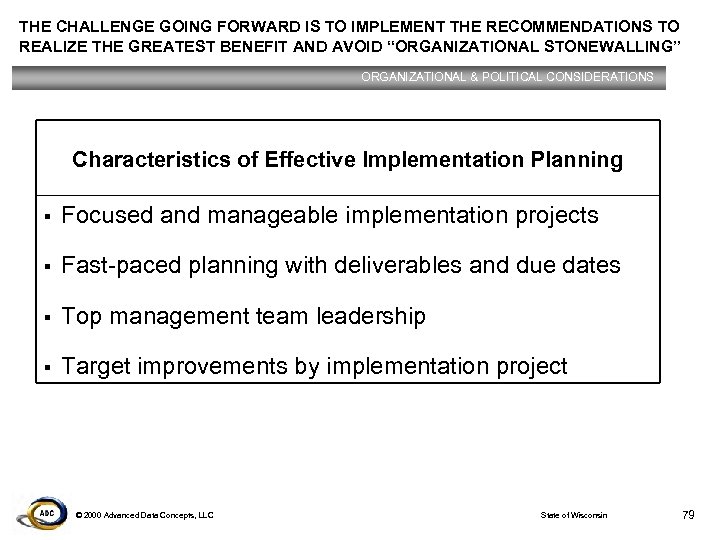 THE CHALLENGE GOING FORWARD IS TO IMPLEMENT THE RECOMMENDATIONS TO REALIZE THE GREATEST BENEFIT AND AVOID “ORGANIZATIONAL STONEWALLING” ORGANIZATIONAL & POLITICAL CONSIDERATIONS Characteristics of Effective Implementation Planning § Focused and manageable implementation projects § Fast-paced planning with deliverables and due dates § Top management team leadership § Target improvements by implementation project © 2000 Advanced Data Concepts, LLC State of Wisconsin 79
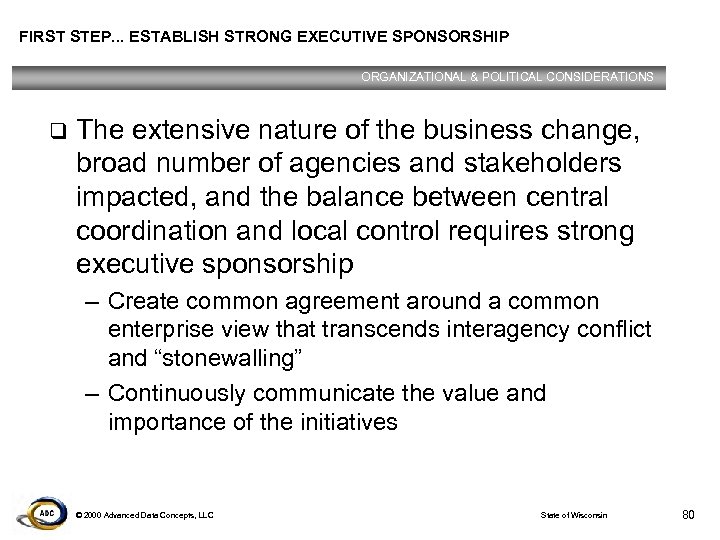 FIRST STEP. . . ESTABLISH STRONG EXECUTIVE SPONSORSHIP ORGANIZATIONAL & POLITICAL CONSIDERATIONS q The extensive nature of the business change, broad number of agencies and stakeholders impacted, and the balance between central coordination and local control requires strong executive sponsorship – Create common agreement around a common enterprise view that transcends interagency conflict and “stonewalling” – Continuously communicate the value and importance of the initiatives © 2000 Advanced Data Concepts, LLC State of Wisconsin 80
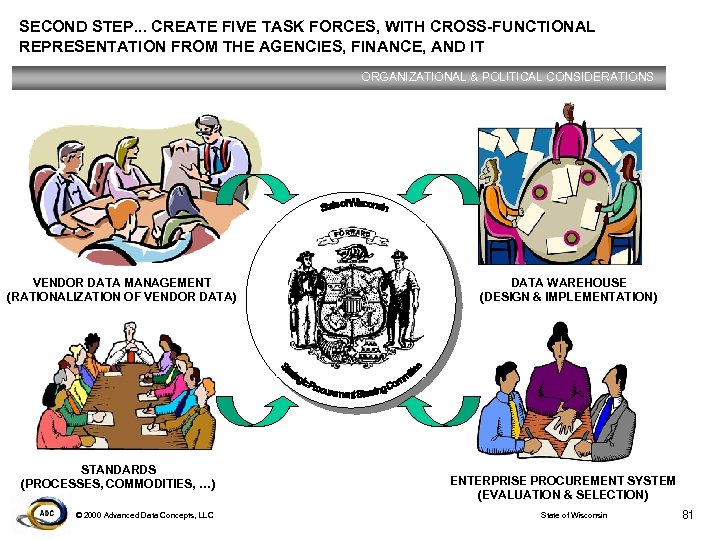 SECOND STEP. . . CREATE FIVE TASK FORCES, WITH CROSS-FUNCTIONAL REPRESENTATION FROM THE AGENCIES, FINANCE, AND IT ORGANIZATIONAL & POLITICAL CONSIDERATIONS VENDOR DATA MANAGEMENT (RATIONALIZATION OF VENDOR DATA) STANDARDS (PROCESSES, COMMODITIES, …) © 2000 Advanced Data Concepts, LLC DATA WAREHOUSE (DESIGN & IMPLEMENTATION) ENTERPRISE PROCUREMENT SYSTEM (EVALUATION & SELECTION) State of Wisconsin 81
 THIRD STEP… ADDRESS POLITICAL CONSIDERATIONS ORGANIZATIONAL & POLITICAL CONSIDERATIONS q q q Change Wis. Stats. 16. 004; 16. 701>Wis. Adm. Code Chapter Adm 9 to indicate that vendors must register with Vendor. Net to bid with the State and/or receive contracts Change Wis. Stats. 16. 75 to identify legal notice as electronic notification The State should establish a centralized CIO position to provide consistent direction to the agencies – Centralized leadership in Information Technology would support the States business strategies and goals while insuring that technology decisions remain aligned with IT strategies q Develop incentives (financial or others) to reward agencies and staff for participating in new statewide procurement initiatives © 2000 Advanced Data Concepts, LLC State of Wisconsin 82
 IMPLEMENTATION GAME PLAN © 2000 Advanced Data Concepts, LLC State of Wisconsin
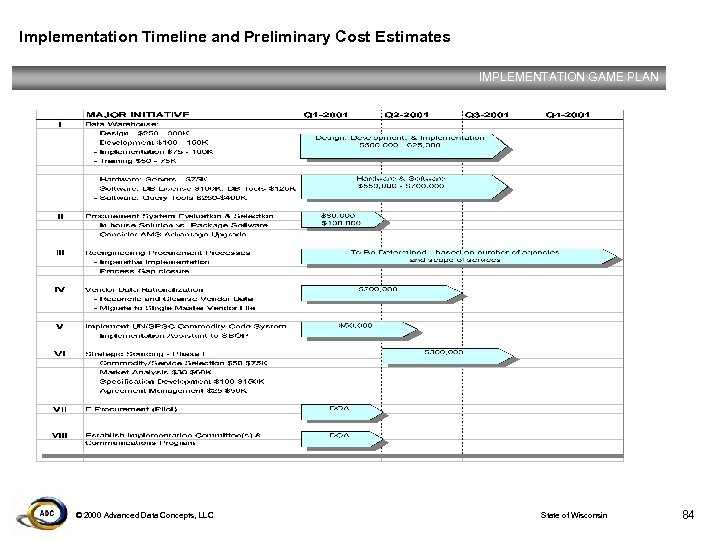 Implementation Timeline and Preliminary Cost Estimates IMPLEMENTATION GAME PLAN © 2000 Advanced Data Concepts, LLC State of Wisconsin 84
 BEST PRACTICES PROCESS MAPS © 2000 Advanced Data Concepts, LLC State of Wisconsin
 BEST PRACTICES PROCESS MAPS FOR THE DESIRED FUTURE STATE HAVE BEEN DEVELOPED BEST PRACTICES PROCESS MAPS q Process Maps illustrating “Best Practices” in procurement have been developed in the following areas: – – – Direct Charge Process Purchase Card Process Simplified Bid Process Statewide Contract Sealed Bid RFP Services – Quarterly Procurement Plan – Accounts Payable – Statewide Contract RFB / RFP – Vendor. Net Registration – Special Services Process Maps are presented on the following pages of this section of the report. © 2000 Advanced Data Concepts, LLC State of Wisconsin 86
 State of Wisconsin Procurement Analysis Project APPENDICES
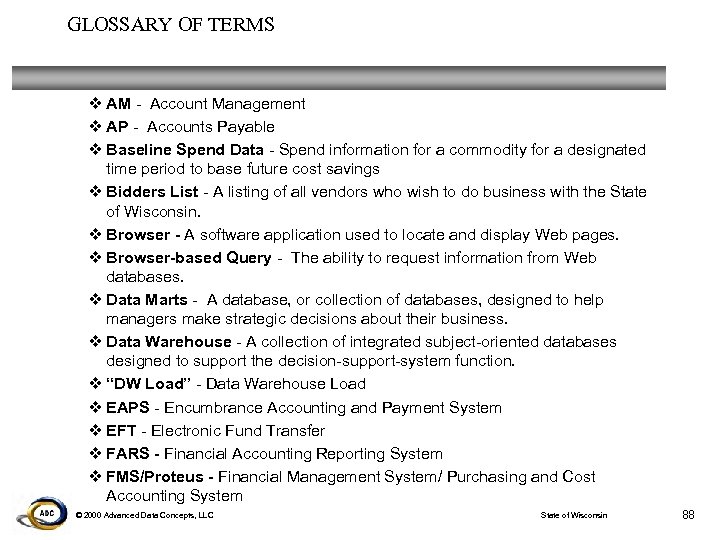 GLOSSARY OF TERMS v AM - Account Management v AP - Accounts Payable v Baseline Spend Data - Spend information for a commodity for a designated time period to base future cost savings v Bidders List - A listing of all vendors who wish to do business with the State of Wisconsin. v Browser - A software application used to locate and display Web pages. v Browser-based Query - The ability to request information from Web databases. v Data Marts - A database, or collection of databases, designed to help managers make strategic decisions about their business. v Data Warehouse - A collection of integrated subject-oriented databases designed to support the decision-support-system function. v “DW Load” - Data Warehouse Load v EAPS - Encumbrance Accounting and Payment System v EFT - Electronic Fund Transfer v FARS - Financial Accounting Reporting System v FMS/Proteus - Financial Management System/ Purchasing and Cost Accounting System © 2000 Advanced Data Concepts, LLC State of Wisconsin 88
 GLOSSARY OF TERMS v GL - General Ledger v OLAP - Online Analytical Processing, a category of software tools that provides analysis of data stored in a database. v Process Maps - a graphic description of a process showing the sequence of process tasks, for a specific purpose from a selected viewpoint. v N-Tier - A special type of client/server architecture consisting of well-defined and separate processes, each running on a different platform. v Client/Server Architecture - A network architecture in which each computer or process on the network is either a client or a server. Servers are powerful computers or processes dedicated to managing disk drives, printers, or network traffic. Clients are PCs or workstations on which users run applications. v RAPIDS - Purchasing System for DWD v RFB/RFP - Request for Bid / Request for Proposal v TIPS - Transportation Interactive Procurement System v UN/SPSC - United Nations Standard Products and Services Codes system is an open, global standard that provides a logical framework for classifying products and services of all kinds throughout the world. It is structured as a five-level hierarchy. At each level, a two-character numerical value classifies each item more specifically. © 2000 Advanced Data Concepts, LLC State of Wisconsin 89
 GLOSSARY OF TERMS v Vendor Table - A list of all vendors who have done or are currently doing business with the State of Wisconsin. v Wis. MART – Wisconsin State Management Accounting and Reporting Tool WISCONSIN STATE DEPARTMENTS v DHFS - Department of Health and Family Services v DOA - Department of Administration v DOC - Department of Corrections v DOT - Department of Transportation v DWD - Department of Workforce Development v SBOP - State Bureau of Procurement v UW/System - University of Wisconsin © 2000 Advanced Data Concepts, LLC State of Wisconsin 90
 SELECTED CASE STUDIES q State of Georgia q State of Washington q State of Pennsylvania / State of Ohio q Dell Computer © 2000 Advanced Data Concepts, LLC State of Wisconsin 91
 STATE OF GEORGIA CASE STUDIES q q Georgia’s Department of Administrative Services (DOAS) implemented People. Soft Inc. ERP software, on time, 18 months, and on budget, at $52 million 1999 “Big bang” approach – went live with ERP system throughout the entire organization at once – Modules include financials, purchasing and human resources – Provides better compliance with Generally Accepted Accounting Principles (reduce audit time by 50%) – Enabled the consolidation of old, non-integrated mainframe applications q Success factors: – Strong support from Governor’s Office – Extensive planning – Effective communications through project Web page, e-mail, instant messaging, and face-to-face meetings – Needed to add temporary employees to help oversee the project – Extensive training of existing staff – Effectively managed regulations, boards, commissions and agencies to minimize turf wars and maximize cooperation © 2000 Advanced Data Concepts, LLC State of Wisconsin 92
 STATE OF WASHINGTON CASE STUDIES q q q Selected AMS’ E-Procurement solution, called Buysense, which allows the state to purchase goods and services online. (July 2000) AMS’s Buysense is powered by software from Ariba, Inc. and can be implemented in three to four months. In pilot study, a transaction made through Buysense reduced transaction cycle time by over 60%. State officials intend to leverage embedded tracking technology to increase the number of purchases at government discount rates. When fully implemented, the state expects to have 10, 000 users making more than 500, 000 transactions annually totaling approx. $150 million in expenditures Deal is structured such that AMS’ revenue will come from transaction feeds charged to both the State and vendors. Supplier will pay a percentage of the value of the transaction, <1%, and the state will incur a purchase order fee of $3. 30, but will drop to as $2. 50 as transaction volumes increase toward target of 500, 000 by the fourth year. © 2000 Advanced Data Concepts, LLC State of Wisconsin 93
 PENNSYLVANIA & OHIO CASE STUDIES q q q Have successfully utilized “Reverse Auctions” to realize cost savings. Pennsylvania has claimed savings of $11 million in 2000. Ohio is the first state in the U. S. to conduct competitive, Internet auction of $250 million in interim Treasury funds. – Using new competitive live auction system, Bid. Ohio, has generated tax savings of over $3 million with the last 12 auctions. © 2000 Advanced Data Concepts, LLC State of Wisconsin 94
 DELL COMPUTER CASE STUDIES q Implemented packaged E-procurement suite from Ariba q Established electronic catalogs for suppliers q Routing about $10 million per month worth of requisitions, representing a broad range of non-production commodities © 2000 Advanced Data Concepts, LLC State of Wisconsin 95
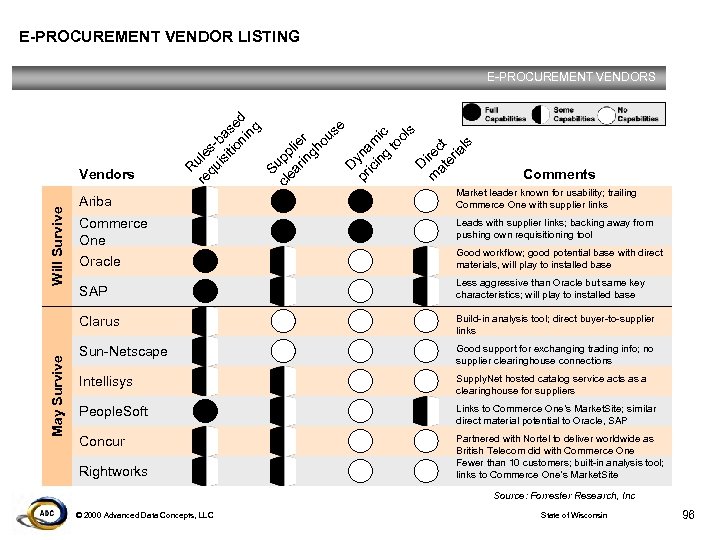 E-PROCUREMENT VENDOR LISTING Will Survive Vendors R re ule qu sis ba iti se on d in g S cl upp ea li rin er gh ou se D pr yna ic m in ic g to ol s D m irec at t er ia ls E-PROCUREMENT VENDORS Comments Ariba Market leader known for usability; trailing Commerce One with supplier links Commerce One Leads with supplier links; backing away from pushing own requisitioning tool Good workflow; good potential base with direct materials, will play to installed base SAP Less aggressive than Oracle but same key characteristics; will play to installed base Clarus May Survive Oracle Build-in analysis tool; direct buyer-to-supplier links Sun-Netscape Good support for exchanging trading info; no supplier clearinghouse connections Intellisys Supply. Net hosted catalog service acts as a clearinghouse for suppliers People. Soft Links to Commerce One’s Market. Site; similar direct material potential to Oracle, SAP Concur Partnered with Nortel to deliver worldwide as British Telecom did with Commerce One Fewer than 10 customers; built-in analysis tool; links to Commerce One’s Market. Site Rightworks Source: Forrester Research, Inc © 2000 Advanced Data Concepts, LLC State of Wisconsin 96
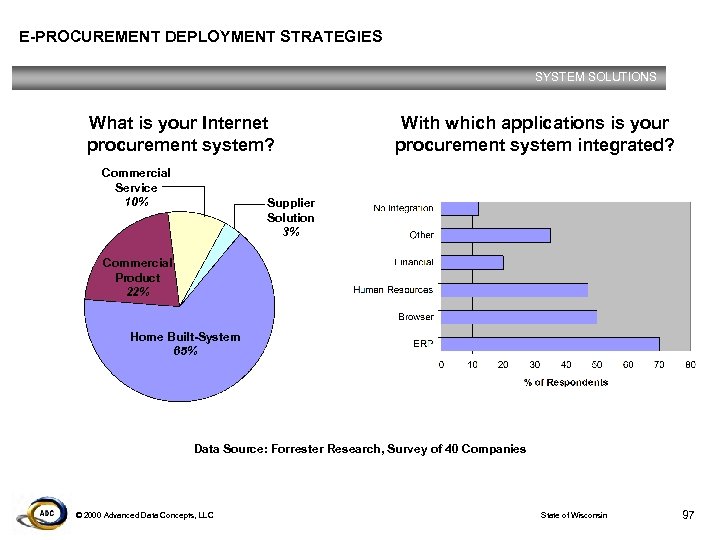 E-PROCUREMENT DEPLOYMENT STRATEGIES SYSTEM SOLUTIONS What is your Internet procurement system? Commercial Service 10% With which applications is your procurement system integrated? Supplier Solution 3% Commercial Product 22% Home Built-System 65% Data Source: Forrester Research, Survey of 40 Companies © 2000 Advanced Data Concepts, LLC State of Wisconsin 97
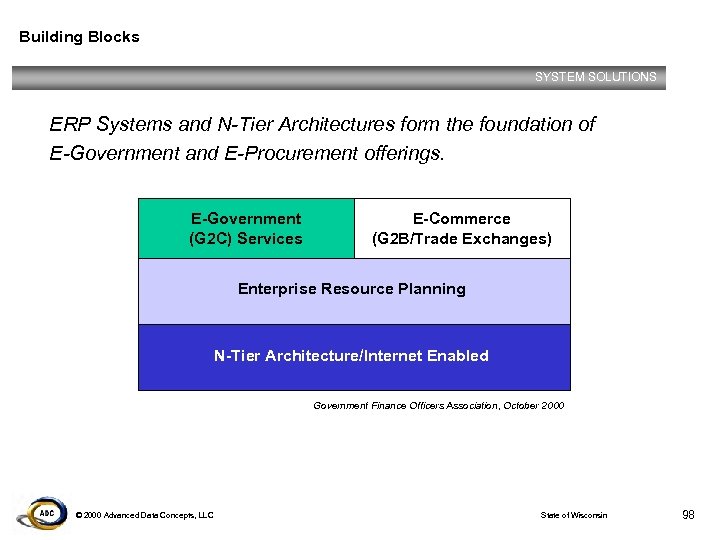 Building Blocks SYSTEM SOLUTIONS ERP Systems and N-Tier Architectures form the foundation of E-Government and E-Procurement offerings. E-Government (G 2 C) Services E-Commerce (G 2 B/Trade Exchanges) Enterprise Resource Planning N-Tier Architecture/Internet Enabled Government Finance Officers Association, October 2000 © 2000 Advanced Data Concepts, LLC State of Wisconsin 98
 N-TIER SYSTEMS ARCHITECTURE IS REQUIRED TO SUPPORT THE STATE’S DIGITAL GOVERNMENT INITIATIVES SYSTEM SOLUTIONS q EAS solution providers have, or are in the process of migrating their product offerings to n-tier architectures. q E-Procurement (G 2 B) and E-Government (G 2 C) solutions leverage n-tier architectures. q Tiered architectures provide increased performance, flexibility, maintainability, reusability and scalability, while hiding the complexity of distributed processing from the user. q Classical distributed, client/server architectures typically consist of three (3) tiers: Presentation, Application, and Data (see appendix x). – Internet adds variations on the Presentation and Application tiers to support web browsers (i. e. , thin clients) and web servers, resulting in the “n-tier” characterization. © 2000 Advanced Data Concepts, LLC State of Wisconsin 99
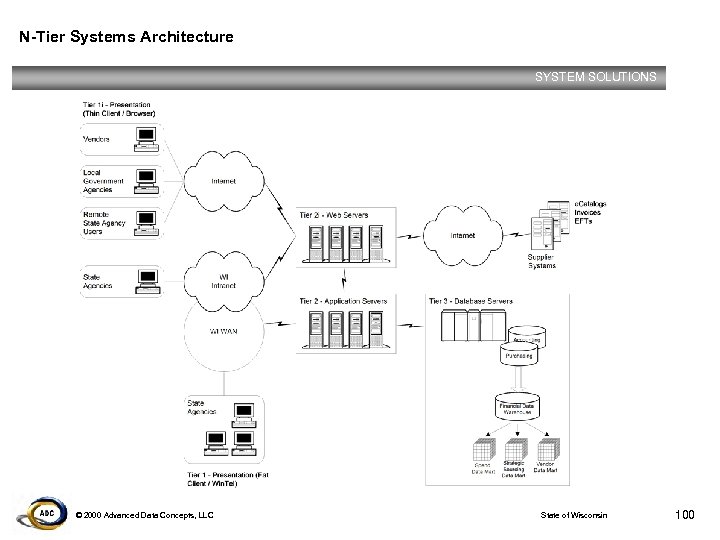 N-Tier Systems Architecture SYSTEM SOLUTIONS © 2000 Advanced Data Concepts, LLC State of Wisconsin 100
 State of Wisconsin Procurement Analysis Project Purchasing Data Warehouse Project Development & Implementation January 2001 Advanced Data Concepts, LLC
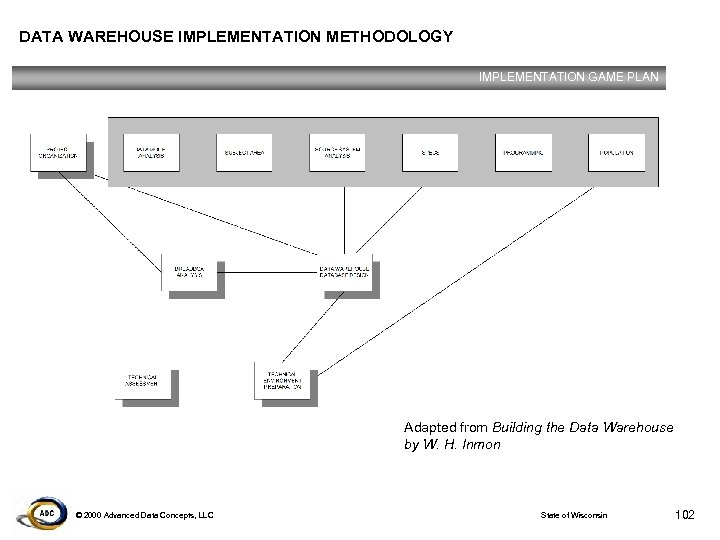 DATA WAREHOUSE IMPLEMENTATION METHODOLOGY IMPLEMENTATION GAME PLAN Adapted from Building the Data Warehouse by W. H. Inmon © 2000 Advanced Data Concepts, LLC State of Wisconsin 102
 DATA WAREHOUSE IMPLEMENTATION TASKS IMPLEMENTATION GAME PLAN q PROJECT ORGANIZATION – Establish Purchasing Data Warehouse project steering committee • Responsible for managing project priorities • Manage expectations of agencies as to benefits they will derive from the data warehouse • Expedite resolution of major issues – Establish project office – Organize project team and define key roles • Project Manager, Architect, Senior Business Analysts • Database Administrator(s) • IS Manager(s) responsible for supporting the project and development – Determine enterprise communications strategy © 2000 Advanced Data Concepts, LLC State of Wisconsin 103
 DATA WAREHOUSE IMPLEMENTATION TASKS … IMPLEMENTATION GAME PLAN q DATA MODEL ANALYSIS – Identify major subject areas (e. g. , strategic sourcing, vendor analysis, commodity spend, etc. ) • keys, attributes, relationships among data attributes, etc. – – q Separate primitive from derived data Entity Relationship Diagram (ERD) Midlevel Data Model (data item set) Physical Data Model BREADBOX ANALYSIS – Sizing (gross estimates) of the purchasing decision support environment; projecting how data the data warehouse will hold – Develop projections for one-year and three-year horizon for the purchasing data warehouse environment – Determine levels of granularity - the level of detail held in the units of data in the data warehouse © 2000 Advanced Data Concepts, LLC State of Wisconsin 104
 DATA WAREHOUSE IMPLEMENTATION TASKS … IMPLEMENTATION GAME PLAN q TECHNICAL ASSESSMENT & PREPARATION – Review both the methods for loading the data warehouse and its access within acceptable performance requirements • ability to manage large amounts of data • ability to organize data according to data model • ability to both receive and send data to a wide variety of technologies supported in the various agencies • ability to allow data to be accessed flexibly – – – Determine timing requirements for data loads Determine security requirements Define amount of disk space storage needed Estimate volume of processing anticipated Profile nature of traffic – short or long bursts – coming out of the technology that controls the data warehouse – Identify required network links – Define technical and online analytical processing (OLAP) tools • Business Objects, Crystal Reports, Cognos Power. Play • DBMS technology and operating system • Performance monitors – Ensure that facilities are available when needed © 2000 Advanced Data Concepts, LLC State of Wisconsin 105
 DATA WAREHOUSE IMPLEMENTATION TASKS … IMPLEMENTATION GAME PLAN q SUBJECT AREA ANALYSIS – Reconfirmation of the scope based on the data to be included – Definition of what data is to be populated – Evaluate the business questions: • What business questions need to be answered by the data warehouse • Which business questions will not be answered by the data warehouse q SOURCE SYSTEM ANALYSIS – Identify the source data for purchasing data mart – Data integration – key structure/key resolution as data passes from the operational environment to the DSS environment – Mapping of data from the operational environment to the decision support environment – Develop meta data (data dictionary for all data elements) – Determine how time variancy will be created from current value data © 2000 Advanced Data Concepts, LLC State of Wisconsin 106
 DATA WAREHOUSE IMPLEMENTATION TASKS … IMPLEMENTATION GAME PLAN q DATA WAREHOUSE DESIGN – Develop data schema (star schema and facts tables) based on previously defined data model and source system analysis – Physical denormalization of data where applicable (e. g. , where performance improvements are desired) – Creation of data artifacts to ensure that relationships are preserved (even if source system no longer retains the needed data) – Define performance improvement opportunities through the use of derived, summarized, and aggregated data – If the volume of warehouse warrants, consideration should be given to partitioning the data and distributing portions of it to remote sites – Identify indexes © 2000 Advanced Data Concepts, LLC State of Wisconsin 107
 DATA WAREHOUSE IMPLEMENTATION TASKS … IMPLEMENTATION GAME PLAN q PROGRAMMING SPECIFICATIONS – Some of the major issues associated with developing the formalized interfaces include: • Determining if two sets of programming specifications may be needed – one for the initial load and one for the ongoing operation • Time stamping of operational data • How updates are made to the data warehouse q POPULATION – Execution of the programs – Frequency of population – Purging of data © 2000 Advanced Data Concepts, LLC State of Wisconsin 108
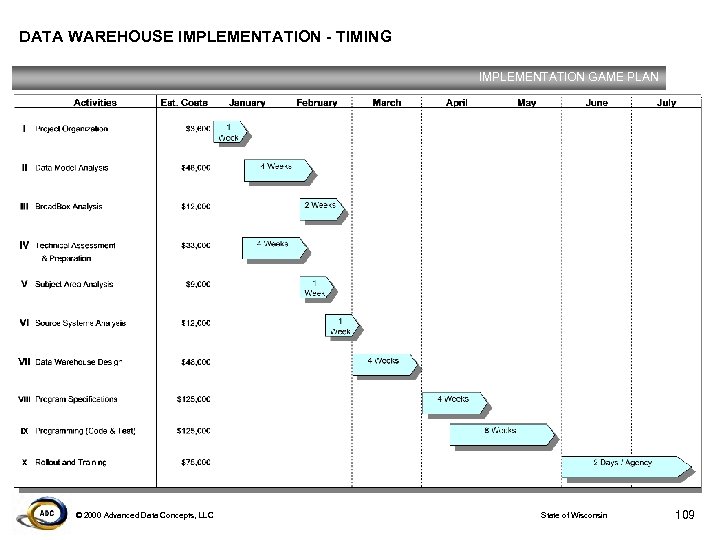 DATA WAREHOUSE IMPLEMENTATION - TIMING IMPLEMENTATION GAME PLAN © 2000 Advanced Data Concepts, LLC State of Wisconsin 109
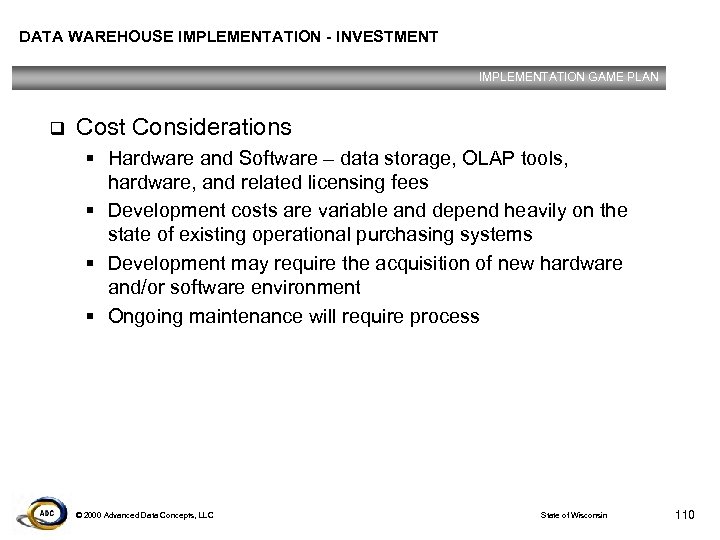 DATA WAREHOUSE IMPLEMENTATION - INVESTMENT IMPLEMENTATION GAME PLAN q Cost Considerations § Hardware and Software – data storage, OLAP tools, hardware, and related licensing fees § Development costs are variable and depend heavily on the state of existing operational purchasing systems § Development may require the acquisition of new hardware and/or software environment § Ongoing maintenance will require process © 2000 Advanced Data Concepts, LLC State of Wisconsin 110
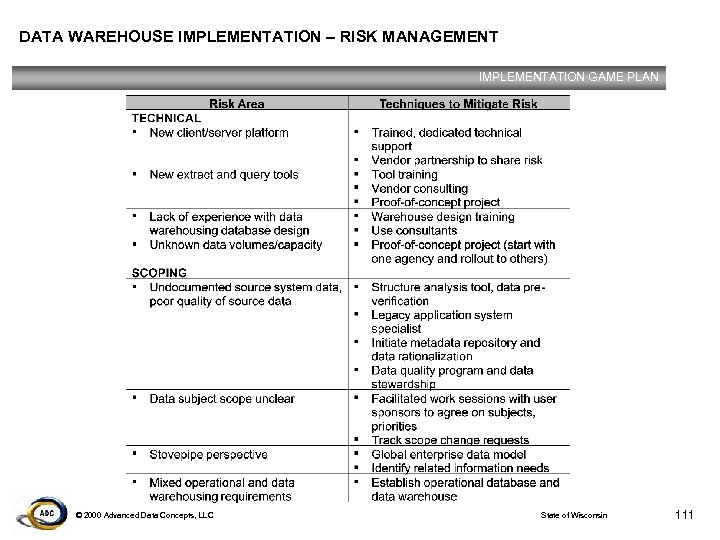 DATA WAREHOUSE IMPLEMENTATION – RISK MANAGEMENT IMPLEMENTATION GAME PLAN © 2000 Advanced Data Concepts, LLC State of Wisconsin 111
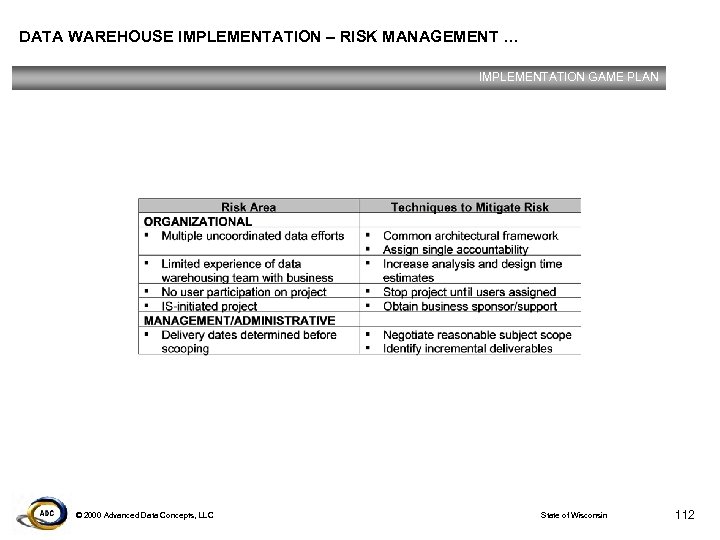 DATA WAREHOUSE IMPLEMENTATION – RISK MANAGEMENT … IMPLEMENTATION GAME PLAN © 2000 Advanced Data Concepts, LLC State of Wisconsin 112