 Скачать презентацию State of Web Application Security Ralph Durkee Consulting
eb2b08ee65eccbefae22afb01db5ad06.ppt
- Количество слайдов: 39



State of Web Application Security Ralph Durkee Consulting, Inc. Rochester ISSA & OWASP Chapters rd@rd 1. net
Ralph Durkee Founder of Durkee Consulting since 1996 Founder of Rochester OWASP since 2004 President of Rochester ISSA chapter SANS Instructor and course developer SANS GIAC Certified – GSEC, GCIH, GCIA, GSNA, GPEN CISSP Certified Application Security, development, auditing, PCI compliance, pen testing, Ethical Hacking , Auditing and consulting CIS (Center for Internet Security) – developed benchmark security standards – Apache, Linux, BIND DNS, Open. LDAP, Free. Radius, Unix, Free. BSD State of Web Application Security 2
Agenda OWASP Updates App Sec DC 2010 State of Web Application Security Web Security Methods and Tools Open Discussion on the State and Future of Web Application Security References and Resources State of Web Application Security 3
OWASP Open Web Application Security Project § A volunteer group, a not-for-profit charitable organization § Produces free, professional-quality, open-source documentation, tools, and standards § Dedicated to helping organizations understand improve the security of their web application. § Facilitates conferences, local chapters, articles, papers, and message forums See www. OWASP. org/rochester for the Rochester Chapter 44 State of Web Application Security
OWASP Brief History Sept 2001 – Started 2004 Local Chapters Started, include the Rochester Chapter Nov 2008 – First Summit in 2008 Portugal - Major Changes n n n Many Working Sessions Formed Global Committees New Outreach program, Tools and Guidance Nov 2009 – Smaller 1 day Summit Feb 2011 – Next Summit in Portugal State of Web Application Security 5
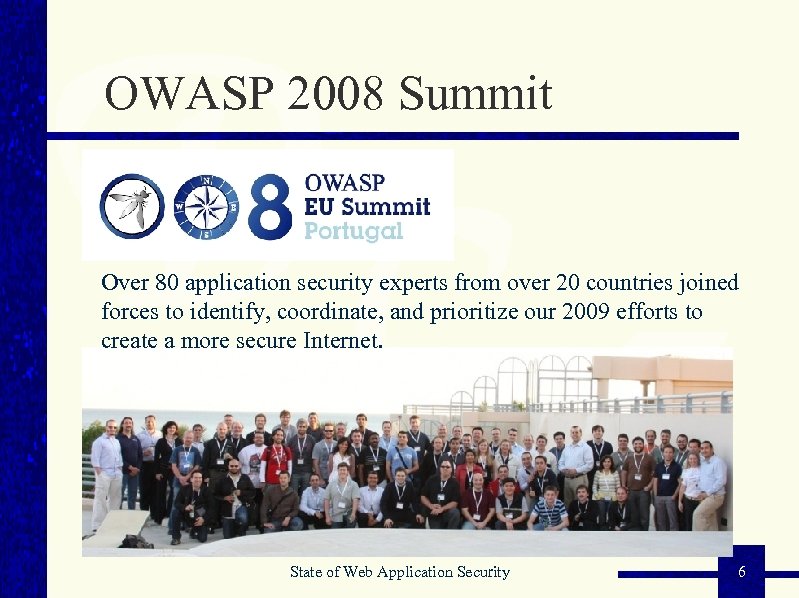
OWASP 2008 Summit Over 80 application security experts from over 20 countries joined forces to identify, coordinate, and prioritize our 2009 efforts to create a more secure Internet. State of Web Application Security 6
OWASP 2011 Summit Lots of anticipated work sessions Expected changes for OWASP Talk of new OWASP 4. 0! State of Web Application Security 7
App Sec DC 2010 Major App Sec Conference 2 Training Days and 2 Plenary Days 4 Parallel Tracks each days Plenty of great presentations RSS get’s a major mention in the keynote Presentation slides available on-line State of Web Application Security 8
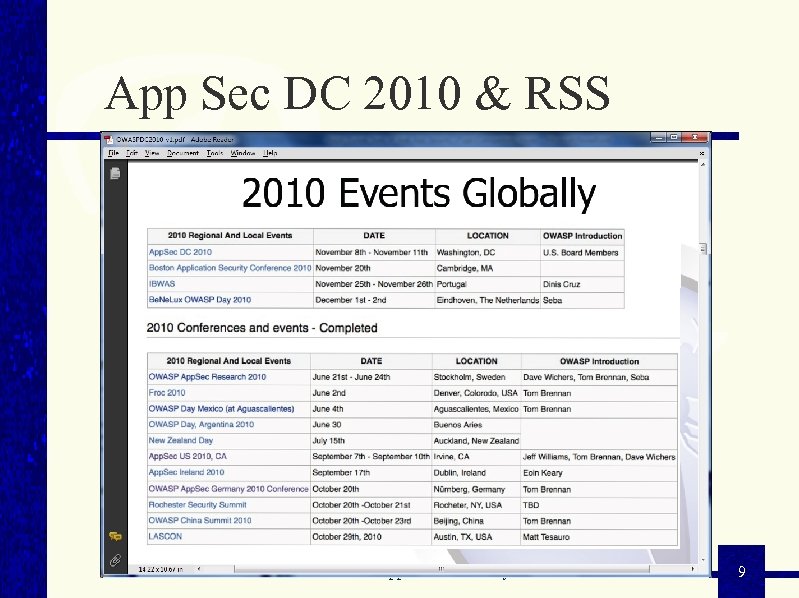
App Sec DC 2010 & RSS State of Web Application Security 9
App Sec DC 2010 – Highlights H. . t. . . . p. . . . o. . . . s. . . . t Presented by Onn Chee – OWASP Singapore Lead Tom Brennan – OWASP Foundation A new Layer 7 Do. S attack State of Web Application Security 10
App Sec DC 2010 – Highlights H. . t. . . . p. . . . o. . . . s. . . . t - Onn Chee & Tom Brennan n New Denial Service Vulnerability n Has some Similar to Slow Loris, but uses POST n Very difficult to mitigate n Affects All Web Applications that allow POST n Vendors – Its a protocol flaw - no fix coming n Followed by Workshop on slow HTTP Post Do. S State of Web Application Security 11
App Sec DC 2010 – Highlights H. . t. . . . p. . . . o. . s. . t How it Works n HTTP Post send with all the HTTP Headers n Sending headers bypasses the IIS Slowloris mitigation which times out on the headers. n Content-Length indicates size of the body n Content is sent very slow and in small pieces. n For Example 1 bytes per 110 seconds. n Large servers easily brought down with only 20 k connections n State of Web Application Security 12
App Sec DC 2010 – Highlights Closing the Gap: Analyzing the Limitations of Web Application Vulnerability Scanners By n David Shelly n Randy Marchany n Joseph Tront Virginia Polytechnic Institute and State Univ. State of Web Application Security 13
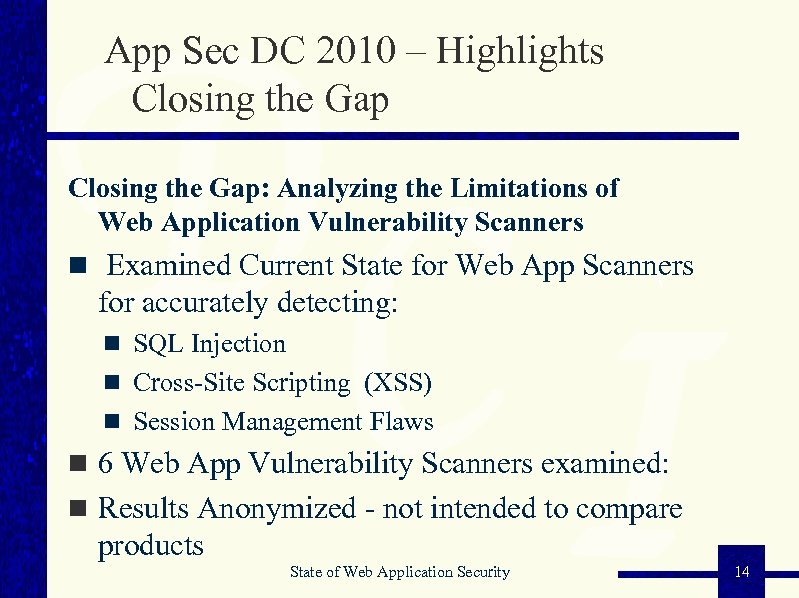
App Sec DC 2010 – Highlights Closing the Gap: Analyzing the Limitations of Web Application Vulnerability Scanners n Examined Current State for Web App Scanners for accurately detecting: n SQL Injection n Cross-Site Scripting (XSS) n Session Management Flaws n 6 Web App Vulnerability Scanners examined: n Results Anonymized - not intended to compare products State of Web Application Security 14
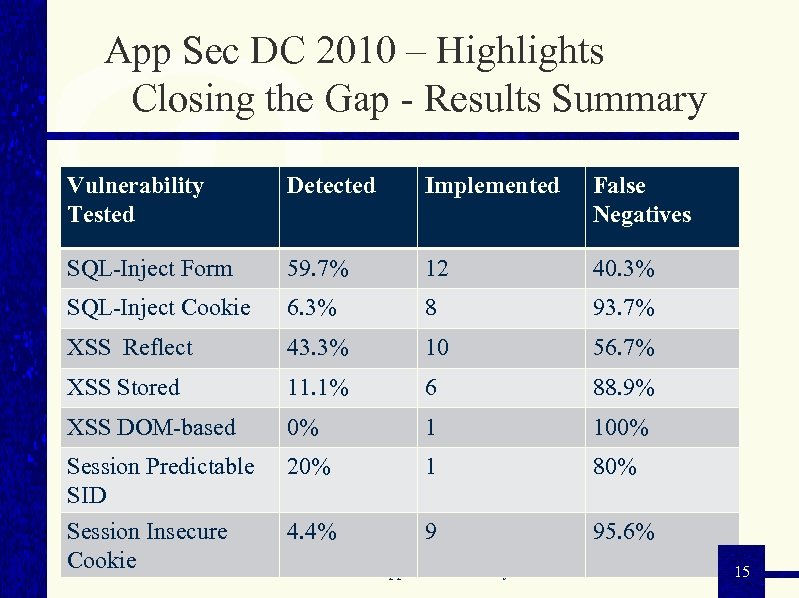
App Sec DC 2010 – Highlights Closing the Gap - Results Summary Vulnerability Tested Detected Implemented False Negatives SQL-Inject Form 59. 7% 12 40. 3% SQL-Inject Cookie 6. 3% 8 93. 7% XSS Reflect 43. 3% 10 56. 7% XSS Stored 11. 1% 6 88. 9% XSS DOM-based 0% 1 100% Session Predictable SID Session Insecure Cookie 20% 1 80% 4. 4% 9 95. 6% State of Web Application Security 15
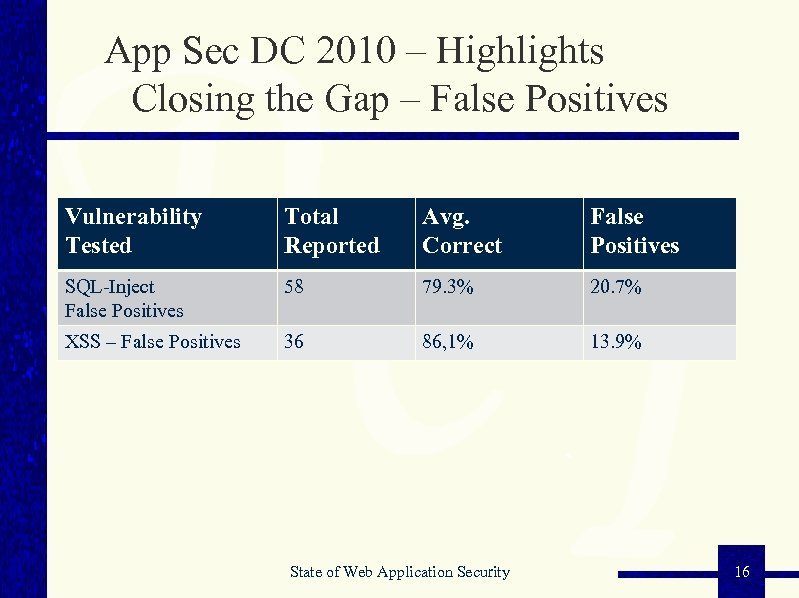
App Sec DC 2010 – Highlights Closing the Gap – False Positives Vulnerability Tested Total Reported Avg. Correct False Positives SQL-Inject False Positives 58 79. 3% 20. 7% XSS – False Positives 36 86, 1% 13. 9% State of Web Application Security 16
App Sec DC 2010 –Highlights Power of Code Review By Dave Wichers – Aspect Security & OWASP Board Compared Manual Code Review vs. Manual Web App Pen Test Demonstrated that many flaws are easier to find and verify with Code Review rather than with penetration testing. State of Web Application Security 17
App Sec DC 2010 –Highlights Power of Code Review - Summary q To find them? • Result: Similar, but slight edge to code review. • It’s a MYTH that code review is way more expensive. If you have people with the right skills, its actually faster AND more effective q To find exactly where they are in the app? • Result: Clear advantage to code review q To verify we don’t have them? • Result: Also clearly the advantage goes to code review State of Web Application Security 18
App Sec DC 2010 –Highlights Read the Label Don’t Judge a Website by its Icon – Read the Label! By Jeff William – Aspect Security & OWASP Chair Reviewed Impact of Consumer Labels on the industry Proposed Security Labels for Applications Addresses Issue of how do we make Software Security Visible. State of Web Application Security 19
State of Security What is being Attacked? Major shifts in targets for Attacks Web Applications n Client Browsers n Client E-mail n Combinations of all of the above n Why the Change? Attackers go for the easy targets n Broadband clients are very useful too n State of Web Application Security 20
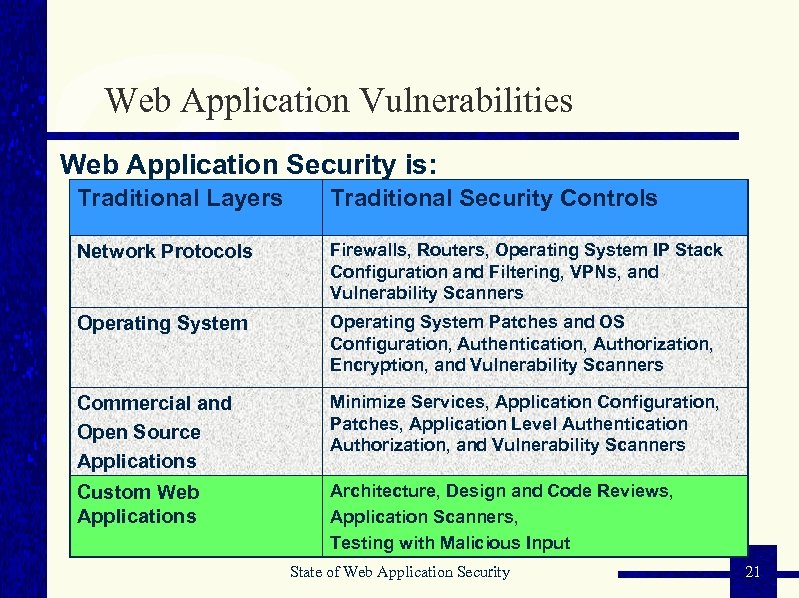
Web Application Vulnerabilities Web Application Security is: Traditional Layers Traditional Security Controls Network Protocols Firewalls, Routers, Operating System IP Stack Configuration and Filtering, VPNs, and Vulnerability Scanners Operating System Patches and OS Configuration, Authentication, Authorization, Encryption, and Vulnerability Scanners Commercial and Open Source Applications Minimize Services, Application Configuration, Patches, Application Level Authentication Authorization, and Vulnerability Scanners Custom Web Applications Architecture, Design and Code Reviews, Application Scanners, Testing with Malicious Input State of Web Application Security 21
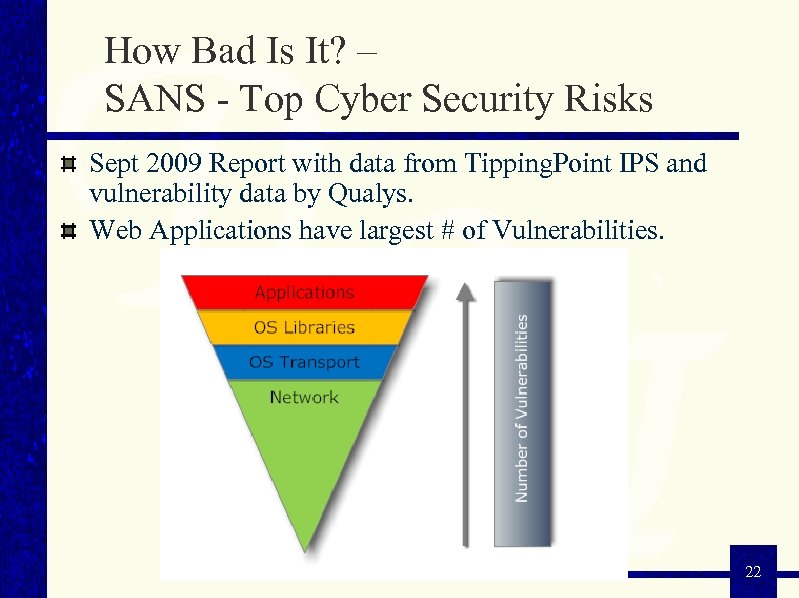
How Bad Is It? – SANS - Top Cyber Security Risks Sept 2009 Report with data from Tipping. Point IPS and vulnerability data by Qualys. Web Applications have largest # of Vulnerabilities. State of Web Application Security 22 22
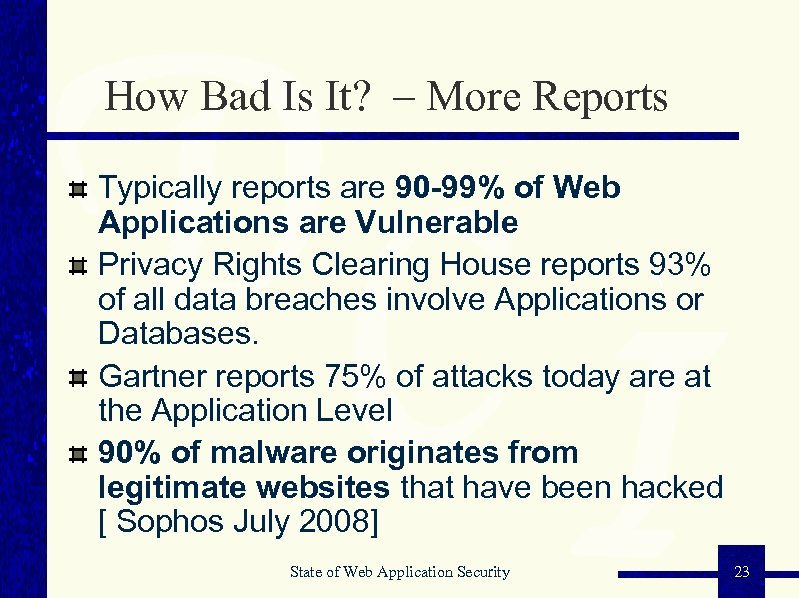
How Bad Is It? – More Reports Typically reports are 90 -99% of Web Applications are Vulnerable Privacy Rights Clearing House reports 93% of all data breaches involve Applications or Databases. Gartner reports 75% of attacks today are at the Application Level 90% of malware originates from legitimate websites that have been hacked [ Sophos July 2008] State of Web Application Security 23
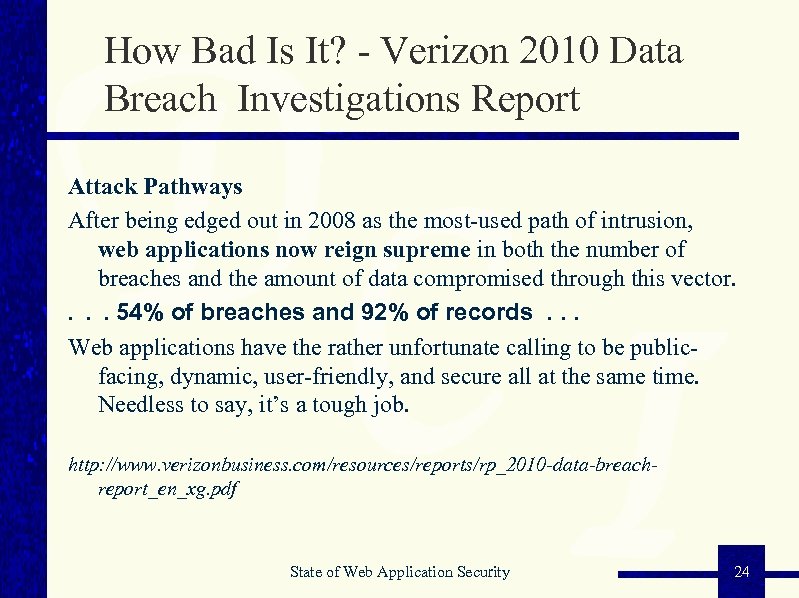
How Bad Is It? - Verizon 2010 Data Breach Investigations Report Attack Pathways After being edged out in 2008 as the most-used path of intrusion, web applications now reign supreme in both the number of breaches and the amount of data compromised through this vector. . 54% of breaches and 92% of records. . . Web applications have the rather unfortunate calling to be publicfacing, dynamic, user-friendly, and secure all at the same time. Needless to say, it’s a tough job. http: //www. verizonbusiness. com/resources/reports/rp_2010 -data-breachreport_en_xg. pdf State of Web Application Security 24
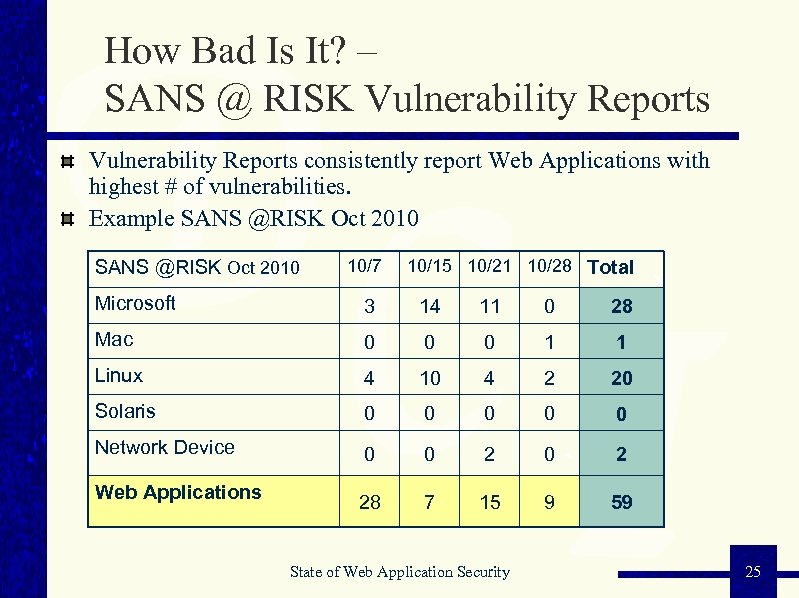
How Bad Is It? – SANS @ RISK Vulnerability Reports consistently report Web Applications with highest # of vulnerabilities. Example SANS @RISK Oct 2010 10/7 10/15 10/21 10/28 Total Microsoft 3 14 11 0 28 Mac 0 0 0 1 1 Linux 4 10 4 2 20 Solaris 0 0 0 Network Device 0 0 2 28 7 15 9 59 Web Applications State of Web Application Security 25 25
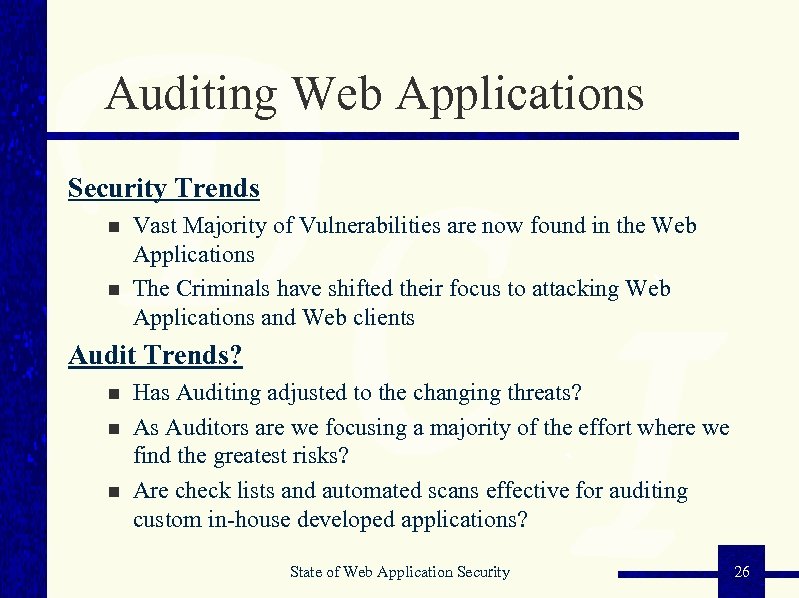
Auditing Web Applications Security Trends n n Vast Majority of Vulnerabilities are now found in the Web Applications The Criminals have shifted their focus to attacking Web Applications and Web clients Audit Trends? n n n Has Auditing adjusted to the changing threats? As Auditors are we focusing a majority of the effort where we find the greatest risks? Are check lists and automated scans effective for auditing custom in-house developed applications? State of Web Application Security 26
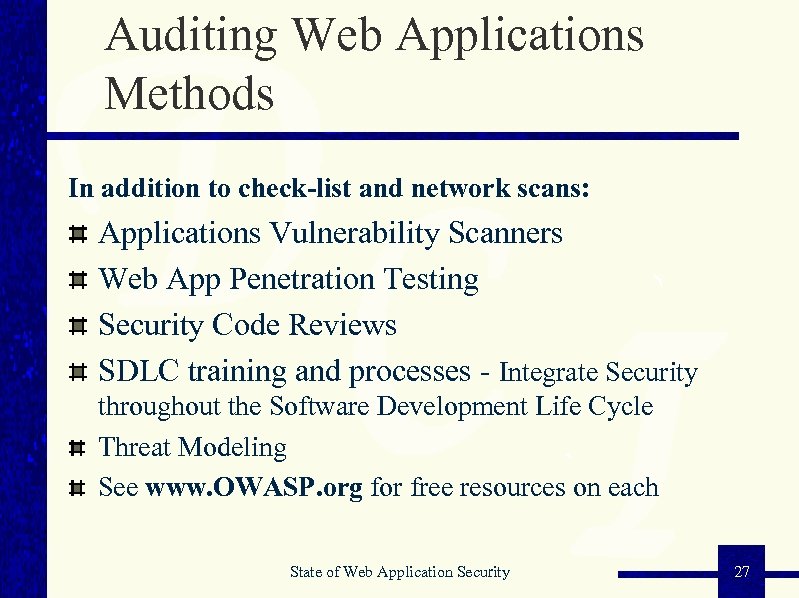
Auditing Web Applications Methods In addition to check-list and network scans: Applications Vulnerability Scanners Web App Penetration Testing Security Code Reviews SDLC training and processes - Integrate Security throughout the Software Development Life Cycle Threat Modeling See www. OWASP. org for free resources on each State of Web Application Security 27
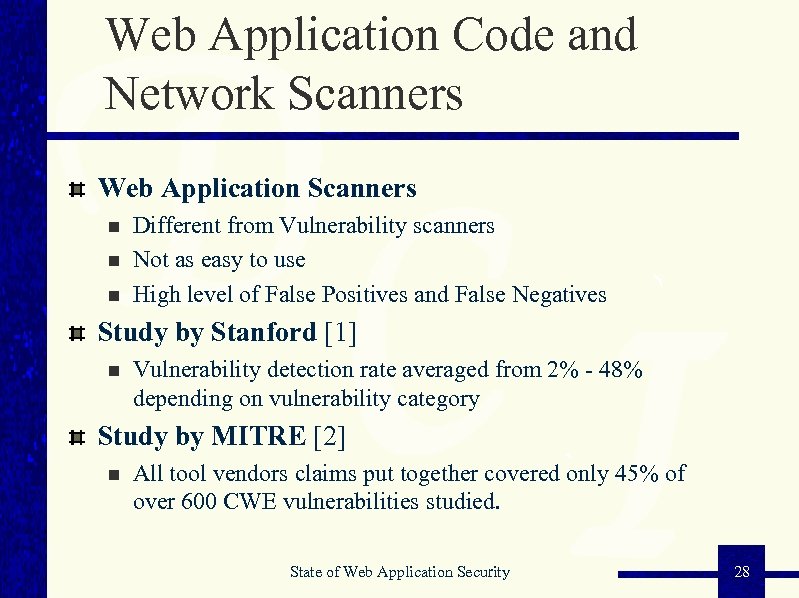
Web Application Code and Network Scanners Web Application Scanners n n n Different from Vulnerability scanners Not as easy to use High level of False Positives and False Negatives Study by Stanford [1] n Vulnerability detection rate averaged from 2% - 48% depending on vulnerability category Study by MITRE [2] n All tool vendors claims put together covered only 45% of over 600 CWE vulnerabilities studied. State of Web Application Security 28
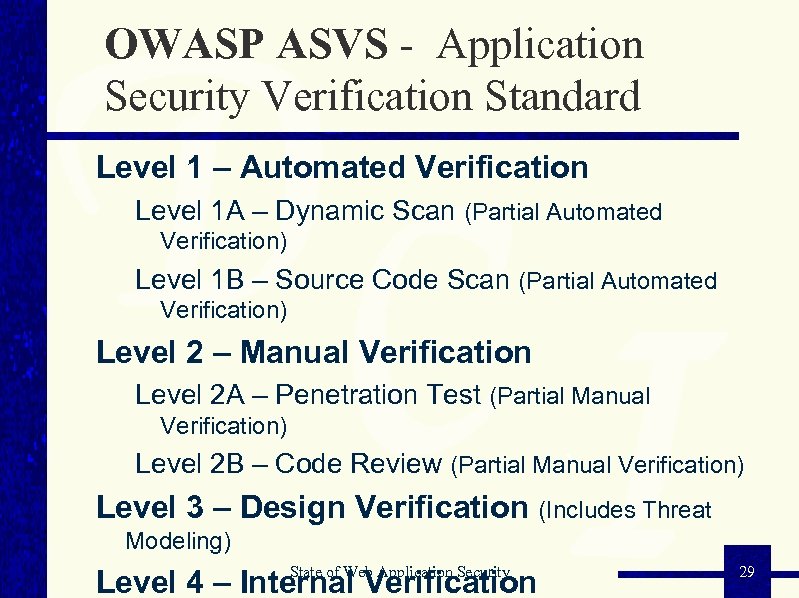
OWASP ASVS - Application Security Verification Standard Level 1 – Automated Verification Level 1 A – Dynamic Scan (Partial Automated Verification) Level 1 B – Source Code Scan (Partial Automated Verification) Level 2 – Manual Verification Level 2 A – Penetration Test (Partial Manual Verification) Level 2 B – Code Review (Partial Manual Verification) Level 3 – Design Verification (Includes Threat Modeling) State of Web Application Security Level 4 – Internal Verification 29 29
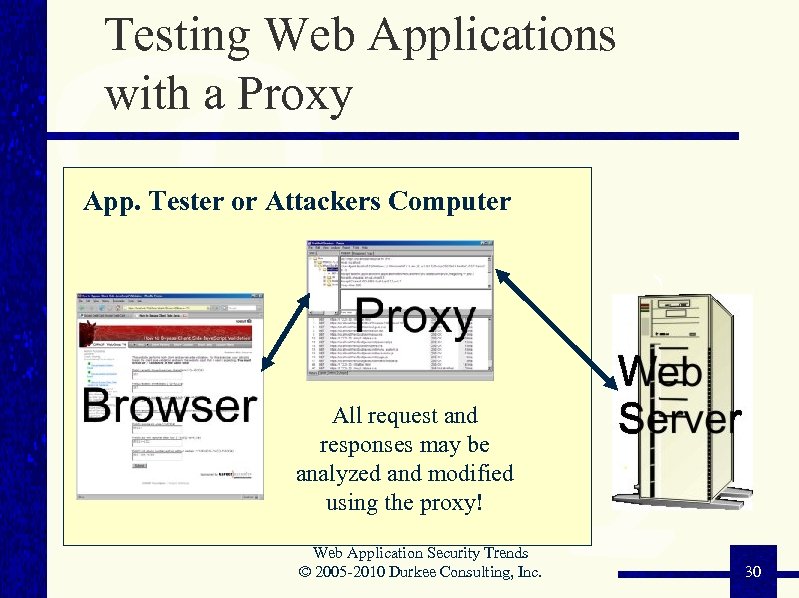
Testing Web Applications with a Proxy App. Tester or Attackers Computer All request and responses may be analyzed and modified using the proxy! Web Application Security Trends © 2005 -2010 Durkee Consulting, Inc. 30 30
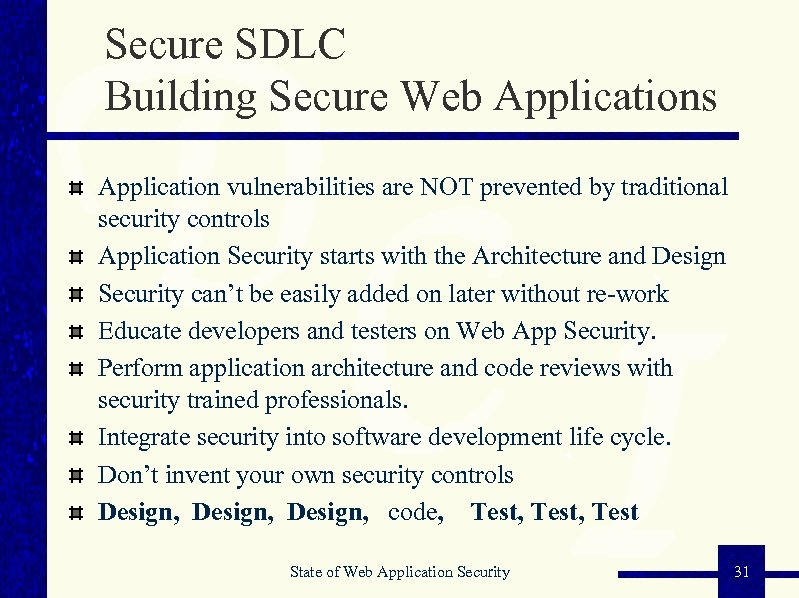
Secure SDLC Building Secure Web Applications Application vulnerabilities are NOT prevented by traditional security controls Application Security starts with the Architecture and Design Security can’t be easily added on later without re-work Educate developers and testers on Web App Security. Perform application architecture and code reviews with security trained professionals. Integrate security into software development life cycle. Don’t invent your own security controls Design, code, Test, Test State of Web Application Security 31
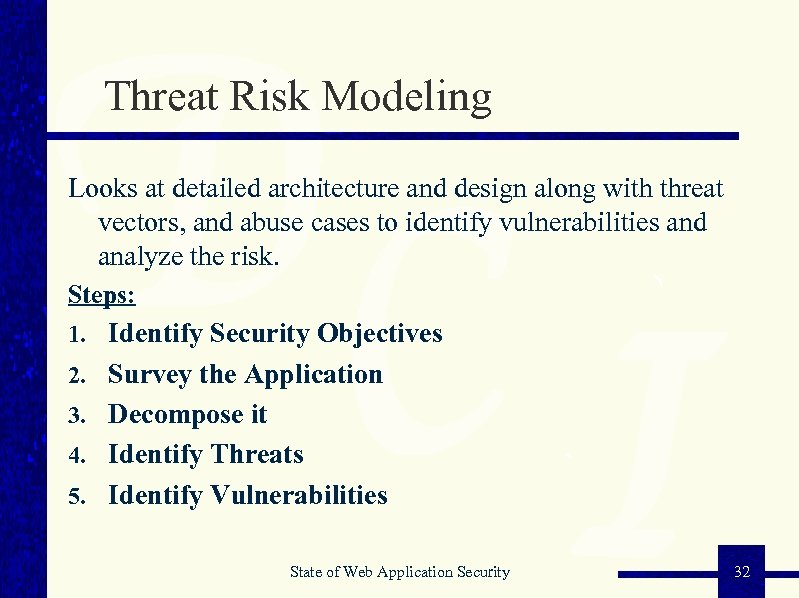
Threat Risk Modeling Looks at detailed architecture and design along with threat vectors, and abuse cases to identify vulnerabilities and analyze the risk. Steps: 1. Identify Security Objectives 2. Survey the Application 3. Decompose it 4. Identify Threats 5. Identify Vulnerabilities State of Web Application Security 32
Discussion and Questions Current State Are we making progress? And are we getting ahead of or keeping up with the threats? How has the risks changed? In what areas are we as an application security industry doing better, and where is improvement needed? State of Web Application Security 33
Discussion and Questions Current State Are we making progress? And are we getting ahead of or keeping up with the threats? How has the risks changed? In what areas are we as an application security industry doing better, and where is improvement needed? Is the Application Software Industry a broken economy? State of Web Application Security 34
Discussion and Questions – Future State Where should we be headed? Are there major changes needed or helpful to “fix” the application security profession? State of Web Application Security 35
Resources – Rochester Non-Profit Groups OWASP Rochester Chapter Information http: //www. OWASP. org/rochester Rochester Security Summit Oct 2011 htttp: //Rochester. Security. org Rochester ISSA Chapter http: //Roch. ISSA. org State of Web Application Security 36
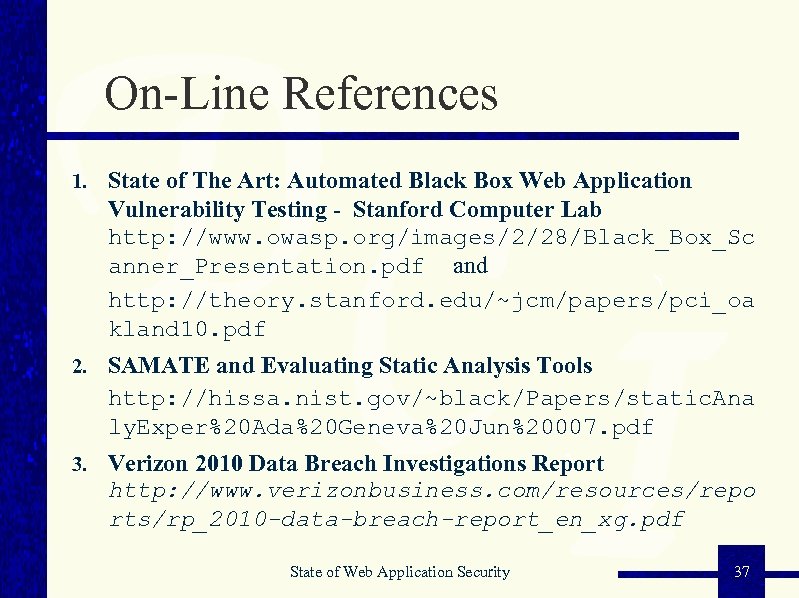
On-Line References 1. State of The Art: Automated Black Box Web Application Vulnerability Testing - Stanford Computer Lab http: //www. owasp. org/images/2/28/Black_Box_Sc anner_Presentation. pdf and http: //theory. stanford. edu/~jcm/papers/pci_oa kland 10. pdf 2. SAMATE and Evaluating Static Analysis Tools http: //hissa. nist. gov/~black/Papers/static. Ana ly. Exper%20 Ada%20 Geneva%20 Jun%20007. pdf 3. Verizon 2010 Data Breach Investigations Report http: //www. verizonbusiness. com/resources/repo rts/rp_2010 -data-breach-report_en_xg. pdf State of Web Application Security 37
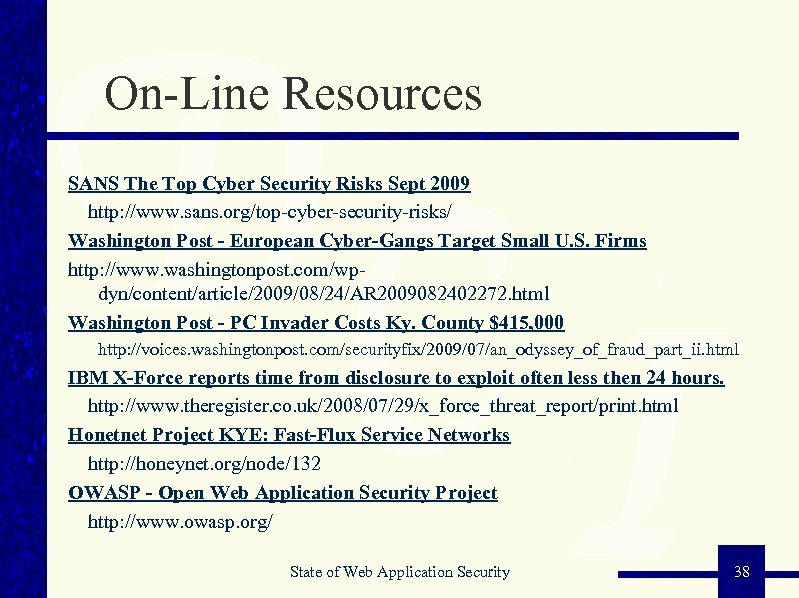
On-Line Resources SANS The Top Cyber Security Risks Sept 2009 http: //www. sans. org/top-cyber-security-risks/ Washington Post - European Cyber-Gangs Target Small U. S. Firms http: //www. washingtonpost. com/wpdyn/content/article/2009/08/24/AR 2009082402272. html Washington Post - PC Invader Costs Ky. County $415, 000 http: //voices. washingtonpost. com/securityfix/2009/07/an_odyssey_of_fraud_part_ii. html IBM X-Force reports time from disclosure to exploit often less then 24 hours. http: //www. theregister. co. uk/2008/07/29/x_force_threat_report/print. html Honetnet Project KYE: Fast-Flux Service Networks http: //honeynet. org/node/132 OWASP - Open Web Application Security Project http: //www. owasp. org/ State of Web Application Security 38
Thank You! Ralph Durkee Consulting, Inc. Rochester OWASP & ISSA Chapters rd@rd 1. net
Скачать презентацию State of Web Application Security Ralph Durkee Consulting
eb2b08ee65eccbefae22afb01db5ad06.ppt