


 Скачать презентацию State of the Marine Transportation System International Maritime
9837ca36d562317d3c77982600ac2867.ppt
- Количество слайдов: 18
 State of the Marine Transportation System International Maritime Statistics Forum Singapore 16 Apr 2007
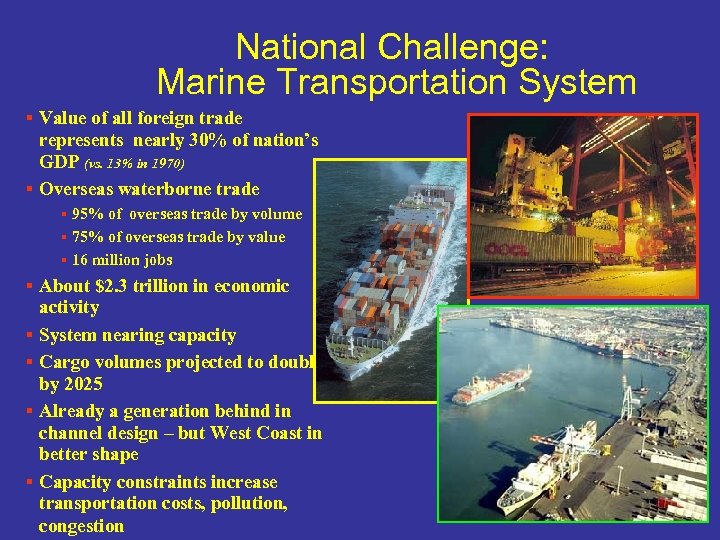 National Challenge: Marine Transportation System § Value of all foreign trade represents nearly 30% of nation’s GDP (vs. 13% in 1970) § Overseas waterborne trade § 95% of overseas trade by volume § 75% of overseas trade by value § 16 million jobs § About $2. 3 trillion in economic § § activity System nearing capacity Cargo volumes projected to double by 2025 Already a generation behind in channel design – but West Coast in better shape Capacity constraints increase transportation costs, pollution, congestion
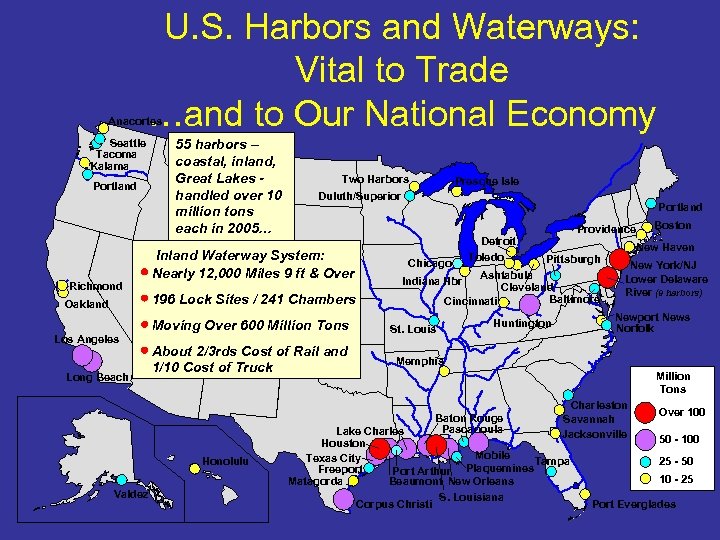 U. S. Harbors and Waterways: Vital to Trade …and to Our National Economy Anacortes Seattle Tacoma Kalama Portland Richmond Oakland 55 harbors – coastal, inland, Great Lakes handled over 10 million tons each in 2005… Two Harbors Duluth/Superior Los Angeles Long Beach Chicago 196 Lock Sites / 241 Chambers About 2/3 rds Cost of Rail and 1/10 Cost of Truck Portland Toledo Valdez Pittsburgh Ashtabula Indiana Hbr Cleveland Baltimore Cincinnati Boston New Haven New York/NJ Lower Delaware River (9 harbors) Newport News Norfolk Huntington St. Louis Memphis Million Tons Baton Rouge Pascagoula Honolulu Providence Detroit Inland Waterway System: Nearly 12, 000 Miles 9 ft & Over Moving Over 600 Million Tons Presque Isle Charleston Savannah Jacksonville Lake Charles Houston Mobile Texas City Tampa Plaquemines Freeport Port Arthur Matagorda Beaumont New Orleans Corpus Christi S. Louisiana Over 100 50 - 100 25 - 50 10 - 25 Port Everglades
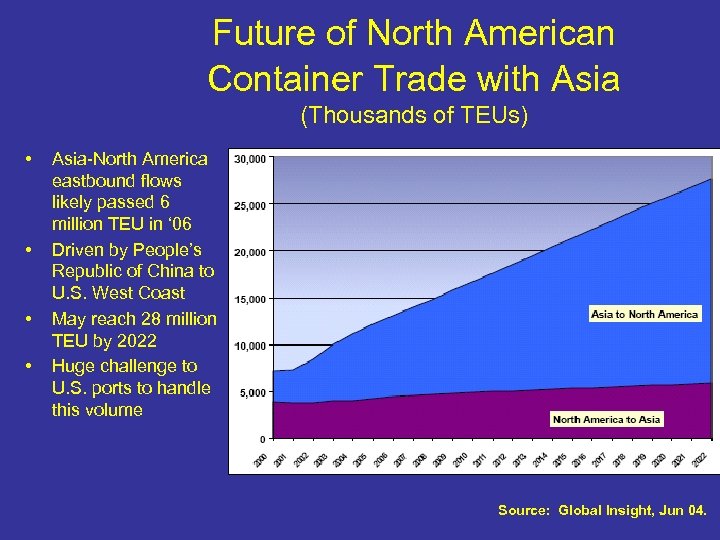 Future of North American Container Trade with Asia (Thousands of TEUs) • • Asia-North America eastbound flows likely passed 6 million TEU in ‘ 06 Driven by People’s Republic of China to U. S. West Coast May reach 28 million TEU by 2022 Huge challenge to U. S. ports to handle this volume Source: Global Insight, Jun 04.
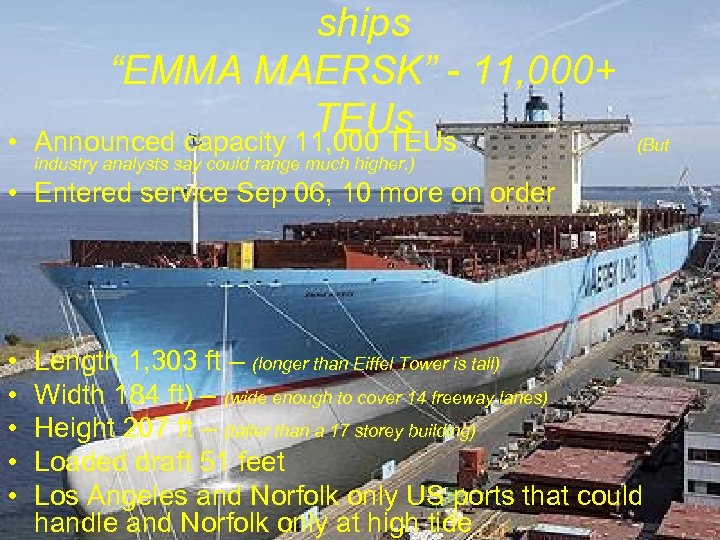 • ships “EMMA MAERSK” - 11, 000+ TEUs Announced capacity 11, 000 TEUs industry analysts say could range much higher. ) (But • Entered service Sep 06, 10 more on order • • • Length 1, 303 ft – (longer than Eiffel Tower is tall) Width 184 ft) – (wide enough to cover 14 freeway lanes) Height 207 ft – (taller than a 17 storey building) Loaded draft 51 feet Los Angeles and Norfolk only US ports that could handle and Norfolk only at high tide
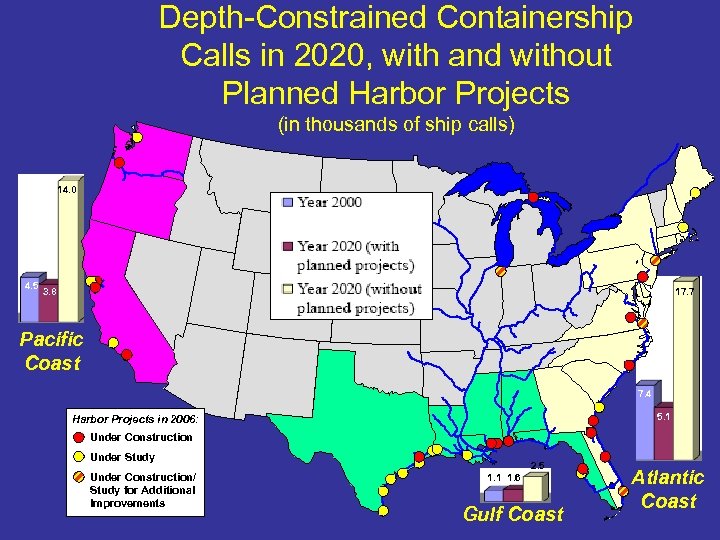 Depth-Constrained Containership Calls in 2020, with and without Planned Harbor Projects (in thousands of ship calls) 14. 0 4. 5 3. 8 17. 7 Pacific Coast 7. 4 5. 1 Harbor Projects in 2006: Under Construction Under Study Under Construction/ Study for Additional Improvements 2. 5 1. 1 1. 6 Gulf Coast Atlantic Coast
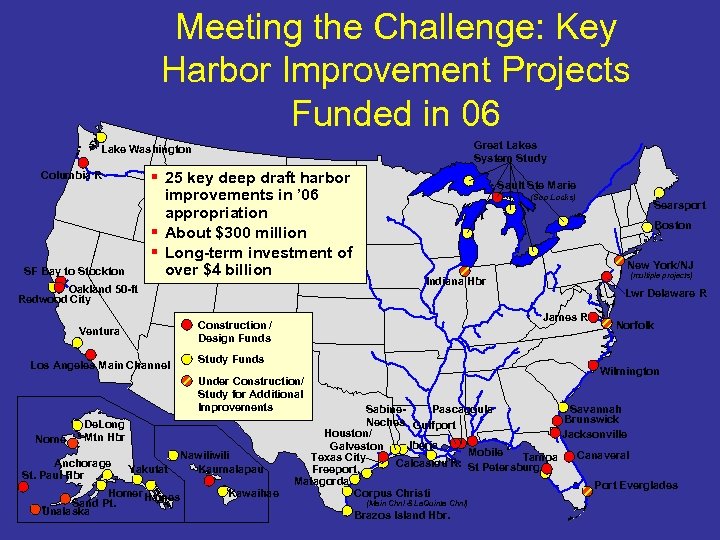 Meeting the Challenge: Key Harbor Improvement Projects Funded in 06 Great Lakes System Study Lake Washington § 25 key deep draft harbor improvements in ’ 06 appropriation § About $300 million § Long-term investment of over $4 billion Columbia R SF Bay to Stockton Oakland 50 -ft Redwood City Sault Ste Marie (Soo Locks) Boston New York/NJ Los Angeles Main Channel Study Funds De. Long Mtn Hbr Anchorage St. Paul Hbr Yakutat Homer Haines Sand Pt. Unalaska Nawili Kaumalapau Kawaihae Lwr Delaware R James R Norfolk Wilmington Under Construction/ Study for Additional Improvements Nome (multiple projects) Indiana Hbr Construction / Design Funds Ventura Searsport Sabine. Pascagoula Savannah Brunswick Neches Gulfport Houston/ Jacksonville Iberia Galveston Mobile Canaveral Texas City Tampa Calcasieu R. St Petersburg Freeport Matagorda Port Everglades Corpus Christi (Main Chnl & La. Quinta Chnl) Brazos Island Hbr.
 U. S. Army Corps of Engineers Coastal and Inland River Information Service Inter-Agency Initiative International Maritime Statistics Forum Singapore 16 Apr 2007
 U. S. Army Corps of Engineers • • • Introduction Numerous Real-time electronic transmission of data between navigation locks and industry is beginning to happen. Numerous Federal agencies have a responsibility for the collection and dissemination of domestic navigation information. An Industry and Federal Government partnership is required.
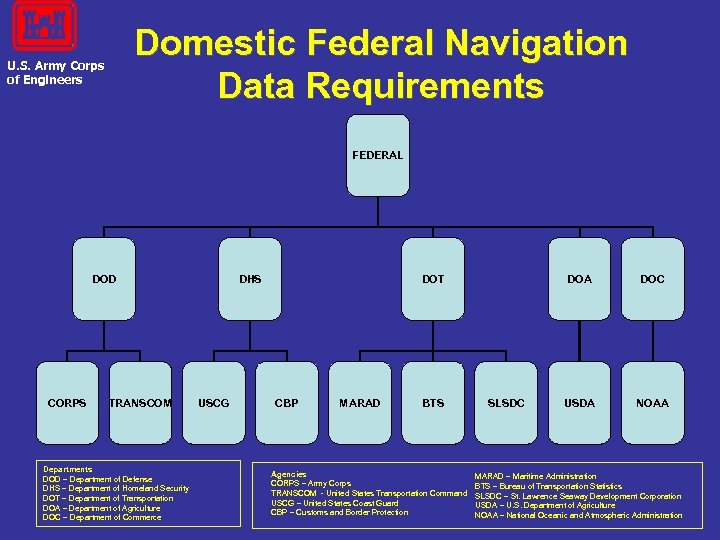 Domestic Federal Navigation Data Requirements U. S. Army Corps of Engineers FEDERAL DOD CORPS TRANSCOM Departments DOD – Department of Defense DHS – Department of Homeland Security DOT – Department of Transportation DOA – Department of Agriculture DOC – Department of Commerce DHS USCG DOT CBP MARAD BTS Agencies CORPS – Army Corps TRANSCOM - United States Transportation Command USCG – United States Coast Guard CBP – Customs and Border Protection DOA SLSDC DOC USDA NOAA MARAD – Maritime Administration BTS – Bureau of Transportation Statistics SLSDC – St. Lawrence Seaway Development Corporation USDA – U. S. Department of Agriculture NOAA – National Oceanic and Atmospheric Administration
 U. S. Army Corps of Engineers • • • Current Initiatives Automated Identification Service (AIS): USCG Barg. Ex: Industry River. Net: Port of Pittsburgh/Corps Real Time Current Velocity (RTCV): Corps/USCG Regional Transportation Security System Coalitions (RTSC)/Portland: Industry/TSA Locks Visibility Mgmt Systems (LVMS): Corps Mississippi State University/Oakridge National Laboratory Grant (MSU/ONL): DOT Lock Performance Monitoring System (LPMS), Operations & Maintenance of Navigation Installations (OMNI): Corps Vessel Tracking System (VTS) for Certain Dangerous Cargoes (CDC’s): Corps/USCG SMART Lock: Port of Pittsburgh
 U. S. Army Corps of Engineers • Present Situation Numerous alternatives related to electronic navigation data – – Wi. Fi vs. VHF Kinematic vs. Differential GPS Vector vs. Raster Inland Elec Nav Charts Data storage/retrieval
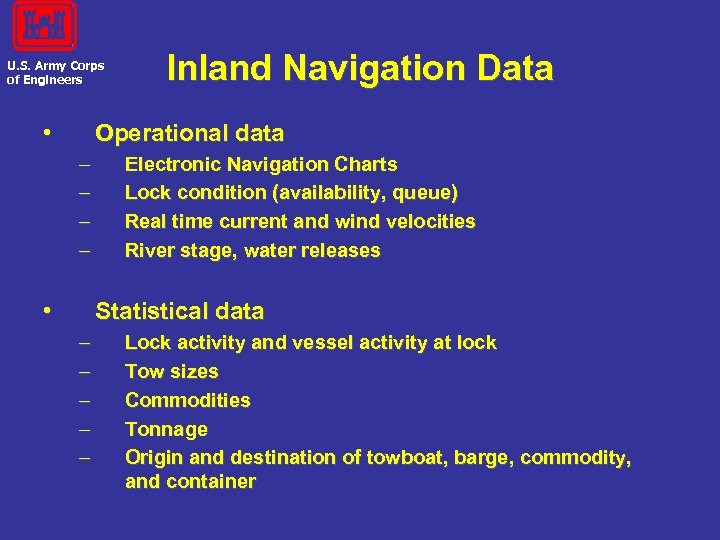 U. S. Army Corps of Engineers • Inland Navigation Data Operational data – – • Electronic Navigation Charts Lock condition (availability, queue) Real time current and wind velocities River stage, water releases Statistical data – – – Lock activity and vessel activity at lock Tow sizes Commodities Tonnage Origin and destination of towboat, barge, commodity, and container
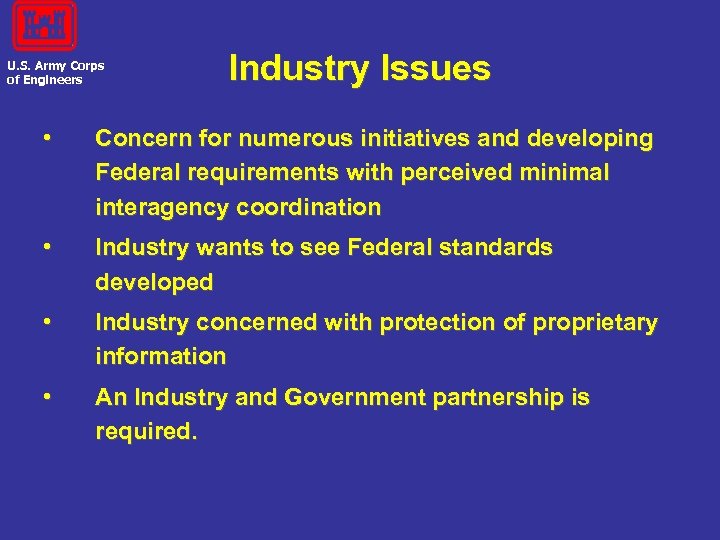 U. S. Army Corps of Engineers Industry Issues • Concern for numerous initiatives and developing Federal requirements with perceived minimal interagency coordination • Industry wants to see Federal standards developed • Industry concerned with protection of proprietary information • An Industry and Government partnership is required.
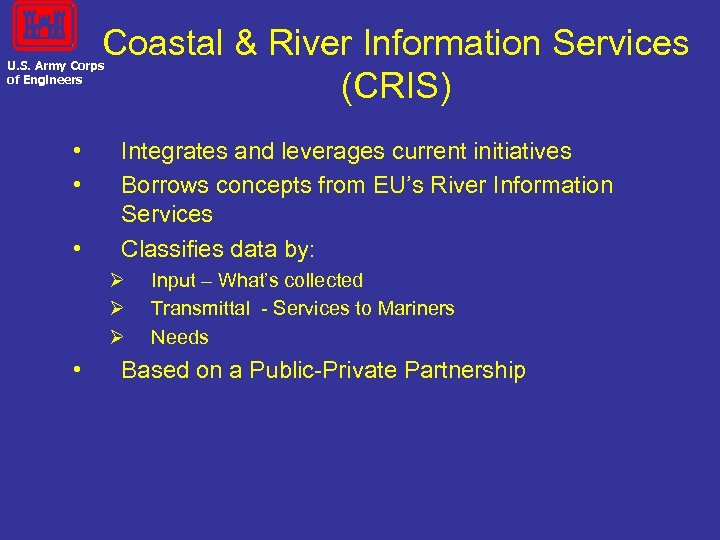 Coastal & River Information Services (CRIS) U. S. Army Corps of Engineers • • • Integrates and leverages current initiatives Borrows concepts from EU’s River Information Services Classifies data by: Ø Ø Ø • Input – What’s collected Transmittal - Services to Mariners Needs Based on a Public-Private Partnership
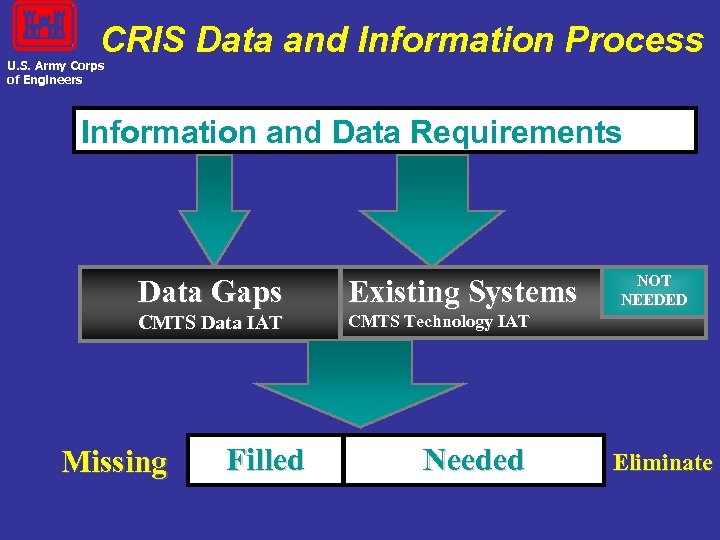 CRIS Data and Information Process U. S. Army Corps of Engineers Information and Data Requirements Data Gaps Existing Systems CMTS Data IAT NOT NEEDED CMTS Technology IAT Missing Filled Needed Eliminate
 U. S. Army Corps of Engineers Next Steps for CRIS • Use the U. S. Committee on the Marine Transportation System (CMTS) for interagency coordination • Create Interagency/Industry product delivery team (PDT) • Partnership with industry via PDT – MTSNAC, IWUB, AWO, IWC • Identify requirements • Harmonize Federal data definitions for domestic data • Establish one Federal set of standards for industry reporting • Align with International and Inter-modal standards • Coordinate with Federal international efforts – ITDS, WCO
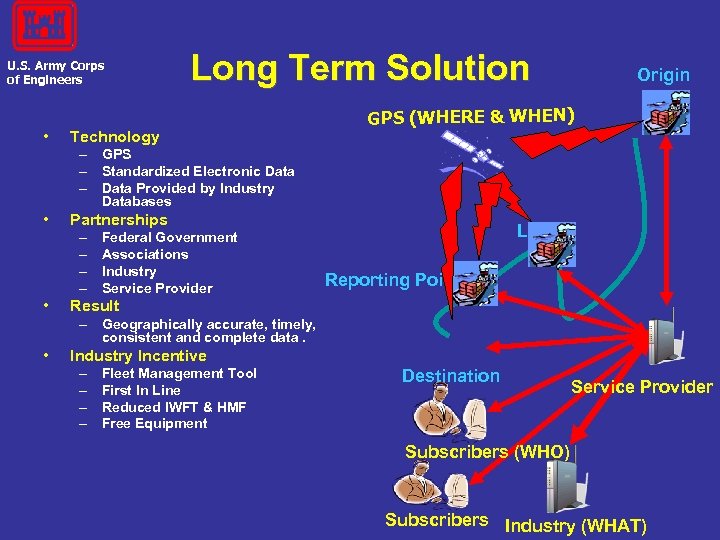 U. S. Army Corps of Engineers • Long Term Solution Technology Origin GPS (WHERE & WHEN) – GPS – Standardized Electronic Data – Data Provided by Industry Databases • Partnerships – – • Federal Government Associations Industry Service Provider Lock Reporting Point Result – Geographically accurate, timely, consistent and complete data. • Industry Incentive – – Fleet Management Tool First In Line Reduced IWFT & HMF Free Equipment Destination Service Provider Subscribers (WHO) Subscribers Industry (WHAT)