 Скачать презентацию State of stock-breeding and plant-growing sectors on the
fdbfd785ba06e8c51c1a33353e6e0878.ppt
- Количество слайдов: 20



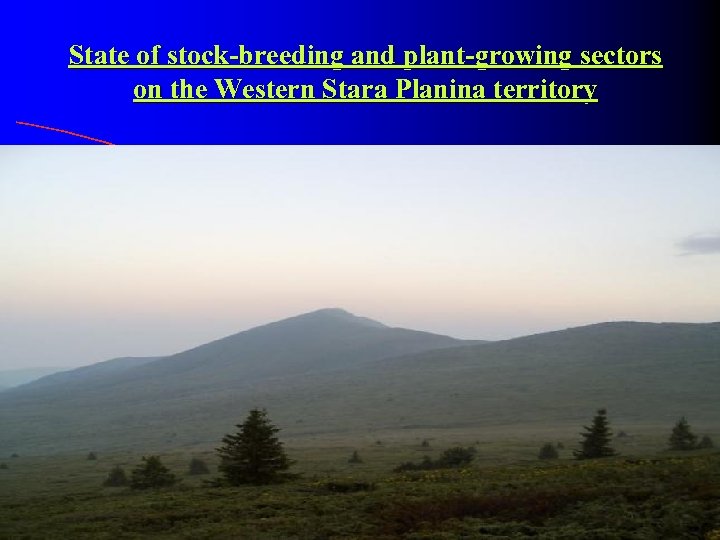
State of stock-breeding and plant-growing sectors on the Western Stara Planina territory
Structure of presentation l Presentation of geographical region. l State of stock-breeding and plant-growing l State of restored workable land its exploitation l State of meadows and pastures l Conclusions l Strengths and weaknesses
Presentation of geographical region l Four municipalities (Berkovitsa, Varshets, Tchiprovtsi, Georgi Damianovo) are situated in the north part of the West Stara Planina. They are assessed as flat and rough terrains and good thermal resources. Quantity of vegetation rainfalls ranges between 400 – 800 mm. Available are conditions for growing of all agricultural crops. Prevailing soil types are grey wood, alluvialmeadow, single massifs of light grey and eroded to different extent. Altitude is from 400 to 1200 meters. According to this geographical characterization in the region of the four municipalities growing of different species of crops , but also of nearly all farm animals breeding is allowed.
Presentation of geographical region In relation with global warming in recent years is observed comparatively mild climate in the region, while the winter is comparatively mild. Snow-standing is mostly up to two months, which allows more longer to be absorbed the natural food in meadows and pastures, but in the same time in plant-growing sector are not observed processes like freezing and perishing of plants.
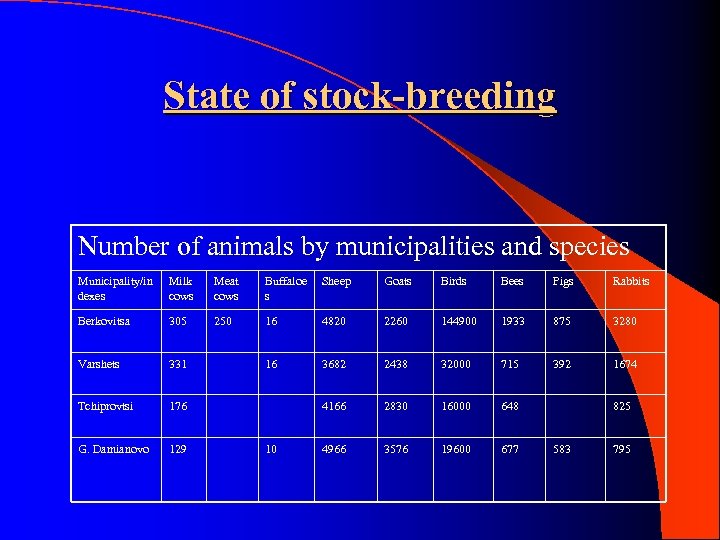
State of stock-breeding Number of animals by municipalities and species Municipality/in dexes Milk cows Meat cows Buffaloe s Sheep Goats Birds Bees Pigs Rabbits Berkovitsa 305 250 16 4820 2260 144900 1933 875 3280 Varshets 331 16 3682 2438 32000 715 392 1674 Tchiprovtsi 176 4166 2830 16000 648 G. Damianovo 129 4966 3576 19600 677 10 825 583 795
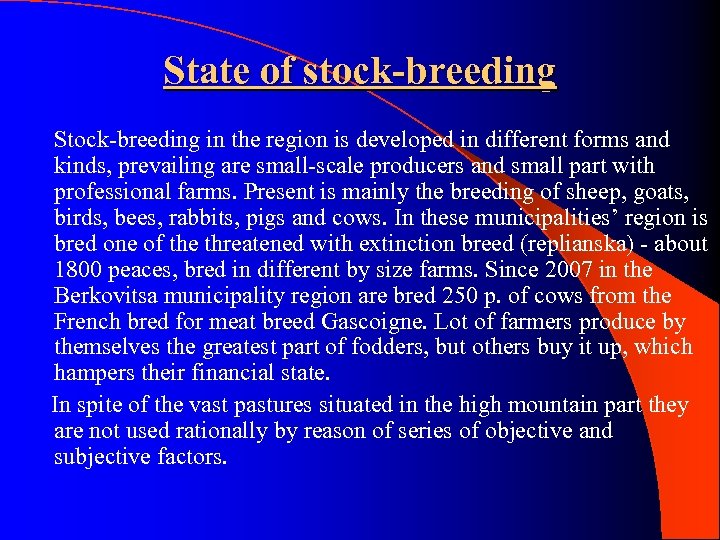
State of stock-breeding Stock-breeding in the region is developed in different forms and kinds, prevailing are small-scale producers and small part with professional farms. Present is mainly the breeding of sheep, goats, birds, bees, rabbits, pigs and cows. In these municipalities’ region is bred one of the threatened with extinction breed (replianska) - about 1800 peaces, bred in different by size farms. Since 2007 in the Berkovitsa municipality region are bred 250 p. of cows from the French bred for meat breed Gascoigne. Lot of farmers produce by themselves the greatest part of fodders, but others buy it up, which hampers their financial state. In spite of the vast pastures situated in the high mountain part they are not used rationally by reason of series of objective and subjective factors.
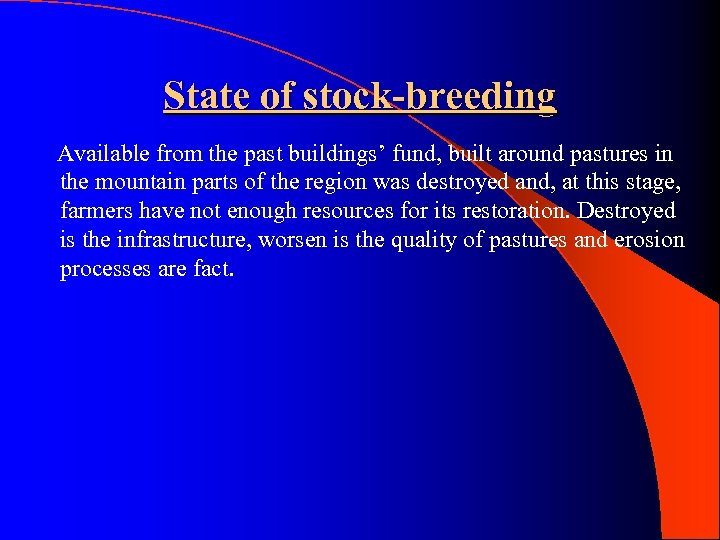
State of stock-breeding Available from the past buildings’ fund, built around pastures in the mountain parts of the region was destroyed and, at this stage, farmers have not enough resources for its restoration. Destroyed is the infrastructure, worsen is the quality of pastures and erosion processes are fact.
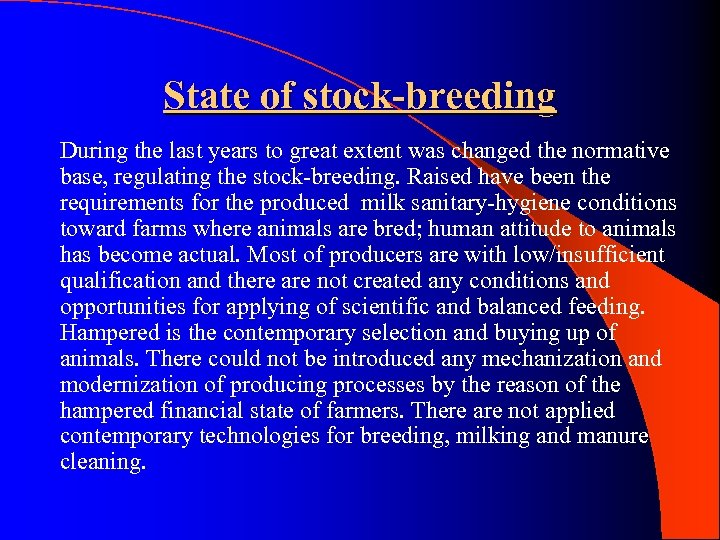
State of stock-breeding During the last years to great extent was changed the normative base, regulating the stock-breeding. Raised have been the requirements for the produced milk sanitary-hygiene conditions toward farms where animals are bred; human attitude to animals has become actual. Most of producers are with low/insufficient qualification and there are not created any conditions and opportunities for applying of scientific and balanced feeding. Hampered is the contemporary selection and buying up of animals. There could not be introduced any mechanization and modernization of producing processes by the reason of the hampered financial state of farmers. There are not applied contemporary technologies for breeding, milking and manure cleaning.
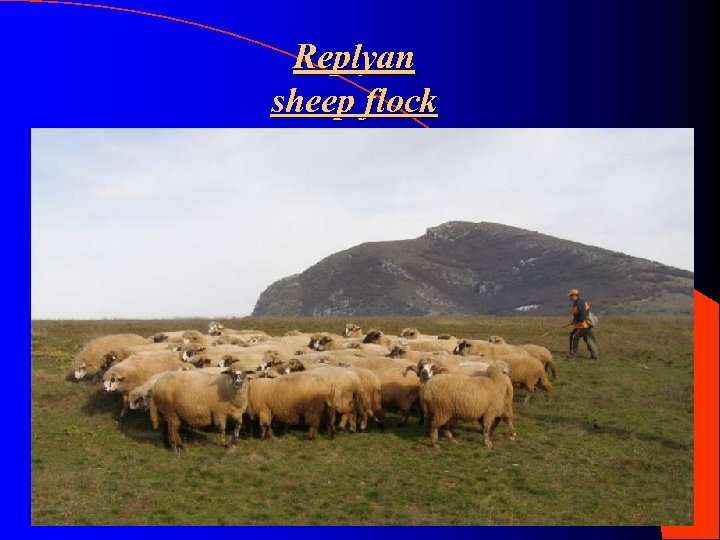
Replyan sheep flock
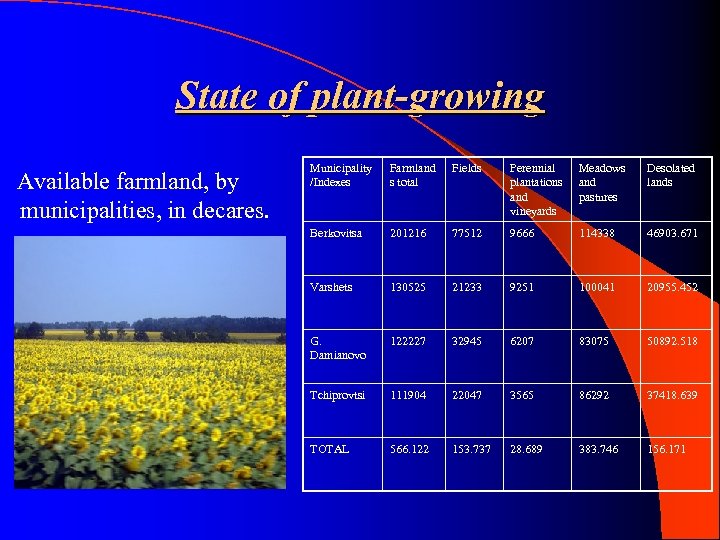
State of plant-growing Available farmland, by municipalities, in decares. Municipality /Indexes Farmland s total Fields Perennial plantations and vineyards Meadows and pastures Desolated lands Berkovitsa 201216 77512 9666 114338 46903. 671 Varshets 130525 21233 9251 100041 20955. 452 G. Damianovo 122227 32945 6207 83075 50892. 518 Tchiprovtsi 111904 22047 3565 86292 37418. 639 TOTAL 566. 122 153. 737 28. 689 383. 746 156. 171
State of plant-growing In spite of the favorable soil-climatic conditions of the region plant-growing is not developed normally or if there is any, it is mainly within individual farms. Agricultural co-operations are missing, great leaseholders could be counted by fingers, but middle-scale ones are about 10 – 15 %. From corn-cereal crops wheat and maize are grown. From orchards' species are introduced raspberry, strawberry, vineyards, a bit of plums, morello and apples. Vegetable crops are grown mainly in individual farms – but namely tomatoes, cucumbers, peppers and etc. From table 2 is clear, that prevailing for the region are meadows and pastures, and not accidentally at this stage, the stock-breeding appears to be the basic livelihood of local population. It is impressive, that desolated lands are more than workable fields. The conclusion is lack of the necessary mechanization, which to serve to individual farmers, violated infrastructure, low purchasing capacity and not at last place – the ageing population in the region. Constant weeding and self-foresting of desolated lands and enforced processes of erosion are widely expressed, which influence on development of agriculture. Although the made production is little, the marketing is embarrassed or if there is any, the purchasing price is low.
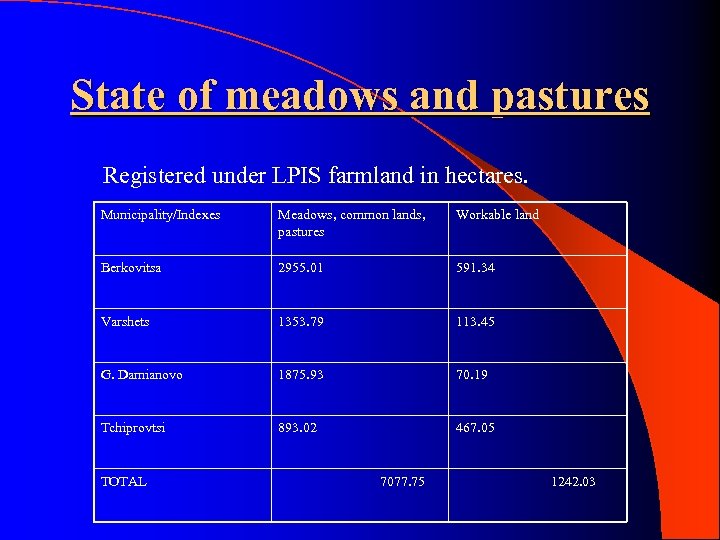
State of meadows and pastures Registered under LPIS farmland in hectares. Municipality/Indexes Meadows, common lands, pastures Workable land Berkovitsa 2955. 01 591. 34 Varshets 1353. 79 113. 45 G. Damianovo 1875. 93 70. 19 Tchiprovtsi 893. 02 467. 05 TOTAL 7077. 75 1242. 03
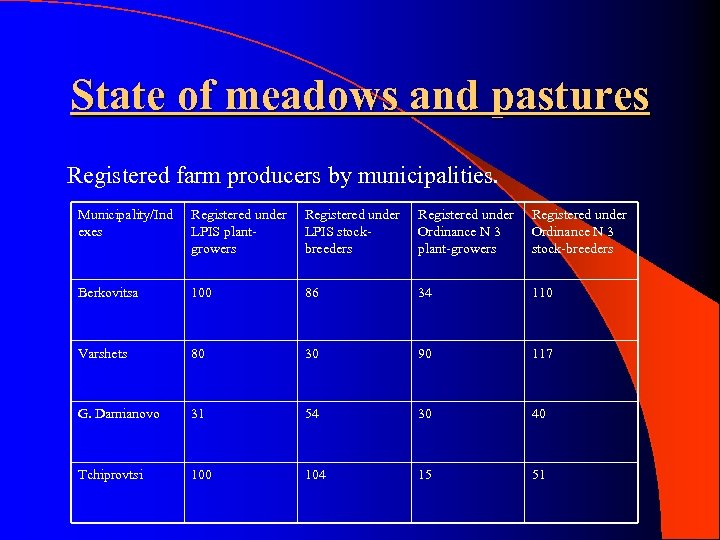
State of meadows and pastures Registered farm producers by municipalities. Municipality/Ind exes Registered under LPIS plantgrowers Registered under LPIS stockbreeders Registered under Ordinance N 3 plant-growers Registered under Ordinance N 3 stock-breeders Berkovitsa 100 86 34 110 Varshets 80 30 90 117 G. Damianovo 31 54 30 40 Tchiprovtsi 100 104 15 51
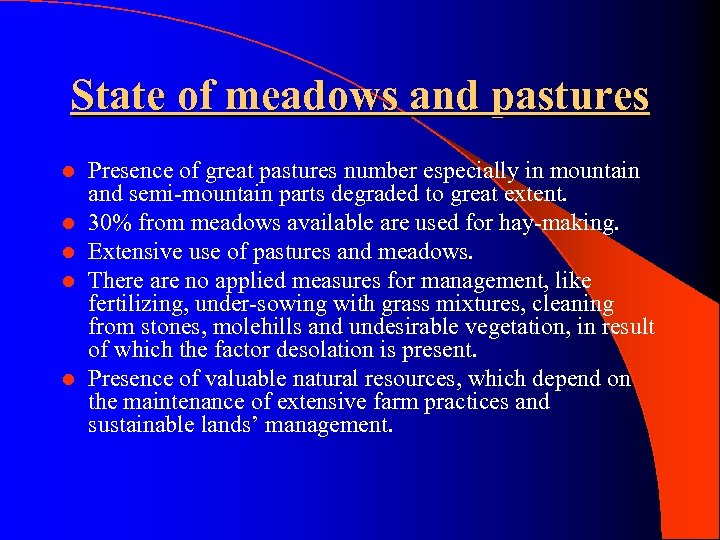
State of meadows and pastures l l l Presence of great pastures number especially in mountain and semi-mountain parts degraded to great extent. 30% from meadows available are used for hay-making. Extensive use of pastures and meadows. There are no applied measures for management, like fertilizing, under-sowing with grass mixtures, cleaning from stones, molehills and undesirable vegetation, in result of which the factor desolation is present. Presence of valuable natural resources, which depend on the maintenance of extensive farm practices and sustainable lands’ management.
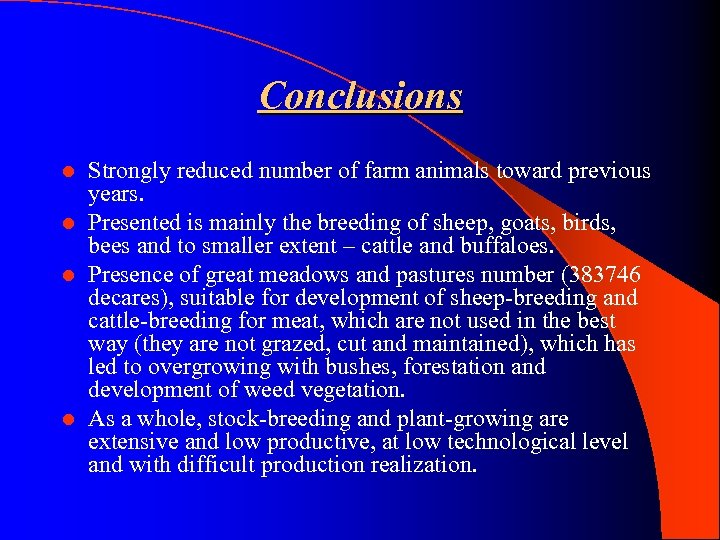
Conclusions Strongly reduced number of farm animals toward previous years. l Presented is mainly the breeding of sheep, goats, birds, bees and to smaller extent – cattle and buffaloes. l Presence of great meadows and pastures number (383746 decares), suitable for development of sheep-breeding and cattle-breeding for meat, which are not used in the best way (they are not grazed, cut and maintained), which has led to overgrowing with bushes, forestation and development of weed vegetation. l As a whole, stock-breeding and plant-growing are extensive and low productive, at low technological level and with difficult production realization. l
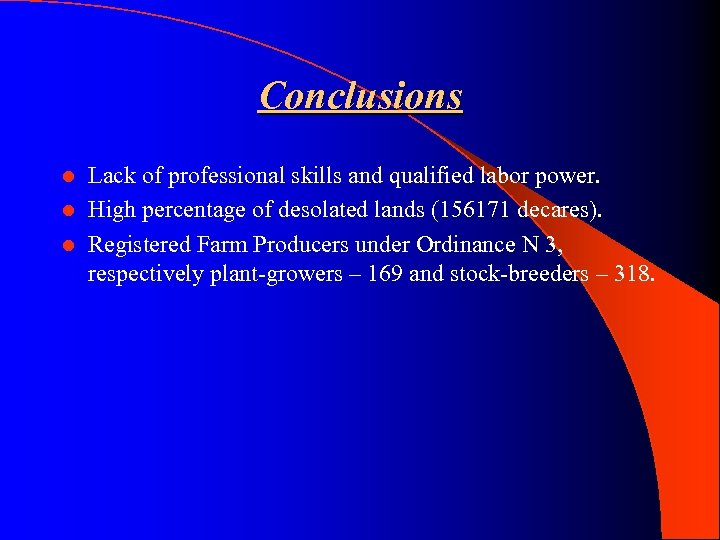
Conclusions Lack of professional skills and qualified labor power. l High percentage of desolated lands (156171 decares). l Registered Farm Producers under Ordinance N 3, respectively plant-growers – 169 and stock-breeders – 318. l
Opportunities for development l l l Development of modern pasture sheep-breeding, goat-breeding and cattlebreeding, through utilizing of the available pasture resources of the West Stara Planina. Improving of breed structure in the stock-breeding by introducing of bred for meat breeds of sheep and cattle. Encouraging of organic plant-growing and stock-breeding Stimulating producing and supply of specific products (meat, milk and their derivatives), bee honey and strawberries and durable goods, produced in the West Stara Planina region. Development of agrarian, rural and ecological tourism. Creation of organizations for producers and registering of trade-marks.
Strengths and weaknesses l Strengths Natural datum l Presence of certain gene fund. (replyan sheep, bred for meat cattle breed “Gascoigne” and etc. ). l Presence of traditions in stock-breeding, and growing of strawberries, perennials and potatoes. l Opportunity for participation in schemes for support from EU and RDP. l
Strengths and weaknesses l WEAKNESSES l l l Ageing population Insufficient classification of employed in agriculture ones Lack of financial aid Violated infrastructure Unadjusted market

THANK YOU FOR YOUR ATTENTION ! NAAS – Montana
Скачать презентацию State of stock-breeding and plant-growing sectors on the
fdbfd785ba06e8c51c1a33353e6e0878.ppt