


 Скачать презентацию State-legal development of France in modern times
frantsia_v_novoe_vremya.ppt
- Количество слайдов: 33
 State-legal development of France in modern times
 Content 1. 2. 3. 4. 5. the causes of the revolution. the french constitution of 1791 the overthrow of the monarchy. the proclamation of the republic. the establishment of the Jacobin dictatorship. 6. the french legal system of the new time. the codification of napoleon
 the causes of the revolution. • A revolutionary situation was brewing in France for a long time. The feudal system led the state to economic crisis that did not allow to develop a new capitalist relations. By the end of XVIII century revolutionary movement began with the simplest of popular uprisings. A poor harvest and economic stagnation led to people impoverishment, while the top of noble estate together with the king continued to live in luxury, not undertaking any action for the recovery of the economy. The revolt of the masses was supported by the representatives of the bourgeoisie who have developed many scenarios — the so-called scenario of revolutionary action. Using the experience of British revolutionaries and their own ideological program, the opposition of the feudal class by the end of the XVIII century, gained enormous power.
 • Trying to resolve the conflict, the king has summoned the States-General in 1789. In 1789, formed a national Assembly, whose members focus on common people and non-estate Association, which later became the constituent. The deputies of the constituent Assembly coordinated action of the revolutionary masses, and in response to the threat of Louis XVI to eliminate the meeting raised the people to revolt.
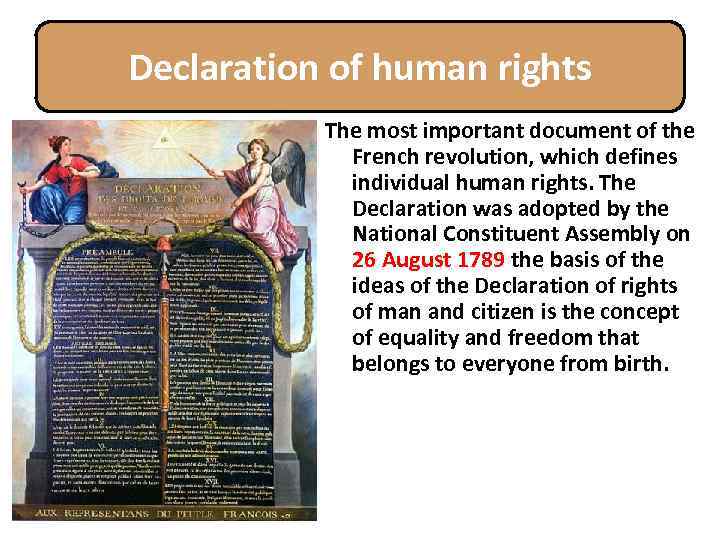 Declaration of human rights The most important document of the French revolution, which defines individual human rights. The Declaration was adopted by the National Constituent Assembly on 26 August 1789 the basis of the ideas of the Declaration of rights of man and citizen is the concept of equality and freedom that belongs to everyone from birth.
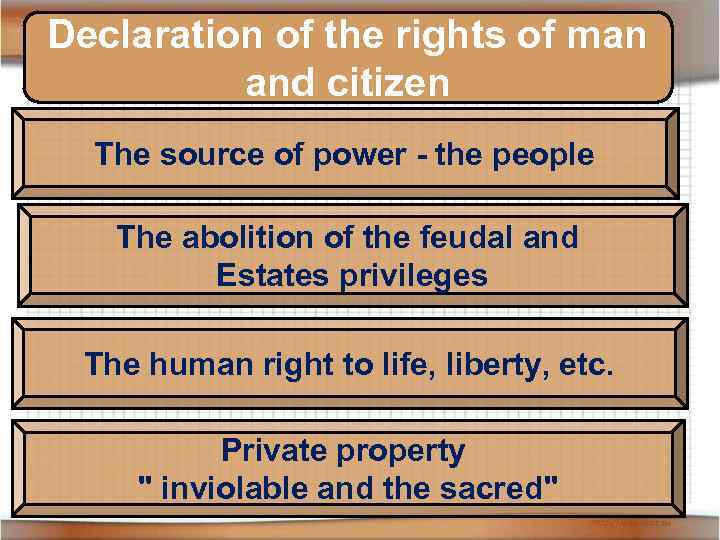 Declaration of the rights of man and citizen The source of power - the people The abolition of the feudal and Estates privileges The human right to life, liberty, etc. Private property " inviolable and the sacred"
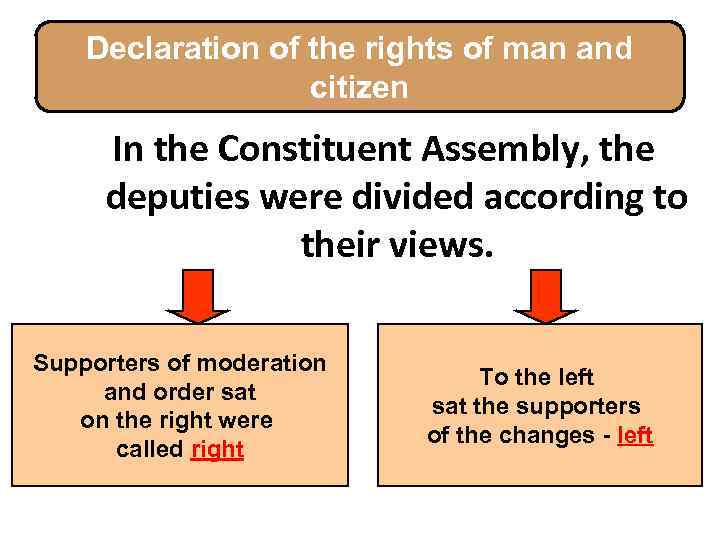 Declaration of the rights of man and citizen In the Constituent Assembly, the deputies were divided according to their views. Supporters of moderation and order sat on the right were called right To the left sat the supporters of the changes - left
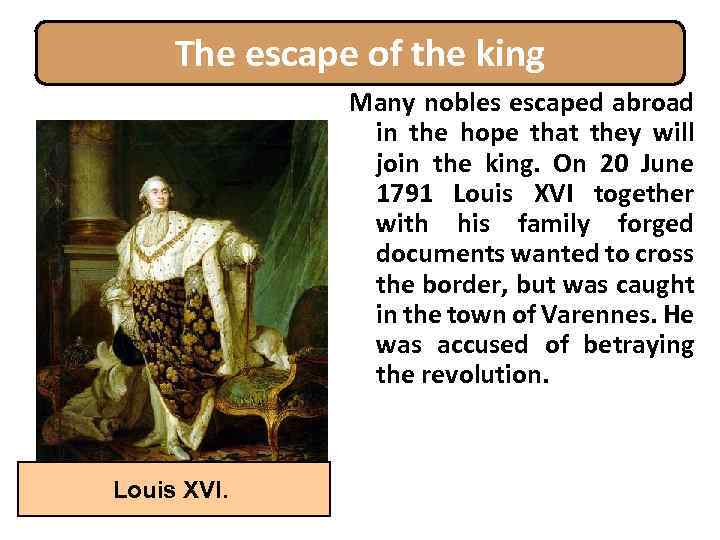 The escape of the king Many nobles escaped abroad in the hope that they will join the king. On 20 June 1791 Louis XVI together with his family forged documents wanted to cross the border, but was caught in the town of Varennes. He was accused of betraying the revolution. Louis XVI.
 The French Constitution of 1791 • On 3 September 1791, the National Assembly proclaimed the first French Constitution. • It was proposed to convene the Legislative Assembly — the unicameral Parliament based on a high property qualification. • The country had established a limited monarchy. What had declared the Constitution of 1791?
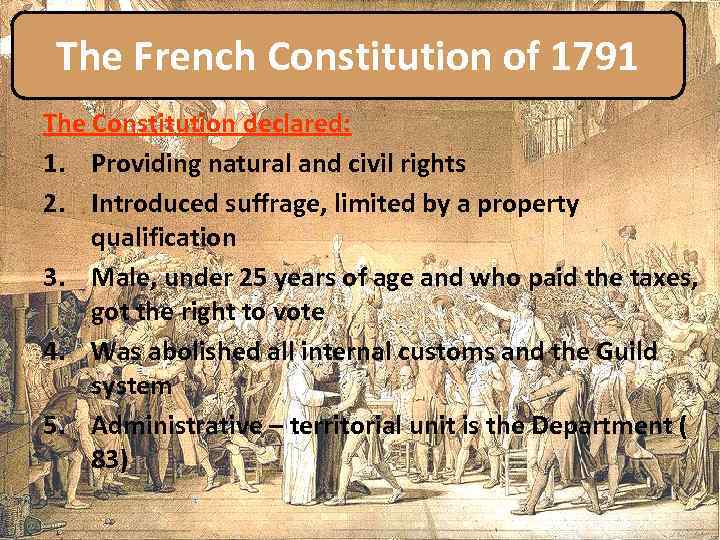 The French Constitution of 1791 The Constitution declared: 1. Providing natural and civil rights 2. Introduced suffrage, limited by a property qualification 3. Male, under 25 years of age and who paid the taxes, got the right to vote 4. Was abolished all internal customs and the Guild system 5. Administrative – territorial unit is the Department ( 83)
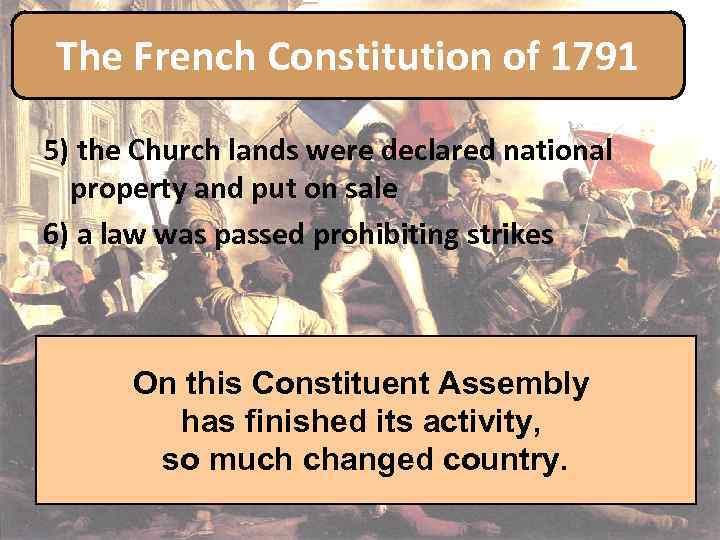 The French Constitution of 1791 5) the Church lands were declared national property and put on sale 6) a law was passed prohibiting strikes On this Constituent Assembly has finished its activity, so much changed country.
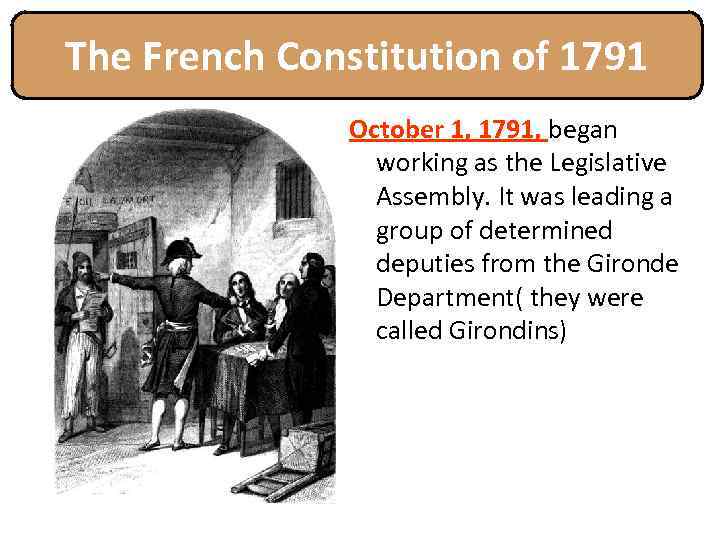 The French Constitution of 1791 October 1, 1791, began working as the Legislative Assembly. It was leading a group of determined deputies from the Gironde Department( they were called Girondins)
 Political club of the Jacobins. • Jacobins — members of a political club, the era of the French revolution, which established its dictatorship in the years 1793 -1794. Formed in June 1789. Got its name from the club, located in the Dominican monastery of St. Jacob.
 The beginning of the revolutionary wars. Revolutionary war began between France and Europe. And began it Louis XVI, hoping to regain his former power.
 The beginning of the revolutionary wars. April 20, 1972, the Legislative Assembly declared the war with Austria.
 "The Fatherland is in danger!" But on the fronts of the French was waiting for failure. Austrian and Prussian troops invaded France and occupied several fortresses. To the enemies of France had joined England. Among the Parisians had grown dissatisfied indecisive the action of the Royal power. In July 1792. Legislature addressed the nation with the slogan "the Fatherland is in danger!" Thousands of volunteers have enlisted in the army
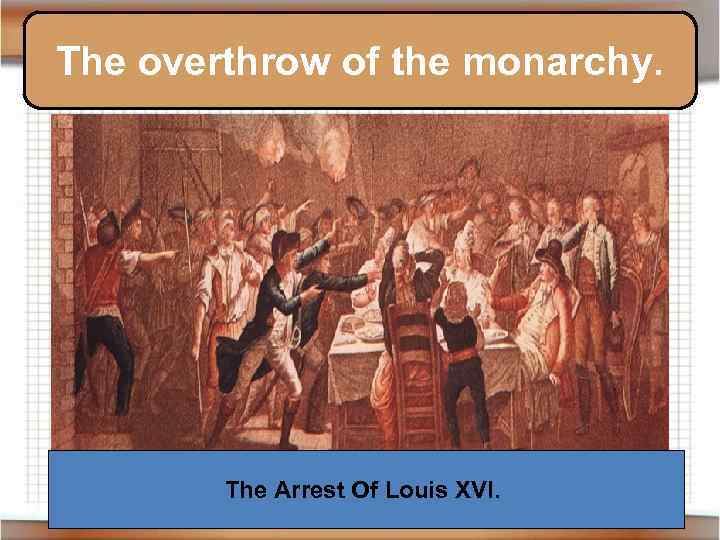 The overthrow of the monarchy. The Arrest Of Louis XVI.
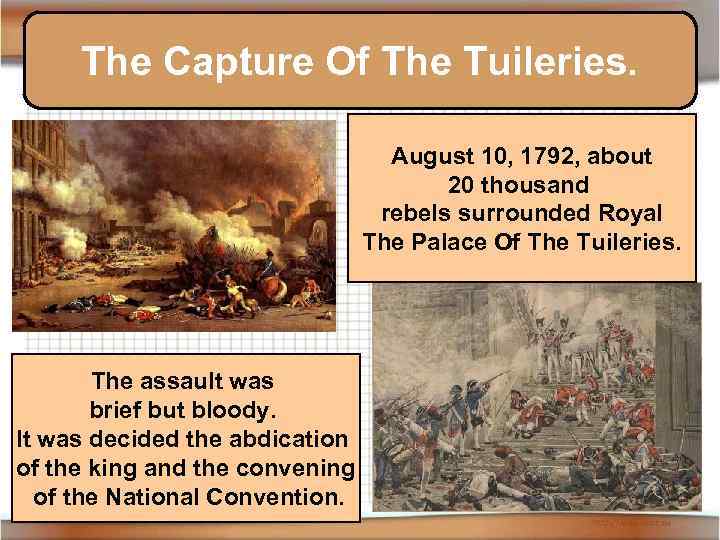 The Capture Of The Tuileries. August 10, 1792, about 20 thousand rebels surrounded Royal The Palace Of The Tuileries. The assault was brief but bloody. It was decided the abdication of the king and the convening of the National Convention.
 The overthrow of the monarchy • The uprising on the 10 of August 1792 episode of the French revolution during which king Louis XVI was deposed and imprisoned. • The result of the uprising, the monarchy in France was abolished, and came to power, the Republican party of the Girondins headed by Brissot.
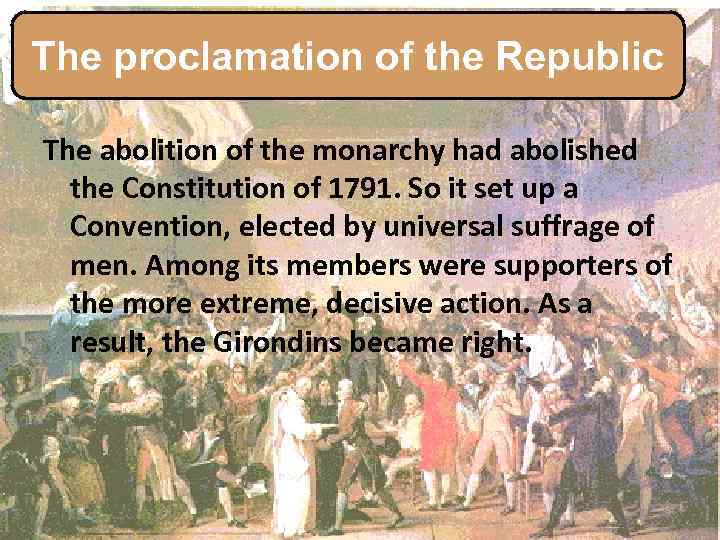 The proclamation of the Republic The abolition of the monarchy had abolished the Constitution of 1791. So it set up a Convention, elected by universal suffrage of men. Among its members were supporters of the more extreme, decisive action. As a result, the Girondins became right.
 The proclamation of the Republic The results of the activities of the Convention In September 1792 France was proclaimed a Republic. Recognized the right of representation in the Convention of the French colonies
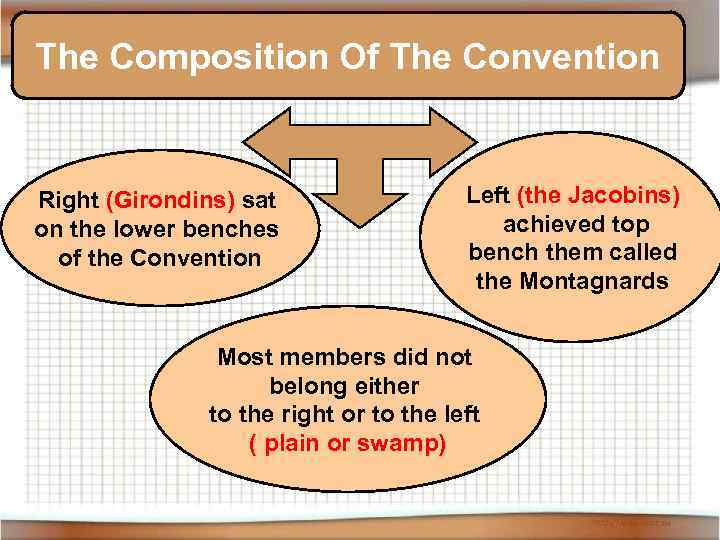 The Composition Of The Convention Right (Girondins) sat on the lower benches of the Convention Left (the Jacobins) achieved top bench them called the Montagnards Most members did not belong either to the right or to the left ( plain or swamp)
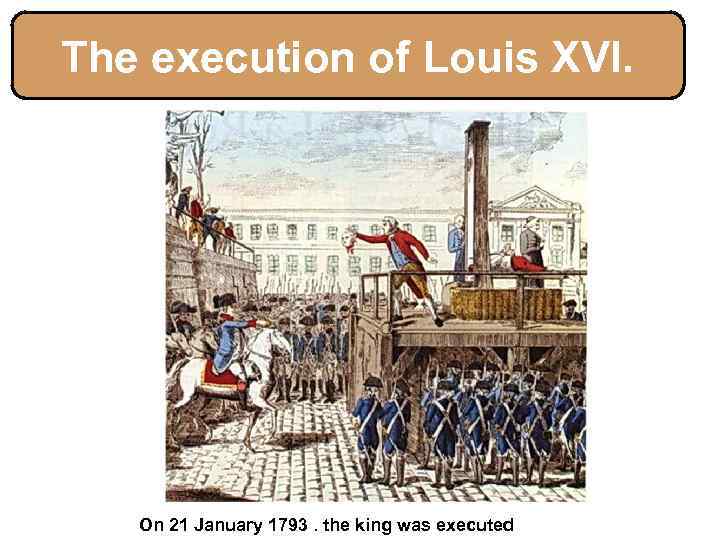 The execution of Louis XVI. On 21 January 1793. the king was executed
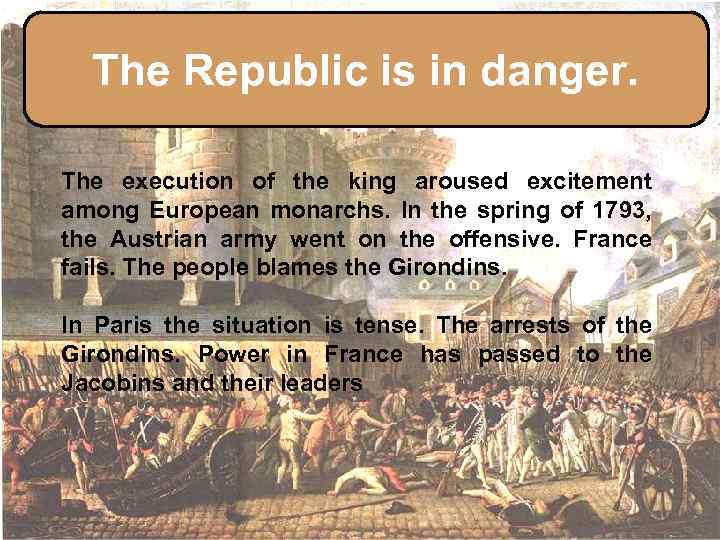 ка The Republic is in danger. The execution of the king aroused excitement among European monarchs. In the spring of 1793, the Austrian army went on the offensive. France fails. The people blames the Girondins. In Paris the situation is tense. The arrests of the Girondins. Power in France has passed to the Jacobins and their leaders
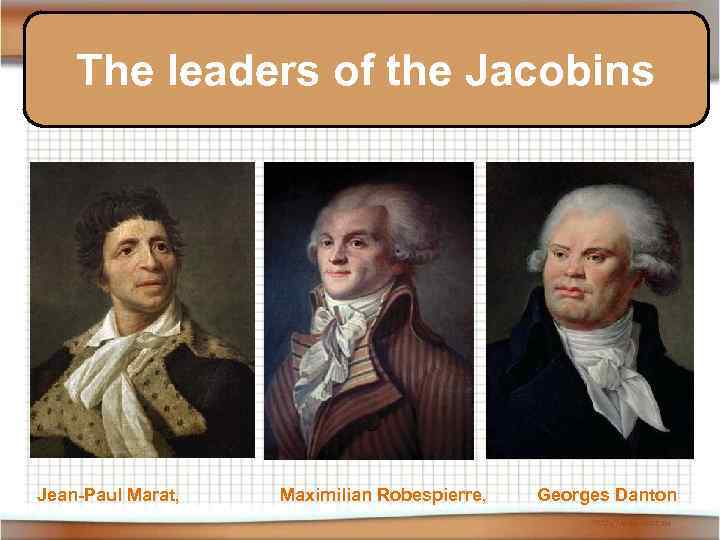 The leaders of the Jacobins Jean-Paul Marat, Maximilian Robespierre, Georges Danton
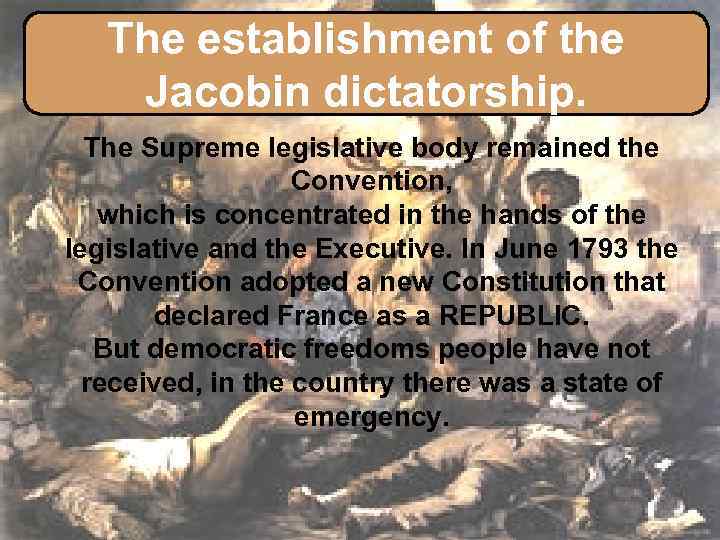 The establishment of the Jacobin dictatorship. The Supreme legislative body remained the Convention, which is concentrated in the hands of the legislative and the Executive. In June 1793 the Convention adopted a new Constitution that declared France as a REPUBLIC. But democratic freedoms people have not received, in the country there was a state of emergency.
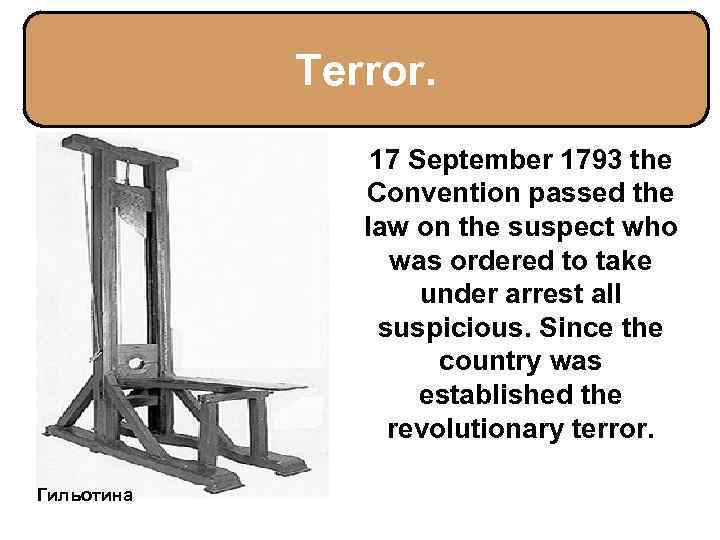 Terror. 17 September 1793 the Convention passed the law on the suspect who was ordered to take under arrest all suspicious. Since the country was established the revolutionary terror. Гильотина
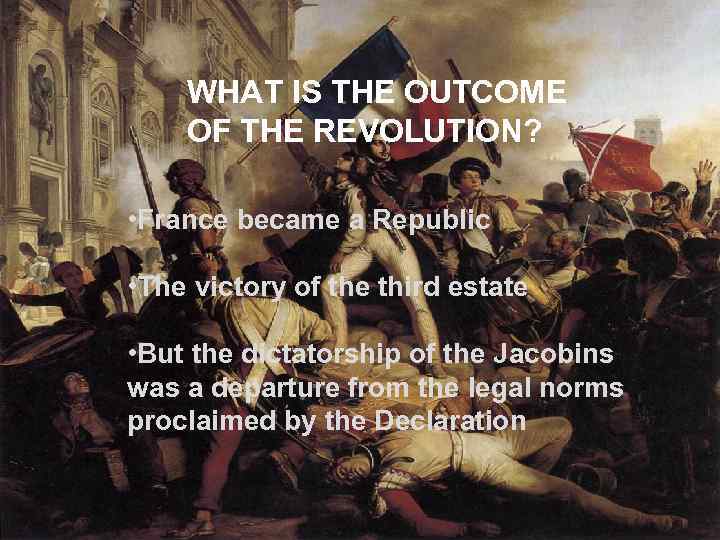 WHAT IS THE OUTCOME OF THE REVOLUTION? • France became a Republic • The victory of the third estate • But the dictatorship of the Jacobins was a departure from the legal norms proclaimed by the Declaration
 THE FRENCH LEGAL SYSTEM OF THE NEW TIME. • The French revolution of the XVIII century demanding the establishment of a new legal system. The use of already known sources of the law, was unacceptable, as was the formation of a completely new structure of the society in which application of the law was not dependent on the class origin. The decisive innovation was the Declaration of the rights of man and of the citizen 1789, the creators of which considered the only source of natural law of human nature.
 Civil law • The process of systematization of French law that received the highest intensity during the reign of Napoleon Bonaparte. Personally, he developed civil, commercial, penal, civil procedure, criminal procedure codes. • The ongoing codification played a huge role in the development of the whole French legal system for a long period.
 Napoleonic code • In three books of the Civil code of Napoleon of 1804 defined the following provisions: • the book "About faces" contain provisions confirming the equality and freedom of citizens in private legal relations (apply these provisions could not foreigners), principles of family law: equality between husband wife, the possibility of recognition of illegitimate children, the assignment to the institution of marriage status of a civil contract; • the book "About the property and the different modifications of ownership" proclaimed the inviolability of private property rights, entitled the owner of the land sovereign to dispose of all the riches located in it or on it;
 Criminal law • The penal code of Napoleon of 1810 was made up of two books, containing the basic concepts and principles of criminal law, and two books specifically addressing the individual criminal acts and penalties to them. Crimes were divided into serious, punishable by physical and moral suffering; offenses, followed by corrective action and offense, and then the police punishment. The code of criminal procedure of 1810 of Bonaparte introduces a mixed judicial process.
 • The judge could put pressure on the decision of the jury. Introduced the figure of the Prosecutor, who had the function of the Prosecutor. Over time, many of the provisions of the Criminal procedure code of 1810, was abolished as inhumane. Among them, the civil penalty, branding and cutting off hands. • The law becomes the only source of law. Based on this, French judges began to rely solely on the written source of law, eliminating the possibility to apply precedent. The French law of that period already had a clear distinction between private and public law.