 Скачать презентацию State Basic Literacy Skills Certification Programs 1
3d9e6df2f833c9b2a2e2a55e2641c937.ppt
- Количество слайдов: 40



State Basic Literacy Skills Certification Programs 1
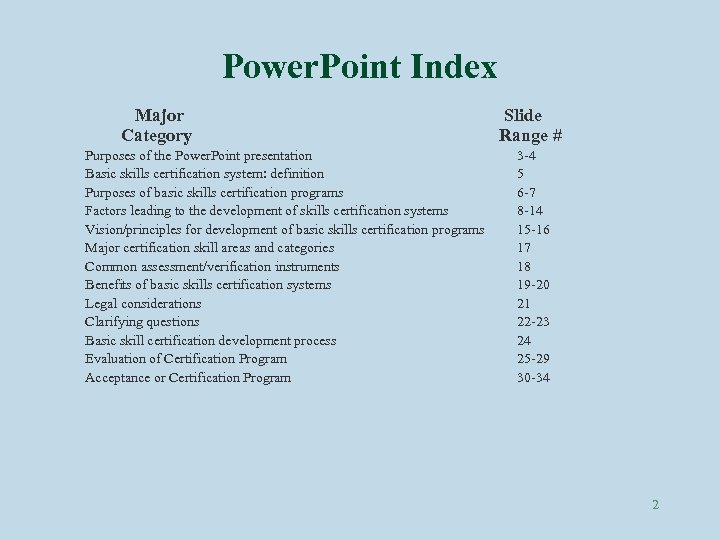
Power. Point Index Major Category Purposes of the Power. Point presentation Basic skills certification system: definition Purposes of basic skills certification programs Factors leading to the development of skills certification systems Vision/principles for development of basic skills certification programs Major certification skill areas and categories Common assessment/verification instruments Benefits of basic skills certification systems Legal considerations Clarifying questions Basic skill certification development process Evaluation of Certification Program Acceptance or Certification Program Slide Range # 3 -4 5 6 -7 8 -14 15 -16 17 18 19 -20 21 22 -23 24 25 -29 30 -34 2
Purposes of the Basic Skills Certification Program Power. Point Presentation · · · Define a basic skills certification system; Identify the major purposes and benefits of a basic skills certification program; Present the principles for the development of a state level basic skills certification program; 3
Purposes of the Basic Skills Certification Program Power. Point Presentation (cont. ) · Establish the relationship between the Adult Education and Family Literacy Act and a state level basic skills certification program; 4
Basic Skills Certification Systems: A Definition · A Basic Skills Certification system is a set of policies and processes to verify and acknowledge the skill level gains of adults who are at a skill level lower than high school completion or GED. These systems acknowledge the knowledge and skills that adults know and are able to do in any of the skill areas of reading, writing, mathematics, employability, ESL and/or computer literacy. 5
Purposes of Basic Skills Certification Programs · · Develops an understandable method of communication to policy makers regarding student learning progress (i. e. legislators, administrators, etc. ); and Provides a standardized method of measuring program effectiveness; Documents basic skills attainment for employers and others; Furnishes a significant data element for an outcomes based reporting system; 6
Purposes of Basic Skills Certification Programs (cont. ) · · · Establishes a common language among literacy partners (i. e. JTPA, Workforce Development Centers, employers, vocational rehabilitation, welfare reform, etc. ); Provides an incentive for student learning motivation; Benchmarks student performance and learning gains based on basic literacy skills attainment. 7
Factors Leading to the Development of Basic Skills Certification Systems · National Initiative. In 1992, adult education programs developed and implemented “State Indicators of Program Quality” which impacted program excellence. One quality indicator identified “learner progress toward attainment of basic skills and competencies” (United States Department of Education, 1992). In response to this indicator, a few states created a Basic Skills Certification System as a way to verify student learning gains. 8
Factors Leading to the Development of Basic Skills Certification Systems (cont. ) · New Legislation. In 1998, the Adult Education and Family Literacy Act, Title II of The Workforce Investment Act passed with a mandate for each state to establish performance measures. Once again a Performance Indicator related to student learning gains. In anticipation of or in response to performance measures, several other states began development of a Basic Skills Certification System. 9
Factors Leading to the Development of Basic Skills Certification Systems (cont. ) In addition to new legislation and the Model Indicators of Quality created by the United States Department of Education (USDE), there are major public trends contributing to the creation of a Basic Skills Certification System. 10
Factors Leading to the Development of Basic Skills Certification Systems (cont. ) · Trends Affecting Business/Government/ Education. Three major public trends serve as a catalyst to states to create systems and to business and government to achieve results. These trends are: ã Mindware Explosion. The imperative to gain new knowledge, information and skills to be able to apply skills in jobs where skill demands are ever changing and escalating. 11
Factors Leading to the Development of Basic Skills Certification Systems (cont. ) · Trends Affecting (cont. ) ã ã Customization and Personalization. The requirement of customers for services that will meet their personal specific needs. Results from Services. Consumers want results from services rendered; therefore, service providers must achieve results to match customer desires. 12
Factors Leading to the Development of Basic Skills Certification Systems (cont. ) · National Events. In the last year, several national events provided an impetus for changes in adult education governance and operation. ã ã Business/Industry Demand for Basic Skills. Every report generated by business and industry discusses the need for increased basic skills in the workplace, the lack of skills by employees, and the fact that current employees will be in the workforce for the next 10 -15 years. Change in Legislation. New legislation links adult education with employment and training and calls for performance measures. 13
Factors Leading to the Development of Basic Skills Certification Systems (cont. ) ã Management Information Systems (MIS). The introduction of computerized MIS data collection systems into states is making it easier to collect, transmit and report accurate student data. 14
Vision/Principles for Development of a Basic Skills Certification Programs · · Incremental gains are important and should be rewarded; Research findings are the basis for development; Basic skills certification is a part of a comprehensive delivery system; Skills certificates focus on the positive aspects of adult skills rather than skill deficiencies; 15
Vision/Principles for Development of a Basic Skills Certification Programs (cont. ) · · · Basic skills certification is an alternative to K-12 system or postsecondary system for articulating basic skills of adults; Certificates are related to work, family and community ambitions; The system is accountability driven. 16
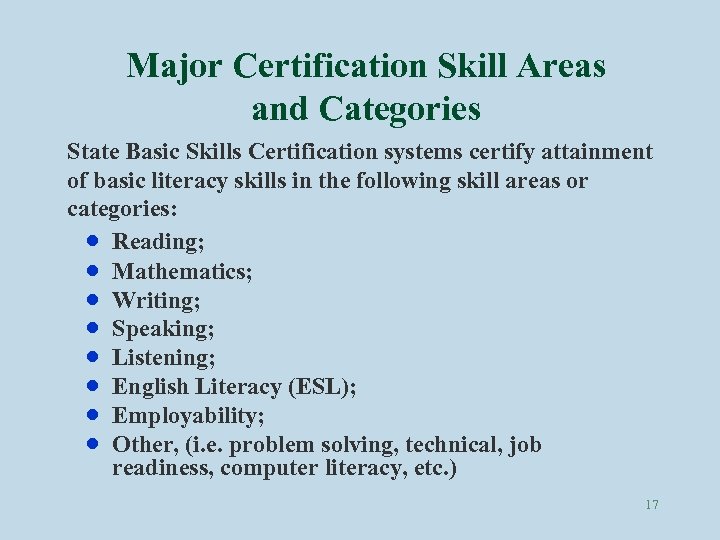
Major Certification Skill Areas and Categories State Basic Skills Certification systems certify attainment of basic literacy skills in the following skill areas or categories: · Reading; · Mathematics; · Writing; · Speaking; · Listening; · English Literacy (ESL); · Employability; · Other, (i. e. problem solving, technical, job readiness, computer literacy, etc. ) 17
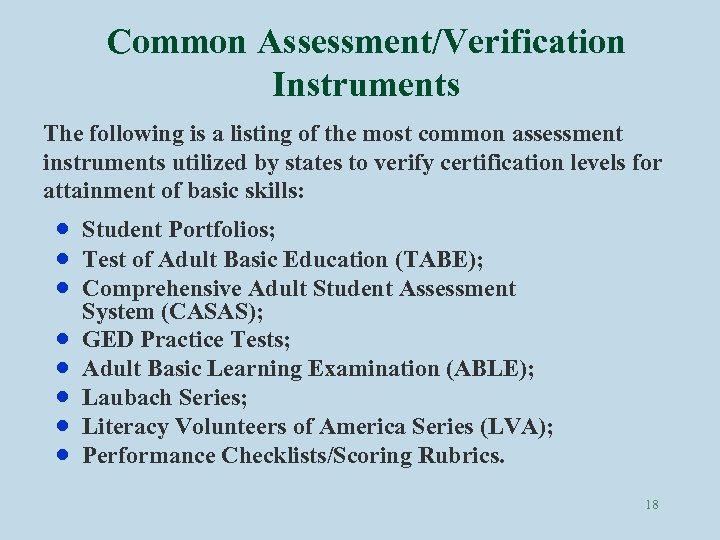
Common Assessment/Verification Instruments The following is a listing of the most common assessment instruments utilized by states to verify certification levels for attainment of basic skills: · · · · Student Portfolios; Test of Adult Basic Education (TABE); Comprehensive Adult Student Assessment System (CASAS); GED Practice Tests; Adult Basic Learning Examination (ABLE); Laubach Series; Literacy Volunteers of America Series (LVA); Performance Checklists/Scoring Rubrics. 18
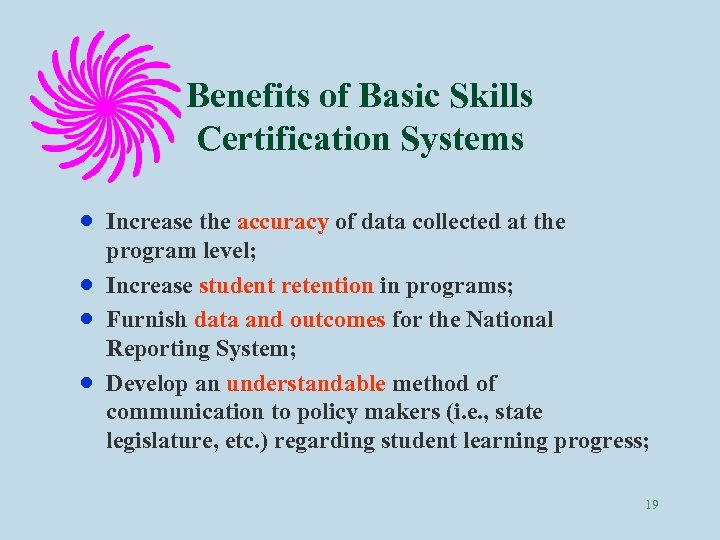
Benefits of Basic Skills Certification Systems · · Increase the accuracy of data collected at the program level; Increase student retention in programs; Furnish data and outcomes for the National Reporting System; Develop an understandable method of communication to policy makers (i. e. , state legislature, etc. ) regarding student learning progress; 19
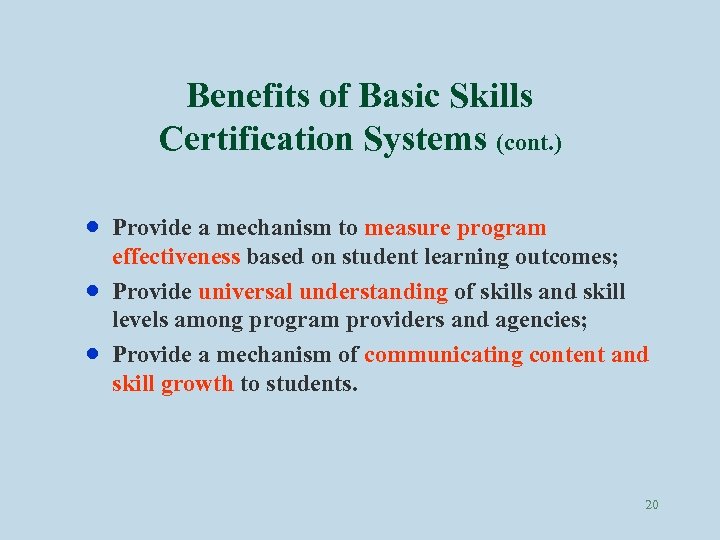
Benefits of Basic Skills Certification Systems (cont. ) · · · Provide a mechanism to measure program effectiveness based on student learning outcomes; Provide universal understanding of skills and skill levels among program providers and agencies; Provide a mechanism of communicating content and skill growth to students. 20
Legal Considerations Basic Skill Certificates serve as a verification of skills and have an endorsement from the instructional program and/or the State of skills identified on the Certificate. States want assurance that their programs and personnel are not placed in a position of legal liability, therefore, the system is carefully crafted to: · · · Ensure that Basic Skills Certification Systems are voluntary on the part of adult learners; Have clear guidelines for issuing Certificates or permitting local programs to issue Certificates; Include a disclaimer on its Certificate or in the policy guidelines. 21
Clarifying Questions Several clarifying questions can be asked to determine if the time is right to develop a Basic Skills Certification system. Questions include: · Is the state willing to institute a skills certification at · · levels prior to high school completion? Is the state seeking a way to acknowledge skills at benchmark points? Does the state want a statewide system that reliably verifies student learning gains? 22
Clarifying Questions (cont. ) · · · Is the state attempting to have a uniform system of quality? Does the state have students who enter programs seeking a high school diploma/GED whose skills are at a very low level? Are agencies within the state asking for information to articulate skills to employers? Is the state willing to provide learners with a means of articulating skill information to employers? Does the state want to create a learning continuum that matches state business skill needs? 23
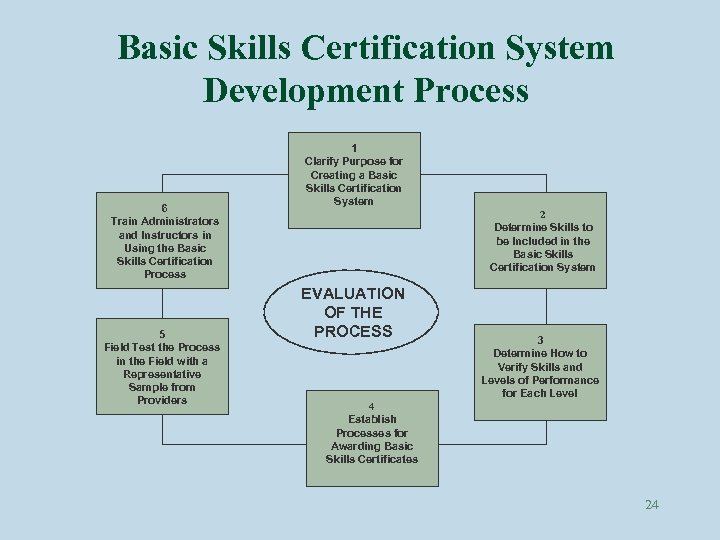
Basic Skills Certification System Development Process 6 Train Administrators and Instructors in Using the Basic Skills Certification Process 5 Field Test the Process in the Field with a Representative Sample from Providers 1 Clarify Purpose for Creating a Basic Skills Certification System 2 Determine Skills to be Included in the Basic Skills Certification System EVALUATION OF THE PROCESS 3 Determine How to Verify Skills and Levels of Performance for Each Level 4 Establish Processes for Awarding Basic Skills Certificates 24
Evaluation · Process Evaluation ã ã Since success of the system rests squarely with the processes used to implement the system, a heavy emphasis is placed on process evaluation during the development of the System. Evaluation that uses a participatory approach highlighting the strengths and challenges of the system. Evaluation should be weighted heavily to qualitative information. 25
Process Evaluation · Process questions that are answered in the field test include: ã ã ã ã Does the System work as designed? Where can the System be improved? Where are teachers/tutors, administrators, and counselors having difficulty implementing? What successes have staff using the System had? What barriers are faced by each type of student and programs? How are Certificates being used by Students? Are Certificates being awarded at each level? What does the data show? 26
Product Evaluation · Evaluating the quality of the product improves the system. Questions asked are: ã ã Are the skills assessed the skills that are important to the state? Do the certificates have value? To whom? Has the Certification System improved other aspects of the system? Do others understand the purpose behind the Certificates? 27
Evaluation Methodologies · Evaluation at the state level is a continuous process. States have used formative and summative evaluation to learn about the Basic Skills Certification System. Methodologies used to gain information have been to: ã ã ã Conduct formal and informal surveys about the processes used to award Certificates. Analyze the number of certificates issued by educational level, programs submitting portfolios, and population of students receiving certificates. Use data to determine the average hours of instruction to obtain a Certificate. 28
Evaluation Methodologies (cont. ) ã ã ã Gather quantitative data and qualitative information about students who achievement Certificates. Determine the extent that other partners accept and recognize Certificates. Obtain feedback from end-users regarding the value of the system to them. 29
Acceptance for the Basic Skills Certification System · · Marketing and Promotion of the Basic Skills Certificates with Employers and Community; Rewards to Students expressed that Basic Skills Certificates were used by them to get a new job (West Virginia), obtain a pay bonus (Delaware), and gain recognition from family (Iowa). 30
Acceptance for the Basic Skills Certification System (cont. ) · Advantages to Program. In a correctional center in Iowa, the Basic Skills Certification system raised learner self-esteem and served as great program motivators. Most learners had little or no success with educational programs in the past and were unlikely to pass the GED test quickly. For many the Certificates are the only recognition for educational success in the student’s future. 31
Acceptance for the Basic Skills Certification System (cont. ) · Benefits to the State. The certification system provides the consistency and standardization of skill attainment. Since all recipients meet the same level of performance, there is no question of the quality of the individual performance or the quality of the program. 32
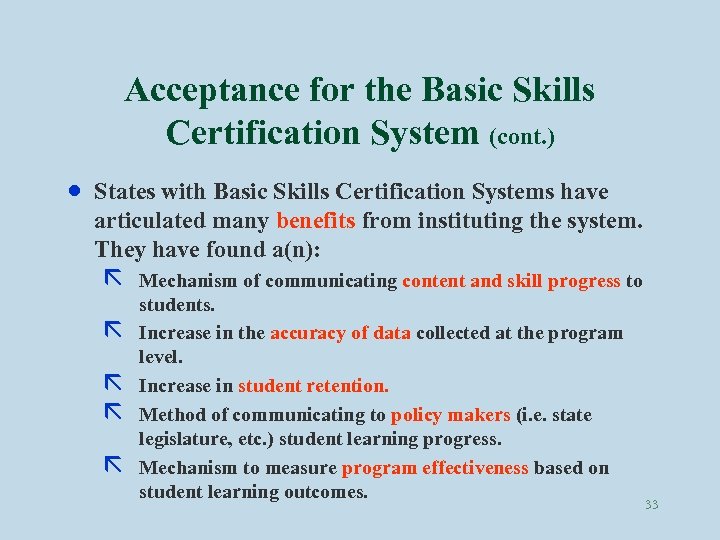
Acceptance for the Basic Skills Certification System (cont. ) · States with Basic Skills Certification Systems have articulated many benefits from instituting the system. They have found a(n): ã ã ã Mechanism of communicating content and skill progress to students. Increase in the accuracy of data collected at the program level. Increase in student retention. Method of communicating to policy makers (i. e. state legislature, etc. ) student learning progress. Mechanism to measure program effectiveness based on student learning outcomes. 33
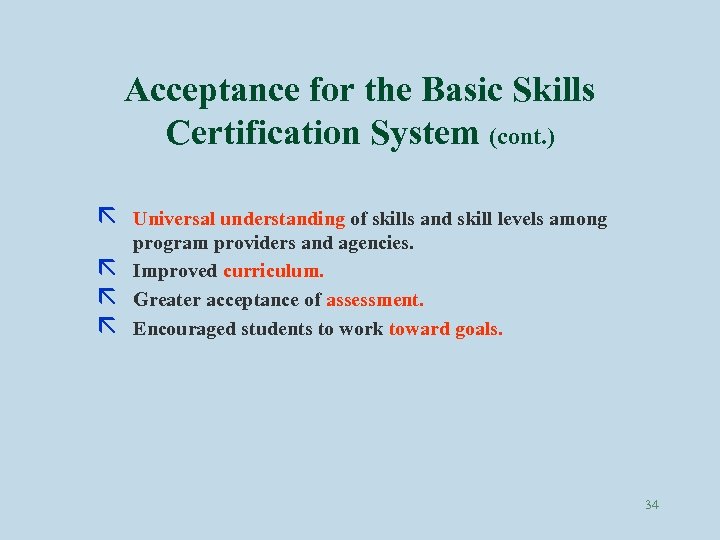
Acceptance for the Basic Skills Certification System (cont. ) ã ã Universal understanding of skills and skill levels among program providers and agencies. Improved curriculum. Greater acceptance of assessment. Encouraged students to work toward goals. 34
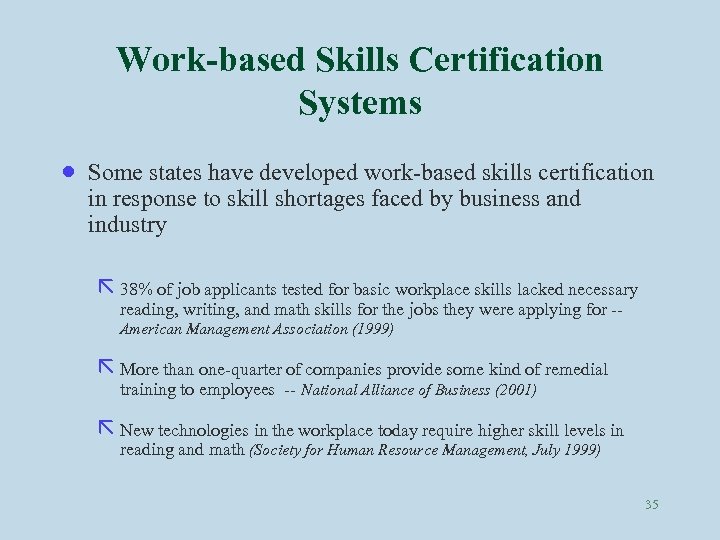
Work-based Skills Certification Systems · Some states have developed work-based skills certification in response to skill shortages faced by business and industry ã 38% of job applicants tested for basic workplace skills lacked necessary reading, writing, and math skills for the jobs they were applying for -American Management Association (1999) ã More than one-quarter of companies provide some kind of remedial training to employees -- National Alliance of Business (2001) ã New technologies in the workplace today require higher skill levels in reading and math (Society for Human Resource Management, July 1999) 35
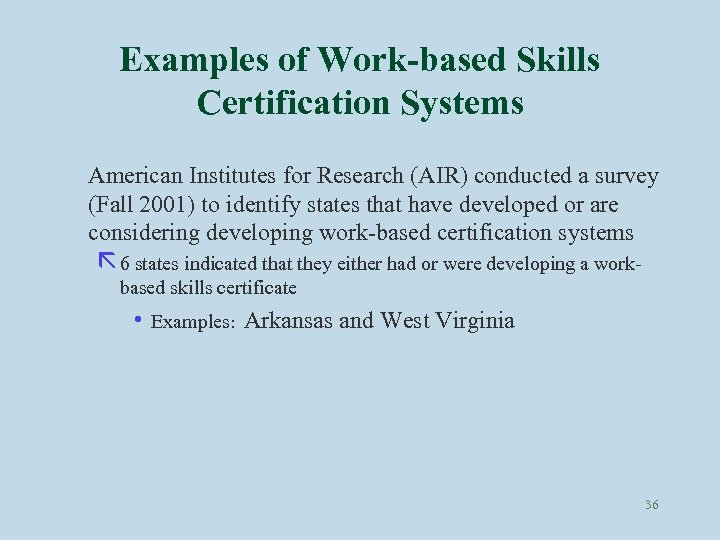
Examples of Work-based Skills Certification Systems American Institutes for Research (AIR) conducted a survey (Fall 2001) to identify states that have developed or are considering developing work-based certification systems ã 6 states indicated that they either had or were developing a workbased skills certificate • Examples: Arkansas and West Virginia 36
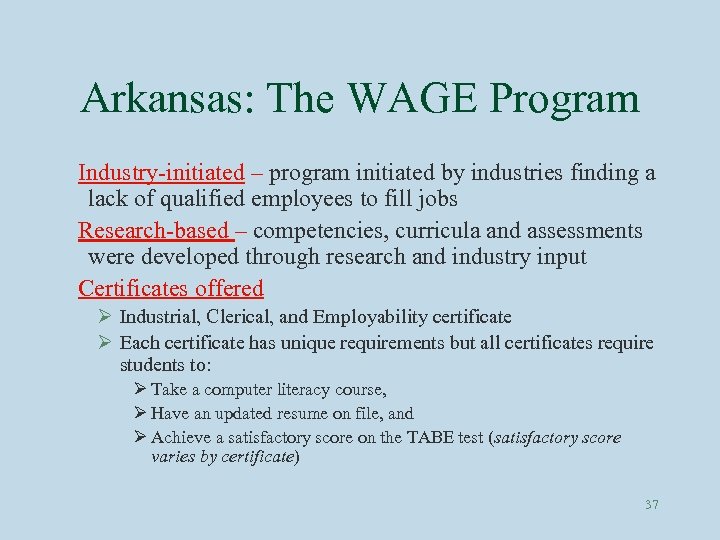
Arkansas: The WAGE Program Industry-initiated – program initiated by industries finding a lack of qualified employees to fill jobs Research-based – competencies, curricula and assessments were developed through research and industry input Certificates offered Ø Industrial, Clerical, and Employability certificate Ø Each certificate has unique requirements but all certificates require students to: Ø Take a computer literacy course, Ø Have an updated resume on file, and Ø Achieve a satisfactory score on the TABE test (satisfactory score varies by certificate) 37
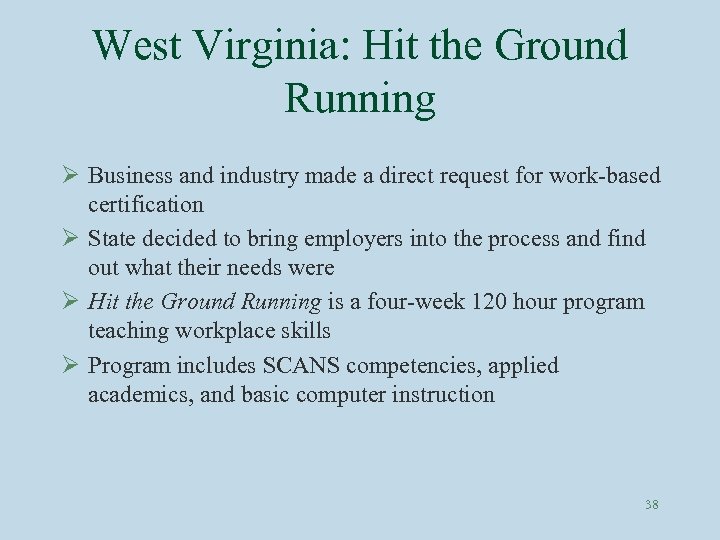
West Virginia: Hit the Ground Running Ø Business and industry made a direct request for work-based certification Ø State decided to bring employers into the process and find out what their needs were Ø Hit the Ground Running is a four-week 120 hour program teaching workplace skills Ø Program includes SCANS competencies, applied academics, and basic computer instruction 38
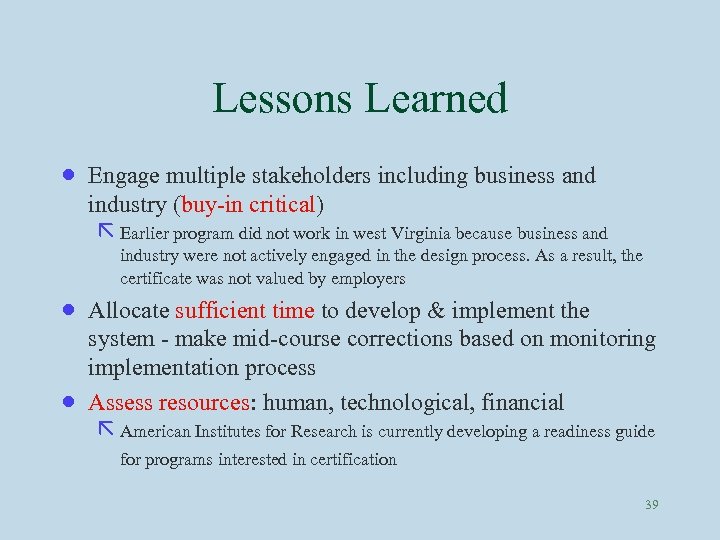
Lessons Learned · · · Engage multiple stakeholders including business and industry (buy-in critical) ã Earlier program did not work in west Virginia because business and industry were not actively engaged in the design process. As a result, the certificate was not valued by employers Allocate sufficient time to develop & implement the system - make mid-course corrections based on monitoring implementation process Assess resources: human, technological, financial ã American Institutes for Research is currently developing a readiness guide for programs interested in certification 39

End of Power. Point Presentation 40
Скачать презентацию State Basic Literacy Skills Certification Programs 1
3d9e6df2f833c9b2a2e2a55e2641c937.ppt