 Скачать презентацию Stat 35 b Introduction to Probability with Applications
21bdc7f6068faee68312f5426af5d992.ppt
- Количество слайдов: 7



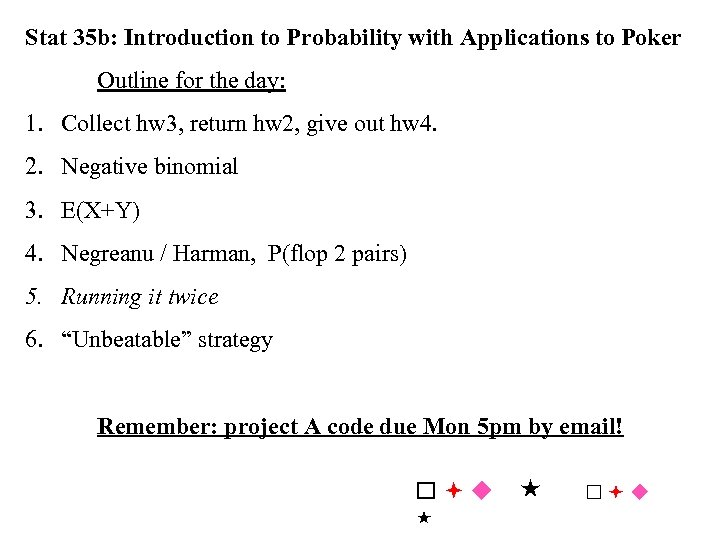
Stat 35 b: Introduction to Probability with Applications to Poker Outline for the day: 1. Collect hw 3, return hw 2, give out hw 4. 2. Negative binomial 3. E(X+Y) 4. Negreanu / Harman, P(flop 2 pairs) 5. Running it twice 6. “Unbeatable” strategy Remember: project A code due Mon 5 pm by email! u
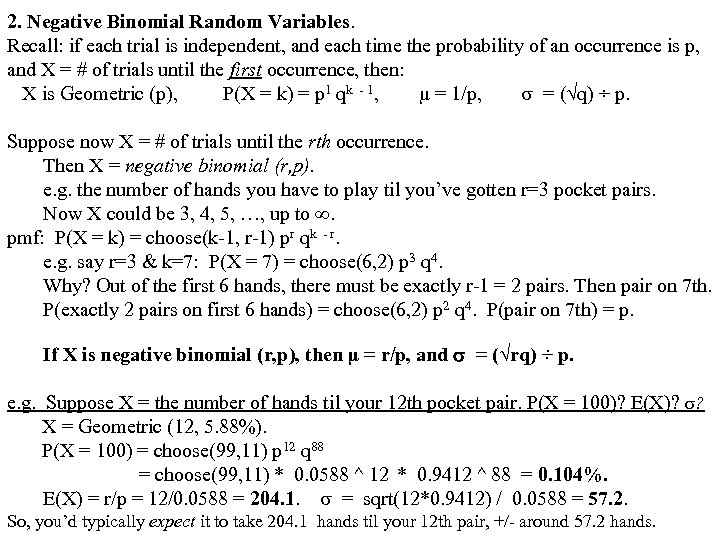
2. Negative Binomial Random Variables. Recall: if each trial is independent, and each time the probability of an occurrence is p, and X = # of trials until the first occurrence, then: X is Geometric (p), P(X = k) = p 1 qk - 1, µ = 1/p, s = (√q) ÷ p. Suppose now X = # of trials until the rth occurrence. Then X = negative binomial (r, p). e. g. the number of hands you have to play til you’ve gotten r=3 pocket pairs. Now X could be 3, 4, 5, …, up to ∞. pmf: P(X = k) = choose(k-1, r-1) pr qk - r. e. g. say r=3 & k=7: P(X = 7) = choose(6, 2) p 3 q 4. Why? Out of the first 6 hands, there must be exactly r-1 = 2 pairs. Then pair on 7 th. P(exactly 2 pairs on first 6 hands) = choose(6, 2) p 2 q 4. P(pair on 7 th) = p. If X is negative binomial (r, p), then µ = r/p, and s = (√rq) ÷ p. e. g. Suppose X = the number of hands til your 12 th pocket pair. P(X = 100)? E(X)? s? X = Geometric (12, 5. 88%). P(X = 100) = choose(99, 11) p 12 q 88 = choose(99, 11) * 0. 0588 ^ 12 * 0. 9412 ^ 88 = 0. 104%. E(X) = r/p = 12/0. 0588 = 204. 1. s = sqrt(12*0. 9412) / 0. 0588 = 57. 2. So, you’d typically expect it to take 204. 1 hands til your 12 th pair, +/- around 57. 2 hands.
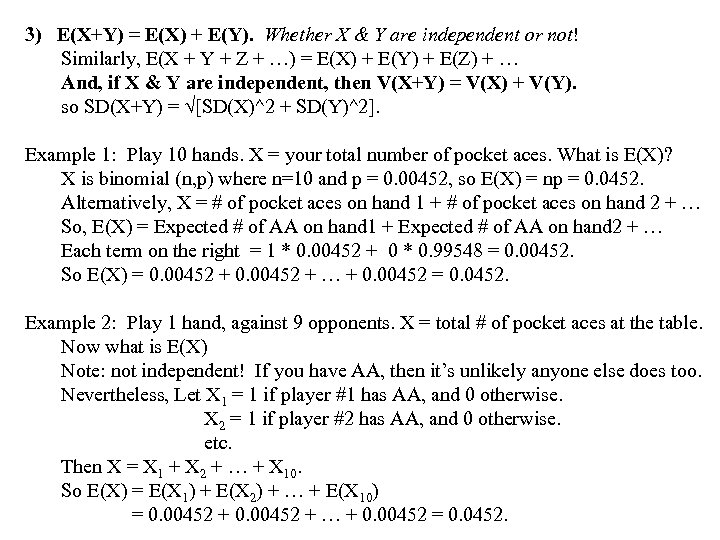
3) E(X+Y) = E(X) + E(Y). Whether X & Y are independent or not! Similarly, E(X + Y + Z + …) = E(X) + E(Y) + E(Z) + … And, if X & Y are independent, then V(X+Y) = V(X) + V(Y). so SD(X+Y) = √[SD(X)^2 + SD(Y)^2]. Example 1: Play 10 hands. X = your total number of pocket aces. What is E(X)? X is binomial (n, p) where n=10 and p = 0. 00452, so E(X) = np = 0. 0452. Alternatively, X = # of pocket aces on hand 1 + # of pocket aces on hand 2 + … So, E(X) = Expected # of AA on hand 1 + Expected # of AA on hand 2 + … Each term on the right = 1 * 0. 00452 + 0 * 0. 99548 = 0. 00452. So E(X) = 0. 00452 + … + 0. 00452 = 0. 0452. Example 2: Play 1 hand, against 9 opponents. X = total # of pocket aces at the table. Now what is E(X) Note: not independent! If you have AA, then it’s unlikely anyone else does too. Nevertheless, Let X 1 = 1 if player #1 has AA, and 0 otherwise. X 2 = 1 if player #2 has AA, and 0 otherwise. etc. Then X = X 1 + X 2 + … + X 10. So E(X) = E(X 1) + E(X 2) + … + E(X 10) = 0. 00452 + … + 0. 00452 = 0. 0452.
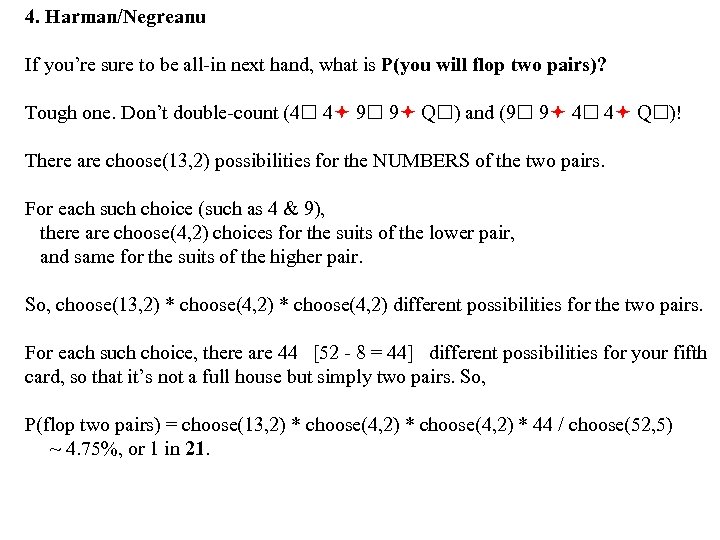
4. Harman/Negreanu If you’re sure to be all-in next hand, what is P(you will flop two pairs)? Tough one. Don’t double-count (4 4 9 9 Q ) and (9 9 4 4 Q )! There are choose(13, 2) possibilities for the NUMBERS of the two pairs. For each such choice (such as 4 & 9), there are choose(4, 2) choices for the suits of the lower pair, and same for the suits of the higher pair. So, choose(13, 2) * choose(4, 2) different possibilities for the two pairs. For each such choice, there are 44 [52 - 8 = 44] different possibilities for your fifth card, so that it’s not a full house but simply two pairs. So, P(flop two pairs) = choose(13, 2) * choose(4, 2) * 44 / choose(52, 5) ~ 4. 75%, or 1 in 21.
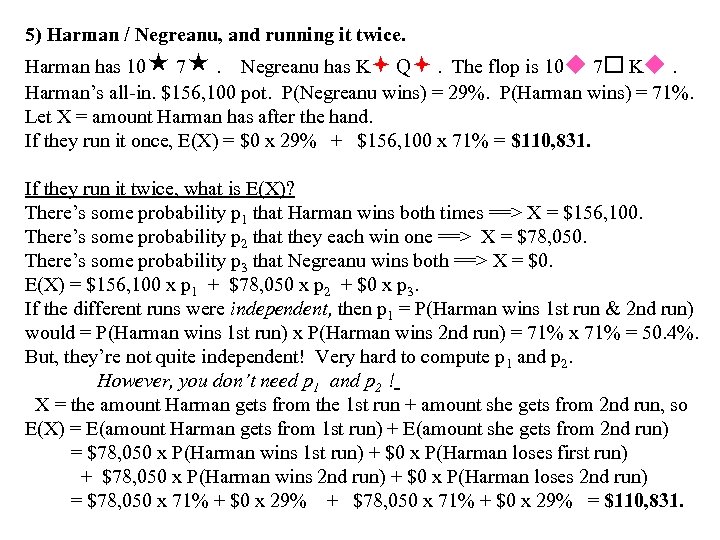
5) Harman / Negreanu, and running it twice. Harman has 10 7 . Negreanu has K Q . The flop is 10 u 7 Ku. Harman’s all-in. $156, 100 pot. P(Negreanu wins) = 29%. P(Harman wins) = 71%. Let X = amount Harman has after the hand. If they run it once, E(X) = $0 x 29% + $156, 100 x 71% = $110, 831. If they run it twice, what is E(X)? There’s some probability p 1 that Harman wins both times ==> X = $156, 100. There’s some probability p 2 that they each win one ==> X = $78, 050. There’s some probability p 3 that Negreanu wins both ==> X = $0. E(X) = $156, 100 x p 1 + $78, 050 x p 2 + $0 x p 3. If the different runs were independent, then p 1 = P(Harman wins 1 st run & 2 nd run) would = P(Harman wins 1 st run) x P(Harman wins 2 nd run) = 71% x 71% = 50. 4%. But, they’re not quite independent! Very hard to compute p 1 and p 2. However, you don’t need p 1 and p 2 ! X = the amount Harman gets from the 1 st run + amount she gets from 2 nd run, so E(X) = E(amount Harman gets from 1 st run) + E(amount she gets from 2 nd run) = $78, 050 x P(Harman wins 1 st run) + $0 x P(Harman loses first run) + $78, 050 x P(Harman wins 2 nd run) + $0 x P(Harman loses 2 nd run) = $78, 050 x 71% + $0 x 29% + $78, 050 x 71% + $0 x 29% = $110, 831.
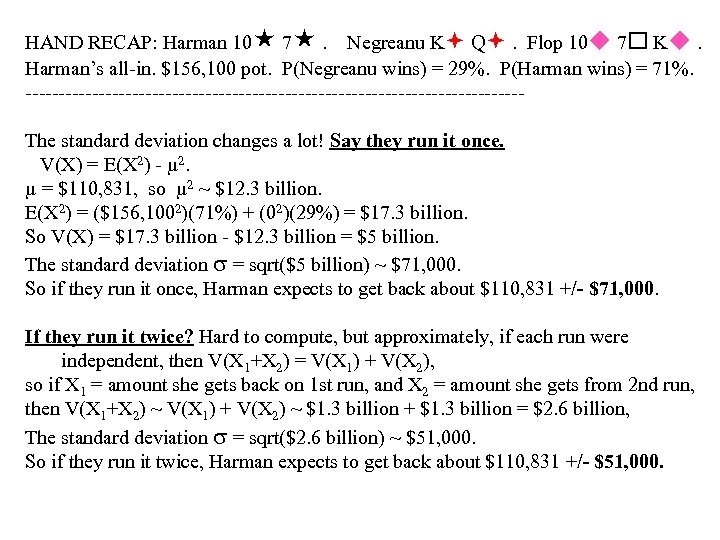
HAND RECAP: Harman 10 7 . Negreanu K Q . Flop 10 u 7 Ku. Harman’s all-in. $156, 100 pot. P(Negreanu wins) = 29%. P(Harman wins) = 71%. -------------------------------------The standard deviation changes a lot! Say they run it once. V(X) = E(X 2) - µ 2. µ = $110, 831, so µ 2 ~ $12. 3 billion. E(X 2) = ($156, 1002)(71%) + (02)(29%) = $17. 3 billion. So V(X) = $17. 3 billion - $12. 3 billion = $5 billion. The standard deviation s = sqrt($5 billion) ~ $71, 000. So if they run it once, Harman expects to get back about $110, 831 +/- $71, 000. If they run it twice? Hard to compute, but approximately, if each run were independent, then V(X 1+X 2) = V(X 1) + V(X 2), so if X 1 = amount she gets back on 1 st run, and X 2 = amount she gets from 2 nd run, then V(X 1+X 2) ~ V(X 1) + V(X 2) ~ $1. 3 billion + $1. 3 billion = $2. 6 billion, The standard deviation s = sqrt($2. 6 billion) ~ $51, 000. So if they run it twice, Harman expects to get back about $110, 831 +/- $51, 000.
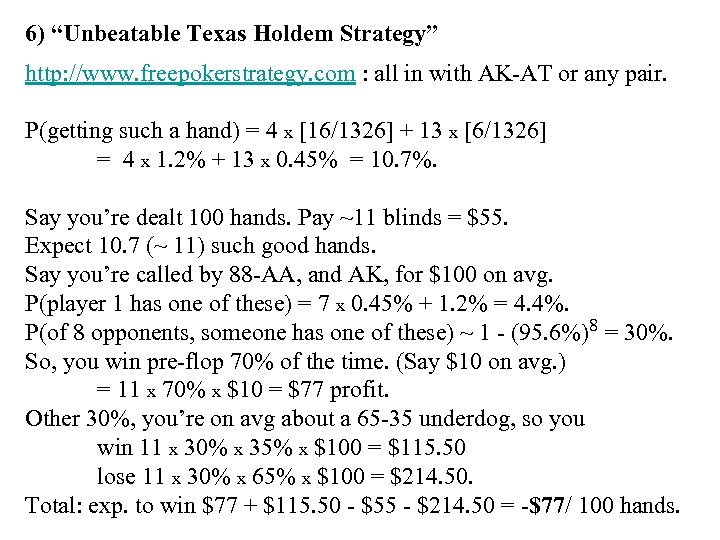
6) “Unbeatable Texas Holdem Strategy” http: //www. freepokerstrategy. com : all in with AK-AT or any pair. P(getting such a hand) = 4 x [16/1326] + 13 x [6/1326] = 4 x 1. 2% + 13 x 0. 45% = 10. 7%. Say you’re dealt 100 hands. Pay ~11 blinds = $55. Expect 10. 7 (~ 11) such good hands. Say you’re called by 88 -AA, and AK, for $100 on avg. P(player 1 has one of these) = 7 x 0. 45% + 1. 2% = 4. 4%. P(of 8 opponents, someone has one of these) ~ 1 - (95. 6%)8 = 30%. So, you win pre-flop 70% of the time. (Say $10 on avg. ) = 11 x 70% x $10 = $77 profit. Other 30%, you’re on avg about a 65 -35 underdog, so you win 11 x 30% x 35% x $100 = $115. 50 lose 11 x 30% x 65% x $100 = $214. 50. Total: exp. to win $77 + $115. 50 - $55 - $214. 50 = -$77/ 100 hands.
Скачать презентацию Stat 35 b Introduction to Probability with Applications
21bdc7f6068faee68312f5426af5d992.ppt